Showing posts with label Not Recommended. Show all posts

Friday, January 25, 2013

John Fahey - City of Refuge


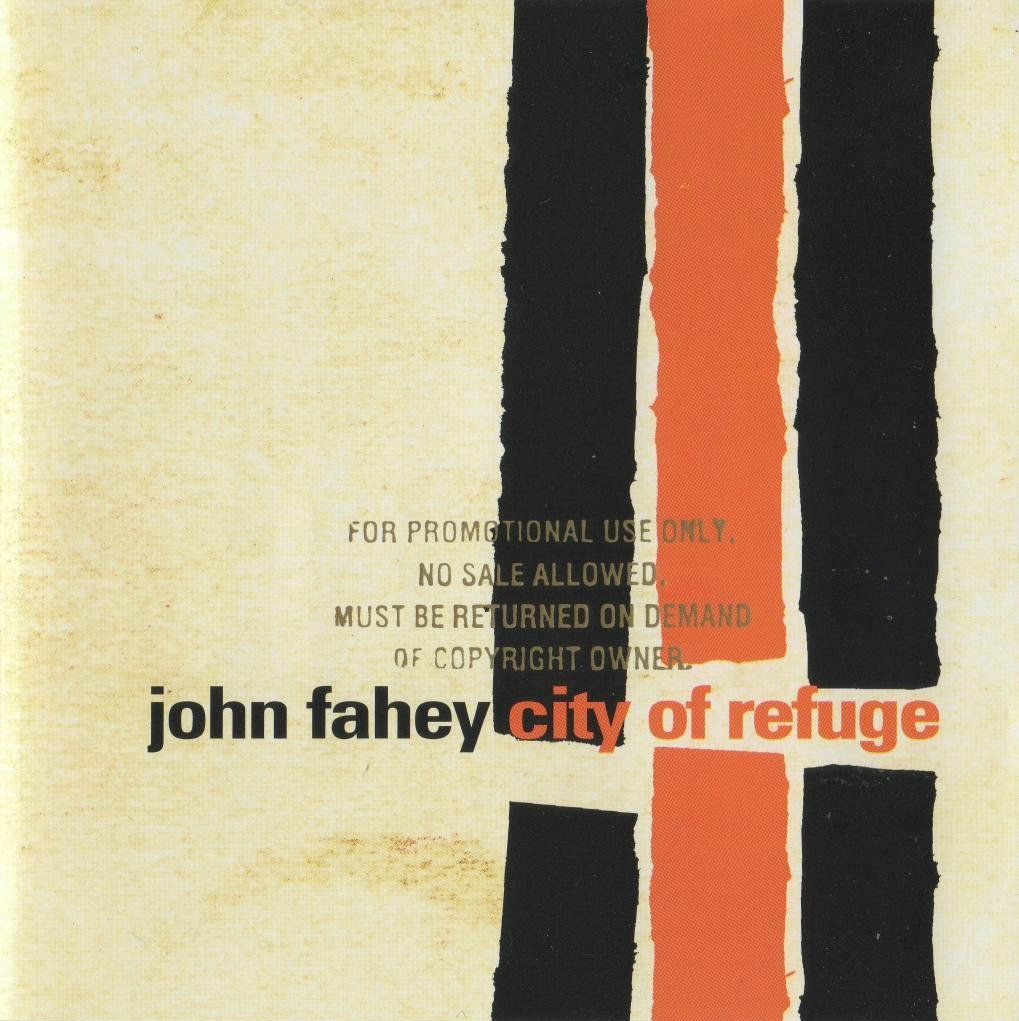
In investigating Fahey's late period, I'm sympathetic with the fact that he felt dead-ended stylistically and was struggling to move beyond his signature American Primitive tropes into something a bit more...different and new.  The issue seems to be just what, precisely, that new direction is, and Fahey's frustration is evident in the music.

In spite of its recording date, City of Refuge most resembles 60's Fahey records like Volume 6: Days Have Gone By and Requia, with equal space and volume given to acoustic guitar and field recordings, found sounds and electronic sound sources.  As with those other recordings, this approach either stands (Days Have Gone By) or falls (Requia, often) on how well those elements mesh with one another compositionally.  The disc starts promisingly enough with "Fanfare," which sees an unusually (for Fahey) overdriven slide guitar layered on top of droning, industrial electronic sounds not unlike those produced by Keith Rowe, especially in his solo works.  As the tracks play on, for me the impression builds that the compositions aren't very well thought-out, which is a serious stumbling block for an artist whose greatest strength is arguably his ability as a longform composer, not as an improvisor, which is what he appears to attempt on "The Mill Pond" and large portions of "City of Refuge I," plucking single notes against a throbbing background drone.  While the proposition of a more spare approach to his guitar style is intriguing, the results here don't feel particularly well-realized.

Elsewhere we are suddenly jolted out of the avant-garde soundworld back into more traditional Fahey territory, with guitar-only excursions like "Chelsey Silver, Please Come Home," and the dirge-like "City of Refuge III."  The former hints at a new compositional twist on Fahey's slide style, with abrupt stops and rhythmic interruptions, but again it feels like he didn't thoroughly integrate the idea into the piece, or maybe it wasn't an idea after all and the performance is just choppy!  Both songs seem to lack distinctive melodies or a feel other than "Fahey filler"--pleasant enough, but by 1997 we know what this man is capable of!  To my ears, "Hope Slumbers Eternal" is the best-realized piece on the album, blending a droning background that relates tonally to the minor slide guitar melody it accompanies, provoking an eerie, meditative atmosphere--most importantly, the electronics and guitar seem to combine coherently, which is mostly not the case with the rest of the experiments here.  The album closes with the 19-minute "On the Death and Disembowelment of the New Age," which, as far as I can tell, contains no guitar (though it does keep alive Fahey's tradition of humorously long and barbed song titles).  It's probably the most successful sound collage on the disc, but sitting at the end of a selection of noodly acoustic guitar pieces, it raises questions about what it's doing here, and why these songs all belong on the same album.  There is some cool rhythmic phasing of a tambourine-like sound that kicks in around the 12-minute mark and lasts for several minutes, and the album closes like it opened, with a classic Fahey field recording motif--a lonely locomotive whistle. 

This is the kind of album that really gets under my skin--not because I think it's bad, but because there's a palpable sense of frustration from an artist with specific ideas and a seeming incapability to fully realize them.  Probably more troubling to me personally is Fahey's frustrated attempt to break beyond his established vocabulary as a guitarist--for a man who reportedly described fingerpicking as a "disease," he must have felt more than a little trapped.  When an artist verges into atonal and pure sound territories, success seems to become as ephemeral as the compositional building blocks are abstract.  I find it daunting to explore these areas as the measure of artistic success depends even more on an unquantifiable gut reaction, and the difference between good and bad is painfully difficult to control as a composer--but perhaps that's where the adventure lies!  My next stop for late-era Fahey is another 1997 album, Womblife.  While my hopes for a successful application of his challenging ideas are tentative, even unsuccessful attempts in this territory are rewarding and always thought-provoking.

Get it here.

Friday, September 30, 2011

Amplifier - The Octopus


The last 2011 album I'm reviewing this week, Amplifier's The Octopus is as vulnerable or more to cries of "hype" as Matana Roberts' Coin Coin, already drawing extreme plaudits (my CD copy had a sticker on it declaring The Octopus to be "the grand standard against which all prog albums will be judged" or some such hyperbole) as well as some rather focused ire from music fans.  Similarly to my experience with Coin Coin, I had read some glowing reviews for this album (the mainstream music press has been quite kind to it) so I was really excited to check it out--how often do you hear music critics putting progressive rock albums in their top albums of the year in 2011?  After investing considerable time in this album  (it's two hours long with an average song length of 7:30) I regret to say that I'm disappointed enough with it that this review will be the second installment of my Know Your Enemy series.

Let's start with the good things about The Octopus, and let's be clear that there are plenty of good things.  Firstly, I want to praise the band's pop instincts--probably the best thing about this album is its melodicism and the amount of catchiness to be found in pretty much every song.  The major/minor shift on "Minion's Song" results in an instantly catchy vocal melody, while songs like "Trading Dark Matter on the Stock Exchange," "The Sick Rose" and "The Wave" are all based on melodic guitar hooks, with plenty more to be found elsewhere.  Similarly, the band is capable of impressive musicianship--the drumming is pretty solid throughout the album, and there are moments where it's obvious the guitarist has got chops (about four minutes before the end of "Trading Dark Matter on the Stock Exchange" is a good one).  The songs here "rock" to the extent that that band's chemistry and energy are evident even though the album's a studio production.  Finally, I think the band's ambition has to be applauded--they're clearly trying to create something epic with The Octopus, managing at times to create an atmosphere of grand proportions and tying the album with an intractably esoteric concept, not to mention the fact that they wrote and recorded the album without label support.  On paper, there's a lot to admire about this effort.

Unfortunately, there is so much about this music that goes against what I stand for musically that the two hours required to listen to it drag by in slow motion, the minutes blending together into a dull aching throb.  To start with, the album is billed as progressive rock.  While a discussion about whether or not this music categorically is or isn't progressive is neither interesting nor productive, it might be illuminating to point out some of the characteristics of progressive music in relation to The Octopus.  If long song lengths, spacey synth sound effects and song introductions, science fiction lyrics and a complicated concept define a music as progressive, then so be it--this album exhibits all of those components.  If "progressive" implies some sort of innovation, surprising content, attempt to move music forward, or at the very least an impressive display of erudite musicianship in composition or playing, then this album falls far short of the mark.  As professionally executed as it is, I hear virtually nothing in The Octopus that we haven't already heard before.  The really disappointing thing is, most of it we've heard from non-progressive music; these guys aren't even plundering classic prog!  In spite of the long song lengths, the band presents us with standardized verse/chorus songwriting, straight-ahead 4/4 time signatures and an ultra-orthodox sense of harmony and melody.  I also have to take issue with those who compliment the band's "intricate" arrangements--despite the guitarist's frustrating display of ability, most of the parts played here are based on achingly simple riffs or clean arpeggios that repeat over and over without embellishment or development across minutes and minutes of track length.  Similarly, the band's interplay pretty much never rises above predictable rock unison riffs and "dramatic" breaks, failing heavily when it comes to subverting the formula.  Combine these structural weaknesses with production that reeks alternately of the heavily processed guitar tone that innumerable bands like Tool have been implementing since the 90's, and synth sounds, effects and samples that sound like they've been excreted by a computer, and most of the music here comes across as the hollow, sterile type of alternative rock that--again--innumerable bands have been producing since the 90's.

If the band marketed itself as a straight-ahead alternative rock band, these commonplace creative choices would at least fit the bill.  Instead, they wrap pedestrian substance with a stylistic sheen that implies "this is gonna blow your mind."  And how is this mind-blowing achieved?  Mostly through the fact that nearly every song is bookended by at least a minute of spacey intro and outro sound effects with no connection whatsoever to the music that eventually appears, not to mention how poorly-integrated and gimmicky they are when they actually appear within the songs.  It's like the band wants to recreate "Shine on You Crazy Diamond" without realizing that the song's atmospheric segues actually contain their own melodic framework and act as commentary on the core song's elements; just because you're playing notes doesn't mean you're producing meaningful musical content.  The album could have easily saved at least a half hour by removing these interludes without even touching the primary content of the songs (which also could stand to have some fat trimmed).  If I'd known how unimaginatively "contemporary alternative" this was going to be, I probably would have been happy to say "that's not really my thing" and leave it alone.  Instead, I'm told it's a great new version of something I love only to find out that it's something else in disguise.

Speaking of disguises, let's get to the lyrics, which probably bother me more than anything else here.  In support of their labyrinthine concept, the band has chosen to present the narrative with an indecipherable stream of pseudo-trippy clichés and embarrassingly cheesy metaphors and images, including (but not limited to): "ice age cometh;" "we're livin' on borrowed time;" "let empires fall;" "cross your heart and hope to die/don't take it personal" (two in a row there!); "don't you know that we belong somewhere over a rainbow/in the wreckage of the UFO;" "faster than a laser beam [beowwww; immediate laser beam sound effect];" "I know that you set the controls for the heart of the sun" (one of the most obvious Pink Floyd references imaginable); "this could be your lucky day;" "well ha fucking ha" (maybe my most hated lyric of the whole album); "divided and conquering;" "ignorance is bliss;" and "reach for the stars, you might grab one."  Rather than attempting to convey the cosmic trip to which they so desperately aspire by using words to disorient and give life to an alien experience, Amplifier is content to undescriptively state their purpose with bland lines like "step inside/take a ride to another dimension," repeated ad nauseum.  Don't forget--these words are sung by a voice that at times sounds eerily similar to Chris Martin's and has the grating habit of pronouncing long "i" sounds as "iiiiii-eeeee-iiiiii."

All in all, I applaud Amplifier's work ethic as an independent group and don't begrudge them their success--it's rare that independent artists can generate so much heat without the aegis of a label (though, to be fair, much the groundwork for their notoriety was laid when they were signed to a label, which I'm sure doesn't hurt).  What upsets me most is the complacency evident on the part of the band and listeners' willingness to assert that this album is a real trip, mind-bending, and weird, when on some pretty objective levels it's far more regressive than it is forward-looking.  I hope that if Amplifier continues to build on their success they'll decide to use their increased means to strive for something a little more outside the box--as of right now, they're about as far in there as you can get.

Saturday, September 17, 2011

Quicksilver Messenger Service - Happy Trails


While I write reviews for this blog mainly to share music I think is great in some way (or at least had potential to be great), sometimes it can be just as illuminating to focus on examples of music that represent the opposite of great.  I know I can come across as a snob here, but please believe me when I say that most of this music isn't really "bad" at all.  Instead, it's more a feeling of disappointment that this kind of music is part of the problem, not the solution--it's a deliberately missed opportunity in the continuing battle to in some way evolve music into something it wasn't already before.  So, I present to you the first installment of what's intended to be a recurring series entitled "Know Your Enemy."  This album's the perfect opposite of the impressive breadth and depth of ideas in last review's album--an album that takes about 4 minutes of clichés and stretches them thinly over an entire 50 minute album.

The popular and critical party line seems to be that this album is a classic of US West Coast psychedelic rock--a live album of unbridled trippiness and unheard-of musicianship and a landmark in its field.  Instead, all I hear is a worst-case-scenario and a band using its audience's indulgence as an excuse for some really lazy decisions.  There's a good chance you're familiar with "Who Do You Love," written by blues legend Bo Diddley and made even more famous by the likes of George Thorogood, Ronnie Hawkins and The Band, and Townes Van Zandt.  Well you're in luck--here you'll get to hear the song's verse/chorus vocal sections twice and you'll get to hear the song's riff for a total of over 25 minutes.  The first side of this album is literally a jam on "Who Do You Love" split into such "cleverly"-titled sections as "When You Love" and "Which Do You Love."  In reality it's an excuse for an extended solo from (mostly) guitarist John Cipollina which ranges from bluesy licks to...almost nothing else.  "Where You Love" gets a little quieter and I guess you could say "spacey," but the underlying 5-second chord progression is the same.  In addition to serving mainly as a vehicle for Cipollina's technically-proficient but unimaginative guitar work (he'll play the kind of repeating arpeggios or repeating string bend licks so incessantly it's easy to understand why punk rock by-and-large eschewed and abhorred the guitar solo), the song's head features unimaginably dull vocals; the arrangement pretty much stinks of white imposter blues with none of Diddley's authenticity, Thorogood's guitar muscle, Hawkins' weirdness or Van Zandt's country flair.

The cherry on top of the A-side's shit sundae is Side B's 7-minute opener, "Mona," another guitar solo vehicle centered around a blues riff that's almost identical to "Who Do You Love."  I'm not saying guitar solos are bad or that extended jamming is always a sin, but for the sake of everything good about music, institute some variety in the songs you're jamming over, or transform the blues standard into something unrecognizable before you recapitulate the head, or play something other than stock lead guitar that everyone's already heard (even in 1969)--do anything to distinguish this music, just a little bit.

It confuses me greatly that this music is labeled "psychedelic," when to me it sounds mostly like generic blues jams and is a clear antecedent to jam band music.  At least the good jam bands of the 90's had the sense to write some interesting compositions, come close to mastering their craft, or acquaint themselves with the more sophisticated improvisational tradition of jazz.  Nothing here resembles the mind-expanding epiphany associated with psychedelic drugs other than the mind's ability to become overly impressed with simplistic repetition and lose track of time during 20-minute jam.  Just because you're high on psychedelics when you're listening to a band does not make their music psychedelic.  The album rounds out with a shorter song, a more interesting Ennio Morricone-flavored Spanish instrumental called "Calvary" and an actually fun, cheesy country cover in "Happy Trails," but it's far too late--we've already been insulted by 40 minutes of repetition, aimless laziness and self-satisfied cliché regurgitation.  It's embarrassing to me that this band couldn't rise above their audience's rudimentary demands and give them something with mind-expanding jams and a collection of compositions and inventiveness that everyone could be proud of, even when they weren't stoned out of their gourds.  You, Quicksilver Messenger Service, are the enemy, and I'll do everything in my power to stop you.

If you want to catch a much more satisfying glimpse of hippie culture, check out Dino Valente's eponymous 1968 solo album--he was the Quicksilver Messenger Service vocalist but was incarcerated at the time of Happy Trails' recording.  His pop instincts probably could have elevated this coaster in the songwriting department and at least given us something to enjoy sober on repeated listens.  Music can be better!

Thursday, June 30, 2011

T2 - It'll All Work Out In Boomland


If you're reading this, there's a good chance you already know that a big part of the allure of hunting through obscure albums from 40+ years ago is the chance of finding buried treasure--a great album or group that for whatever reason never achieved success in its day but deserved much more attention than it ever got.  Now that we've got the internet, there are numerous resources (review aggregates like allmusic, user-generated databases like Rate Your Music, helpful product reviews on Amazon, and any number of great blogs) dedicated to spreading the word about great, sometimes non-commercial music.  Thing is, the same basic rules apply to these sources that apply to the mainstream media's coverage of commercially-successful music--there's hype surrounding some artists, reviews aren't always well-written or unbiased, and aficionados of a certain genre can sometimes be a little hyperbolic when describing how good an album might be in a general sense.  Sometimes artists are hyped for the simple reason that original vinyl copies of their albums have always been scarce and sell between record collectors for huge sums of money--often times irrespective of the actual quality of the music.  None of these rules are hard-and-fast, though, and like always we have to use our own tastes and personal preferences to decide if something is buried treasure or not--even if a bunch of people say it's great.

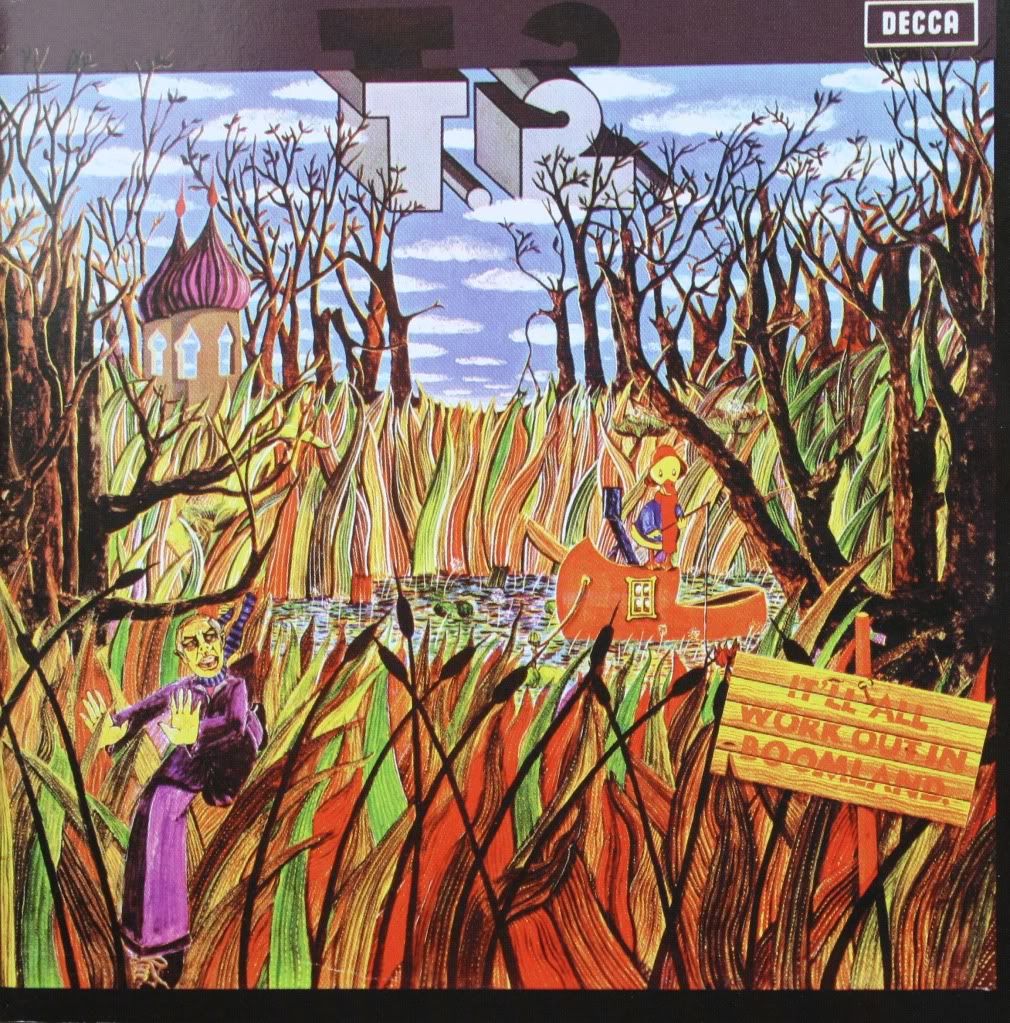
I came across T2's sole 70's release, It'll All Work Out In Boomland, while on the hunt for some fresh, good heavy, psychedelic and progressive rock, finding it heavily lauded by a number of sources.  Naturally, my expectations were pretty high after hearing a lot of praise for this album, and I can firmly say that it doesn't meet them.  The album consists of four tracks (ah, the 70's), the first of which is a fairly uptempo rocker ("Moving in Circles") with a jazzy guitar riff.  While it's not an inauspicious start for the album, there's nothing to distinguish the mildly dissonant guitar lines from any number of similar 70's bands that didn't make it big--melody and the ability to compose catchy riffs are things that you either have a special knack for or you don't, and while the riffs on this song certainly rock and are pleasant to listen to, it's easy for me to hear why they didn't stick out to 1970 listeners.

Another element on which hard rock stands or falls (for my tastes) is vocals--so many obscure bands from the 70's wear their lead singers like albatrosses around their necks.  T2's lead vocalist can certainly sing on-key and not unpleasantly, but his voice sounds like any number of generic rock singers of the era and it pretty much never rises to a level of aggressiveness that matches that of the music's high points.  The lyrics are vague but not compelling enough to provoke any sense of mystery or closer listening.  Again, it's easy to hear how singers with more distinctive vocal styles achieved more success in the hard rock genre.

The center of the album is made up of two ballads--the first, the mellow, and jazzy acoustic guitar/piano-driven "J.L.T." never really takes off, though there's a cool odd-metered piano/mellotron riff at the end.  "No More White Horses," more of a power ballad, is probably the album's best track from a songwriting perspective, plodding along into a dramatic buildup with some electric guitar shredding and a majestic trumpet melody.  The side-long "Morning" closes the album, beginning downbeat (yet again) and building into some riffing that recalls the first track, as well as some pretty satisfying interplay including the bass and drums.  For an epic, it's fairly well-constructed, with some loud/soft/loud alternations and a pretty great "Whyyyyyyyyyy" vocal refrain, though I'm not sure the ideas presented really warrant over 21 minutes.

After my initial disappointment, this album has incrementally grown on me--in spite of its generic nature, there's surely some craftsmanship at play, and it's certainly better than quite a few obscure albums in its genre.  Part of my disappointment lies in the style of the music--though it's "hard psych," most of the tempos are almost maddeningly slow, even if there is eventually some heaviness to be found--I prefer my hard rock/proto-metal to have quite a bit more energy, though changes in dynamics are always welcome.  I also prefer a lot more in the way of good guitar hooks and riffs--the soloing here is ok if a bit limited in terms of different musical ideas presented, but most of the time the mix is a lot of chordal sound without much identifiable melodic substance holding it together or giving it direction.  As I mentioned before, the riffs that are actually here aren't particularly distinctive or interesting.  I'm much more likely to reach for something like Captain Beyond, which swiftly and relentlessly pursues a wealth of compelling ideas with an uncluttered and forceful guitar sound and much better vocals, or something like High Tide's Sea Shanties (more on that one later), which is heavy to an ungodly degree without sacrificing energy or a clear sense of melody--both of which are much more satisfyingly progressive, rather than simply taking cues from prog's tendency to sprawl (which is just about the sum of T2's connection to progressive ideals). 

When it comes to searching for hidden gems, you can't win 'em all--this album's attempt at an anthemic sound didn't really strike me as particularly heavy, progressive or psychedelic, but I can see why people who are really into hard psych, etc., might be able to get behind it--that's about the only listener to whom I'd recommend this album.  Since it's not my #1 genre, I have a much lower tolerance for generic sounds than I would with, say, something from the Canterbury scene or avant-progressive rock.  As it stands, I can leaven the majority opinion with my observations and try and help like-minded listeners avoid disappointment. 

This album is out-of-print, but you can find it here.