Showing posts with label Recordings. Show all posts

Tuesday, December 4, 2012

Official Release Day!

It's been a long year and a whole lot of work putting together the music and visuals for this album, and today it officially drops!  The CD and digital album are currently available on Bandcamp, where the music is also streaming if you'd like to have a listen.


I'm really excited about the limited edition deluxe package, which includes the standard CD issue as well as a handmade sleeve with pearl snaps (if you know me, you know my love of snap-button western shirts), a rubber-stamped brain graphic and hand-written lyrics and signature.  I'm not hugely crafty, but I'm pumped at how they turned out.  The watercolor was done by Chelcie (more on credits and thank-yous for the album soon).


And finally, there's the release party!  Thursday night at 7 pm, I'm playing a short acoustic set at the beloved Noble Fir, and we're spinning the album afterward.  It'll be a celebration of a year of hard work and hopefully the start of some more traction with what's been a pretty "underground" music career so far.  If you found yourself on this site because of another artist I've reviewed, please do take the time to check out and possibly purchase my album--independent music takes a lot of work and a lot of money and it can't survive and grow without help.  A couple more Cheap Seats posts coming soon, then down to the business of introducing some specific tracks from the album.

Tuesday, May 29, 2012

Cheap Seats 4: The (Un)Happy Accident

Signal to...1, 0 or some combination thereof
The previous Cheap Seats installments have mostly focused on my own recent creative experiences as an independent musician recording a new album.  Please permit me (in an effort to gradually expand the scope of the discussion to a realm that involves all musicians and listeners alike) to get a little bit macro.  Today's focus is the single most powerful determining factor affecting the distribution of any artist's music as well as the top force that dictates the ebb and flow of today's commercial music marketplace--I'm talking about the advent and full scale implementation of digital music recording

I'm sure when Sony and Philips designed and released the first CDs in 1982 they were mostly thinking about the obvious benefits CDs possess in comparison with the analog music media of the day--unlike vinyl and tape, CDs are sturdier and less easily damaged, are smaller and more lightweight, last much longer and are not degraded by use, and have ultimately become as inexpensive (or more) than the other available options.  In the intervening 30 years, though, the simple twist of converting source analog audio recording data to the universal binary 1's and 0's of the digital vernacular has had far-reaching implications for the music world.  On the consumer end, the introduction of CD-R technology first allowed easy copying of any audio files, while the increasing capabilities of home computers and the internet have gradually made the distribution of audio files (the size of which has more or less remained the same) easier and easier, providing music consumers with innumerable sources to acquire recordings for purchase or for free.  This increasing broadening has significantly diminished the sales of traditional physical recording media, not to mention how it's made it more and more difficult for copyright holders to keep track of and protect their intellectual property. 

On the "industry" side, not only has digital music technology changed the shape of music as a product, in the last 15 or so years it's also replaced analog recording as the most accepted method for the very creation of recordings.  ProTools has both become the industry standard software for recording studios, but its relative ease of use and availability (as well as the availability of similar free and inexpensive recording software) has meant that the average person potentially has the ability to record and edit digital music in much the same way (and with many of the same tools) as a professional recording studio--and when the product's finished, the aforementioned home computer technology and internet advancements have made it possible for artists to distribute their recordings without any of the record label, distribution and promotional infrastructure that was compulsory before digital recording dominated the market. 

Like most of the issues I'm trying to wrestle with in this series, digital recording is the quintessential double-edged sword.  Music listeners now have unprecedented access to almost any music they'd like to hear--gone are the days when local record stores could only mail-order expensive imports of cult artists whose distribution was too poor to make the music widely available, and the realities of file sharing mean that most recordings can be found and downloaded for free without risk of punishment and regardless of the recordings' copyright status or availability for sale through mainstream channels.  MP3 players allow consumers to consolidate a nearly limitless library of digital music that can be accessed instantaneously and portably (my personal favorite!).  Up-and-coming artists are no longer necessarily forced to demonstrate popularity in order to make their first recordings (a chicken-and-egg scenario that imploded as often as it succeeded).  It's never been easier to find out about and sample new music, and there's more music being recorded than ever before. 

For the recording industry, the sword mostly cuts viciously in the negative direction--though digital music does offer even more avenues for sales, when offered the choice, "You can either pay us and download the recordings, or search Google and download the recordings for free," consumers have by and large chosen the second option.  Promotional power still rests in varying degrees in the hands of record labels, but it's often limited in the case of independent labels and diminishing sales have scared the big labels into a policy of recording and promoting only guaranteed money-makers, which, as you can imagine, does little to further the spread of non-commercial music, impairing the strength of music as a product one degree of blandness at a time.  For independent musicians, it may indeed be easier and cheaper to record music, but when it comes to standing out amongst a constantly-swelling sea of competition, there are few promotional tools that seem to be worth the time or monetary investment. 

This is where the pros and cons of digital recording become even subtler.  For cash-strapped musicians, free recording is often a deal that's difficult to pass up, but the benefits of using a professional recording studio (high quality microphones and other recording equipment that most musicians don't possess, and especially the technical expertise of recording professionals) are often noticeably manifest in the quality of the finished product.  Then there comes the role of the recordings themselves--are they designed as a promotional device, to be given away at no cost to spread the word about the artist and hopefully convert more fans?  Or, is the artist hoping to offer the recordings as a product for sale?  I've heard again and again that music recordings "are free" and that the only way for musicians to make money these days is through live performance.  While I don't want to diminish the value of live performance, this argument denies the fundamental fact that regardless of the recording, somebody is investing a certain amount of time and/or money into its creation, and investments with virtually no chance of return are utterly unsustainable.  Since this entry is not supposed to focus completely on the financial aspects of independent music, I'll leave further development of those points for a later date.  Additionally, the choice to give away recordings is a difficult decision for reasons unrelated to finances--what message does it send a potential listener if you're willing to give up the fruits of your hard work in exchange for nothing?  There is an intangible degree of integrity lost when you tell listeners that your recording is worth...nothing...even when your decision is motivated by a desire to acknowledge the inevitability that your recordings will be pirated.  In such a competitive music marketplace, I've repeatedly found that the most difficult accomplishment is to simply get people to give your music a chance and listen to even one song all the way through (let alone a whole album).  Can unknown musicians afford to devalue their work at the very outset?

Likewise, for listeners, digital music has made it easy to react in a knee-jerk fashion, skipping or abandoning a recording if it doesn't instantly gratify our spoiled ears and robbing us of that crucial repeated exposure that so much great music needs in order to sink in and sound great to our often inattentive ears.   Similarly, the art of a cohesively-crafted album has been all but lost in the mainstream, with consumers able to pick and choose tracks selectively without hearing them in the intended context.  There is indeed more music than ever for listeners to choose from, but it's also becoming increasingly difficult to find out if it's actually good (of course, by "good" I mean relative to each listener's tastes and musical ideals).  How does the average listener navigate the swarm of hopeful independent musicians without help and without becoming cynical?  Do the types of algorithms that govern internet radio stations like Pandora actually succeed in steering us toward new music we'll eventually love, or do their fixed formulae actually rob us of the chance of hearing something new or different that might actually expand our tastes?  On a hopeful note, there does seem to be a kinesthetic aspect to recordings that cannot be digitized--many people believe that the added dimension of a physical package that comes with a CD or LP isn't sufficiently conveyed by a digital scan of the album art, and the artistic possibilities that come with mixed media can enhance the music and facilitate the development of a special relationship between listeners and the musical thing they're holding in their hands that's simply not possible with an intangible digital file.  Additionally, the "warm" analog sound quality, enhanced art and retro chic of vinyl records has recently experienced a resurgence among aficionados, probably for very similar reasons--still, the challenge of dealing with the rest of the potential market persists!

As an independent musician on the verge of releasing another recording, I wish I had answers to these questions--the more I think about it the more I realize that the digitization of music recordings is neither good nor bad, but that it's at its root a coincidental reality that further complicates an already complicated endeavor!  Printed text will likely remain a viable physical product in books and magazines because it can simply be unpleasant to read text on a computer screen for extended periods of time; digital reproduction of physical art like paintings and especially sculpture never comes close to capturing the physical dimensions apparent in person; television and movies may be easily digitally-reproduced at home, but live theater, dance and movie theater screenings offer an experience that cannot be digitally reproduced to come anywhere close to the live experience.  In our increasingly digitized world, recorded music has been the perfect victim of an unhappy accident insofar as it's easily reduced to digital form and sent down the waterfall into the world's digital information collective.  The issues of promotion and the value of music recordings will be further developed later, but for now I pose these questions:  What's your relationship with digital recordings?  If you're old enough, how has your relationship with music changed as digital has become standard?  Do you think the digitization of music recordings is a good or bad thing for musicians and listeners, and why?  Comments welcome and appreciated!

Cheap Seats Part 1
Cheap Seats Part 2: Non-Commercial Music 
Cheap Seats Part 3: A Day in the Studio

Monday, April 30, 2012

Cheap Seats 3: A Day in the Studio

The blog is back, and why is that?!  Last week I reached a surreal milestone in the recording of my next album--I've pretty much finished tracking overdubs; just one more drum session and we're on to mixing, mastering and release!  This means the blogging time I had to sacrifice to recording-related work is all freed-up and you can expect resumption of a steady stream of reviews and Cheap Seats content!


To keep the Cheap Seats ball rolling, I've decided that the next logical step is to delve a bit deeper into the technical details of the recording process itself.  Based on conversations I've had with friends and family, most people are pretty unfamiliar with the process by which music is recorded in a professional studio.  This blog's readership includes quite a number of music enthusiasts who probably have an above-average understanding of the recording process and terminology--at the risk of insulting your intelligence, please permit me to define some of the basics as I describe a recent day in the studio.

.......................................

April 25, 2012: It's day three of a five-day session week.  The recording is in its twilight phase--we're starting the 20th day of what will probably be 26 total studio days to track the whole album.  At this point, almost all of the songs are pretty fleshed-out and Justin and I are adding some of the final parts to the songs at Cloud City Sound.  Things are starting to get a little bit surreal, as the project has been going for almost six months and we're finally getting to the point where we're doing "the last" of things--yesterday we recorded the last of the woodwind parts (good riddance, as far as I'm concerned--my wind chops plateaued in 1999) and today's going to be most of the final guitar parts.  What we're doing is called "overdubbing," a process where new parts are added to a pre-existing recording.  Most recording sessions start with what's called "basic tracking," where several members of the ensemble record a number of instruments simultaneously; usually it's at least the rhythm section with at least the bass, drums, guitar, keys etc. laying down a recording of the song's core parts, after which the vocals, extra guitar parts, horns, etc. are overdubbed.  Of course, every recording and group is different--for example, a lot of jazz groups are doing everything live, so there won't really be any overdubs, whereas a lot of rock groups may have four members playing on a song with three or four guitar parts, so it won't be physically possible the play all of the parts live, and vocals are often overdubbed because of the technical issues of getting a hi-fi recording of a voice while lots of other noise is happening.  In the case of this project, where I play almost all of the instruments, there wasn't really such a thing as basic tracking--for each song there was a day when I recorded the first part (usually either an electric or acoustic guitar) to a "click track" (a recording of a metronome) which will be used as a guide throughout the rest of the recording project and removed in the final recording--everything else from there on out is an overdub!

It's been a fun week so far--we've worked on a lot of songs, recorded a lot of different instruments (including the studio's awesome vintage Hammond B3 organ) and made some serious progress.  Monday was a fun day because my jazz pianist friend Peter tracked some slick piano on three of the songs, making him the second musician besides myself to contribute to the album (more on the special guests later!).  Being a one-man recording project has its positives and negatives.  On the one hand, I've usually got extremely specific ideas and goals I want to get across and playing every part gives me the maximum amount of control and cuts down on the sometimes difficult process of communicating desires and instructions to other musicians.  On the other hand, it can be extremely time-consuming to compose, arrange and rehearse (if I even get around to that phase) parts for numerous instruments--some of which I am barely familiar with--and in spite of my confidence in my own ideas, I'm always humbled by the fresh air that a skilled collaborator can breathe into arrangements that are in danger of becoming claustrophobic; it's thrilling to see someone else's ideas transform a piece of music I thought I'd considered from all angles into something more

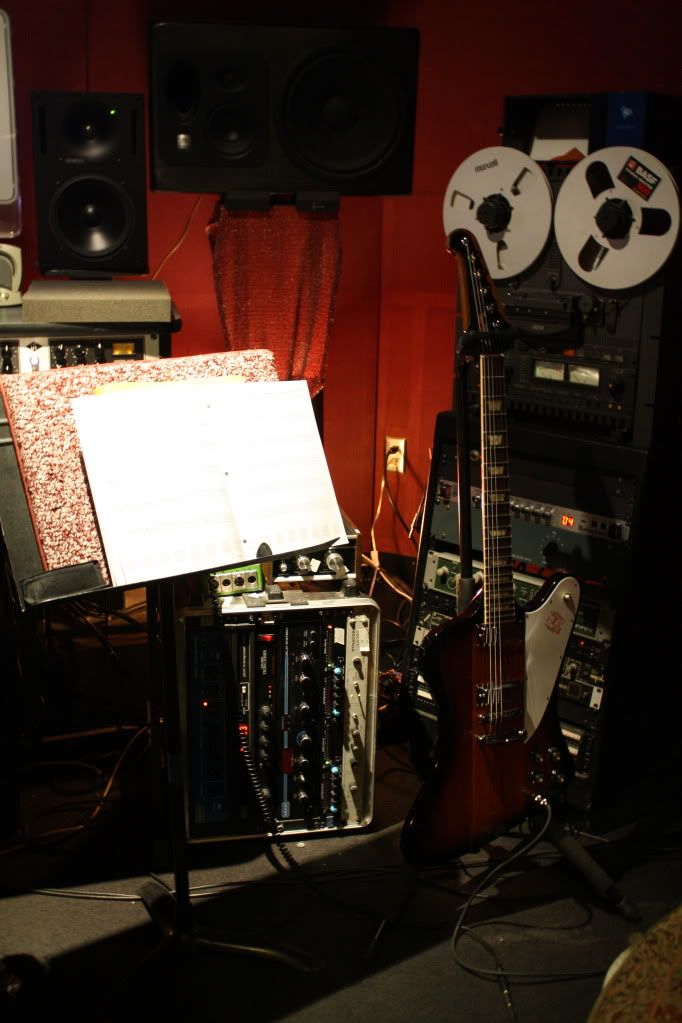
Emboldened by my recent woodwind accomplishment, I've decided that today's the day to finish most of the final electric guitar overdubs.  Justin's job title is audio engineer, which means he performs a number of different duties crucial to the recording process.  Firstly, there's the physical engineering of the sound--selecting the microphones and preamps best suited to whatever instrument we're recording, and setting the volume and compression levels to get the best possible sound for the part.  Secondly, there's the actual recording of the instrument--Justin uses his thorough knowledge and years of experience with industry-standard ProTools recording software to set up tracks for each instrument, hits "record" over...and over...and over...and applies editing wizardry where needed to compensate from the fact that this isn't actually a live recording and to make things as smooth and seamless as possible.  Later, these skills will reach their culmination when we mix and master the raw tracks we've been recording.  Simply having a professional engineer means that this project is instantly worlds more high-quality than In Not-Even-Anything Land, and Justin's particular expertise and sympathetic attitude to the material has really taken things to the next level. 

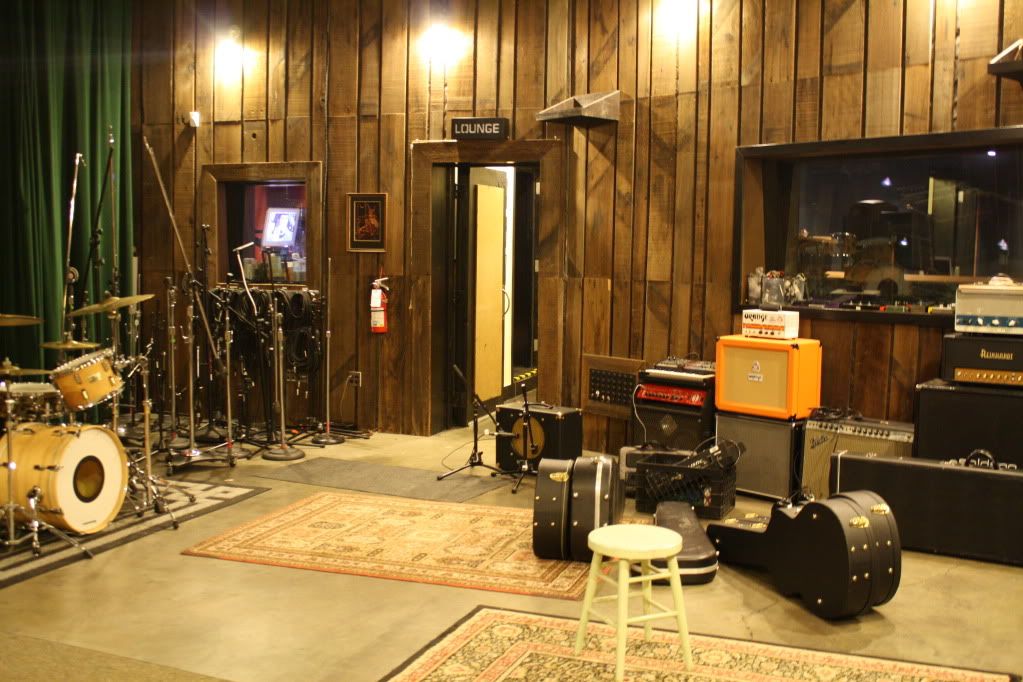
When it comes to recording guitar for this album, we've used countless combinations of mics, guitars and amplifiers to give each part a distinctive character and ensure that this will be a kick-ass guitar album with awesome tone that matches the often ear-challenging guitar parts.  We start our 10-hour day two hours later than usual at 12 pm, loading three amps into the isolation booth (the tiny room next to Justin's office where I've been recording vocals, horns and various acoustic instruments).  From there, we'll send out cables and I'll sit right next to Justin while I play and he records.  The guitar parts for this album can be roughly divided into three categories--composed rhythm parts, composed lead parts and more improvisational textural parts.  Today, we're recording some of both of the latter two categories.  While it's anathema to what a lot of musicians and music fans think the recording process "should be," the creation of this album has been an unusual and painstaking one.  The process starts at home, where I compose the parts in demo form using Apple's free recording software, GarageBand.  The sound quality is horrible and the performances are often pretty lackluster, but the main function is to figure out what the instruments are playing and give me a chance to hear what things sound like together, as I work primarily by ear.  At this time, if I'm "working smart," I'll also be transcribing the part I'm composing either with standard music notation onto a five-bar staff, or onto a guitar tablature sheet for later reference in the studio (one of the earliest lessons I learned is that the inconvenience of transcribing a part as I'm writing it pales in comparison with having to go back and figure out what I played two weeks ago).  Ideally, I'd then practice the parts at home in advance of the session to ensure smooth reproduction of the ideas for the final recording.  In reality, though, my time is limited--I work to pay for the privilege of recording this music, and during the last six months my free time at home has been more often spent writing, arranging and composing the next parts for whatever songs are coming down the pipe, and my rehearsal discipline has suffered accordingly. 

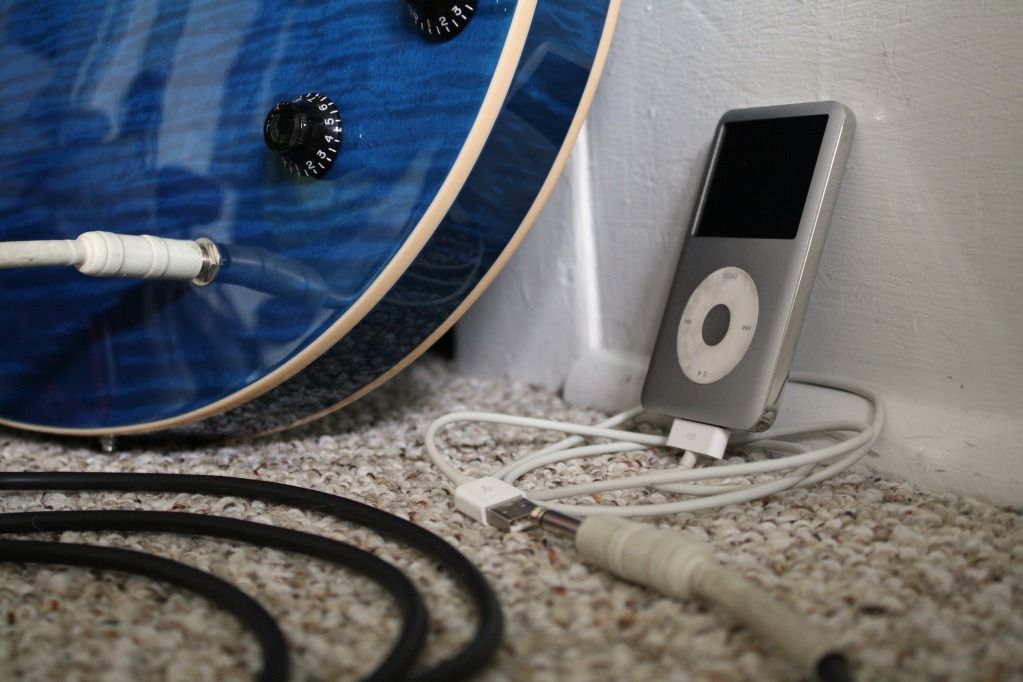
When it comes to recording the parts in the studio, I sit with my notes in front of me and a copy of the demo queued up on my iPod for immediate reference.  Here's where things start to become anathema to some people's expectations.  Of the aforementioned three guitar part categories, the first two are meticulous in their specificity and can be extremely time-consuming.  While some believe that guitar parts should be recorded all in one pass or compiled from several complete takes, that's simply not how we've recorded the guitar for this album.  ProTools has a function called "punching in," where the engineer can roll the recording and start and stop recording with the click of a button.  The function is designed to fix small mistakes, continue a take where maybe the first half was keep-able but the performer stopped playing, etc., by giving the performer a chance to play perhaps just one missed note correctly without having to record a whole take.  From what I understand, this process has been around since the analog days, but digital technology makes punching in much easier and more controllable.  Not to pull the curtain back too far, but in the case of my sometimes-labyrinthine composed guitar parts, they are most often recorded using a punch-heavy technique where sections of the part are recorded one at a time.  The composed rhythm parts tend to be less difficult and can be recorded in larger chunks, but some of the more difficult lead parts eventually have to be broken down phrase-by-phrase in order to accurately achieve the part I've composed, often including a formidable amount of rigidity and precision  in terms of interlocking parts and counterpoint.  I'm sure some purists scoff at the approach and I can understand why; it's natural for a musician's ego to demand an uninterrupted live performance, which is one of music's core avenues of expression.  In truth, I would love to have prepared the parts to technical perfection and recorded them in just a couple of passes, but the reality is that some of the parts I wrote are so difficult that rehearsing them all to perfection would probably add another year onto what's already been a half-year-long recording process!  Beside, the "off the cuff" approach is pretty much abandoned the minute you decide you're going to record a one-man project. 

There's also the objection that the element of spontaneity is lost when all of the parts are pre-composed.  In relation to my artistic goals, this objection is beside the point--the ultimate goal here is the final product, which is the total experience of an album-long recorded piece of music.  Whatever it takes to get there is what has to be done.  Again, I'd love to be able to simply improvise these parts in the studio, but my guitar part goals usually center on coming up with the most out-there and cliché-avoiding parts possible; only improvisers of unbelievable skill (i.e., definitely not I) are capable of ad libbing such parts (indeed, most improvisation actually tends toward the spontaneous reassembly of what can fairly be described as...clichés), and the benefit of hindsight allows me to fine-tune the parts I've written in order to improve them before they're set in stone.  It's true that I could eliminate the middleman by doing the part-composing in the studio, but that situation would remove the option to tweak the part later and would not be a cost effective use of my studio time--for every hour I spend reproducing a composed part in the studio there's at least two to three hours of hair-pulling and composition at home.  The punch-in recording method is likely to be a surprise for a lot of music listeners, but the truth is--though they aren't using the functionality to quite the same painstaking extent--almost all recording artists use punch-ins, editing and take compilation to create the best recordings possible.  In the case of my project, it's simply what the process is--the compositions, ideas and listening experience are the ultimate goals, and those goals take however much time and whatever means necessary. 

So, Justin and I sit down to start the day, choose a song, and fire away.  I've decided to use the morning's freshness on one of the more difficult parts left to record, and away we go--there's lots of "again please, same punch," a lot of swearing on my part, and a lot of digital clean-up needed when all's said and done, but the parts get done and it takes as long as it takes--the record for this album is five hours for a four minute lead part!  Whatever it takes for the ultimate goal!  At this point in the session Justin and I have gotten our system in place and things tend to go faster--one to two hours for a difficult lead part, and I've been playing so much guitar that I've gotten much better at hitting the parts in fewer tries.  At this point Justin performs one of his most important duties: quality control--paying attention to timing and synch while I do my best to hit the parts and keep the energy up in what's often an energy-draining situation.  Today we've got three difficult lead parts (two of which are in the same song) and some more textural, improvised stuff.  Each song change necessitates a change of guitar and amp, a resetting of levels and another adventure--luckily we can alternate between tough parts and improvised/textural ones, which gives me a break from the demands of brutal precision, and gives Justin's punch finger and patience a much-needed break.  We break for lunch around 2:00 (today's a big milestone; I'm redeeming my buy-seven-get-one-free coupon at the Safeway deli) and get back to work around 2:30.  By 8:30 we've recorded guitar for eight different songs and the scheduled guitar program is finished.  I decide to spend the last 90 minutes hitting a few backing vocals, which provides a nice cool-down for a day of hard work.  Tomorrow will be the final acoustic guitar overdubs, more vocals and starting the last of the bass recordings. 
.......................................

And that's how it goes...the days are long and things can get frustrating, but hearing everything together (which has been happening more and more as time goes on) is worth it for many reasons, not least of which is that the sound quality blows the demos out of the water.  This'll probably be the last really "technical" post until we get to mixing (others will probably focus more on the artistic and aesthetic aspects), but a lot of people have been asking me since as early as January, "So, you're almost done?"  I hope the detail here has helped clarify my "No, it's going to be a long time" reply and, as is the overarching goal of the Cheap Seats series, I hope it's given you some more pieces of the puzzle of what exactly goes into the production of an independent album and the way we can attempt to quantify and express the ultimate value of this kind of thing.  More soon!

Cheap Seats Part 1
Cheap Seats Part 2: Non-Commercial Music

Saturday, February 18, 2012

Cheap Seats 2: Non-Commercial Music


I'm 11 studio days and nine songs deep into my next album and thinking hard about how the work so far measures up to my standards, where I'm going next, and what's coming in the distant future in terms of post-recording production and an eventual release.  Though writing, arranging and recording is a challenging and difficult process, it's mostly straightforward to me and is still ultimately rewarding even when it's frustrating.  When it comes to thinking about how I can best represent my music once it's released and how to reach the kind of people who actually might be interested, things get a lot foggier. That's what a lot of this Cheap Seats series is about--what else (and there's potentially a lot of it) besides writing, recording and performing goes into the average independent musician's quest to be heard.  One of the fundamental issues that continues to plague my thoughts is the issue of non-commercial music and how it fits into today's bizarre musical marketplace. 

The struggle to define the phrase "non-commercial music" instantly reminds me of the classic US Supreme Court opinion on obscenity and pornography--creating a concise definition is all but impossible, but "I know it when I see it."  In the case of non-commercial music, it might easier to define its opposite--commercial music.  To me, "commercial music" is broadly music that is specifically created to appeal to the widest audience possible and consequently maximize sales.  This is neither necessarily a bad thing nor an absolute category, but under this definition, it's pretty easy to "know it when you see it."  In terms of musical characteristics, commercial music is almost always concise (songs under, say, six minutes), utilizes conventional harmony (major or minor keys with occasional implementation of jazz-related harmony), lyrically appeals to specific emotions that most people feel on a regular basis (romance-related, nostalgia, euphoria, sadness [use sparingly]), is full of easily recognizable elements that are catchy and memorable, and often identifies strongly with the conventions of a particular well-established musical genre in order to provide listeners with a clear connection to music they already like.  If it hadn't started becoming such a pejorative term and associated exclusively with corporate-produced mass market music, I'd even say that "commercial music" is synonymous with "pop music," but let's not narrow the definition unnecessarily with negative connotations.  Like I mentioned before, none of these characteristics are inherently bad and they describe a lot of great music, but surely they don't describe the only way to make good music?  It would seem that problems arise when the characteristics that describe commercial music become the only guiding principles in making music.

Indeed--they aren't; all kinds of great music has been made across the years with varying levels of non-commerciality including attention-span-testing song lengths, unconventional dissonant harmony or atonality, unconventional song structure (or complete lack of structure), inaccessible lyrics, a focus on less straightforward hooks, expression of less attractive moods and emotions, lack of easy identification with recognizable genres, and all-around weirdness in the sound of the music and especially the sound of the singer's voice.  Naturally, the list goes on and these descriptors have and will be freely combined, mixed and matched with each other as well as with characteristics associated with commercial music.  The point is, the more non-commercial elements you employ, the tougher it's going to be to achieve significant commercial success.  However, just as making the decision to produce purely commercially-oriented music doesn't guarantee commercial success, plenty of non-commercial music has (eventually) achieved widespread commercial success.  Tom Waits is an artist who immediately springs to mind; these days he's a hallowed saint of the independent/weird music world, but it took him a long time to break past the cult status to which his now-classic 1980's albums initially resigned him.  So, commercial and non-commercial music aren't necessarily mutually exclusive, and non-commercial music can succeed commercially, it just has a bit less going for it in terms of accessibility.  However, it seems reasonably undeniable that certain types of music will never be commercially successful by the conventional measures (like, say, the Billboard charts)--but they have to have some kind of value, right? 

I think the Tom Waits example speaks well to the tough-to-quantify value of non-commercial music.  Simply put, if you're slavishly working toward the goal of creating music that's as commercial as possible, there's a good chance it's going to come across as boring.  There have been innumerable artists treading the exact same path, and the characteristics that define strictly commercial music limit your artistic options from the get-go.  Yes, there's joy to be found in those options, but there's also the soulless thirst for the lowest common denominator that makes so much commercial music hackneyed to the extreme.  There are many artistically-justifiable reasons non-commercial music is valuable, including one that can even be connected to the all-sacred dollar--the fact that it plays a key role in refreshing what qualifies as commercial music.  It's been happening throughout history, from Beethoven to Elvis--the avant-garde does something weird and against the rules, enough people like it and prove that it can make somebody some money, then it becomes an acceptable convention for the mainstream.  Tom Waits is a great example, especially considering the fact that a lot of his Captain Beefheart-influenced material introduced just enough commercial elements for Waits to eventually succeed where the Captain utterly failed commercially.  Good ideas have a way of rising to the top, and in addition to being aesthetically enjoyable for its own idiosyncratic reasons, each type of non-commercial music is always ultimately connected to the mainstream, whether it's valued monetarily or not. 

After working on this music for several months, I have no illusions that nearly all of the songs I'm working on qualify as non-commercial music.  Personally, I find an exciting freedom in non-commercial music (which explains why the majority of albums I review here display varying levels of non-commercial characteristics) that means anything goes, as long as it's expressing an interesting idea.  If you're not afraid of breaking a rule that'll cost you sales, then your options are unlimited.  Of course, it's a double-edged sword and each non-commercial choice you make further limits your potential appeal to the average listener.  And aesthetically, the further you tread from the established rules, the more subjective the evaluation of the quality of your work becomes--who says what I think is an interesting or dull idea is interpreted the same way by others (a principle amply demonstrated by the response I've gotten to some of the critical reviews I've written)?  This ambiguity is one of my favorite parts about art, since I believe it's ultimately true even when evaluating art that abides by strictly established rules. 

So, I personally believe that non-commercial music is valuable both artistically in terms of the potential for innovation and the unlimited scope of expression, as well as for the role that it plays in propelling forward the slower-moving behemoth of popular music.  Choosing to make non-commercial music means I'm subject only to my own artistic whims, but it also means I'm further narrowing the already-limited avenues through which I can seek success as an unknown independent musician.  It's not a matter of "being discovered" at this point (since there's no major pop label that would be interested in trying to sell this kind of music), but rather a matter of finding ways to connect with the disparate but very real audience that could potentially be interested in the music.  It's the how that continually occupies my thoughts--how does any non-commercial musician access the narrower and diffuse selection of people who are interested in non-commercial music, and what does it take in the present day to achieve enough commercial success with that audience to sustain and continue the artistic process?  The answers are probably extremely complicated and different for every band or artist, but repeatedly considering these questions will be a key part of this series as I continue trying to outline the labyrinthine choose-your-own-adventure that faces today's independent musicians. 

Cheap Seats Part 1

Wednesday, December 7, 2011

Cheap Seats Part 1: New Album Go!


The time has come--I'm fresh off my first two days at Cloud City Sound Studios in Portland, OR starting work with engineer Justin Phelps on my next album.  Though I've been working on demos for a few months, this week marks the official start of the album as a professional production.  It was an interesting and activity-packed couple of days with plenty of progress made--we tracked rhythm guitar for eight songs and vocals for four.  Although there will be numerous other instruments on the songs, getting a tight and accurate base skeleton of one instrument and vocals is one of the most crucial parts of the process.  Less quantifiably, I'm really glad to get the learning experience portion my first professional studio days behind me--the differences between demoing and recording (my last album was all home recorded) at home and in a professional studio are huge.  On the one hand, at home creative control and patience for perfectionism are absolute.  On the other hand, though, the ceiling for perfection is much higher at a professional studio, and the technical and creative input of a professional engineer like Justin are invaluable.  After I started getting through the jitters and self-consciousness of having to take and retake certain sections over and over, Justin and I were able to get in a good groove and the benefit of his professional experience became apparent--not only does it help to have input from someone who's approaching my songs and arrangements with fresh ears and a well-developed sense of taste, it's also helpful to have someone there to say, "Hey, that take was great, let's keep going" when I would probably continue trying to get every performance detail perfect (in my ears) before moving on.  Most of all, it feels really good to work with someone who is taking my vision and goals seriously and is investing himself creatively in the project--I know it'll be much stronger for it.  Having someone besides myself treat the project as something worthy of that investment is immeasurably boosting to my confidence.

As I continue to create this album I'm planning to continue this "Cheap Seats" series to both document my experiences and in hopes of providing people I know and all of you music "sharers" with an insight into what goes into the production of an album like the one I'm making.  I'd like to dig deeper into some of the unanswerable questions relating to modern music and the life of an independent musician like myself.  These questions include: What is the measurable value of music and music recordings?  What is non-commercial music and what's its purpose?  Is it reasonable for a musician to attempt to make music a paying career, or should music only be pursued as a hobby?  Will more or less great music be created if musicians are poorly compensated financially?  How has modern technology impacted the creation and distribution of music recordings?  What are the reasonable responsibilities of a music consumer?  What does it take to be heard?  While these questions probably sound like the setup for a bitter rant, they are all complex issues with many sides and I'm hoping to get feedback from both musicians and music fans alike.  I'm just as much (or more) of a music fan as I am a musician, and consequently I think these issues are relevant to more than just independent musicians trying to make it big.  If anything, the goal of the pieces will be to show that there's much more to that MP3 or concert you just listened to than meets the ears and eyes.  Welcome to the world of an unknown independent musician and the process of recording a contribution to the vast abundance of music this world has to offer--you've got the cheapest seats in the house!

Friday, November 4, 2011

In medias res


Seattle's settling in for a long, probably mild (though you wouldn't know it seeing all the people who busted out their scarves when the temperature "dropped" to 60º) winter, and I'm...in the middle of something.

Demo recording for my next album continues at full steam, and the fact that I've got two sessions booked with stone cold recording engineer Justin Phelps (who mastered my last album) in Portland for the beginning and end of December means I don't have much time for fooling around.  As I continue the demanding but exciting task of bringing the often fragmentary sounds and ideas that have existed only in my head into the real world I'm continually confronted by both challenges and delightful surprises.

Something of which I'm constantly aware is that this isn't my first rodeo.  In some ways it was so easy to make decisions on the last album; it's almost easier to try and avoid clichés when your only competition is every other artist out there.  Now my worries are equally focused on my own very modestly-sized canon.  Is this guitar riff/lyric/vocal melody/song style basically the same as something I did before?  How can I make it distinctive?  I'm finding that it's continually challenging to keep things moving and avoid excessively repeating myself, and that eventually the methods for achieving new directions often take some serious thought and concerted effort to expand my perspective.  When you're making a first record, it's hard to imagine how great artists always eventually produce substandard work, but after getting back on the horse again and again it's become apparent that simply running out of new ideas is an almost an unavoidable inevitability.  I suppose it's either a matter of eventually accepting some repetition or considering the extra work part of the fun!

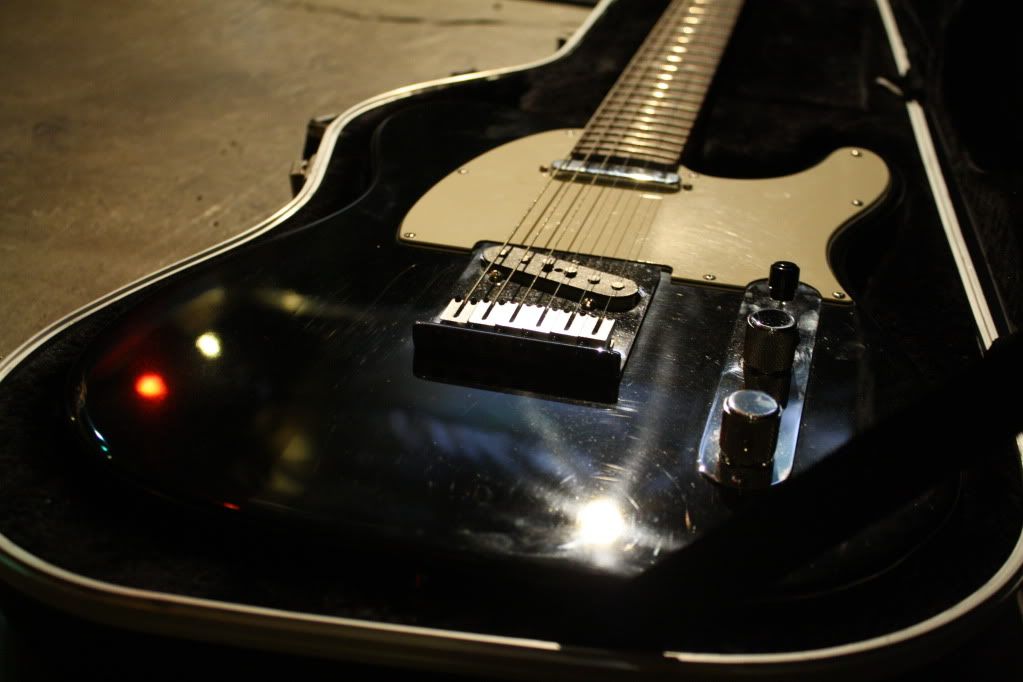
One great way to keep things moving is to expand your palette, which I'm certainly doing--the tentative lineup is somewhere between 23 and 25 songs, many of which are miniatures and discrete song experiments with a range of styles (including ones I've never tried before) and compositional themes.  In addition to adding bass clarinet, to my wind arrangements, there's going to be a lot more electric guitar on this album, as well as some contributions from an extremely accomplished drummer school friend of mine, Portland's Drew Shoals, whose jazz/rock chops I'm hoping to put to good use on several of the album's songs--his late December session is the one for which I'm working hardest to prepare, which means a lot of the electric-heavy songs are in the forefront of my mind.  Though I haven't actually been recording a guitar amp (a little to noisy for the home recording environment) it's been really fun to reacquaint myself with my electrics and remember that, although the harmonic timbres of an acoustic guitar are more organic and rich in their own way, the great part of a good electric guitar/amp combination is how much control you have over the timbre with pickup, EQ, overdrive and distortion parameters.  I'm still planning a number of acoustic-only songs to utilize both the instrument's more delicate and "heavy" (in the way I tried to explore on In Not-Even-Anything Land) aspects, but I think the diversity will be even more satisfying and enhance the eclecticism.

In arranging, one of the biggest challenges has been replacing bass--adding drums and electric guitar, it's inevitable I'll need some kind of bass texture to balance the songs (though I'm still open to not having bass--some great recordings consist of just bass and acoustic guitar), but I really want to avoid having to play much bass myself--I've bitten off enough as it is when it comes to brushing up my woodwind chops.  So, it's been fun thinking about filling the bass necessity with bass clarinet, piano, synth and detuned guitars.  On the detuned guitar subject, I've most recently been working on a two-guitar piece that's extremely counterpoint-heavy with one guitar replacing bass tuned to A# instead of E, which seems to be low enough but is difficult to keep in tune--time to buy some heavier strings.  It's been a funny couple of days, piecing together both parts, with a lot of passing back and forth between guitars to record two-second-long bits, but it's always fun to listen to the whole thing together once it's taken on more of a real shape.  Based on the arrangements I've fleshed out so far, there is some busy stuff happening here!  Another fascinating part of the arranging process is the gradual sense of awareness that comes about the vibe of the whole thing--already knowing I've got a few complex and chaotic songs has me thinking about some ways I can balance out with some space and simplicity in other places; this process goes on well after the songs start showing themselves--there are still things I wish I could change about my last album, which is why I'm trying to give myself more time with this one to hopefully notice a few of the things that will later annoy me and change them before they're permanent.  At least you can always make another record if you're not satisfied with choices you made!  The excitement continues...

Tuesday, April 27, 2010

She is kind and beautiful/I am young and strong

I feel strong. I've spent almost six months recording 11 songs (55 minutes) and the entire process has been overwhelmingly positive and empowering. The past four years have actually been pretty turbulent ones as far as my creative musical life is concerned--in 2006 I started to change the style and approach of my songs. Through the summer of 2007 in the creative shelter of my aunt and uncle's farm my new intended direction began to be realized as a collection of lyrics and compositions that fit my new standard started to grow. I started a recording project at the end of the summer that split some of my more conventional songs with some of my newer, more experimental and complex songs. Unfortunately, the project was never completed before the deadline for my move to Seattle fell--in addition, during the process of recording I developed health issues with my throat and vocal chords (a very long and tedious sob story) that effectively prevented me from singing until some tentative attempts in 2009.

The intervening years have been really difficult for me both as a musician and generally as a person. My intention was to pursue music as soon as I moved to Seattle, and the last few years haven't seen much progress in that direction. At first I made attempts to continue writing and composing despite my inability to sing properly, but eventually the prospect of writing songs I knew I couldn't sing had a debilitating effect on both my work and my spirits. My self confidence hit an all-time low--there I was claiming that songwriting and performing are my ultimate passions, but I was doing next to none of either one. I often felt like a complete sham and doubted any ability in which I may have believed in the first place, and my depression negatively affected all aspects of my life.

After trying multiple marginally helpful solutions for my throat, I made a concerted effort to pit my resolve and so-called passion against my health problems and the subsequent disabling psychological effects of which I'm still embarrassed and ashamed today. I performed at Miro Tea last June for the first time in over two years at my dear friend Courtney Morgan's art opening, and since then my throat issues have mysteriously subsided enough (I may never know why, but I think it's a combination of the steroids the doctor gave me and strength I gained from practicing in safer, more effective ways learned from some speech therapy I took during my many different treatments) that I also performed at a number of other small and unpopulated (except for my generously supportive friends and family) venues before deciding that in order to properly convey the songs that I'd been developing in my head, I needed to fully-realize them in the form of recordings to supplement any live performances I may do.

So, I holed up in the living room end of our apartment in November with the intention of recording a handful of songs to fill up my MySpace and Facebook, promote myself to potential venues, and maybe even send to a record label or two. In truth, I didn't actually even know how many songs I was going to have until putting the finishing touches on the files a couple of weeks ago. Recording has been a long, difficult, but ultimately cathartic and rewarding process. At first I was often haunted by the familiar crippling lack of productivity that plagued my last two years--the limitations of my recording equipment, abilities as an engineer and producer, and often as a guitarist frequently conspired to block my momentum--I remember a few dark days of unsuccessfully playing the same 30 second fingerstyle guitar part over and over, still unsatisfied that the sounds didn't match the ideas that had been bouncing around my head for two years. Things picked up, though, after a visit with some friends in Mexico restored my belief in pursuing what's really important to me--no matter how little free time I have. My time management skills sharpened to an alarming degree and I've obsessively spent as much free time as possible in the last 3 months working toward my goal.

The closer the project has come to completion, the happier I've been with both the results and with my decision to do the whole thing in the first place. I've had the chance to present songs I've performed live in a form that more completely represents the concepts and sounds I've been hearing in my head for the last two years, and I've also had the chance to record a couple songs that I've never played live--hearing completed productions of songs that have only existed as plans and concepts in my head and on paper has been thrilling and intensely fulfilling.

So, at the end of this recording process, I feel strong--not only do I feel that my songwriting, poetry and guitar playing have made immense progress and become more sophisticated and distinctive in the last four years, my damaged throat not only met the challenge of recording, I feel like my singing is the most technically proficient and nuanced it's ever been. My original intentions have been supplemented with a desire to actually produce a CD--I feel that the recording quality is adequate and that the works are fully-realized enough to press onto a physical medium. My current plans are to select a number of these 11 songs as well as record a couple more early this summer and have them professionally mastered (which should make a demonstrable difference in sound quality). I'm so enthusiastic about the accomplishments I've made I'm already thinking forward to a second album, but there's no need to get too far ahead of myself!

Although I feel strong, let's not confuse strong with confident--the progress I feel I've made as a songwriter and musician over the last few years has remained largely an introverted, personal transformation that I feel like I've failed to effectively show (as opposed to tell) to anyone. Though I've eagerly devoured more new music in the last 4 years than all the previous years of my life combined, I've shown precious little evidence of the effect it's had on my approach to songwriting and playing. Now it's time to relax my grip on my music and share it with other people, which is a frightful proposition--I've had very little feedback on my music in a few years and I'm quite nervous, but not enough to keep the fruits of hundreds of hours of work to myself.

Now that the back story is on the table, it's time to start presenting the songs--one per day for 11 days. As I mentioned before, about two-thirds of these songs are intended for an album. The rest either didn't fit with the planned collection of songs or I recorded them just for fun to include with the other, usually more serious compositions as 'palate cleansers.' There are also two songs that were partially recorded in Walla Walla in the summer of 2007; I'll go into more detail about each song as I post the recordings and lyrics. I physically made all of the sounds on the songs, and almost all the instruments are acoustic (only excepting some electric guitar on "Ghost in the Machine," I think). I'm satisfied with the quality of the recording, but when I eventually produce a quality CD, I'm hoping to fund a professional mastering job, which will match the volume levels between each song and smooth out the general sound and balance, hopefully eliminating any of the slight distortion you may hear, especially in the EQ department (Bass/Mid/Treble) department, of which I've only done a poor-man's job for these songs I'll be posting. I sincerely hope you get something out of the songs I've produced, and it's my greatest pleasure to finally share them. Here they come...

http://www.myspace.com/elliotknapp
http://www.facebook.com/elliotgknapp
http://twitter.com/elliot_knapp