Showing posts with label Roots. Show all posts
Tuesday, July 26, 2011
Neil Young and Crazy Horse - Ragged Glory
Another excellent album that's chiefly great not necessarily because the songs or ideas are good (though there is plenty of quality writing here), but simply because it sounds so good. In a lot of ways, the fact that Ragged Glory is such a good album defies belief. At this point, Young was well over 20 years into his career as a musician and had been playing with Crazy Horse for nearly as long. For artists of his vintage, 1990 didn't exactly yield a bumper crop of mid-career creative comebacks--the fact that Young and company manage to produce such a cohesive and vital album in the same style they've been playing since 1969 is another marvel in itself.
The heavily-distorted arpeggio and thunderous wash of overdriven rhythm guitar and bass that opens "Country Home" (apparently a 70's-penned track) is like a warm blanket for longtime Neil Young fans--aside from perhaps a small increase in heaviness, there is no difference between the band's sound here and on Young classic fuzz-rockers like "Cowgirl in the Sand," or any number of tunes on Zuma. What's more, there's almost no diversion from the template in the entire album--two guitars, a bass, drums, Neil on lead vocals and the inimitable low-rent beauty of Crazy Horse backing vocals. "Then why's it so great?" you may ask. Well, as is often the case with classic Neil Young, it's hard for me to put my finger on it. The man's best albums usually sound pleasant but generic to me on first listen then gradually unfurl their unassuming craftsmanship and casual splendor over several repeated plays. I wish I could say it's the subtlety of the songwriting, but Neil's got better collections of songs than this--"White Line," "Mansion on the Hill" and cover "Farmer John" are pretty forgettable in terms of melody and structure, and by the time "Love and Only Love" comes on it's difficult to distinguish it from the album's previous epic jams "Over and Over" and "Love to Burn." And still, there's something about the band's well-worn chemistry that carries the songs past their substance.
As always, Young's lead guitar lines are simple, often eschewing speed and multi-string complexity for melody, a wealth of subtle variation in ideas and that unquantifiable alchemical quality that makes anything Young plays--no matter how technically or melodically clichéd--sound like manna from heaven. It must be a combination of the man's ear and his taste, neither of which are easy to fault when it comes to his guitar playing. Then there's the matter of Old Black, Young's 1953 Les Paul Goldtop, and his 50's Fender Deluxe amplifier, which provide a tone so thick and so completely unique that it almost doesn't matter what Young plays, the sound is self-justifying. Though I earlier mentioned that the songwriting is occasionally forgettable, there are some classic moments--"Fuckin' Up" is as humble and self-dissatisfied a self-admonishment as can be imagined from a star of Young's caliber, and it's got a main riff that could have invented grunge all by itself (apparently this album was quite popular with the up-and-coming grunge stars of the day, and it's easy to hear why with its "don't give a fuck" rough attitude). "Days That Used to Be" interestingly addresses the lapsed hippie ideals of an unnamed contemporary while simultaneously borrowing the melody from Dylan's "My Back Pages," while "Love to Burn," "Over and Over" and "Love and Only Love," despite their extended jamming and overlapping subject matter, are actually founded on functioning and potentially concise songs with thought-provoking lyrics. In actuality, despite its heavy sound, Ragged Glory is populated by relentlessly optimistic songs and a rough-edged, weathered wisdom that ought to be expected from Young at this point in his career. In reality, the only major misstep is the album-ending live cut, "Mother Earth (Natural Anthem)," which marries the melody from "The Water is Wide" with some preachily facile lyrics about respecting Mother Earth and her healing ways--not exactly the subtlety we expect from Young's pen, and the faux-Hendrix-"Star Spangled Banner" guitar doesn't really help.
Sometimes, you're not hoping to have your ears challenged or assaulted with earth-shattering ideas--sometimes you just want to roll the windows down and crank some rock and roll, and Ragged Glory is the perfect album for that mood. It's tough to dispute that artists experience fewer and fewer creative epiphanies as they age, but in my mind Neil Young remains a paragon of self-reinvention. After his often ill-received experimental period of the 80's this album is at once familiar and striking in its consolidation of Crazy Horse's hard rock strengths, an incrementally unique moment in Young's discography. Though his casual approach to songwriting and recording results in a seemingly nonstop stream of workmanlike albums and songs, these days we rarely get a whole album quite this solid from Neil. If I'm still writing songs at his age, I'll consider myself lucky to strike gold half as often as Young manages to still do after four decades of songwriting. May the gold keep coming, even if it's accompanied by a little more silver and bronze with each passing year!
Monday, July 18, 2011
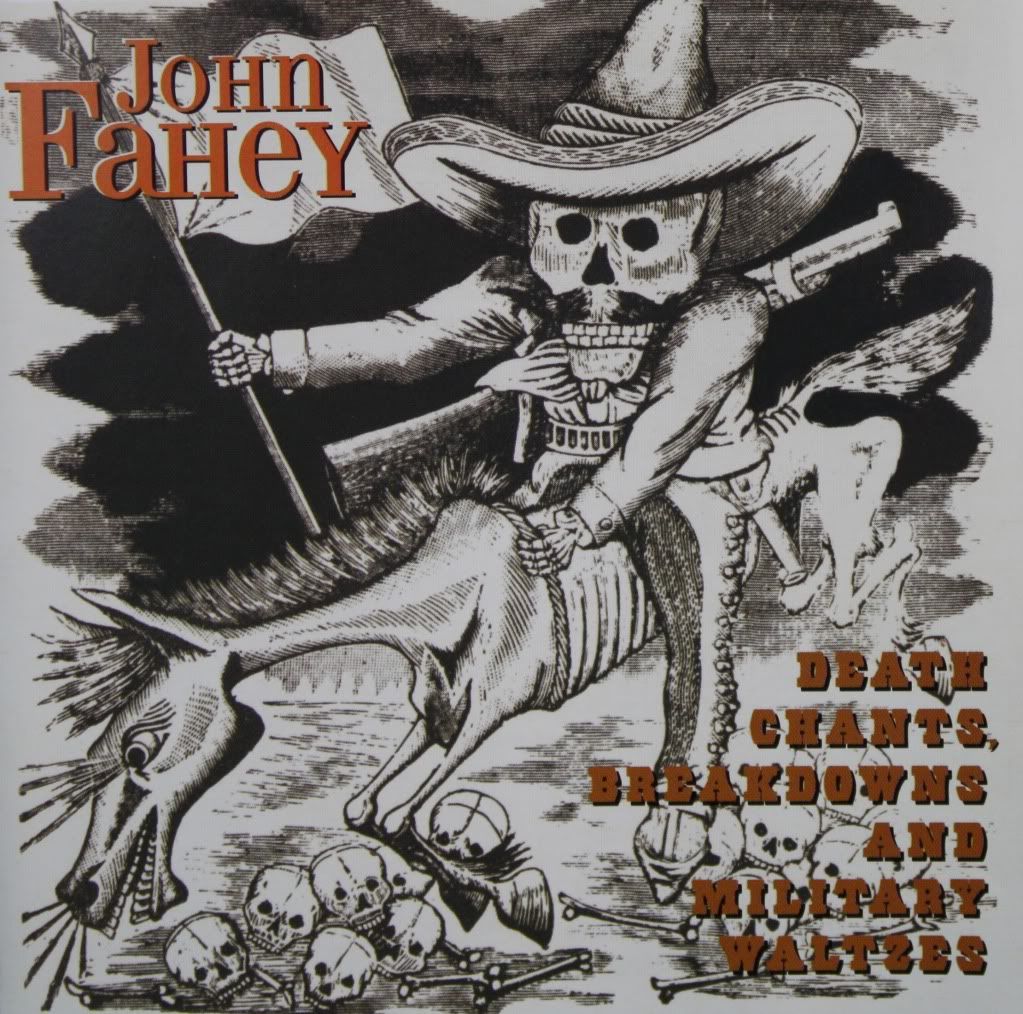
John Fahey - Death Chants, Breakdowns and Military Waltzes
In laying out markers for my musical landscape and contextualizing some of the other reviews I've written, I've been totally remiss in not yet mentioning John Fahey--sole creator of the solo steel string guitar genre, acoustic blues fanatic, composer and innovator--so I'll start with my first Fahey disc, and an enduring favorite from a man whose first 15 recorded years spanned an astonishing array of progression while still remaining anchored in the blues.
Death Chants, Breakdowns and Military Waltzes is John Fahey's second album, released on his own Takoma Records in 1963, four years after his unassuming but iconic debut. The intervening years allowed Fahey to significantly refine his technique (mostly open tunings, allowing for lots of octave Travis picking, arpeggiatos and some majestic slow strums with blues-cum-classical melodies played on the high strings) as well as his compositional style, which sees the song lengths stretching out and the compositions featuring more surprising changes and contrasting movements. Take "Stomping Tonight on the Pennsylvania/Alabama Border," which begins with a string-bending slow blues with a turnaround, mutates into a free, ascending arpeggio on the high strings, then again to a crushing minor blues dirge before revisiting each of its sections and closing on an arpeggio that crosses through dissonance to a dreamy major 7th concluding passage.
Like a lot of albums that have become long-term favorites of mine, part of what I love about this album is how it sounds--the recording quality isn't great, but since it's (mostly) just one instrument, everything's still audible and the music is laced with an antique atmosphere--and the room reverb is awesome. There are a few moments where the volume of Fahey's guitar threatens to distort the recording equipment (to its great) as on the slide glissando of "On the Beach of Waikiki," or where the distance of the guitar to the microphone lends a raucous feel, as on the energetic "Spanish Dance," and then on "John Henry Variations" when the instrument's slightly out-of-tune harmonic overtones warble with an unsettling but hypnotic pulse. If I call some of this album "psychedelic," it's these sort of extra-melodic elements that I'm talking about, like 3:15 into "America" where (through the use of tape editing, I assume) the guitar timbre suddenly changes from bassy fingerstyle to tinny high-neck strumming, or 1:06 into "When the Springtime Comes Again," when the key abruptly shifts from minor to major but the theme remains almost the same--there's something within those quavering intervals that lingers on the precipice of some forgotten memory that never ceases to make my hairs stand on end. The piece would continue to fascinate Fahey the composer as it evolved into numerous versions on the 1967 re-recording of this album, in numerous live recordings, and on 1971's America as "Mark 1:15"--each time expanding on the last but somehow leaving a trail of discrete incarnations, each with its own particular magic.
The dark corners of this album aren't without some extreme eccentricities, either, like the dissonant strumming on the flute duet, "The Downfall of the Adelphi Rolling Grist Mill" (Fahey's titles were often almost as great as the songs they labeled). Ultimately, though, Fahey's genius substantially rests on his ability to bizarrely marry the familiar harmony and structure of the blues with the dissonance and imagination of 20th century classical composers. For someone like myself who gets bored with the repetition inherent in a lot of blues music, hearing Fahey deconstruct his beloved genre and reassemble its innards into dazzling piecemeal sculptures breathes new life into what's usually a compositionally inert idiom. His preternatural melodic abilities provide melodic lines that sink into the brain slowly but insidiously--not sounding like much at first, but ultimately sounding as beautiful as any music possibly could--I really love the way his sweeping melodies traverse multiple string plucks, simultaneously savoring a note and impatiently re-sounding it before the sound has a chance to decay.
I've got a feeling that whichever Fahey album most people name as their favorite is one of the first (if not the first) that they hear. Though his early career covered expansive ideological and theoretical territory, it did so at a modest pace and Fahey would often repeat the same ideas either explicitly or intuitively. At the time he was only pressing hundreds of copies of each album, so how was he to know how things would sound when his discography was considered retrospectively? For example, he re-recorded and re-released most of the songs from this album (to be reviewed at a later date) in 1967, and the advancements he made in technique and composition are noticeable. What I'm trying to convey is that, beautiful as they are, some of his ideas lose that "first time" magic when they crop up elsewhere, and where you hear them first tends to remain the most memorable. For me, it was here with Death Chants, Breakdowns and Military Waltzes--I still think it's a great place to start with Fahey as it states many of the ideas he would continue to pursue--compositionally, technically, sonically (he'd continue to experiment with tape editing as the 60's wore on), and arrangement-wise (many more of his albums feature his own adaptations of Episcopal hymns as closers)--but it all comes in a relatively digestible form, mostly adhering to compartmentalized song structures and resonating with some sort of pop instinct in terms of flow and melody. I've got several John Fahey favorites, but this is probably the one I'd give up last--you can pry this album from my corpse's withered fingers.
Friday, April 22, 2011
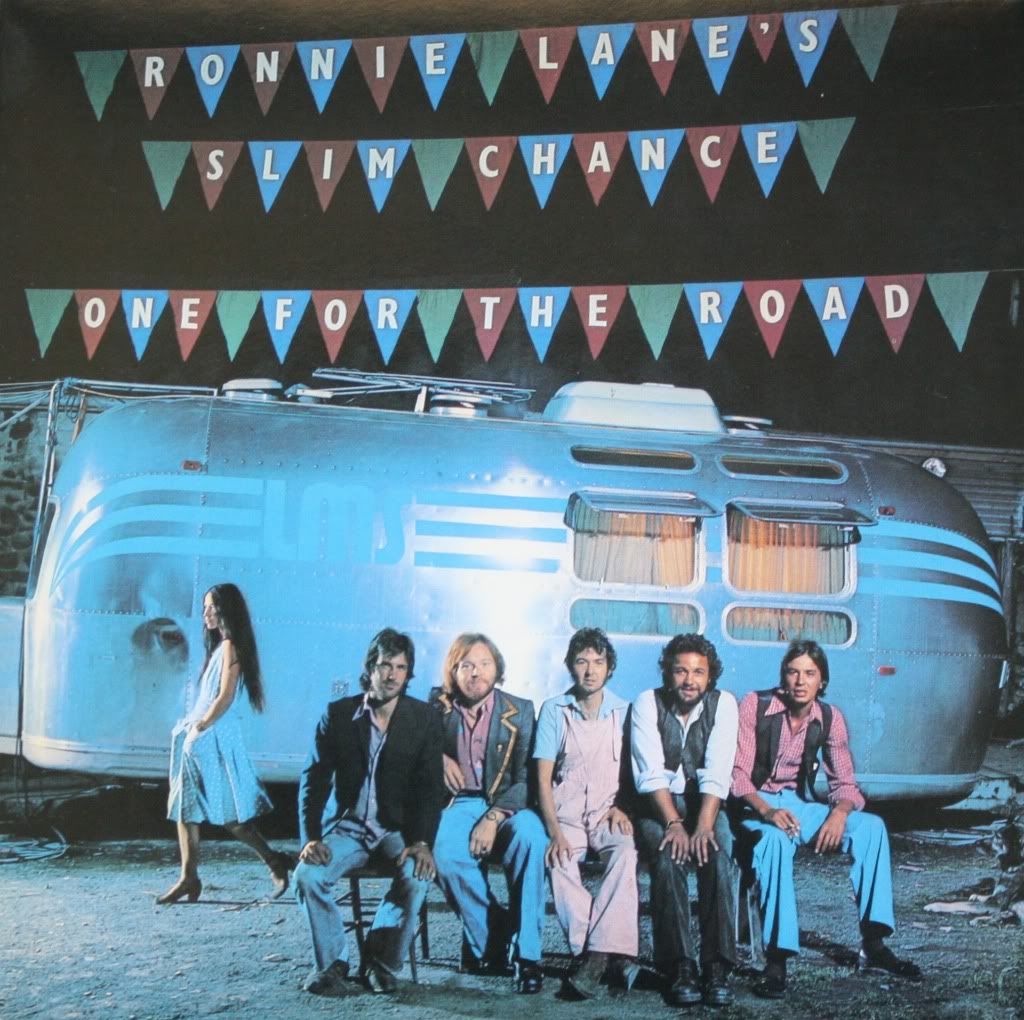
Ronnie Lane's Slim Chance - One for the Road
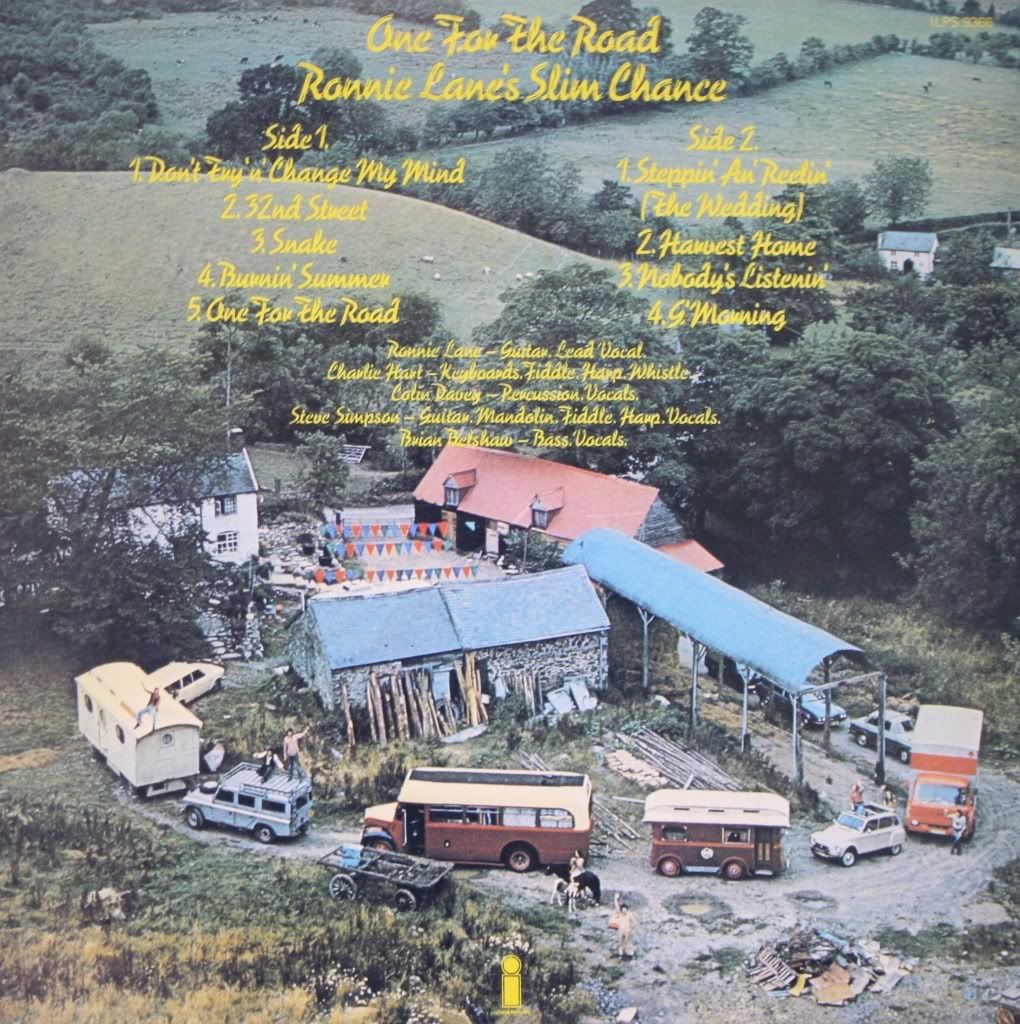
Although this is is my first Ronnie Lane review, One for the Road represents the tail end of Ronnie Lane's remarkable 2-year stint as a solo artist--one last blazing home fire of an album before his dreams of surviving in a traveling musical caravan (see the back of the album cover below) buckled under financial pressure and criminally poor album sales. Excepting the pretty good Pete Townshend collaboration Rough Mix, this is Lane's creative and energetic swansong.
Even more than its two predecessors (Anymore for Anymore and Slim Chance), this is an album of struggle against the pressure to live a mainstream life and an expression of the pure joy of living in connection with nature and self-developed values. For all his skills as a songwriter and lyricist, Lane's words are deceptively simple. At times he rants and raves like a man pacing around in a prison cell--"Give me just one wish and leave me be," or "I'd rather have a bad time than no time at all" from "32nd Street"--while tossed off observations like "I've just been where I been/Just seen what I seen/Nothin' more" ("Don't Try'n' Change My Mind") belie the hard wisdom his working-class background and financial struggles must surely have earned him. Elsewhere it's the simple pleasures he extolls, like a rural wedding ("Steppin' and Reelin'"), waking up with the sun ("G'morning"), and the slow burn-out of late summer ("Burnin' Summer"). Despite his obvious frustration with the societal pressures he so concertedly contradicts, Lane never sounds bitter. His voice, at times a rough growl and at others a soulful croon, is an ever-present reminder that this is a man laying his passion and struggle bare for all to see.
Ronnie Lane's earlier contributions to the Small Faces and The Faces certainly hinted at the direction his solo career took, but who would have ever guessed his sound would ever get as organic, joyous and soulful as it is here? Slim Chance not only employs typical rock band instrumentation, there's also fiddle, accordion and mandolin--not bad for just five dudes. They're also able back-up singers, making songs like "One for the Road," "32nd Street" and "Nobody's Listenin'" some of the most raucous shout-alongs Lane ever laid to tape. In my mind, Ronnie Lane's Slim Chance is about as close as anyone else has ever gotten to the Band's confluence of soul, genre-blending, songwriting, earthy feel and purity of feel--and Slim Chance only has one lead vocalist. In today's musical era of anachronistic old-timey so-called "Americana," trumped-up agrarian costumery and forced vocal affectations, more than a few performers could learn something from Lane's authenticity, both as a songwriter and performer--he uses simple instruments not to look backward, but to conjure the timeless energy of a group of friends playing and singing together, and his songs still sound fresh because they tap into his passionate self-expression, not some imagined sepia folk world. With simple music that sounds as instantly familiar as this, that's what separates the few kernels of wheat from the god-awfully huge piles of chaff--even though the system eventually battered Ronnie Lane into submission, he's got at least three shining albums of beautiful defiance that escape commercial surrender and stand proud on their own distinctive spirit.
You can get this (nearly complete) album here
Subscribe to:
Posts (Atom)