Showing posts with label Good Guitar. Show all posts

Tuesday, June 5, 2012

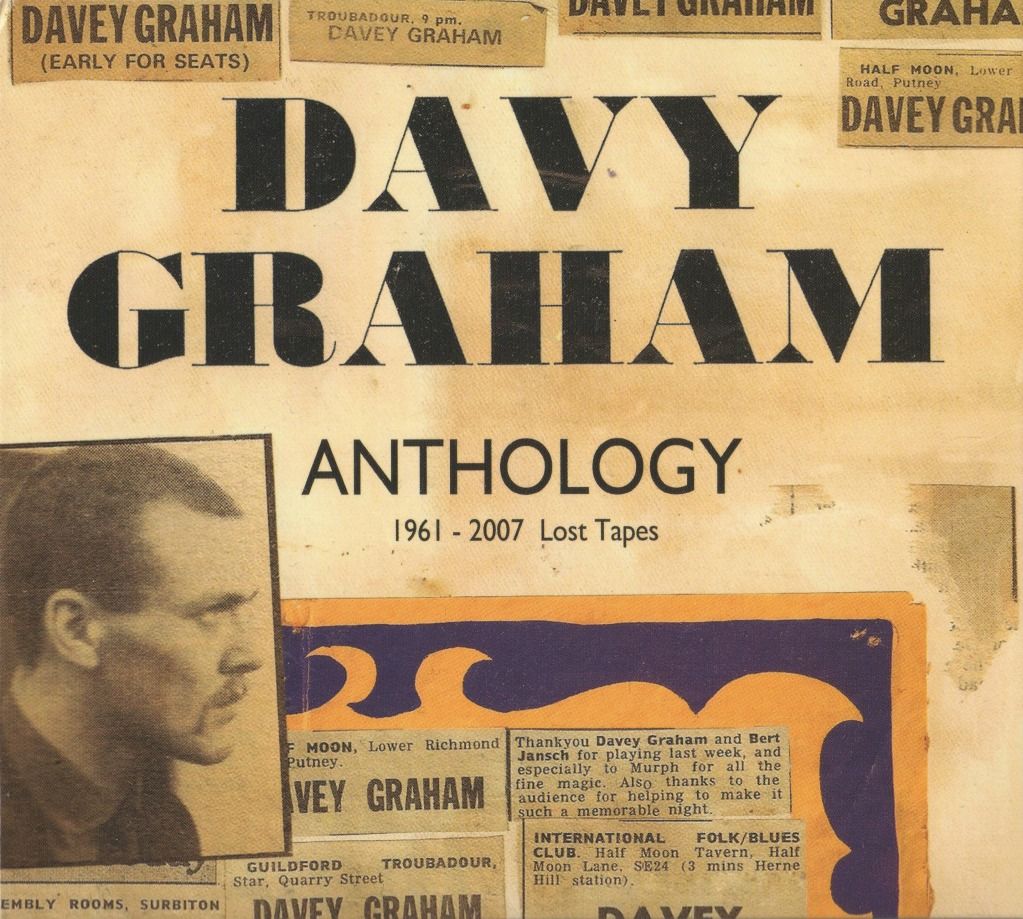
Davy Graham - Anthology: 1961-2007 Lost Tapes


Almost four years after Davy Graham's death, the folks at Les Cousins Music are still working not only to preserve his officially-recorded legacy, but also to expand the scope and depth of his output, making it clearer for those who weren't there why the guitarist was the undisputed king of the 1960's English folk revival.  Nostalgically packaged in a collage of images gleaned from Graham's personal scrapbook (and simultaneously displaying both spellings of the guitarist's first name he confoundingly vacillated between), this three-CD collection anthologizes no less than 54 tracks across more than 2 1/2 hours of unreleased recordings.  Count me in!

It's a fool's errand to attempt a track-by-track analysis of an anthology so deep, so I'll attempt to convey some general impressions and reference tracks where appropriate.  Having been a Davy Graham fan for several years, I think I'm finally starting to understand how, as Roy Harper says, Graham "never managed to turn his talent into a brand that people could go out and buy and enjoy," yet every other guitarist from the same time period and beyond cites Graham as a towering giant of the six-string.  After five years of absorbing Graham's studio output I'm still at a loss to recommend a single album of his that fully conveys and encompasses what was so revolutionary about his playing, and not having been there it's been hard to picture myself in that bright-eyed hopeful time and imagine myself at some bohemian party with Graham conjuring untold spirits out of an acoustic while everyone just sits and listens.  Enter this anthology, which as far as I've heard does the best job this side of After Hours at Hull University of recreating such a scene.  The sound quality (especially on the first two discs) is almost exclusively of home/bootleg quality and most of the performances are solo, with Graham positively shredding in front of small audiences as he sends jazz, folk, blues and "world music" (before such a term existed) through a blender and we get to hear what comes out.

Since it's mostly just an acoustic with or without vocals, the sound quality isn't much of a bother--if anything, it enhances the intimacy of the performances, which find Graham energetically blasting solo performances of many of the folk and blues songs found on his albums as well as never-before-heard tracks.  Throughout, his technique is astounding, transitioning as quickly as ever between lead and rhythm, melody and harmony, from style to style.  Somehow the setting's informality allows the guitarist's hard-won chops to shine brighter with none of the studio adornments meant to commercialize his sound, and we instead get to hear him exclaim "Ah, fuck" after some imperceptible mistakes during a lightning-fast take on Leadbelly's "Fannin Street" with nary a missed note, as well as a verbal introduction to his classic instrumental "Anji" (there are two versions here, along with an unreleased track and album highlight "Anji's Greek Cousin") that details how he wrote the tune.  While the live renditions of guitar-and-vocal folk/blues tunes present uniformly great guitar and often contain vocals that are superior to the studio versions, they also miss the mark when it comes to what made the guitarist unique--more than almost any other Graham album, this anthology conveys the strange alchemy that occurred between Graham's musical influences, his fingers and his guitar, and these discs present ample, undiluted evidence of what was possible when only these elements were on display.

Of the three discs, the third is probably the least essential, reflecting the diminishing returns that Graham's post-60's releases offer, yet it often sounds more vital than studio recordings from the same period.  Though Graham's lifestyle choices and age would gradually slow his playing and attenuate his already limited vocals, we still get some surprisingly good representations of the more delicate British folk, jazz, medieval-sounding instrumentals and world folk music explorations he continued to make through the 70's and beyond.  "The Gold Ring" shows his pull-off speed undiminished, "Sita Ram" and "Mevlut" pair his further eastern experiments with appropriate accompaniment, and "DeVisee Suite" shows a subtle, slower side to his playing that was all but absent in the early days.  The final late-period tracks remind us that we're summing up the career accomplishments and contributions of a distinctive force in 20th century popular music.  As with his 2007 swansong Broken Biscuits, the joy here comes less from marveling at jaw-dropping speed, but more from giving credit where it's due and appreciating that the man's muse was still active at the end.

While I still think it's impossible to recommend an accurate starting point for a prospective Davy Graham fan (it takes more than the average time investment to really "get" him as an artist), this anthology is a surprisingly worthy addition to even a modest Davy Graham collection.  Unlike so many retrospective collections, it manages (with the help of Graham's considerable skill and restlessness) to make familiar songs sound fresh and new songs sound immediate and relevant to the further-broadening portrait available of Graham as an artist. 

Get it here.

Saturday, January 14, 2012

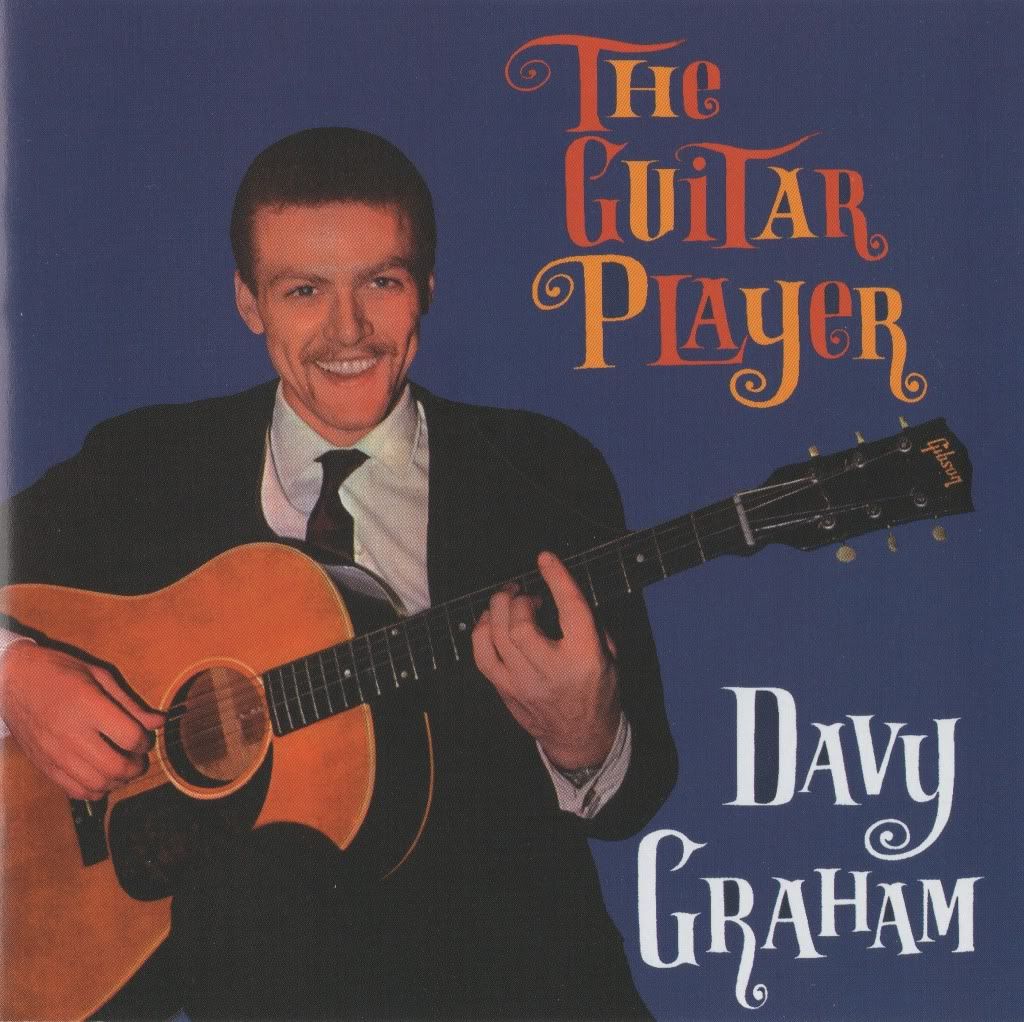
Davy Graham - The Guitar Player


If you're interested in delving into the influential and often mind-blowing rabbit hole that is Davy Graham's guitar playing and inimitable fusion of jazz and blues with folk from across the world, I urge you not to start here!  That's right, it's another installment of the only-very-occasionally-controversial Know Your Enemy series.  This time it's not really poor Davy or his fleet fingers, but rather his presumed audience who's the enemy.  It's got to be pretty much impossible to reckon how many great artists' originality and instincts have been stifled (either by their record labels or by themselves) in hopes of presenting their music as inoffensive and appealing to the largest and most middle-of-the-road audience possible.  By this album's 1963 release, Davy had already been doing the things that made him a legend among many British musicians who would find considerably more fame (things like showing up to a party and playing a single-guitar arrangement of Ravel's Boléro).  Instead of committing his unrivaled guitar excursions to tape, Pye subsidary Golden Guinea decided it would be more commercially accessible to pair Graham with a jazz session drummer and record an inoffensive mix of jazz and blues standards.

And so, we have The Guitar Player, whose title and cover promises an aural vision of Graham it doesn't deliver, at least in relation to his historical reputation.  We get "Take Five" and "Cry Me A River" (an earlier filmed version of which secured Graham this record deal) as well as Cannonball Adderly's "Sermonette."  While the material is in places somewhat mundane, Graham's playing is always flowingly organic (the tempo ebbs and flows with quite a bit of endearing imperfection) and it's fascinating to hear him collapse all the vocal and instrumental parts of a song like "Ray Charles' "Hallelujah, I Love Her So" into a single fingerstyle guitar part.  Disappointingly, most of the songs veer toward jazzy blues (or maybe bluesy jazz, as many Graham's mini-fills tend to riff on blues scales), though there are a few outliers that hint at the man's true passion--"The Ruby and the Pearl" injects a satisfying amount of minor Latin into the mix (and the drummer manages to play the sticks in a considerably more complementary way than he often does elsewhere, or maybe it's the fact that it's just acoustic guitar and drums that makes some of the arrangements sound  just a bit hollow).

Re-listening to this album, I'm reminded how much of a joy it is to listen to Graham's guitar playing, no matter what the context--sort of the guitar equivalent of saying you'd be OK listening to your favorite singer singing names out of the phone book.  It's just the knowledge that Graham had much bigger ideas to share and the way the songs are all so self-consciously happy sounding that rings somewhat forced.  The liner notes Davy writes "I sincerely hope you enjoy this record either to listen to or as a background to a good conversation," which just about sums it up--cowering in submission to your hoped-for audience so very rarely produces the stuff from which legends are born.  The CD reissue of this album seems determined to apologize for the original album's timidness, including examples of what actually made Graham legendary (raga-infused Irish folk in "She Moved Thru' The Bizarre/Blue Raga," Greek folk in "Miserlou" and a considerably more eclectic selection of songs from Graham's later-70's All That Moody, including his legendary instrumental "Anji").  Still, the unfortunate truth is that, pleasant as it is, this album doesn't come close to doing Graham's contributions justice.  While Graham would have career-long troubles finding a marketable niche for himself and regularly seemed to make artistic choices in hopes of endearing himself to an intangible audience, he at least managed to create a concurrent legacy of music that more successfully represented his unique and unprecedented vision.  While it's frustrating that he never produced an epic, vocal-less collection of his genre-shattering experiments (I'm sure partly owing to the fact that solo acoustic guitar as a genre was pretty much just getting going in the early 1960's), there are much better places to start than The Guitar Player.

You can get it here.

Monday, January 2, 2012

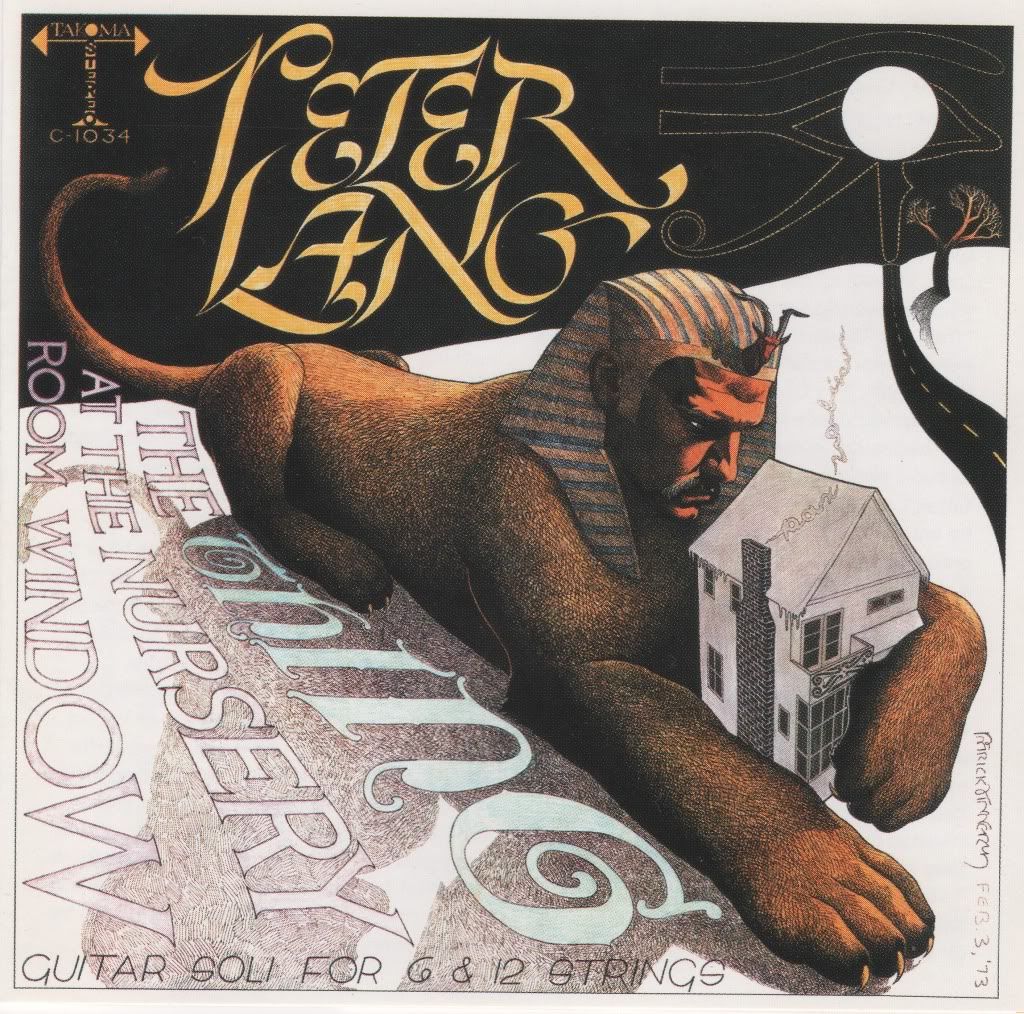
Peter Lang - The Thing at the Nursery Room Window

One of the greatest title/cover art combinations I'm aware of...what exactly is that cursive smoke spelling out?

Especially considering the fact that the "American Primitive" genre of folk guitar was just over a decade old in the early 1970's, I think it's a testament to the depth of the stable of outstanding guitarists Takoma Records had assembled that each one managed to have a distinctive style and purpose.  While genre founder John Fahey wanted to communicate something mystical he discovered by examining the elemental essence of early blues players under a microscope and Robbie Basho strove to reimagine his guitar technique to communicate incommunicable mystical secrets, Leo Kottke and Peter Lang both seemed to be players first and composers second--musicians driven most by the joy of making beautiful sounds come out of their instruments.  While this is an important component to any musician's working life, I think vision is one of the elements that separates musicians who truly have something to say from those who are simply technically proficient.  What I find most interesting about Peter Lang's Takoma debut is the fact that it finds the guitarist at a developmental crossroads, growing past his pure technical roots into a territory with far fewer limits, determined only by his own compositional imagination.

According to the CD reissue's liner notes, Fahey told Lang that he was thinking (as a composer) in too small blocks of time and urged him to allow his pieces to stretch out a bit.  You can hear where Fahey's coming from on the opening tracks "Snow Toad" and "Muggy Friday," where Lang's formidable technique seems bent on making the finish line.  While his rapid fingerpicking audibly owes more to Kottke's style than Fahey's, Lang's approach is subtly idiosyncratic, with a nice emphasis on string bends and slides.  As the album progresses, though, we get to see the fruits of Lang's response to Fahey's critique--"Turnpike Terror," though only slightly longer, starts playing with dynamic and textural changes, utilizing space and strumming to take the short piece in several directions.  The marvelous "Bituminous Nightmare" stretches even further, flirting with much more dissonance, theme development and single note layering (for lack of a better term) that seems to be wholly Lang's trick. 

Though only a few of the songs here fully demonstrate Lang's growth as a composer, his playing is always beautiful, engaging, and (for my money) more emotionally compelling than Kottke's.  He proves himself an able slide player on "Wide Oval Ripoff," a capable balladeer on "Young Man, Young Man, Look At Your Shoes," and unafraid of lightning fast swing on "Quetico Reel."  Satisfyingly, though, the album ends on his most ambitious and adventurous compositions, the nearly 10-minute "Future Shot at the Rainbow," which further explores his penchant for overlapping single note lines to an almost baroque extent, unfolding and refolding a humbly beautiful melody with a real sense of journey abetted by judicious pacing and flow.  While Lang never managed a consistent output, his playing is always delightful and this album stands as one of the most enjoyable Takoma releases and a hopeful nod to the virtue of stretching beyond your comfort zone.

Get it here.

Monday, November 21, 2011

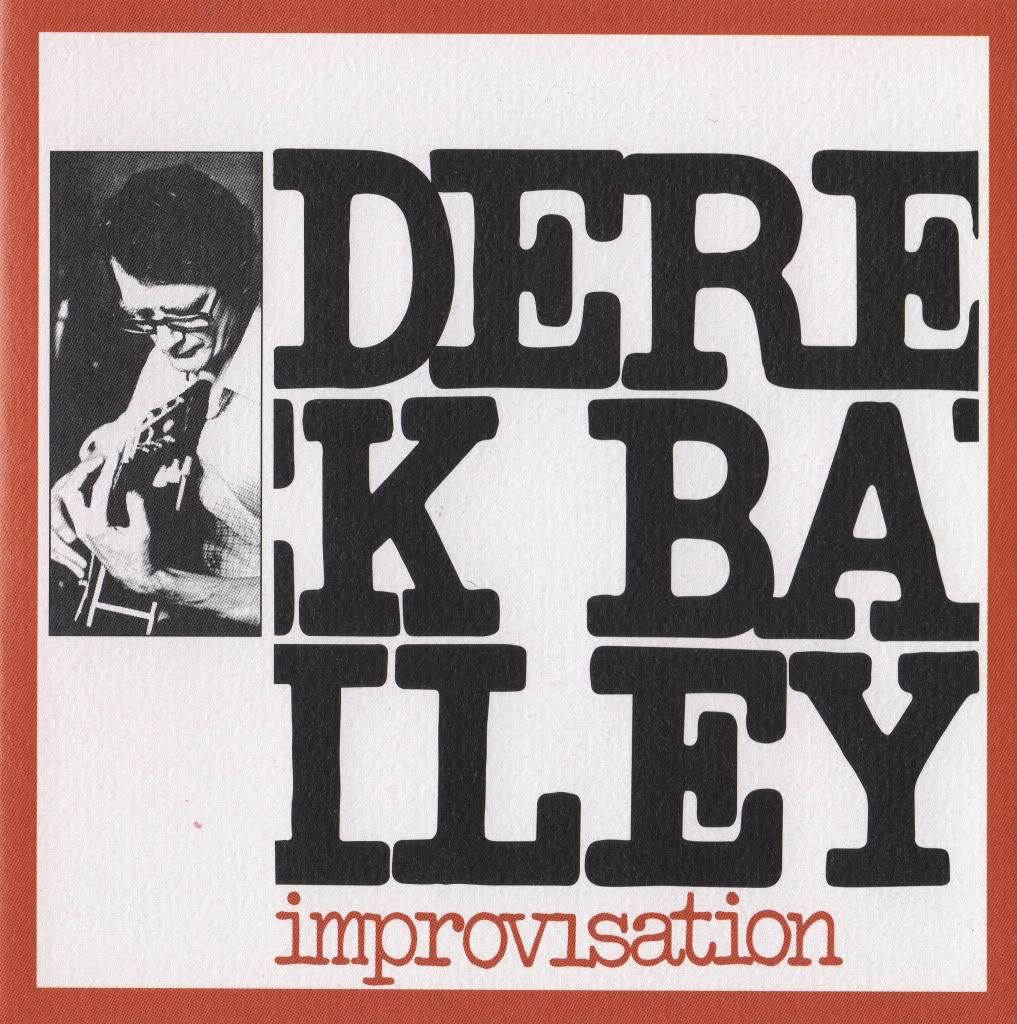
Derek Bailey - Improvisation


Derek Bailey is known for two things: being a grouchy old man when he wasn't even old, and for single-handedly creating his own free improvisation idiom on the six-string guitar.  Right up my alley on both counts!  By the time Bailey recorded Solo Guitar Volume One in 1971, he'd already been a prominent figure in the British and European free jazz circuits, performing with people like saxophonists Evan Parker and Peter Brötzmann and bassist Dave Holland, and by the time this 1975 album was released he had refined his solo improvisational technique (which came across as a bit tentative in his debut) to the rarefied level it remained for most of the rest of his career.

Listening to Derek Bailey for the first time can be a disorienting--his style is thoroughly and often brutally atonal, arrhythmic and usually very nonrepetitive.  It's also most assuredly the type of music that sounds like an irritating mess if the volume is low and you're only half paying attention.  Crank it up so your surrounded by Bailey's sound world and focus on what he's doing and an exciting (if somewhat cold) sense of adventure-in-logic dominates every move the guitarist makes.

While Keith Rowe is responsible for making equally influential advances in the guitar free improvisation realm, Bailey's music sounds much more like a conventional guitar played to an exponentially "out" degree; in fact, his amplification is so clean it's almost difficult to discern that he's playing an electric guitar on this album.  Though he almost exclusively flatpicks, Bailey's style relies heavily on harmonics, muting and exploiting the instrument's natural sustain and decay.  This can be easily heard on "M4" and to even greater depth on "M8," where Bailey's harmonics and string bends pit two strings against one another on nearly the same note, deftly controlling the oscillation between the two notes as they eerily decay into space.  At other points Bailey embarks on furious runs across bizarre intervals, sporadically halting to interject with brief spurts of silence or allowing a note to ring before again changing direction completely with some explosively percussive cluster chords ("M10").

One of the things I love most about Bailey's style is how fluidly he moves from one idea to the next; though there really isn't any melody to his playing, it's usually easy to discern what is fascinating him at any given moment, and the thrill of his free improvisation is in the headlong rush into whatever the next idea might be.  Sometimes the difference lies in the textural discrepancy between harmonics, standard string plucking and jabbing chords ("M13"), and at other points it might be a digression into exploring the percussive potential of the instrument with skittering string scrapes ("M14") or interjecting taps on the guitar top between the string's tonal sounds.  Finally, and perhaps most subtly, Bailey uses a two-amplifier setup and volume/swell pedals to dynamically pan the output of his guitar, which adds a richness and mobility to his fretboard wandering (especially noticeable on "M5").  While not quite as finely controllable as Fred Frith's dual pickup/output experiments, it's easy to see that Frith's guitar solos owe a sizable debt to the pioneering done by Bailey.

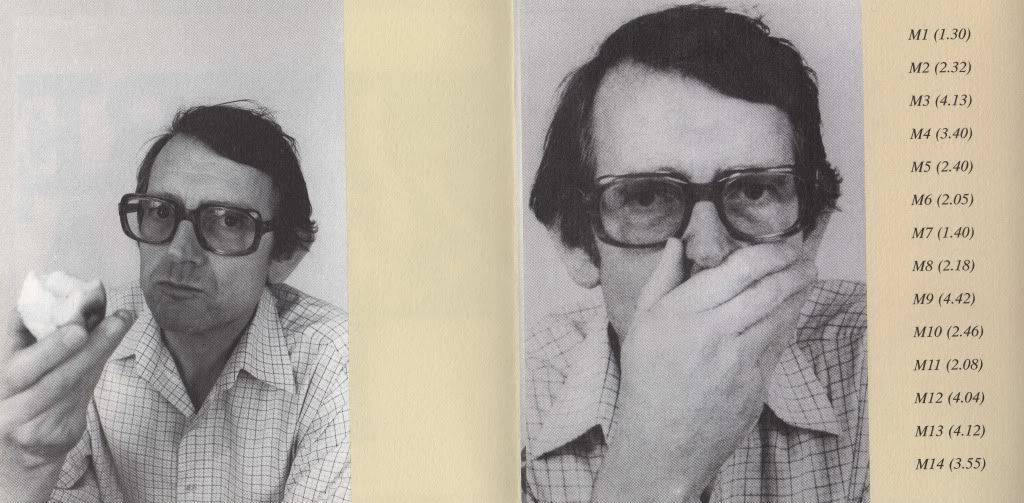
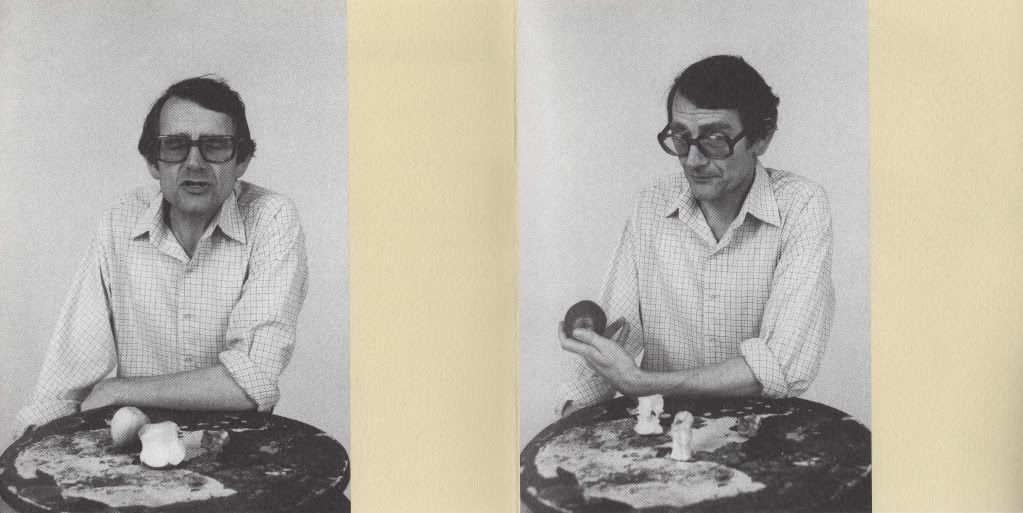
While he's got more epic albums (Aida is often regarded as his best), I think Improvisation is just as strong and is probably a better introduction to Bailey's challenging style because the track lengths are short and can be more easily focused on and digested.  Though my interest in Bailey has been tempered by the realization that his style became formalized mid-70's and didn't develop much further, revisiting his best works reminds me that 1) his style is so radically different from those who came before him that he didn't really need to reinvent himself to maintain his validity and 2) his style is so all-over-the-place that there isn't a whole lot more he could do to develop it further.  Bailey's playing is an inescapable golden standard for atonal guitar as well as an audacious challenge to all followers to conjure something else new and exciting from those six strings.  Please enjoy these pictures of Derek Bailey eating some apples.
Get it here.

Friday, October 28, 2011

Keith Rowe - The Room


Now, back to something really weird.  Keith Rowe, formerly the guitarist for house favorites AMM, is probably one of the most influential underground guitarists of all time.  He was one of the first guitarists to pioneer a tabletop prepared guitar technique wherein the instrument is placed flat on a table and manipulated with various found objects to create unusual and unconventional timbres.  After quitting AMM for the second time in 2004 (a move of which he's apparently quite proud), Rowe's solo performance and album release schedule has picked up markedly, as has his further exploration of the possibilities of Electroacoustic Improvisation (EAI), a loosely-defined branch of free improvisation with an emphasis on live computer processing of improvised sound sources.  This, a 2007 solo release, is regarded by some as Rowe's best solo album and was released on Erstwhile Records, which courageously releases an impressive amount of good EAI to a generally apathetic public (awesomely enough, the label also eschews barcodes in their packaging).

While Rowe's contributions to AMM often seem intended to amplify the sounds of his unusual guitar approach into a space (i.e. a room or concert hall), The Room sounds to me much more inward, as if he is listening to the innards of the things producing the sound.  This impression is probably intensified by the fact that Rowe's improvisations sound like they're directly input to the recording device, rather than amplified and miked.  In any case, the result is a single 38:57 continuous track (though there are brief silences between sections) of droning guitar tone, amplified signals and electronic processors, some traces of Rowe's signature radio frequency manipulation, and some visceral textures produced by Rowe's physical manipulation of the guitar's strings.  If that description doesn't sound like much, please be aware that the actual sounds contained on this disc are very difficult to verbalize!  Though this album is much too indie to appear on YouTube, this video of Rowe playing prepared guitar will at least give you a better idea of what some of this sounds like (though I personally prefer not having these bizarre sounds attached to any visual explanations for their origins).  To me, the dominant timbres of the music are a sort of ambient hum (presumably the guitar), and a more rhythmically dynamic, twittering, upper-frequency sort of repetitive digital bleeping.  It's fascinating how the textures overlap in a sort of progressively sliding series of layers, with one tone source pulsing gently while another simultaneously rapidly dances on top, and before you know it one of the sounds has disappeared while your ears were transfixed by another, and a new one is just moving into the picture.

How does this music compare to free improvisation like AMM?  Well, for starters, I think it's not completely discrete--if there was some way to only hear what Rowe was doing during certain AMM performances (I'm thinking especially of the drone-heavy 2001 album Fine), I think it might sound a lot like parts of this album, despite Rowe's written assertions that it's an attempt to go somewhere completely new.  In other ways, though, it's much colder, more alien and less organic than AMM's albums, conjuring a claustrophobic atmosphere (perhaps there's a connection to the album's title and the feeling the music conveys) and a sort of digital industrial feel that never really occurs on AMM albums.  Not that it's a particularly bad thing--I vividly remember on my first listen feeling (perhaps around the 22:30 minute mark, when Rowe starts scraping the strings beneath a piercing electronic tone) a powerful sense of unease and a strange, alien emotion that no other music has ever made me feel before.  Though it's far from the warm-and-fuzzy elation that most listeners hope to achieve from an album, the experience remains ingrained in my memory as an inspirational example of music's unlimited emotional potential, and as a sort of revelation (how often do you feel a feeling you've never felt before, right?!).  Don't get me wrong--Rowe's sometimes laughably-strident views on musical aesthetics (which seem to come with the territory of free improvisation) inform this music with an uncommon level of academic seriousness--but attempting to deny the music's very real emotional power in the name of disagreeing with Rowe's artistic choices seems to unjustly disregard his contributions to the ever-growing palette of potential moods and emotions available to listeners and musicians alike. 

It's hard to really assess the quality of music like this--it's so fundamentally different structurally and in its aesthetic goals that even when talking in terms of elemental sound, it's hard to separate what's "good" from "bad," and the subjectivity of personal preference that's present with all music becomes a starting point rather than an ultimate conclusion.  Despite Rowe's professed anti-virtuosic method, though, he clearly (in my ears, at least) has a flair for space, flow and tone/timbre choice that few other improvisers do.  Though I think The Room occasionally suffers from the sort of repetitiousness and aimless structure that understandably pops up in a lot of free improv, the frigid atmosphere and occasional moments of revelation (like the digital explosion at about 24:25) make it a much-appreciated part of my collection (though I'm not sure I currently have the interest to sustain a lot more similar additions).  Support some fringe indie music facilitators and grab a copy from Erstwhile!

Monday, October 24, 2011

Michael Hedges - Aerial Boundaries


Now here's an artist who never fails to evoke conflicting reactions from me, both emotionally and intellectually.  Though it'd be easy to write Hedges off based purely on his record label (Windham Hill, epicenter of the dreaded New Age musical movement and all of its paradoxically limp-wristed perviness), to do so would be to ignore a guitar player who accomplished considerable innovation and influence in his field, as well as a composer of undeniable ability.

That Aerial Boundaries is still Hedges' most known album is undoubtedly due to the brooding title track, which is a well-realized representation of the uniqueness of his spin on the acoustic guitar and also a tight example of his trademarks as a composer.  Technically, Hedges' brilliance seems to lie in his exploration of producing sound by striking the strings not over the sound hole (the traditional location for flatpicking and fingerpicking) but on the fretboard itself--"Aerial Boundaries" combines traditional picking with a repeating figure on the fretting hand and a series of percussive interjections higher on the fretboard (on the lower strings, er) by Hedges' right hand.  The resulting sound (though it almost always necessitates unconventional open tunings tunings to make up for how busy the player's hands are) approximates three or more distinctive parts happening at the same time.  Though plenty of fingerpickers have achieved breathtaking counterpoint and polyphony by abandoning one pick for five, it would seem that no one did it in quite this way before Hedges came along.  While I probably wouldn't say Hedges has influenced me technically as a guitar player as strongly as he has other recent players like Andy McKee or Trace Bundy, I really love the way his style plays fundamentally with the incredible dynamic, tonal and harmonic range that's waiting to be discovered in the acoustic guitar.  It's amazing how many textures and sounds you can get out of a guitar by sounding it in a different way, or how much those alternate techniques can transform the way the instrument sounds when the recording or amplification volume is cranked up--this kind of fretting-as-note-striking shows that a note's decay is really a lengthy window even when the string isn't actually struck over the sound hole.  Hedges manages to avoid his innovation becoming novelty by supplementing it with more standard finger picking and even strumming on songs like "Bensusan."  Probably my favorite tracks are the more percussive, upbeat ones, like the brooding "Ragamuffin" and the funky jabbing of "Hot Type."  Also compelling is the more psychedelic "Spare Change," which uses reverse delay to further expand the interlocking nature of Hedges' playing.

While it's easy to applaud Hedges' technique and his ability as a composer to keep his pieces moving with distinctive sections and developing structures, I can't say that he's gifted or even proficient when it comes to melody--though some of the songs have memorable chord changes, the only one with a hummable melody is a cover of Neil Young's "After the Gold Rush," on which the melody is ironically carried by the fretless bass, not Hedges' guitar.  Perhaps it's my general distaste for the New Age "house flavor," but the gentle harmonic palette becomes cloying in my ears, especially on songs like the embarrassingly-titled flute/guitar/bass trio "Menage A Trois," which is so lacking in distinctive melody that it seems to beg to stay in the background at some New Age meditation party.  In fact, there are very few songs here that manage to break out of the tunefully tonal but indistinct haze that Hedges' composing generates.  While it's certainly "pretty," it seems that the pinnacle of pretty music--melody--is conspicuously absent, which to me almost defeats the purpose of trying to make pretty-sounding music.  From what (thankfully) little New Age music I've heard, this seems to be par for the course--it's as if the first goal of these artists is to make background lifestyle music that's unfocused enough that you can easily ignore it, which is horrifying to me as someone whose greatest joy comes from subsuming myself in complete attention to some beautiful music.  It seems like an unhappy coincidence that Hedges pioneered such a cool technique but used it to make New Age music--this kind of percussive attack just begs for more aggressive music, but it's also disappointing to see that most of the man's followers seem content to follow in his footsteps as a composer as well.  This music is worth hearing for the awesomeness of Hedges' guitar playing, but I suggest you crank the volume up when you do, so you can dive into the guitar playing, overcome the terribly quiet sound of the early CD issue, and avoid the vapid pseudo-emotion that many of these songs attempt to convey.

Wednesday, October 12, 2011

Roy Harper - Valentine


You know you're in a good place artistically when you're pumping out massive, sweeping epics every couple of years and still find you have enough shorter, less ambitious songs coming out of your pen to collect another entire album without even having to try.  Roy Harper was in such a situation in 1974, coming off of a couple of conceptual beasts in 1971's Stormcock and 1973's Lifemask and realizing he'd amassed enough unrelated but equally strong material in the meantime to release an album of (mostly) love songs--1974's Valentine.

The fact that a spread of songs dating as far back as the mid-60's succeeds so well comes undoubtedly by the grace of the unstoppable roll Harper was on in the mid-70's.  Still in the continual process of honing his individualistic acoustic singer/songwriter-cum-absurdist rock experimenter style, it's clear on Valentine that there were plenty more song experiments and odd ideas yet to go before the well ran dry--indeed, with his move to a more rock centered style on 1975's HQ, Harper moved on before having to scrape the bottom of the barrel.

In Valentine we get the classic Harper blend of tenderness ("I'll See You Again," an update of his debut's "Forever,"), belligerence ("Male Chauvinist Pig Blues," "Che"), comic vulgarity ("Magic Woman Liberation Reshuffle") and spaciness ("Twelve Hours of Sunset," "Acapulco Gold"), all tied together by an ever-present sense of human searching in things both musical and lyrical.  While I know this schizophrenic aesthetic can be disorienting for Harper newcomers, it's the unflinching honesty that brings the converted back again and again.  In fact, it's often in the songs in which more than one of these contrasting moods are juxtaposed that Roy produces his most compelling tension--the lilting folk psychedelia of love song "Forbidden Fruit" belies the reality that, save some ambiguity regarding the narrator's age, it's about pedophilia (a fact the song's beauty makes fittingly all-to-easy to ignore).  The lush, well-paced "I'll See You Again" places the songwriter's compassion at odds with his stubborn pursuit of his own path, shading a hurtful move with obvious deep consideration.  The perennial live favorite "Commune" achieves this contrast perhaps best of all, with Harper exposing love's complexity through his own fickleness, gradually softening the chorus from "And love is my torment/And I'll take when I can/But I'll give in the moment/When you are my woman and I am your man" to "And love is no torment/For we'll give when we can/And we'll live in the moment/When you are my woman and I am your man" and finally altering the final line to "And we'll live for the moment/When she is my woman and I am her man," somehow using a few short words to subtly lay bare the simultaneously selfish and selfless act of reaching out that lies at the heart of love.  Oh, let's not forget that the same song also combines Harper's inclination for bodily imagery (enough to make many listeners squirm) with one of his most gloriously distinctive fingerstyle pull-off laden guitar riffs.

In light of my recent complaints against less refined attempts at adding orchestration to pop music, I want to make special note of the contributions of recently-deceased English composer and conductor David Bedford.  Appearing on a select handful of tracks, Bedford's arrangements are the quintessence of sympathetic--they swell with strings and blaring brass on the aforementioned "I'll See You Again," lending added drama but also harmonically enhancing Harper's vocal melody.  Repeating string figures rhythmically punctuate the guitar part on "Commune" without ever obscuring it, tonally enhancing the lyric's nature imagery and adding variation to the repeating guitar part.  Harper's version of "North Country" possesses a polish Dylan never matched, and the strings again swoop below, above and around the polytonality of his guitar line, their liquidity contrasting the more percussive sound of a fingerpicked guitar and at other times emphasizing Harper's naked guitar and vocals with judicious application of one of the most important (yet underutilized) tools in every musician's box--silence.  Finally, the arrangement collaboration between Harper and Bedford on the immortal "Twelve Hours of Sunset" produces some of the most spine-tinglingly beautiful moments I've ever heard, as Harper's multi-tracked vocal arrangement explores extended harmony while Bedford employs French horn and dissonance with more strings to funnel tension into the song's hair-raising dual crescendos.  Bedford's respect for Harper's songs and his crucial intuitive understanding of the colors his instrumentation contributes take these hallowed additions to the Harper songbook and elevate them even further.  In answer to the two orchestration-related questions from my last review, "yes," the songs work without the orchestration, and "yes," each and every added element enhances the song with distinctive character (there's virtually no excess in Bedford's instrumental choices or part writing), which seems to be the ideal outcome in all ways.

Aside from these canonical contributions, Harper also gives us a generous helping of his inimitable coarseness in "Male Chauvinist Pig Blues" and "Magic Woman Liberation Reshuffle," both of which experiment with electric guitars, rock arrangements, and what could politely be referred to as "contentious" attitudes toward monogamy and feminism (it wouldn't be a classic Harper album without some controversy).  "Acapulco Gold" combines Harper's love for dope with a rare vocal jazz piano arrangement, while mostly instrumental dedication "Che" successfully stretches Harper's formidable guitar skills into the Spanish realm with some of his best guitar playing on tape.  All in all, Valentine is often overshadowed by Harper's more ambitious 70's recordings, but its charms lie in the subtlety and quality of its somewhat more conventionally-constructed songs.  Once you've had a taste of singer/songwriter material that's this varied and deep, it's hard to settle for anything less.

Buy it from the artist.

More Roy Harper.

Thursday, October 6, 2011

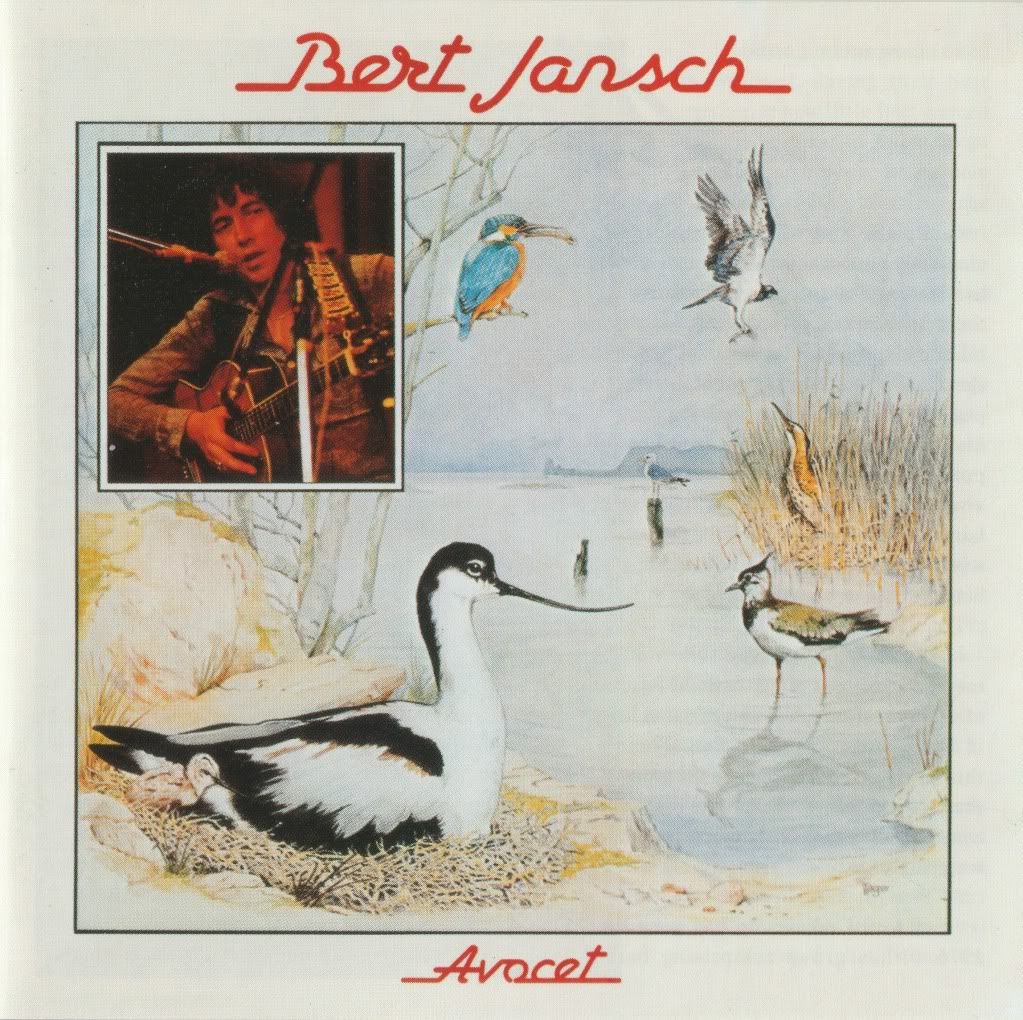
Bert Jansch - Avocet


In observance of Bert Jansch's passing yesterday, I think it's fitting to feature what's probably my favorite Bert Jansch album, 1979's Avocet.  Though Bert had already flirted with pure instrumentals on his solo albums, as far as I know Avocet is his only all-instrumental album.  While it may not get the attention Bert's earlier solo records generated, I think it's a fine showcase for Bert's abilities as a guitarist as well as a composer, and a sort of detour I always wish he would have pursued further on other albums.

The lengthy title track occupies the first side of the album and is thus its centerpiece.  It's easy to realize right away that this is what music critics love to call a "pastoral" album (I wouldn't be surprised to hear the words "very British" either).  The focus, of course, is on Jansch's fingerpicked acoustic guitar, supported by all-around double bass badass Danny Thompson and English folk journeyman Martin Jenkins on violin, flute, mandolin and mandocello (don't get to hear that one very often), who often carries the songs' melodic burden.  Jansch's playing is typically beautiful, seamlessly superimposing arpeggios, single-note lines and multi-string leads on top of his characteristic Travis picking.  I'm always struck by how understated yet impressive Jansch's playing is when viewed close-up; it doesn't sound like he's showing off, but the amount of string bending, pattern-changing and fluid stylistic variation is constant and awesome in its scope.  "Avocet" meanders gently through its many parts, providing plenty of melody to anchor the musicianship--though it's not the most focused extended instrumental, it manages to weave a recurring melody across major/minor subsections that span folk, jazz and more of a renaissance flavor before gently coming to rest with Jansch's uniquely mellow-yet-somehow-violent plucking.

Call me a rogue, but the album's second side sounds even better to my ears--the shorter song lengths seem to lend themselves to more distinctive structures.  "Lapwing" transcends Jansch's rudimentary piano technique to deliver a pensive minor melody, while "Bittern" introduces a hypnotic, swaying waltz melody and showcases Thompson's righteous bass skills (I can't decide if he's simply an awesome bassist, or it's just that he's miked hotter than most, or [more likely] both).  Things get jazzy on the darker "Kingfisher," which features some of the album's more surprising chord changes.  The 5/4 time of "Osprey" and the lush lyricism and guitar/mandolin doubling "Kittewake" close the album at its most melodic, proving that, though the title and mood of the disc connote nature documentary background music, there's more than enough substance here to justify close listening.  After reacquainting my ears with these songs, I think Avocet is a fitting representation of Bert Jansch the musician--unassuming and humble, yet full of complex and effortless beauty--you just have to take the time to pay attention.

Sunday, August 28, 2011

The Incredible String Band - The 5000 Spirits or the Layers of the Onion


The Incredible String Band managed to make a pretty impressive change between the tame contemporary folk of their 1966 debut and this, their second long-player, which finds the core duo formulating their idiosyncratic classic sound around an increasingly strong set of songs.  It's also the first album where Mike Heron and Robin Williamson begin to live up to the promise of their band's name, expanding their instrumental repertoire to include sitar, gimbri, oud, and tamboura, in addition to the more traditional guitar, fiddle and mandolin they'd already been using.

Of course, playing weird instruments alone a great album does not necessarily make.  Without Heron and Williamson's songwriting, chemistry as performers, and the bizarre fusion of world music, more traditional blues and folk, progressive song structures and budding interest in world religions, The Incredible String Band might just sound like every other British 60's folk revival group.  The more I revisit my favorite ISB albums, the more interesting I find the combination of Heron's and Williamson's songs.  As far as I know, they never really collaborated in co-writing, yet there's a wide-eyed optimism and mystical euphoria that pervades both writers' contributions.  With further listening, though, it becomes easier to identify Heron's (the deeper, rounder voice) songs for their whimsy and pop instincts, and Williamson's (the more nasally voice) for their focus on narration and more abstract, eerie imagery.  Most people I've talked to about the ISB have a preference for one or the other (I probably like Williamson's more, though Heron's voice is easier on the ears), but the magic of the duo is how well their albums flow between the two writers' songs and how well they both contribute to one another's songs.

By most music fans' standards, The Incredible String Band is quite eccentric and usually elicits divisive reactions.  Interestingly enough, the things that most haters complain about--the vocal style, the duo's amateur skills at some of their strange stringed instruments, their hippie ideals, and their proclivity for meandering, twee and overt mysticism--are the precise things that fans of the group love about them.  While I totally understand many of these criticisms (many of these songs aren't really the kind of "pretty" music you'd probably expect from a 60's folk duo), I'm obviously in the latter camp.  I'd even go so far as to say that there haven't been enough groups making music like this, and that it's heavily influenced my own choices as a musician.  That is, acoustic music that is experimental, eclectic, heedless of fashion and conventions, and also transcends the typical trappings of folk, singer/songwriter and pop (other notable practitioners of this underdeveloped approach include Comus, Roy Harper, Tudor Lodge, and maybe Kevin Coyne and Robbie Basho).  The Incredible String Band is gloriously unusual in a way that's both deliberate and completely natural, and I don't think they've been matched in their field.

While the band's next album, The Hangman's Beautiful Daughter, is probably their strongest and most imbued with vision and taste, this album has some of their finest (simply) songs.  From infectiously catchy and whimsical Heron contributions like the hand-percussion workout "Little Cloud," the sweet metaphor and harmonies of "Painting Box," and Caribbean inflection and great slide guitar of "The Hedgehog's Song" to Williamson's tender highlight "First Girl I Loved" and twisted folk revival deconstruction "No Sleep Blues," the duo turns in some of the most accessible songcraft of their career.  And then there's songs like the hazy "Chinese White" with its incantatory rhythm and fiddle, and Williamson's fantastically knobbly "The Mad Hatter's Song," which reveals its author as both a progressive visionary and an able poet.  Though a few songs lean a little too heavily on established folk music tropes and a few others fail to be made of the memorable stuff of the album's highlights, The 5000 Spirits or the Layers of the Onion is a worthy cornerstone in the ISB's discography and one of the furthest-out albums of 1967.  To say that this album and its successor profoundly influenced a lot of great British psychedelic and progressive music that was soon to come would be a flagrant understatement. 

Monday, August 8, 2011

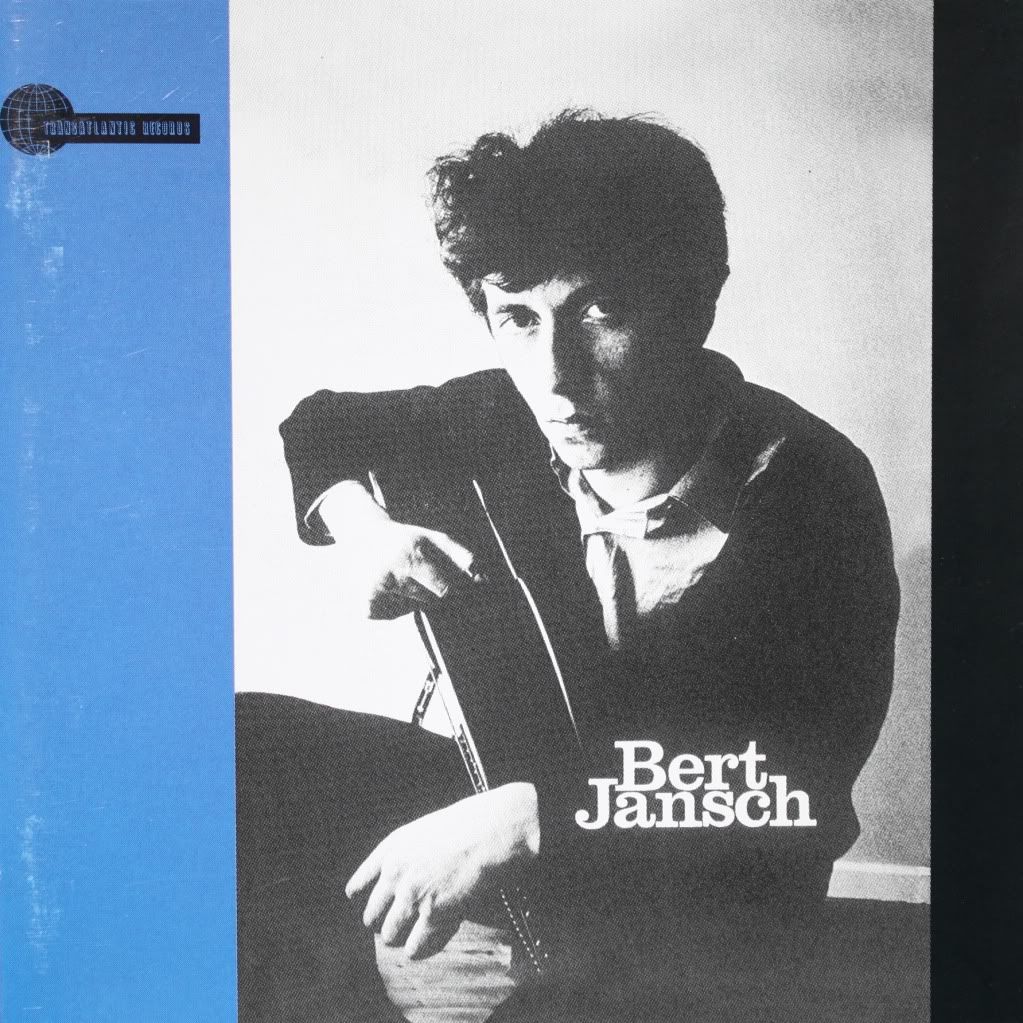
Bert Jansch - Bert Jansch


Bert Jansch is one of those figures whose legendary status in his field is easily justified but who never really succeeded in creating a categorically "great" album.  In Jansch's case, the field is contemporary folk and especially acoustic fingerpicking.  His prolific solo catalog and membership in The Pentangle (who arguably did record a few great albums), combined with his influence on many more notable guitar players add up to ample evidence for his reputation, but when it comes to selecting his best album, it's hard for me to find one that I feel is lacking in easily-identifiable flaws.  His 1965 debut, though, is probably the best album to check out because it demonstrates most purely his personality, guitar abilities, interests (or lack thereof) as a songwriter, and his unique role in the 60's British folk revival.

Since it seems to be the number one critical talking point regarding this album, you probably already know that part of this album's mystique stems from the fact that it was recorded in a friend's flat on a borrowed guitar.  Other than the fact that it actually sounds pretty good, considering, I think it speaks to Bert's abilities as a performer that the thing turned out so well--he makes nary a mistake in his playing, and it's easy to see how, in 1965 England, he was something of a rarity insofar as he was a folk(ish) singer who was actually quite capable at playing his instrument.  Though many fans might be unaware that Davy Graham had already set this precedent at least a couple of years earlier, Jansch easily sits as one of the other firsts alongside future collaborator John Renbourn.  Unlike Graham and many of the other young British people getting interested in folk music at the time, Jansch was one of the first to become recognized for his original songs; this pioneering shift from folk to singer/songwriter-contemporary folk is probably one of Jansch's most significant accomplishments.

As important as his debut was, listening in retrospect there are few really great songs on this album.  The opening track, "Strolling Down the Highway" is one of them--Jansch's rough vocals sound great in unison with his string bends as he describes his rambling lifestyle and ironically mentions the suspicion with which he's treated by the straight-laced general public.  "Needle of Death," notable for its unflinching directness (which overcomes one of the album's least interesting guitar arrangements and some awkward lyrical flow), is the best-known song on the album.  "Do You Hear Me Now?" is pretty good too, raising up some counterculture fire that's absent elsewhere on the album.  I know that some people don't cotton to Jansch's rough-hewn vocal style, but I actually don't mind it, considering the album's lo-fi vibe.  He's rarely off-key and musters a decent vibrato at places, and when the music's like this, I'd prefer some roughness to immaculate perfection.  In other places, Jansch seems content to tout the virtues and drawbacks of his rambling lifestyle through considerably less interesting songwriting, as on "Rambling's Going To Be the Death of Me," "Running From Home," and "Oh How Your Love Is Strong," where a rather unsympathetic narrator tries to explain to the mother of his child that he just has to keep his freedom.  Then there's the confused "I Have No Time," a dark, cautionary piece that can't decide if it's about social inequality, hippie ideals or war.  Despite the lack of vision in the songwriting department, though, Jansch's guitar is always a pleasure to hear.

Whenever I revisit this album, what strikes me most is how great the short instrumental tracks are.  While Jansch sticks to pretty standard picking patterns on the vocal songs, the instrumentals show quite a bit of range in mood and Jansch stretches out in his playing style quite a bit more.  "Smokey River" has a great sing-song melody for an opener and closer and the main body of the song rests on a chromatic figure punctuated by  lots of gently dissonant polyphony in the high strings.  It's easy to see that self-professed Jansch devotees like Roy Harper were listening closely; this piece is specifically reminiscent of Harper's own "Blackpool" from his debut, still a year to come.  The whimsical "Finches" features some excellent syncopation surrounding an ascending figure, while "Veronica" and "Alice's Wonderland" flirt with a minor jazz feel.  Finally, the instrumentals round off with two Davy Graham tributes--the single-note pounder "Casbah," which is quite obviously indebted to Graham's jaw-dropping arrangement of "Better Git In Your Soul," and Graham's own "Angie" [sic], of which Jansch produces a fine reading.  Though I've heard Martin Carthy complain that Jansch has never played the song correctly, I find his hammer-ons and bursts of percussive strumming make it a lively and fresh interpretation.

Though Jansch's debut is far from perfect, it's always a pleasure to listen to.  As a guitar player, it's also hard not to be inspired after hearing the man explore the possibilities of his instrument with such apparent ease.

Here's a great recent interview with Jansch that touches on his debut and Davy Graham's influence.

Monday, July 18, 2011

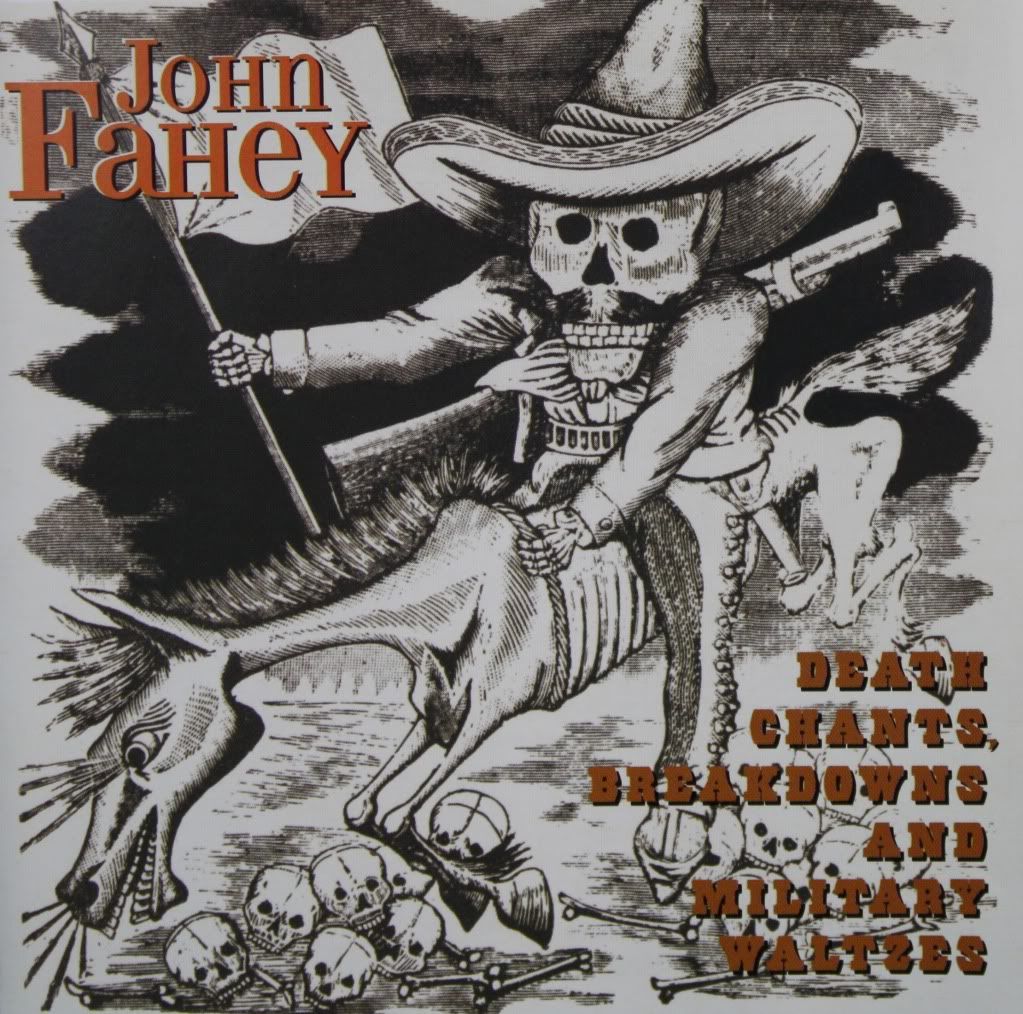
John Fahey - Death Chants, Breakdowns and Military Waltzes


In laying out markers for my musical landscape and contextualizing some of the other reviews I've written, I've been totally remiss in not yet mentioning John Fahey--sole creator of the solo steel string guitar genre, acoustic blues fanatic, composer and innovator--so I'll start with my first Fahey disc, and an enduring favorite from a man whose first 15 recorded years spanned an astonishing array of progression while still remaining anchored in the blues.

Death Chants, Breakdowns and Military Waltzes is John Fahey's second album, released on his own Takoma Records in 1963, four years after his unassuming but iconic debut.  The intervening years allowed Fahey to significantly refine his technique (mostly open tunings, allowing for lots of octave Travis picking, arpeggiatos and some majestic slow strums with blues-cum-classical melodies played on the high strings) as well as his compositional style, which sees the song lengths stretching out and the compositions featuring more surprising changes and contrasting movements.  Take "Stomping Tonight on the Pennsylvania/Alabama Border," which begins with a string-bending slow blues with a turnaround, mutates into a free, ascending arpeggio on the high strings, then again to a crushing minor blues dirge before revisiting each of its sections and closing on an arpeggio that crosses through dissonance to a dreamy major 7th concluding passage. 

Like a lot of albums that have become long-term favorites of mine, part of what I love about this album is how it sounds--the recording quality isn't great, but since it's (mostly) just one instrument, everything's still audible and the music is laced with an antique atmosphere--and the room reverb is awesome.  There are a few moments where the volume of Fahey's guitar threatens to distort the recording equipment (to its great) as on the slide glissando of "On the Beach of Waikiki," or where the distance of the guitar to the microphone lends a raucous feel, as on the energetic "Spanish Dance," and then on "John Henry Variations" when the instrument's slightly out-of-tune harmonic overtones warble with an unsettling but hypnotic pulse.  If I call some of this album "psychedelic," it's these sort of extra-melodic elements that I'm talking about, like 3:15 into "America" where (through the use of tape editing, I assume) the guitar timbre suddenly changes from bassy fingerstyle to tinny high-neck strumming, or 1:06 into "When the Springtime Comes Again," when the key abruptly shifts from minor to major but the theme remains almost the same--there's something within those quavering intervals that lingers on the precipice of some forgotten memory that never ceases to make my hairs stand on end.  The piece would continue to fascinate Fahey the composer as it evolved into numerous versions on the 1967 re-recording of this album, in numerous live recordings, and on 1971's America as "Mark 1:15"--each time expanding on the last but somehow leaving a trail of discrete incarnations, each with its own particular magic.

The dark corners of this album aren't without some extreme eccentricities, either, like the dissonant strumming on the flute duet, "The Downfall of the Adelphi Rolling Grist Mill" (Fahey's titles were often almost as great as the songs they labeled).  Ultimately, though, Fahey's genius substantially rests on his ability to bizarrely marry the familiar harmony and structure of the blues with the dissonance and imagination of 20th century classical composers.  For someone like myself who gets bored with the repetition inherent in a lot of blues music, hearing Fahey deconstruct his beloved genre and reassemble its innards into dazzling piecemeal sculptures breathes new life into what's usually a compositionally inert idiom.  His preternatural melodic abilities provide melodic lines that sink into the brain slowly but insidiously--not sounding like much at first, but ultimately sounding as beautiful as any music possibly could--I really love the way his sweeping melodies traverse multiple string plucks, simultaneously savoring a note and impatiently re-sounding it before the sound has a chance to decay.

I've got a feeling that whichever Fahey album most people name as their favorite is one of the first (if not the first) that they hear.  Though his early career covered expansive ideological and theoretical territory, it did so at a modest pace and Fahey would often repeat the same ideas either explicitly or intuitively.  At the time he was only pressing hundreds of copies of each album, so how was he to know how things would sound when his discography was considered retrospectively?  For example, he re-recorded and re-released most of the songs from this album (to be reviewed at a later date) in 1967, and the advancements he made in technique and composition are noticeable.  What I'm trying to convey is that, beautiful as they are, some of his ideas lose that "first time" magic when they crop up elsewhere, and where you hear them first tends to remain the most memorable.  For me, it was here with Death Chants, Breakdowns and Military Waltzes--I still think it's a great place to start with Fahey as it states many of the ideas he would continue to pursue--compositionally, technically, sonically (he'd continue to experiment with tape editing as the 60's wore on), and arrangement-wise (many more of his albums feature his own adaptations of Episcopal hymns as closers)--but it all comes in a relatively digestible form, mostly adhering to compartmentalized song structures and resonating with some sort of pop instinct in terms of flow and melody.  I've got several John Fahey favorites, but this is probably the one I'd give up last--you can pry this album from my corpse's withered fingers.

Friday, June 24, 2011

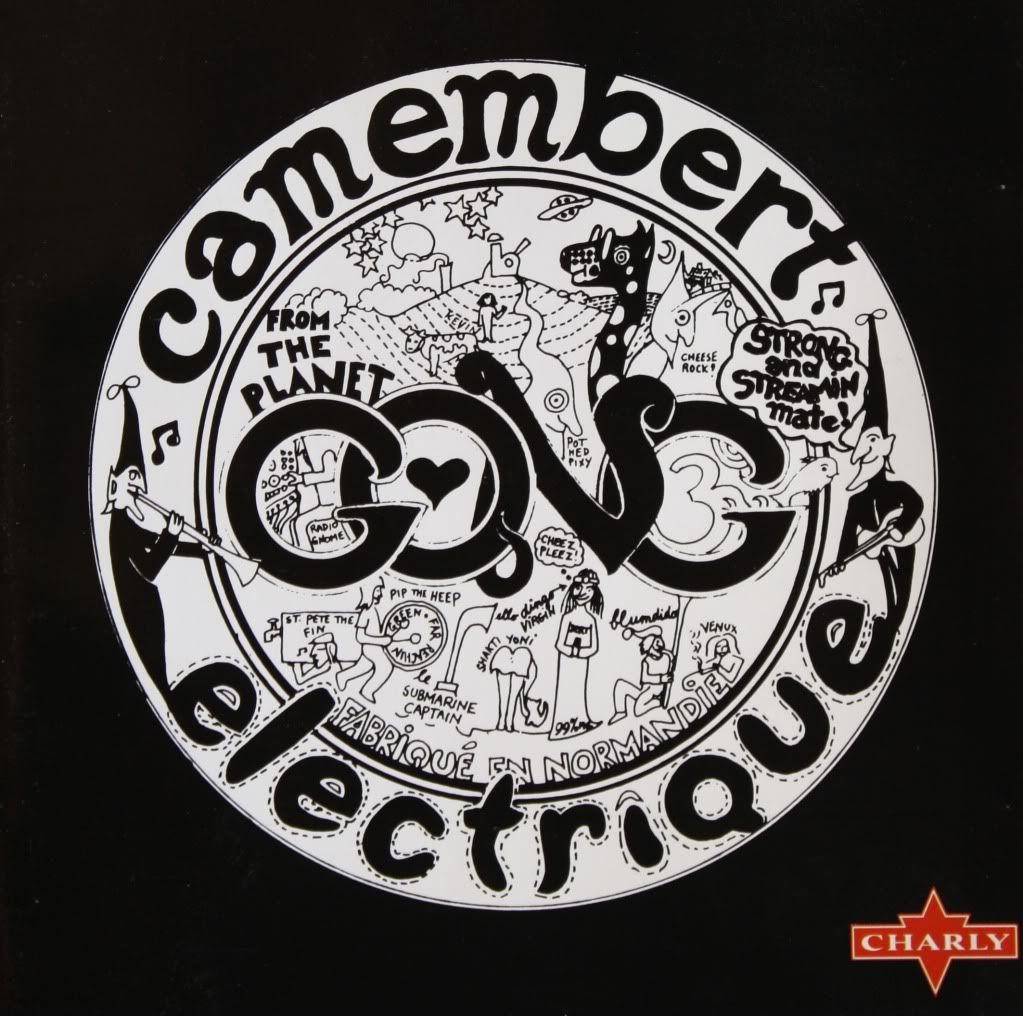
Gong - Camembert Electrique


Back to the Canterbury scene, but certainly not too far of a step away from free jazz or even RIO, here we've got one of the all-time great Canterbury albums and one of the most frenetic psychedelic rock albums of the early 70's.  Even though he's not British, Aussie Gong bandleader Daevid Allen was a member of that most embryonic of Canterbury groups--The Soft Machine--which, along with other proto-Canterbury group The Wilde Flowers, was at one time home to members of most of the scene's later core bands.  If ever there was a hippie, it would be Daevid Allen--he was famously refused reentry into the UK when attempting to return from Europe because of overstaying his visa on a previous trip, so he remained in Europe (mostly France) and formed Gong.  It's for this reason that Gong is one of the most (if not the most) international of the original Canterbury bands. 

Although Cambembert Electrique isn't the Gong debut (that honor goes to 1970's Magick Brother), it's undeniably the beginning of what most people consider the classic form of Gong--the one that concerns itself with Allen's hippie mystical and anti-establishment vision shrouded in mythology of teapots, Pothead Pixies and mythical planets, all displayed over some of the craziest jazz-influenced psychedelic music to be heard in the entire era.  The story of the planet Gong is first broached in the sound-effect heavy opening introductory snipped voiced by the "Radio Gnome"--from there on out, though, the album is a nearly nonstop barrage of weirdness, humor, noise, rock and jazz that knows no equal--in the Gong discography and elsewhere.

"You Can't Kill Me" offers a pretty solid template for the album--Allen's winding but catchy compositions feature a lot of repeating figures and ostinati, looping rhythms and noise, while the lyrics hilariously toy with ideas of reincarnation and karma, while his partner Gilli Smyth contributes heavily-reverbed high-pitched moans, groans and what became known as "space whispers."  Though on first listen this music might sound like utter chaos (well, it is chaotic, but not necessarily utterly), closer attention reveals an almost punk rock-like attitude supplemented by Didier Malherbe (distinctly "French" saxophone style) and Pip Pyle (unparalleled prowess on the drum kit, later to become one of the most experienced Canterbury journeymen) both of whom seem to have no difficulty negotiating Allen's compositions and their innumerable and quickly-transitioning ideas.  Though the tumultuous Gong lineup later featured the more-lauded guitar hero Steve Hillage on lead guitar, I find Allen's guitar style particularly impressive for its audacity (just listen to the noise he conjures up on "You Can't Kill Me").

The album continues to plow an increasingly eclectic furrow with the organ-driven music hall "I've Been Stoned Before," where Allen goes from comical farce to sounding like he's going to shred his vocal chords in torment in just about 2 1/2 minutes.  "Mr. Long Shanks" (see above video) transistions from gleeful carnival jazz rock ("The man in the parlor/you know what he's after") to a Gilli Smyth space whisper tour-de-force at its halfway point, while "I Am Your Animal" finds the female vocalist projecting a more aggressive (even x-rated) performance over Allen's spiky repeated riff, which morphs into a rapid-fire vocal barrage that ends with Allen madly yelling about licking the moon.

After a couple of sound collage interludes ("Tu veux un Camembert?") the band returns with the forward-looking (to later Gong albums) "Fohat Digs Holes in Space," which spins an atmosphere out of Allen's "glissando" slide guitar--the part when he seamlessly drops from the eerie high register into the midrange before 40 seconds is breathtaking.  I'm not sure if glissando is really the correct word for the playing style, but that's what Gong fans have decided to call it--anyway, it's that echoey spacey sound that starts about 30 seconds in.  The song's eventual rock riff is one of the album's catchiest, with Allen extolling some beat-cum-hippie poetry ("mirror mirror, on the wall, who's the biggest fool of all?") before another overdriven sax and lead guitar breakdown.  The beginning of "And You Tried So Hard" is the closest thing to folk rock to be found on the album, though it quickly weirds itself out with more Gong flavor.  The album closes just as powerfully as it opened with "Tropical Fish"--one of the band's most effective mechanisms is doubling the melodies on guitar and sax for a stabbing effect--with a heaping handful of bizarre riffs and lyrics ("seem like a typical witch to me/seem like a tropical fish to me"), a spaced-out interstellar desert in the middle ("I couldn't believe my eyes....") and closing with the almost martial invocation of the moon goddess, "Selene," and a recapitulation of the album's earlier machine-gun lyrical themes.  The Radio Gnome returns to remind you that the ride's only just beginning, and you'd better believe him.

Although the full on Gong mythology isn't in narrative form here, the lyrical themes set the scene for the epic Radio Gnome Trilogy to come.  Though Gong may have equaled the fun, trippiness and quality and ideological resourcefulness found here on later albums, they did it from a spacier angle, and sadly this album is in many ways one-of-a-kind with its energy, barrage of ideas, and noisy edginess.  It manages to incorporate a lot of jazz influence without committing to long-form jazzy passages (like so many later groups, including Gong would do) by radically changing from idea to idea in short periods of time.  Their arrangement style here is one that was certainly emulated by later Canterbury bands, and it's easy to tell that Allen's association with Robert Wyatt and Kevin Ayers was a mutually-enriching one; his idiosyncratic sense of humor obviously influenced to a large extent the sense of whimsy and insubordination prevalent in a lot of the Canterbury scene's later music.  My only complaint with the Charly CD reissue of this album is sound, which is quiet, treble-heavy and not as full as I imagine it should be.  Let's hope for a good remaster.

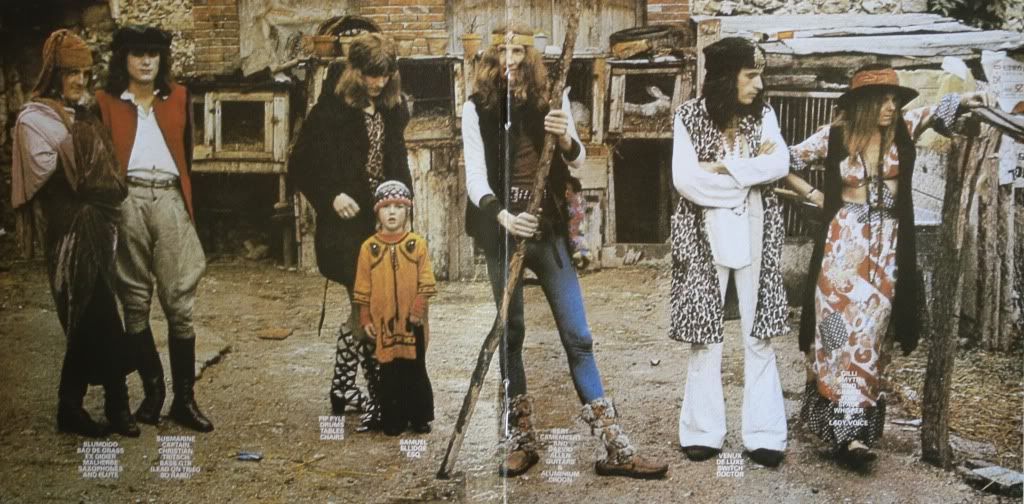
Until then, you can get it here on CD or MP3.  Oh, and if you listen to any of this and think Gong don't sound like typical hippies, take a gander at their ridiculous get-ups.  Allen appears not to mind being stapled in the face...and that's quite a wizard staff.
Saturday, April 9, 2011

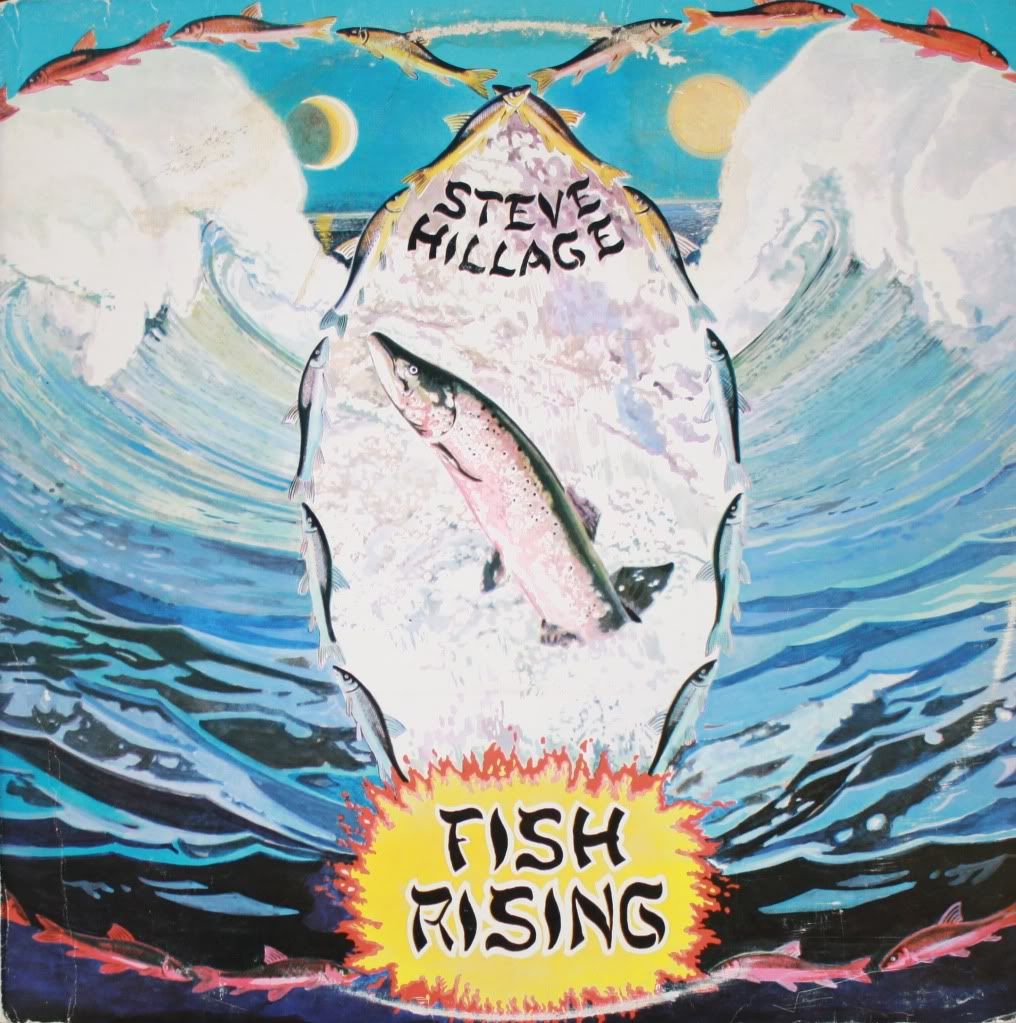
Steve Hillage - Fish Rising


Here's another later Canterbury favorite.  Due to its associations with jazz, the Canterbury scene was never as guitar-centric as mainstream rock.  Nevertheless, Steve Hillage is certainly one of the biggest Canterbury guitar heroes and probably the most accessible one in terms of his style and technique.  He was a member of both Arzachel and Khan, then joined Gong in the early 70's.  This, his first solo album, features numerous Gong members as well as Henry Cow's Lindsay Cooper on bassoon and Egg/Hatfield and the North/National Health keyboardist Dave Stewart.

Like a lot of the classic Canterbury albums, I treasure this one for its variety, intelligence and light-heartedness.  1970's progressive rock music is often associated with bloated epics, overseriousness and romantic-period leanings, but I believe that the music on albums like this is actually more progressive in the literal meaning of the word--yes, there are epics (steer clear if you don't like long songs!) but the primary goal is advancing music past the established forms and status quo.  Hillage manages to challenge us with his compositions but simultaneously provides some of the tastiest guitar ever laid to tape.

The opening suite is the longest on the album, building from gentle psychedelia with jazzy soloing to a harder sound, more reminiscent of Gong.  This is much more centered on Hillage, though, and the compositions are organized around nice, identifiable guitar riffs and themes, though there's a great ostinato section with some furious soloing by Stewart.  "Fish" and "Meditation of the Snake" are shorter experiments, the first being a fast-paced Gong-like discussion of different fish and the second being a delay-guitar soundscape.

Side two is more hypnotic and repetitive than the first--"Salmon Song" may be my favorite track, with a spacey riff and a barnstorming set of dual solos.  Similarly, "Aftaglid" features several repeating patterns that act as platforms for Hillage's guitar soloing.  The key to these long songs is organization, as the mood segues seamlessly between gentler, quieter parts and heavier soloing, never wearing out each riff and always following with a change of texture.

The only bad thing about this album is that I bought three more Steve Hillage albums hoping they'd come close and none of them quite match the glory of Fish Rising--I don't mind Hillage's voice, but the New Age lyrics get heavier and heavier-handed on later efforts, and though the more song-oriented sound is in some places successful, many of the guitar ideas are just restatements of things heard here and on earlier Hillage collaborations.  It's a bit disappointing, but this album is so good and so full of ideas that Hillage can't be blamed for being unable to match their breadth and quality on every other album.  At least we've got Fish Rising

Observant readers may notice that this one is another deep pull from my tiny but cherished vinyl collection.  Out of the few records I own, I have to say that this one sounds better in its remastered CD version; the vinyl is actually a bit muddy (not well-balanced between clarity and heaviness the way my Captain Beyond LP is), making it hard to catch the small details that this album is packed with--I think I know what's going on because I recognize the riffs but closer listening reveals numerous quieter passages and depth uncommon in guitar-oriented rock. 

Get the CD or MP3s here.

Friday, February 18, 2011

Roy Harper - Flat, Baroque and Berserk


Roy Harper's one of my all-time favorites, but that doesn't mean I think he's got a Midas touch.  Part of the reason why I love his music so much is because he wears his flaws on his sleeve--in many ways, he's made a career out of artistic as well as professional self-sabotage, always ready to nosedive with erratic behavior when a big break was on the way, and always quick to follow up an incisive gem of a song with a lewd throwaway.  Really, he's just like any of the rest of us, he just exemplifies what it means to be human to the utmost degree--the peaks of his greatness are shadowed equally by the troughs and valleys necessary to achieve that success, and the evidence is there in his songs and public personality for us all to see.  Part of great singer/songwriter music is coming to understand the person's deep personality, and Harper's got it in spades.  Like Robbie Basho, though, it's not always easy to hear and a lot of listeners have been turned off by his unflinching honesty.  As a songwriter, I think there's a lot to learn (obviously) from Harper's style as well as from his creative path--how his strengths have played out over a career and whether each of his experiments and artistic overreaches were worth the risk on principle alone, or when it's time to exercise restraint.  Then again, you can't win if you don't play.

Flat, Baroque and Berserk is Roy Harper's fourth album, and to me it's his first unqualified artistic success.  There are serious kinks in the first couple records with respect to production, focus and just how effectively his message is communicated, and the same can be argued of Folkjokeopus, but the blinding success of "McGoohan's Blues" still stands as a Harper classic and his first long-form triumph.  Here those issues seem to melt into the ether--gone is the dainty lo-fi folk rock of Come Out Fighting Genghis Smith (it's almost all acoustic guitar here, with the occasional acoustic wind instrument and one hard-rocker to break up the monotony), and the poetic confusion from Folkjokeopus' is trimmed away, leaving multifaceted yet economical poetry sung with Harper's very last breath--or so it would seem.

The instrumental arrangements are much simpler, showing off Roy's best guitar playing since his debut.  Snapshots like "Feeling All the Saturday," "Davey" and "Francesca" show a quietly intense mind working through mortality, aging and the (sometimes welcome) consequences of free love, and they're buoyed by Harper's distinctive fingerstyle.  Of course, his flatpicking style is equally as idiosyncratic, as we hear on the Jesus/Judas dialogue "Don't You Grieve" and the valedictory kiss-off, "Goodbye."  Even after all these years, the poetry on this disc still tantalizes--the inter-verse rhyming on "How Does it Feel" is fantastic, and there are numerous moments where he effortlessly pierces the shroud--a favorite of mine happens in "Tom Tiddler's Ground": "And you heard me say yes, but you know it's a guess/ Somebody else shouted 'No!'"

Yes, I'm aware I haven't even mentioned the obligatory mentionables--the gloriously ballsy "I Hate the White Man" was sort of an albatross around Harper's neck for years (listen to pretty much any live album to hear cries of "White Man!" from the audience).  Then there's the painful, smoldering resignation of "Another Day," graced by a really grand David Bedford string arrangement that prefigures his crucial contributions to Stormcock and Valentine.  Then, of course, the album closes with a hard rocking bang in  "Hell's Angels," where Roy's backed by (of all bands) The Nice (ugh...Keith Emerson...shudder).  While it's not quite as controversial as he may have intended, it's still a totally jarring close to a meditative album (see paragraph one) and his uncontrollable stoned laughter lets us know that the ride's only just beginning. 

Flat, Baroque and Berserk has a few less memorable moments ("Song of the Ages" in particular), but overall it's a pillar of the Harper discography and a refreshing album to return to when you want the good stuff but not the pomp of his mid-70's output.

Get it here, direct from the artist, or here.