Showing posts with label 1976. Show all posts

Wednesday, May 16, 2012

Captain Beefheart - Bat Chain Puller


It's been well over a year since I kicked off the reviews division of this site with a review of Captain Beefheart and the Magic Band's Shiny Beast (Bat Chain Puller), and considering how much the Captain's work has continued to influence my approach to music and writing I'm surprised I haven't waxed poetic about any of his other classic albums.  Technically, today still isn't that day--I'm here to gush about the "brand new" 2012 Captain Beefheart release, the lost 1976 first studio version of Bat Chain Puller, just released this spring (to disappointingly limited fanfare) on the Frank Zappa record label and nearly exclusively available for purchase here (which just might be why the album's gotten so little press).

To describe the genesis of this release briefly, Don Van Vliet decided in 1976 to return to the avant-garde and stage a creative comeback.  Herb Cohen (Frank Zappa's manager) secretly used Zappa's money to fund the project and the two had a falling out upon Zappa's return from tour, resulting in Cohen's seizure of many of Zappa's assets, unreleased Bat Chain Puller masters included. Zappa eventually reclaimed his property through legal means, but by that time Van Vliet had re-recorded most of the material on his final albums.  Since then Zappa, and now his widow Gail, have been busy enough managing Zappa's gargantuan legacy that the tapes have remained neglected in the vaults...until now!
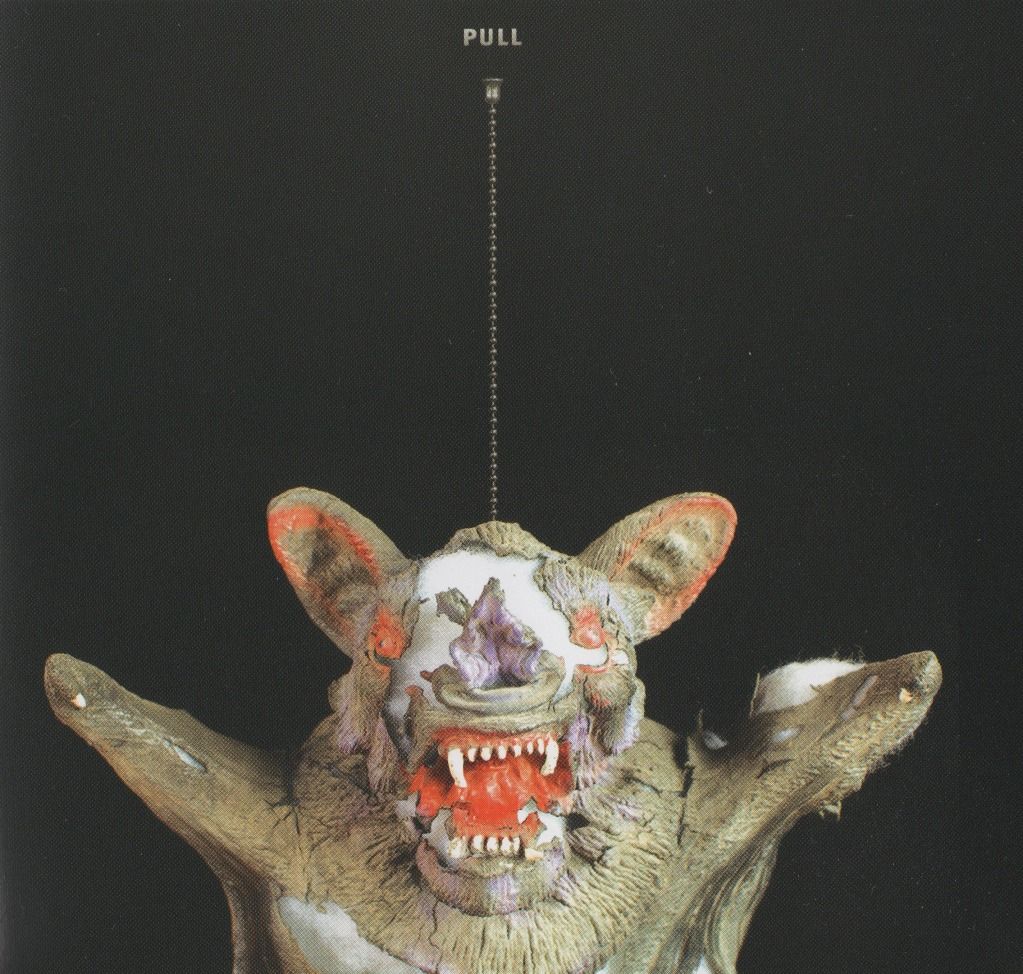
With 10 of 12 tracks already appearing on Captain Beefheart albums that have been available for 30 years, the biggest worry with Bat Chain Puller is that it'll come across as merely supplementary to those "definitive" versions, or worse that it'll sound only partially complete in comparison to the later recordings.  Thankfully, the disc falls prey to neither possibility, playing like the hazy, dream-like album-that-never-was that it's always been!

After listening to these different versions of familiar songs and becoming familiarized with the new track sequencing, I'm left with the strong impression that this album has an undeniably distinct feel, especially in relation to Shiny Beast (Bat Chain Puller) in terms of its accessibility.  Compared to Shiny Beast's almost exclusively song-based program, this Bat Chain Puller is very much a venture split between songs, spoken word-over-music and pure poetry.  Sure, it's still considerably more mainstream than the hallowed stuff of Doc at the Radar Station, but even compared with Doc's orchestrated prickles, the poetry/music tracks here feel much more spontaneously arranged and the sonic palette more often unexpectedly drops down to just one instrument or Van Vliet's voice in some very effective instances. 

Perhaps as expected, some of the material here isn't significantly different from later versions--the arrangement of "Harry Irene" (never one of my favorite later Beefheart tracks, but an important contributor to this album's accessibility) includes guitar, but otherwise isn't much different.  The title track has its own subtle identity (further shaded by a third version here in bonus track form), bristling with kinetic motion (it's easy as ever to hear how Van Vliet originally pulled the rhythm from windshield wipers), more of an organic feel with cranked harmonica and just-barely-conflicting guitar layers (though the ever-important synths are still there) and outstanding vocal delivery (dig the the naked place he takes "their very remains and belongings").  Right off the bat, my highest hopes are kindled--one of my disappointments with later Beefheart albums is the marked reduction in the elasticity of Van Vliet's voice and additionally, in the case of Ice Cream for Crow, an overall dip in energy and compositional effort--here the Captain's voice still possesses a razor's edge and he takes enough risks that we can almost forgive him wasting the early/mid-70's trying to become a mainstream star.  "Owed T'Alex" burns with a reinvigorated closeness that's magnified further on "Floppy Boot Stomp," where the band's joyous delirium pushes the vocals so close that it sounds like the Captain's ranting all the way inside your brain. 

The most exciting aspect of Bat Chain Puller, of course, is the brand new material, namely the poetry/music hybrids "Seam Crooked Sam" and "Odd Jobs."  The former is a moody guitar/electric piano duet with Van Vliet's downbeat-yet-intense images spinning seemingly unrelated on top, while the latter is more of a full band piece with tunefully-spun vagrant imagery while the band shifts ever so slightly into what must be the first kernel of Shiny Beast's "Tropical Hot Dog Night."

Evaluating these pieces has helped me identify a couple of the specific traits that make Captain Beefheart one of my top favorite artists--first, it's the way his poetry mirrors the music, flowing smoothly then stopping, jerking, suddenly rhyming or playfully riffing off of a phrase's connotations or expected syntactical outcome.  Unsurprisingly, Van Vliet chooses words like paint colors on a palette, not necessarily concerned with their logical or expository value but rather their energy, emotional color, and the way they sound.  When I hear these songs, there are countless unexpected images and feelings popping into my head, and I can't think of too many other poets in the popular music sphere who can achieve that.  And yet, there's a strange logic or narrative to many of these pieces--what at first seems like incoherent rambling in "81 Poop Hatch," for example, gradually reveals itself to be an impressionistic panoramic scene including Van Vliet's beloved natural imagery as well as a view of his internal landscape--at least, that is, until he leaps mid-sentence to somewhere completely different; every piece seems to be at its root a rational enigma with unlimited emotional potential.
Secondly, the compositions here are a dazzling presentation of Van Vliet's painterly approach implemented in yet another aspect of the music.  More than on any of his other albums we hear open, warm-sounding jazz harmony on songs like "Seam Crooked Sam" and "Ah Carrot Is As Close As Ah Rabbit Gets To Ah Diamond."  Again, though, Van Vliet applies these combinations of notes intuitively and without regard to how theoretical rules say they're "supposed" to be used.  Fragile, sweet harmony can dissolve into dissonant, minor darkness just as quickly as it can pursue a completely fresh melodic path, as evidenced on "The Human Totem Pole (The 1,000th And 10th Day Of The Human Totem Pole)," one of two album-closing commentaries on the human race's cumulative achievements (or lack thereof) and precarious current position on earth.  Here he fuses this weird compositional approach with one of his more straightforward (yet most compelling) poems, sketching a partially-obscured picture of the skin-crawling, comical-yet-repulsive "pole," and delivering it all with a seething creepy mystery that trumps the Ice Cream for Crow version within just a few seconds..."the man on the top was starrrrrrrrvinnnnng" indeed!  Now is probably an important time to laud the contributions of the rest of the band--this music certainly couldn't have been made without the conscientious talent and attention of the rest of the band, especially drummer/guitarist John French, who also performed a crucial "music director" role in transcribing Van Vliet's hastily-blurted musical ideas into a form that the other band members could understand and memorize--just listen to the through-composed spacious atmosphere as the song sputters out in a denouement that takes up over half the song's length.  The idea that it's possible and even ideal to consent to the urge to compose and arrange notes and sounds in whatever way sounds intuitively best (regardless of the rules) is one of the important lessons I've learned from Van Vliet's music and attempted to apply to my own process.  Though the difficulty of successfully communicating such an idiosyncratic method to collaborating musicians is challenging to overcome, the singular character of the end result can really be worth the sweat.  It's also one of the few lessons any artist can potentially adapt from Van Vliet's work without necessarily ripping off his total sound wholesale--it's possible, no matter what Tom Waits tells you!

In the end, this album is like a gift sent from beyond Van Vliet's grave (though very real thanks are due to all of the living collaborators who finally brought this album to release).  Amazingly, it never sounds unnecessary in comparison with the later albums--"Brick Bats" is the only song that sounds more unfocused than its later version, with a much looser guitar arrangement, less effective vocal delivery and a fun but meandering free jazzy end section made more effective in the shorter Doc at the Radar Station version.  Nor does this earlier album obviate the ones that follow (except Ice Cream for Crow, which was always teetering on the brink of being a "completists only" release, especially now that two of its best tracks are revealed to belong to a more vital earlier work), with Shiny Beast (Bat Chain Puller) still best straddling avant-garde and pop and Doc at the Radar Station best warping Trout Mask Replica poetic/musical craziness into a newer, mature and carefully-integrated form.  Thankfully, we now have all three to consider as required listening--though the price of this CD is still uncommonly high (it cost me $27 including shipping and tax), it's worth the added expense and work it takes to track it down--let's hope there's some wider distribution on the way to make it a little easier to get the word out about this remarkable album's first issue.

Friday, January 20, 2012

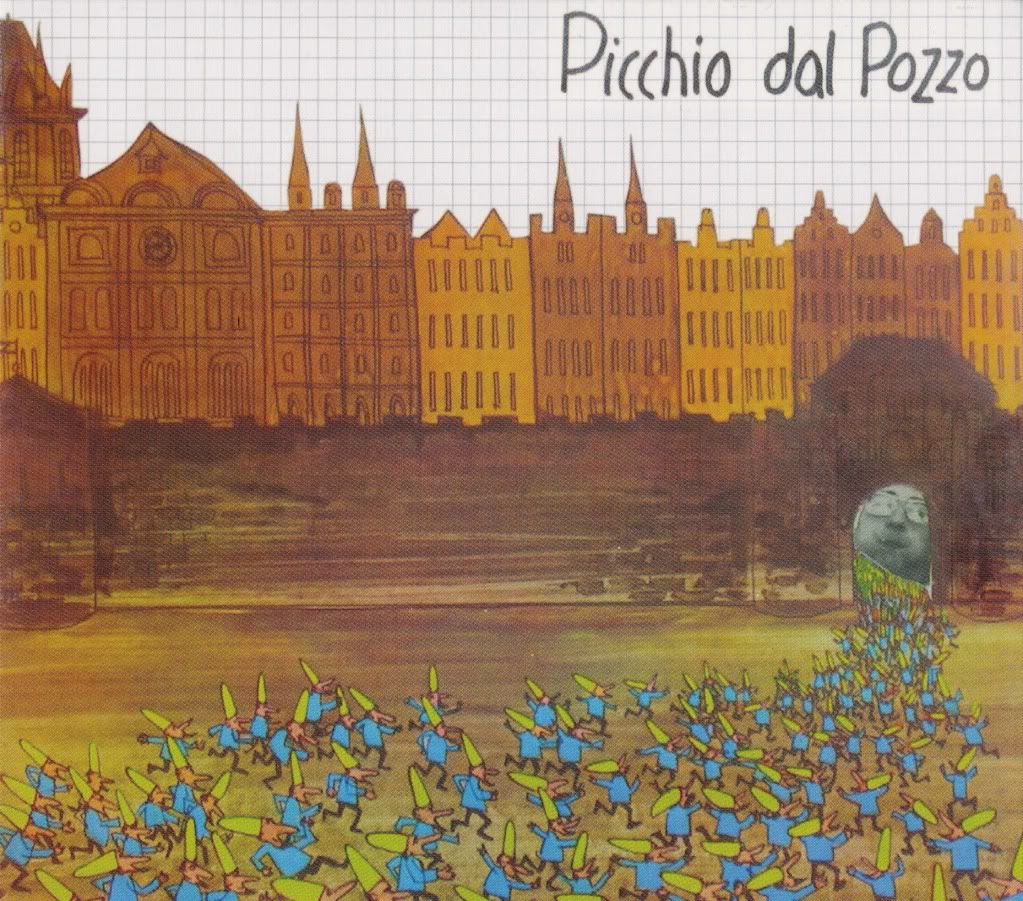
Picchio dal Pozzo - Picchio dal Pozzo


To round out this week's Canterbury Scene focus, here's one of the best examples of how the scene's sounds eventually transcended their geographical and physical origins, and a few even more obscure groups in Europe carried the Canterbury influence in an expanded and often quite interesting and artistically successful direction.  On their 1976 eponymous debut, Italian group Picchio dal Pozzo manage to fuse the gentle synth atmospheres and vocalizing of solo Robert Wyatt with space rock jams not unlike those of mid-70s Gong, all the while sticking to a very Canterburian classical-jazz instrumentation that's heavy on flute, xylophone, oboe, keyboard and fuzzed-out bass and guitar.   

Like so many of my very favorite albums, part of what I love about this album is simply how the music sounds--from the first fade-in acoustic guitar notes of "Merta" the tone of this album is like a warm bath--enveloping, soothing and somehow comforting in spite of its more challenging moments.  Though it's easy to trace this group's influences to Canterbury, there's something about their hazy, dreamy sound and penchant for mischievous wordless vocals that is totally their own.  "Cocomelastico" follows with a direct segue into an awesome-sounding guitar/saxophone counterpoint melody underpinned by layers of spacey synths and some sort of twisted lounge music with suitably gently goofy singing.  As you can see from the lyrics provided on the band's official website, the few words to these songs are mostly nonsense and whimsical wordplay; perhaps one of the Canterbury scene's greatest strengths in terms of longevity is that, unlike most progressive bands, its groups never seemed to take themselves too seriously!

The album's darkest track and arguably its centerpiece is the magnificent "Seppia," beginning with a minor ostinato and some well-chosen dissonant note pairs in the bass before stating a dramatic oboe-led melody and dropping into on of the most deliriously hypnotic fuzz bass riffs in Canterbury history for a synth/xylophone/vocal jam that lasts a good six minutes before dropping suddenly into a quietly avant-garde flute/xylophone/bass trio and closing the tune with some spoken word and a stately, mysterious reed-led section.  The number of sudden surprises, dynamics, details and layers of beauty in a track like this are my total ideal--it's at once accessible and traditionally melodic, while at the same time playing with dissonance and bizarre choices.  The genius of Picchio dal Pozzo's approach seems to be their use of gentle instruments and textures to explore these potentially grating musical moves; they're not going to offend anybody too blatantly, but if you pay attention you realize that there's a lot more going on here than it might initially appear.

"Napier" and the rest of the tracks present more densely-packed, swiftly-moving ideas, quirky but accessible melodies and almost narcotic timbres.  While the last couple of tracks are perhaps less obviously memorable in terms of melody and structure, their humble beauty does improve with further listening and the texture and atmosphere suits the rest of the album's mood so well that the disc trails off in a dreamy whisper that makes me want to start over immediately.  Though it can be argued that the heavy Canterbury influences make Picchio dal Pozzo's debut a bit derivative, as far as I'm concerned we could do with a few more great Canterbury albums and the quality of this music is so consistent and the atmosphere is so uniquely dreamy that it really doesn't bother me; sometimes doing something really well trumps doing something first, and you'll often find there are subtle wrinkles of originality hidden within.

Picchio dal Pozzo is one of my favorite Canterbury albums and is probably favorite Italian progressive album (though there are only a few Italian progressive groups who have actually clicked with me; Stormy Six, Area and Museo Rosenbach and maybe one or two others who manage to do more than rehash the less interesting aspects of symphonic prog).  I'm also really excited to say that this album is back in print on CD--just reissued by Italy's Goodfellas label at the end of 2011.  Now I can review it guilt-free and point you to one of my favorite online storefronts, Recommended Records, as a great place to purchase this CD and support these artists. Obviously, this album is highly recommended, as is the group's second and final studio release, the more challenging and RIO-flavored (but equally rewarding) Abbiamo tutti i suoi problemi, which has been consistently commercially available--more on that album later!