Showing posts with label Virtuoso. Show all posts

Monday, November 21, 2011

Derek Bailey - Improvisation


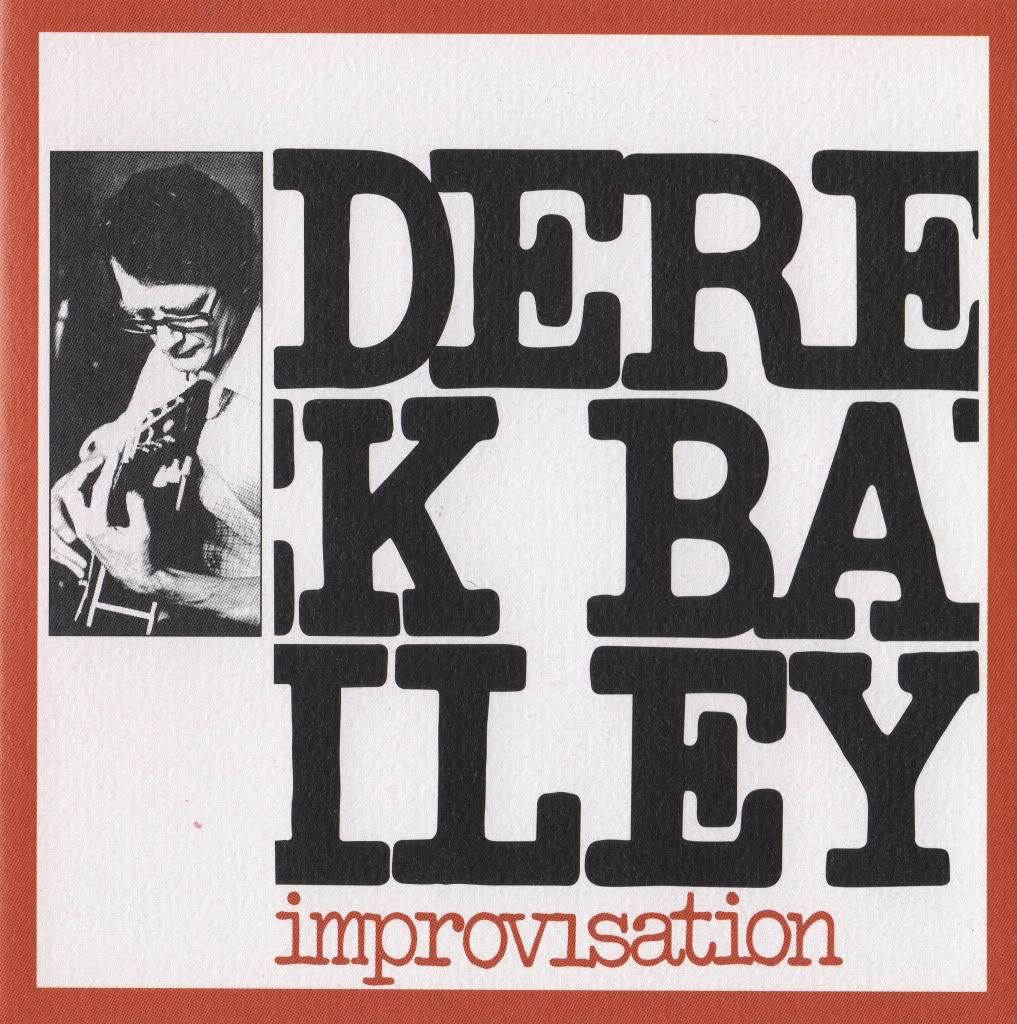
Derek Bailey is known for two things: being a grouchy old man when he wasn't even old, and for single-handedly creating his own free improvisation idiom on the six-string guitar.  Right up my alley on both counts!  By the time Bailey recorded Solo Guitar Volume One in 1971, he'd already been a prominent figure in the British and European free jazz circuits, performing with people like saxophonists Evan Parker and Peter Brötzmann and bassist Dave Holland, and by the time this 1975 album was released he had refined his solo improvisational technique (which came across as a bit tentative in his debut) to the rarefied level it remained for most of the rest of his career.

Listening to Derek Bailey for the first time can be a disorienting--his style is thoroughly and often brutally atonal, arrhythmic and usually very nonrepetitive.  It's also most assuredly the type of music that sounds like an irritating mess if the volume is low and you're only half paying attention.  Crank it up so your surrounded by Bailey's sound world and focus on what he's doing and an exciting (if somewhat cold) sense of adventure-in-logic dominates every move the guitarist makes.

While Keith Rowe is responsible for making equally influential advances in the guitar free improvisation realm, Bailey's music sounds much more like a conventional guitar played to an exponentially "out" degree; in fact, his amplification is so clean it's almost difficult to discern that he's playing an electric guitar on this album.  Though he almost exclusively flatpicks, Bailey's style relies heavily on harmonics, muting and exploiting the instrument's natural sustain and decay.  This can be easily heard on "M4" and to even greater depth on "M8," where Bailey's harmonics and string bends pit two strings against one another on nearly the same note, deftly controlling the oscillation between the two notes as they eerily decay into space.  At other points Bailey embarks on furious runs across bizarre intervals, sporadically halting to interject with brief spurts of silence or allowing a note to ring before again changing direction completely with some explosively percussive cluster chords ("M10").

One of the things I love most about Bailey's style is how fluidly he moves from one idea to the next; though there really isn't any melody to his playing, it's usually easy to discern what is fascinating him at any given moment, and the thrill of his free improvisation is in the headlong rush into whatever the next idea might be.  Sometimes the difference lies in the textural discrepancy between harmonics, standard string plucking and jabbing chords ("M13"), and at other points it might be a digression into exploring the percussive potential of the instrument with skittering string scrapes ("M14") or interjecting taps on the guitar top between the string's tonal sounds.  Finally, and perhaps most subtly, Bailey uses a two-amplifier setup and volume/swell pedals to dynamically pan the output of his guitar, which adds a richness and mobility to his fretboard wandering (especially noticeable on "M5").  While not quite as finely controllable as Fred Frith's dual pickup/output experiments, it's easy to see that Frith's guitar solos owe a sizable debt to the pioneering done by Bailey.

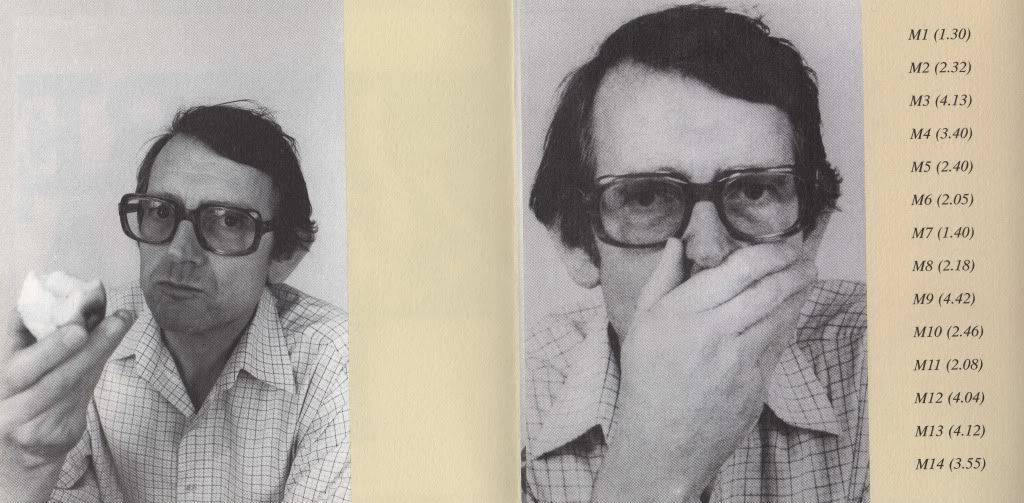
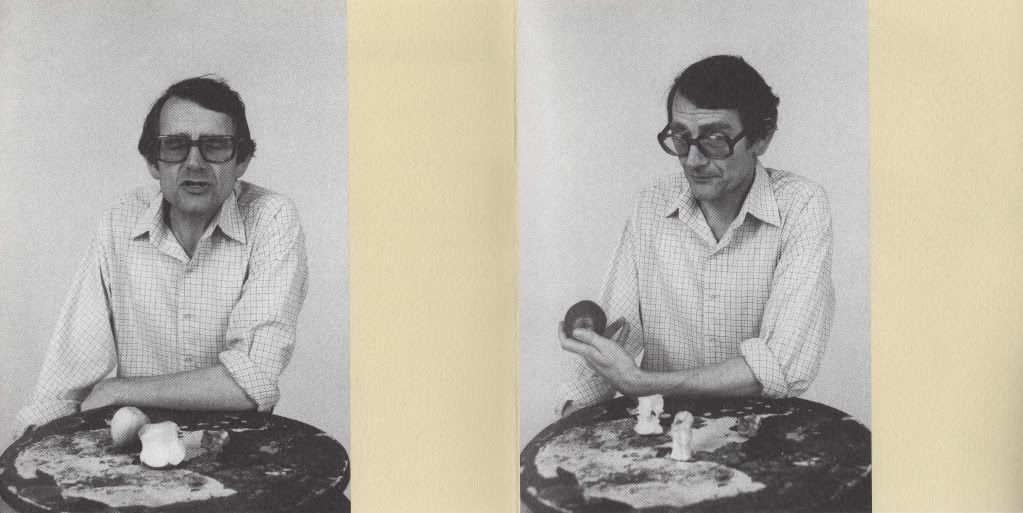
While he's got more epic albums (Aida is often regarded as his best), I think Improvisation is just as strong and is probably a better introduction to Bailey's challenging style because the track lengths are short and can be more easily focused on and digested.  Though my interest in Bailey has been tempered by the realization that his style became formalized mid-70's and didn't develop much further, revisiting his best works reminds me that 1) his style is so radically different from those who came before him that he didn't really need to reinvent himself to maintain his validity and 2) his style is so all-over-the-place that there isn't a whole lot more he could do to develop it further.  Bailey's playing is an inescapable golden standard for atonal guitar as well as an audacious challenge to all followers to conjure something else new and exciting from those six strings.  Please enjoy these pictures of Derek Bailey eating some apples.
Get it here.

Friday, November 18, 2011

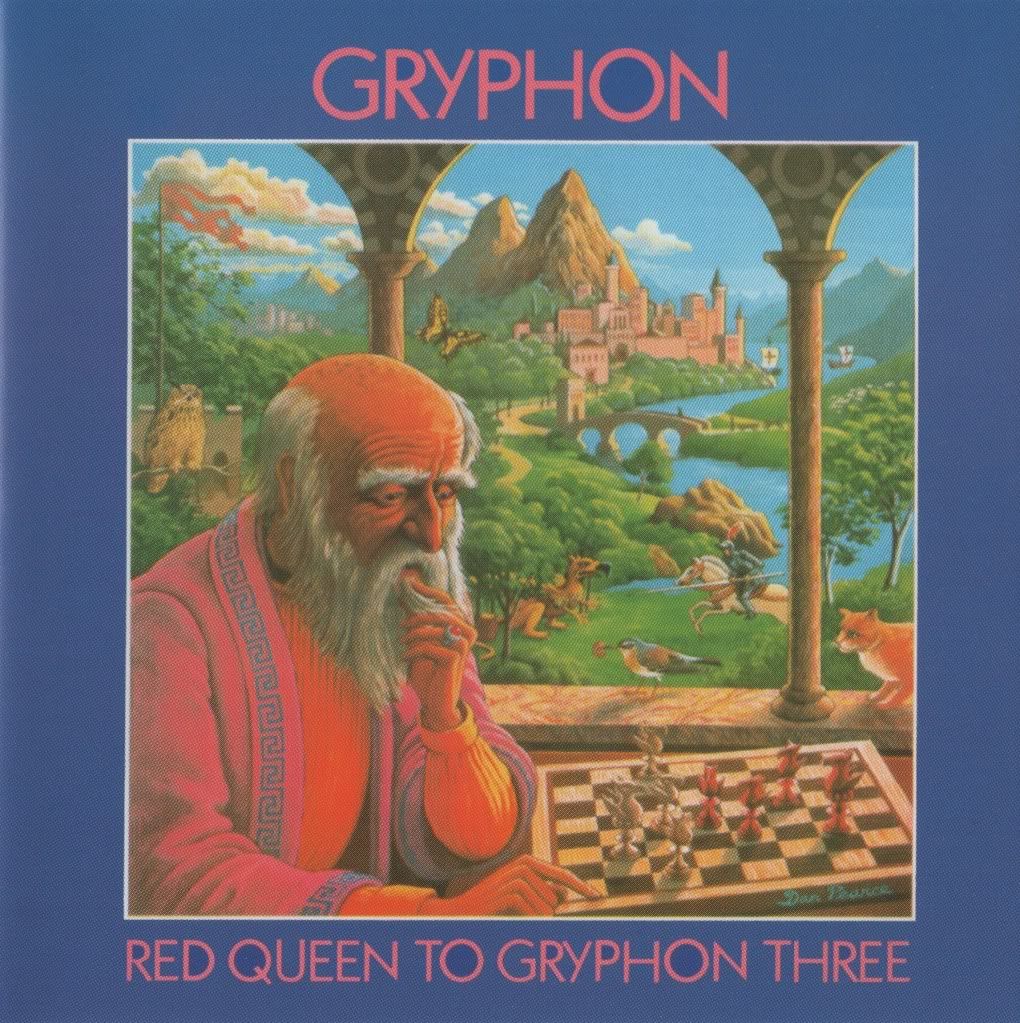
Gryphon - Red Queen to Gryphon Three


Some progressive albums from the 1970's sound like the compositions could be played in the present and might actually manage to sound a little more modern, while others remain permanently tied to the time of their origin.  British group Gryphon's 1974 third album is surely one of the latter category, and a perfect choice to end the relative drought of progressive material here.  Listening to this album is like burying your head in a synthesized pillow of 70's renaissance heaven. 

Among the numerous progressive groups of similar ambitiousness, Gryphon are distinguishable (on this album at least) for eschewing vocals entirely and utilizing crumhorns, a Renaissance-era woodwind that imbues the band's backward-looking style with some aural authenticity.  Looking at the band's credits, though, it's not a huge surprise they're adept at accommodating the crumhorn--the horn is double-reeded, and Brian Gulland spends half of his time in the group playing bassoon.  Unsurprisingly considering these guys' academic credentials, the virtuosic level of musicianship is one of the album's strongest characteristics.

Compositionally, Gryphon has to be one of the most classically-influenced contemporary progressive groups, neatly folding Renaissance and especially Baroque influences into their songs while still pumping up the amplification with electric guitar and bass, drums and some well-arranged synth parts.  The album's "Opening Move" boasts some of the dreamiest instrumental passages, utilizing gorgeous but tense chord progressions, and juxtaposing a twinkling group sound very much influenced by passages in similar Yes songs with interlocking contrapuntal sections similar to those often explored by Gentle Giant.  Unlike Yes and Gentle Giant, though, Gryphon rarely breaks past the Baroque atmosphere into a more contemporary rock sound.  In some ways, they don't have to because their vocal-free sound doesn't pose the problem of matching lyrics and vocals to such an academic sound, but it's also because they're exploring the fusion of classical and rock to a much deeper extent.  The ebb and flow of tempo and energy in "Opening Move" is abetted by the development of a strong melodic motif and showcases of the band's multi-instrumental talents.

"Second Spasm" features the most overt rock sounds of the album, with the bass and guitar doubling on a boisterous and satisfying progressive riff after a couple of the most intricate Medieval and Baroque passages of the album.  As might be reasonably inferred from its title, "Lament" is the requisite quiet piece, which seems slightly unnecessary considering even most of the mid-tempo pieces here are fairly mellow.  By the time the album closes with "Checkmate," it's apparent that the group's arrangements--replete with synth/piano double runs and multi-flute harmonies--are the album's greatest asset.  While some of the melodies are unmemorable even after numerous listens, there's always joy to be found in the spaces between the multiple simultaneous sounds, and it's clear the band took great care with keeping the sections of their extended pieces constantly on the move and heading toward the next surprising combination.  While the band's sound is uncommercial by even progressive standards and the album will always sound hopelessly dated, this kind of music will always sound great to the converted and acts as a cheerful reminder that there was once a time when bands making music like this could land a record deal and at least have a shot at success.

Get it here.

Wednesday, June 22, 2011

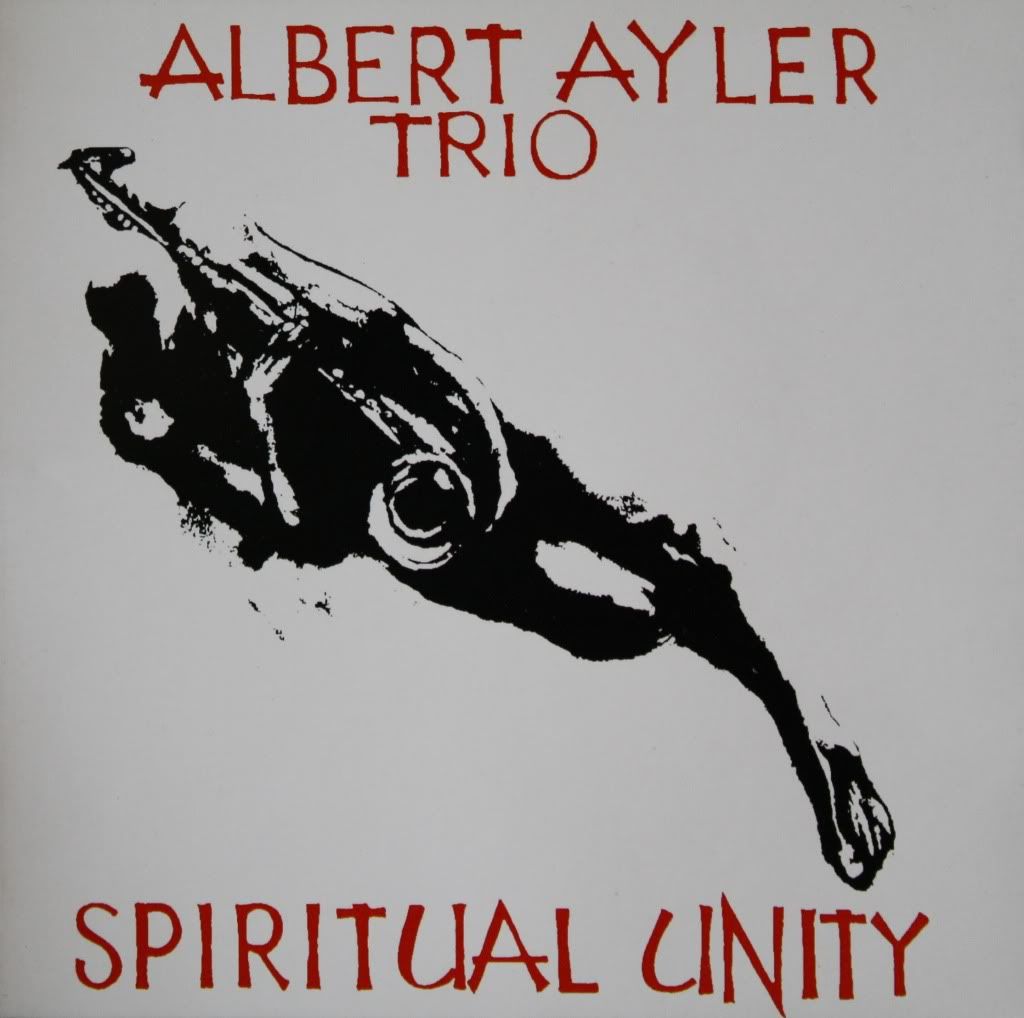
Albert Ayler - Spiritual Unity


Although I've mentioned free jazz a few times, I still haven't ever actually defined it or reviewed a full-on free jazz release.  Although free jazz is a widely-accepted subdivision of the jazz genre, it came about gradually over a couple of decades (mostly the 1950's and 60's) and through the work of a number of pioneers, so it can be difficult to pin down exactly what its characteristics are.  There is, for instance, a big difference between Ornette Coleman's unrestrained soloing over a relatively orthodox rhythm section in The Shape of Jazz to Come and some of the 20+ minute raging noisefests in Sun Ra's more audacious outings.  The unifying principle behind most music labeled "free jazz," though, is the elimination of some of the more traditional restrictions of the jazz idiom--be they adhering to chord changes when soloing, playing the instrument in a traditional way, including a repeating melody in the song, ensemble members playing in the same key (or even the same tempo), or ensemble members paying attention to what the others are doing.  It would also seem that free jazz places utmost importance on emotional expression--famous players have sought to avoid limitations in order to more authentically communicate their emotions through improvisation.  There will always be critics who argue that no jazz is actually "free," pointing out that there's always some structure, repetition, or limit to how the music will sound, but I think this observation misses the point--few free jazz players have ever claimed complete freedom; rather, the idea is to become freer from the traditional structures of jazz.  To this end, something that's interested me is the difference between free improvisation, a few examples of which I've already reviewed, and free jazz.  It's usually pretty easy to identify free jazz from free improvisation or atonal modern classical music, as the instrumentation is usually traditional, and the style of playing seems almost always to obviously fall within the jazz idiom (a saxophonist's phrasing, for example) no matter how noisy or atonal it is.  Free improvisation, on the other hand, often seems hell-bent on avoiding connections with any established musical idioms and more in combining elemental sound with the energy and unpredictability of improvisation.  While I'm neither a jazz musician nor particularly knowledgeable on the subject, I've recently gotten to a place where I feel like I'm starting to appreciate the tenets of jazz (especially of the free variety) and can enjoy and talk about it on specific aesthetic grounds.

Albert Ayler's 1965 album Spiritual Unity seems to me to be a great introduction to free jazz as it bridges the gap between early free jazz efforts and the much more ethereal works to come.  Ayler is widely regarded as one of the greatest free jazz saxophonists for his emphasis on timbre and characteristic vibrato-heavy style.  The album is book ended by two different versions of a tune called "Ghosts."  The first variation beautifully illustrates Ayler's stance in the free jazz movement--the piece opens with Ayler belting a winding gospel-influenced melody before gradually disassembling it over the course of the next five minutes only to recapitulate the original theme at the end.  It's thrilling to listen as Ayler inverts intervals between the notes, perverting what was originally an extremely recognizable melody into an at times hilarious and at other times furiously energetic caricature.  No matter how wild his trills and runs get, though, they still fit within the rhythmic footprint of the original theme.  The drums and bass are barely on the map, too, wildly filling the space with sound and energy, which seems to suffice in place of an actual beat.  

"The Wizard" continues to showcase Ayler's playing, beginning on an even shorter melodic motif before devolving into some of his rawest playing on the album--his harmonics and overblowing sound so amazing that it's easy to understand why some of the fathers of the movement believed texture alone could replace melody and harmony as the centerpiece of a solo.  "Spirits" brings the tempo down, showcasing the rhythm section with a little more space and room for the bass and drums to play off of each other, while Ayler's tremulous vibrato communicates a wailing sort of mourning sound reminiscent of a New Orleans jazz funeral.  The relatively short album closes with a second variation of "Ghosts" in which Ayler stretches beyond even the theme's rhythmic form, running all over the map during his solo and returning for more soloing after the bass and drum break before returning to the theme.  Spiritual Unity unifies free soloing with highly unstructured rhythm section playing to delve pretty deeply into free jazz territory, but its utilization of recognizable themes and loose but undeniable song structures make it considerably more accessible than some free jazz outings.  My only gripe is with the drummer, who spends too much time on the ride for my tastes, but I've got nothing bad to say about Ayler's stunning chops and energy. 

Get it here on CD or MP3.

Tuesday, June 21, 2011

Aksak Maboul - Un Peu de l'Âme des Bandits


After a week that saw reviews for Brazilian pop, 60's folk and French pop, I feel it's time to travel back out into the...beyond.  There's so much to say about this album, Belgian group Aksak Maboul, and RIO (Rock In Opposition) that I almost don't know where to start--let's begin with RIO.  Rock In Opposition, though it's sometimes loosely used as a genre tag, was originally actually a festival organized by British group Henry Cow (with especial effort on the part of drummer Chris Cutler) in order to promote avant-garde rock groups selected by Cutler (eight in total) that were receiving little to no support from commercially-minded record companies.  Though the movement was short-lived, it garnered a fair amount of press for the groups and, more importantly, facilitated the release of some of the most challenging progressive music produced throughout the 1970's and beyond.  Since the loose movement became inactive in the 1980's, you're more likely to hear RIO referred to as a music genre used to describe either music that members of the original RIO groups have made, or music that is similar to, for example, Henry Cow's--dense, avant-garde, forward-looking, often with healthy doses of modern classical and jazz influences, though I personally don't find the tag to be the most helpful.

Belgian group Aksak Maboul was part of the second group of artists invited to RIO and was primarily the project of Marc Hollander (previously of CoS and founder of record label Crammed Discs).  Aksak Maboul's 1977 debut was much more of a solo effort, with Hollander playing most of the instruments (a lot of keyboards, wind instruments and drum machines)--it's a playful, eclectic and enjoyable outing, but not today's album!  In 1980, Hollander was joined by Henry Cow alumni Fred Frith and Chris Cutler and a few lesser-known European musicians for this, "their" second and final album.  Though Aksak Maboul wasn't an original RIO group, I picked this album to introduce RIO because it's one of the most consistent, representative, and simply best RIO has to offer.

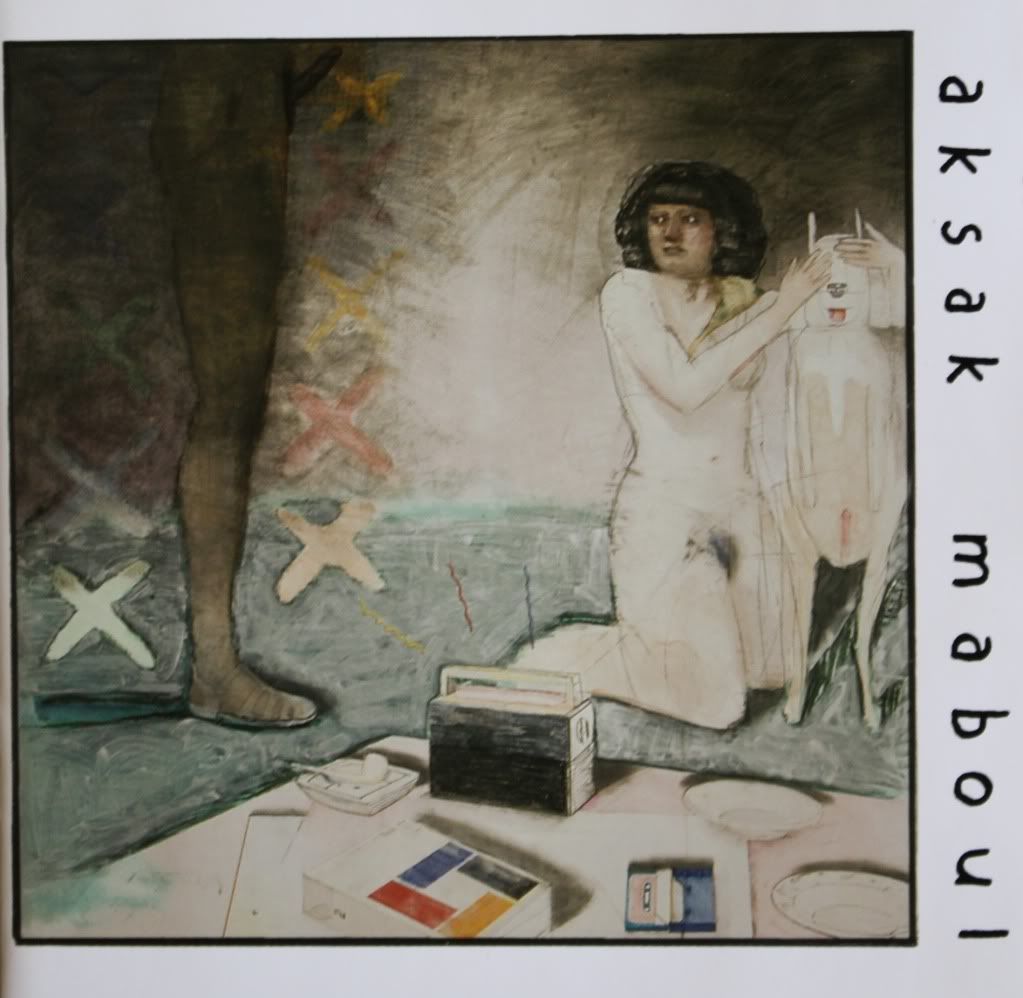
You know (or at least hope) from the ridiculous cover (depicting no fewer than two erections) that this album is going to be a crazy trip, and it certainly doesn't disappoint.  Personally, I find this album extremely satisfying because of the experimentation--most all of the songs are based on at least one describable experiment, and the results are not only challenging, they're often quite listenable.  A great example is the opener, "A Modern Lesson" (please, oh please, watch the video), which manages to deconstruct a classic blues riff with dissonance, drum machines, and wacked-out female vocals in under 6 seconds.  As the track progresses, the wind instruments enter (along with some pinball machine recordings) for an interlude, the main riff returns, then the bass and tempo increase and Hollander's electronic keys and Frith's detuned guitars amp up the energy for a driving finale that sees an incredibly complex wind/key/string arrangement brimming with head-spinning counterpoint and--what elevates this beyond similar attempts--a memorable melody.  "Palmiers en Pots" radically switches gears with a tango supposedly composed of (get this) pieces of several popular tangos, cut up with scissors, rearranged, and performed in random order.

That Fred Frith was on an unstoppable roll in the early 1980's, I'll never deny--his fingerprints (as musician, composer and producer) are all over this album, and in some ways it's better than its Frith solo contemporaries as his ideas (some heard already heard on other albums) are supplemented and developed by other musicians.  Though the resulting disc doesn't exude quite as much of Hollander's personality as the Aksak Maboul debut, its diversity is one of its greatest assets--"Geistige Nacht" features a frantic sax-led melody with some great free jazz soloing in which the sax and eventually Frith's guitar trade squawks, and "I Viaggi Formano La Gioventu" features a snaking Middle-Eastern melody doubled on wordless vocal, violin that's strongly reminiscent of Frith's other 80's work, though that handclap track buried in the mix toward the end of the song shows up again on Cheap At Half the Price's "Absent Friends."   "Inoculating Rabies" is probably the second best experiment on the disc, blending a balls-out punk riff driven by Frith's and Cutler's unfettered noise with the addition of a delicate woodwind arrangement.  It's probably the best (if not only) progressive commentary on and appropriation of the burgeoning punk movement I've heard so far, which, by 1980, had all but swallowed what little market experimental progressive music like Aksak Maboul might have cornered.  It's pretty ironic how loud Frith, bass and Cutler get considering how "obsolete" punk supposedly made their musical contributions.

The 23-minute-long "Cinema" rounds out the album with long-form composition interspersed with free improvisation (there's a lengthy and wicked cello solo as well as a pretty epic Fred Frith guitar solo), recording collage, a recurring sinister-sounding theme, some really heavy jamming from the full group (Cutler's drumming here is the liveliest I've heard since Henry Cow's last album, and recently, too).  The melodies and ideas aren't quite as immediate as they are on the shorter songs, but the added space allows the group to accomplish some things that it couldn't in five minutes, and it gives us more to uncover on later listens.  Pieces like this often seem to divide the camp of potentially interested listeners--take longer than five or six minutes and some people will complain about having their time wasted.  If there are enough different ideas being developed, though, I don't mind it taking a while--as much as I'm leaning toward shorter songs packed with briefly-stated ideas these days, I can appreciate a piece that actually allows listeners to engage with and unravel the ideas being presented during the piece, rather than after numerous plays.  While Hollander's personality is somewhat obscured by the thickness of the production and arrangements, it's perceptible on repeated listens, especially if you've heard his earlier works.  I really enjoy his mechanical-sounding drum machines and keyboard lines, not to mention his contributions to the horn sections.  Let's hear it for RIO, and this week let's keep going down the rabbit hole.


Available here on CD, and here on MP3.

Sunday, March 27, 2011

Fred Frith - Gravity


Gravity, Fred Frith's first post-Henry Cow solo outing, is an album positively packed with ideas.  From its through-and-through dance/rhythm concept, to the dizzying array of styles presented by each song, to the mottled textures of Frith's fantastically wrinkly songs to the man's all-over-the-place guitar playing, a lesser group would have make a career's worth of albums out of the ideas present on just half of these songs. 

The songs presented here tread middle-Eastern themes and modes ("Hands of the Juggler"), Scandanavian and British folk ("Don't Cry For Me" and "A Career in Real Estate," respectively), as well as more familiar Frith subjects like melodic jazz (on "Spring Any Day Now" I could swear he single-handedly created the template for all Nintendo music to come) and the avant-garde ("Year of the Monkey," "Crack in the Concrete").  We also get a taste of classic Canterbury humor with a totally wonky-melodied but somehow recognizable rendition of "Dancing in the Street."

I think what sets this apart from other 80's (and beyond) Fred Frith albums is the driving energy, which must in part be attributed to the backing bands--Samla Mammas Manna on the A-Side and the Muffins on the B-Side--who lend able, ballsy and often manic flesh to the bones of Frith's compositions.  Additionally, it's probably the highest concentration of pure guitar shredding ever collected on one Fred Frith album (including his solo guitar albums)--the avant-garde rock songs here have some of the most complex riffs, lead lines and soloing I've ever heard the man play, and considering the rest of the projects he's been involved in, that's really saying something.  Songs like "Norrgarden Nyvla," with its majestic-turned-insane distortion-soaked lead lines contrast yet sit perfectly comfortably near the clean Massacre-esque riffing and unbalanced sliding he pulls of on "Slap Dance."

At times the music gets quite atonal and almost mathematical in its composition (though Frith's kind of atonality rivals Captain Beefheart's in its sense of melody), but somehow it's more listenable (if still quite busy) than a lot of other avant-garde music--even examples from Frith's own canon.  Probably its greatest asset is its sense of humor and the aura of fun surrounding the whole album--a sense of humor that was surely lacking from the final days of Henry Cow and the entirety of the Art Bears project.  To hear this album immediately after Western Culture is to believe against plain evidence that avant-garde can be fun.

Get the CD here.

Thursday, March 10, 2011

Davy Graham - Large As Life and Twice As Natural


Time to turn our probing ears to another unjustly-overlooked guitarist.  Today, few have even heard of Davy Graham, but he's unanimously considered "important" by those who have--a host of better-known performers and guitarists are quick to drop his name (Bert Jansch, John Renbourn, John Martyn, Paul Simon, Ralph McTell, Roy Harper, Jimmy Page, Martin Carthy, the list goes on...) as the most adventurous and eclectic guitarist of the early 60's English folk revival, yet his actual work remains painfully obscure (though thankfully currently in print).

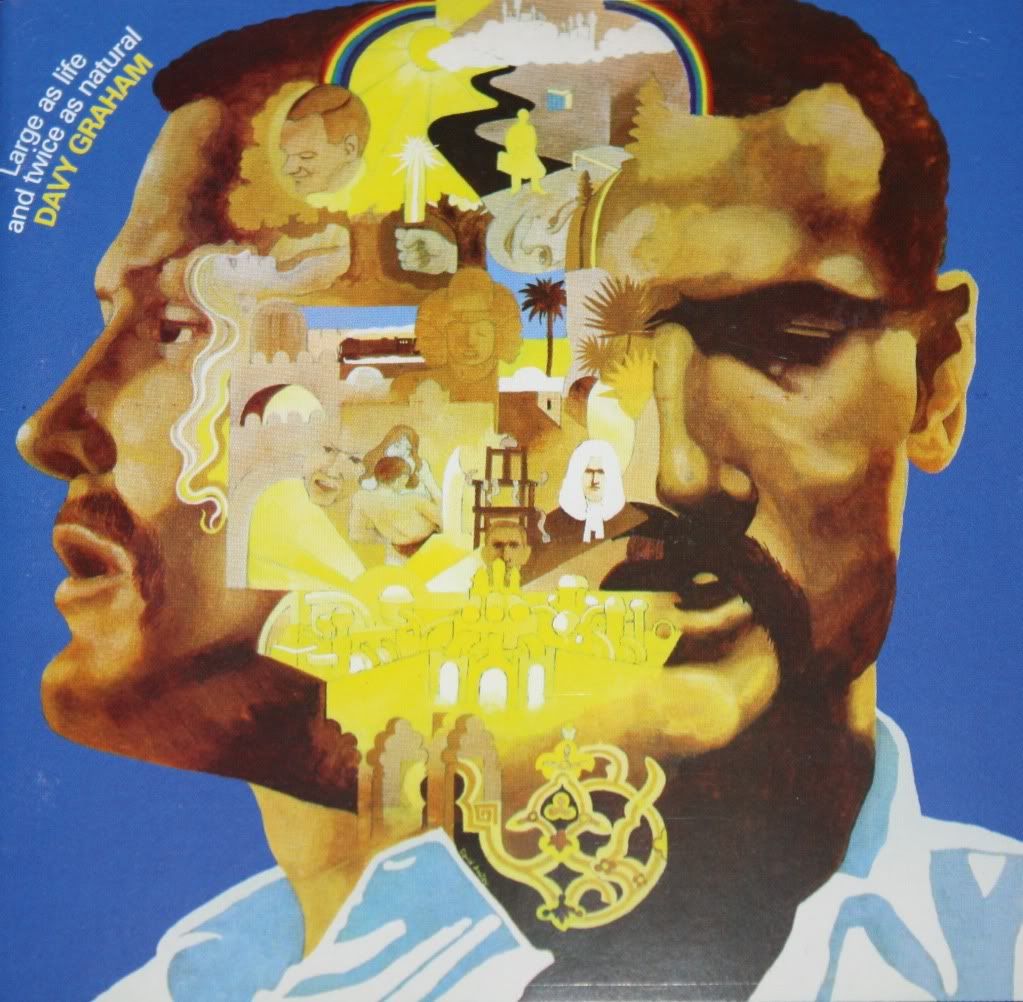
Davy Graham's fourth LP, Large As Life and Twice As Natural (genius title!) presents equal justification for his esteemed reputation it does evidence for his failure to achieve commercial success.  The solo guitar "Tristano" reveals Graham as a virtuoso of the truest stripe, capable of seamless transition between (or simultaneous juggling of both) rhythm and lead parts, while the song itself fuses jazz, blues, folk and middle-Eastern modalities in a way that nobody in the mid-60's could have even imagined.  That's how Davy is usually described by the converted--a loner whose penchant for world-traveling gave him an untouchable breadth of experience which, combined with his seemingly boundless imagination and ungodly chops, meant he was fusing Irish folk songs with Indian ragas and Eastern-izing obscure blues songs (by all accounts he invented DADGAD guitar tuning) while his later followers were aping Anthology of American Folk Music standards and worshiping Dylan.  In reality, though, very little of Graham's recorded output consists of solo guitar, which I think might have played a role in his commercial difficulties.

More representative of Davy's standard MO would be his expansive reading of classic British folk song "Bruton Town," where the guitar flits jazzily around the traditional melody, refusing to adhere to traditional folk rules.  Graham's voice is probably his greatest limitation--not bad (I actually enjoy it) but certainly not traditionally "beautiful" or as marketable as his guitar abilities.  Likewise, "Both Sides Now" is a revelatory opener--its languorous, modal opening makes you wonder if this is actually the same "Both Sides Now" you thought it was, then BAM!  The bass and drums kick in and Davy presents us with an uncannily energetic and imaginative reading of Joni Mitchell's oft-covered standard.  The cacophonous rhythm section ably handles the eclectic mix of styles present here (Pentangle's Danny Thompson has got to be one of the best session bassists of the time period), bringing lots of ethnic flair to the Eastern songs (the major-key "Sunshine Raga" and minor-key "Blue Raga," as well as the hypnotic "Jenra") and provide a suitably grinding bottom to the  blues numbers ("Freight Train Blues" has some awesome cymbal work and Davy's singing is pretty rocking).

The whole album feels like it was recorded live (there are plenty of vocal imperfections and loose improvisation to attest to this observation) and the sound is great--nobody else's guitar sounded like Graham's.  The commercial flaws of the albums can be seen a mile off, though--it's neither folk (too experimental and eclectic) nor folk-rock (too jazzy and accoustic), and it's got nothing to do with psychedelia (apart from the delirium-inducing guitar excursions), which was the rage in 1968--how do you market that, and to whom?  Perhaps Davy's eclecticism became his career's undoing (deliberately becoming addicted to heroin in order to emulate his jazz idols probably didn't help either) but for me it's the best thing about him--you never know where the next song is going and his playing is full of surprises both compositionally and technically.  Here Graham might not quite fuse as many genres within the same song as he does on Folk, Blues and Beyond, but it's a fine representation of his style and contains some career highlights. 


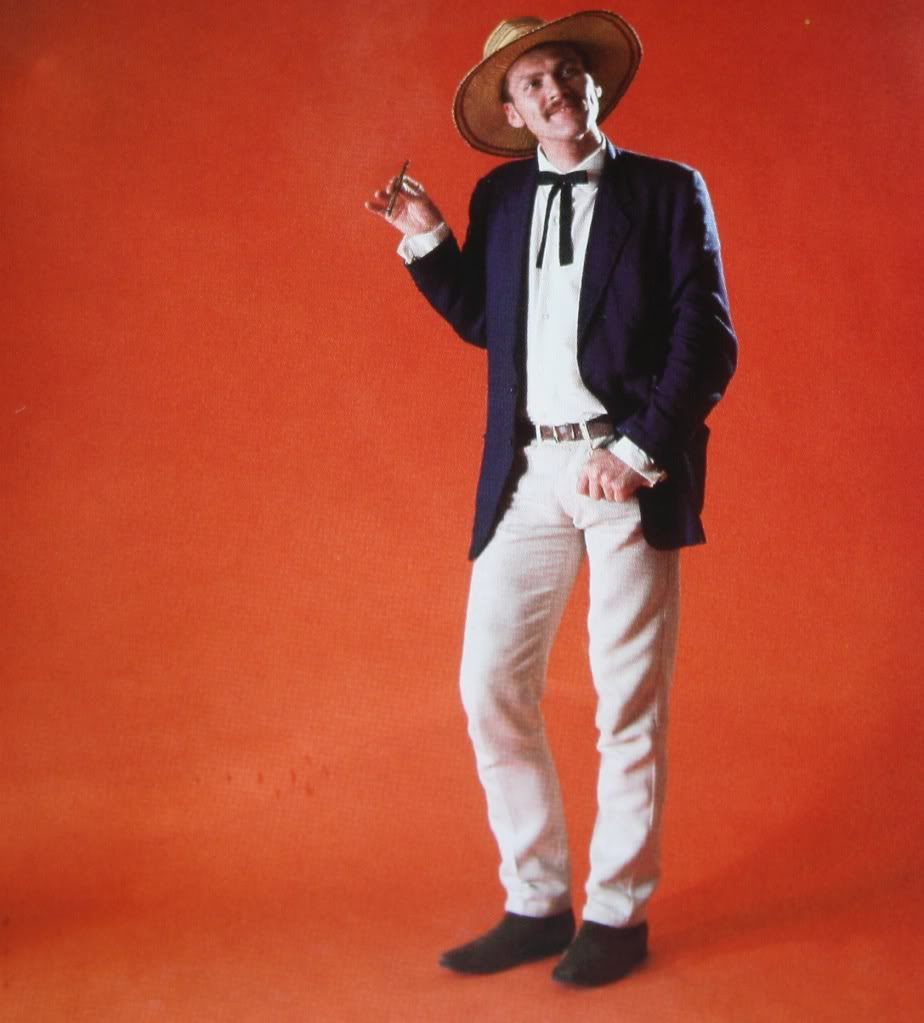
I couldn't resist including this shot from the album notes--what a cigarillo-smoking, big straw hat-wearing ladies man.  Thanks Davy. Get the CD here.

Thursday, February 17, 2011

Robbie Basho - Venus in Cancer

Photobucket was scared of this photo and wouldn't let me upload it, because a naked woman = pornography.
This is easily Robbie Basho's most celebrated recording, most likely due to the tragic state of his legacy--it's one of only three (counting the fact that the entirety of The Grail and the Lotus is presented on the Guitar Soli compilation) of his original studio albums that's available today on CD.  Despite this unjust reality, Venus in Cancer is one of the better Basho albums, so we can at least be glad that what's out there does the man's contribution justice. 

In a lot of ways, I consider this album to be Robbie Basho's study in arpeggio.  Instead of the gale-force sonic flurry often heard on his earlier albums, here we get gentle, climbing guitar figures in which each individual note is audible and easy to savor.  For me, the two six-string pinnacles of Basho's Venus in Cancer style are the leadoff title track and "Kowaka d'Amour."  The former is a tentative, searching piece that sounds partly improvised--there's not necessarily an explicit melody, but the piece has an overall melodic flow and the mood progresses from mysterious to soaringly sublime at a majestic pace.  The latter song is like a darker, moodier shadow of the opener (perhaps like the astrological cover art suggests), with more of a minor, Eastern feel, but still an emphasis on space with a lot of the playing in arpeggio form.

Aside from these two brilliant solo guitar pieces, we get three vocal tunes and a 12-string instrumental.  It's customary--nay, obligatory--when writing about Robbie Basho to comment on his "love it or hate it" voice.  People love pretty guitar instrumentals, but they don't want to worry about weird.  Basho's vocal style is undeniably unconventional, but I'd argue that it's also tough to deny his ability.  If you can listen to "Eagle Sails the Blue Diamond Waters" without being moved, you've got a harder heart than I.  For me, it's not the timbre or style of Basho's voice that's an issue--I think it's marvelously unique, especially in combination with his guitar style--it's more of an issue with his poetry, which is often a bit florid (see "Wine Song").  But somehow, it all fits together here--I think "Song for the Queen" is one of the best realizations of Basho's combined guitar/vocal vision, with an aura of stately mystery that meshes well with the track's french horn and string arrangement. Out of the man's entire discography, I think the vocals work best here--far better than the less distinctive Basho Sings! and probably also even better than the vocal-heavy The Voice of the Eagle.  Regardless, Basho's vocals will probably always be bound turn off a number of those listeners who are merely looking for another John Fahey.  To the initiated, though, it's clear that Basho had a different purpose and for better or worse wasn't willing to go all-instrumental.

Venus in Cancer is a pretty good place to start with Robbie Basho--I still remember my first listen, standing out in the late summer sun painting a barn door, watching birds cross overhead and marveling at the man's passion and ability without really understanding the extent of his vision.  A lot of my favorite albums have taken years to fully appreciate, but I can still vividly remember that first unknowing encounter--this is definitely one of them. 

Out of print, but For sale used here.