Showing posts with label Electroacoustic Improvisation (EAI). Show all posts

Friday, January 25, 2013

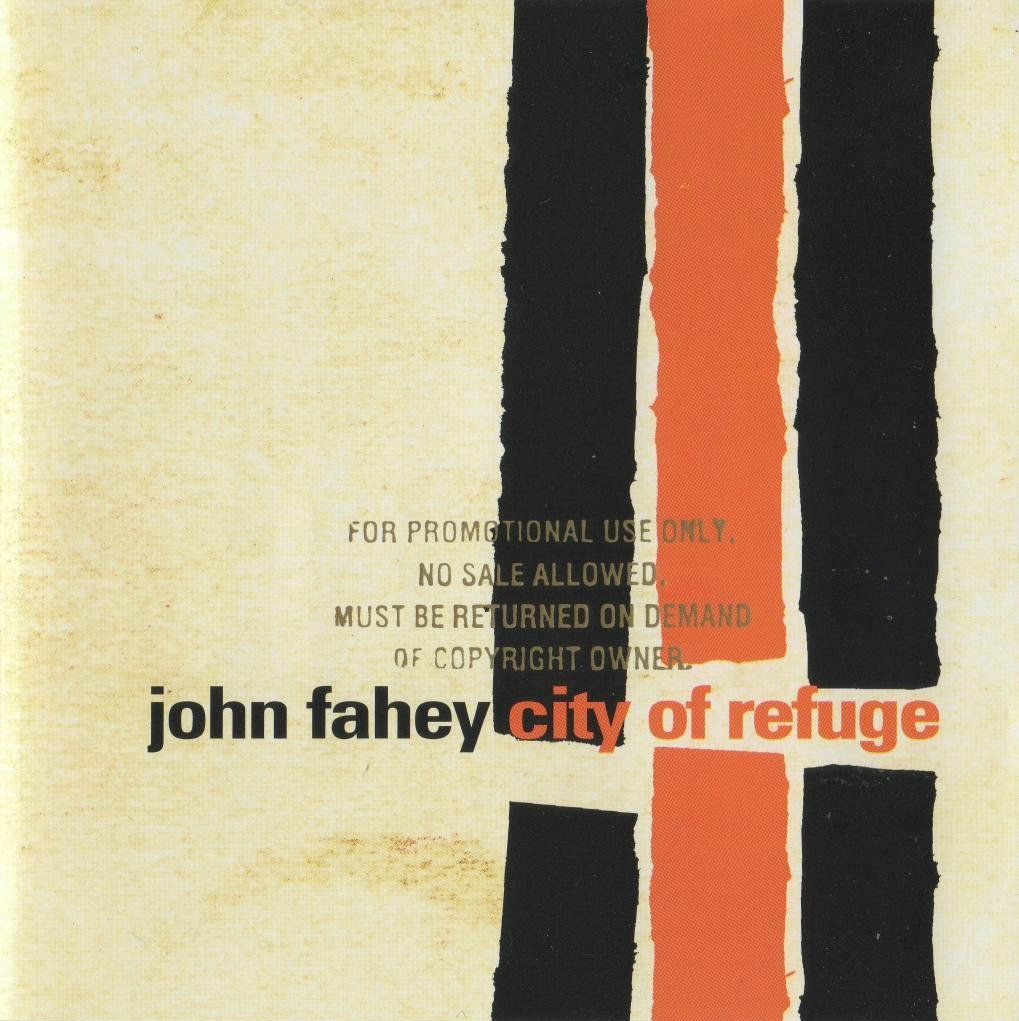
John Fahey - City of Refuge


In investigating Fahey's late period, I'm sympathetic with the fact that he felt dead-ended stylistically and was struggling to move beyond his signature American Primitive tropes into something a bit more...different and new.  The issue seems to be just what, precisely, that new direction is, and Fahey's frustration is evident in the music.

In spite of its recording date, City of Refuge most resembles 60's Fahey records like Volume 6: Days Have Gone By and Requia, with equal space and volume given to acoustic guitar and field recordings, found sounds and electronic sound sources.  As with those other recordings, this approach either stands (Days Have Gone By) or falls (Requia, often) on how well those elements mesh with one another compositionally.  The disc starts promisingly enough with "Fanfare," which sees an unusually (for Fahey) overdriven slide guitar layered on top of droning, industrial electronic sounds not unlike those produced by Keith Rowe, especially in his solo works.  As the tracks play on, for me the impression builds that the compositions aren't very well thought-out, which is a serious stumbling block for an artist whose greatest strength is arguably his ability as a longform composer, not as an improvisor, which is what he appears to attempt on "The Mill Pond" and large portions of "City of Refuge I," plucking single notes against a throbbing background drone.  While the proposition of a more spare approach to his guitar style is intriguing, the results here don't feel particularly well-realized.

Elsewhere we are suddenly jolted out of the avant-garde soundworld back into more traditional Fahey territory, with guitar-only excursions like "Chelsey Silver, Please Come Home," and the dirge-like "City of Refuge III."  The former hints at a new compositional twist on Fahey's slide style, with abrupt stops and rhythmic interruptions, but again it feels like he didn't thoroughly integrate the idea into the piece, or maybe it wasn't an idea after all and the performance is just choppy!  Both songs seem to lack distinctive melodies or a feel other than "Fahey filler"--pleasant enough, but by 1997 we know what this man is capable of!  To my ears, "Hope Slumbers Eternal" is the best-realized piece on the album, blending a droning background that relates tonally to the minor slide guitar melody it accompanies, provoking an eerie, meditative atmosphere--most importantly, the electronics and guitar seem to combine coherently, which is mostly not the case with the rest of the experiments here.  The album closes with the 19-minute "On the Death and Disembowelment of the New Age," which, as far as I can tell, contains no guitar (though it does keep alive Fahey's tradition of humorously long and barbed song titles).  It's probably the most successful sound collage on the disc, but sitting at the end of a selection of noodly acoustic guitar pieces, it raises questions about what it's doing here, and why these songs all belong on the same album.  There is some cool rhythmic phasing of a tambourine-like sound that kicks in around the 12-minute mark and lasts for several minutes, and the album closes like it opened, with a classic Fahey field recording motif--a lonely locomotive whistle. 

This is the kind of album that really gets under my skin--not because I think it's bad, but because there's a palpable sense of frustration from an artist with specific ideas and a seeming incapability to fully realize them.  Probably more troubling to me personally is Fahey's frustrated attempt to break beyond his established vocabulary as a guitarist--for a man who reportedly described fingerpicking as a "disease," he must have felt more than a little trapped.  When an artist verges into atonal and pure sound territories, success seems to become as ephemeral as the compositional building blocks are abstract.  I find it daunting to explore these areas as the measure of artistic success depends even more on an unquantifiable gut reaction, and the difference between good and bad is painfully difficult to control as a composer--but perhaps that's where the adventure lies!  My next stop for late-era Fahey is another 1997 album, Womblife.  While my hopes for a successful application of his challenging ideas are tentative, even unsuccessful attempts in this territory are rewarding and always thought-provoking.

Get it here.

Friday, October 28, 2011

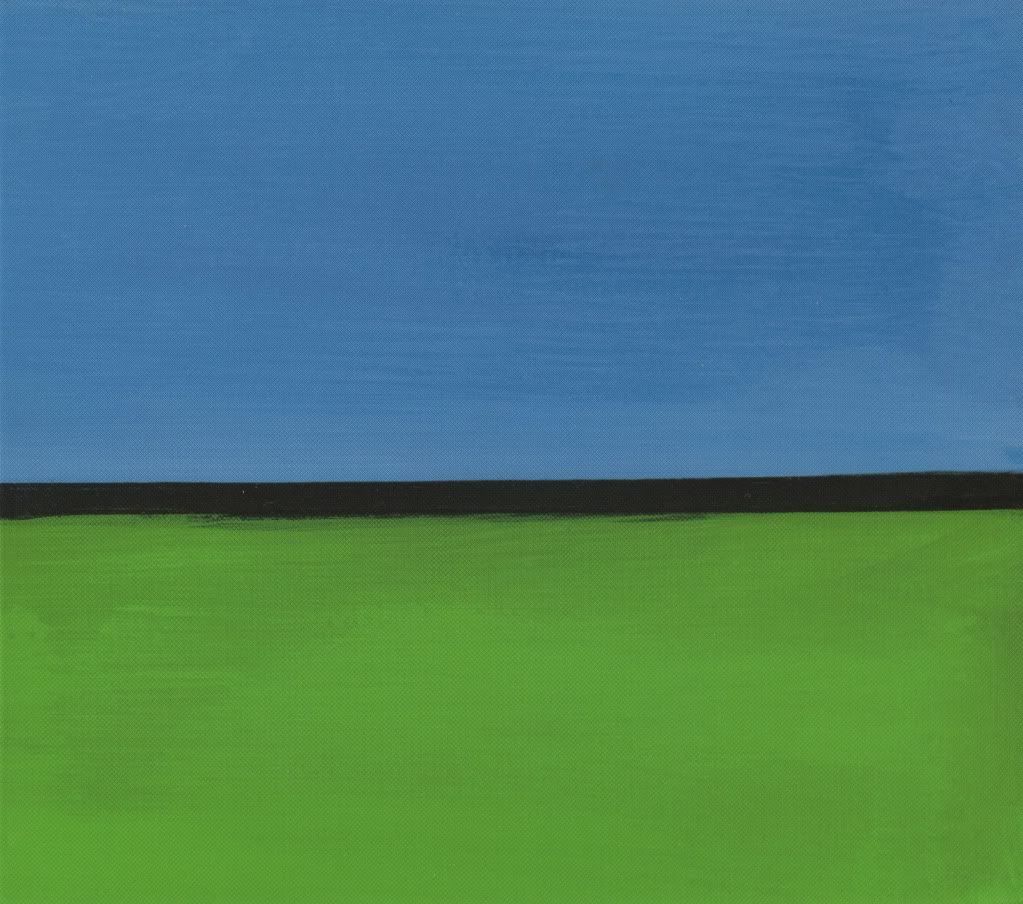
Keith Rowe - The Room


Now, back to something really weird.  Keith Rowe, formerly the guitarist for house favorites AMM, is probably one of the most influential underground guitarists of all time.  He was one of the first guitarists to pioneer a tabletop prepared guitar technique wherein the instrument is placed flat on a table and manipulated with various found objects to create unusual and unconventional timbres.  After quitting AMM for the second time in 2004 (a move of which he's apparently quite proud), Rowe's solo performance and album release schedule has picked up markedly, as has his further exploration of the possibilities of Electroacoustic Improvisation (EAI), a loosely-defined branch of free improvisation with an emphasis on live computer processing of improvised sound sources.  This, a 2007 solo release, is regarded by some as Rowe's best solo album and was released on Erstwhile Records, which courageously releases an impressive amount of good EAI to a generally apathetic public (awesomely enough, the label also eschews barcodes in their packaging).

While Rowe's contributions to AMM often seem intended to amplify the sounds of his unusual guitar approach into a space (i.e. a room or concert hall), The Room sounds to me much more inward, as if he is listening to the innards of the things producing the sound.  This impression is probably intensified by the fact that Rowe's improvisations sound like they're directly input to the recording device, rather than amplified and miked.  In any case, the result is a single 38:57 continuous track (though there are brief silences between sections) of droning guitar tone, amplified signals and electronic processors, some traces of Rowe's signature radio frequency manipulation, and some visceral textures produced by Rowe's physical manipulation of the guitar's strings.  If that description doesn't sound like much, please be aware that the actual sounds contained on this disc are very difficult to verbalize!  Though this album is much too indie to appear on YouTube, this video of Rowe playing prepared guitar will at least give you a better idea of what some of this sounds like (though I personally prefer not having these bizarre sounds attached to any visual explanations for their origins).  To me, the dominant timbres of the music are a sort of ambient hum (presumably the guitar), and a more rhythmically dynamic, twittering, upper-frequency sort of repetitive digital bleeping.  It's fascinating how the textures overlap in a sort of progressively sliding series of layers, with one tone source pulsing gently while another simultaneously rapidly dances on top, and before you know it one of the sounds has disappeared while your ears were transfixed by another, and a new one is just moving into the picture.

How does this music compare to free improvisation like AMM?  Well, for starters, I think it's not completely discrete--if there was some way to only hear what Rowe was doing during certain AMM performances (I'm thinking especially of the drone-heavy 2001 album Fine), I think it might sound a lot like parts of this album, despite Rowe's written assertions that it's an attempt to go somewhere completely new.  In other ways, though, it's much colder, more alien and less organic than AMM's albums, conjuring a claustrophobic atmosphere (perhaps there's a connection to the album's title and the feeling the music conveys) and a sort of digital industrial feel that never really occurs on AMM albums.  Not that it's a particularly bad thing--I vividly remember on my first listen feeling (perhaps around the 22:30 minute mark, when Rowe starts scraping the strings beneath a piercing electronic tone) a powerful sense of unease and a strange, alien emotion that no other music has ever made me feel before.  Though it's far from the warm-and-fuzzy elation that most listeners hope to achieve from an album, the experience remains ingrained in my memory as an inspirational example of music's unlimited emotional potential, and as a sort of revelation (how often do you feel a feeling you've never felt before, right?!).  Don't get me wrong--Rowe's sometimes laughably-strident views on musical aesthetics (which seem to come with the territory of free improvisation) inform this music with an uncommon level of academic seriousness--but attempting to deny the music's very real emotional power in the name of disagreeing with Rowe's artistic choices seems to unjustly disregard his contributions to the ever-growing palette of potential moods and emotions available to listeners and musicians alike. 

It's hard to really assess the quality of music like this--it's so fundamentally different structurally and in its aesthetic goals that even when talking in terms of elemental sound, it's hard to separate what's "good" from "bad," and the subjectivity of personal preference that's present with all music becomes a starting point rather than an ultimate conclusion.  Despite Rowe's professed anti-virtuosic method, though, he clearly (in my ears, at least) has a flair for space, flow and tone/timbre choice that few other improvisers do.  Though I think The Room occasionally suffers from the sort of repetitiousness and aimless structure that understandably pops up in a lot of free improv, the frigid atmosphere and occasional moments of revelation (like the digital explosion at about 24:25) make it a much-appreciated part of my collection (though I'm not sure I currently have the interest to sustain a lot more similar additions).  Support some fringe indie music facilitators and grab a copy from Erstwhile!