Showing posts with label Instrumental. Show all posts

Tuesday, June 5, 2012

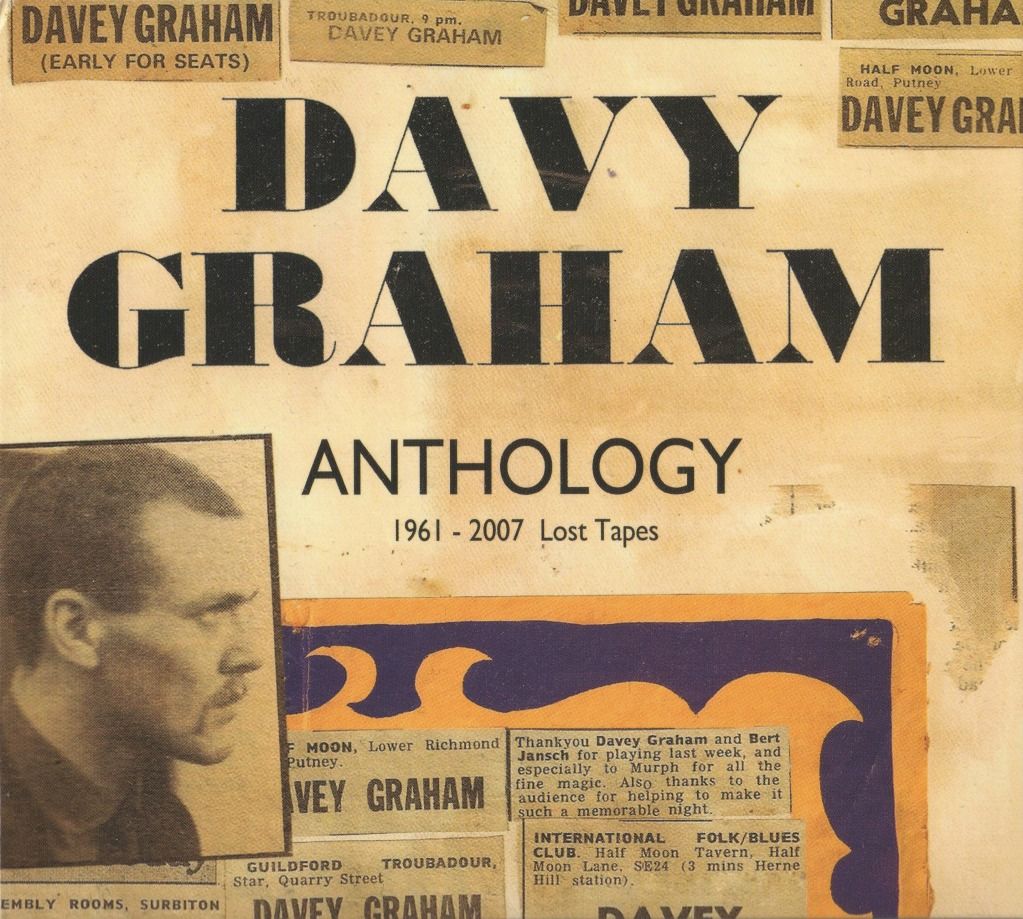
Davy Graham - Anthology: 1961-2007 Lost Tapes


Almost four years after Davy Graham's death, the folks at Les Cousins Music are still working not only to preserve his officially-recorded legacy, but also to expand the scope and depth of his output, making it clearer for those who weren't there why the guitarist was the undisputed king of the 1960's English folk revival.  Nostalgically packaged in a collage of images gleaned from Graham's personal scrapbook (and simultaneously displaying both spellings of the guitarist's first name he confoundingly vacillated between), this three-CD collection anthologizes no less than 54 tracks across more than 2 1/2 hours of unreleased recordings.  Count me in!

It's a fool's errand to attempt a track-by-track analysis of an anthology so deep, so I'll attempt to convey some general impressions and reference tracks where appropriate.  Having been a Davy Graham fan for several years, I think I'm finally starting to understand how, as Roy Harper says, Graham "never managed to turn his talent into a brand that people could go out and buy and enjoy," yet every other guitarist from the same time period and beyond cites Graham as a towering giant of the six-string.  After five years of absorbing Graham's studio output I'm still at a loss to recommend a single album of his that fully conveys and encompasses what was so revolutionary about his playing, and not having been there it's been hard to picture myself in that bright-eyed hopeful time and imagine myself at some bohemian party with Graham conjuring untold spirits out of an acoustic while everyone just sits and listens.  Enter this anthology, which as far as I've heard does the best job this side of After Hours at Hull University of recreating such a scene.  The sound quality (especially on the first two discs) is almost exclusively of home/bootleg quality and most of the performances are solo, with Graham positively shredding in front of small audiences as he sends jazz, folk, blues and "world music" (before such a term existed) through a blender and we get to hear what comes out.

Since it's mostly just an acoustic with or without vocals, the sound quality isn't much of a bother--if anything, it enhances the intimacy of the performances, which find Graham energetically blasting solo performances of many of the folk and blues songs found on his albums as well as never-before-heard tracks.  Throughout, his technique is astounding, transitioning as quickly as ever between lead and rhythm, melody and harmony, from style to style.  Somehow the setting's informality allows the guitarist's hard-won chops to shine brighter with none of the studio adornments meant to commercialize his sound, and we instead get to hear him exclaim "Ah, fuck" after some imperceptible mistakes during a lightning-fast take on Leadbelly's "Fannin Street" with nary a missed note, as well as a verbal introduction to his classic instrumental "Anji" (there are two versions here, along with an unreleased track and album highlight "Anji's Greek Cousin") that details how he wrote the tune.  While the live renditions of guitar-and-vocal folk/blues tunes present uniformly great guitar and often contain vocals that are superior to the studio versions, they also miss the mark when it comes to what made the guitarist unique--more than almost any other Graham album, this anthology conveys the strange alchemy that occurred between Graham's musical influences, his fingers and his guitar, and these discs present ample, undiluted evidence of what was possible when only these elements were on display.

Of the three discs, the third is probably the least essential, reflecting the diminishing returns that Graham's post-60's releases offer, yet it often sounds more vital than studio recordings from the same period.  Though Graham's lifestyle choices and age would gradually slow his playing and attenuate his already limited vocals, we still get some surprisingly good representations of the more delicate British folk, jazz, medieval-sounding instrumentals and world folk music explorations he continued to make through the 70's and beyond.  "The Gold Ring" shows his pull-off speed undiminished, "Sita Ram" and "Mevlut" pair his further eastern experiments with appropriate accompaniment, and "DeVisee Suite" shows a subtle, slower side to his playing that was all but absent in the early days.  The final late-period tracks remind us that we're summing up the career accomplishments and contributions of a distinctive force in 20th century popular music.  As with his 2007 swansong Broken Biscuits, the joy here comes less from marveling at jaw-dropping speed, but more from giving credit where it's due and appreciating that the man's muse was still active at the end.

While I still think it's impossible to recommend an accurate starting point for a prospective Davy Graham fan (it takes more than the average time investment to really "get" him as an artist), this anthology is a surprisingly worthy addition to even a modest Davy Graham collection.  Unlike so many retrospective collections, it manages (with the help of Graham's considerable skill and restlessness) to make familiar songs sound fresh and new songs sound immediate and relevant to the further-broadening portrait available of Graham as an artist. 

Get it here.

Friday, November 18, 2011

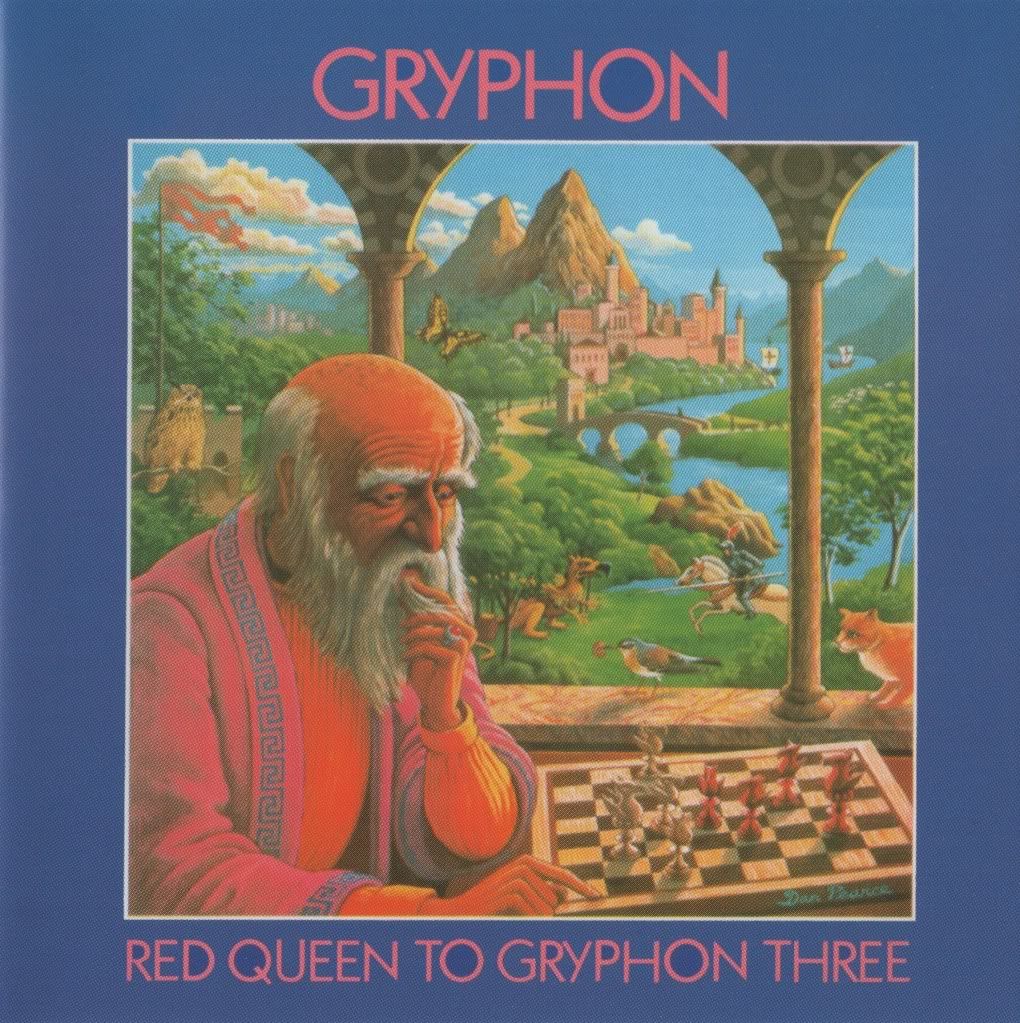
Gryphon - Red Queen to Gryphon Three


Some progressive albums from the 1970's sound like the compositions could be played in the present and might actually manage to sound a little more modern, while others remain permanently tied to the time of their origin.  British group Gryphon's 1974 third album is surely one of the latter category, and a perfect choice to end the relative drought of progressive material here.  Listening to this album is like burying your head in a synthesized pillow of 70's renaissance heaven. 

Among the numerous progressive groups of similar ambitiousness, Gryphon are distinguishable (on this album at least) for eschewing vocals entirely and utilizing crumhorns, a Renaissance-era woodwind that imbues the band's backward-looking style with some aural authenticity.  Looking at the band's credits, though, it's not a huge surprise they're adept at accommodating the crumhorn--the horn is double-reeded, and Brian Gulland spends half of his time in the group playing bassoon.  Unsurprisingly considering these guys' academic credentials, the virtuosic level of musicianship is one of the album's strongest characteristics.

Compositionally, Gryphon has to be one of the most classically-influenced contemporary progressive groups, neatly folding Renaissance and especially Baroque influences into their songs while still pumping up the amplification with electric guitar and bass, drums and some well-arranged synth parts.  The album's "Opening Move" boasts some of the dreamiest instrumental passages, utilizing gorgeous but tense chord progressions, and juxtaposing a twinkling group sound very much influenced by passages in similar Yes songs with interlocking contrapuntal sections similar to those often explored by Gentle Giant.  Unlike Yes and Gentle Giant, though, Gryphon rarely breaks past the Baroque atmosphere into a more contemporary rock sound.  In some ways, they don't have to because their vocal-free sound doesn't pose the problem of matching lyrics and vocals to such an academic sound, but it's also because they're exploring the fusion of classical and rock to a much deeper extent.  The ebb and flow of tempo and energy in "Opening Move" is abetted by the development of a strong melodic motif and showcases of the band's multi-instrumental talents.

"Second Spasm" features the most overt rock sounds of the album, with the bass and guitar doubling on a boisterous and satisfying progressive riff after a couple of the most intricate Medieval and Baroque passages of the album.  As might be reasonably inferred from its title, "Lament" is the requisite quiet piece, which seems slightly unnecessary considering even most of the mid-tempo pieces here are fairly mellow.  By the time the album closes with "Checkmate," it's apparent that the group's arrangements--replete with synth/piano double runs and multi-flute harmonies--are the album's greatest asset.  While some of the melodies are unmemorable even after numerous listens, there's always joy to be found in the spaces between the multiple simultaneous sounds, and it's clear the band took great care with keeping the sections of their extended pieces constantly on the move and heading toward the next surprising combination.  While the band's sound is uncommercial by even progressive standards and the album will always sound hopelessly dated, this kind of music will always sound great to the converted and acts as a cheerful reminder that there was once a time when bands making music like this could land a record deal and at least have a shot at success.

Get it here.

Thursday, October 6, 2011

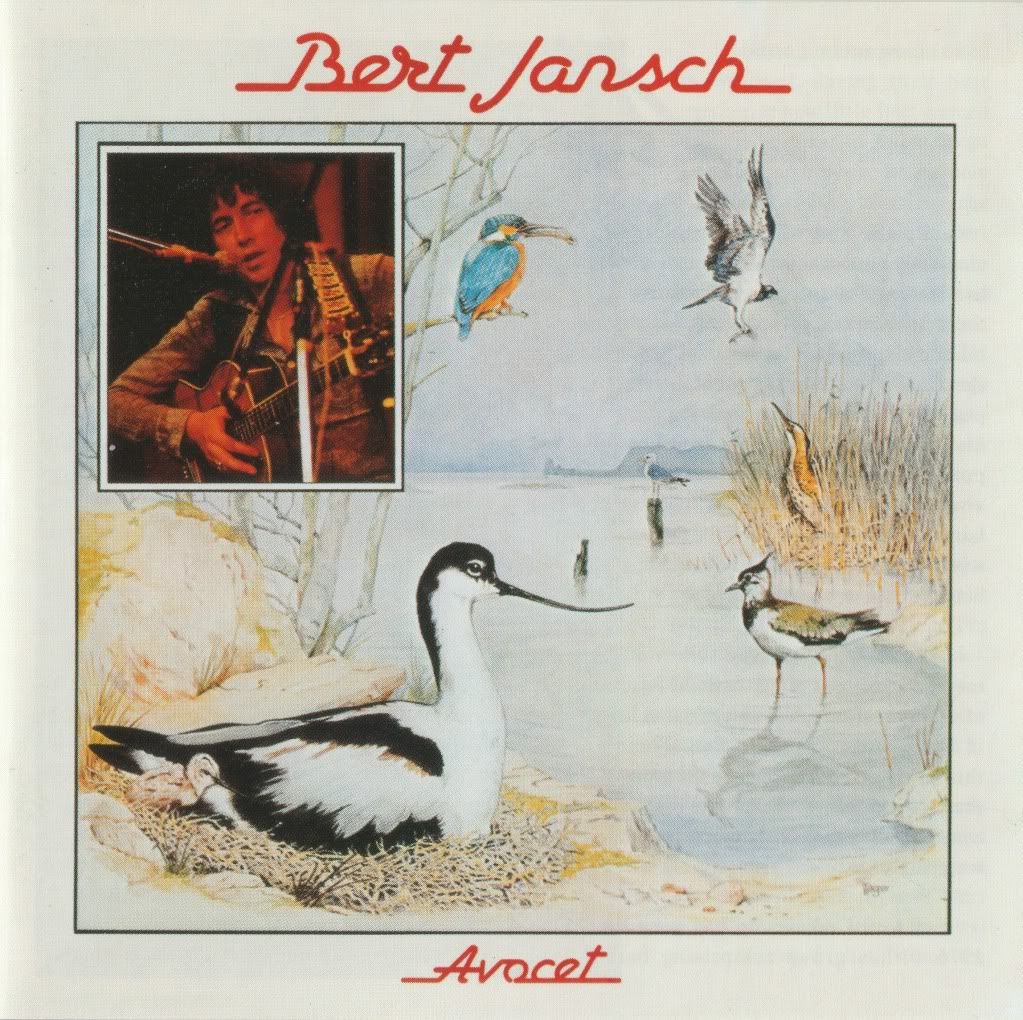
Bert Jansch - Avocet


In observance of Bert Jansch's passing yesterday, I think it's fitting to feature what's probably my favorite Bert Jansch album, 1979's Avocet.  Though Bert had already flirted with pure instrumentals on his solo albums, as far as I know Avocet is his only all-instrumental album.  While it may not get the attention Bert's earlier solo records generated, I think it's a fine showcase for Bert's abilities as a guitarist as well as a composer, and a sort of detour I always wish he would have pursued further on other albums.

The lengthy title track occupies the first side of the album and is thus its centerpiece.  It's easy to realize right away that this is what music critics love to call a "pastoral" album (I wouldn't be surprised to hear the words "very British" either).  The focus, of course, is on Jansch's fingerpicked acoustic guitar, supported by all-around double bass badass Danny Thompson and English folk journeyman Martin Jenkins on violin, flute, mandolin and mandocello (don't get to hear that one very often), who often carries the songs' melodic burden.  Jansch's playing is typically beautiful, seamlessly superimposing arpeggios, single-note lines and multi-string leads on top of his characteristic Travis picking.  I'm always struck by how understated yet impressive Jansch's playing is when viewed close-up; it doesn't sound like he's showing off, but the amount of string bending, pattern-changing and fluid stylistic variation is constant and awesome in its scope.  "Avocet" meanders gently through its many parts, providing plenty of melody to anchor the musicianship--though it's not the most focused extended instrumental, it manages to weave a recurring melody across major/minor subsections that span folk, jazz and more of a renaissance flavor before gently coming to rest with Jansch's uniquely mellow-yet-somehow-violent plucking.

Call me a rogue, but the album's second side sounds even better to my ears--the shorter song lengths seem to lend themselves to more distinctive structures.  "Lapwing" transcends Jansch's rudimentary piano technique to deliver a pensive minor melody, while "Bittern" introduces a hypnotic, swaying waltz melody and showcases Thompson's righteous bass skills (I can't decide if he's simply an awesome bassist, or it's just that he's miked hotter than most, or [more likely] both).  Things get jazzy on the darker "Kingfisher," which features some of the album's more surprising chord changes.  The 5/4 time of "Osprey" and the lush lyricism and guitar/mandolin doubling "Kittewake" close the album at its most melodic, proving that, though the title and mood of the disc connote nature documentary background music, there's more than enough substance here to justify close listening.  After reacquainting my ears with these songs, I think Avocet is a fitting representation of Bert Jansch the musician--unassuming and humble, yet full of complex and effortless beauty--you just have to take the time to pay attention.