Showing posts with label 2011. Show all posts
Wednesday, January 4, 2012
Tyler Fortier - Bang On Time
Time for some friend music! I've known today's artist--Eugene, Oregon-based singer/songwriter Tyler Fortier--since we were both about five years old, having both grown up in Camas, so it's always a pleasure today to track his continuing path as an artist and a special pleasure to feature an album of his here on the blog. Bang on Time is Tyler's third release of 2011, following February's ...And They Rode Like Wildfire Snaking Through the Hills 'Neath the Scarlet Sun and April's Fear of the Unknown. The fact that he managed to even find time and energy to write, record, distribute and tour behind three releases (let alone take the care to give each album a discrete identity) is hard to imagine, yet here the evidence is for us to enjoy.
One thing we songwriters and musicians hate to hear is that we've improved or gotten "better"--there's no quicker way to backhandedly dismiss a creative legacy that took years and an immeasurable amount of personal investment to create. When I say Tyler has improved, I mean that he's progressively honed the aspects of his music that have been there making his albums great since the beginning--he's become more assured as a vocalist, his artistic vision has become clearer with each release and, most importantly, his craft as a songwriter has reached a level of nuance that pushes it well past what many working musicians are even capable of.
Tyler introduces Bang On Time as stripped-down and lyrically-driven; while I'd hesitate to call the arrangements stripped-down (songs often feature several acoustic instruments, three-part vocal harmony, and there are a few string arrangements), the mood is certainly more contemplative than the rock arrangements of Fear of the Unknown. The lyrics are indeed the centerpiece, with the irrevocable passing of time being the prime thread that connects Tyler's varied thoughts. After listening a few times, I'm most struck by a feeling of immediacy, the sense that now is the imperative time for action, whether it's to get out of "A Place I Used To Know," to stop the clock in the title track, to continue moving "To Keep From Growing Old," or to cut the shit and get back to the things we really care about in "This World Is Moving Slow." Tyler for the most part avoids cliché when dealing with these topics, and overcomes their familiarity to the listener with an earnest emotional authenticity that always shines through.
Of course, melody and hooks never hurt. Moments like the transition from the chorus "home" to the bridge "home" on "This World Is Moving Slow" come at just the right time, and the restraint and simplicity of a chorus melody like the one on "When The Day Gets Lonely" transform and elevate a track that begins deceptively plainly. While we're on the subject, one of my very favorite things about Tyler's recent work is his continuing musical relationship with his fiance, Erin Flood, whose harmony vocals blend with and accent Tyler's lead vocals perfectly, amplifying the emotional power and lifting less memorable songs like "Sweet Marie" with enhanced melodicism.
Equally as exciting as Tyler's attention to songwriting and arranging craft are the places where he starts taking risks outside his established field, like when the breathiness gives way for a naked, strong high or low note in the vocals, or on unexpected songwriting experiments. While the textured instrumental arrangements occasionally have me wondering if the same result couldn't necessarily be achieved with fewer sounds, a song like the moodily dark "Bang On Time" hangs on its hypnotic bassline, cavernous reverb and multiple guitars, while the album-closing "We Waited For Everything" successfully employs a dense arrangement that includes bells, pre-recorded voices, piano and spacious delay to enhance the song's dream theme with subtle psychedelic touches. With today's proliferation of independent musicians and the ease of creating and distributing digital recordings, I often wonder what it takes for good music to finally reach mainstream notoriety--hearing songs like these, it seems like Tyler's starting to tap into even more methods that can distinguish him from the host of other Americana acts out there.
I spend so much time looking for "out-there" artists that deconstruct our fundamental assumptions about music aesthetics that I can forget how equally rewarding more traditional music can be if the songwriting is crafted with minute and loving detail--I look forward to seeing where Tyler takes his rarefied craft with his next release. For now, you can see him live on his solo tour around Oregon and Washington--I'll be at Nectar Lounge to see him this Friday!
Wednesday, December 7, 2011
Cheap Seats Part 1: New Album Go!
The time has come--I'm fresh off my first two days at Cloud City Sound Studios in Portland, OR starting work with engineer Justin Phelps on my next album. Though I've been working on demos for a few months, this week marks the official start of the album as a professional production. It was an interesting and activity-packed couple of days with plenty of progress made--we tracked rhythm guitar for eight songs and vocals for four. Although there will be numerous other instruments on the songs, getting a tight and accurate base skeleton of one instrument and vocals is one of the most crucial parts of the process. Less quantifiably, I'm really glad to get the learning experience portion my first professional studio days behind me--the differences between demoing and recording (my last album was all home recorded) at home and in a professional studio are huge. On the one hand, at home creative control and patience for perfectionism are absolute. On the other hand, though, the ceiling for perfection is much higher at a professional studio, and the technical and creative input of a professional engineer like Justin are invaluable. After I started getting through the jitters and self-consciousness of having to take and retake certain sections over and over, Justin and I were able to get in a good groove and the benefit of his professional experience became apparent--not only does it help to have input from someone who's approaching my songs and arrangements with fresh ears and a well-developed sense of taste, it's also helpful to have someone there to say, "Hey, that take was great, let's keep going" when I would probably continue trying to get every performance detail perfect (in my ears) before moving on. Most of all, it feels really good to work with someone who is taking my vision and goals seriously and is investing himself creatively in the project--I know it'll be much stronger for it. Having someone besides myself treat the project as something worthy of that investment is immeasurably boosting to my confidence.
As I continue to create this album I'm planning to continue this "Cheap Seats" series to both document my experiences and in hopes of providing people I know and all of you music "sharers" with an insight into what goes into the production of an album like the one I'm making. I'd like to dig deeper into some of the unanswerable questions relating to modern music and the life of an independent musician like myself. These questions include: What is the measurable value of music and music recordings? What is non-commercial music and what's its purpose? Is it reasonable for a musician to attempt to make music a paying career, or should music only be pursued as a hobby? Will more or less great music be created if musicians are poorly compensated financially? How has modern technology impacted the creation and distribution of music recordings? What are the reasonable responsibilities of a music consumer? What does it take to be heard? While these questions probably sound like the setup for a bitter rant, they are all complex issues with many sides and I'm hoping to get feedback from both musicians and music fans alike. I'm just as much (or more) of a music fan as I am a musician, and consequently I think these issues are relevant to more than just independent musicians trying to make it big. If anything, the goal of the pieces will be to show that there's much more to that MP3 or concert you just listened to than meets the ears and eyes. Welcome to the world of an unknown independent musician and the process of recording a contribution to the vast abundance of music this world has to offer--you've got the cheapest seats in the house!
Friday, September 30, 2011
Amplifier - The Octopus
The last 2011 album I'm reviewing this week, Amplifier's The Octopus is as vulnerable or more to cries of "hype" as Matana Roberts' Coin Coin, already drawing extreme plaudits (my CD copy had a sticker on it declaring The Octopus to be "the grand standard against which all prog albums will be judged" or some such hyperbole) as well as some rather focused ire from music fans. Similarly to my experience with Coin Coin, I had read some glowing reviews for this album (the mainstream music press has been quite kind to it) so I was really excited to check it out--how often do you hear music critics putting progressive rock albums in their top albums of the year in 2011? After investing considerable time in this album (it's two hours long with an average song length of 7:30) I regret to say that I'm disappointed enough with it that this review will be the second installment of my Know Your Enemy series.
Let's start with the good things about The Octopus, and let's be clear that there are plenty of good things. Firstly, I want to praise the band's pop instincts--probably the best thing about this album is its melodicism and the amount of catchiness to be found in pretty much every song. The major/minor shift on "Minion's Song" results in an instantly catchy vocal melody, while songs like "Trading Dark Matter on the Stock Exchange," "The Sick Rose" and "The Wave" are all based on melodic guitar hooks, with plenty more to be found elsewhere. Similarly, the band is capable of impressive musicianship--the drumming is pretty solid throughout the album, and there are moments where it's obvious the guitarist has got chops (about four minutes before the end of "Trading Dark Matter on the Stock Exchange" is a good one). The songs here "rock" to the extent that that band's chemistry and energy are evident even though the album's a studio production. Finally, I think the band's ambition has to be applauded--they're clearly trying to create something epic with The Octopus, managing at times to create an atmosphere of grand proportions and tying the album with an intractably esoteric concept, not to mention the fact that they wrote and recorded the album without label support. On paper, there's a lot to admire about this effort.
Unfortunately, there is so much about this music that goes against what I stand for musically that the two hours required to listen to it drag by in slow motion, the minutes blending together into a dull aching throb. To start with, the album is billed as progressive rock. While a discussion about whether or not this music categorically is or isn't progressive is neither interesting nor productive, it might be illuminating to point out some of the characteristics of progressive music in relation to The Octopus. If long song lengths, spacey synth sound effects and song introductions, science fiction lyrics and a complicated concept define a music as progressive, then so be it--this album exhibits all of those components. If "progressive" implies some sort of innovation, surprising content, attempt to move music forward, or at the very least an impressive display of erudite musicianship in composition or playing, then this album falls far short of the mark. As professionally executed as it is, I hear virtually nothing in The Octopus that we haven't already heard before. The really disappointing thing is, most of it we've heard from non-progressive music; these guys aren't even plundering classic prog! In spite of the long song lengths, the band presents us with standardized verse/chorus songwriting, straight-ahead 4/4 time signatures and an ultra-orthodox sense of harmony and melody. I also have to take issue with those who compliment the band's "intricate" arrangements--despite the guitarist's frustrating display of ability, most of the parts played here are based on achingly simple riffs or clean arpeggios that repeat over and over without embellishment or development across minutes and minutes of track length. Similarly, the band's interplay pretty much never rises above predictable rock unison riffs and "dramatic" breaks, failing heavily when it comes to subverting the formula. Combine these structural weaknesses with production that reeks alternately of the heavily processed guitar tone that innumerable bands like Tool have been implementing since the 90's, and synth sounds, effects and samples that sound like they've been excreted by a computer, and most of the music here comes across as the hollow, sterile type of alternative rock that--again--innumerable bands have been producing since the 90's.
If the band marketed itself as a straight-ahead alternative rock band, these commonplace creative choices would at least fit the bill. Instead, they wrap pedestrian substance with a stylistic sheen that implies "this is gonna blow your mind." And how is this mind-blowing achieved? Mostly through the fact that nearly every song is bookended by at least a minute of spacey intro and outro sound effects with no connection whatsoever to the music that eventually appears, not to mention how poorly-integrated and gimmicky they are when they actually appear within the songs. It's like the band wants to recreate "Shine on You Crazy Diamond" without realizing that the song's atmospheric segues actually contain their own melodic framework and act as commentary on the core song's elements; just because you're playing notes doesn't mean you're producing meaningful musical content. The album could have easily saved at least a half hour by removing these interludes without even touching the primary content of the songs (which also could stand to have some fat trimmed). If I'd known how unimaginatively "contemporary alternative" this was going to be, I probably would have been happy to say "that's not really my thing" and leave it alone. Instead, I'm told it's a great new version of something I love only to find out that it's something else in disguise.
Speaking of disguises, let's get to the lyrics, which probably bother me more than anything else here. In support of their labyrinthine concept, the band has chosen to present the narrative with an indecipherable stream of pseudo-trippy clichés and embarrassingly cheesy metaphors and images, including (but not limited to): "ice age cometh;" "we're livin' on borrowed time;" "let empires fall;" "cross your heart and hope to die/don't take it personal" (two in a row there!); "don't you know that we belong somewhere over a rainbow/in the wreckage of the UFO;" "faster than a laser beam [beowwww; immediate laser beam sound effect];" "I know that you set the controls for the heart of the sun" (one of the most obvious Pink Floyd references imaginable); "this could be your lucky day;" "well ha fucking ha" (maybe my most hated lyric of the whole album); "divided and conquering;" "ignorance is bliss;" and "reach for the stars, you might grab one." Rather than attempting to convey the cosmic trip to which they so desperately aspire by using words to disorient and give life to an alien experience, Amplifier is content to undescriptively state their purpose with bland lines like "step inside/take a ride to another dimension," repeated ad nauseum. Don't forget--these words are sung by a voice that at times sounds eerily similar to Chris Martin's and has the grating habit of pronouncing long "i" sounds as "iiiiii-eeeee-iiiiii."
All in all, I applaud Amplifier's work ethic as an independent group and don't begrudge them their success--it's rare that independent artists can generate so much heat without the aegis of a label (though, to be fair, much the groundwork for their notoriety was laid when they were signed to a label, which I'm sure doesn't hurt). What upsets me most is the complacency evident on the part of the band and listeners' willingness to assert that this album is a real trip, mind-bending, and weird, when on some pretty objective levels it's far more regressive than it is forward-looking. I hope that if Amplifier continues to build on their success they'll decide to use their increased means to strive for something a little more outside the box--as of right now, they're about as far in there as you can get.
Wednesday, September 28, 2011
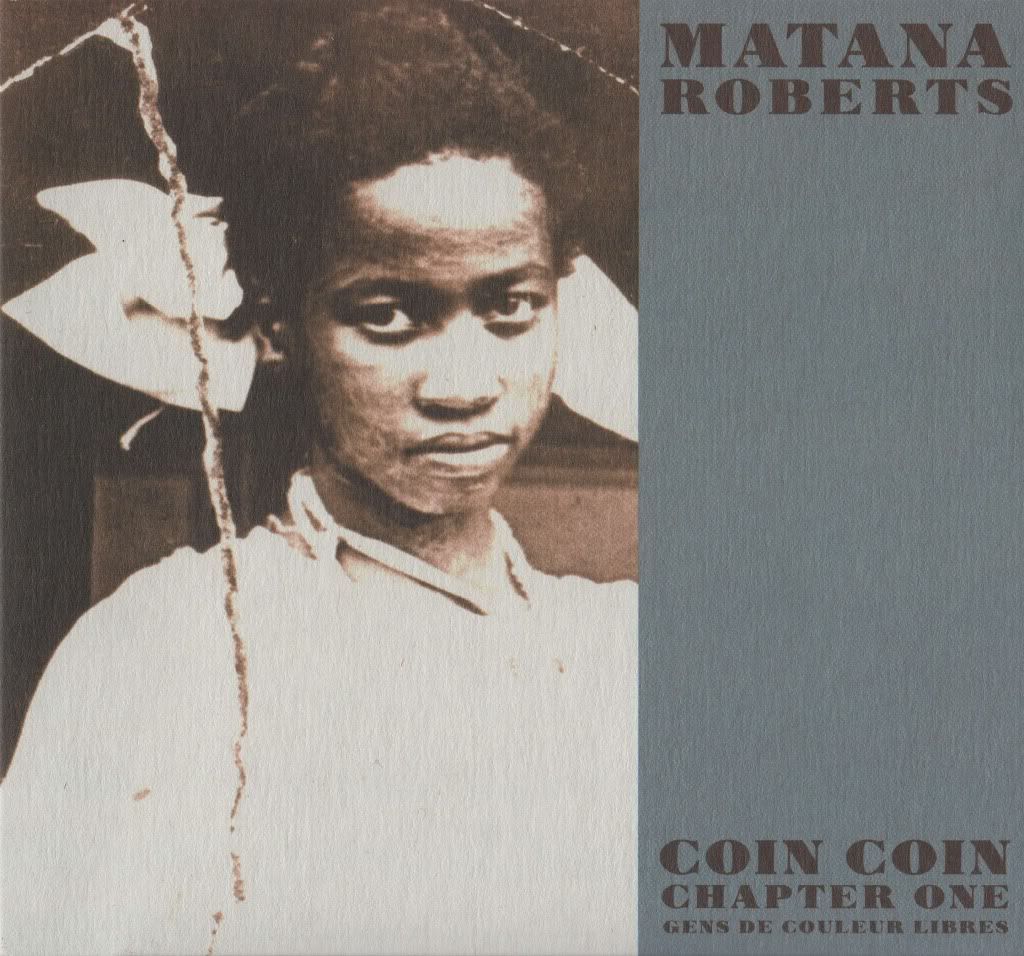
Matana Roberts - Coin Coin Chapter One: Gens de couleur libres
As unfortunate as it may sound, it's unusual in 2011 to have a challenging new jazz release to get excited about, but New York (via Chicago) alto saxophonist Matana Roberts has undeniably produced one. Though she's been publicly active since the early 2000's, the first "chapter" of her ambitious planned 12-part Coin Coin series seems to have been Roberts' biggest break to date, getting her a lot of exposure in print and online. People have already been talking about this album enough that the word "hype" is getting tossed around, which usually results in heavy skepticism and considerably less interesting conversations. After getting to know this album I don't feel any need to declare it the "best" anything of 2011, but I do agree with the growing number of people out there that it's an uncommon album in the contemporary jazz landscape and well worth checking out.
Coin Coin Chapter One is probably best described as a conceptual piece of performance art, which covers the wide variety of musical styles it incorporates as well as the use of poetry and narrative that are central to its purpose. The core themes of the work are memory, history and shared human experience, focusing primarily on subject matter relating to historical African Americans in slavery and positions of adversity, drawing from Roberts' own explorations of her family history and ancestry. This subject matter is presented over and together with a diverse backdrop of different jazz styles, including avant-garde jazz, free jazz, dixieland, blues, and more. While I think it's a valid point that the subject of the African American slavery is arguably not immediately relevant to most people's present-day lives and that it can be "too easy" of a choice (for obvious reasons relating to the horrors that countless African Americans have experienced throughout history) when it comes to eliciting a strong emotional response, I think these objections are a little too dualistic. When confronted with Roberts' vision, it's clear that her exploration of the historical black American experience remains a living, vital part of her (and I'm sure innumerable others') identity, and the authenticity and emotion of her presentation soon dispels any attempt at dismissing the subject matter as purely contrived.
The most powerful pieces on Coin Coin Chapter One are undoubtedly those that feature Roberts' voice either singing or reciting spoken word. In the Coin Coin world, Coin Coin is a sort of "every person" spirit who repeatedly appears in different people's lives across history, reinforcing the concept of shared experience that seems central to Roberts' project. In "Pov Piti," "Kersaia" and "I Am," Roberts introduces Coin Coin's different manifestations with anguished cries, powerfully conveying the spirit's rebirth through another African American's existence. Each song continues, describing each character's experience through Roberts' spoken word. It's hard not to admit that these pieces are crushingly compelling in their emotional message, as Roberts' lilting spoken word describes episodes of yellow fever, slave rape, and redemption through freedom and the jaw-dropping concept of buying back children who were taken and sold as slaves. I really love her poetic delivery; the meter is flowing, organic, and wholly reminiscent of instrumental improvisation--she stops, starts and repeats lines as if she's blowing a horn, imbuing the words with rhythm and often downplaying the force of the ideas, casually dropping blood-freezing lines like "I have seen so much but yet have experienced less than most dogs" and "I am twenty-five; there will never be any pictures of me." Her lyrical concerns also come to fruition through sung vocals, as on the bitterly sarcastic auction block vocal blues parody "Libation for Mr. Brown: Bid 'Em In," and more contemporarily on the dedication "How Much Would You Cost?"
Musically, Roberts' vision is as sweeping and all-inclusive of African American history as her narrative is, drawing together a smattering of all of the historical jazz developments imaginable and weaving them together into a smoothly-flowing collage. The opener, "Rise" recalls Coltrane's A Love Supreme in both title and its incantatory feeling, though its cacophony eventually marries modern electric instrumentation with more of a Pharoah Sanders-like free jazz sound. The mercurial, progressively shifting main theme that introduces the album's spoken word pieces possesses the album's most memorable instrumental melody, effectively aurally tying the recurring themes together, and including a vocal arrangement that recalls 40's film scores. "Song for Eulalie" blends ominous piano riffing with some nice free duet playing between Roberts (whose alto saxophone tone variously recalls both Coltrane and Sanders as well as the keening gospel sounds of Albert Ayler), while the album closing waltz ends on an uplifting note with the disc's most unassuming and most compelling vocal melody.
Though there are numerous brief kernels of vibrant and effective composition, I think one of Coin Coin Chapter One's weakest aspects is that it often plays like an all-inclusive pastiche; its eclecticism is only occasionally displayed in fully-formed songs and more often occurs willy-nilly across songs that seem to have little in the way of structure. While the mood and playing of "Rise," for example, display a slight modern twist on free jazz, the track presents little in the way of recognizable melody or memorable elements. Consequently, when the album ends the actual compositional elements seem rather slight and repetitive--the repeating theme, a couple of traditional songs, and a whole lot of episodic genre sampling spanning over 60 minutes, with a number of ideas taking up a bit more time than they probably justify. Since Roberts has already announced that Coin Coin will be a 12-part series, it's hard not to start wondering if the musical approach will be the same for the entire work, which I fear could result in some artistic stagnation. Though, as far as I know, this album is strikingly original in the jazz world (the closest thing I'm aware of is Max Roach's We Insist!: Freedom Now Suite), it's arguably only original in its performance art/narrative approach and wide-reaching inclusion of different styles. Without Roberts' concept, words and voice, I think the music would come off as a bit unremarkable and unfocused in its scope. I sympathize with Roberts' ambitions, since creating something simultaneously eclectic, developed, and original requires a sort of unidentifiable magic touch. I hope that later installments in the series retain her obvious passion with a stronger focus on composition and hopefully her emergence as a truly original musical voice, neither of which I think have happened quite yet on this release. Either way, I'll be first in line to pick up chapter two whenever it's released, and I hope those jazz artists listening to Matana Roberts achieve a little bit of inspiration to stretch past the hard bop regurgitation that so much contemporary jazz seems to cling to. Whether or not it "lives up to the hype" (probably the most boring discussion imaginable when confronted with an album like this), I think Coin Coin Chapter One is unarguably an uncommon work and worthy of the interest it's received.
Monday, September 26, 2011
Fred Frith - Clearing Customs
For the first of three 2011 releases I'm reviewing this week I've chosen a new album by an old hand--Fred Frith, an artist who's already popped up here in numerous places as a solo artist, band member and producer. I can think of few artists more prolific than Frith, who continues to improvise and compose with unabated verve at the age of 62. This album is a collaboration between Frith and six other musicians--Wu Fei on guzheng (zither) and vocals, Anantha Krishnan on Indian hand drum and tabla, Marque Gilmore on drums and electronics, Tilman Müller on trumpet, and Patrice Scanlon and Daniela Cattivelli, both on electronics. The disc contains one track--the 68 minute-long title track, which is based on a graphical score written by Frith and with a stated purpose of bringing together artists of diverse and unrelated backgrounds into a functioning, communicating performing unit.
Unsurprisingly, Clearing Customs unites Frith's modern classical compositional approach with not only free improvisation but also his predilection for rock and folk. As a large, extended composition, it's also unsurprisingly opaque on the first few listens, though the compositional elements and structure is evident and unfolds more and more with each revisitation. Overall, I think the atmosphere is best described as moody; the most dominant aspects to my ears are the sounds of the zither and the computer elements, both of which account for a large part of the album's spacious feel. The proceedings begin promisingly, with gently pulsing synth sounds and a (real or sampled?) ping pong ball bouncing. Fractured beats soon enter the picture along with some typically Frithian clusters of guitar squeals and atonal cries from the other instruments. After six minutes or so, a somewhat odd pace becomes apparent and persists for the duration of the piece. Generally speaking, things flow viscously between spurting free improvisation, solo showcases for each instruments, and a gently throbbing returning minor motif.
While the idea of a graphical score is a thought-provoking one, my first thoughts are "Will it actually sound audibly different from a conventional score, and will it make a difference?" After getting to know the album, it's difficult for me to say that there's anything inherently distinctive (audibly) about Frith's graphic score, but I don't mind--if the unconventional scoring method provides the musicians with enough direction and inspires their playing, I don't see why it shouldn't be employed as a tool. That said, it's safe to say that this particular graphical score didn't create some unheard-of new kind of music for the first time ever. Aside from the sultry mood, the music this album most reminds me of is Frith's own Traffic Continues orchestral collaboration, though his ensemble here would be more considered a "chamber" group. In fact, it's rather reminiscent of a lot I've heard from later-period Frith, inasmuch as it's organized longform and sandwiches frantic blurts along with quieter sections, utilizes repetitive ostinati figures quite a bit, and includes fragmented but undeniable melodicism. While this approach seems to reliably produce some great ideas from Frith and his collaborators, I think it almost always shows the demonstrable weakness of coming across as too inclusive--like the kind of painting that has piles and piles of paint, albums like this seem to always have a scattershot feel, with compelling ideas and textures juxtaposed starkly against less effective occupation of time and less strong ideas or ones that don't gain traction in the context provided. For that reason, these kinds of pieces can be a frustrating hybrid between improvised and scored music that offers less in the way of free improvisation's pure intuitive musicianship and elemental sound presentation as well as less in the way of the focus provided by careful composition.
There is, however, a lot to like about this--Frith's guitar is in fine form, both percussively and in his signature distorted lead, the zither and percussion add distinctively ethnic timbres to the mix, and some of the beats add a lot of richness and energy to what would otherwise remain more of a chill-out set. The main melodic theme is an attractive one, making use of a descending minor scale and spreading the line across multiple instruments--later in the album (I think in general things get strongest about 3/4 of the way in, especially right around the hour mark with some sweet grooves) it really flowers into full development. I'm not completely sold on all of the electronics; they sometimes verge on cheesy with bursting, blaring samples and obviously computer-generated beat loops (some of the settings are clearly recognizable from groups like Radiohead, while others much more satisfyingly conjure Keith Rowe-like electroacoustic signal manipulation). In all, I think my unease is due to their tendency to create a sterile, tinny and unorganic atmosphere that clashes with the very organic principles behind free improvisation; it seems like the more actual instrument-playing there is, the more alive and breathing the music seems. At best, though, the electronics (and especially their combination with the trumpet playing) conjure the sort of twitchy mystery that Supersilent has progressively explored more and more.
Clearing Customs might not be the most satisfying or efficient experience, nor is it Fred Frith's finest hour as a composer or performer, but it does provide enough substance to be worth the purchase and time spent listening. The album's mission statement is rather lofty, but the results are never really as transcendent or culturally gulf-bridging as the CD text would have you believe. Though Frith has succeeded at incorporating musicians of diverse backgrounds into a functioning ensemble, the "diverse" characters seem to come together anticlimactically--only to produce sounds under the banner of Frith's already-established musical vocabulary and palette of ideas, demonstrating the unfortunate reality that disciplined and capable musicianship doesn't always come hand-in-hand with interesting ideas and vision. Luckily Frith's got both, and so his quirks and idiosyncrasies (most of which he's already developed best and stated elsewhere in his prolificacy) creatively dominate the proceedings. Though some of the longer twiddly passages may, on close familiarity and examination, ultimately prove vacant of any special ideas (which perhaps has to do with that ineffable quality that separates the best free improvisers with those who are simply valiantly attempting), giving this album space, attention and more and more plays has only improved my listening experience and I hope to view it with increasingly (if incrementally) higher regard as an agreeable, if small and inessential, pleasure.
Get it here.
Tuesday, September 6, 2011
Observe->Think->Write->Compose->Arrange->Rehearse->Record->Observe...
For me, working at music always seems to be vexing but ultimately leads to some kind of feeling of fulfillment. Please excuse the indulgence while I use this space as a sort of diary to process some of my recent thoughts and feelings related to music-making.
Probably the biggest thing I've realized lately--and it's taken about eight months to get there--is that my approach to live performance needs to be altered in some way. 2011 conventional wisdom tells aspiring musicians that live performance is the only way to increase your fan base, make money, and become successful. After playing at upward of 10 shows since the new year, I've got mixed feelings. One the one hand, rehearsing some of my more difficult material as single-guitar arrangements has incalculably benefited my instrumental skills and ability to play complex parts and sing at the same time. I've also become somewhat less anxious and nervous about performing (if only a little bit).
On the other hand, it's hard to say that any of the shows have tangibly benefited my progress as a musician who hopes to become better-known. In so many ways, things just haven't gelled: my type of music has little to no established market in the Seattle area, where as far as I can tell people favor a range of music including indie rock, indie pop, indie folk, Americana, "punk," and metal, few of which strongly identify with my style. So, I'll play a bill with singer/songwriters or Americana-type acts and, even though it's just acoustic guitar and vocals, the audience usually just stares blankly, especially if some of the more eccentric songs come out. Speaking of the audience, usually there isn't much of one--a handful of people out to see the other performers, and friends and family (you know who you are), many of whom have been extremely supportive, but I feel they've often taken more of the burden of support than they should have to. Despite warm-and-fuzzy theories that every show is an opportunity to make new fans, after playing around 10 shows, I have yet to sell a single CD, though I've had a few compliments from audience members and more often from other musicians. Though none of my performances have been anywhere near perfect, I feel like I've represented my music and goals fairly well--and yet, it's difficult not to interpret the overwhelming feeling that people aren't connecting with the music as evidence that they think it's not very good.
At the present time, I think my decision to perform solo was probably a miscalculated one. In a hypothetical world where fans I don't personally know come out to see me play, they'd be familiar with my recordings and would appreciate the alternate perspective that stripped-down arrangements provide. In reality, though, my sometimes unconventional songs in conjunction with the sparse arrangements often imply (melodically, structurally, rhythmically, texturally, energetically) instead of directly stating through repetition. While this is a deliberate artistic choice that is still foundational to my approach, I totally understand how someone could come away from a performance and not remember anything about the music or feel that some of the songs were unintelligible. One of many delightful catch-22's is the fact that people dismiss songs that are meant to be growers after one listen. There's also something inherent in audience members' expectations when viewing a solo performer instead of a band--this won't be energetic, it will be mellow, it's not "night out" music, I like rock and this isn't rock, etc. I've thus far avoided playing with a group because of the above miscalculation as well as out of a sort of lazy desire to keep things simple, uncluttered and efficient.
At some point in the last two weeks while practicing for my September 1 show, I felt extremely dissatisfied that I was spending so many hours rehearsing for a performance which would likely net no new fans, rather than working on the amorphous but large blob of new material I've had brewing for well over a year--all so I could sit like a fish out of water in front of an empty room. So, I've decided that, in future performance situations, I'm much more likely to seek the help of one or more other musicians in order to more fully flesh out the songs as well as be taken more seriously by an unfamiliar audience. Even more, a small group would allow me to enjoy the experience much more, not having as much pressure to produce all the sound, and also provide the fun dynamic of playing onstage with friends--a dynamic that will exist whether the room is empty or full. I'm sure I'll still play solo shows but they're more likely to happen at times and places where I know there will be at least a handful of people there who I didn't have to browbeat or plead into coming.
Most importantly and in light of the above experiences, I'm ready to admit that in doing what I'm "supposed" to do (playing live in order to further my "career"), I've moved about as far away as I can from what fascinates me, drives me, and what I love most about making music (in no particular order): writing lyrics, poetry and songs, attempting to compose music for them that is dictated by the words and at the same time enhances and accentuates them but also stands on its own aesthetically, arranging the music for multiple instruments, inventing lead parts that attempt to play with convention and avoid cliché, attempting to stretch myself and grow as a songwriter and incorporate more and newer styles and ideas into every song/experiment opportunity, and especially the thrill of the magical transmutation that happens between mentally planning all of these elements and getting to hear the final product in the form of a recording.
It's with great anticipation and a certain amount of relief that I make this admission and return headlong into my chosen passion. Yesterday I started recording demos of some of my already-determined new songs and I have to say I'm happier than a pig in shit about it. The bizarre composite feeling of compulsion, fascination, disgust, perfectionism, elation, disappointment, surprise, fertility, derangement-verging-on-slight-madness, and restlessness that I felt over a year ago when working on In Not-Even-Anything Land returned virtually instantly and it felt like a warm bath.
Of course, there are still many frustratingly vexed dilemmas relating to the trajectory of me-the-musician as a professional endeavor. I certainly don't reject the idea that live performance is probably the strongest opportunity for success as a musician, but in addition to deeming it not my main focus at present, I also maintain that it's not the only avenue for exposure. This blog has been largely created as an attempt to reach potential interested music fans by writing about related music and posting my creative content in the same place. I've had a really fun time honing my critical skills, sharing music, and watching the readership steadily increase, but the core dilemma persists--how can I best reach my potential audience (which I still believe exists, though it's probably quite diffuse) and convince them to give my music the fair chance and repeated listens that it probably needs in order to be enjoyed? So far, despite my efforts, online CD sales have pretty much mirrored my live performance CD sales--a couple of the most frustrating catch-22's are 1) the fact that people assume that if an artist is unknown that they're not worth checking out, and 2) the fact that most of my potential online audience believes that music recordings should be free and either won't ever hear my music because they don't want to pay for it, or will listen to brief snippets of the songs online (which are intended to be listened to as an album and grow with repeated listens) and dismiss them on first encounter (more on the "music should be free" subject later). I don't have a real answer for this problem at this time; rather, I've decided that I'm committed enough to my creative impulses that I feel like this is worth doing whether anyone supports me or not. Thankfully, I've had a few really heartening interactions with like-minded music fans--this recent review of my album on RYM by a Portuguese music fan with whom I provided a CD confirmed my hopes that there are people out there who will understand a lot of what I'm going for, enjoy the music (even if we differ on a few aesthetic points, which is both natural and constructive), and help spread the word a little bit. It would be really interesting to see what would happen if I could get some traction with a few more music fans like that and spread the word online a little bit more, since independent radio and most of the blogs I've contacted have met with little response.
This diary entry wasn't meant to be a self-pity party, but rather an opportunity to consolidate and process a lot of thoughts I've been having lately about my past year's successes and frustrations. I hope in the future I can improve my reaction time and stay true to my impulses and values without wasting quite as much time between unsatisfactory experiences and keep my focus on efficient production, unfettered connection with the creative wellspring, and on attempting to spread the word and encourage some type of support from potential listeners that will help alleviate the financial burden of funding these pursuits. I'm well on my way with my next project--there are 23 songs on my demo recording list; when I get done with those it's on to intense rehearsal and then to a professional recording studio to build on my last album's accomplishments with a product that's even closer to my vision and of a higher production standard, too!
Saturday, July 23, 2011
One Tea (Song Video)
` ` ` ` ` ` ` ` ` ` ` ` ` ` ` ` ` ` ` ` ` ` ` ` ` ` ` ` ` ` `
Video for one of my newer songs--quieter, reflective and melody-focused. Lyrics and more info are here.
Thursday, July 14, 2011
The Locks
` ` ` ` ` ` ` ` ` ` ` ` ` ` ` ` ` ` ` ` ` ` ` ` ` ` ` ` ` ` `
More of a physical kind of frustration
Centered on gravity--lying low
Looking for an out
Inches are insufficient
Foot-pounds squeeze a reserve of might
Massive bulk held at bay by
old-growth concrete trees
dead at the roots
Iron leaves comb trash
Scalp just a bit of the good stuff
from a small but potent torrent
somehow clearer than the source
the rest released into the foam void
Garbage trees jealously bear the weight
Craving more pressure
Frigid
Begrudging the escapees
Over-containing to a spill no valve can safety release
Shrugging it off as the pressure sags to a limp ex-tension
At first furiously dumping
Then just blandly merging
Good stuff, garbage, primary sources
All a spreading foam puddle
Indifferent
apart from the craving
as iron and concrete too are consumed in the blend
` ` ` ` ` ` ` ` ` ` ` ` ` ` ` ` ` ` ` ` ` ` ` ` ` ` ` ` ` ` `
` ` ` ` ` ` ` ` ` ` ` ` ` ` ` ` ` ` ` ` ` ` ` ` ` ` ` ` ` ` `
` ` ` ` ` ` ` ` ` ` ` ` ` ` ` ` ` ` ` ` ` ` ` ` ` ` ` ` ` ` `
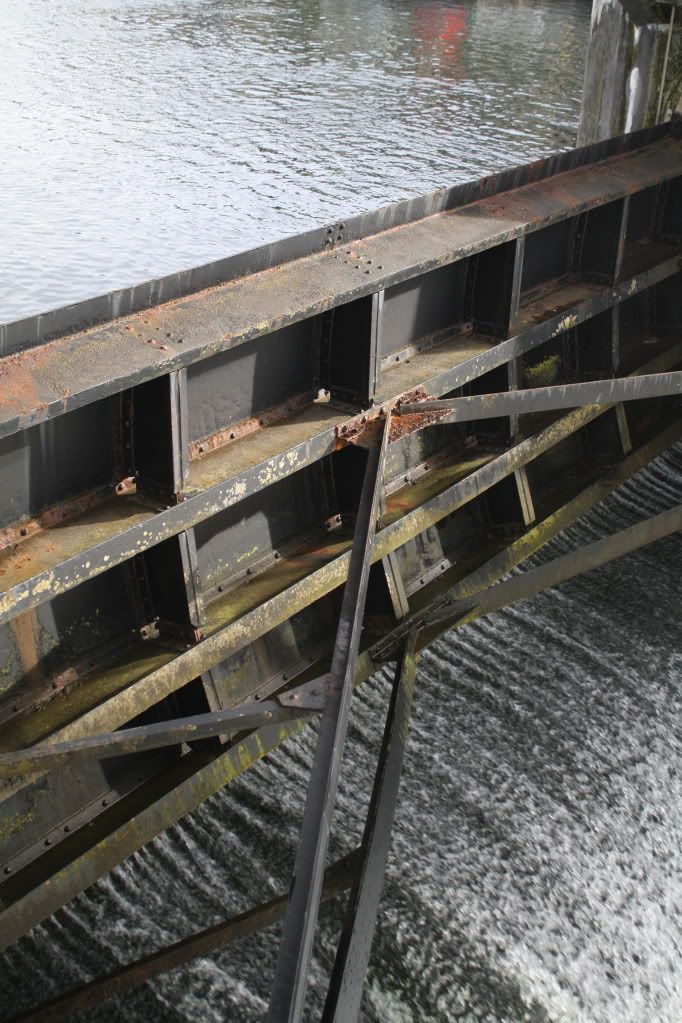
In general, this poem is an attempt to explore the mechanism of the creative impulse and the external forces that inhibit and sometimes ultimately destroy its renewability--wrapped in the imagery and metaphor of the Ballard Locks, a Seattle landmark across which I find myself traveling at least a few times each week. Looking back on my last few months of writing, I notice that I've been repeatedly interested in close-up depictions of inconspicuous physical things or concepts that usually lurk unnoticed in the periphery of our eyes and minds. The shift in perspective turns the focus on the object's individual personality and isolates the specific nature of its being, resulting in a portrait that's not necessarily hostile but perhaps disconcerting, unsettling and certainly alien to our own sensibilities, even if it's couched in vaguely personified terms (as this poem does). Scrutinize one object from its own perspective and you realize there are limitless viewpoints, few of which have any relation to our own until we impose it upon them, which usually results in their broad dismissal (we can't help it, it's how our brains work). Anyway, this method is an attempt to communicate an experience I often have wherein I'm walking by something and I'm suddenly struck by its thinly-concealed strangeness to the point of absorption.
As for the extended metaphor, I've come to appreciate over the years the delicate pressure-release of the creative impulse. Complete absence of antagonism results in shitty art, but over-pressurization threatens to override the fail-safes and extend creation's feverish momentary madness into an inescapable morass. I personally most often notice this external "over-pressurization" in the form of group apathy, remorselessly-short attention spans and the severe devaluation of art (hence the bitter closing line). Even though it's stylistically mellow and unassuming (some consonance, alliteration and low-profile puns), this poem has become pretty close to my heart for the familiar imagery (standing there on the locks, you can really feel the weight of the water held back by the grace of the small amount that's allowed to escape), the characterization of the reservoir and release of creativity, and the resolve to continue maintaining the balance--even if the results merely disappear "into the foam void."
` ` ` ` ` ` ` ` ` ` ` ` ` ` ` ` ` ` ` ` ` ` ` ` ` ` ` ` ` ` `
Monday, June 20, 2011
Word Pillow Quietly Smother
` ` ` ` ` ` ` ` ` ` ` ` ` ` ` ` ` ` ` ` ` ` ` ` ` ` ` ` ` ` `
Comically I sitstanding before you
falling over myself
to describe fumbling profundities
nestled in between
just a pinch
of carefully selected words
What could I possibly use to describe them?
How about more words?
Only this time it'll be a duffel bag's worth
doled out in sloppy handfuls
so it's more like a stuffed word pillow
used to quietly smother the topic in its sleep
Allow me to mock a litany of useless things
while at the same time praising uselessness
Reassembling other people's ideas
behind a gauze of cheap pictures
Pretending self-seriousness and mockery
are somehow mutually exclusive
and in some way compensate for each other
Before reiterating one more time
my distaste for repetition
Patiently wait when I demand space
to carve a greedy slice of our hours for myself
in devotion to only the most unmarketable of pursuits
only to pass the time pursuing
only the most common of habits
Take notes as I distance myself
from the behavior of others
based on the proximity of our resemblance
Exclaiming that
What's to be done is that which has not yet been done
only to quickly retreat from the challenge
equivocating that these days
such things are a matter of degree
when I know full well I can't see that far
What, speaking?
I wasn't saying anything
` ` ` ` ` ` ` ` ` ` ` ` ` ` ` ` ` ` ` ` ` ` ` ` ` ` ` ` ` ` `
` ` ` ` ` ` ` ` ` ` ` ` ` ` ` ` ` ` ` ` ` ` ` ` ` ` ` ` ` ` `
` ` ` ` ` ` ` ` ` ` ` ` ` ` ` ` ` ` ` ` ` ` ` ` ` ` ` ` ` ` `
Whereas some of my other recent poems are composed of brilliant wordplay and jaw-droppingly profound ideas, this one was created pure self-loathing, sarcasm and disgust with my own hypocrisy. Enjoy!
Tuesday, June 14, 2011
Gone Man Bleat
` ` ` ` ` ` ` ` ` ` ` ` ` ` ` ` ` ` ` ` ` ` ` ` ` ` ` ` ` ` `
Just back thereYou--bespoketacled
Planes swimming across oceans of
Truth is the flast flame that's gone all too qulickly
You granted us a shriek peek into the either
(against our baddered judgmental expectorations)
Hollering rowder
before you blurred yourself out of fuck-us
one weak after naut floating above the space shit
your only way back down
Then you dinged back in just in time
to make use of the last of the
un-un-un-unquoinium
before we even triggered out how to synthefy it!
The things that so hrashly know us down
over
under
do they flaunt us in kept gossipy wings
only to disreappear to take the piss out of us
spoiling the mictury
no longer supplising the grizzly necessiprocities?
The flings we chuck up
Is their contritioning enough to
bent-dumbbell-tricep-row us
up
out of this ditch crack cave
we've begotten ourselves unto?
Should youn't be fiftied a don't-worry-about-it
we saw we our supposed deserved fine ale?
` ` ` ` ` ` ` ` ` ` ` ` ` ` ` ` ` ` ` ` ` ` ` ` ` ` ` ` ` ` `
` ` ` ` ` ` ` ` ` ` ` ` ` ` ` ` ` ` ` ` ` ` ` ` ` ` ` ` ` ` `
` ` ` ` ` ` ` ` ` ` ` ` ` ` ` ` ` ` ` ` ` ` ` ` ` ` ` ` ` ` `
This elegy for Don Van Vliet considers the man's accomplishments and reflects my frustration that
Saturday, June 4, 2011
Constructing a Shell
` ` ` ` ` ` ` ` ` ` ` ` ` ` ` ` ` ` ` ` ` ` ` ` ` ` ` ` ` ` `
I'm constructing a shellCollecting necessities, I'll form the walls--make them thick
When I have enough to last a while, I'll collect some more!
A soft quilt for my shelter
And how about when I have enough that I'll never run out?
It's possible to gather useful things before you need them
before you even have them
This is what's called
"invisible stones"
That's what I'll use to shape the tower--invisible stones
I'll wave to you from inside the tower when you pass by
I'm working something out inside!
When the walls are high, I might decide to dress the place up a bit
at which time I'll probably start acquiring what's known as
"see-through paintings"
I can dodge recurring fears and avoid other types of trouble
using see-through paintings
--to a point
Eventually, I'll vacate
The tower, lying on its side, might not look like much at all
But people will definitely want some of the see-through paintings
And the invisible stones will be useful to those
who can get their hands on what's left of them
As for the rest
some of it might come in handy to others with similarly-sized
desires
but most of it will be useless, unwanted
cold without the heat of my need
And yet, it will have to go somewhere
Both useful and useless tossed in a salad of use
less
ness
Still sitting, staying safe
secure
While I sit somewhere, somehow
else
` ` ` ` ` ` ` ` ` ` ` ` ` ` ` ` ` ` ` ` ` ` ` ` ` ` ` ` ` ` `
` ` ` ` ` ` ` ` ` ` ` ` ` ` ` ` ` ` ` ` ` ` ` ` ` ` ` ` ` ` `
` ` ` ` ` ` ` ` ` ` ` ` ` ` ` ` ` ` ` ` ` ` ` ` ` ` ` ` ` ` `
More conventional and expository (if still pretty surreal) than the last poem I posted, save a bit of alliteration toward the end. This poem is sort of an extended metaphor about our relationship with different types of material things and the extremely surreal power attributed to completely intangible concepts like money, which, regardless of the amount, is only a representation of the ability to get more things. How many shells can a hermit crab use at any given time?
Subscribe to:
Posts (Atom)