Showing posts with label Acoustic. Show all posts

Friday, January 25, 2013

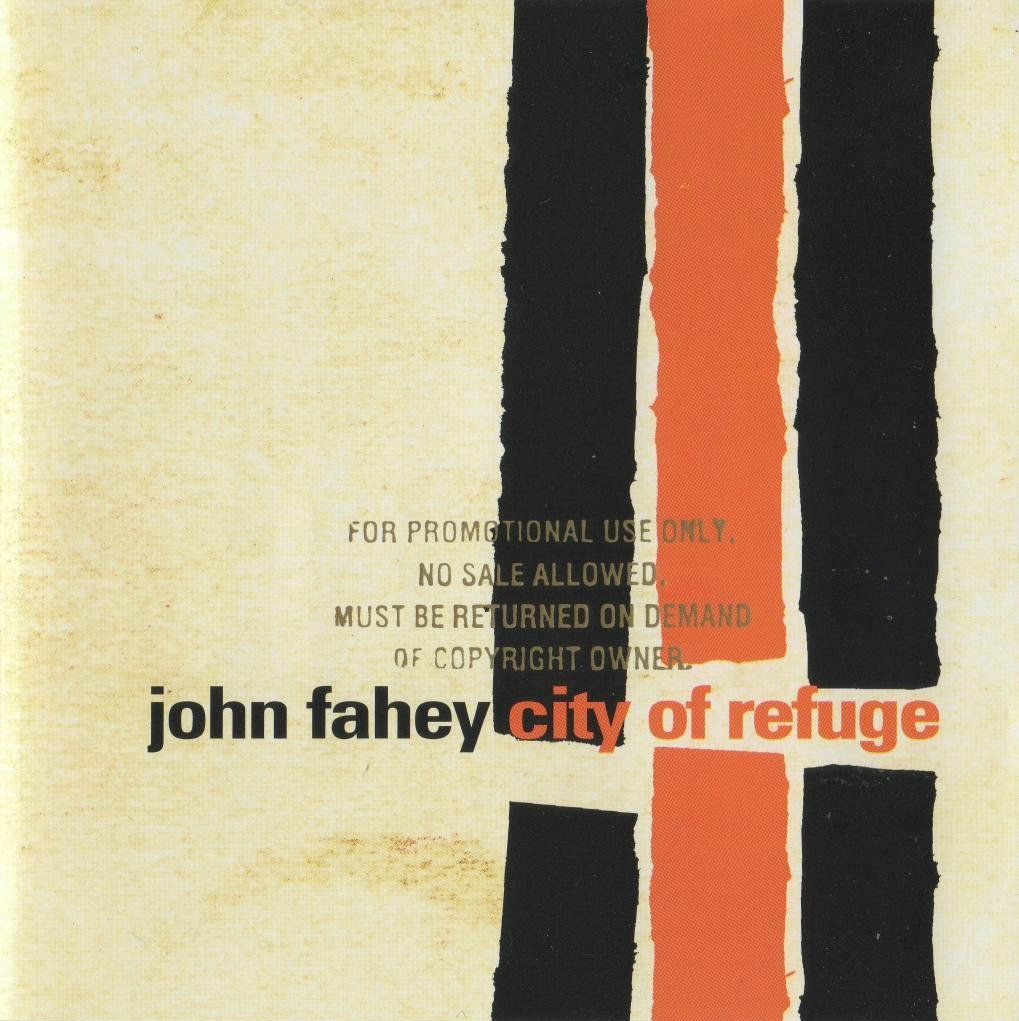
John Fahey - City of Refuge


In investigating Fahey's late period, I'm sympathetic with the fact that he felt dead-ended stylistically and was struggling to move beyond his signature American Primitive tropes into something a bit more...different and new.  The issue seems to be just what, precisely, that new direction is, and Fahey's frustration is evident in the music.

In spite of its recording date, City of Refuge most resembles 60's Fahey records like Volume 6: Days Have Gone By and Requia, with equal space and volume given to acoustic guitar and field recordings, found sounds and electronic sound sources.  As with those other recordings, this approach either stands (Days Have Gone By) or falls (Requia, often) on how well those elements mesh with one another compositionally.  The disc starts promisingly enough with "Fanfare," which sees an unusually (for Fahey) overdriven slide guitar layered on top of droning, industrial electronic sounds not unlike those produced by Keith Rowe, especially in his solo works.  As the tracks play on, for me the impression builds that the compositions aren't very well thought-out, which is a serious stumbling block for an artist whose greatest strength is arguably his ability as a longform composer, not as an improvisor, which is what he appears to attempt on "The Mill Pond" and large portions of "City of Refuge I," plucking single notes against a throbbing background drone.  While the proposition of a more spare approach to his guitar style is intriguing, the results here don't feel particularly well-realized.

Elsewhere we are suddenly jolted out of the avant-garde soundworld back into more traditional Fahey territory, with guitar-only excursions like "Chelsey Silver, Please Come Home," and the dirge-like "City of Refuge III."  The former hints at a new compositional twist on Fahey's slide style, with abrupt stops and rhythmic interruptions, but again it feels like he didn't thoroughly integrate the idea into the piece, or maybe it wasn't an idea after all and the performance is just choppy!  Both songs seem to lack distinctive melodies or a feel other than "Fahey filler"--pleasant enough, but by 1997 we know what this man is capable of!  To my ears, "Hope Slumbers Eternal" is the best-realized piece on the album, blending a droning background that relates tonally to the minor slide guitar melody it accompanies, provoking an eerie, meditative atmosphere--most importantly, the electronics and guitar seem to combine coherently, which is mostly not the case with the rest of the experiments here.  The album closes with the 19-minute "On the Death and Disembowelment of the New Age," which, as far as I can tell, contains no guitar (though it does keep alive Fahey's tradition of humorously long and barbed song titles).  It's probably the most successful sound collage on the disc, but sitting at the end of a selection of noodly acoustic guitar pieces, it raises questions about what it's doing here, and why these songs all belong on the same album.  There is some cool rhythmic phasing of a tambourine-like sound that kicks in around the 12-minute mark and lasts for several minutes, and the album closes like it opened, with a classic Fahey field recording motif--a lonely locomotive whistle. 

This is the kind of album that really gets under my skin--not because I think it's bad, but because there's a palpable sense of frustration from an artist with specific ideas and a seeming incapability to fully realize them.  Probably more troubling to me personally is Fahey's frustrated attempt to break beyond his established vocabulary as a guitarist--for a man who reportedly described fingerpicking as a "disease," he must have felt more than a little trapped.  When an artist verges into atonal and pure sound territories, success seems to become as ephemeral as the compositional building blocks are abstract.  I find it daunting to explore these areas as the measure of artistic success depends even more on an unquantifiable gut reaction, and the difference between good and bad is painfully difficult to control as a composer--but perhaps that's where the adventure lies!  My next stop for late-era Fahey is another 1997 album, Womblife.  While my hopes for a successful application of his challenging ideas are tentative, even unsuccessful attempts in this territory are rewarding and always thought-provoking.

Get it here.

Tuesday, June 5, 2012

Davy Graham - Anthology: 1961-2007 Lost Tapes


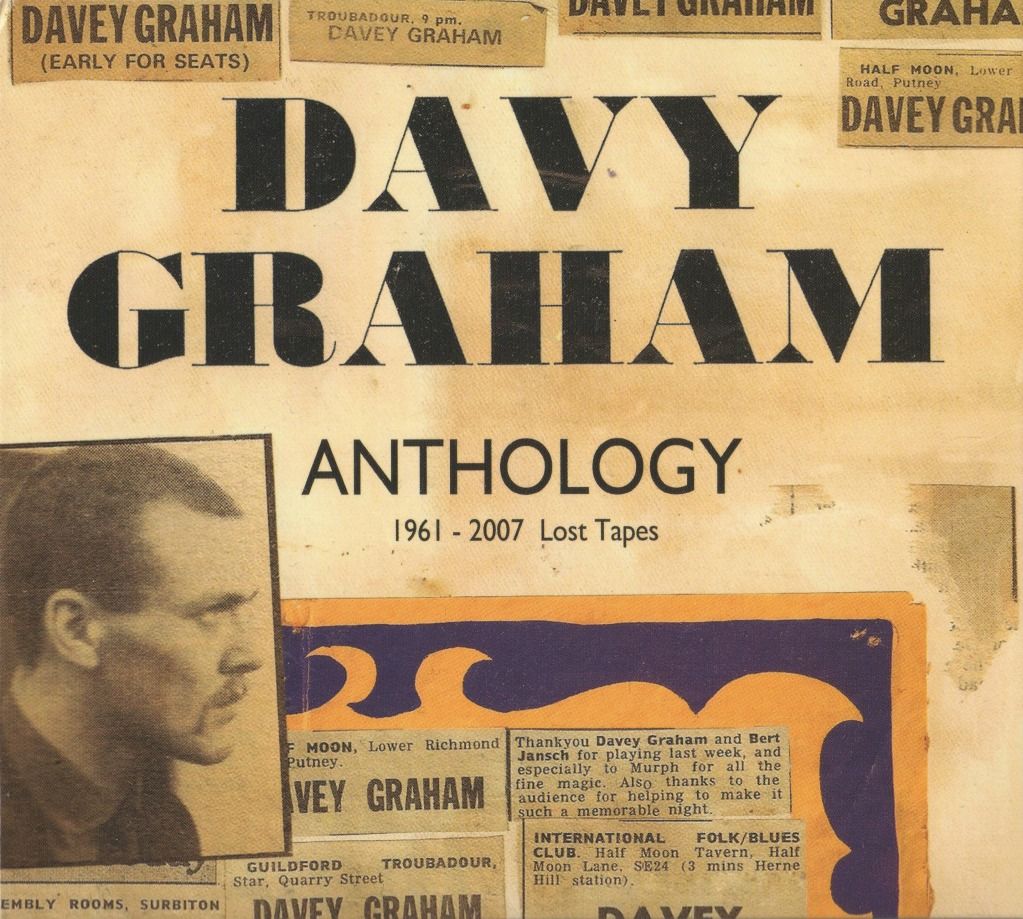
Almost four years after Davy Graham's death, the folks at Les Cousins Music are still working not only to preserve his officially-recorded legacy, but also to expand the scope and depth of his output, making it clearer for those who weren't there why the guitarist was the undisputed king of the 1960's English folk revival.  Nostalgically packaged in a collage of images gleaned from Graham's personal scrapbook (and simultaneously displaying both spellings of the guitarist's first name he confoundingly vacillated between), this three-CD collection anthologizes no less than 54 tracks across more than 2 1/2 hours of unreleased recordings.  Count me in!

It's a fool's errand to attempt a track-by-track analysis of an anthology so deep, so I'll attempt to convey some general impressions and reference tracks where appropriate.  Having been a Davy Graham fan for several years, I think I'm finally starting to understand how, as Roy Harper says, Graham "never managed to turn his talent into a brand that people could go out and buy and enjoy," yet every other guitarist from the same time period and beyond cites Graham as a towering giant of the six-string.  After five years of absorbing Graham's studio output I'm still at a loss to recommend a single album of his that fully conveys and encompasses what was so revolutionary about his playing, and not having been there it's been hard to picture myself in that bright-eyed hopeful time and imagine myself at some bohemian party with Graham conjuring untold spirits out of an acoustic while everyone just sits and listens.  Enter this anthology, which as far as I've heard does the best job this side of After Hours at Hull University of recreating such a scene.  The sound quality (especially on the first two discs) is almost exclusively of home/bootleg quality and most of the performances are solo, with Graham positively shredding in front of small audiences as he sends jazz, folk, blues and "world music" (before such a term existed) through a blender and we get to hear what comes out.

Since it's mostly just an acoustic with or without vocals, the sound quality isn't much of a bother--if anything, it enhances the intimacy of the performances, which find Graham energetically blasting solo performances of many of the folk and blues songs found on his albums as well as never-before-heard tracks.  Throughout, his technique is astounding, transitioning as quickly as ever between lead and rhythm, melody and harmony, from style to style.  Somehow the setting's informality allows the guitarist's hard-won chops to shine brighter with none of the studio adornments meant to commercialize his sound, and we instead get to hear him exclaim "Ah, fuck" after some imperceptible mistakes during a lightning-fast take on Leadbelly's "Fannin Street" with nary a missed note, as well as a verbal introduction to his classic instrumental "Anji" (there are two versions here, along with an unreleased track and album highlight "Anji's Greek Cousin") that details how he wrote the tune.  While the live renditions of guitar-and-vocal folk/blues tunes present uniformly great guitar and often contain vocals that are superior to the studio versions, they also miss the mark when it comes to what made the guitarist unique--more than almost any other Graham album, this anthology conveys the strange alchemy that occurred between Graham's musical influences, his fingers and his guitar, and these discs present ample, undiluted evidence of what was possible when only these elements were on display.

Of the three discs, the third is probably the least essential, reflecting the diminishing returns that Graham's post-60's releases offer, yet it often sounds more vital than studio recordings from the same period.  Though Graham's lifestyle choices and age would gradually slow his playing and attenuate his already limited vocals, we still get some surprisingly good representations of the more delicate British folk, jazz, medieval-sounding instrumentals and world folk music explorations he continued to make through the 70's and beyond.  "The Gold Ring" shows his pull-off speed undiminished, "Sita Ram" and "Mevlut" pair his further eastern experiments with appropriate accompaniment, and "DeVisee Suite" shows a subtle, slower side to his playing that was all but absent in the early days.  The final late-period tracks remind us that we're summing up the career accomplishments and contributions of a distinctive force in 20th century popular music.  As with his 2007 swansong Broken Biscuits, the joy here comes less from marveling at jaw-dropping speed, but more from giving credit where it's due and appreciating that the man's muse was still active at the end.

While I still think it's impossible to recommend an accurate starting point for a prospective Davy Graham fan (it takes more than the average time investment to really "get" him as an artist), this anthology is a surprisingly worthy addition to even a modest Davy Graham collection.  Unlike so many retrospective collections, it manages (with the help of Graham's considerable skill and restlessness) to make familiar songs sound fresh and new songs sound immediate and relevant to the further-broadening portrait available of Graham as an artist. 

Get it here.

Thursday, May 3, 2012

Exuma - Exuma


Getting deep into a recording project, I've found I usually go through a specific progression in my listening habits.  At the beginning, I'll keep listening to my never-ending queue of new music as a sort of respite from the day's work of composing parts and worrying about small details.  As the project starts to take shape and I realize I'm getting somewhere close to actually completing it, it gets harder and harder to tear myself away, and all I can do is compulsively listen and re-listen, fretting over the relative strength of the tracks, what should be done during mixing, whether I need to come up with more songs, and what track sequencing will eventually look like.  During this phase my exploration of new music all but dries up--if I check out something new, I find I don't even fully pay attention and maybe won't even give the music a fair shot--not ideal!  At the same time, though, when I've got a spare 40 minutes, I might pull something random out of my back collection that I haven't listened to for quite a while--because it's already familiar I don't have to pay complete attention, but the result is usually quite pleasant.  Such was my recent experience with Exuma's 1970 debut--reacquaintance with an old friend, and a fresh perspective on the kind of decisions available to musicians. 

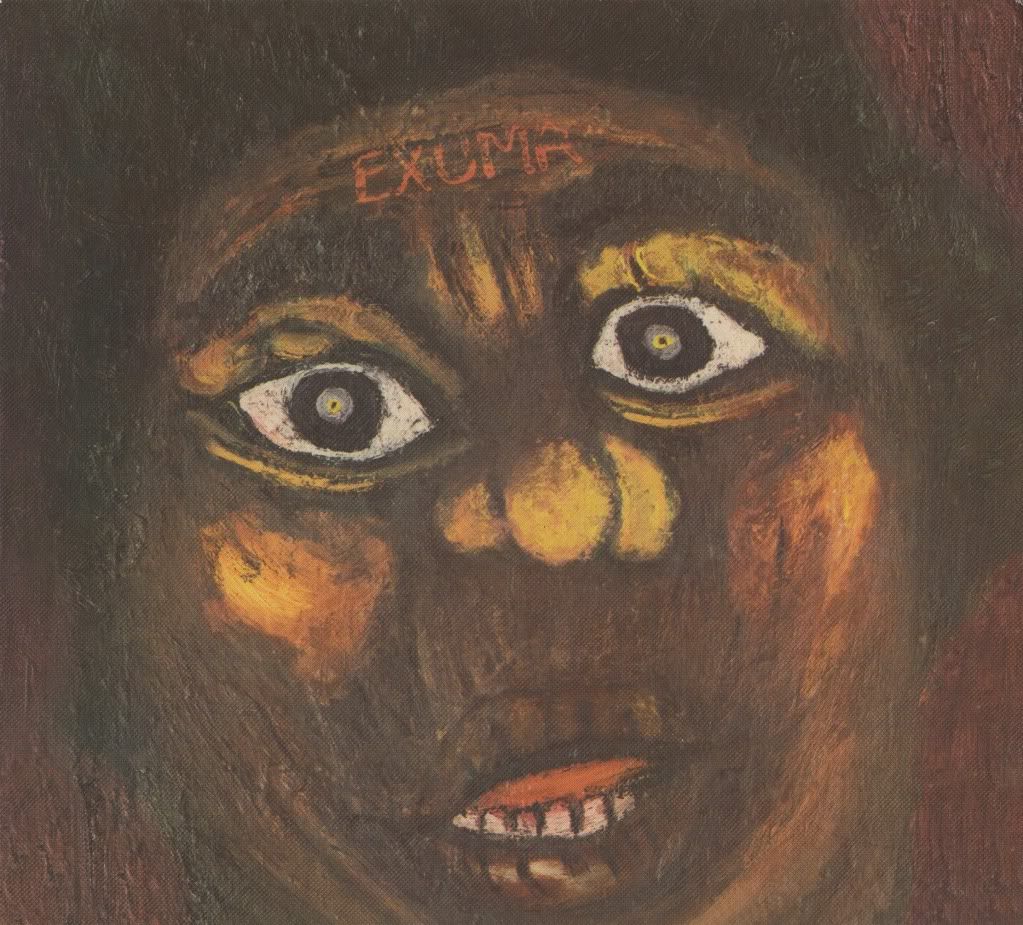
This album makes great use of that most classic option available to singer/songwriters--create a ridiculous, outlandish personality for yourself and perform an entire conceptual album in that persona (cf. Comus, Captain Beefheart, and especially Dr. John circa Gris Gris, to which this album owes both a conceptual and musical debt).  Whether or not Exuma is actually a practitioner of obeah is pretty much immaterial--this disc is an immersive experience of primal witchcraft and dangerously good times.  In the tradition of "Seventh Son," the album opens with some classic boasting, with "Exuma, the Obeah Man" standing as a howled litany of Exuma's supernatural abilities over an appealingly filthy musical canvas of strummed acoustic guitar, hand percussion, chanting and animal sounds.  Exuma's voice is awesome--thick, edgy and surprisingly nuanced as the album goes on; few people can go from tender and soft to throat-shredding roaring with such ease, and it perfectly complements the weird song program on display here.

After the first track's invitation, the album practically plays like a field recording of an obeah ritual, including an ode to "Dambala," wherein Exuma chillingly assures us that we won't be going to heaven or hell, we'll just be stuck in our graves with the stench and the smell...over one of the album's most liltingly beautiful melodies.  We get explicit zombie references in "Mama loi, Papa loi," spiritual testimony in "The Vision," and an extended séance in "Séance in the Sixth Fret."  The reason I wrote earlier that this album makes me think of the choices available to musicians is that Exuma makes some strange and specific ones through the course of the album--instrumentally, it's pretty simple, with nary an instrumental melody to be found (lead and background vocals bear that burden) with commitment to the album's concept sometimes overriding the call for actual songs ("Séance..." isn't so much a song as it is something more like musical performance art, while "Junkanoo" is a fantastic but structure-free percussion jam).  Considering this, it's surprising when a fully-formed Caribbean folk song in "You Don't Know What's Going On" shows up to entertain us with verses, choruses, and absolutely nothing to do with the rest of the album's concept.

I really like how an album like this demonstrates it's possible to pursue alternative goals and produce music just as thrilling as an album full of "good songs;" it's as heartening as it is entertaining, though the challenge of spinning a great album out of personality and mood is probably much harder to achieve than by simply writing some great songs.  As such, Exuma is an album not quite like any other and one that contains some great songs, but ultimately stands best as an album-length statement than it does when you try to pick it apart song-by-song.

Dive into this bizarre world, and get it here.

Tuesday, February 14, 2012

David Gray - A Century Ends


After a busy couple of weeks in the studio, here I am back again to talk about some more music (another Cheap Seats installment should be issuing forth pretty soon as well).  I first got into David Gray since seeing him live in 2001 when he was just breaking through with White Ladder.  Since then I've stayed a fan as his popularity has ebbed and flowed, but it wasn't White Ladder that cemented my support--it was Gray's back catalog, and especially Flesh and A Century Ends, his 1993 debut.

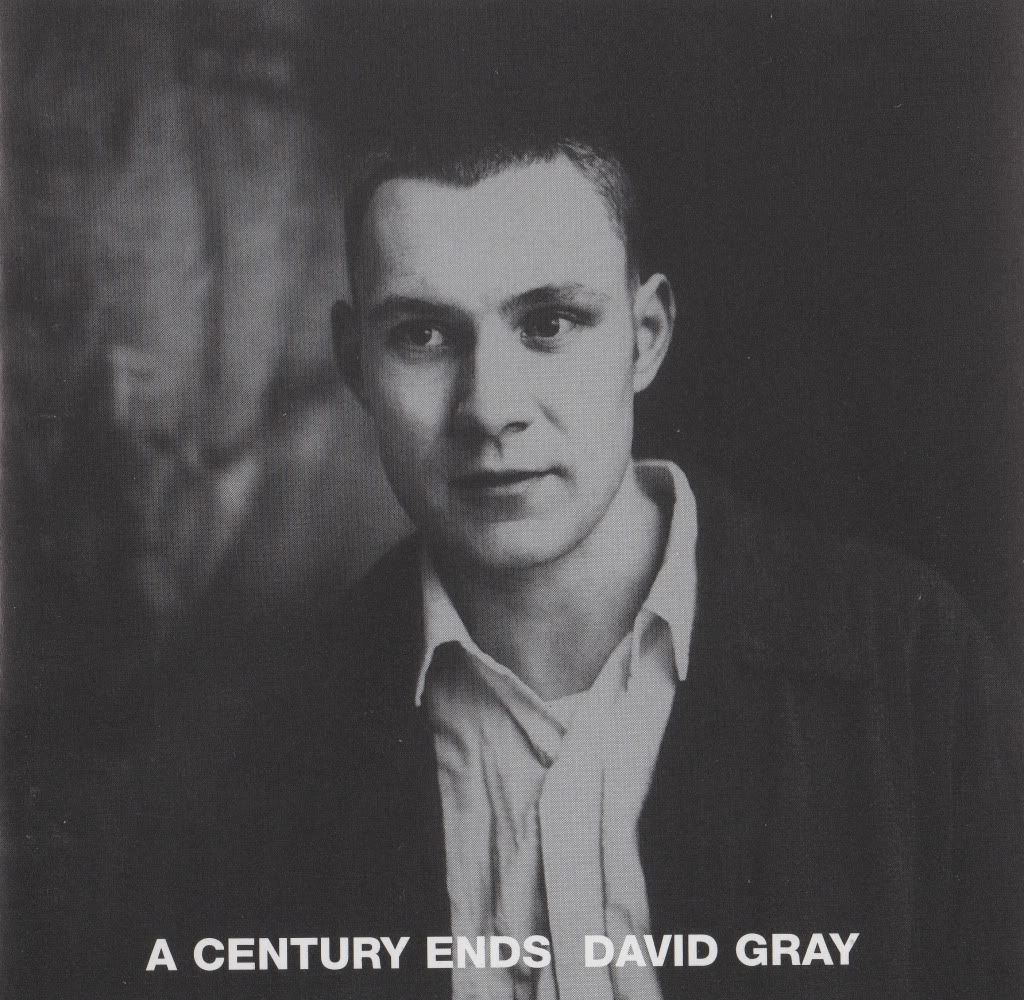
Though Gray's first couple albums display his liking for Van Morrison and Bob Dylan a lot more than his more recent stuff, they're also a lot more focused on pure songwriting than fusing electronic and accessible acoustic elements than his breakthrough albums are.  The arrangements mostly center on Gray's acoustic guitar, though there's some uncharacteristically (for Gray's music) overdriven electrics that accentuate some of the album's edgier tracks.  What always draws me into A Century Ends is the fact that it's much angrier than Gray's later works--as he's matured his cynicism has often been re-routed into less recognizable forms as he strives to keep his music accessible and prolong his mainstream popularity.  Here, though, Gray rails against the apathy and decline he sees in society on songs like "Let the Truth Sting," "Birds Without Wings" and the title track, singing in a sometimes growling brogue and spitting bile with every line.  Revisiting this album I occasionally feel that Gray's poetic lyrics are occasionally a bit florid and sound exactly like the kind of stuff an earnest, angry 24-year-old writes (which probably explains why I liked it so much when I was a teenager), but he repeatedly delivers goods that offer insight beyond his years with lines like "when the cat comes/we're just birds without wings."

Also noticeable throughout the set is a sort of dingy grit that comes with the life of a frustrated young artist--"Debauchery," "Living Room" and "Wisdom" abound with grimy urban imagery and a sense of urgent desperation that rarely appears in Gray's works these days.  This might be most evident on the quietly simmering "Lead Me Upstairs," which focuses the album's themes of innocence lost and disillusionment into the image of a single romantic encounter.  What really balances Gray's youthful angst, though, is a few unassumingly gorgeous tracks that blend the singer's exuberance with an open-ended bittersweetness and depth that's occasionally lacking on some of the collection's more straightforward material.  The opener, "Shine" continues to be one of Gray's finest heartbreak songs, based on open-tuned guitar and rising to a crescendo that sees the singer experimenting with Van Morrison-like vocalizations.  "Gathering Dust," further develops a quiet sense of searching, featuring one of the album's most memorable melodies (delivered by Gray's wordless na-na-na's).

While it's probably true that A Century Ends presents some of David Gray's least mature material, it's also refreshing to hear someone singing passionately and obviously caring about the subject matter, even if the wide-eyed sincerity of youth is a little overly-apparent.  And while the music sometimes suffers the characteristic fate of existing merely as a platform for Gray's voice and lyrics, he does present us with a lot to enjoy in those departments.  I've heard Gray speak mildly disparagingly about his first few albums and say that the too-familiar folk rock arrangements were part of the reason he didn't achieve success before White Ladder (not to mention that this album is a way too British-sounding to find widespread success overseas).  That may be true, but listen to both albums in 10 years (or maybe even now) and I bet this collection sounds a whole lot more difficult to date in comparison.  While Gray has continued to tread middle-of-the-road territory with his recent albums, he always seems to show glimmers of the insight and un-poplike impulses that made his early stuff so compelling.  He's got his fair share of detractors who validly point out his overplay and recent blandness at the expense of recognizing his well-developed craft, but I live in hope that his continuing maturity and subtlety will again result in something that aims to challenge more than it does generate another safe adult contemporary hit.  A taste of success seems to often instigate a hunger that's fraught with compromise, and that feeling is never evident on A Century Ends.

Get it here.

Monday, January 2, 2012

Peter Lang - The Thing at the Nursery Room Window

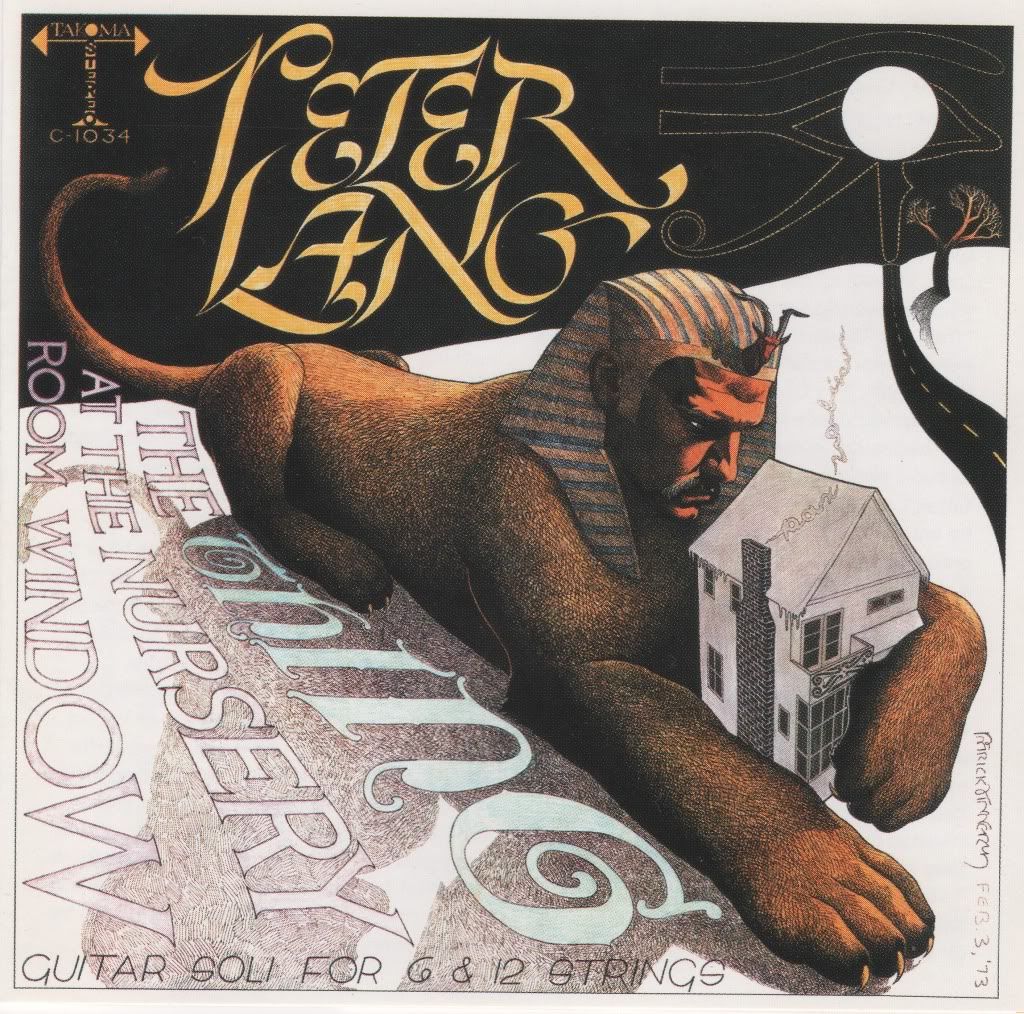
One of the greatest title/cover art combinations I'm aware of...what exactly is that cursive smoke spelling out?

Especially considering the fact that the "American Primitive" genre of folk guitar was just over a decade old in the early 1970's, I think it's a testament to the depth of the stable of outstanding guitarists Takoma Records had assembled that each one managed to have a distinctive style and purpose.  While genre founder John Fahey wanted to communicate something mystical he discovered by examining the elemental essence of early blues players under a microscope and Robbie Basho strove to reimagine his guitar technique to communicate incommunicable mystical secrets, Leo Kottke and Peter Lang both seemed to be players first and composers second--musicians driven most by the joy of making beautiful sounds come out of their instruments.  While this is an important component to any musician's working life, I think vision is one of the elements that separates musicians who truly have something to say from those who are simply technically proficient.  What I find most interesting about Peter Lang's Takoma debut is the fact that it finds the guitarist at a developmental crossroads, growing past his pure technical roots into a territory with far fewer limits, determined only by his own compositional imagination.

According to the CD reissue's liner notes, Fahey told Lang that he was thinking (as a composer) in too small blocks of time and urged him to allow his pieces to stretch out a bit.  You can hear where Fahey's coming from on the opening tracks "Snow Toad" and "Muggy Friday," where Lang's formidable technique seems bent on making the finish line.  While his rapid fingerpicking audibly owes more to Kottke's style than Fahey's, Lang's approach is subtly idiosyncratic, with a nice emphasis on string bends and slides.  As the album progresses, though, we get to see the fruits of Lang's response to Fahey's critique--"Turnpike Terror," though only slightly longer, starts playing with dynamic and textural changes, utilizing space and strumming to take the short piece in several directions.  The marvelous "Bituminous Nightmare" stretches even further, flirting with much more dissonance, theme development and single note layering (for lack of a better term) that seems to be wholly Lang's trick. 

Though only a few of the songs here fully demonstrate Lang's growth as a composer, his playing is always beautiful, engaging, and (for my money) more emotionally compelling than Kottke's.  He proves himself an able slide player on "Wide Oval Ripoff," a capable balladeer on "Young Man, Young Man, Look At Your Shoes," and unafraid of lightning fast swing on "Quetico Reel."  Satisfyingly, though, the album ends on his most ambitious and adventurous compositions, the nearly 10-minute "Future Shot at the Rainbow," which further explores his penchant for overlapping single note lines to an almost baroque extent, unfolding and refolding a humbly beautiful melody with a real sense of journey abetted by judicious pacing and flow.  While Lang never managed a consistent output, his playing is always delightful and this album stands as one of the most enjoyable Takoma releases and a hopeful nod to the virtue of stretching beyond your comfort zone.

Get it here.

Monday, October 24, 2011

Michael Hedges - Aerial Boundaries


Now here's an artist who never fails to evoke conflicting reactions from me, both emotionally and intellectually.  Though it'd be easy to write Hedges off based purely on his record label (Windham Hill, epicenter of the dreaded New Age musical movement and all of its paradoxically limp-wristed perviness), to do so would be to ignore a guitar player who accomplished considerable innovation and influence in his field, as well as a composer of undeniable ability.

That Aerial Boundaries is still Hedges' most known album is undoubtedly due to the brooding title track, which is a well-realized representation of the uniqueness of his spin on the acoustic guitar and also a tight example of his trademarks as a composer.  Technically, Hedges' brilliance seems to lie in his exploration of producing sound by striking the strings not over the sound hole (the traditional location for flatpicking and fingerpicking) but on the fretboard itself--"Aerial Boundaries" combines traditional picking with a repeating figure on the fretting hand and a series of percussive interjections higher on the fretboard (on the lower strings, er) by Hedges' right hand.  The resulting sound (though it almost always necessitates unconventional open tunings tunings to make up for how busy the player's hands are) approximates three or more distinctive parts happening at the same time.  Though plenty of fingerpickers have achieved breathtaking counterpoint and polyphony by abandoning one pick for five, it would seem that no one did it in quite this way before Hedges came along.  While I probably wouldn't say Hedges has influenced me technically as a guitar player as strongly as he has other recent players like Andy McKee or Trace Bundy, I really love the way his style plays fundamentally with the incredible dynamic, tonal and harmonic range that's waiting to be discovered in the acoustic guitar.  It's amazing how many textures and sounds you can get out of a guitar by sounding it in a different way, or how much those alternate techniques can transform the way the instrument sounds when the recording or amplification volume is cranked up--this kind of fretting-as-note-striking shows that a note's decay is really a lengthy window even when the string isn't actually struck over the sound hole.  Hedges manages to avoid his innovation becoming novelty by supplementing it with more standard finger picking and even strumming on songs like "Bensusan."  Probably my favorite tracks are the more percussive, upbeat ones, like the brooding "Ragamuffin" and the funky jabbing of "Hot Type."  Also compelling is the more psychedelic "Spare Change," which uses reverse delay to further expand the interlocking nature of Hedges' playing.

While it's easy to applaud Hedges' technique and his ability as a composer to keep his pieces moving with distinctive sections and developing structures, I can't say that he's gifted or even proficient when it comes to melody--though some of the songs have memorable chord changes, the only one with a hummable melody is a cover of Neil Young's "After the Gold Rush," on which the melody is ironically carried by the fretless bass, not Hedges' guitar.  Perhaps it's my general distaste for the New Age "house flavor," but the gentle harmonic palette becomes cloying in my ears, especially on songs like the embarrassingly-titled flute/guitar/bass trio "Menage A Trois," which is so lacking in distinctive melody that it seems to beg to stay in the background at some New Age meditation party.  In fact, there are very few songs here that manage to break out of the tunefully tonal but indistinct haze that Hedges' composing generates.  While it's certainly "pretty," it seems that the pinnacle of pretty music--melody--is conspicuously absent, which to me almost defeats the purpose of trying to make pretty-sounding music.  From what (thankfully) little New Age music I've heard, this seems to be par for the course--it's as if the first goal of these artists is to make background lifestyle music that's unfocused enough that you can easily ignore it, which is horrifying to me as someone whose greatest joy comes from subsuming myself in complete attention to some beautiful music.  It seems like an unhappy coincidence that Hedges pioneered such a cool technique but used it to make New Age music--this kind of percussive attack just begs for more aggressive music, but it's also disappointing to see that most of the man's followers seem content to follow in his footsteps as a composer as well.  This music is worth hearing for the awesomeness of Hedges' guitar playing, but I suggest you crank the volume up when you do, so you can dive into the guitar playing, overcome the terribly quiet sound of the early CD issue, and avoid the vapid pseudo-emotion that many of these songs attempt to convey.