Showing posts with label Lyrics. Show all posts

Wednesday, December 19, 2012

Song of the Week: "Turn South"

Here's the next song of the week from Cheap Seats--track #4, "Turn South."


~~~
I can tell you what you’re doing is predictably sad
And point out all the wasted potential you’ve had
Believe me, I won’t point the finger any which way but out
I may as well go ahead and turn South

I’ll go on about the secrets that you’d better learn quick
And I’ll scoff if you suggest a method other than logic
Nobody’s impressed with what I’m talking about
I oughta go ahead and turn South

I’ll swear there’s something good in the alternative
I’ll bluff so hard I’ll claim that I don’t mind if I live
I don’t believe in all the shit that’s coming out of my mouth
I’d better go ahead and face South
~~~

In terms of the album's concept, "Turn South" represents an early peak in conflict--it's about overconfidence and ego.  By the time we've reached adulthood, it seems we are secure enough in the way our minds behave (and in the relationship between our minds and our brains) that it becomes just "the way things are" and there's no need to question that there may be other things going on behind the scenes that the conscious mind is unaware of.  In this state, our elective preferences and opinions dominate to the point that ego becomes a caricature.  Of course, this is a personal song with some scathing self-assessment.  The phrase "turn South" relates to my much-explored interest in Daoist writings and classical Chinese religion--it's said that when the emperor achieves order in his kingdom and harmonizes the way of the human world with the way of nature and heaven, as a natural next step, he'll "face South"--as in, "attain perfection."  Naturally, here it's used sarcastically (time to add the ever-popular self-loathing tag!).  Along with "The Knack" and "Chrysalis (In Three Verses)," this makes up the hubristic peak from which a fall is inevitable.

Musically, this is another example of what I'm short-handing "ITC (intuitive through-composition)," where one part is through-composed and the others are subsequently composed by ear to fit together as a sort of sloppy puzzle.  Differently from other songs, though, this one doesn't really have a "lead" guitar part--there's the acoustic (trivia: the very first part I tracked over a year ago...talk about an ego-destroying experience), then the Telecaster (which plays a rhythm part in low-register octaves that somewhat overlap the acoustic) and finally the ES-335 (the last guitar part composed, which plays smaller intervals of thirds and fourths in the upper register).  You'd better believe that things get contrapuntal. 

This being one of the first songs I started working on, it's interesting to revisit because I had so many hypothetical goals and ideas about how the project would play out--for instance, I was hoping to avoid bass guitar entirely for the album, replacing it with bass clarinet and synthesizer where appropriate.  Obviously that didn't work out, but this one has low register Moog and no bass guitar, which contributes to a sort of (attempted) "warped indie rock" feel.  Also contributing to the "indie rock" feel is the eighth-note focus (so many staccato eighth-notes in indie rock...so many) and the absence of lead guitar.  The verses modulate chromatically, which was easy to write on paper but you can bet was a bitch to record vocals for.  The horn arrangement is another interesting thing to look back at--though it changes harmonically, the placement of the parts doesn't change, and I think it's one of the arrangements that fits best and most audibly in the overall mix...guess I got lucky early on, since not all of the parts work out as successfully.  In the studio, this was the second song Drew recorded drums for, and the first really weird one.  At first I was directing him to go "dancy," which turned out to be obviously not what I was hearing in my head.  After a few false starts and a quickly-internalized lesson in communication, we settled on "jazzy" and Drew basically figured out that he could do whatever he wanted, blasting out some ridiculous fills in the song's ending (a show for which I was privileged enough to have front row seats).  And so proceeded the rest of the drum tracking...

Wednesday, December 12, 2012

Song of the Week: "An Unsettling Preposition"

As promised, here I am introducing some material from Cheap Seats--it's my plan to talk about one song per week.  This is indeed a concept album about the human mind, and though there isn't a specific "story," there is something of a narrative progression to the track listing.  "An Unsettling Preposition" opens the album, and while I won't be proceeding chronologically with these weekly updates, this song is the perfect place to start.  Lyrics are listed below, followed by some thoughts about the song's place in the concept as well as some info about the words and music.  Please take my introspection with a grain of salt; it's there for anybody who wants explanation or is interested enough to learn more about the details imbued in this work, but also as a tool for myself in moving forward artistically for my next projects.

*
~~~
You’ve been on the understanding where the way is by the will
You say you use the fundamental features, not the flashy frills
It’s within reason’s pungent sound you sail without a doubt
Though you were once upon a time so short these tools you were without

But I recall

I’ve been in and out of context enough to lose the feeling
I by no means know the meaning of a life without this ceiling

It’s been a while!
But I recall

We’ve been under these assumptions since I thought they’d keep us dry
You say we both agree that I am you and we are I

You’re so sure!
But I recall
~~~

"An Unsettling Preposition" effectively sets the scene--amongst a lot of lyrics and poems that deal with duality, an anxious sense of questioning and explorations-posed-as-dialogues, this song opens the proceedings with a one-sided conversation directed at the complacent, passive, comfortable (perhaps willfully ignorant) self of routine--the "me" that most of us experience, most of the time.  The speaking voice comes from a corner of the mind with a nagging sense that certain day-to-day assumptions ("In conjunction with my brain, 'I' consciously choose to act, then my physical body acts;" "Logic is a clear map I use to determine and decide the course of my actions;" "My reasoning mind and my physical brain are one and the same, always acting in accord with my conscious free will;" and finally, "It's always been this way") are perhaps not quite representative of the entire picture.  I think we forget that there was a time (childhood) when our brains were soaking up sensory input like sponges--before we really had any congealed sense of selfhood or the ego to behave with confidence about it.  Once this system is firmly in place and running like a well-oiled machine fueled by memories of cause and effect, life is an easy enough plate to keep spinning--but have you ever wondered about how much sensory input (present and past) your brain is ignoring because it doesn't fit into the framework whereby you've been routinely living your life for the past decades?  The lyric also posits that the "me" that sits comfortably in routine and the "me" who questions and balks at such an anemic mind-life just might not be co-existing quite as peacefully as the automatic mind would prefer.

Lyrically, I had a lot of fun with this one as a sort of word game--the verses are built from prepositional figures of speech treated as if the locations in question were actually physical.  There's further punning happening with some homophones and imagery tied to the fact that I was looking out across the water from the Ballard Locks to the Olympics when writing the words.

Musically, the song serves as an apt introduction for the rest of the album, displaying a concise structure (a much-abbreviated traditional verse/chorus structure with a brief breakdown and an even briefer sort of post-second-chorus bridge).  It's a three-guitar arrangement, with one guitar (my ES-335 though a tiny 4-watt Hawaiian guitar amp that belongs to my friend Nick, complete with "mother of toilet seat" turquoise case) laying down rhythm riffs in the lower register and two other guitars functioning in tandem and a sort of "intuitive through-composition" (this ends up happening enough across the songs I'll go ahead and start calling it "ITC") in the upper register, where the Telecaster plays two-note chords, and the Firebird plays more of a liquid, distorted, single-note lead.  This approach has allowed me considerable freedom in terms of partwriting where I'll attempt to to create detail-rich parts with minimal repetition that can be followed individually by the listener but also fit together as parts of a more singular whole.  There's a sort of pleasing (to me) chaos in the fact that the parts can either fit together like a jigsaw puzzle, call and respond, blend harmonically, or be saying different things entirely at the same time, and it can all change from one bar to the next.  So far I've achieved this by sitting down and writing one guitar part, taking care to leave at least some space rhythmically, then composing the second by ear, using the first as a general map of inspiration.  Needless to say, it's an exacting, painstaking process and it's an enormous bitch to reproduce in the studio without extensive rehearsal (which I mostly didn't have time to invest in) but to the ear, the results are pretty unusual sounding with that sort of nearly-falling-apart groove that's been another big goal with the project.  The track really came alive when Russ tracked his drums, handling the odd-metered grooves and tempo shifts of the chorus section with aplomb.  Moving forward, I see challenges in developing the ITC aspect so I don't end up continually repeating myself (though by its fluid nature it may take a while for that to happen), as well as in general arranging--there are bass clarinet/alto sax parts, backing vocals and some piano in the final verse that are only marginally audible--this may be partially a mixing issue, but it's certainly in my mind to pay attention to how many elements can exist in an arrangement before they're obscured by the others. 

* Yes, the YouTube videos have ads.  Why?  It's expensive to make music independently...if my music is being played for free by YouTube users and there's a way for me to make a tiny pittance in return for my self-funded creative content, I'll take it. 

Friday, March 25, 2011

We'll Be All Right

Flowers're pretty

` ` ` ` ` ` ` ` ` ` ` ` ` ` ` ` ` ` ` ` ` ` ` ` ` ` ` ` ` `  
Can you sing a song in a whispery voice
About your big love as if you were the first?
Can you do it all cute, like you don't have a choice?
If you can be bad, but not quite the worst

You'll be all right
The poor kids'll listen (they don't know any better)

Can you dress for your gig with an old-timey twang?
Just like the old days, but a little bit cleaner
Can you parrot the songs that your dead heroes sang?
If you can sing it all sweet when they would have been meaner

You'll be OK
The condo people'll like you

Can you sing a song that'll make us forget
The big problems and make our small ones seem strange?
Don't show us any ideas we haven't seen yet
If you can assure us that nothing should change

You'll do just fine
The baby people'll love you

` ` ` ` ` ` ` ` ` ` ` ` ` ` ` ` ` ` ` ` ` ` ` ` ` ` ` ` ` `  


This is a tongue-in-cheek but rather derisive song about some current trends in music.  Specifically, it's directed at the type of breathy "Americana" acts (and their liberal-yet-complacent audience) whose idea of creativity seems to be aping Nick Drake and creating music so predictable, so lowest-common-denominator and unchallenging that it apologizes for even being audible.  That, or they're sterilely covering folk songs note-for-note in anachronistic getups, trying to trick us into believing it's not 2011 (sorry, but your Iron and Wine arrangement was a dead giveaway).  Surely we can set our sights a little higher.

Tuesday, March 22, 2011

Come November


` ` ` ` ` ` ` ` ` ` ` ` ` ` ` ` ` ` ` ` ` ` ` ` ` ` ` ` ` ` 
Come November,
I need someone who'll pander to my beliefs
In brief--
If he wants my vote, rote memorization of newscast persuasions won't do
True, they can be compelling but selling's not always the top goal
                                          --full stop (whole)
I'm afraid we disagree

I want someone who's said, instead of
"God bless us,"
"Maybe our messes stem from our own hands."
Grand speeches reach us, teach us false pride
While others deride what our real progress lacks
                                           --tax.

I need somebody who knows some wars aren't
worth beginning (or winning)
Who knows that a rifle and a contract a hero
do not necessarily make
Take, for example the so-called bravery
of slavery to flags and empty ideals
that steal your days to pay the already rich
                                            --you were tricked!

Please, show me someone whose thoughts aren't bought
by the sheen of a preening wool-pulling machine
Whose spleen stomachs all sides
not non-sides of meaning
manufactured for our end

Send someone quick who's not too thick to shout:
"The more we know, the less it shows!"
Whose throat parches at our sleepwalk forced marches--
Our arms raised, bills brandished in bare fists
kissed by the flaccid promise of
satisfaction from checking purchases off a perpetual list
                                             --will you ever get pissed?!

I need someone who's aware change doesn't happen
in two- four- and six-year increments
Whose implements and wisdom are unhurried
Who's worried, to boot
that the root's that there's more new ones breathing 
than older ones leaving

I need someone who doesn't exist
If you need me, 
I'll be dangling my feet in the water,
my slaughtered ballot already confetti
in the victorious breeze


` ` ` ` ` ` ` ` ` ` ` ` ` ` ` ` ` ` ` ` ` ` ` ` ` ` ` ` ` ` ` ` ` `


An uncommonly political song for me (though the conclusions are perhaps familiar) and a solid step forward on the poetry side of things.  I've been having lots of fun lately getting more and more fluid with rhyming--both in placement and how accurate/imperfect the rhyme is--and this song is the tip of the iceberg.  The process has been freeing, allowing for some associative ideas to arise unexpectedly, though at times to the extent that the resulting poems are totally unfit to accompany songs.  I wasn't sure if I could do it with this one, but it's actually been fun performing the serpentine thing.  There is no structure other than a repeating melodic motif, though it's fairly firmly in a single key--you'll forgive a few departures, right?  I'm going to try not to beat these things to death and make people work a little harder, but I will say that I couldn't resist intentionally mixing a couple of bodily metaphors.  Bad poetry--C minus.

Tuesday, March 1, 2011

Cheap Seats at the Cartesian Theater


 ` ` ` ` ` ` ` ` ` ` ` ` ` ` ` ` ` ` ` ` ` ` ` ` ` ` ` ` ` ` `
And who, pray tell
do you think you are?
What might you think
you're saying?
What do you prove?
Can you act?
Are you more than a caption?
Are you trapped?
Can you become no stronger?
Are you even aware?

You think you know it means something
You know you think it means something
You mean you think you know something
You know you mean to think something
You thing--you mean to think you know!


` ` ` ` ` ` ` ` ` ` ` ` ` ` ` ` ` ` ` ` ` ` ` ` ` ` ` ` ` ` `
Another new song I've been playing at recent performances.  This will likely be the title track on the second album, whenever that happens.  I'm pretty excited about how the project's shaping up--it'll be a collection of mostly short (< 2 minute) songs, many of which will explore different aspects of the human mind.  For example, "One Tea" partly concerns the brain's ability to visualize and conceptualize in abstract, not to mention become lost in thought to the point of ignoring current sensory input.  The short song format should allow for a lot of wide-ranging musical experiments but ensure that they're all easily digestible (well, at least from the perspective of time commitment--some, including this song, tread near or past the far reaches of what I was messing with last time). 

I spend an inordinate amount of time thinking (insert comment about irony here) about how our brains work simultaneously as the executors of our actions and as the collectors and facilitators of our sensory and mind experience.  When I'm feeling particularly...frank, I'm tempted to think that our brains most often act automatically to fulfill their programming--to unconsciously act as we've acted before or are predisposed to act, to supply habitual necessities, to remember and want to re-achieve pleasure and avoid pain, and to veil it all with the so-arrogantly-human conscious certainty that each of our "selves" is really in control of what we're thinking, deliberately choosing before each action, and serving something greater than mere biological chemistry and deterministic behavioral probability.  Luckily, with the help of modern cognitive science and a bit of observant humility it's possible to at least try to rise above this oh-so predictable hubris and attempt something more.  It might not be wrapped in as neat a package, but acknowledging the realest state of things as accurately as possible seems to me to be the first step forward. 

Anyway, one day I was thinking something along these lines and was suddenly aware of that part of my mind which evaluates these thoughts--sure, I may (or may not) have a skeptical thoughts regarding the level of free agency the human mind actually possesses, but where do those thoughts come from?  Are they subject to the same predictability and programming, or do they perhaps issue from a less rigidly-regulated part of the mind--is it possible to stretch that rigidity and, if not travel to completely unmarked territory, to at least tread in a slightly different direction and free things up a bit?  This song addresses that part of my mind that sits in judgment of my programming.  Is it evidence of a more powerful agency, or merely illusory, another aspect of the mind's complexity--efficacy or description?  If it's indeed a sign that more can be wrung out of our minds than zombie-like fulfillment of our predispositions, is this small part of the mind enough to overcome the habitual brain chemistry that gets us through every day, or is it helpless in its novelty?  The shuffling word game at the end of the song ironically warns against becoming too impressed with the mind's ability to oversee some of its own processes.  Let's not forget what we are, where we came from and where we're going.

Musically, the song doesn't have any sort of real time signature, or a key, for that matter, though it's based on fifth intervals so each chord isn't harmonically unfamiliar to the ear.  It's got a tempo and a couple of recurring patterns, but the number of beats of silence between guitar strums alternates even if the pattern is similar.  It's also an experiment with using only bar chords.

Friday, February 25, 2011

One Tea


 ` ` ` ` ` ` ` ` ` ` ` ` ` ` ` ` ` ` ` ` ` ` ` ` ` ` ` ` ` ` `

One tea shared between two cups
Separate pools, distinct
Two cups tilt--contents together
Crashing marbles, silent groans

Still two together
or now a third--discrete from one?
What force set two from one?
Moot questions, you may assert
Recombination erases any artificial identity

However, moving closer
can't you see?
Two side by side
around
passing under
Restless pacing


 ` ` ` ` ` ` ` ` ` ` ` ` ` ` ` ` ` ` ` ` ` ` ` ` ` ` ` ` ` `

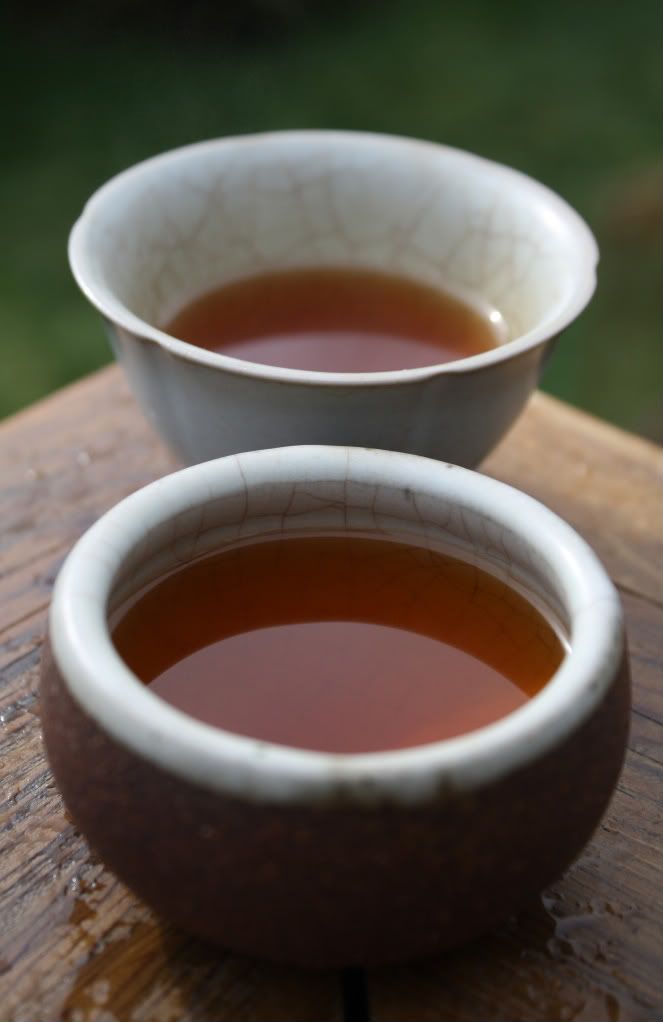
A new poem and song I've been performing this past month.  It's a quiet observation from my tea table.  Here's how it goes--I pour the tea from the pot into the sharing pitcher.  From there, the tea goes into two cups.  Now we have two different cups of tea--sure, it's the "same" tea, but not quite--the tea in the first cup isn't exactly the same as the second--to start with, they're in completely different vessels.  So, now the tea substance in each cup has a name--let's call them "A" and "B."  And what if I pour them back, together, into the sharing pitcher?  Does the tea return to being the exact same as before it was poured into cups and became "A" and "B"?  Is the distinction (which surely described something that was different about the two cups) so easily discarded and forgotten about?  Then I start thinking about the "A" molecules and the "B" molecules swimming, intermingling there in that pitcher.  It's happening as an utterly unmeasurable, ever-shifting dance.  The broader implications of this exercise constitute a substantial cornerstone of my worldview.  It's a good day when I can become so lost in amazement at a small wonder...it's nice to have some perspective.  Oh yeah, this is also a love song describing what happens to two personalities together over time.

Wednesday, February 16, 2011

This and That (The Piping of Earth)


` ` ` ` ` ` ` ` ` ` ` ` ` ` ` ` ` ` ` ` ` ` ` ` ` ` ` ` ` ` 
Adding, swelling
More in one spot
Growing, staying
Pretty much the same
Slowly, quicker
Helps if it's hot

At once--release!
In pieces small enough to have no name

Hurry, arms outstretched
Carry seeds of gold on uplifting fingers
Don't delay--to the weightless depths!
Peek with wonder
Fertile currents allow spring again!
You can know if you don't understand

Choosing, changing
Switching order
Sculpting, fleshing
Accidents become the laws
Encircling meaning
With a porous border

A shape is born!
The product falsely clarifies the cause

Hurry, arms outstretched
Carry seeds of gold on uplifting fingers
Don't delay--to the weightless depths!
Peek with wonder
Fertile currents allow spring again!
You can know if you don't understand


` ` ` ` ` ` ` ` ` ` ` ` ` ` ` ` ` ` ` ` ` ` ` ` ` ` ` ` ` ` 
This poem is about a dream I had--it was one of those dreams with very little action, but a whole lot of implicit meaning and impressionistic understanding.  I was facing a giant aquarium that was lit from the inside, full of tiny microorganisms floating around.  In the dream I remember feeling it was imperative that I get to the aquarium with what I was holding in my hands (which I knew was the beginning of a new life) so it could grow in the hot, fertile waters--and I wasn't the only one there ferrying life to the waters.

I spend a lot of In Not-Even-Anything Land trashing on our unqualified glorification of life (Hiding from Heaven and Dedicated... in particular), but this song celebrates the utterly inexplicable, microscopic transmutation that occurs when inanimate material becomes life.  Although I think we humans prize life as the ultimate good without giving much thought to the greater picture of the other amazing things going on in the universe, the beginning of life is a pretty amazing thing...just not necessarily better than something else. 

Among other things, the music experiments with ambiguous time signatures (for life's seeming randomness) and also with the guitar's timbre--I used a fine brush to play a hotly-miked guitar on the chorus to try and get ahold of the mysterious feeling the dream gave me.

Saturday, February 12, 2011

Hiding from Heaven

Hiding from Heaven

Elbows gasping, nails bleeding—following electricity (whatever THAT is)

I fought my way out of a box to find myself in a bigger box
Then it hit me—it’s not about boxes!
They’re always collapsing—you’re always in the (W)ay

If you think you’re outside the box, then you forgot
The hardest rocks are the ones rattling round inside our heads--Dead!
I found you no longer breathing from your heels
But from your throat!

Each radical breath you take is speeding you to
The shallow grave your lungs are digging for you

It will be filled by a frail form that failed to feel the flailing madness

In the old days they called it ‘hiding from heaven’—back in the day
These days they call it “faith”

Ears sputtering, spine coughing—chased down by stars (whatever THEY are)
I sucked to empty self-fulfilling prophecies, filling my saintly virtue
Til the whole of my being leaked excess in puddles on the floor

What’s more—I awoke to find my “I”ness gone
In its place, a view through the eye of the storm

Can I trouble you to stop a sec, explain why death’s so bad
When everything that ever lived on earth is dead except for this now

Huh? Huh? Don’t make me laugh!

You reek of a living way of thinking, stinking of “human first”—“life as good”

You’re clawing forward as you fall back instead of graciously giving yourself to
A deep grave, gallantly going on with the great game, gulping gutfuls of ground
Grasp the gatekeeper’s grip when you gasp in a new way

In the old days they called it “hiding from heaven”—back in the day
These days they call it “salvation”


` ` ` ` ` ` ` ` ` ` ` ` ` ` ` ` ` ` ` ` ` ` ` ` ` ` `

Before I launch into what’s likely to be another tiresome rant, let me just comment on that very subject. This is the reason I love and MUST practice music and songwriting. You can discuss these things with prose, but you’ll never achieve the thrill of understanding the same (or many more) ideas from only five, well-chosen and aesthetically appealing words. You can write poems about these ideas, but you can never feel the same sublime, soaring feeling or crushing weight without the addition of music and at least one singing human voice. There’s something irreplaceable in that combination, and the coalescence of popular music’s conciseness and accessibility with high art’s depth, audacity and range of emotion is dizzyingly intoxicating—a vein that I can see myself mining for the rest of my days. So, I’ll try to explain myself in these entries, but only for those interested in a different perspective on the sounds than they’ve already provided themselves, and also, personally, to help me understand what I actually think myself.

Out of these 11 songs, “Hiding from Heaven” is unequivocally my baby…a “Rosemary’s” baby of sorts, but no less loved for it. Ever since it began its 2+ year gestation period on the back patio of the farm as an enormous, serpentine, wonky poem, this song has constantly harassed my thoughts. It took two years before I had fit the entire asymmetrical shape of the poem to music, and when it came to recording, “Hiding from Heaven” was the first song I started in November and one of the last ones finished in early April (most of the songs took 1-2 hours to mix, this one took over 4). A lot of thoughts were expended on how best to translate the booming din I’d been hearing in my head into a thing of dark, terrible majesty (insert “yeah, Elliot, it really is TERRIBLE” joke here) and you can rest assured I started feeling sympathetic pangs of the song’s professed madness in the process.

Musically, the song is a culmination of a large number of influences, tempered with a sense of my own personality. Despite its length, the song moves quickly and often abruptly between different musical sections—from the dissonant and odd-metered intro to the spacious first vocal section, the proggy breakdown, etc. I’ve tried my hardest to populate this song with guitar riffs and leads that other players will appreciate, but also that don’t tread the same ground too many times, playing with the song’s themes, dissonance, listener expectations and musical styles. A lot of these parts didn’t seem humanly possible when I started attempting takes, so hopefully that’s a good sign…most importantly, though, they strive to support the song’s overarching ideas. This principle has been crucial for all of these songs, but “Hiding from Heaven” required even more reaching on my part to bring the ideas to fruition—I used (but by no means invented) a few different techniques to get uncommon sounds out of the guitar. The eerie sustained notes at 1:45 are produced by a rubbing/tapping a steel slide on the strings; the single notes with the high-pitched texture around 3:10 come from scraping the pick perpendicularly against the strings windings instead of plucking. Finally, I couldn’t have realized my ideals for this song if my voice hadn’t gotten better. The theatrics you already heard in “No More” are turned up a notch in so many ways and the emotional brunt of the poem required a number of different singing styles and moments of strangeness and wildness to illustrate its intensity. I mention all of this out of a sense of accomplishment, but also to give you an idea of just how obsessively hard I worked to make this song sound how it does.

Lyrically, this is a long and complicated song. It’s heavily influenced by the ideas of and uses a few images from the ancient Taoist text, the Chuang-Tzu to illustrate a feverishly personal mind journey. You know you’re in for a fun time when a song starts with sensory dissociation and disbelief in such “comprehensible” and “tangible” items as electricity and stars…teetering on the edge. The one thing I keep thinking of when rounding up my thoughts for this note is Thomas Paine’s revolutionary “Common Sense” pamphlet—“Hiding from Heaven” means ignoring common sense—the way things simply are—attempting to circumvent demonstrable reality in favor of a coddling lollipop philosophy that panders to our most selfish indulgences. In my opinion, the major religious traditions offered in the world’s marketplace today offer solutions to undeniable human needs that insult our progress as thinking beings. Despite everything our science, art and long historical record has shown us, the best we can come up with is still an anthropomorphized “god” who created everything and will reward us with an eternal “after”life that fulfills all of our creature wants and pacifies all of our living fears—that is, only if we follow the arbitrary system of morality in the book that He (never She) wrote! Please! First of all, our infinitesimal scientific knowledge about the vastness of the universe, physics and biology here on earth demonstrate that a human-centric vision of the universe is a laughable proposition—on top of that, an omnipotent god that looks like a human and any system that is so clearly tailored to compensate for and satisfy human-only desires can only be human creations. Secondly, the justification for this system can be distilled to just one element—fear: fear of not having enough to eat, fear of physical pain, fear of losing loved ones, and fear of the inexplicable experience of death. These fears are entirely reasonable aspects of the human condition, but I think that we, as thinking creatures, deserve a better response than the utter fantasy that is fed to us by the religious institutions who can’t see beyond their own experience of power. There are currently a lot of social and environmental threats to our human world, but we can’t fight them effectively if we don’t address the fundamental ways of thinking that spawn them.

In spite of the above, this song isn’t merely another attempt to tear down organized religion—all you need for that is a bit of common sense, and it’s been done eloquently and effectively many times in the past 200+ years, regardless of whether or not the masses have climbed on board. Rather, it’s an attempt to address the same base human dilemmas in a way that takes into account our current advances (which should be obvious enough to be taken for granted) and reaches beyond to the unknowable to postulate a meaning—a rational mystic’s rally call. Sure, it’s much more difficult than jumping through moral hoops for a pie in the sky, but it’s ultimately a lot more rewarding and realistic.

Achievement of this sort of reconciliation not only requires abandonment of the status quo, but also engagement of our mystical potential (see “Head in the Clouds,” which also cautions against over-rationalization)—it requires intuitive experience of the Tao—(a descriptor for) the ineffable, indescribable, incomprehensible, inhuman, infinite and chaotic way the universe operates and is. For me personally, this process was a turbulent one that included several points of despair. When it comes to conjuring visions of the holistic nature of the universe, there’s a fine line between despair and ecstasy—easing the attachment to the knee-jerk ego response and ultimately abandoning the arrogance of any sense of human importance in the universe eventually replaces fear and despair with serene calmness and even sublime ecstasy. It’s not the human that takes first place, but the awe-inspiring, all-inclusive storm of the universe, from which we’re kidding ourselves if we say we’re separate. Death of a living organism is just one of incalculable aspects of the universe, and seen in such a vast perspective isn’t very dramatic at all. As the only living creatures (we’re aware of) that have the ability to contemplate the void, death is less of a loss of our beloved senses to be feared, and more of a reunification with the one to be anticipated when the time comes—to me a concept much more empowering, exciting and “other” than an eternity of sensory fulfillment on a cloud. So, despite the song’s foreboding atmosphere, the message is ultimately a positive (if challenging) one. Oh, and just remember—these are all opinions.

There, I finally got some ideas across without explaining the song line by line! I am pretty satisfied with the aesthetics of this song, though, and if you’ll indulge my hubris I’ll mention a line that indicates the layered detail that went into the word choice for the whole poem: “I sucked to empty self-fulfilling prophecies, filling my saintly virtue/till the whole of my being leaked excess in puddles on the floor,” which can be variously taken to mean “I sucked” (in the parlance of our time), “I sucked/latched [on]to self-fulfilling prophecies that were empty,” and “I sucked self-fulfilling prophecies until they were empty.”

Not sure how much I like this professor Elliot…luckily tomorrow’s song doesn’t require his services in the least, and he won’t be coming back in this capacity any time soon.

Wednesday, April 28, 2010

Chained and Bound

I know you make a little money—but you owe it faster than you can
‘Cause you’ll buy anything if it fits into your little plan

You like and tell me that I’m better than anyone you’ve found
You’re gonna have to do it all yourself as soon as I’m not around

I know that you only want to keep me where I am
You don’t even notice you’re chained and bound

I know you’ve got expectations ‘cause you think there’s some things that you know
And you want me to shut up and agree there’s just one way to go

I can’t hear the words ‘cause I don’t like the way that they sound
When you tell me that I’ve crashed before my feet have stopped touching the ground

All you can talk about is money and what makes it grow
You forgot what it was like before you were chained and bound

------------------------------------------------------------------------


If one of these 11 songs is the “single,” it’s got to be “Chained and Bound”—concise, punchy and accessible, it’s even got a couple of hooks! If I ever describe myself as something like an “experimental singer-songwriter,” it’s not because I think I’m creating something that’s never been done before, but more that most songs are experiments—attempts to do something specifically musically, lyrically or both that I haven’t done before. When composing the guitar parts for this song, the idea was that the song would combine more aggressive proto-punk-style (out of my comfort zone) power chords with some more progressive elements (right up my alley). The moody, faux Graham/Frith (80%/20%) intro gives way to power chords with additive rhythms and between the verses is a loopier instrumental section. I’ve never played this song live—I probably can, but it’ll be a challenge to keep the wonky changing riff lengths straight with the vocals. It was pretty fun to finally hear the ideas come to life when I assembled everything together in one day of recording—probably some of the most efficient work I did during this whole project. I’m pretty happy with this one, although the progressive elements aren’t quite as noticeable audibly as they were in my brain.

The lyrics are pretty aren’t meant to be too poetic on this one—more economical and attitude-oriented, not to mention extremely personal. This song is an aggressive “fuck-you” to the forces within and without that try to break concerted resolve. The first verse addresses the issue of imposed inertia and the second addresses the sort of reasoning used to talk people out of pursuing more important priorities in favor of safer, more mundane comforts—a kind of sneering affront thinly disguising a desperate plea for acceptance. See you tomorrow.

Saturday, September 5, 2009

Tough Love

Shut yourself in a dark room in the daytime
Fill it with your own oppressive smoke
Your eyes will water--really you're just self-blind
Better realize it's you before you choke

If you're not happy, do something about it!

So you stumbled on a tripwire that you strung out
When you promised everyone you had control
And you fell into your pride now you can't get out
Until you return to yourself the time you stole

If you're not happy, do something about it!

You say the world is just a darkened mirror
You can't see anything that's worth your sweat
It's only you and you don't know what you're here for
Well, if you're all alone, then alone take your first step!

If you're not happy, do something about it!
You have to see: you're the one who can
You have to be more than just a plan

And you medicate yourself with words and plans to fix yourself
But those pills are blowing clouds across your eyes
You slide into bed thinking that you're really doing well
Forgetting that you haven't even tried!

I'm sorry that I couldn't fix your problems
I can't accept the gift of all your grief
Once you climb a person, you can't be down there with them
I can't move 'cause I'm buckling underneath

If you're not happy, do something about it!
You have to see: you're the one who can
You have to be more than just a plan

------------------------------------------------------------

My mom recently asked me if I ever planned to post any happy songs, so here's one with an explicitly positive message. Real life is real life, though, and most ideas I end up writing about are at least touched by trouble. Sorry!

To my memory, I've only performed this song once, at a Whitman Coffeehouse in 2006. Revisiting the words, I'm pretty happy with the flow, straightforward economy, and a few nifty bits. But the music is straightforward and poppy, especially compared to the kinds of stuff I've been working on recently, so I don't know how well it'd fit. Recently, though, I've been thinking more about how a lot of artists these days obediently accept the conventions of a single genre, which can get a bit boring, unless it's really well done (I think I was reading a review referencing the eclecticism of the Al Kooper-led Blood Sweat and Tears album Child Is Father To The Man). Then again, you can't be too eclectic--you've got to have a recognizable sound, and there's danger of becoming a jack-of-all-trades, master-of-none. Getting way off track here.

Not too much going on that can't be gleaned from reading the words. Mostly it deals with those times a person (sometimes myself, sometimes others, as is often the case) spends more time lamenting problems, feeling sorry for oneself, and rationalizing depression by blaming others when the only real solution is taking responsibility and owning the agency to improve the situation. The side note in the bridge is the maddening practice of "OK, this sucks, I'd better do something. Wow, it felt good to admit that--I'll get around to dealing with the problems tomorrow, maybe." Meanwhile, time passes.

Maybe I'll resurrect this one for the next gig.

Thursday, August 6, 2009

The Rules Are Changing

Naked soil, barren earth
The sun is shining down for what it's worth
Writhing field, funny crop
Flailing, scrambling just to stay on top

Full and fat today by forcing fields to fallow
Bodies pressed together meet a hungry end tomorrow

The rules are changing

Chasing blackness, dripping gold
Guiding sparks inside the things we hold
Making journeys sitting still
Entrusting labor to an easy fill

Speeding South today by spinning wheels with smoke
Tomorrow journeys screech and halt as fires cough and choke

The rules are changing

Sweating earns phantom power
Trading numbers for a safer tower
Rules are set, deals are made
Symbols printed, everyone gets paid

Paper notes in piles today make bags and pounds of plenty
Tomorrow numbered paper just won't fill a mouth that's empty

The rules are changing

------------------------------------

A pretty straightforward song. It's probably not inaccurate to say that overpopulation is at the root of almost every major problem facing the human race, and the curve shows no signs of tapering off. Unfortunately, food and energy aren't unlimited, and there's a good chance many of us will live to see serious crises on both fronts. If we do, the things we take for granted (labor made easy with the help of cheap power, cheap and abundant food) will be even harder to come by than they already are today (for much of the world's population, that is). In that kind of situation, the basic economic system (money=goods or services)--in which we all have so much faith--could poof-be-gone like the illusion it truly is. At that point, I'm not sure exactly what the rules will be (Cormac McCarthy's The Road might be onto something), but they're sure going to be different. What can we do about it? I wish I knew. The head-in-the-sand status quo doesn't seem to be doing us many favors. This song has music but something's missing--it might just be too straightforward or too unrelentingly dark, but I do like some of the words and the rhythm. I'll see what I can do. Meanwhile, please enjoy this tea-stained lyric sheet.

Monday, August 3, 2009

Head in the Clouds (Clarity)

Head in the clouds
Vapor zones
Blurry edges--hazy borders
Escaping capture
Disappointing grasping fingers
Established ghosts mock expectations
With the unquestionable touch of rain

Head's in the clouds
Feet not far below
Dangling out of touch with something solid
On the ground, with sense consensus
Is the ideal position
To stage the tired compulsory spectacle
No choosing--celebrate the magnificent piles we've made!

Head in the clouds
The inevitable diffusion
Viewpoints equal, denominators common
The skies--now--the only show--one!
Shield your eyes with illusion now, you'll see it later
Or stare now while you can feel


----------------------------------------------------------------------

I'm in the process of setting these admittedly abstract words to music; sort of a dreamy but insistent guitar part with some tone painting and a growing between-verse guitar line that splits into R and L stereo channels for some hopefully interesting psychedelic interplay. We'll see. It'll certainly be difficult to realize by myself in a live setting, but the sound of the recorded version is already pretty well-formed in my head.

Since I'm trying to babble less extensively about these words, here are a few way markers. The song uses the familiar figure of speech "head in the clouds" to evoke the battle between abstract, mystical, imaginative thinking and extremely rational, cause-and-effect, score-keeping thinking. The first verse illustrates the mystical process--reality clearly exists as a force to be intuitively experienced, but its purpose is unclear--you can't deny the feeling of rain, but the abstract idea of the process of rain forming in the sky is difficult for the human mind to comprehend and express. Verse 2 more disparagingly refers to the rational denial of those types of thinking ("Get your head out of the clouds!") in favor of peaceful interaction with the rational world we strive to create for ourselves in human society (i.e. the "magnificent piles we've made," which is probably one of my more venomous images for the status quo). The third verse asserts that large, abstract and greater-than-human processes are at work whether you want to bury your head in society's sand or not. Ironically, the two viewpoints aren't really mutually exclusive, though today's world seems to have a large enough body of rational evidence that many people seem uninterested in contemplating what's going on beyond the reality that is immediately affecting their personal worlds.

Thursday, July 30, 2009

On Sacrifice

Hand on my shoulder
You rocked me awake, gently
I knew I was struggling
I knew I'd grown older
You reached for my hands when they could only take
And you showed me that everything's good when you give it so free

Then you made me afraid of what you might do
You scared me so badly

Loving me
You remade my eyes--clearly
Colors, faces, reasons for living
That I couldn't see
You poured out your love and you sang to the skies
And you brought me to life when my future had died--nearly

Then you twisted in rage and cut me down
Clutching my face, dragging me closer
Mocking my past--pushing my future
Taking your gifts, refusing to leave
Slitting your throat to save my life

----------------------------------

An exercise in surprise; exaggerated happiness undercut by sudden ugliness. This song comes from a difficult, painful place. I'm arranging it minimally; a far-ranging vocal melody barely accompanied by some guitar. As far as surprise goes, it should be fairly effective in performance.

Monday, July 27, 2009

No More (In the World of Men)

I come from a home where the guns are cocked
The book is open and the safe is locked
Wide open spaces are holes to be filled
Babies just breathing await to be billed
Diseases and difference just need to be pilled
Everyone pays when the black stuff gets spilled

You don't need to ask questions when the answers are wrong!
You just get us excited when you talk about change
Can you really change a habit when you've had it this long?
We think we need ideas, but we need something strange...

I see what you're pushing and I've seen it before
NO MORE!

I come from a home where the end is near
The walls are thin and the pace is fear
I live in a place where the past is a tower
The purpose is fluid and the illusion is power
Senses are gods and they won't be ignored
Your rights and your wrongs will be tallied and scored
Life is one exit and it's got to be doored
The food chain got topped and we're really just bored

You don't need to ask questions when the answers are wrong!
You just get us excited when you talk about change
Can you really change a habit when you've had it this long?
We think we need ideas, but we need something strange...

I see what you're pushing and I've seen it before
NO MORE!

NO MORE
NOT AGAIN
UNREPEATED
AGAIN-LESS
NO MORE TIMES
NE PLUS PAS
FREE FROM REPETITION
NON-MORE
IRREPEATED
UNMORELESSLY
NEVER ANOTHER EXTRA TIME IN THE FUTURE MORE AGAIN

------------------------------------------------------------------

Get ready for Elliot 2.0, the guy who actually updates this blog regularly. This surge is what we need! This is a favorite of my newer songs--in my endless questing after good music, I've come to realize that the songwriters with the gravest messages come across more effectively when their seriousness is not all-encompassing and is sometimes leavened with appropriate doses of irreverence or, at the very least, scornful mockery. So, I try to keep the humor principle alive, especially since it's a large part of my non-music life.

Looking back on my past postings, I realize I've tried to write too much after every song, mostly in fear that nobody really reads poetry analytically these days. That may be so, but it's probably best to explain less and hope someone can appreciate the serious brain sweat I've put into this stuff just from reading (or later hearing) it. Henceforward, I'll strive to annotate less.

This song is pretty recent and was set to music quickly after being written. It's been a favorite of mine because I'm very happy with both the images used to describe our society, and also the way the words flow with the music. This song is a resounding rejection of the same rhetoric, list of problems, ways of thinking, and list of solutions we've been force-fed from every angle for as long as we can remember. Bullshit! Instead of a repackaged version of what we've already heard, seen and done, the only thing that's going to provoke actual """"change"""" is something known to the English-speaking Buddhist world as "expedient means"--a shocking, strange but simple event that grants deep and profound insight. Unfortunately I'm not sure if this is really possible on a large-scale level, since I've mostly seen it happen on an individual basis. Here's hoping. Something like the sudden worldwide absence of electricity or food might do the trick, but it's also likely that by the time those eventualities come around we'll not be in a very efficacious position as a species to act on our new insight.

More incoherent blathering:

The format exhibited in “No More” is a big aspect of my current MO: a bit longer, more of a dynamic range between loud/soft and fast/slow, with a sense of drama, and with the music often attempting to conceptually illustrate the poem. The song’s in an open guitar tuning---DADGAD (thanks Davy, thanks Roy); you’ll get to hear me bust out some lead guitar and also a bit of slide (more of that later).

The words focus on the peculiar state of the modern human condition—I’m not sure we think very often about just how different the experience of our lives is compared to 100 years ago, or maybe even less. I think our arrogant fascination with some of our civilization’s “advances” denies some of the types of favors we’re not doing ourselves in terms of our longevity as a species and the quality of experience we reach as individual human beings.

Revisiting and re-singing these words over and over for recording, I’ve been pretty satisfied with the fulfillment of my vision for this song—the verses start with one poetically-dense stanza where the lines ideally contain layered meaning (“I come from a home where the guns are cocked” is supposed to represent our violent nature, but also the underlying male/penis connections when it comes to aggression and guns, or “I live in a place where the past is a tower” is meant to illustrate one of the primary human characteristics that sets us apart from other animal species—we have a continually-growing collective record of history from which we all [more or less] benefit, but also the fact that our pride in that history and our accomplishments has given us a sense of superiority over our surroundings that is causing us untold problems). I don’t want to insult anybody’s interpretive abilities, and the meaning of poetry is also meant to be determined by the reader/listener, but for those interested I’ll fill in some more blanks further down after the lyrics—I also use these notes as an opportunity to process my work personally.

The second halves of the verses are more direct observations, and the chorus concludes that our inertia is great enough that we won’t be able to use our own tools to solve our problems—to really wise up and overcome ourselves, we need some sort of catastrophe to act as an “expedient means” for immediate understanding. This song is a rejection of the stale political solutions (even attractive, eloquent liberal ones), ways of thinking, and ways of thinking, speaking and communicating that bore me to death on a daily basis. The refrain at the end mocks this repetitiveness with a little bit of humor…something from my personality that doesn’t get a chance to show up quite as often in my more serious songs as I’d like. Hopefully it leavens the heavy message a bit. If you’re still reading, you’re either procrastinating from something more important(!), of maybe you’re my biggest fan…tomorrow I’ll do something a bit…quieter.

More notes:

“The Book is open” is about how the different religious scriptures often dominate our behavior as a species in questionable ways, but also that the interpretation of these texts is “open,” and people will always bend them to their own predetermined rationalizations regardless of the texts’ supposed authority.

“the safe is locked” has to do with the effort we expend on gathering and protecting material wealth, but also that our wealth is inaccessible to a great deal of our population.

“I come from a home where the end is near” details the irony between the perennial crisis many religions have been perpetuating over the past 2,000 years about some god catastrophe being imminent and the more measurable ways that the end of our species and civilization is threatening.

“The walls are thin”—our technological and governmental advances mean that our privacy is sacrificed daily, and also our gross overpopulation means that you can hardly turn around without bumping into somebody else.

“The pace is fear”—find me a more common motivator for human behavior.

“The purpose is fluid”—we’re so adept at shifting our reasoning and convictions to suit our wants that we can’t even separate our true wills from our own hot air, and let’s not forget—the whole basis of our tenuous living existence on this planet is fluid—water.

“and the illusion is power”—illusion might produce tangible power more often than physical force (just watch the news, and I’m not only talking about FOX), and also the power we think we have over our lives, over each other, over our actions and over our physical habitat in the long-term, is ultimately a laughable fallacy. 

Saturday, March 14, 2009

Box Elder (Virtue Complete)

You're out of order!
At least, any order I can see
You don't even know why you do the things you do, but you do them!
Ugly, even hideous in eyes that fail to see beyond near sight

Slender branch no good for burning
growth not quick enough returning
winding trunk too bent for planing,
and a grain unfit for staining
Not worth chopping, stopping interest
in your wisdom buried deep
asleep

Bend in a breeze you don't need to understand and
if you break, it's ok.
Bending, breaking, who decided they were different anyway?
You never know; you feel
Everything imaginary, everything is real

You sprang from a great clod
You sprang, an unhewn log
You sprang from yourself!

The laws that you obey change with the wind
As soon as you begin the old rules blow away
but you don't mind

Action is overrated; supple reaction makes for taller growth
Growing toward a fall
Falling to the sky

When they think they know what's good
they will cut you down to make room for square plans
Plans that stand til wind blows
Plans based on good that is not bad
With an end that is not beginning
Because they know when they go they do not return
When they are gone for good you will begin
from end anew

Bend in a breeze you don't need to understand and
when you break, it's ok.
Bending, breaking, who decided they were different anyway?
You never know; you feel
Everything imaginary, everything is real

From the In Not-Even-Anything Land CD Tray

` ` ` ` ` ` ` ` ` ` ` ` ` ` ` ` ` ` ` ` ` ` ` ` ` ` ` ` ` ` ` ` ` `


This is one of my favorite creations from the summer of 2007. The titular box elder is pictured above--it's located on my aunt and uncle's farm in Walla Walla, among my favorite (if not my very favorite) places to be. It's a curious tree--not particularly pretty, symmetrical or shapely. It tends to blow over, break and continue growing in odd directions. It's also a great place to sit in the shade on a hot Walla Walla day. The tree reminded me of a couple stories from the Chuang Tzu about a tree that grows to a monstrous size because it isn't ideal for any of the applications for which humans cut trees down. So, by being useless, the tree lives a happy and long life.

The song is meant to be a mess with no apparent structure (poetically or musically), just like the tree. I'm pretty happy with the words I've chosen insofar as they evoke a number of meanings (for me anyway) and I've been a little unhappy with my tendency to explain too much on this blog, so I'll just say generally that we humans seem to try to understand structure and usefulness from a fairly limited perspective--and often with catastrophic results--when in reality what's "good" (more like what's efficacious) is less fixed and more situational. Perhaps an alternative to attempting to understand and control unfathomable and uncontrollable situations and events (like, why are we here, man?) a bit more supple and reactive attitude might result in a deeper intuitive understanding of what's going on. Less wordily: Go with the flow, and nothing can break you. Or maybe it will break you, but maybe being broken isn't a problem from a wider perspective.

In seeming validation of this trash heap of a song, the rough winter of '07 and '08 kicked this tree's ass pretty bad--it lost some major limbs and looks much less full, and perhaps a bit uglier. It's still growing strong, though. I'm about halfway through putting this song to music which mimics the lyric's formlessness. It probably won't be easy listening, but then again I'll probably have a smile on my face when I sing it.

Tuesday, February 10, 2009

This Stretch of Road

Tenderness and words so full of meaning
Slopes of pleasure down which your thoughts just keep careening
For the first time the only thing you want is more
Yeah, you had all of these things, before

Is this love?
It's not what you're thinking of
When did it become a chain to the place you're coming from?

Second chances never turn out like the first
'Cause they start with promises that just end up hurting worse
No matter how bright the memories of old
You can't start a fire from ashes gray and cold

Is this love?
It's not what you're thinking of
When did it become a chain to the place you're coming from?

Sometimes the future seems so very far away
When the echoing past holds you hostage here today
Oh don't compromise your hope with this constant throbbing pain
You won't ever walk this stretch of road again

Is this love?
It's not what you're thinking of
When did it become a chain to the place you're coming from?
Where are you going?


______________________________________


After a busy move and settling down in the new place a bit, I'm back.

For the most part I think writing a song about love is like standing in line to beat a dead horse's grave, especially with a lot of today's songwriters--even so-called experimental musicians don't seem capable of stretching outside of their own sighing and navel-gazing to come up with words that challenge something outside the lowest common denominator. It's tough not to become desensitized to the entire subject, though I'm still partial to a love song done well, as long as it's not an album full of them. Suffice to say, if I'm going to write a song about romantic love, I hope to do it in a way that approaches the subject from a fresh angle and/or imbues the song with some authentic and compelling emotion (though even that is becoming hackneyed these days).

A lot of people seem to define love as some sort of objective phenomenon that exists based on criteria outside of their control. Being "in" love and "out of" love become black-and-white states and people seem to put up with a lot of unacceptable behavior from others because they've already signed the "I love you" contract. I've suspected for a while that love (in any transcendental sense) is a flimsy concept, and that each person probably has a unique, very complex definition surrounding love, and that's probably the only real (extremely subjective) standard by which all things "love" should be measured--on an individual basis.

The first verse starts out describing a seemingly ideal situation between two people only to reveal that the good times are now memories. Verse two describes the perpetual descent of the relationship into repeated pain in the hope that the old happy times can be re-attained. Finally, the third verse encourages a break in the cycle and alludes to now as a time that is precious and won't be repeated. All the while the chorus asks--is this constantly painful relationship, this ghost of past emotional pleasure, this daily defeat, is this LOVE? If the answer is yes, perhaps the "love" contract you signed and are tragically trying to uphold needs to be compared with reality and the pros and cons need to be weighed. Not the happiest or easiest proposal, but the payoff comes in the potential of the future and freedom from the energy vacuum of a negative situation.

A pretty simple song about owning up to reality and actively making your own life better (by cutting your losses, if need be), written from the heart in empathy for a friend. Why trap yourself in the confines of someone else's definition of love when you can define, embrace, and bestow your own version of love on someone who will appreciate it?

Monday, January 19, 2009

Smoke 'Em If You Got 'Em

It's beneath my dignity to use my feet
Legs are for squatting; legs are for shaving
The hiss of tires, the thump of shocks is something sweet
Ancient blackened corpses are for burning, not for saving

Tell me why I shouldn't use what god allowed me?
Invention and convenience are just parts of being free
We're drinking from a cup and it ain't got no bottom
I'm just saying--smoke 'em if you got 'em!

Alright, if you insist, I'll move my legs to keep the fat off
If you want them to want your body, I guess it takes a little pain
Ride a bike to get somewhere? Please, don't make me scoff!
But you'd better bet your ass that I won't do it in the rain!

Tell me why I shouldn't use what god allowed me?
Invention and convenience are just parts of being free
We're drinking from a cup and it ain't got no bottom
I'm just saying--smoke 'em if you got 'em!

The silky touch of blacktop sends shivers to my groin
Grass is for fairways; trees are too dirty
Coffee from a paper cup is easier to enjoy
Commuting on a freeway...going 30

Tell me why I shouldn't use what god allowed me?
Invention and convenience are just parts of being free
We're drinking from a cup and it ain't got no bottom
I'm just saying--smoke 'em if you got 'em!


______________________________________

After a few 'heavy' songs, here's something a bit lighter (aka a throwaway). I wrote this shortly after moving to Bellevue. I decided I wanted to go for a walk, but it turns out the Factoria area is not as well-equipped for pedestrians as it is for motorists--I ended up having to walk on the shoulder of a pretty busy road while the cars whizzed by because there was nary a sidewalk in sight. So, I focused my indignant ire into irreverent words directed at the lazy majority.

I had an especially lewd alternate title for this one, but I can't for the life of me remember it.

Friday, January 16, 2009

Dedicated to You, But You Were Napping

How do you feel?
Do you feel now?
You lie, the final vessel of a life full
Wrapped in blankets of earth
Kind bedfellows--smaller points of life pull
Gently sharing your old form for what it's worth

What do you see?
Do you see now?
A mass of many units tightly clinging
As they relax what was so you abandons form
A million pieces wild and beautiful and singing!
Whirling knowingly and madly in the storm

[---]
[---]
In the spinning cloud of [---] the patterns rearrange
Here death and life are one and nothing finds it strange
I hope you felt no fear accepting senseless night
Existence is not limited to life


` ` ` ` ` ` ` ` ` ` ` ` ` ` ` ` ` ` ` ` ` ` ` ` ` ` ` ` ` ` ` ` ` `

Sarah's comforter cover, purchased for our new apartment, makes a special appearance in this picture. The punning title of this one finds its roots on the Soft Machine's second album. For a more obvious hint, also see Matching Mole's first album (Robert Wyatt is the source of both). If you still can't figure out who it's dedicated to after that, say ten 'Hail Mary-s', take 5 aspirin, and call me in the morning.

This one reads a little bit dark, but in reality it's more of a celebratory song, dedicated to a deceased loved one. Spoiler alert: Things are about to get pretty hairy and philosophical. If you'd rather explain the song for yourself, skip to the last paragraph. Death is a departure from the sense- and identity-filled existence we're all currently leading, and that departure frightens a lot of people. Rather than see death as a mournful occasion, though, I'd prefer to see it as something truly glorious--a more complete return to the awe-inspiring mass of matter and energy from which our 'unique identities' sprang in the first place (and were only illusorily separate from, for that matter).

As living things, we humans tend to take the characteristics that are unique to living things (humans first, animals second, plants third) as what is good or ideal. Since we have no experience of death and can't conceptualize the experience of the quaintly-titled "inanimate," they constitute a black void of fear. Really, though, it's fairly arrogant to think that human consciousness is the only type of consciousness in this crushingly-huge universe that we infinitesimally understand. So, why not think of death as a chance to experience existence on a very different and more universal--if inconceivable--level? To me, that's not only heartening, it's exciting.

These ideas are partly inspired by a story from chapter 18 of the Zhuangzi in which Huizi finds Zhuangzi mourning his wife not by weeping, but by pounding on a tub and singing. Classic stuff.
The "[---]"s indicate wordless vocals--musical symbols for the jump from a fearful "Oh no, I can't feel anymore" to an entirely different experience. I've actually written all the music for this one--fingerpicked acoustic guitar in DADGAD tuning, for the interested. For many reasons, I personally consider this song one of my best accomplishments of the past several years.

Tuesday, January 13, 2009

The Hinge (Three in the Morning)

You were right; you are right
Can I tell you--if I told you
What would you do?
Can I convince you--would you smile?
If my face looked just like yours

You were right; you are right
Could it happen--what would happen?
How would we be then?
Stripped of the drag that grabs collision
Or idle, fallen to peaces?
Can the sacrifice be made without our blood?


` ` ` ` ` ` ` ` ` ` ` ` ` ` ` ` ` ` ` ` ` ` ` ` ` ` ` ` ` ` ` ` ` ` ` ` ` ` ` ` ` `
Lyrically, this one is based on a simple speculative question: What would happen to the human world if all of our large-scale arguments were resolved with one side's simple "OK, you're right." Would the absence of thinly-constructed right/wrong binary oppositions remove the friction from our collisions, or would we consequently have nothing to do, fallen to pieces (peaces). "Stripped of drag that grabs collisions" has two meanings, one more related to physics and one more lightheartedly related to the silliness in which some moral stances are clothed.

It's funny how complicated our world 'problems' are in relation to how simple this response would be, if only someone could drop their unilateral and undeniable sense of correctness. At least for me, though, saying "Yep, you're right" is often the most difficult part of resolving an argument.

I originally wrote these lyrics in a modern British literature class (Sorry Gaurav; we were talking about T.S. Eliot, so I'm sure you'll understand). Musically, this song is pretty experimental. A simple guitar line opens the tune, then the first section is sung a cappella, the guitar line repeats--more embellished--then the second section is sung a cappella. Finally, the guitar line returns in a more complex form, ending in cacophony. The first guitar line is meant to convey the one-sided simplicity that seems to resonate from most human-made doctrines, and the rich cacophony is meant to represent the blurry, splattered mess that is usually much closer to reality. Unless you disagree, that is, in which case, I admit it--you're right!

I was trying to work out the vocal melody for this song the last day my voice worked properly. Maybe it's a sign.

Monday, January 12, 2009

Echoes (Broad-and-Boundless)

Come along with me and we'll turn over every stone
We can set out to turn on the lights
Please don't stay behind--it wouldn't be the same alone
And I'd hate to think that you're staying out of spite

Come along with me, come along with me

Come along with me and let's find the answers
Maybe something new from what we're shown
Oh, you know, you can't think on it forever
But let's make it something we can call our own

Echoes of you in me, we're so much more than we seem to be
Reflecting me in you, bending the rules of what we can do

Come along with me and we can breathe it in
Intoxicate ourselves with essence pretended
A thing so pure could never be sin
So we know it's not true when they say we've surrendered

Come along with me, come along with me
(Surely, we belong in the broad-and-boundless field)

Come along with me; it's time to leave
We've found out that our answer is wrong
But reality is built from what we believe
It's plain to see that we belong

Echoes of you in me, we're so much more than we seem to be
Reflecting me in you, bending the rules of what we can do

Spinning up and out
All expands but everything is we
Looking all around
Infinity that only few can see
Feelings unbearable
Connecting dots to build a plan
Knowing impossible
Doing more than they admit we can

Surely, we belong in the broad-and-boundless field!


` ` ` ` ` ` ` ` ` ` ` ` ` ` ` ` ` ` ` ` ` ` ` ` ` ` ` ` ` `
A call to make up your own rules and access potential that remains untapped due to unconsidered conformance with religious, cultural, governmental, societal, superstitious (etc.) rules. What could be more human than formulating your own interpretive framework for understanding the world, and what could be more human than rushing headlong into that unknown tightly gripping the hand of a companion who's of the same mind? If, at the end of your days, you find out you didn't quite get all of it exactly right, don't worry--you're likely in good company, historically speaking. What could the human race accomplish if we dropped our collective baggage? A favorite line: "All expands but everything is we(e)." Wish I had more meaning-soaked lines like that up my sleeve.

Looking back, this song marked the beginning of the more experimental and progressive acoustic direction I've continued in up until the present, so it's become a bit of a personal anthem. I recorded a passable version with all of the guitar parts from my head; it's on my Myspace (http://www.myspace.com/elliotknapp) if you're interested.