Showing posts with label Funk. Show all posts

Friday, December 9, 2011

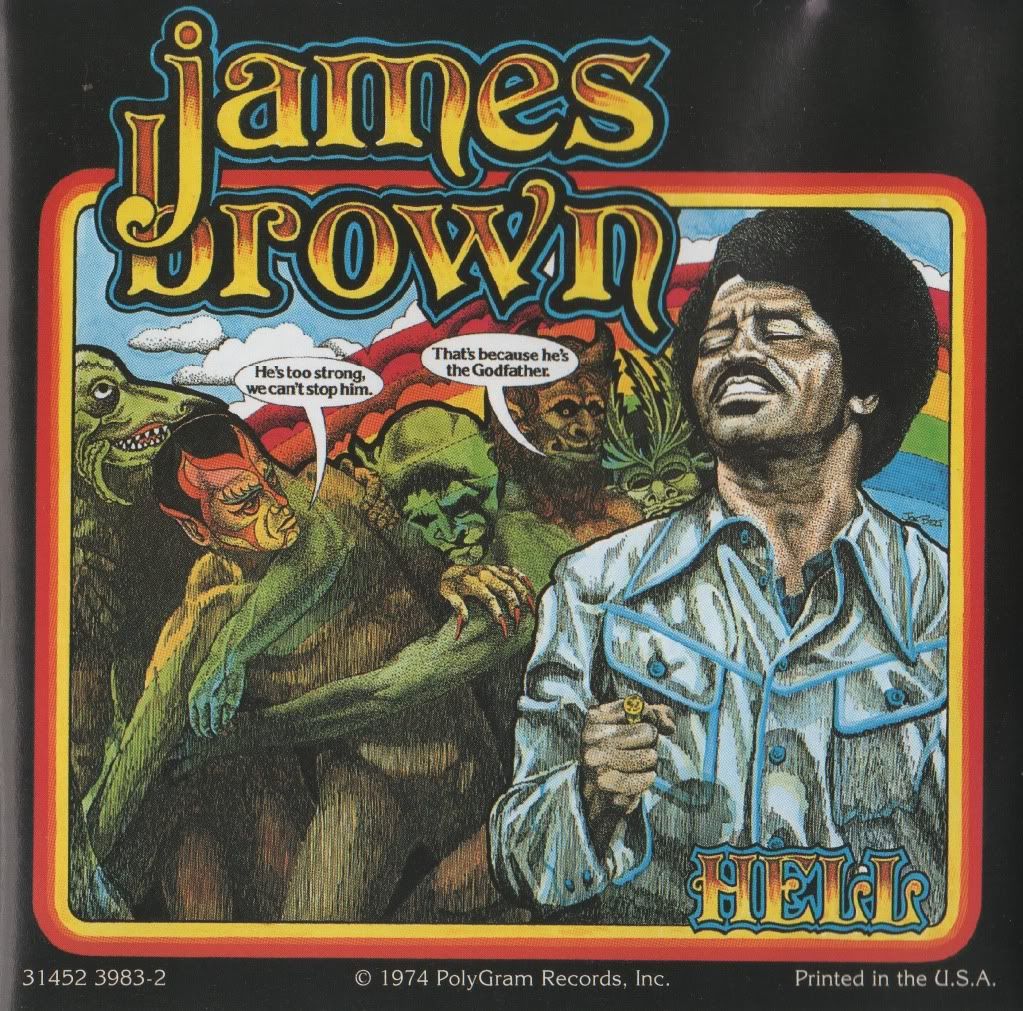
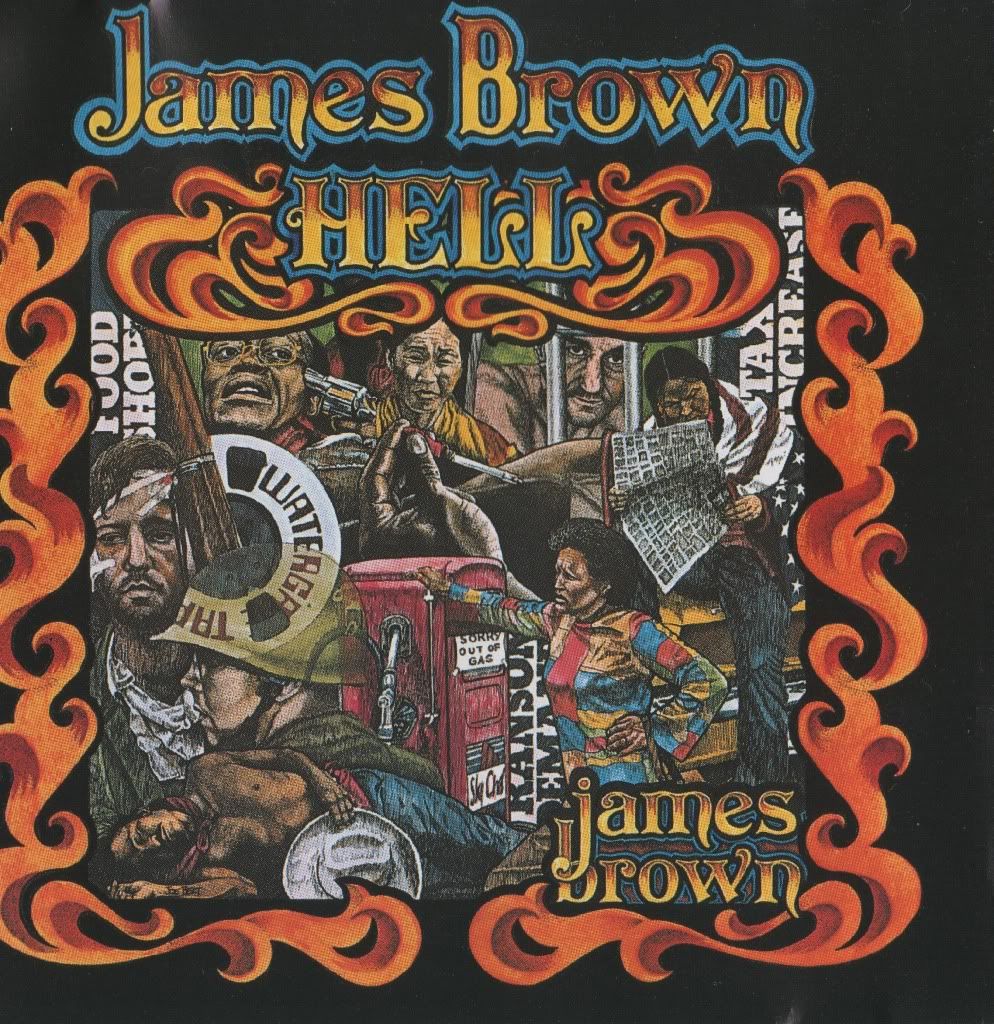
James Brown - Hell


One of the popular music phenomena that most fascinates me is when an artist (almost always in conjunction with a label) attempts to recreate a successful album with a follow-up that attempts to in some way recreate the magic of its predecessor.  Harry Nilsson's Son of Schmilsson is definitely one of those albums, but his willful merry prankster approach seems a deliberate (and artistically sound) attempt to undermine his label's hopes for a repeat hit album in comparison with this, James Brown's rapid-fire follow-up to his early '74 hit The Payback.  Sure, it's not an attempt to completely duplicate The Payback's 20 minute grooves, but the fact that it's another double album with a bunch of indelibly funky jams interspersed with a bizarre and jarring segue (this time it's a blaring gong instead of a bunch of background singers going "zzzzzzzoooooo!") makes the comparison inevitable.

If anything, Hell is probably best described as an overreach.  While the quality of the funk is indisputable on tracks like "Coldblooded" and the title track's chainsaw delivery, it's easy to get the sense that the stripped-down essence of Brown's earlier funk masterpieces has become lost in a proliferation of instruments and experiments in eclecticism.  For example, there's the bizarre Latin treatment of the early Brown hit "Please Please Please," immediately followed by the even more bizarre funk-cum-proto-disco treatment of "When the Saints Go Marching In" (which finds Brown pleading cringe-worthily to be "in that funky number").  There are less egregious offenses, like the awkward attempt to update the blues classic "Stormy Monday" and an uncomfortably slick and square update of another classic pre-funk Brown tune in "I Lost Someone" (don't worry, you won't be inspired to throw away your copy of Live at the Apollo).  And then again, there are some guilt free moments in the Parliament-esque (and huge mouthful) "Dont' Tell A Lie About Me and I Won't Tell the Truth About You" and the ideologically confused but utterly on-the-one "Sayin' and Doin' It" (the CD reissue liner notes' attempts to credit Brown with social awareness on the level of What's Going On or Curtis based purely on "Hell," the cover art and a couple other tracks are valiant but laughable).  When the time comes for Brown and his crew to stretch out into some longform funky jams, the results are both tight ("I Can't Stand It") and solid but strangely ho-hum ("Papa Don't Take No Mess"), but never sounding quite as natural as the long tracks on The Payback.

When it comes to assessing the overall strength of this album, it's easy to pick holes in its particular (and ultimately relative) failures, but what keeps me coming back is the experimentation and, of course, Brown's ability to use his voice as an inimitable instrument even when singing the most inane nonsensicalities imaginable.  As I've probably said before, hearing someone try and fail at something uncharacteristic can often be just as rewarding as hearing them succeed at what they already do best.  Brown and company's attempt to prolong the hit magic may not be a complete artistic success, but at this point in his career (as evidenced below) he was on such a roll that any 80 minute double album was guaranteed to at least get your booty shaking--and that's always been the point, right?

Get it here.


Monday, November 7, 2011

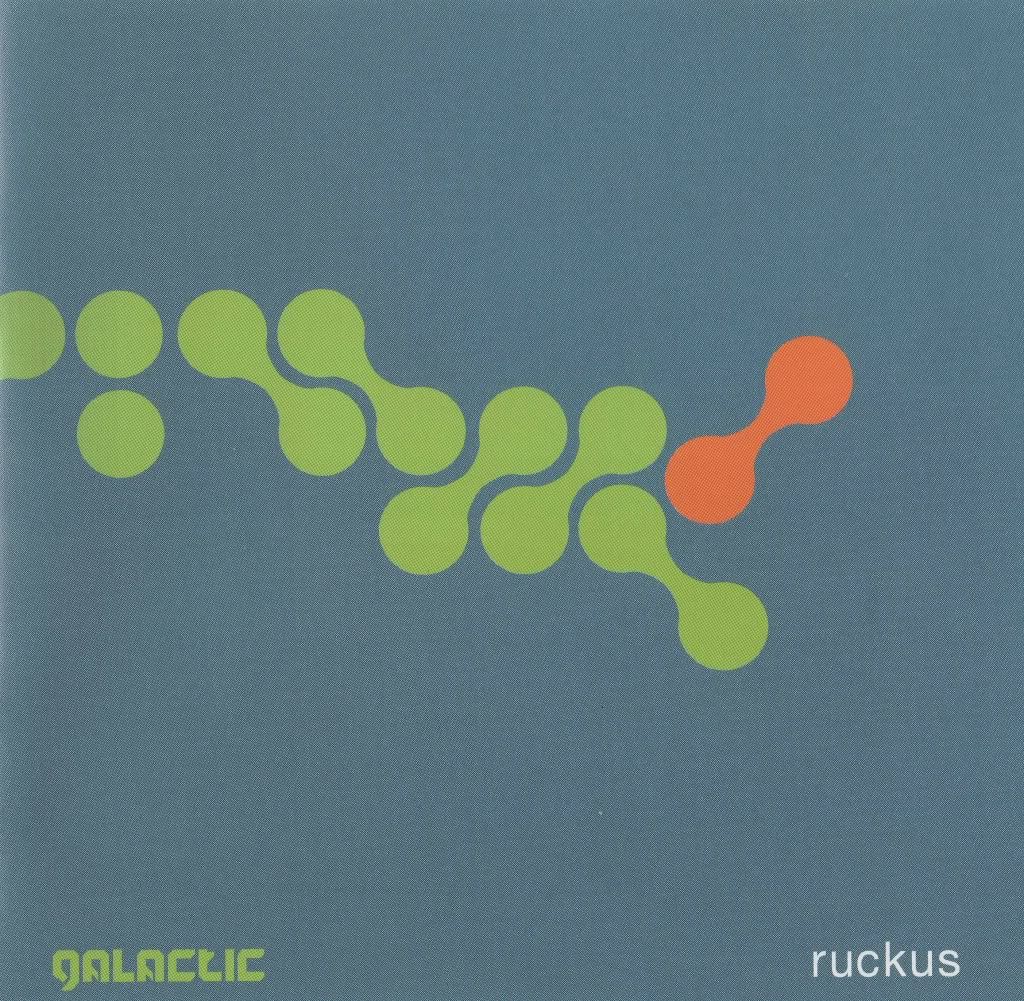
Galactic - Ruckus


Nothing earth-shattering this morning; just some kick-ass funky jams from the group I've seen live the most times--New Orleans' Galactic.  Though I've lost track of them a little since their singer Theryl "Houseman" De'Clouet departed, Galactic has long been a source of a lot of listening pleasure.  Their jams blend funk and heavier Hendrix-like guitar rock with some formidable jazz chops on the part of reed man Ben Ellman, keyboardist Richard Vogel and drummer Stanton Moore.  While they'd been including vocals since their first album, most of their early releases mimicked their live shows, with vocal tunes interspersed with longer instrumentals, some of which were attempts to re-create the band's sense of energy and build-up that makes their live shows so exciting.  On 2003's Ruckus, though, the group made a concerted effort to hone their pop instincts, hiring hip-hop producer Dan the Automator, enlisting the editorial aid of a couple of outside songwriters, upping the number of vocal tracks, and reigning in the run-time of the instrumentals.  The result, in my opinion, is far and away their tightest and most cohesive album.

The biggest immediate difference here is that Stanton Moore's drum sound--always a defining element of the band's sound--has been amped even more, and it's also a lot less jazzy.  A heaviness of the low midrange is also more apparent, with Jeff Raines' guitar and Rich Vogel's synths, organ and clavinette often doubling to give the songs a thick backbone.  While some of the vocal tunes could fit comfortably in the context of earlier Galactic albums (the pounding unison of "All Behind You Now," the clean funky riffing of "Never Called You Crazy,"), the band really explores some new territory in some songs, making use of softer, more soulful sounds (except for the drums of course) and Houseman's pedigree on the sultry "Paint," the downright poppy "Uptown Odyssey" and the left-field General Public cover, "Tenderness."  In other places the band manages to conjure some unforeseen magic by weaving brief vocal passages with mostly instrumental music--"Kid Kenner" is electronic-tinged, trading between ridiculously heavy drum loops and an ethereal vocal section, while "The Beast" merges Moore's weighty drums with the guitar for one of the heaviest beats of the album while the mysterious vocal sort of merges with the groove like an incantation.  They even manage something really strange on the awesome "Gypsy Fade," one of the most interesting songs of their discography--sort of a funk dirge, where the bittersweet harmonica and acoustic guitar somehow coexist with heavy overdrive and synth sounds.

I remember being a little disappointed in the instrumentals when I first bought this album at the time of its release--where was the loose jazzy element that made some of their earlier stuff so epic?  The drum sound, though heavy and impressive, seemed a little too rigid and repetitive, and the songs hardly have any soloing at all.  Needless to say, repeated listens made it apparent that these instrumentals aren't about jamming, but about melody and pop structure.  For the most part, they succeed--"Bongo Joe" blends samples and an eastern melody to great effect, "Mercamon" plays with different textures and riff-based melodies, and "The Moil" has got to be one of the hottest, most exciting songs in the band's entire discography, whereas "Doomed" is a little vacant in the melody department and seems a little superfluous in the wake of the valedictory "All Behind You Now."  Even when not much melody is happening, though, the beat is difficult to deny--it's obviously one of the best things Ruckus has going for it, and it's possible to just feel the drums for the album's duration and still be highly entertained.  My only other complaint is that the lyrics are mostly pretty superficial (the wordplay on "Tenderness" easily trumps anything the band wrote here), but it's not like Galactic was ever about deep messages or wordcraft, and neither is most pop music!

It's hard to believe this album is eight years old, and that Houseman departed the group for health reasons only a month or so after its release.  While the purpose of this recording doesn't really match the loose jamming that live Galactic past and present continues to purvey, the songs and overall sound here is so fresh, tight and catchy it's hard to believe that the album didn't make a bigger splash for the band and they never tried to follow up on the template it set.  I suppose nonstop touring has always been Galactic's bread-and-butter and that albums have been more of a begrudging necessity.   To me, though, this unrepresentative disc still stands as their best studio achievement, not to mention a great reminder of how much can be gained from concentrating on focus and brevity.

Get it here.

Tuesday, July 12, 2011

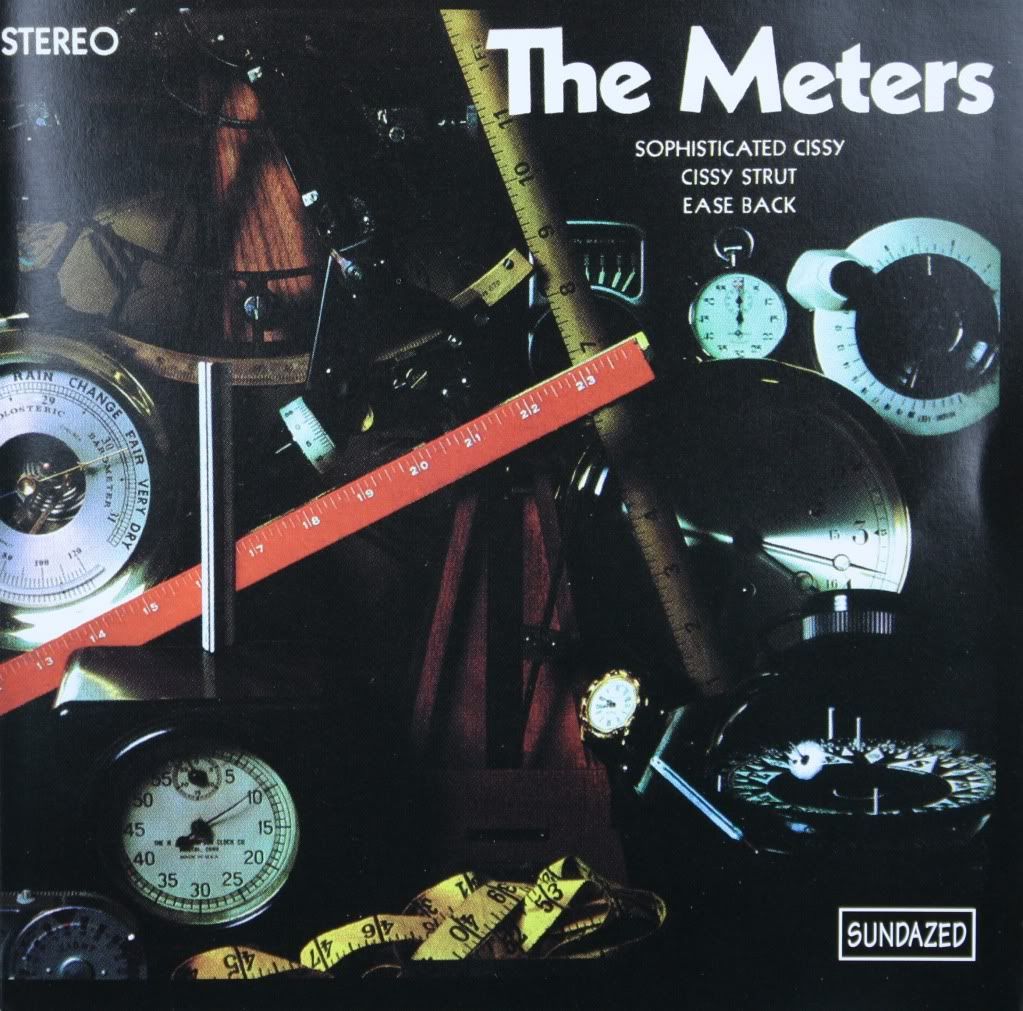
The Meters - The Meters


The Meters' 1969 debut can easily described as a distilled quintessence of what funk is.  In my opinion, it's also early enough to be considered a pivotal and influential step (along with things that James Brown was contemporaneously doing) in that slight shift in direction from R&B and soul that first resulted in what' now commonly known as "funk."  Though The Meters had already established themselves (and would further do so) as backing musicians for Allen Toussaint-produced artists and many others, they really sprang forth fully-formed with a distinctive group identity on this album.

What I love about this album is the beauty of its simplicity--the band serves up 12 indelibly fresh cuts of clean funk using only drums, bass, guitar and organ.  Despite the limited instrumental palette, each and every song is brimming with melody, hooks, energy and variety.  Because of the clarity in the band's approach, it's easy to discern the elemental form of funk that they're innovating.  The first beat of the measure is almost always heavily accented (wouldn't James Brown be proud), and the playing is so tight it's unbelievable.  The simplicity of Zigaboo Modeliste's drumming belies his impeccable precision and sense of timing (nobody could be more in-the-pocket), and the way it interlocks with George Porter's bass really gets at the point of the visceral grooves that make up the backbone of all good funk.  Leo Nocentelli's guitar tone is clean, for the most part, stating the melodies with the support of Arthur Neville's organ, but occasionally delving into melodic (but never overly-flashy) soloing and fills.

What I love about this and Look-Ka Py Py (their second album) is that they both embody the spirit of funk but manage to do so in a pop song context--the hypnotic rhythmic jamming of James Brown's 10 and 20-minute songs isn't present, but the same rhythmic principles and precise syncopation and dance-ability is.  Both approaches definitely have their virtues, but Brown's longform excursions can sometimes be a bit lengthy for some attention spans.  It's pretty amazing to imagine that, at one time, music like this had potential to chart (if only modestly); "Cissy Strut" charted on the R&B charts and is a perfect example of the band's more laid-back tunes.  My other pick is the infectious, up-tempo instrumental version of Sly Stone's "Sing A Simple Song" (difficult to relate to the original, save the ascending scale in the chorus) which perfectly exemplifies the bitchin' synthesis of drums, bass, overdriven guitar and keys.  Surely no modern band could have a hit with music like this, and isn't that a shame?

A while back when I heard that some of my favorite contemporary funk bands like Galactic held The Meters in high regard, I started checking out their mid-70's albums like Rejuvenation and Fire On The Bayou.  They're good albums, but by then the band's sound had become more mainstream and vocal-oriented--my jaw certainly dropped when I finally delved further into their back catalogue and understood what all the fuss is about.  If you want to comprehend just why The Meters remain one of New Orleans' best-kept secrets and cultural treasures, listen no further.

Get it here on CD, or here in MP3.