Showing posts with label Avant-Garde. Show all posts

Tuesday, April 30, 2013

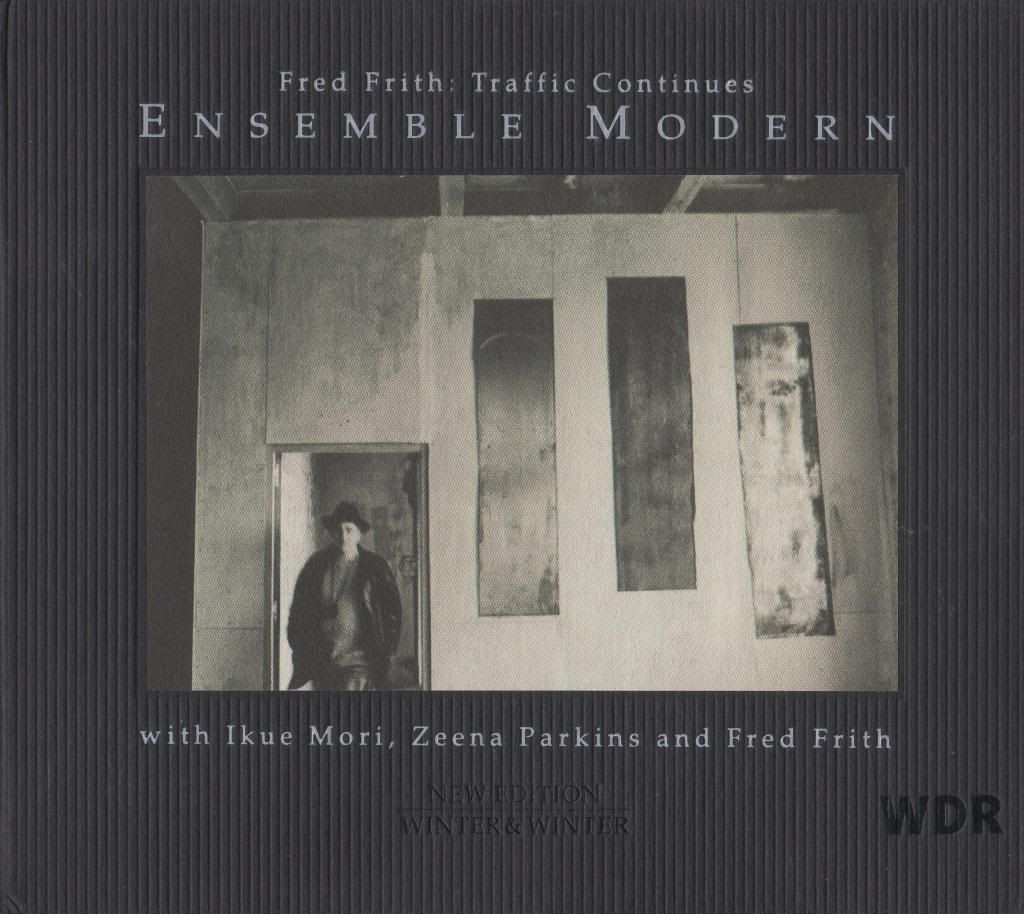
Fred Frith and Ensemble Modern: Traffic Continues


Although our man is credited as guitarist, this album plays more like a performance of Fred Frith compositions than it does like a "Fred Frith album," as we may have variously come to understand what they might sound like.  That said, the ensemble (which audibly sounds basically like classical instrumentation with a few subtle electronic elements) is fantastic, playing with virtuosity you'd expect from concert musicians, but also a zany freedom that firmly places them in a modern context.

To my ears the compositions start off very strongly with some brilliantly knotty orchestrations and a vaguely conventional harmonic aesthetic.  Evaluated through this type of lens, the disc loses some steam in the middle (around the beginning of "Traffic Continues II: Gusto", composed for and from audio samples of Frith's recently-deceased friend and Skeleton Crew bandmate, cellist Tom Cora) as it becomes more spare and quiet, then closes strongly with the final and longest track.  It may be true that the quieter bits require a different sort of criteria for evaluation and may succeed by those standards, but for me the act of readjusting what I'm listening for has so far proven frustrating to the extent that I'm usually left with a feeling that I just heard a recording with some great parts and some that merely passed me by.  I get the feeling that more effort could either yield more appreciation or a stronger sense that some of the writing is a bit too casual and reliant on free performances to carry the weight.  Either way, this is inarguably the kind of music you need to let act on you before imposing any kind of sweeping critical judgment.  Here's to more trying!

Get 'er.

Friday, January 25, 2013

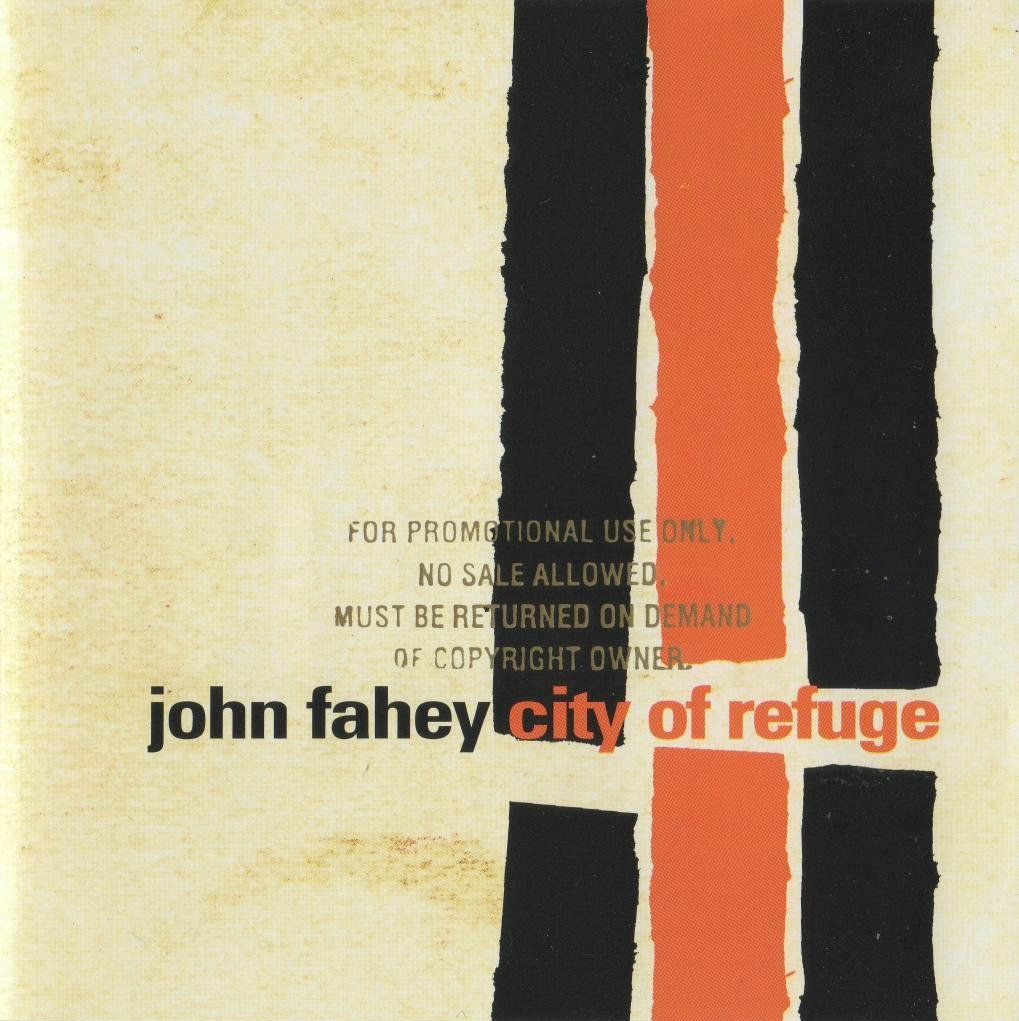
John Fahey - City of Refuge


In investigating Fahey's late period, I'm sympathetic with the fact that he felt dead-ended stylistically and was struggling to move beyond his signature American Primitive tropes into something a bit more...different and new.  The issue seems to be just what, precisely, that new direction is, and Fahey's frustration is evident in the music.

In spite of its recording date, City of Refuge most resembles 60's Fahey records like Volume 6: Days Have Gone By and Requia, with equal space and volume given to acoustic guitar and field recordings, found sounds and electronic sound sources.  As with those other recordings, this approach either stands (Days Have Gone By) or falls (Requia, often) on how well those elements mesh with one another compositionally.  The disc starts promisingly enough with "Fanfare," which sees an unusually (for Fahey) overdriven slide guitar layered on top of droning, industrial electronic sounds not unlike those produced by Keith Rowe, especially in his solo works.  As the tracks play on, for me the impression builds that the compositions aren't very well thought-out, which is a serious stumbling block for an artist whose greatest strength is arguably his ability as a longform composer, not as an improvisor, which is what he appears to attempt on "The Mill Pond" and large portions of "City of Refuge I," plucking single notes against a throbbing background drone.  While the proposition of a more spare approach to his guitar style is intriguing, the results here don't feel particularly well-realized.

Elsewhere we are suddenly jolted out of the avant-garde soundworld back into more traditional Fahey territory, with guitar-only excursions like "Chelsey Silver, Please Come Home," and the dirge-like "City of Refuge III."  The former hints at a new compositional twist on Fahey's slide style, with abrupt stops and rhythmic interruptions, but again it feels like he didn't thoroughly integrate the idea into the piece, or maybe it wasn't an idea after all and the performance is just choppy!  Both songs seem to lack distinctive melodies or a feel other than "Fahey filler"--pleasant enough, but by 1997 we know what this man is capable of!  To my ears, "Hope Slumbers Eternal" is the best-realized piece on the album, blending a droning background that relates tonally to the minor slide guitar melody it accompanies, provoking an eerie, meditative atmosphere--most importantly, the electronics and guitar seem to combine coherently, which is mostly not the case with the rest of the experiments here.  The album closes with the 19-minute "On the Death and Disembowelment of the New Age," which, as far as I can tell, contains no guitar (though it does keep alive Fahey's tradition of humorously long and barbed song titles).  It's probably the most successful sound collage on the disc, but sitting at the end of a selection of noodly acoustic guitar pieces, it raises questions about what it's doing here, and why these songs all belong on the same album.  There is some cool rhythmic phasing of a tambourine-like sound that kicks in around the 12-minute mark and lasts for several minutes, and the album closes like it opened, with a classic Fahey field recording motif--a lonely locomotive whistle. 

This is the kind of album that really gets under my skin--not because I think it's bad, but because there's a palpable sense of frustration from an artist with specific ideas and a seeming incapability to fully realize them.  Probably more troubling to me personally is Fahey's frustrated attempt to break beyond his established vocabulary as a guitarist--for a man who reportedly described fingerpicking as a "disease," he must have felt more than a little trapped.  When an artist verges into atonal and pure sound territories, success seems to become as ephemeral as the compositional building blocks are abstract.  I find it daunting to explore these areas as the measure of artistic success depends even more on an unquantifiable gut reaction, and the difference between good and bad is painfully difficult to control as a composer--but perhaps that's where the adventure lies!  My next stop for late-era Fahey is another 1997 album, Womblife.  While my hopes for a successful application of his challenging ideas are tentative, even unsuccessful attempts in this territory are rewarding and always thought-provoking.

Get it here.

Friday, June 22, 2012

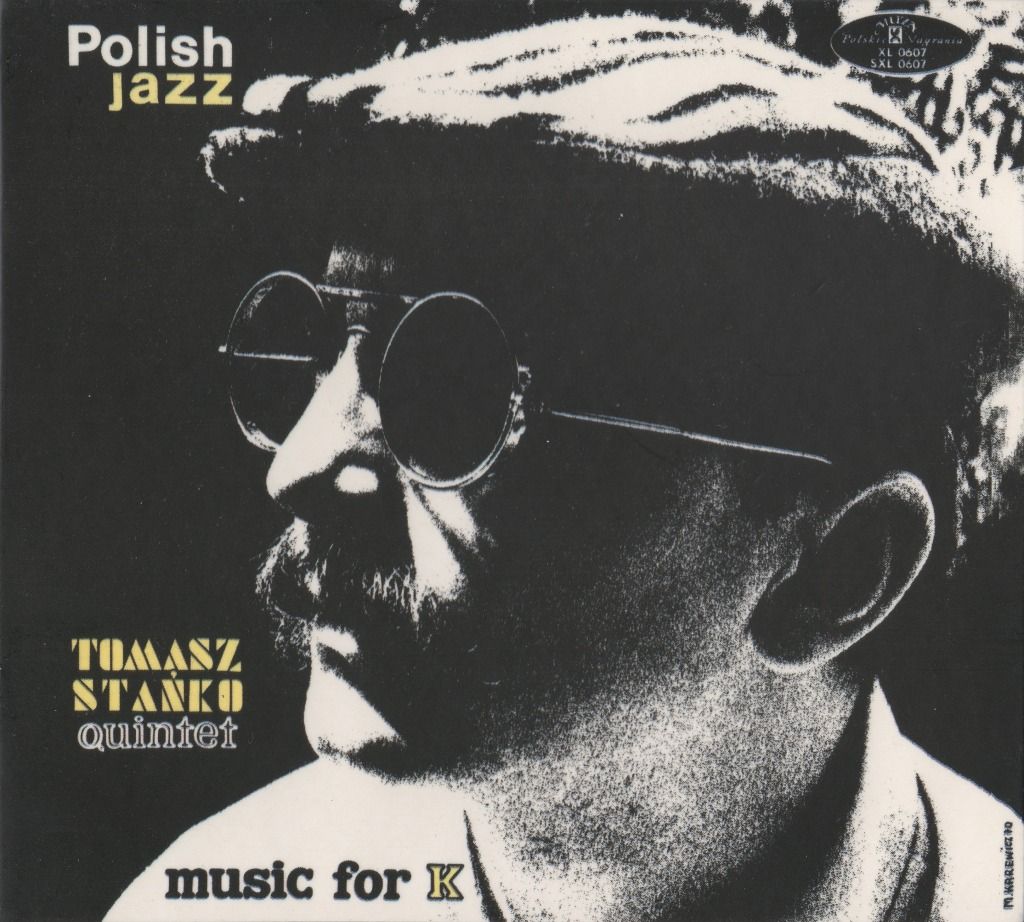
Tomasz Stańko - Music for K


These days, what's probably the biggest obstacle for Polish trumpeter Tomasz Stańko's 1970 debut is that it says "Polish Jazz" in the top left corner, leading to some reasonable assumptions that it's going to be some sort of fusion of polka or mazurka and American jazz, and some perhaps less justified assumptions that it'll be crap jazz because it's not American.  Not only are both of these assumptions proven incorrect by the music contained in these (digital) grooves, an album like this provides key evidence of the roots of the compositional framework that British/European jazz fusion bands like Nucleus and The Soft Machine utilized in the mid-1970's, but also that the narrative of jazz history in Europe is unjustifiably incomplete and marginalized in comparison with that of America.

Now, anybody in the know about this period of European jazz will probably acknowledge that I'm sort of getting ahead of myself by starting with Stańko's debut--many would cite Krzysztof Komeda's 1966 album Astigmatic as the most important illustration of the above points...in my own feeble defense, let's just say that this was the album I decided to review today for no other reason than that it's the one my eyes landed upon and seemed like a good one to write about.  Music for K is indeed a tribute to the late Komeda, on whose watershed Astigmatic album Stańko also played trumpet, and who is credited with contributing heavily to the development of a distinct flavor of European jazz that started in the 1960's and has continued to present.  Assigning credit is important but not as much as acknowledging a quality piece of work.  Here the influence of Komeda (who also had extensive film score experience including Roman Polanski's Rosemary's Baby) and Astigmatic are felt both in a sense of cinematic drama and a tonal palette that trades much of American jazz's jubilant euphoria for a darker, more cerebral form of expression.

The opener "Czatownik" both recalls Komeda's descending chromatic piano themes and predicts the tangled melodies that the aforementioned electric fusion groups would favor, with alto and tenor saxophones blurting rapid fire unison themes with the trumpet before things start to get more shambling, with each voice separating into an upward call that again lines up for a dramatic fanfare.  One of the things I really appreciate about this music is the shifting dynamics--things can go from blaring horns to sizzling quiet in an instant--the bass and drum interaction is prime here (check out that drum sound around 3:30)--and the piano-less lineup both points to the absent Komeda  and allows for alternation between skeletal frameworks and a spotlight on the wind instruments' melodies, not to mention a huge potential for free playing, of which there is an abundance.

In trying to define the specifics of a "European" jazz sensibility, my instincts are to point at its richly developed classical tradition, which seems to be borne out in a predilection for ostinato (check out the gently pulsing reeds in "Nieskonczenie Maly," and their darker, more anguished and dissonant counterparts in "Cry") and song structures that seem more linear than the typical circular jazz structures (head, solo:, head).  Things reach their freest and most intense in the 16-minute title track, which climbs a series of crescendos and mini-dips to a collective caterwaul, then steps back down across one of the album's greatest drum showcases to a squawking conclusion.

More than anything, the quality and energy of the playing on this album raises questions about the relative obscurity of the players here and severely shakes my confidence in a completely American-centric jazz narrative...we need better informational resources and access to more great music like this!  On the plus side, if you're feeling like you've exhausted the available avant-garde American jazz and everything's sounding a bit too happy and boppy for you, maybe there's hope in the Old World's "new" jazz--who knows what else we're still missing!

Get it here.

Wednesday, May 16, 2012

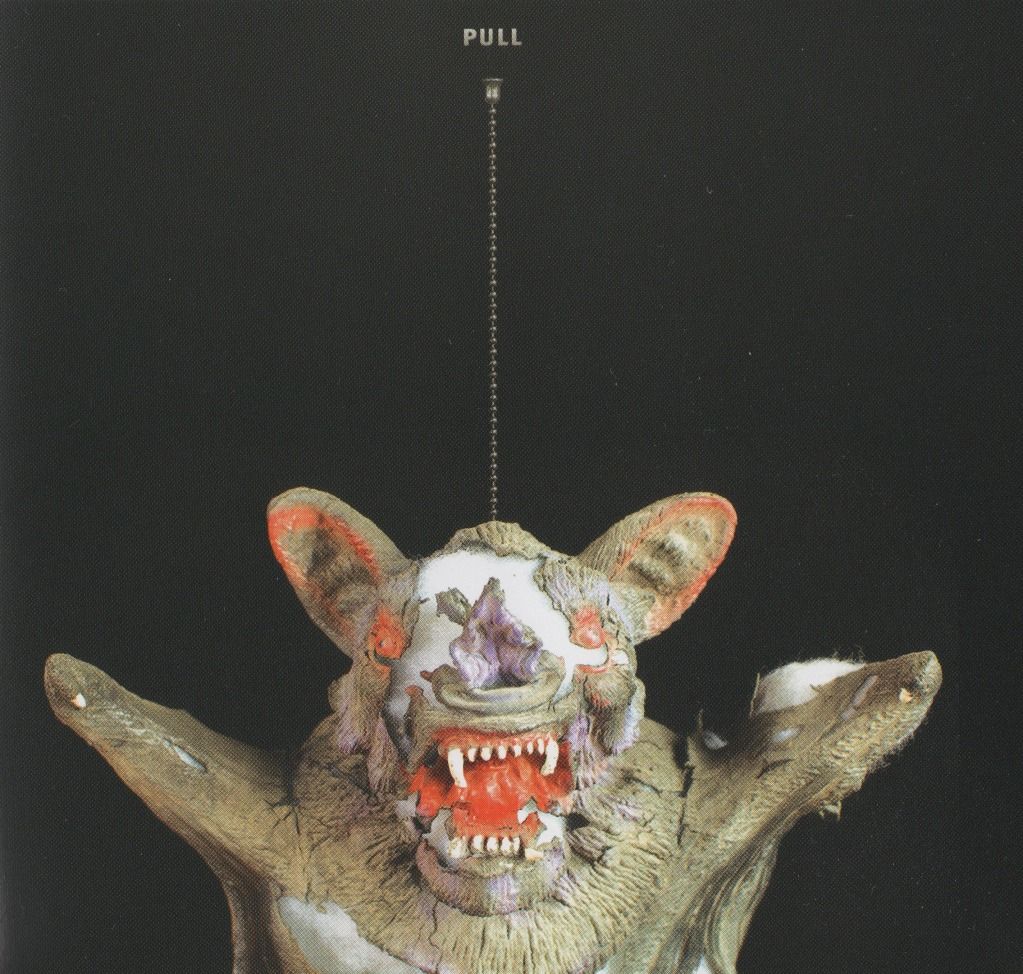
Captain Beefheart - Bat Chain Puller


It's been well over a year since I kicked off the reviews division of this site with a review of Captain Beefheart and the Magic Band's Shiny Beast (Bat Chain Puller), and considering how much the Captain's work has continued to influence my approach to music and writing I'm surprised I haven't waxed poetic about any of his other classic albums.  Technically, today still isn't that day--I'm here to gush about the "brand new" 2012 Captain Beefheart release, the lost 1976 first studio version of Bat Chain Puller, just released this spring (to disappointingly limited fanfare) on the Frank Zappa record label and nearly exclusively available for purchase here (which just might be why the album's gotten so little press).

To describe the genesis of this release briefly, Don Van Vliet decided in 1976 to return to the avant-garde and stage a creative comeback.  Herb Cohen (Frank Zappa's manager) secretly used Zappa's money to fund the project and the two had a falling out upon Zappa's return from tour, resulting in Cohen's seizure of many of Zappa's assets, unreleased Bat Chain Puller masters included. Zappa eventually reclaimed his property through legal means, but by that time Van Vliet had re-recorded most of the material on his final albums.  Since then Zappa, and now his widow Gail, have been busy enough managing Zappa's gargantuan legacy that the tapes have remained neglected in the vaults...until now!

With 10 of 12 tracks already appearing on Captain Beefheart albums that have been available for 30 years, the biggest worry with Bat Chain Puller is that it'll come across as merely supplementary to those "definitive" versions, or worse that it'll sound only partially complete in comparison to the later recordings.  Thankfully, the disc falls prey to neither possibility, playing like the hazy, dream-like album-that-never-was that it's always been!

After listening to these different versions of familiar songs and becoming familiarized with the new track sequencing, I'm left with the strong impression that this album has an undeniably distinct feel, especially in relation to Shiny Beast (Bat Chain Puller) in terms of its accessibility.  Compared to Shiny Beast's almost exclusively song-based program, this Bat Chain Puller is very much a venture split between songs, spoken word-over-music and pure poetry.  Sure, it's still considerably more mainstream than the hallowed stuff of Doc at the Radar Station, but even compared with Doc's orchestrated prickles, the poetry/music tracks here feel much more spontaneously arranged and the sonic palette more often unexpectedly drops down to just one instrument or Van Vliet's voice in some very effective instances. 

Perhaps as expected, some of the material here isn't significantly different from later versions--the arrangement of "Harry Irene" (never one of my favorite later Beefheart tracks, but an important contributor to this album's accessibility) includes guitar, but otherwise isn't much different.  The title track has its own subtle identity (further shaded by a third version here in bonus track form), bristling with kinetic motion (it's easy as ever to hear how Van Vliet originally pulled the rhythm from windshield wipers), more of an organic feel with cranked harmonica and just-barely-conflicting guitar layers (though the ever-important synths are still there) and outstanding vocal delivery (dig the the naked place he takes "their very remains and belongings").  Right off the bat, my highest hopes are kindled--one of my disappointments with later Beefheart albums is the marked reduction in the elasticity of Van Vliet's voice and additionally, in the case of Ice Cream for Crow, an overall dip in energy and compositional effort--here the Captain's voice still possesses a razor's edge and he takes enough risks that we can almost forgive him wasting the early/mid-70's trying to become a mainstream star.  "Owed T'Alex" burns with a reinvigorated closeness that's magnified further on "Floppy Boot Stomp," where the band's joyous delirium pushes the vocals so close that it sounds like the Captain's ranting all the way inside your brain. 

The most exciting aspect of Bat Chain Puller, of course, is the brand new material, namely the poetry/music hybrids "Seam Crooked Sam" and "Odd Jobs."  The former is a moody guitar/electric piano duet with Van Vliet's downbeat-yet-intense images spinning seemingly unrelated on top, while the latter is more of a full band piece with tunefully-spun vagrant imagery while the band shifts ever so slightly into what must be the first kernel of Shiny Beast's "Tropical Hot Dog Night."

Evaluating these pieces has helped me identify a couple of the specific traits that make Captain Beefheart one of my top favorite artists--first, it's the way his poetry mirrors the music, flowing smoothly then stopping, jerking, suddenly rhyming or playfully riffing off of a phrase's connotations or expected syntactical outcome.  Unsurprisingly, Van Vliet chooses words like paint colors on a palette, not necessarily concerned with their logical or expository value but rather their energy, emotional color, and the way they sound.  When I hear these songs, there are countless unexpected images and feelings popping into my head, and I can't think of too many other poets in the popular music sphere who can achieve that.  And yet, there's a strange logic or narrative to many of these pieces--what at first seems like incoherent rambling in "81 Poop Hatch," for example, gradually reveals itself to be an impressionistic panoramic scene including Van Vliet's beloved natural imagery as well as a view of his internal landscape--at least, that is, until he leaps mid-sentence to somewhere completely different; every piece seems to be at its root a rational enigma with unlimited emotional potential.

Secondly, the compositions here are a dazzling presentation of Van Vliet's painterly approach implemented in yet another aspect of the music.  More than on any of his other albums we hear open, warm-sounding jazz harmony on songs like "Seam Crooked Sam" and "Ah Carrot Is As Close As Ah Rabbit Gets To Ah Diamond."  Again, though, Van Vliet applies these combinations of notes intuitively and without regard to how theoretical rules say they're "supposed" to be used.  Fragile, sweet harmony can dissolve into dissonant, minor darkness just as quickly as it can pursue a completely fresh melodic path, as evidenced on "The Human Totem Pole (The 1,000th And 10th Day Of The Human Totem Pole)," one of two album-closing commentaries on the human race's cumulative achievements (or lack thereof) and precarious current position on earth.  Here he fuses this weird compositional approach with one of his more straightforward (yet most compelling) poems, sketching a partially-obscured picture of the skin-crawling, comical-yet-repulsive "pole," and delivering it all with a seething creepy mystery that trumps the Ice Cream for Crow version within just a few seconds..."the man on the top was starrrrrrrrvinnnnng" indeed!  Now is probably an important time to laud the contributions of the rest of the band--this music certainly couldn't have been made without the conscientious talent and attention of the rest of the band, especially drummer/guitarist John French, who also performed a crucial "music director" role in transcribing Van Vliet's hastily-blurted musical ideas into a form that the other band members could understand and memorize--just listen to the through-composed spacious atmosphere as the song sputters out in a denouement that takes up over half the song's length.  The idea that it's possible and even ideal to consent to the urge to compose and arrange notes and sounds in whatever way sounds intuitively best (regardless of the rules) is one of the important lessons I've learned from Van Vliet's music and attempted to apply to my own process.  Though the difficulty of successfully communicating such an idiosyncratic method to collaborating musicians is challenging to overcome, the singular character of the end result can really be worth the sweat.  It's also one of the few lessons any artist can potentially adapt from Van Vliet's work without necessarily ripping off his total sound wholesale--it's possible, no matter what Tom Waits tells you!

In the end, this album is like a gift sent from beyond Van Vliet's grave (though very real thanks are due to all of the living collaborators who finally brought this album to release).  Amazingly, it never sounds unnecessary in comparison with the later albums--"Brick Bats" is the only song that sounds more unfocused than its later version, with a much looser guitar arrangement, less effective vocal delivery and a fun but meandering free jazzy end section made more effective in the shorter Doc at the Radar Station version.  Nor does this earlier album obviate the ones that follow (except Ice Cream for Crow, which was always teetering on the brink of being a "completists only" release, especially now that two of its best tracks are revealed to belong to a more vital earlier work), with Shiny Beast (Bat Chain Puller) still best straddling avant-garde and pop and Doc at the Radar Station best warping Trout Mask Replica poetic/musical craziness into a newer, mature and carefully-integrated form.  Thankfully, we now have all three to consider as required listening--though the price of this CD is still uncommonly high (it cost me $27 including shipping and tax), it's worth the added expense and work it takes to track it down--let's hope there's some wider distribution on the way to make it a little easier to get the word out about this remarkable album's first issue.

Wednesday, January 25, 2012

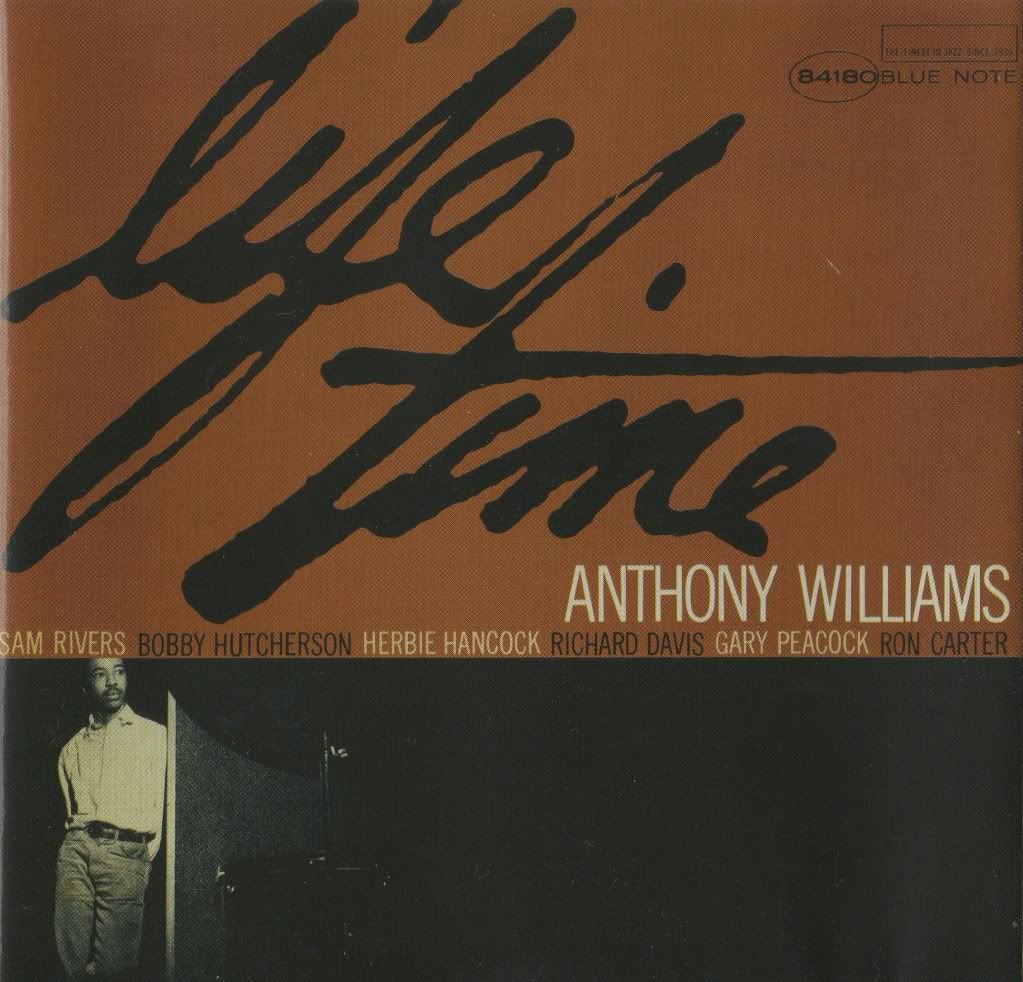
Tony Williams - Life Time


By 1965 and this--drummer Tony Williams' first set as a leader--the then-17-year-old had already been working with a slew of talented and innovative jazz artists, including Herbie Hancock, Eric Dolphy, Andrew Hill, Sam Rivers, Jackie McLean and Grachan Moncur III (not to mention his recent incorporation into Miles Davis' Second Great Quintet).  Listening to Life Time, it's clear that Williams was listening closely to what the latter two were doing, especially on the sessions for McLean's One Step Beyond and Moncur III's Evolution.  For me, this album represents one of several high points from the period when it comes to a distinctive brand of avant-garde jazz that seems to favor space over wild soloing.

You know from the eerie, quietly intense opening melody of "Two Pieces of One: Red" that this isn't going to be a typical bop album, but as Sam Rivers' tenor fades out and dual bowed basses from Richard Davis and Gary Peacock gently arpeggiate it's apparent that this subtle opening isn't going for the explosion your ears might expect.  One of the bassists takes the first solo, and from then on you can rest assured that we're not returning to the usual structures or sounds for the rest of the album.  "Two Pieces of One: Red" and the rest of Life Time are typified by a restrained, spacious atmosphere wherein solos take place with very little backing instrumentation (aided considerably by the fact that there's no piano on three of five tracks) and rarely take off into the rapid-fire solo excursions popular even with some of the players on this disc--Sam Rivers is surprisingly subdued here, but he manages to ride the transition with little difficulty, relying more on dynamics and the presence/non-presence duality that's much more of an option when you're playing in a musical landscape as open as this one.  Indeed, the overall sound of this album owes as much to the theoretical advancements of John Cage as it does to free jazz pioneers, setting up blocks of silence as both an effective compositional tool (making it easier to tell when the sometimes skeletal compositions are moving to another section) and as an invisible member of the combo, giving the players another (absence of) sound to play off and somehow adding depth and intensity to the sounds that are actually present.  Williams' drums in particular seem to particularly smolder in the open, reverb-heavy environment, with his brushwork lifelike in its texture and his cymbal work especially benefiting from miles of reverb and a lack of competition with other instruments (and himself, for that matter--this music wouldn't be so great if the players didn't match the mood by leaving a little space in their own playing).

"Two Pieces of One: Green" is the album's longest track, with Rivers contributing some more of his characteristic fire and blasting some really juicy overtones, while Williams explores the toms and un-snared snare.  While the subtle melody of some of the album's other tracks gradually reveals itself, this track is one of the freest of the bunch, demonstrating amply that free jazz doesn't have to always consist of several instruments blaring at the same time.  "Tomorrow Afternoon" comes closest to hard bop in melody and swing, but gradually breaks up into greater and greater caverns of space, like the floor is dropping away from the comfortable atmosphere that was so briefly established.  "Memory" drops Rivers and brings vibraphonist Bobby Hutcherson and Herbie Hancock in for a bassless free improvisation that sees Hutcherson and Williams riffing off one another quite effectively, with the vibes providing just enough of a tonal anchor; with Williams' wood block and other hand percussion providing yet another noticeable textural contribution.  The arrangement is so sparse that when Hancock finally asserts himself around 5:30 with a brief chord, it sounds like the loudest, most melodic thing you've ever heard.  The album ends with "Barb's Song to the Wizard," a piano and bass duet with no drums--the tense melody nods to Williams' aforementioned work with Moncur III and McLean.  Unlike those great albums, though, Williams always seems to take things one step further, providing no real traditional bop tunes to appease nervous listeners and committing fully to the album's mission statement.

The fact that this album works so well with such a piecemeal, rotating assortment of players exclusively playing the compositions of a 17-year-old drummer is a testament both to Williams' skill and unheard-of musical maturity at the time, but also to whatever it was in the air at the time that made all of these players so assured in their judgment, synchronicity and adventurousness.  Life Time is a grower in the best sense of the word--sounding like nothing much on first listen but gradually unfolding into a paradoxically dense work, considering its relative quietness--and every time I listen to it I find myself asking "Why isn't there more free jazz like this?!"  Luckily a little research into the discographies of the artists involved here yield further pairings in the same time period and several great albums in the same vein.  While Williams would go on in the next few years to collaborate with some of avant-garde jazz's most acclaimed albums (as well as Miles Davis' less challenging but equally iconic work [I bet he hated this album]) before heading into fusion territory, he did reconvene with some of these players for the nearly-as-excellent Spring, but no album I've found has done such a good job of fusing an AMM-like free improv space aesthetic with "traditional" free jazz harmony and melody--recommendations welcome!

Get it here.

Friday, January 20, 2012

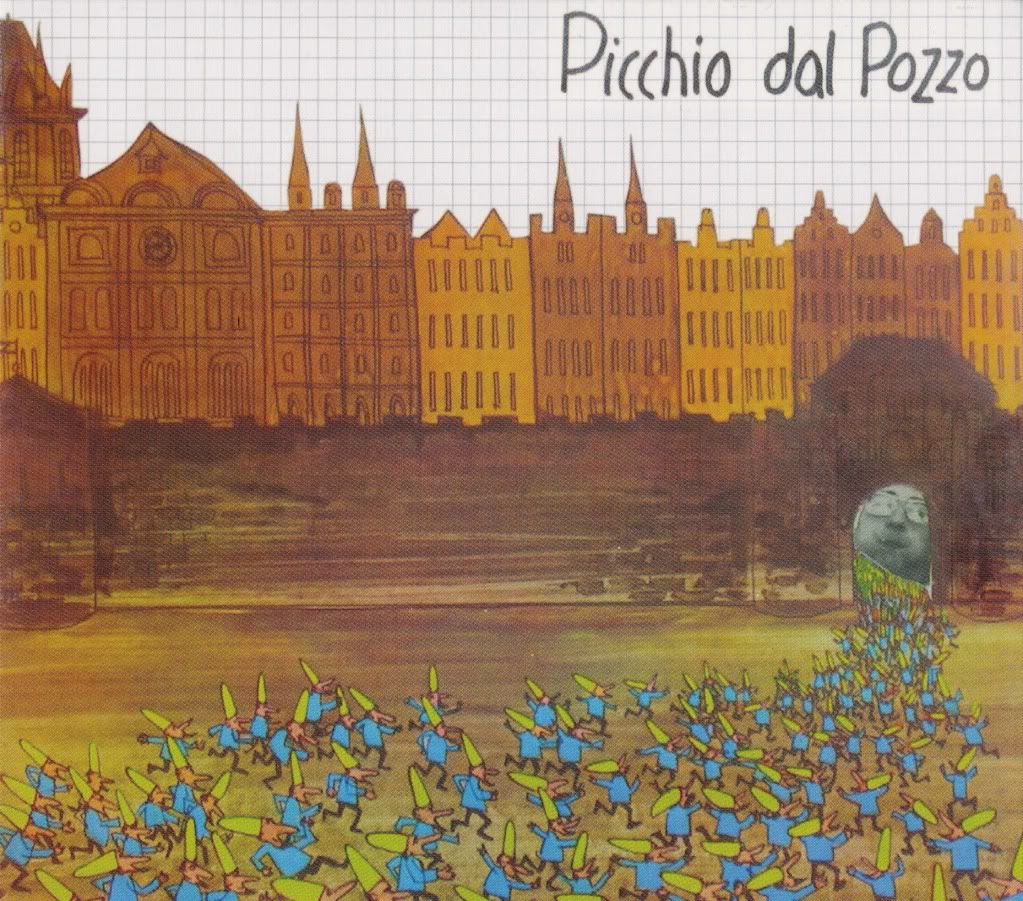
Picchio dal Pozzo - Picchio dal Pozzo


To round out this week's Canterbury Scene focus, here's one of the best examples of how the scene's sounds eventually transcended their geographical and physical origins, and a few even more obscure groups in Europe carried the Canterbury influence in an expanded and often quite interesting and artistically successful direction.  On their 1976 eponymous debut, Italian group Picchio dal Pozzo manage to fuse the gentle synth atmospheres and vocalizing of solo Robert Wyatt with space rock jams not unlike those of mid-70s Gong, all the while sticking to a very Canterburian classical-jazz instrumentation that's heavy on flute, xylophone, oboe, keyboard and fuzzed-out bass and guitar.   

Like so many of my very favorite albums, part of what I love about this album is simply how the music sounds--from the first fade-in acoustic guitar notes of "Merta" the tone of this album is like a warm bath--enveloping, soothing and somehow comforting in spite of its more challenging moments.  Though it's easy to trace this group's influences to Canterbury, there's something about their hazy, dreamy sound and penchant for mischievous wordless vocals that is totally their own.  "Cocomelastico" follows with a direct segue into an awesome-sounding guitar/saxophone counterpoint melody underpinned by layers of spacey synths and some sort of twisted lounge music with suitably gently goofy singing.  As you can see from the lyrics provided on the band's official website, the few words to these songs are mostly nonsense and whimsical wordplay; perhaps one of the Canterbury scene's greatest strengths in terms of longevity is that, unlike most progressive bands, its groups never seemed to take themselves too seriously!

The album's darkest track and arguably its centerpiece is the magnificent "Seppia," beginning with a minor ostinato and some well-chosen dissonant note pairs in the bass before stating a dramatic oboe-led melody and dropping into on of the most deliriously hypnotic fuzz bass riffs in Canterbury history for a synth/xylophone/vocal jam that lasts a good six minutes before dropping suddenly into a quietly avant-garde flute/xylophone/bass trio and closing the tune with some spoken word and a stately, mysterious reed-led section.  The number of sudden surprises, dynamics, details and layers of beauty in a track like this are my total ideal--it's at once accessible and traditionally melodic, while at the same time playing with dissonance and bizarre choices.  The genius of Picchio dal Pozzo's approach seems to be their use of gentle instruments and textures to explore these potentially grating musical moves; they're not going to offend anybody too blatantly, but if you pay attention you realize that there's a lot more going on here than it might initially appear.

"Napier" and the rest of the tracks present more densely-packed, swiftly-moving ideas, quirky but accessible melodies and almost narcotic timbres.  While the last couple of tracks are perhaps less obviously memorable in terms of melody and structure, their humble beauty does improve with further listening and the texture and atmosphere suits the rest of the album's mood so well that the disc trails off in a dreamy whisper that makes me want to start over immediately.  Though it can be argued that the heavy Canterbury influences make Picchio dal Pozzo's debut a bit derivative, as far as I'm concerned we could do with a few more great Canterbury albums and the quality of this music is so consistent and the atmosphere is so uniquely dreamy that it really doesn't bother me; sometimes doing something really well trumps doing something first, and you'll often find there are subtle wrinkles of originality hidden within.

Picchio dal Pozzo is one of my favorite Canterbury albums and is probably favorite Italian progressive album (though there are only a few Italian progressive groups who have actually clicked with me; Stormy Six, Area and Museo Rosenbach and maybe one or two others who manage to do more than rehash the less interesting aspects of symphonic prog).  I'm also really excited to say that this album is back in print on CD--just reissued by Italy's Goodfellas label at the end of 2011.  Now I can review it guilt-free and point you to one of my favorite online storefronts, Recommended Records, as a great place to purchase this CD and support these artists. Obviously, this album is highly recommended, as is the group's second and final studio release, the more challenging and RIO-flavored (but equally rewarding) Abbiamo tutti i suoi problemi, which has been consistently commercially available--more on that album later!

Monday, January 9, 2012

Plastic People of the Universe - Egon Bondy's Happy Hearts Club Banned


Recorded in 1974 in communist Prague but not released until 1978 in France Egon Bondy's Happy Hearts Club Banned is the first album by long-lived Czech band Plastic People of the Universe.  Like a number of other bands in the 60's and 70's, these guys were part of an underground rebellion against repressive communist governments that took the shape of rock music--I can't think of a much cooler reason to make music.

I remember the first time I tried to listen to this album, I was a little disappointed in the opener, "Dvacet;" though it introduces the group's appealing instrumentation (including saxophone, violin, some weird keyboards and delay-treated vocals), the melodic pattern is simple and repetitive, and though I'm aware the Czech poetry (written by Egon Bondy) that makes up the lyrics is probably pretty charged, I can't understand Czech and don't have a source for translation.  I must have stopped listening and switched to something else before the one-minute mark, when the free jazz-informed sax solo starts with a scream from one of the vocalists, and the group's primal groove kicks in.  When I finally gave the album a second chance, I remember kicking myself for not listening just a bit further.  Though it's just a couple minutes long, "Dvacet" is a good example of the group's compositional style, which relies on repetitive grooves and sing-song melodies as a backdrop for some pretty wild soloing.

It becomes pretty apparent how Frank Zappa-influenced these guys are (they even took their name from a Mothers of Invention song) after just a few minutes, but I like how they take the irreverent mood and tense harmonic structure of Zappa and Henry Cow and apply it to a much more primitive structure of simplistic but often brutal riffing.  "Toxica" spaces out a minor theme with effective theatricality before riff-izing it for a great fuzz guitar solo, while "Magicke Noci" starts with some delirious synthesizer before launching into one of the album's most punishingly foreboding riffs, somehow conjured just from bass, rhodes and drums.  "Podivuhodny mandarin" is probably the best fusion of lyrical rhythm and hypnotic riffing on the album--make sure to check out the video of a 2009 performance; these guys are still rocking this material even though they're old and grizzled!

Though a few of the quieter tracks (like "Okolo Okna") might not be as immediate or arresting, the group always manages to set up a unique atmosphere and accomplish some spacey soloing.  I also really like their deeper ventures into satirical territory on the short spoof "MGM" (wherein the group imitates MGM's opening lion roar with their own voices) and the theatrical closer "Jo - to se ti to spi," where the vocalizing is almost Robert Wyatt-like.  Keep in mind that this is an underground recording (the sound quality is pretty low), but the group's untamed irreverent spirit and counter-cultural defiance always manage to show through--you can easily tell that they're not only risking their political freedom to make this music, they're also having a great time doing it!  Good luck finding a CD of this sadly out of print album; luckily it's around for download in quite a few places.

Wednesday, December 14, 2011

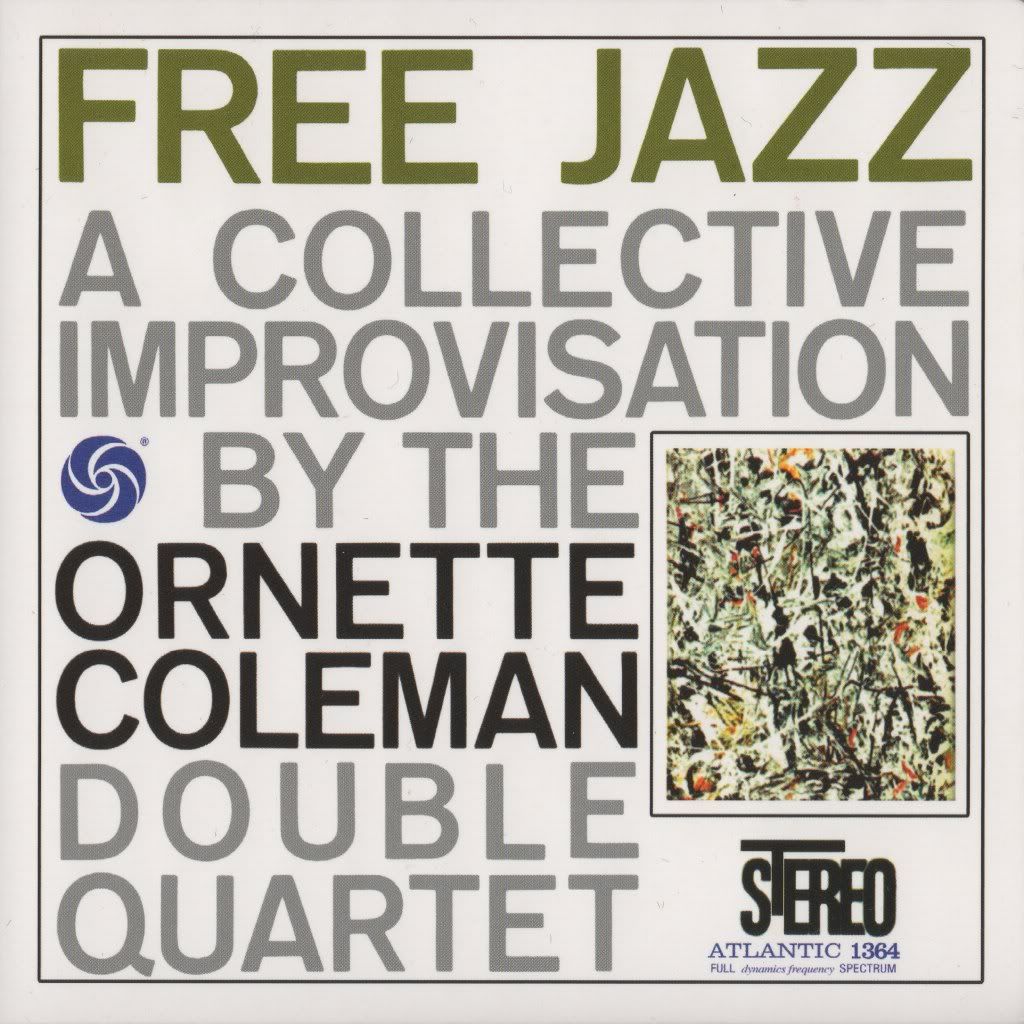
Ornette Coleman - Free Jazz


Though he'd already been prolifically recording for a few years by 1961 and had already thrown down the free soloing gauntlet with The Shape of Jazz to Come in 1959, Ornette Coleman's 1961 Free Jazz album continues to stand as a peak among peaks in Coleman's celebrated early discography and as one of the earliest and most fully-developed statements that would define the loose but enduring free jazz movement.  For me, the thrill of Free Jazz is the feeling of looking into a petri dish as something utterly unprecedented happens for the first time.  The album's form intersperses lengthy solo sections (Coleman's saxophone solo is the longest) with rhythmically-composed atonal horn fanfares, a typically labyrinthine Coleman-ian 'melodic' head and a closing duet for each rhythm section duo.  The double quartet (Coleman on alto, Eric Dolphy on bass clarinet, Coleman stalwart Don Cherry and Freddie Hubbard on trumpet, Scott LaFaro and Charlie Haden on bass, and Billy Higgins and Ed Blackwell on drums) is arranged in stereo, with one quartet on each side.  The result makes the bass interplay much clearer (the bassists decide, for the most part to stick to different octave registers to stay out of each other's way), but for some reason the drums are difficult to discern--reaffirming my usual opinion that dual drum kits are a concept that sounds good on paper but usually comes across as excessive in real life.

This tension between concept and practice is what's most exciting to me about Free Jazz; clearly Coleman thought out the large pieces of the puzzle quite well, but it had still never been done before.  He exhorted his side-men to contribute whenever they felt the urge and play as expressively as possible without connections to any recognizable pieces of music or styles, but the end product swings like a mother and Coleman's instructions didn't stop Hubbard from quoting "Jingle Bells" at one point ("don't pour salt in your eyes, don't pour salt in your eyes").  What always captivates me when listening is the range of development in "freeness" that's on display.  It's almost like looking at that classic image of human development; Coleman and Dolphy had both already reached a comfortable level of freedom in their playing (which is still extremely melodic [at least in Coleman's case] and fluid if idiosyncratic), and Don Cherry isn't far behind, no doubt aided by his tenure in Coleman's quartet.

Of the horn players, Freddie Hubbard is undoubtedly the weak link in terms of freeness, which might be the most interesting in terms of historical context.  His inability to really wrap his brain (and chops) around Coleman's concepts are evidenced in his tentative stop/start soloing which ultimately owes more to the theoretical constraints of bop than any sort of previously uncharted territory (it's particularly evident in the CD reissue "first take" bonus track, where Hubbard's feet are audibly cold and his solo's conventionality comes across as the equal and opposite reaction to the excitement and hurried uncertainty of the song's "first go").  It's funny to hear Dolphy pedagogically prodding at Hubbard during his solo, mimicking the trumpeter's ideas with repeated derangement, throwing in squawking vocalizations and wonky riffs--it's as if he's saying "let it go man, try it like this."  Dolphy's accompaniment might be even better than his formidable solo--when he and Hubbard start team-riffing to Ornette's solo, things get really fun, and though his bass clarinet seems to be miked really poorly, the character of his atonal hooting not only accentuates Coleman's soloing, it pours directly into the raucous, party-like atmosphere that's central to this session.

Finally, and in a more meta sense, Free Jazz is a reminder of the areas of "out" and free jazz that had not yet been explored.  While Coleman's compositional framework abandons many of the classic tropes, it's also still pretty close to jazz tradition in terms of solo vocabulary (compared with some of Sun Ra's stuff, for example), rhythm (compared with, say, Spiritual Unity), and overall composition--Free Jazz still paints (though in broader brush strokes) a quite clear picture of dedicated solo sections and sometimes leans on obligatory building blocks like the extended bass and drum sections (compared with something like the impressionistic structures of something like Peter Brötzmann's Machine Gun) in a way that suggests automatic impulse in place of a well-considered original idea.  These are just historical/theoretical observations, though--people who argue about how Free Jazz isn't really free seem to me to miss the point.  It's not about trying to pursue only freedom, but to show how much the jazz idiom opens up to new directions, ideas, and expression of emotion if players and composers start casting off some of the conventions that have become stale.  Sure, this album is cacophonous and not always easy listening, but its richness in ideas and energy remain undimmed and helped catalyze a movement that produced some of the most interesting music made in history of jazz.

Get it here.

Friday, November 25, 2011

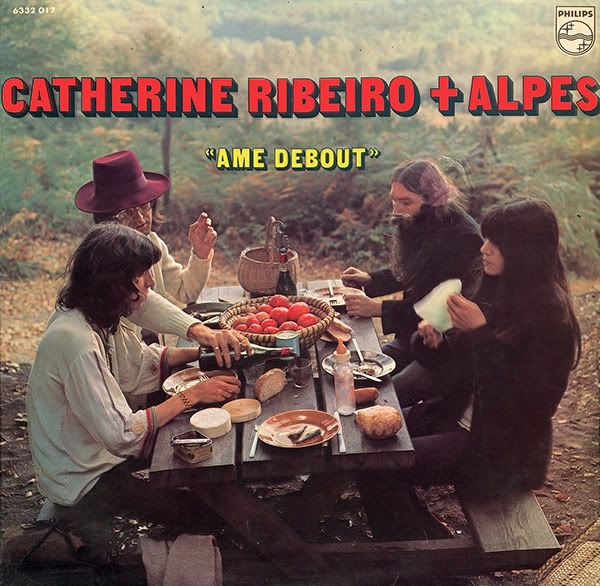
Catherine Ribeiro et Alpes - Ame Debout


We're not done with you yet, France.  In spite of all of my spirited attempts to express what I do and don't like about music into writing, sometimes it actually feels good to have those words and opinions shoved right back down my throat.  The exceptional work of singer and poet Catherine Ribeiro and her sometime-group Alpes (consisting primarily of guitarist and composer Patrice Moullet) not only defies all of my complaints about excessive repetition, its use of repetition in and across all of the album's tracks is often the precise reason why it's so great.

Rather than attempting to fuse any real recognizable styles of music with lyrics and vocals, Alpes' relationship with Ribeiro is at once more complicated and more elemental.  The band's sound is indeed consistent on most of these songs, formed primarily of repeating hand drum, bass, violin and guitar figures and droning organ and synth tones supplemented by a couple of bizarre instruments (the percuphone and the cosmophone).  The repetitious sounds are stretched long across time--minutes of the same textures, shifting perhaps ever so slightly, but rarely ever responding directly to Ribeiro's vocals rhythmically.  Instead, the music floats like an uneasy sea beneath Ribeiro's, swelling to support her vocals harmonically but rarely (if ever) displaying enough ego to act as anything other than a perfect platform for her existential angst.  For her part, Ribeiro displays peerless skills as both a singer and an actress, projecting a distilled humanity with a powerful, husky low register and desperate, cracking high range, sometimes speak-singing, sometimes freely vocalizing with moans, growls, whispers and frantic pleas.

The superb title track demonstrates the band's unique aesthetic with grace and power, as the droning instrumentation fades in with subtle dynamism and Ribeiro's vocals soar and dive as if she's pacing inside a six foot cell.  A spare organ backdrop is all that's needed to supplement the chanteuse's vocals "Le Kleenex, Le Drap De Lit Et L'etendard," wherein the bitter irony of a line like "je cherche un kleenex" sits bizarrely comfortably next to the singer's pleas to "regarde-moi, ecoute-moi."  The heart-rending "Diborowska" is undoubtedly the most compelling song melodically, with its harrowing "le train en partance pour Diborowska" merging tragically with the song's arpeggiated nylon string guitar and eerie train whistles.  The band manages to assert that its fleeting, gossamer instrumentation can arguably stand alone without Ribeiro's words with a few instrumentals, including the atmospheric "Alpes 1," the bizarre, unintelligible vocalizations of "Alpes 2" and Ribeiro's ghostly wordless vocal on "Aria Populaire."  The album comes to a folky, pounding close with "Dingue," which combines the folkiness of Ribeiro's earlier recordings with 2 Bis with a similar sort of energy to early Leonard Cohen with even more bile and energy in the vocals.

While the compositional elements and harmony employed by this music are really quite simple, there's an emotional expression happening in the combination of the vocals and music that is so rare and direct that I can't say I've ever heard anything quite like it, even in the realm of similar artists like Peter Hammill.  It's almost like the instrumentation is there for the explicit purpose of putting Ribeiro in the zone to extemporaneously conjure her deepest self onto tape, and it's always inspiring to hear.  As much as I'll probably continue to rail against excessive repetition in all forms of music, this album (along with the rest of Ribeiro's work from the same period) is a humbling reminder that there is never one single right way to make music, and the effort to conceptualize and verbalize a musical aesthetic is only an imperfect attempt to reach the sort of unquantifiable magic found here, using incomplete means.  If you can achieve this level of intuitive expression, it doesn't really matter to me how many chords are in the song or how many times you play the same note in a row.  Unfortunately most of us mortals lack the innate spark required and must attempt to find our lesser inspiration by toying with established theory and idioms down in the everyday muck.  It's absolutely criminal that these albums are out of print and Ribeiro's music is even harder to find out about than it should be.

For now, you can find it here.

Monday, November 21, 2011

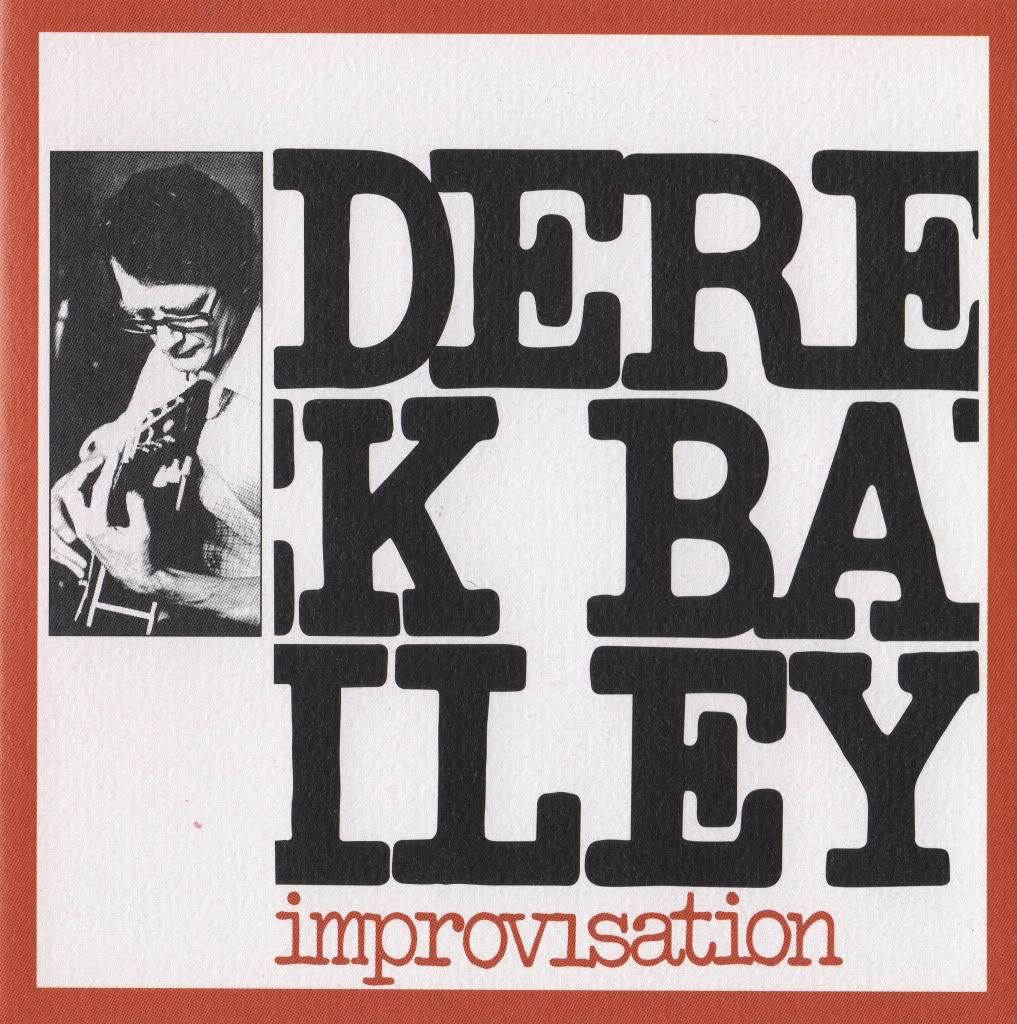
Derek Bailey - Improvisation


Derek Bailey is known for two things: being a grouchy old man when he wasn't even old, and for single-handedly creating his own free improvisation idiom on the six-string guitar.  Right up my alley on both counts!  By the time Bailey recorded Solo Guitar Volume One in 1971, he'd already been a prominent figure in the British and European free jazz circuits, performing with people like saxophonists Evan Parker and Peter Brötzmann and bassist Dave Holland, and by the time this 1975 album was released he had refined his solo improvisational technique (which came across as a bit tentative in his debut) to the rarefied level it remained for most of the rest of his career.

Listening to Derek Bailey for the first time can be a disorienting--his style is thoroughly and often brutally atonal, arrhythmic and usually very nonrepetitive.  It's also most assuredly the type of music that sounds like an irritating mess if the volume is low and you're only half paying attention.  Crank it up so your surrounded by Bailey's sound world and focus on what he's doing and an exciting (if somewhat cold) sense of adventure-in-logic dominates every move the guitarist makes.

While Keith Rowe is responsible for making equally influential advances in the guitar free improvisation realm, Bailey's music sounds much more like a conventional guitar played to an exponentially "out" degree; in fact, his amplification is so clean it's almost difficult to discern that he's playing an electric guitar on this album.  Though he almost exclusively flatpicks, Bailey's style relies heavily on harmonics, muting and exploiting the instrument's natural sustain and decay.  This can be easily heard on "M4" and to even greater depth on "M8," where Bailey's harmonics and string bends pit two strings against one another on nearly the same note, deftly controlling the oscillation between the two notes as they eerily decay into space.  At other points Bailey embarks on furious runs across bizarre intervals, sporadically halting to interject with brief spurts of silence or allowing a note to ring before again changing direction completely with some explosively percussive cluster chords ("M10").

One of the things I love most about Bailey's style is how fluidly he moves from one idea to the next; though there really isn't any melody to his playing, it's usually easy to discern what is fascinating him at any given moment, and the thrill of his free improvisation is in the headlong rush into whatever the next idea might be.  Sometimes the difference lies in the textural discrepancy between harmonics, standard string plucking and jabbing chords ("M13"), and at other points it might be a digression into exploring the percussive potential of the instrument with skittering string scrapes ("M14") or interjecting taps on the guitar top between the string's tonal sounds.  Finally, and perhaps most subtly, Bailey uses a two-amplifier setup and volume/swell pedals to dynamically pan the output of his guitar, which adds a richness and mobility to his fretboard wandering (especially noticeable on "M5").  While not quite as finely controllable as Fred Frith's dual pickup/output experiments, it's easy to see that Frith's guitar solos owe a sizable debt to the pioneering done by Bailey.

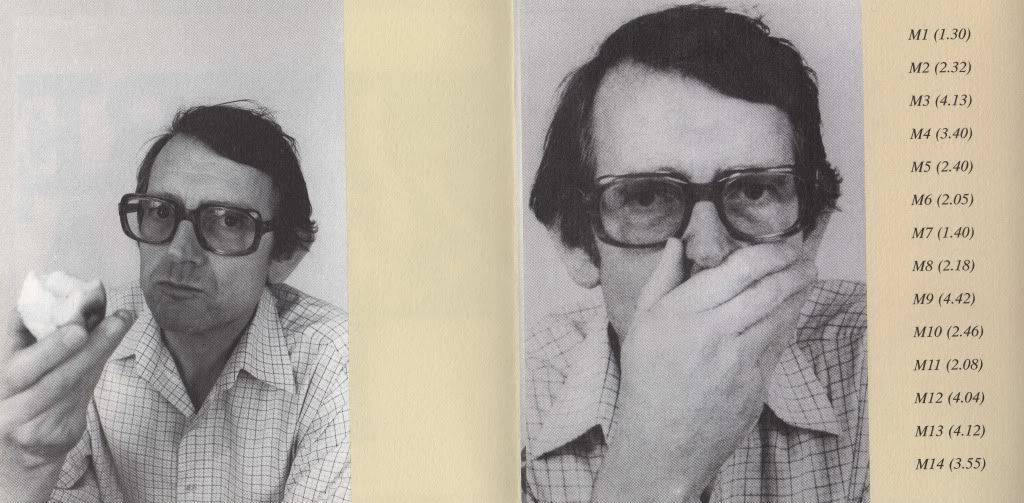
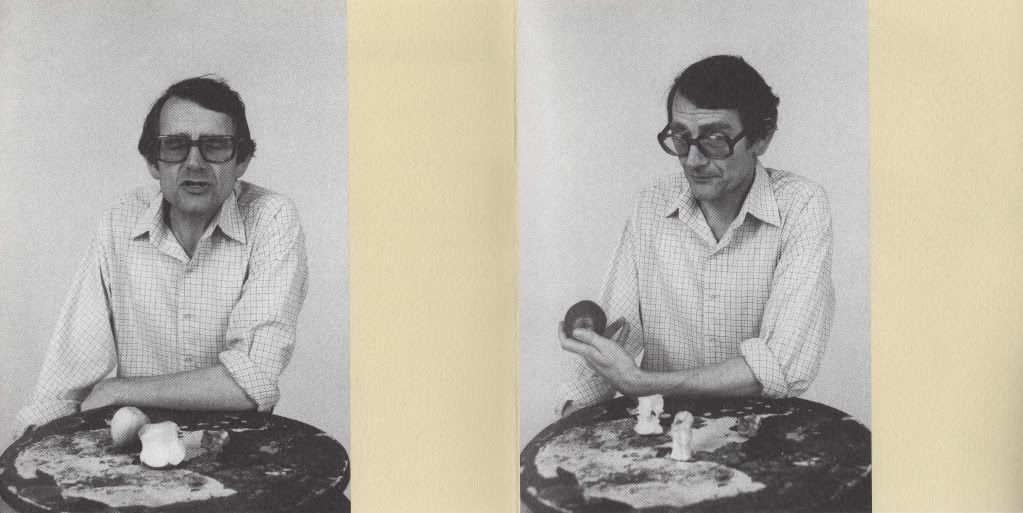
While he's got more epic albums (Aida is often regarded as his best), I think Improvisation is just as strong and is probably a better introduction to Bailey's challenging style because the track lengths are short and can be more easily focused on and digested.  Though my interest in Bailey has been tempered by the realization that his style became formalized mid-70's and didn't develop much further, revisiting his best works reminds me that 1) his style is so radically different from those who came before him that he didn't really need to reinvent himself to maintain his validity and 2) his style is so all-over-the-place that there isn't a whole lot more he could do to develop it further.  Bailey's playing is an inescapable golden standard for atonal guitar as well as an audacious challenge to all followers to conjure something else new and exciting from those six strings.  Please enjoy these pictures of Derek Bailey eating some apples.
Get it here.

Thursday, October 20, 2011

Eric Dolphy - Out to Lunch!


If I had to credit one album for inciting my recent obsession with jazz, it would have to be Eric Dolphy's 1964 crowning achievement, Out to Lunch!  Before then, I'd found something of a backward insertion point into jazz by moving into free jazz from the less idiomatic free improvisation realm.  After hearing this album, though, I realized that there's an entire movement within jazz (generally known as avant-garde jazz) that overlaps with free jazz in terms of soloist expression but also focuses heavily on expanding the compositional palette of bop and post-bop to a wide variety of places it'd never been before--undoubtedly, avant-garde jazz is the jazz for me!

By 1964 Eric Dolphy had had a storied career as both a sideman (supporting, among others, John Coltrane and Charles Mingus) and as a leader, recording several studio and live albums since his bandleader debut on 1960's Out There.  It's unsurprising that Dolphy was in great demand as a session and live ensemble member, as he could play alto saxophone, flute and bass clarinet--the wider success of which in jazz music he can arguably credited--with comparable (but always idiosyncratic) virtuosity.  Though he was playing "out" for years before the date of this recording, Out to Lunch! is the first (and last, since he died within months of its recording) of Dolphy's albums to feature only his own compositions.  As I've increasingly found among successful avant-garde jazz albums, the combination between the adventurousness and innovation of the compositions and the freedom, creativity and chemistry of the performers creates a perfect storm of blissful, challenging sounds.

On the compositional side, Dolphy provides songs that run the gamut between dissonant odd-metered avant-garde ("Out to Lunch," "Straight Up and Down," "Hat and Beard," dedicated to Thelonious Monk, one of the only jazz composers who could be said to foreshadow Dolphy's style), early 1900's gospel jazz (the ballad "Something Sweet, Something Tender") and frantic, twisted bop riffing ("Gazzelloni").  On the more dominant weird stuff, Dolphy strikes a fascinating balance between abstractness (which often pleasingly extends typical jazz harmony to the brink of atonality) and Ornette Coleman's sinuous sense of head melody.  "Hat and Beard," with its constantly mutating descending scale and lurching unison non-melody, fits the former category, while the title track fits the latter with a seemingly never-ending head that winds around in spiraling circles, somehow never separating the tight unison between trumpet and alto sax.  The final track, "Straight Up and Down" is supposed to emulate a drunken stagger but, really, the same could be said of most of the rhythms here!  What I really love about Dolphy's compositions is that they travel well beyond the head-solo-head formula that sometimes hangs like an albatross from so much ultra-orthodox jazz; sure, the songs have recognizable and recapitulated heads, but there are innumerable pockets of group dynamic shifts, coordinated rhythmic interplay and near complete dropouts that you never get the sense that things are happening without a good reason.

As far as the playing goes, like I said earlier, this is an undeniable example of a perfect storm where a dream team of players come together over a set that pushes them all to places they've never been before.  The absence of piano means that vibraphonist Bobby Hutcherson carries the mid-range chromatic accompaniment on his shoulders, which means a lot of the accompaniment is more spacious than the type of comping that piano usually provides.  I really enjoy how Hutcherson swaps between helping state the songs' melodies, comping with two or three-note chords over occasionally strange intervals, and spontaneously supporting solos with minor melodic excursions.  While Hutcherson's replacement of piano on this album is often lauded (as must be his ability to make one of the geekiest jazz instruments as cool as it could possibly be), I think some credit is also due to bassist Richard Davis, who often uses two-note chords (sometimes with a bow) in addition to a more standard walking style to emulate the piano's absent tonal cluster effect.  The tightness of Hutcherson and Davis allows Tony Williams free reign to play counter-rhythm to the vibes, alternate between blasting and delicate fills out of nowhere, and keep the ideas coming one after another without obsessing about blatantly stating the beat--sometimes it's just implied, and that space is one of the best parts about this music.  Trumpeter Freddie Hubbard could easily be labeled this set's least adventurous performer, but there's really no denying his chops; though he can't compete with Dolphy in terms of out-ness, he ably makes up for his relative conventionality with furious energy, which just might be considered out on its own.

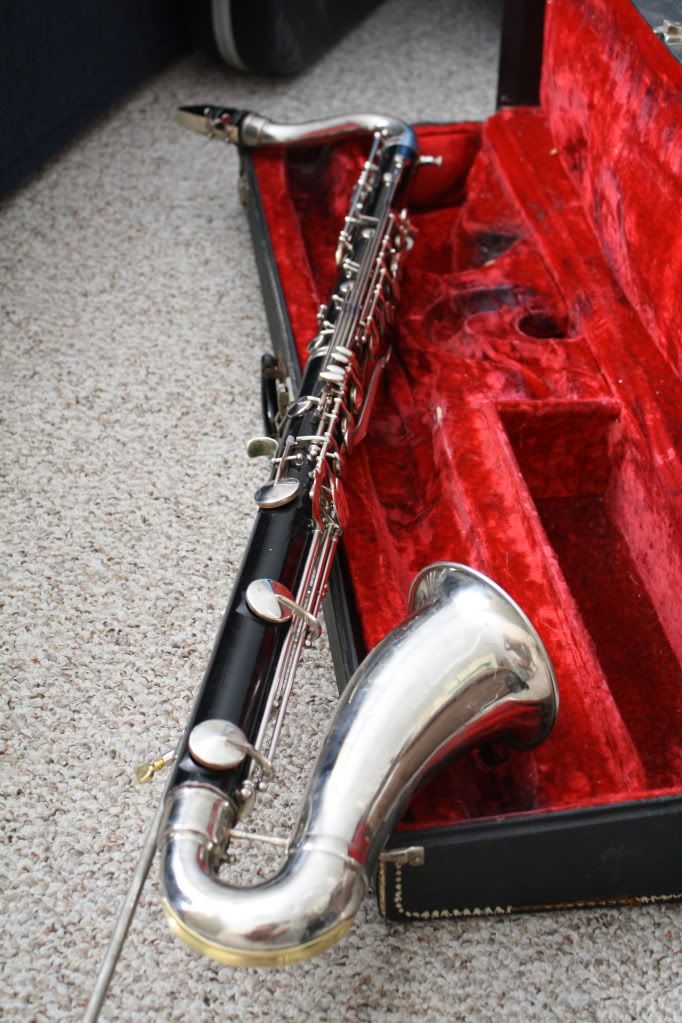
Finally, Dolphy manages to consolidate his well-documented strengths on all three instruments by stealing his own show.  I can never get enough of his bass clarinet playing--the instrument's ear candy timbre is enjoyable on its own, but in the hands of someone like Dolphy, it becomes something else entirely.  Especially with the bass clarinet, his intuitive feel for the instrument's range and voicing allows him to employ it quite vocally, screeching through wide intervals just as often as he blurts out vaguely tonal (but always strangely melodic) fragments.  The beauty of this approach comes out even more on "Something Sweet, Something Tender," where the slow tempo and old-timey feel allow for some wide vibrato and compelling emotional expression.  Dolphy's alto saxophone chops are another thing entirely; his tone is so flagrant it sounds like he's blowing fire out of his horn and the mics can barely handle it.  "Gazzelloni" is the only flute showcase, which seems like a good ratio--the vibraphone seems to overlap in terms of timbre, so one example of Dolphy's rapid fire, often viscerally percussive flute style satisfies quite well.

It's a shame Dolphy wasn't able to follow up this masterpiece with a few more albums of his own compositions--he was clearly on a roll.  Fortunately, there are numerous great examples of his ability as a sideman (my picks for a balance between Dolphy's chops and adventurous composition are Andrew Hill's Point of Departure, George Russell's Ezz-thetics, and Ornette Coleman's iconic Free Jazz), and if you just want to hear the man play, his Wikipedia page comprehensively lists his discography as a leader and sideman--enjoy the trip.  It's disappointing that few contemporary jazz artists have attempted to push the genre forward in this way--there's clearly lots of space left to fill with audacious sounds, and it's hard to argue that these guys didn't have a great time making this music.

On a side note, here's what happens when you listen to too much Eric Dolphy...for use on my upcoming recording project.

Wednesday, September 28, 2011

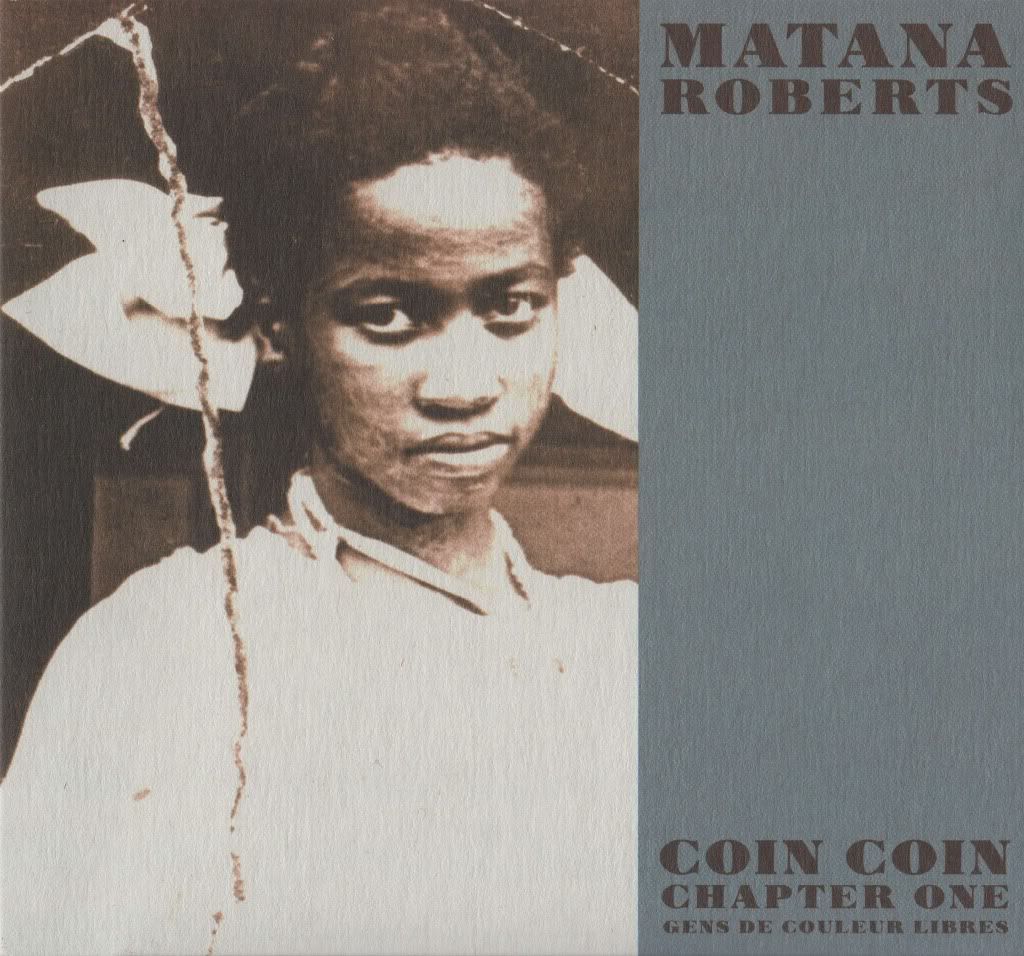
Matana Roberts - Coin Coin Chapter One: Gens de couleur libres


As unfortunate as it may sound, it's unusual in 2011 to have a challenging new jazz release to get excited about, but New York (via Chicago) alto saxophonist Matana Roberts has undeniably produced one.  Though she's been publicly active since the early 2000's, the first "chapter" of her ambitious planned 12-part Coin Coin series seems to have been Roberts' biggest break to date, getting her a lot of exposure in print and online.  People have already been talking about this album enough that the word "hype" is getting tossed around, which usually results in heavy skepticism and considerably less interesting conversations.  After getting to know this album I don't feel any need to declare it the "best" anything of 2011, but I do agree with the growing number of people out there that it's an uncommon album in the contemporary jazz landscape and well worth checking out.

Coin Coin Chapter One is probably best described as a conceptual piece of performance art, which covers the wide variety of musical styles it incorporates as well as the use of poetry and narrative that are central to its purpose.  The core themes of the work are memory, history and shared human experience, focusing primarily on subject matter relating to historical African Americans in slavery and positions of adversity, drawing from Roberts' own explorations of her family history and ancestry.  This subject matter is presented over and together with a diverse backdrop of different jazz styles, including avant-garde jazz, free jazz, dixieland, blues, and more.  While I think it's a valid point that the subject of the African American slavery is arguably not immediately relevant to most people's present-day lives and that it can be "too easy" of a choice (for obvious reasons relating to the horrors that countless African Americans have experienced throughout history) when it comes to eliciting a strong emotional response, I think these objections are a little too dualistic.  When confronted with Roberts' vision, it's clear that her exploration of the historical black American experience remains a living, vital part of her (and I'm sure innumerable others') identity, and the authenticity and emotion of her presentation soon dispels any attempt at dismissing the subject matter as purely contrived.

The most powerful pieces on Coin Coin Chapter One are undoubtedly those that feature Roberts' voice either singing or reciting spoken word.  In the Coin Coin world, Coin Coin is a sort of "every person" spirit who repeatedly appears in different people's lives across history, reinforcing the concept of shared experience that seems central to Roberts' project.  In "Pov Piti," "Kersaia" and "I Am," Roberts introduces Coin Coin's different manifestations with anguished cries, powerfully conveying the spirit's rebirth through another African American's existence.  Each song continues, describing each character's experience through Roberts' spoken word.  It's hard not to admit that these pieces are crushingly compelling in their emotional message, as Roberts' lilting spoken word describes episodes of yellow fever, slave rape, and redemption through freedom and the jaw-dropping concept of buying back children who were taken and sold as slaves.  I really love her poetic delivery; the meter is flowing, organic, and wholly reminiscent of instrumental improvisation--she stops, starts and repeats lines as if she's blowing a horn, imbuing the words with rhythm and often downplaying the force of the ideas, casually dropping blood-freezing lines like "I have seen so much but yet have experienced less than most dogs" and "I am twenty-five; there will never be any pictures of me."  Her lyrical concerns also come to fruition through sung vocals, as on the bitterly sarcastic auction block vocal blues parody "Libation for Mr. Brown: Bid 'Em In," and more contemporarily on the dedication "How Much Would You Cost?"

Musically, Roberts' vision is as sweeping and all-inclusive of African American history as her narrative is, drawing together a smattering of all of the historical jazz developments imaginable and weaving them together into a smoothly-flowing collage.  The opener, "Rise" recalls Coltrane's A Love Supreme in both title and its incantatory feeling, though its cacophony eventually marries modern electric instrumentation with more of a Pharoah Sanders-like free jazz sound.  The mercurial, progressively shifting main theme that introduces the album's spoken word pieces possesses the album's most memorable instrumental melody, effectively aurally tying the recurring themes together, and including a vocal arrangement that recalls 40's film scores.  "Song for Eulalie" blends ominous piano riffing with some nice free duet playing between Roberts (whose alto saxophone tone variously recalls both Coltrane and Sanders as well as the keening gospel sounds of Albert Ayler), while the album closing waltz ends on an uplifting note with the disc's most unassuming and most compelling vocal melody.

Though there are numerous brief kernels of vibrant and effective composition, I think one of Coin Coin Chapter One's weakest aspects is that it often plays like an all-inclusive pastiche; its eclecticism is only occasionally displayed in fully-formed songs and more often occurs willy-nilly across songs that seem to have little in the way of structure.  While the mood and playing of "Rise," for example, display a slight modern twist on free jazz, the track presents little in the way of recognizable melody or memorable elements.  Consequently, when the album ends the actual compositional elements seem rather slight and repetitive--the repeating theme, a couple of traditional songs, and a whole lot of episodic genre sampling spanning over 60 minutes, with a number of ideas taking up a bit more time than they probably justify.  Since Roberts has already announced that Coin Coin will be a 12-part series, it's hard not to start wondering if the musical approach will be the same for the entire work, which I fear could result in some artistic stagnation.  Though, as far as I know, this album is strikingly original in the jazz world (the closest thing I'm aware of is Max Roach's We Insist!: Freedom Now Suite), it's arguably only original in its performance art/narrative approach and wide-reaching inclusion of different styles.  Without Roberts' concept, words and voice, I think the music would come off as a bit unremarkable and unfocused in its scope.  I sympathize with Roberts' ambitions, since creating something simultaneously eclectic, developed, and original requires a sort of unidentifiable magic touch.  I hope that later installments in the series retain her obvious passion with a stronger focus on composition and hopefully her emergence as a truly original musical voice, neither of which I think have happened quite yet on this release.  Either way, I'll be first in line to pick up chapter two whenever it's released, and I hope those jazz artists listening to Matana Roberts achieve a little bit of inspiration to stretch past the hard bop regurgitation that so much contemporary jazz seems to cling to.  Whether or not it "lives up to the hype" (probably the most boring discussion imaginable when confronted with an album like this), I think Coin Coin Chapter One is unarguably an uncommon work and worthy of the interest it's received.

Monday, September 19, 2011

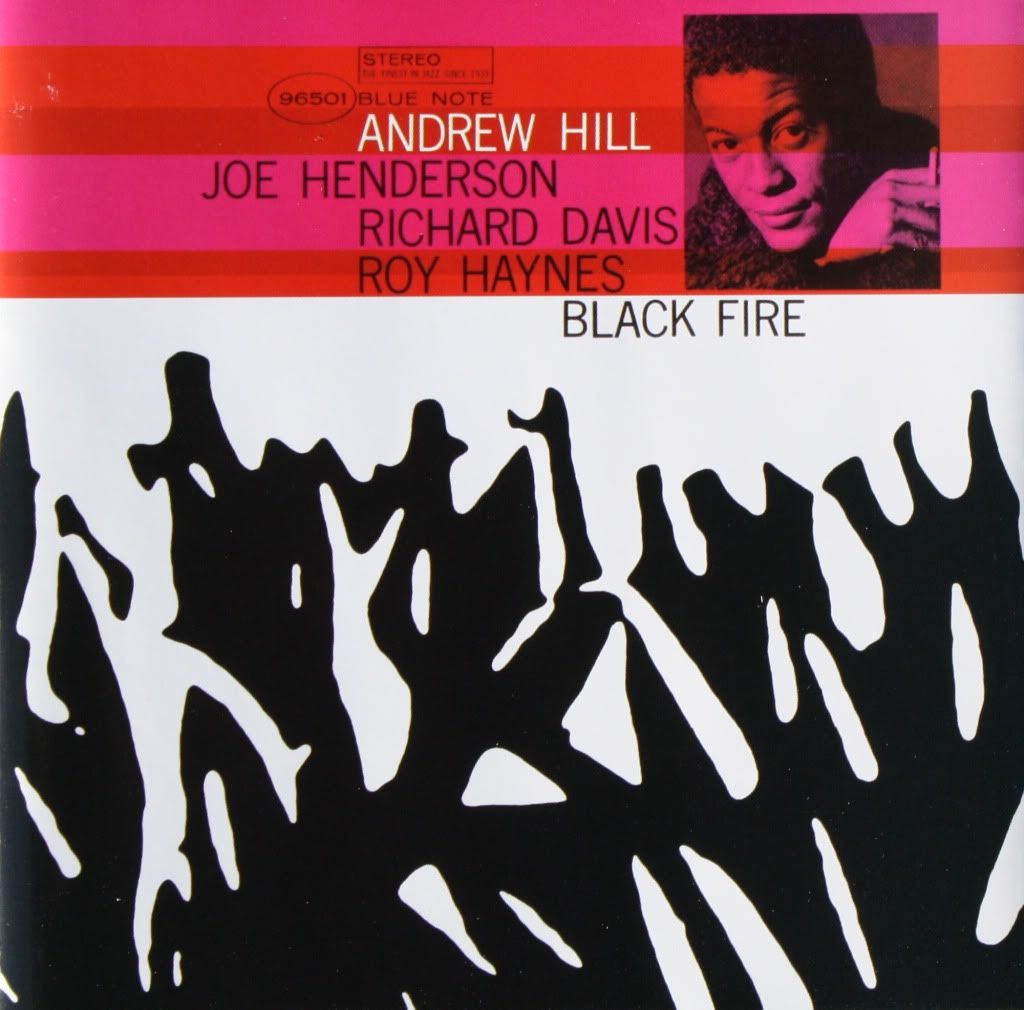
Andrew Hill - Black Fire

 
The path that's led me from dispassionate appreciation to real enjoyment of jazz has been a serpentine one, coming to like the genre not from its more accessible and well-known forms but backward from things like jazz-rock, the Canterbury scene and from experimental and free improvisation music to the more "out" forms of jazz like free jazz and avant-garde jazz.  I'm not sure if it was repeated exposure to jazz harmony (whose distinctive sound sometimes lacks the pointed directness of the more simplistic harmony employed by most pop music) or just the fact that I found jazz that's more up my alley, but after years of unsuccessfully trying to enjoy the genre, something finally clicked a few months ago and I'm pretty happy about it--there is a whole lot of great jazz out there, even within short 10 year spans (most of the jazz I've taken to seems to come from the 60's).  With jazz's current cultural dominance in an extremely attenuated form and many young people coming to jazz as outsiders, there's potential for jazz to sound samey; extended solo breaks, walking bass lines and a lot of commonality between different players' vocabulary can make it tough to distinguish between songs, styles and players, but repeated acquaintance with a couple of albums and the tenets of the style (most basic jazz compositions feature a melody or "head" that's stated a couple of times, embellished through one or more solos, and repeated again at the end of the song) make it a little easier to view jazz as something decipherable and not just a bunch of honking, noodling, or uncool music fit only for background at a restaurant.  In a suitably backward way, I've already introduced free jazz and jazz fusion on the blog, but have yet to share an album from the post-bop or avant-garde jazz styles.  It's fair to say that in the early 60's the dominant form of jazz was probably hard bop, known for its liveliness, dance-ability and connection to R&B, gospel and blues.  As early as the late 50's, though, there were jazz artists starting to stretch the somewhat conservative boundaries of bop both in their playing and compositions to such an extent that some jazz became different enough that new labels were needed to describe it.  In my understanding, at the time, jazz musicians referred to this trend using the adjective "out," and when free jazz started emerging there were enough people doing it that it was being referred to as "the new thing."  Nowadays we have varying descriptive shades from the mild alterations and expansions on the formula found in post-bop (probably the only time I'm comfortable using "post" as part of a genre title, as it represents changes in the music that really were unprecedented and couldn't be described by existing vocabulary) to the nebulous but definitely more acute abandonment of bop's rules found in avant-garde jazz, to the very "out" and least structured form that would become known as free jazz.  The terms usually aren't mutually exclusive and often don't describe in a hard-and-fast way what the music will sound like, only that it will be different and probably more adventurous than the bop, modal jazz, and cool jazz that preceded it--sounds like the jazz for me! 

On to the actual disc at hand, pianist Andrew Hill's debut for avant-garde and post-bop watershed label Blue Note, 1964's Black Fire.  Though he's best known for his star-studded 1965 album Point of Departure, Hill's career as both a sideman and band leader is  prolific, varied and vibrant--at this point in my fledgling jazz fandom, he might be my favorite jazz artist.  I think it has something to do with his ability to ride the line between edgy and accessible, the wide variety of styles his compositions cover, and the fact that he's got a million great albums.  Black Fire is a perfect example to introduce both avant-garde jazz and post-bop, and I'd venture to say it's a great gateway album through which the uninitiated can get into jazz.

What distinguishes this album most as avant-garde and post bop is definitely Hill's compositions, which are at times irreverent to jazz custom and obviously sound beyond the boundaries of bop.  "Pumpkin" opens the album with an uptempo and edgy bang, teetering between a dark minor theme stated by Joe Henderson on tenor saxophone and a rapid sax/piano run that gives way to a dissonant and playful counterpoint riff between the piano and sax.  Hill takes the first solo, ranging between flitting runs, rapid interval two-note chords, and a lot of inventive and acrobatic maintenance and embellishment of the repeating quarter note triplet riff that punctuates the song every several bars.  As with any good jazz album, the interplay between the players is top notch--in addition to Henderson and Hill, journeymen Roy Haynes and Richard Davis ably hold down the drum stool and double bass, respectively.  Even this early in his band leader discography, Hill's piano style and compositions are heavily rhythmic; his repeating riffs often form poly-rhythmic counterpoint with Haynes' aggressive drum style, leaving Davis to keep the steady pulse uninterrupted.

"Subterfuge" is another driving minor number, with Hill's percussive left hand riffing and two-hand unison riffs stating the melody.  The saxophone-less track leaves lots of room for unexpected turns in texture and mood in Hill's solos and makes space for a great drum solo from Haynes.  The title track lightens the mood with a lithe and cheerfully knotty saxophone melody and a lot more rhythmic juxtaposition between the low keys and the drums.  "Cantarnos" has more wonky rhythmic interplay, this time around a Latin-inflected riff and long-note legato melody from Henderson.  Things get slightly less driving on the bluesy and again horn-less "Tired Trade" and the album's only brief ballad, "McNeil Island."  The dizzying, stuttery and awesomely-titled "Land of Nod" closes the album with an excellent summation of the album's strengths and points the direction to Hill's later, even stranger compositions.

Black Fire is a great example of jazz that's simultaneously very listenable, extremely melodic (I can think of few jazz albums with melodies so instantly memorable), yet still strange and outside the bounds of what most jazz composers were doing in 1963.  Andrew Hill is as able a sideman as he is a composer and soloist; he never hogs the stage and displays impeccable taste when it comes to showing off his chops or supplementing the other players; such is the mercurial quality of truly great jazz musicians.  To speak in terms of my last two reviews, other than the risky compositions there isn't a lot formally to differentiate this music from the standard jazz formula, and yet there's no shortage of ideas regularly flowing out of all four players--the beauty of jazz is its liquidity.  All four are accomplished enough that they comp inventively and unpredictably around the chord changes and each others' solos, making for music that is founded on fixed elements but avoids repetition through in-the-moment and unrepeatable imagination.  Ideas are tossed out, perhaps repeated and slightly mutated a few times, then the player alters the idea enough that it's become something completely different, heading off into another direction like a feather in the wind.  Of course, it helps that Hill's compositions are so subtly unusual--I'm sure the weirdness lends itself to great idea-making in the minds of the sidemen.  There is much more great material to come from Andrew Hill and avant-garde jazz in general, but Black Fire is as good a place as any to get your first taste.

Friday, August 5, 2011

Egg - The Civil Surface


The sound of a ticking metronome opens Egg's third and final album, 1974's The Civil Surface.  I don't think there's any better sound to introduce a band like Egg, whose music is probably the most classically-influenced of all the Canterbury bands and is typified by Mont Campbell's precise, intricate compositions that are filled in by Dave Stewart's interweaving organ and keyboard parts and driven by Clive Brooks' undeniably exact skills at the drum kit.  The Civil Surface is really more of a reunion album for Egg (not to be confused with newer group, The Egg), as the group had broken up in 1972--luckily for us, they had another album in them and here develop the sound of their first two albums even further.

Being a reunion album, The Civil Surface is a bit of a fractured collection.  Therein lies the main stumbling block regarding my ability to enjoy Egg--they present some of the most interesting and "out" ideas of any of the Canterbury (or any other progressive bands, for that matter), but when it comes to crafting a cohesive and really great album, they were never really able to make it happen.  The ideas really do reach rarefied heights, though.  The aforementioned opener, "Germ Patrol" is perhaps most typical of the group's overall career sound, with plenty of Canterbury fuzz organ and bass, jazz harmony and ear-surprising twists.  It's on this track I most notice a common complaint with The Civil Surface--the drums are mixed extremely loudly, and it's especially painful when Brooks goes for the high-hat, with lots of sibilance that can be really sharp and hard on the ears.  Because of this, the album doesn't really sound good on a lot of sound systems (especially ones prone to treble-y sound), and the more you push the volume to discern the compositional intricacies, the more the drums get in the way.  The song plays effectively with additive rhythms and builds on its somewhat anonymous melody, though, and features nice clarinet and bassoon from Henry Cow guests Tim Hodgkinson and Lindsay Cooper, respectively, and some signature french horn from Campbell.  This style reprises on the confusingly-titled mid-album "Prelude," which also features wordless female vocals reminiscent of those which would later appear on related acts Hatfield and the North and National Health.

The album's crowning achievement is undoubtedly "Enneagram," which Mont Campbell supposedly composed in response to composer Aaron Copland's criticism that his "Long Piece" (from The Polite Force) was merely music of repetitions and didn't develop.  Campbell certainly took Copland's words to heart--over its 9 minutes, "Enneagram" develops Egg's tricky rhythms to their fullest, alternating between driving hard, fuzzed-out riffs and spacey sections where Stewart's keys flitter away with echo and the cymbals provide a backdrop for Campbell's bass runs.  The song's rousing conclusion fuses heavy toms with stuttering organ and bass unison.  It's really interesting to hear Dave Stewart's keyboard work in the midst of the 70's; though the compositions are mostly Campbell's, there are keyboard moments that recall both the gentle jazzy interludes of previous band Khan as well as crisp contrapuntal figures that predict breaks that show up later in National Health and Hatfield and the North.  Though that style dominates here, I think it displays Stewart's abilities to play to different styles but also forge a distinctive style of his own when the time came for his compositions to dominate.

As for the rest of the set, there's material that echoes Egg's earlier work ("Wring Out the Ground Loosely Now"), featuring what are probably Campbell's weakest vocals to date and some mainly textural guitar from Gong and future solo star Steve Hillage.  Compared musically and lyrically with "Contrasong" from The Polite Force, it doesn't hold up so well--depending on how you look at it, the vocals either add variety to or awkwardly interrupt a mostly-instrumental album.  There's also plenty of material exhibiting some modern classical vibes, like the interesting and blithely-plodding "Nearch" which joyfully experiments with continually-increasing amounts of silence, and two wind quartets, which only feature Campbell from the Egg lineup.  To my ears, the sprightly first quartet ironically echoes some of Copland's more accessible works, albeit with a little more dissonance, and the second experiments more with longer-sustained notes and a sort of rocking eighth-note rhythmic figure.  The quartets are good, in my opinion, but if you came to Egg looking for their more rocking tendencies, I can see how you might find them irrelevant and cluttering.  As I mentioned earlier, despite a wealth of creative ideas, the album can't seem to weave its variety into a really good flow.  Still, I manage to enjoy it quite a bit every time I hear it!

Thinking about Egg in the context of their whole discography and the Canterbury scene in general, it seems like their strengths lie more in their rhythmic and contrapuntal pursuits rather than their melodies--even the best songs here are difficult to recall melodically, in part due to the fact that only bass and keyboards contribute to the melodic statements.  Though melody probably wasn't on top of the list of the band's intentions, I can't help feeling that this contributes in a mildly negative way to their overall accessibility--but hey, we're talking about the Canterbury scene already, so there's no need to worry about billboard charts!  Judging by his recent interviews on the BBC's progressive rock documentary and on blog friend It's Psychedelic Baby's recent interview, Mont Campbell is fairly bitter that he wasn't allowed to fully flower as a composer and musician because the music business wasn't nurturing enough.  It's the sad truth, but three albums released on fairly large labels is a whole lot better than similar artists are getting these days!  Sometimes we just have to nurture ourselves.

Tuesday, August 2, 2011

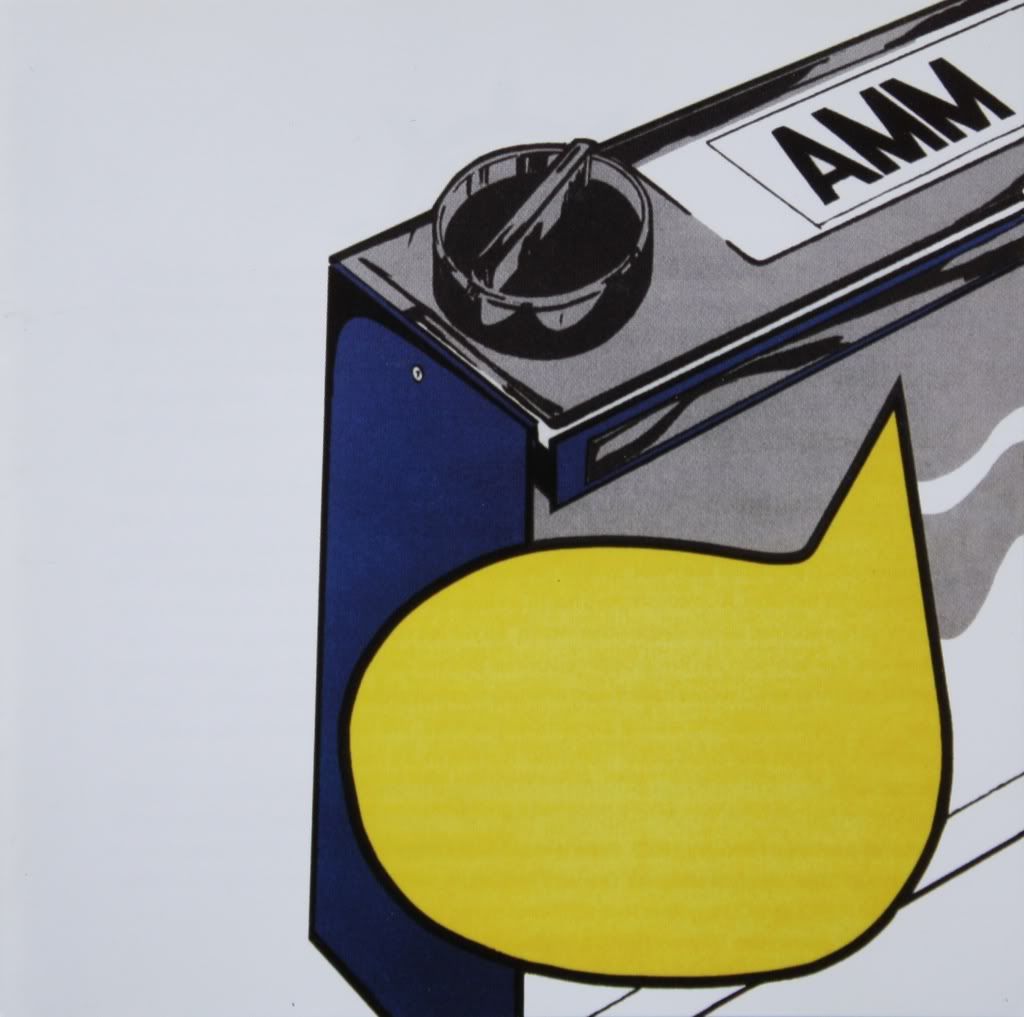
AMM - The Crypt: 12th June 1968


It's been a while since my last AMM review--with The Crypt we move to the primary album outside of AMM's 1967 debut AMMMusic that points to the foundations of their immortality in the world of avant-garde music.  Despite my passion for AMM and other free improvisation and avant-garde groups, writing about music like this is at once easier and more difficult than writing about traditional styles or genres.  Easier because the lack of structure and outrageously long tracks usually demand considerably less writing, since there aren't any lyrics or a large number of individual "songs" to describe and evaluate, and more difficult because the music bears little relation to most traditional music and the vocabulary used to describe such music is of little use.  It may or may not help to reference an earlier essay in which I tried to articulate some aesthetic concepts that more accurately apply to music like this.  Either way, I'll do my best to describe in a meaningful just what it is that I enjoy in The Crypt: 12th June 1968.

By this time in the collective's history, the core group of Eddie Prévost (percussion), Lou Gare (saxophone), Keith Rowe (guitar/transistor radio) and Cornelius Cardew (cello/piano) were augmented by percussionist Christopher Hobbs; absent from the AMMMusic lineup is multi-instrumentalist Laurence Sheaff.  It's not my primary focus in these reviews to chronicle groups' membership and instrumental roles--the main reason I mention it is because, when the music starts, there's really no way to discern who's making which sound and what the audible instruments even are.  The concert begins with a couple of seconds of high-pitched feedback, a couple of seconds of dissonance not unlike the sound of an orchestra tuning, and then around the seven second mark, a thick howl is undeniably the center of attention, as it will be for over a half hour of this 90-minute set.  "Noise"-haters, please exit through the wings--I'm not here to argue about whether or not this is "noise" or music, nor am I here to apologize for the characteristics of the sounds contained here; I wholly understand that most people probably won't enjoy how this sounds, but the validity of the assertion that someone can and does enjoy this isn't up for debate.  Not that the two are mutually exclusive, but one great thing about being an AMM fan compared with loving Captain Beefheart and Trout Mask Replica is, for the most part, you don't have a chorus of sanctimonious people telling you that you're lying about liking how it sounds--even fewer people give a shit about AMM.

When I think about The Crypt, it's this howling sound is the first thing that comes to mind.  The sustained collective sound is the most purposeful study of timbre I can call to mind; it's not the note or pitch that attracts attention, but the quality of the sound.  Hearing the undulating screech as the layered instruments blend and enfold only to compete again, the descriptors that come to mind pertain to the sense of touch--rasping roughness drags across the seconds, and a certain viscosity seems to govern the pace with which each instrument's sound slowly evolves across time, and the primal sense of vibration happening between the different sound sources shifts at what seems like a glacial pace between the miniature warbles of dissonance to the earthquake rattling of flagrantly high volume.  Also particularly noticeable are definite spatial feelings--the music sounds at some points like it's expanding omni-directionally into an endless void and at other times it conjures a feeling of rapidly speeding through a narrow tunnel.  In one sense, the collective sound is liquid in the way it seems to move within itself slowly and naturally, but there's simultaneously a dryness to the collective sound, as if every sound source is being scraped to produce the sound.  When it comes to declaring that this is "good" (implying that there's similar music that isn't), my first instinct is to say that it's the collectivity that elevates this music above the quality of so-called "noise rock" for me.  It's likely that Keith Rowe's prepared guitar and electronics account for the backbone of the sound, but without the shadings and constant flux of the other players (keep in mind there's a saxophone, percussion, cello and piano contributing, though, as the liner notes so eloquently state, "It was not uncommon for the musician to wonder who or what was creating a particular sound, stop playing, and discover that it was he himself who had been responsible") that separates the subtlety of this sound from just a couple of guys seeing how loud they can get their distorted guitars to feedback. Though the sound is ultimately inseparable and cohesive, all of the players' personalities are perceptible to an extent; like the best free jazz that came before free improvisation, each person leaves enough space for the others.

The dynamics of the epic howl ebb and flow past the half-hour point, at which time the proceedings become significantly quieter.  It's pretty surprising, actually, how similarly the second disc sounds to the AMM of the 90's and 00's; the contributions of each member are quite a bit more audible, though it's not a lot easier to discern what the instruments are (percussion aside).  Interestingly, the droning of the first half is still present, but in an attenuated form--it's almost like a different version of the same thing, more distant or more spacious.  In this way, part of the magic of The Crypt is the way in which it plays with the experience of time.  The music could easily be summed up thus: "A really loud screechy howling noise, then more quieter droning with a bit more space and silence with some intermittent crescendos."  Thing is, it takes 90 minutes for all of that to happen--it's like the shriek of a hawk slowed to 5,000 times the original length of the cry.  If you're not paying attention, time disappears and a limitless pool of sound is the only thing there is.  I can only imagine how awe-inspiring it must have been to experience the concert live, in the moment, without the ability to replay the recording over and over.  As anathema as recordings are to the AMM school of improvisation, albums like The Crypt bear repeated listening remarkably well.  Beholding the sounds the group produces is like turning over a crystal in front of your eyes--there are innumerable intricacies and crannies to be found.  There's also something to be said for the cathartic effect produced by the band's immediate sonic assault and the lengthy but punctuated denouement.

There are AMM albums with more variety, more changes in dynamics and diversity in instrument color and perhaps more relatable musical structures, but I'd be hard pressed to find one that's more intense or one that goes any deeper in pursuit of a single idea than The Crypt.  In closing, I take enjoyment in recollecting the first time I realized that the track titles on this (as well as some on AMMMusic) come from my favorite Daoist text, and a major influence on In Not-Even-Anything Land, the Zhuangzi (the liner notes quote the part of the text that "Box Elder" is based on, though they call him Kwang-sze).  Strangely enough I leaned heavily on the Zhuangzi when first attempting to wrap my head around music like AMM and Henry Cow's free improvisation--the text's exhortations to strip away preconceptions in pursuit of the gnarled beauty that lies in spontaneity and the natural state of things were key to my understanding of the music.  Nice to hear that I'm not the only person who thinks the Zhuangzi might have something useful to say about music appreciation.

CD available here.