Showing posts with label Fred Frith. Show all posts

Tuesday, April 30, 2013

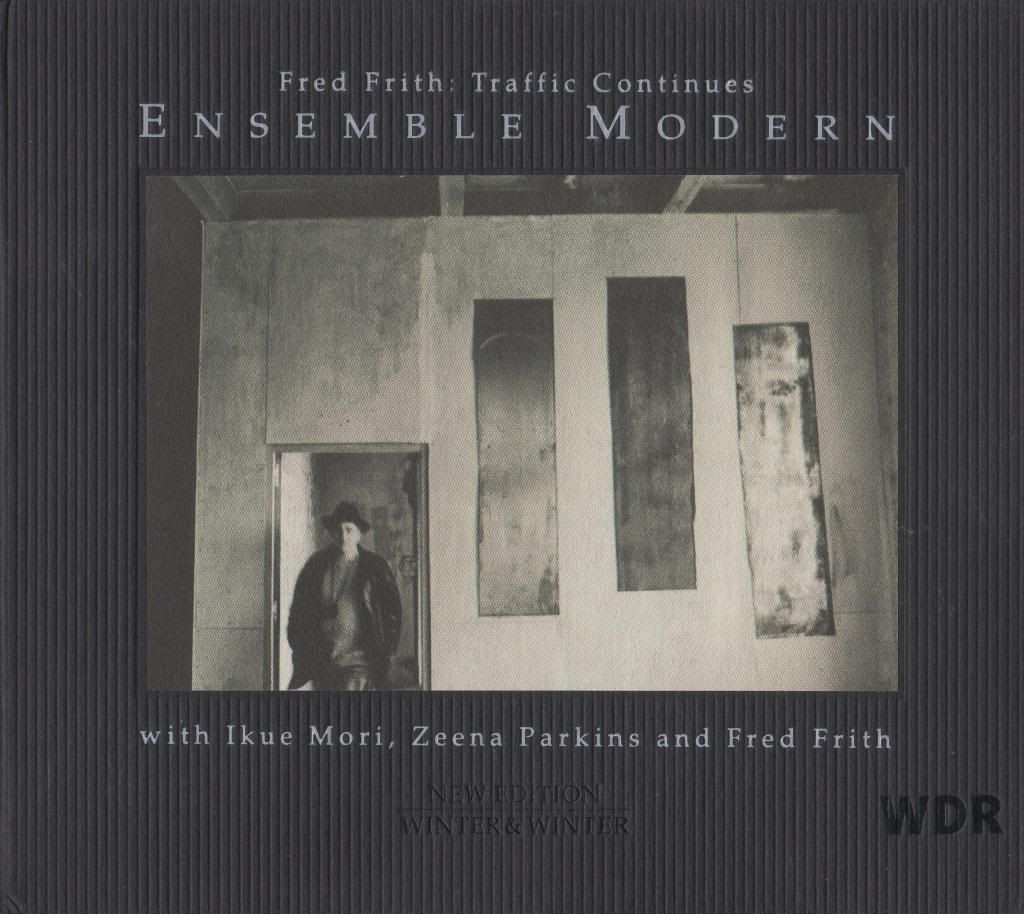
Fred Frith and Ensemble Modern: Traffic Continues


Although our man is credited as guitarist, this album plays more like a performance of Fred Frith compositions than it does like a "Fred Frith album," as we may have variously come to understand what they might sound like.  That said, the ensemble (which audibly sounds basically like classical instrumentation with a few subtle electronic elements) is fantastic, playing with virtuosity you'd expect from concert musicians, but also a zany freedom that firmly places them in a modern context.

To my ears the compositions start off very strongly with some brilliantly knotty orchestrations and a vaguely conventional harmonic aesthetic.  Evaluated through this type of lens, the disc loses some steam in the middle (around the beginning of "Traffic Continues II: Gusto", composed for and from audio samples of Frith's recently-deceased friend and Skeleton Crew bandmate, cellist Tom Cora) as it becomes more spare and quiet, then closes strongly with the final and longest track.  It may be true that the quieter bits require a different sort of criteria for evaluation and may succeed by those standards, but for me the act of readjusting what I'm listening for has so far proven frustrating to the extent that I'm usually left with a feeling that I just heard a recording with some great parts and some that merely passed me by.  I get the feeling that more effort could either yield more appreciation or a stronger sense that some of the writing is a bit too casual and reliant on free performances to carry the weight.  Either way, this is inarguably the kind of music you need to let act on you before imposing any kind of sweeping critical judgment.  Here's to more trying!

Get 'er.

Monday, September 26, 2011

Fred Frith - Clearing Customs


For the first of three 2011 releases I'm reviewing this week I've chosen a new album by an old hand--Fred Frith, an artist who's already popped up here in numerous places as a solo artist, band member and producer.  I can think of few artists more prolific than Frith, who continues to improvise and compose with unabated verve at the age of 62.  This album is a collaboration between Frith and six other musicians--Wu Fei on guzheng (zither) and vocals, Anantha Krishnan on Indian hand drum and tabla, Marque Gilmore on drums and electronics, Tilman Müller on trumpet, and Patrice Scanlon and Daniela Cattivelli, both on electronics.  The disc contains one track--the 68 minute-long title track, which is based on a graphical score written by Frith and with a stated purpose of bringing together artists of diverse and unrelated backgrounds into a functioning, communicating performing unit.

Unsurprisingly, Clearing Customs unites Frith's modern classical compositional approach with not only free improvisation but also his predilection for rock and folk.  As a large, extended composition, it's also unsurprisingly opaque on the first few listens, though the compositional elements and structure is evident and unfolds more and more with each revisitation.  Overall, I think the atmosphere is best described as moody; the most dominant aspects to my ears are the sounds of the zither and the computer elements, both of which account for a large part of the album's spacious feel.  The proceedings begin promisingly, with gently pulsing synth sounds and a (real or sampled?) ping pong ball bouncing.  Fractured beats soon enter the picture along with some typically Frithian clusters of guitar squeals and atonal cries from the other instruments.  After six minutes or so, a somewhat odd pace becomes apparent and persists for the duration of the piece.  Generally speaking, things flow viscously between spurting free improvisation, solo showcases for each instruments, and a gently throbbing returning minor motif.

While the idea of a graphical score is a thought-provoking one, my first thoughts are "Will it actually sound audibly different from a conventional score, and will it make a difference?"  After getting to know the album, it's difficult for me to say that there's anything inherently distinctive (audibly) about Frith's graphic score, but I don't mind--if the unconventional scoring method provides the musicians with enough direction and inspires their playing, I don't see why it shouldn't be employed as a tool.  That said, it's safe to say that this particular graphical score didn't create some unheard-of new kind of music for the first time ever.  Aside from the sultry mood, the music this album most reminds me of is Frith's own Traffic Continues orchestral collaboration, though his ensemble here would be more considered a "chamber" group.  In fact, it's rather reminiscent of a lot I've heard from later-period Frith, inasmuch as it's organized longform and sandwiches frantic blurts along with quieter sections, utilizes repetitive ostinati figures quite a bit, and includes fragmented but undeniable melodicism.  While this approach seems to reliably produce some great ideas from Frith and his collaborators, I think it almost always shows the demonstrable weakness of coming across as too inclusive--like the kind of painting that has piles and piles of paint, albums like this seem to always have a scattershot feel, with compelling ideas and textures juxtaposed starkly against less effective occupation of time and less strong ideas or ones that don't gain traction in the context provided.  For that reason, these kinds of pieces can be a frustrating hybrid between improvised and scored music that offers less in the way of free improvisation's pure intuitive musicianship and elemental sound presentation as well as less in the way of the focus provided by careful composition.

There is, however, a lot to like about this--Frith's guitar is in fine form, both percussively and in his signature distorted lead, the zither and percussion add distinctively ethnic timbres to the mix, and some of the beats add a lot of richness and energy to what would otherwise remain more of a chill-out set.  The main melodic theme is an attractive one, making use of a descending minor scale and spreading the line across multiple instruments--later in the album (I think in general things get strongest about 3/4 of the way in, especially right around the hour mark with some sweet grooves) it really flowers into full development.  I'm not completely sold on all of the electronics; they sometimes verge on cheesy with bursting, blaring samples and obviously computer-generated beat loops (some of the settings are clearly recognizable from groups like Radiohead, while others much more satisfyingly conjure Keith Rowe-like electroacoustic signal manipulation).  In all, I think my unease is due to their tendency to create a sterile, tinny and unorganic atmosphere that clashes with the very organic principles behind free improvisation; it seems like the more actual instrument-playing there is, the more alive and breathing the music seems.  At best, though, the electronics (and especially their combination with the trumpet playing) conjure the sort of twitchy mystery that Supersilent has progressively explored more and more.

Clearing Customs might not be the most satisfying or efficient experience, nor is it Fred Frith's finest hour as a composer or performer, but it does provide enough substance to be worth the purchase and time spent listening.  The album's mission statement is rather lofty, but the results are never really as transcendent or culturally gulf-bridging as the CD text would have you believe.  Though Frith has succeeded at incorporating musicians of diverse backgrounds into a functioning ensemble, the "diverse" characters seem to come together anticlimactically--only to produce sounds under the banner of Frith's already-established musical vocabulary and palette of ideas, demonstrating the unfortunate reality that disciplined and capable musicianship doesn't always come hand-in-hand with interesting ideas and vision.  Luckily Frith's got both, and so his quirks and idiosyncrasies (most of which he's already developed best and stated elsewhere in his prolificacy) creatively dominate the proceedings.  Though some of the longer twiddly passages may, on close familiarity and examination, ultimately prove vacant of any special ideas (which perhaps has to do with that ineffable quality that separates the best free improvisers with those who are simply valiantly attempting), giving this album space, attention and more and more plays has only improved my listening experience and I hope to view it with increasingly (if incrementally) higher regard as an agreeable, if small and inessential, pleasure.

Get it here.

Tuesday, June 21, 2011

Aksak Maboul - Un Peu de l'Âme des Bandits


After a week that saw reviews for Brazilian pop, 60's folk and French pop, I feel it's time to travel back out into the...beyond.  There's so much to say about this album, Belgian group Aksak Maboul, and RIO (Rock In Opposition) that I almost don't know where to start--let's begin with RIO.  Rock In Opposition, though it's sometimes loosely used as a genre tag, was originally actually a festival organized by British group Henry Cow (with especial effort on the part of drummer Chris Cutler) in order to promote avant-garde rock groups selected by Cutler (eight in total) that were receiving little to no support from commercially-minded record companies.  Though the movement was short-lived, it garnered a fair amount of press for the groups and, more importantly, facilitated the release of some of the most challenging progressive music produced throughout the 1970's and beyond.  Since the loose movement became inactive in the 1980's, you're more likely to hear RIO referred to as a music genre used to describe either music that members of the original RIO groups have made, or music that is similar to, for example, Henry Cow's--dense, avant-garde, forward-looking, often with healthy doses of modern classical and jazz influences, though I personally don't find the tag to be the most helpful.

Belgian group Aksak Maboul was part of the second group of artists invited to RIO and was primarily the project of Marc Hollander (previously of CoS and founder of record label Crammed Discs).  Aksak Maboul's 1977 debut was much more of a solo effort, with Hollander playing most of the instruments (a lot of keyboards, wind instruments and drum machines)--it's a playful, eclectic and enjoyable outing, but not today's album!  In 1980, Hollander was joined by Henry Cow alumni Fred Frith and Chris Cutler and a few lesser-known European musicians for this, "their" second and final album.  Though Aksak Maboul wasn't an original RIO group, I picked this album to introduce RIO because it's one of the most consistent, representative, and simply best RIO has to offer.

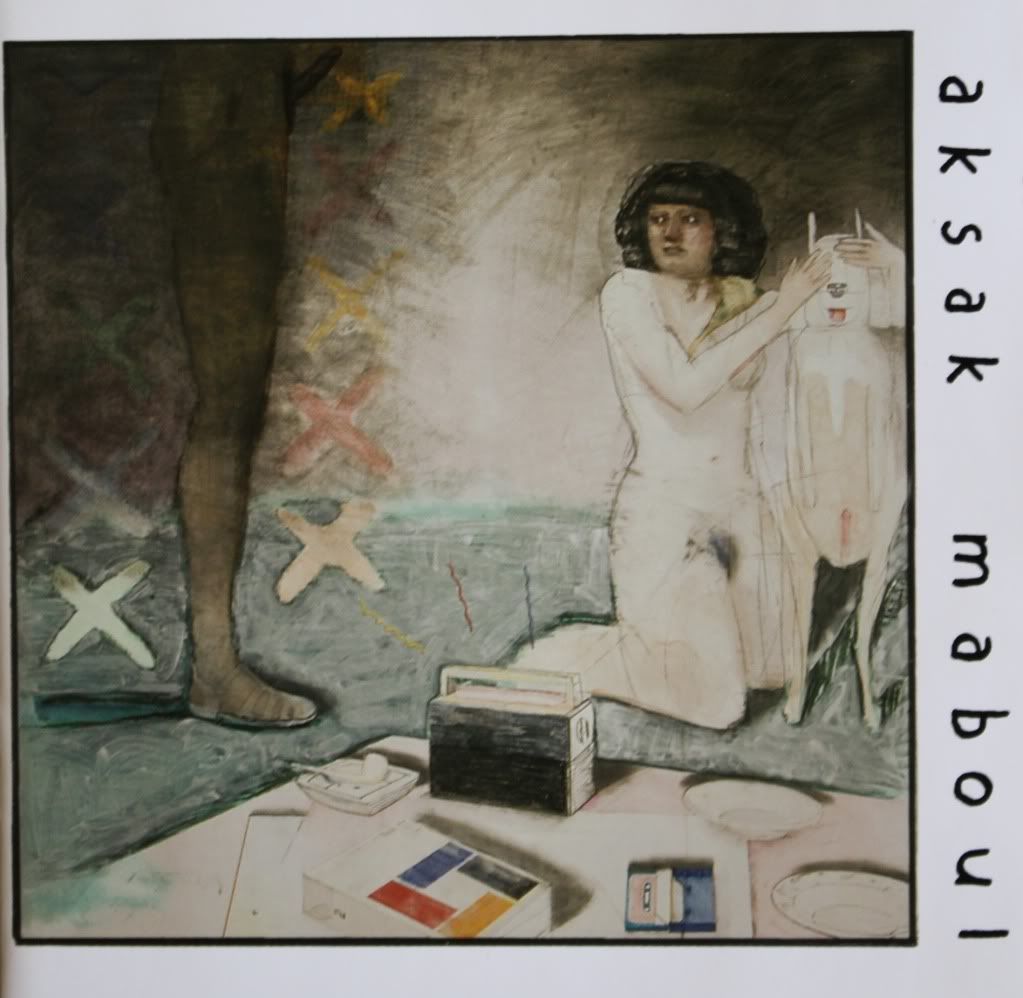
You know (or at least hope) from the ridiculous cover (depicting no fewer than two erections) that this album is going to be a crazy trip, and it certainly doesn't disappoint.  Personally, I find this album extremely satisfying because of the experimentation--most all of the songs are based on at least one describable experiment, and the results are not only challenging, they're often quite listenable.  A great example is the opener, "A Modern Lesson" (please, oh please, watch the video), which manages to deconstruct a classic blues riff with dissonance, drum machines, and wacked-out female vocals in under 6 seconds.  As the track progresses, the wind instruments enter (along with some pinball machine recordings) for an interlude, the main riff returns, then the bass and tempo increase and Hollander's electronic keys and Frith's detuned guitars amp up the energy for a driving finale that sees an incredibly complex wind/key/string arrangement brimming with head-spinning counterpoint and--what elevates this beyond similar attempts--a memorable melody.  "Palmiers en Pots" radically switches gears with a tango supposedly composed of (get this) pieces of several popular tangos, cut up with scissors, rearranged, and performed in random order.

That Fred Frith was on an unstoppable roll in the early 1980's, I'll never deny--his fingerprints (as musician, composer and producer) are all over this album, and in some ways it's better than its Frith solo contemporaries as his ideas (some heard already heard on other albums) are supplemented and developed by other musicians.  Though the resulting disc doesn't exude quite as much of Hollander's personality as the Aksak Maboul debut, its diversity is one of its greatest assets--"Geistige Nacht" features a frantic sax-led melody with some great free jazz soloing in which the sax and eventually Frith's guitar trade squawks, and "I Viaggi Formano La Gioventu" features a snaking Middle-Eastern melody doubled on wordless vocal, violin that's strongly reminiscent of Frith's other 80's work, though that handclap track buried in the mix toward the end of the song shows up again on Cheap At Half the Price's "Absent Friends."   "Inoculating Rabies" is probably the second best experiment on the disc, blending a balls-out punk riff driven by Frith's and Cutler's unfettered noise with the addition of a delicate woodwind arrangement.  It's probably the best (if not only) progressive commentary on and appropriation of the burgeoning punk movement I've heard so far, which, by 1980, had all but swallowed what little market experimental progressive music like Aksak Maboul might have cornered.  It's pretty ironic how loud Frith, bass and Cutler get considering how "obsolete" punk supposedly made their musical contributions.

The 23-minute-long "Cinema" rounds out the album with long-form composition interspersed with free improvisation (there's a lengthy and wicked cello solo as well as a pretty epic Fred Frith guitar solo), recording collage, a recurring sinister-sounding theme, some really heavy jamming from the full group (Cutler's drumming here is the liveliest I've heard since Henry Cow's last album, and recently, too).  The melodies and ideas aren't quite as immediate as they are on the shorter songs, but the added space allows the group to accomplish some things that it couldn't in five minutes, and it gives us more to uncover on later listens.  Pieces like this often seem to divide the camp of potentially interested listeners--take longer than five or six minutes and some people will complain about having their time wasted.  If there are enough different ideas being developed, though, I don't mind it taking a while--as much as I'm leaning toward shorter songs packed with briefly-stated ideas these days, I can appreciate a piece that actually allows listeners to engage with and unravel the ideas being presented during the piece, rather than after numerous plays.  While Hollander's personality is somewhat obscured by the thickness of the production and arrangements, it's perceptible on repeated listens, especially if you've heard his earlier works.  I really enjoy his mechanical-sounding drum machines and keyboard lines, not to mention his contributions to the horn sections.  Let's hear it for RIO, and this week let's keep going down the rabbit hole.


Available here on CD, and here on MP3.

Friday, May 20, 2011

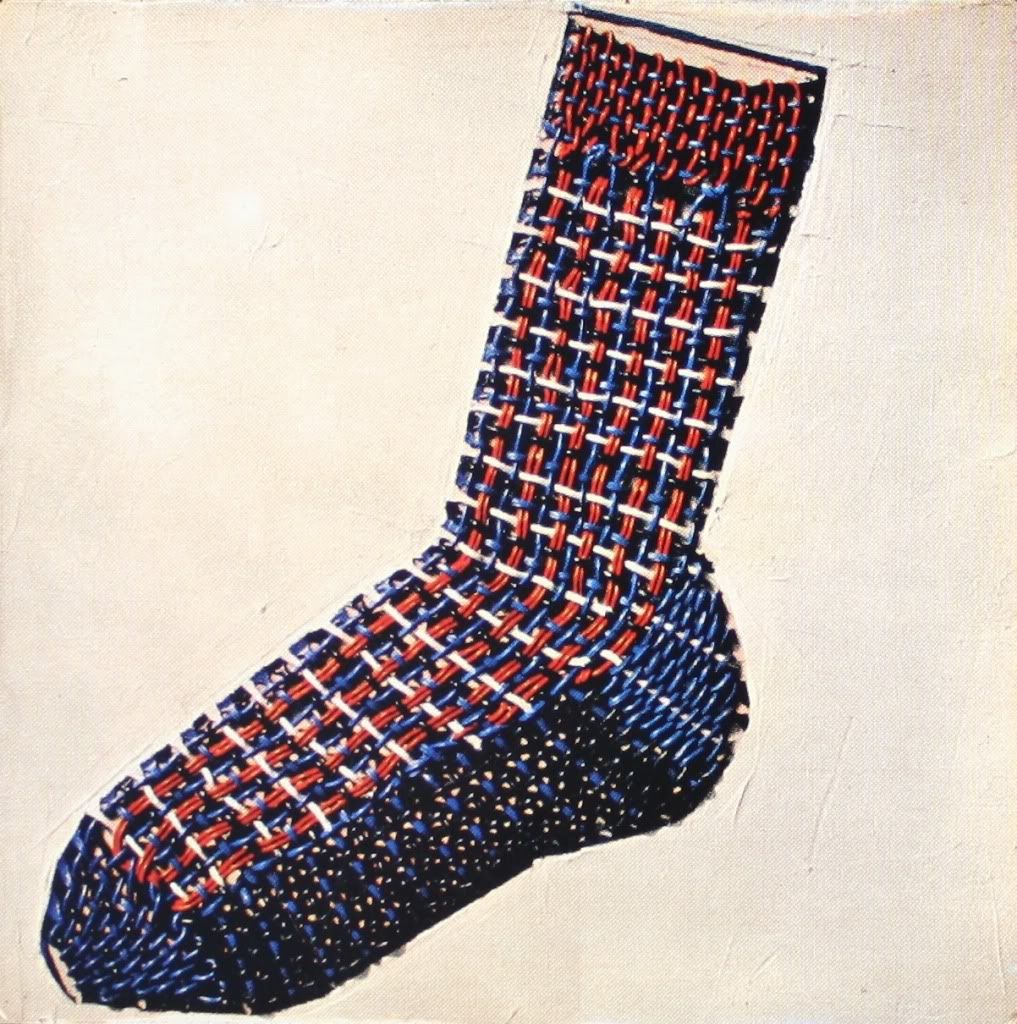
Henry Cow - Leg End


There is apparently some debate as to whether Henry Cow can accurately be deemed part of the Canterbury scene as an actual physical scene, but to me they're both clearly a part of the scene (due to guitarist Fred Frith's geographical origins and the band's association with Robert Wyatt both live and on his Rock Bottom and Ruth is Stranger than Richard albums) and part of the Canterbury scene as a genre of music that blends rock, jazz, folk, experimental and a playful sense of whimsy.  Henry Cow is one of my favorite groups in or out of the Canterbury scene for the complexity and dense melody of their music, the way each member of the group contributes in an identifiable and irreplaceable way, for the way they blend avant-garde compositions with improvised music across their sparse but evolutionary discography, and for the fact that their music remains challenging but listenable no matter how many times I return to it.

Leg End is the band's 1973 debut--it doesn't take too many seconds after the rimshot that kicks off "Nirvana for Mice" before it's obvious that Henry Cow is probably the Canterbury band most influenced by avant-garde modern classical music, which shows in their compositions' weaving concentric circles of odd-metered counterpoint as well as a hefty dose of atonality and dissonance lurking behind and within the jazzy melodies.  The sound is saxophone-heavy, with at least two horns at most times, and Fred Frith's guitar is often double-tracked, while some synthesizer fills in the background not covered by the manic drums and restlessly probing bass lines.  "Nirvana..." sort of sums up a good part of the band's mission on Leg End, consisting of a vibrantly intricate composition which quickly dissolves into a jam over which Geoff Leigh's saxophone runs rampant in an ecstatic free jazz testimony.  Interestingly, the rest of the group's vamping mechanism during Leigh's solo acts as a sort of improvisational version of the composed sections, as each band member sticks with a different meter and improvises accompaniment.  The parts interweave, at times synchronizing and at other times sounding rather tenuously held-together.  For me, it's exhilarating.  If you weren't already awake, the song-ending staccato blast will ensure either your attention or annoyance (these guys are admittedly not for everyone).

The rest of Leg End follows a similar path, though there is a superabundance of ideas, great variety in mood and melody, and some more surprises in instrumental arrangements, including flute, clarinet and Frith's violin.  The Tim Hodgkinson-penned "Amygdala" boasts an ever-shifting melodic structure that dabbles in the types of Renaissance style that is Gentle Giant's stock in trade, while the dark and cacophonous "Teenbeat Introduction" goes further down the free jazz rabbithole before swelling gloriously into Frith's "Teenbeat" composition.  "The Tenth Chaffinch" sounds very much like one of the group's live improvisations (mostly unreleased until the release of the box set The Road), blending musique concrete (pre-recorded sounds) with totally atonal, unstructured improvisation.  The album closes with an odd track, "Nine Funerals of the Citizen King," which actually features a vocal arrangement.  Though the music is extremely dense (perhaps even impenetrable on first listen), further listening reveals melodic motifs that pop up in "Teenbeat" and return again throughout "With the Yellow Half-Moon" and again in "Nine Funerals..."

For me, Leg End and the rest of Henry Cow's discography represents the real deal when it comes to progressive music--genre is irrelevant, and the band unflinchingly incorporates modern musical concepts into a sound that assaults the ear with surprises at every turn but remains a fun and energetic (especially Chris Cutler's drums, which rival Robert Wyatt's Soft Machine-era drums in energy and creativity) listen with innumerable moments of twinkling beauty.  I've heard the band's earlier material compared with Frank Zappa and the Mothers' albums from the same period, and while I can see a general stylistic similarity (jazzy, complex compositions, lots of noise and craziness), Henry Cow sounds so much more out-of-this-world and surprising to my ears, while Zappa's compositions (and especially his guitar playing), idiosyncratic as they are, always remind me directly of something I've already heard before.  This album is the perfect example of music that doesn't need lyrics--when it sounds and feels this indescribable, why limit it with the trappings of lyrics?

The whole Henry Cow discography can be found at Recommended Records, which is owned and operated by drummer Chris Cutler, or here, if you don't want to pay in GBP.

Friday, April 8, 2011

Robert Wyatt - Ruth Is Stranger Than Richard


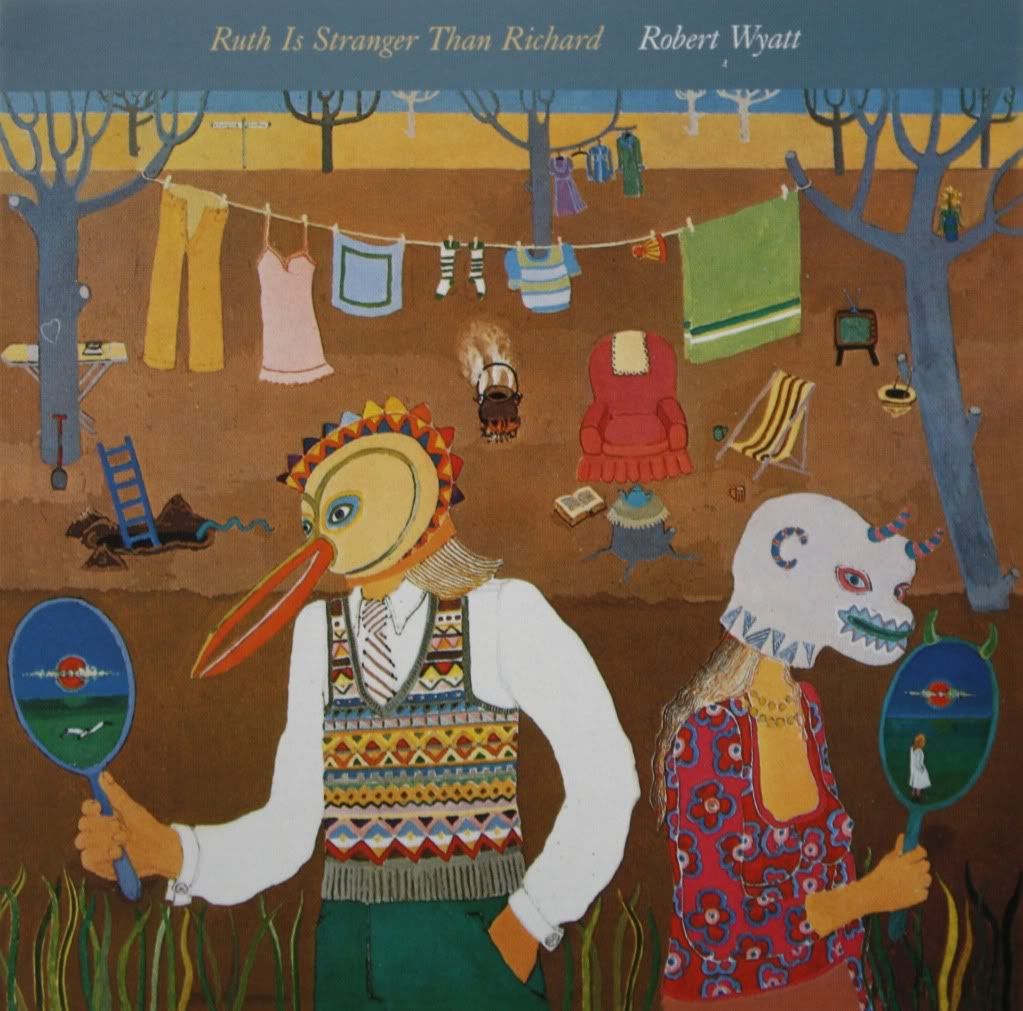
Robert Wyatt's first album after the career-defining Rock Bottom is not likely to satisfy any relative newcomers looking for a reprise of its predecessor's dark catharsis and cohesive brilliance.  To longer-term initiates, though, it's a solid representation of what's most often expected from Wyatt from his Soft Machine days to his more recent work.  In many ways, I think this album sets the template for his material from the last 15 years in terms of the wealth of guest contributions (John Greaves and Fred Frith from Henry Cow, Phil Manzanera and Brian Eno) and its unevenness.

Like most of Wyatt's post-accident music, the sounds here are gentle but quirky, moodily psychedelic and jazzy in that classic Canterbury way.  The whimsical, melodically-challenging "Muddy Mouse" segments punctuate the first, "Richard" side of the album (or second, depending which version you have), breaking up the hypnotic groove and progressive sonic layering of "Solar Flares" and the equally languid, spine-tingling "Five Black Notes and One White Note," which plays with gorgeous intervals on a magnified level, similarly to some of his later work on Dondestan.  Wyatt accomplishes some of his best vocal trumpet impressions on the side-closing "Muddy Mouth" as well as some pretty humorous and casual singing regarding the world's oceans.

The other, "Ruth" side of the album is rather different, featuring much more conventional song structures, as on the jazzy sort-of-funny (mostly for the words) "Soup Song" and the slightly quirky blues of "Sonia."  "Team Spirit" is a more rocking, long-form song about a football that stretches into more interesting territory with some cool sonic excursions.  The dirge-like "Song for Che" closes the album on a fittingly valedictory note.

While Ruth Is Stranger Than Richard rarely succeeds in the same ways Rock Bottom did, it's pretty typical of later Wyatt--despite its status as a mixed bag of sorts, there is plenty of experimentation going on and it's a pleasant listen without ever being too hard on the ears.  If you manage your expectations and can forgive the album's inability to stack up to its predecessor, it'll be a good gauge of how much you'll likely enjoy Wyatt's later albums. 

Get it here on CD, or here on MP3.

Sunday, March 27, 2011

Fred Frith - Gravity


Gravity, Fred Frith's first post-Henry Cow solo outing, is an album positively packed with ideas.  From its through-and-through dance/rhythm concept, to the dizzying array of styles presented by each song, to the mottled textures of Frith's fantastically wrinkly songs to the man's all-over-the-place guitar playing, a lesser group would have make a career's worth of albums out of the ideas present on just half of these songs. 

The songs presented here tread middle-Eastern themes and modes ("Hands of the Juggler"), Scandanavian and British folk ("Don't Cry For Me" and "A Career in Real Estate," respectively), as well as more familiar Frith subjects like melodic jazz (on "Spring Any Day Now" I could swear he single-handedly created the template for all Nintendo music to come) and the avant-garde ("Year of the Monkey," "Crack in the Concrete").  We also get a taste of classic Canterbury humor with a totally wonky-melodied but somehow recognizable rendition of "Dancing in the Street."

I think what sets this apart from other 80's (and beyond) Fred Frith albums is the driving energy, which must in part be attributed to the backing bands--Samla Mammas Manna on the A-Side and the Muffins on the B-Side--who lend able, ballsy and often manic flesh to the bones of Frith's compositions.  Additionally, it's probably the highest concentration of pure guitar shredding ever collected on one Fred Frith album (including his solo guitar albums)--the avant-garde rock songs here have some of the most complex riffs, lead lines and soloing I've ever heard the man play, and considering the rest of the projects he's been involved in, that's really saying something.  Songs like "Norrgarden Nyvla," with its majestic-turned-insane distortion-soaked lead lines contrast yet sit perfectly comfortably near the clean Massacre-esque riffing and unbalanced sliding he pulls of on "Slap Dance."

At times the music gets quite atonal and almost mathematical in its composition (though Frith's kind of atonality rivals Captain Beefheart's in its sense of melody), but somehow it's more listenable (if still quite busy) than a lot of other avant-garde music--even examples from Frith's own canon.  Probably its greatest asset is its sense of humor and the aura of fun surrounding the whole album--a sense of humor that was surely lacking from the final days of Henry Cow and the entirety of the Art Bears project.  To hear this album immediately after Western Culture is to believe against plain evidence that avant-garde can be fun.

Get the CD here.