Showing posts with label Solo Guitar. Show all posts

Friday, January 25, 2013

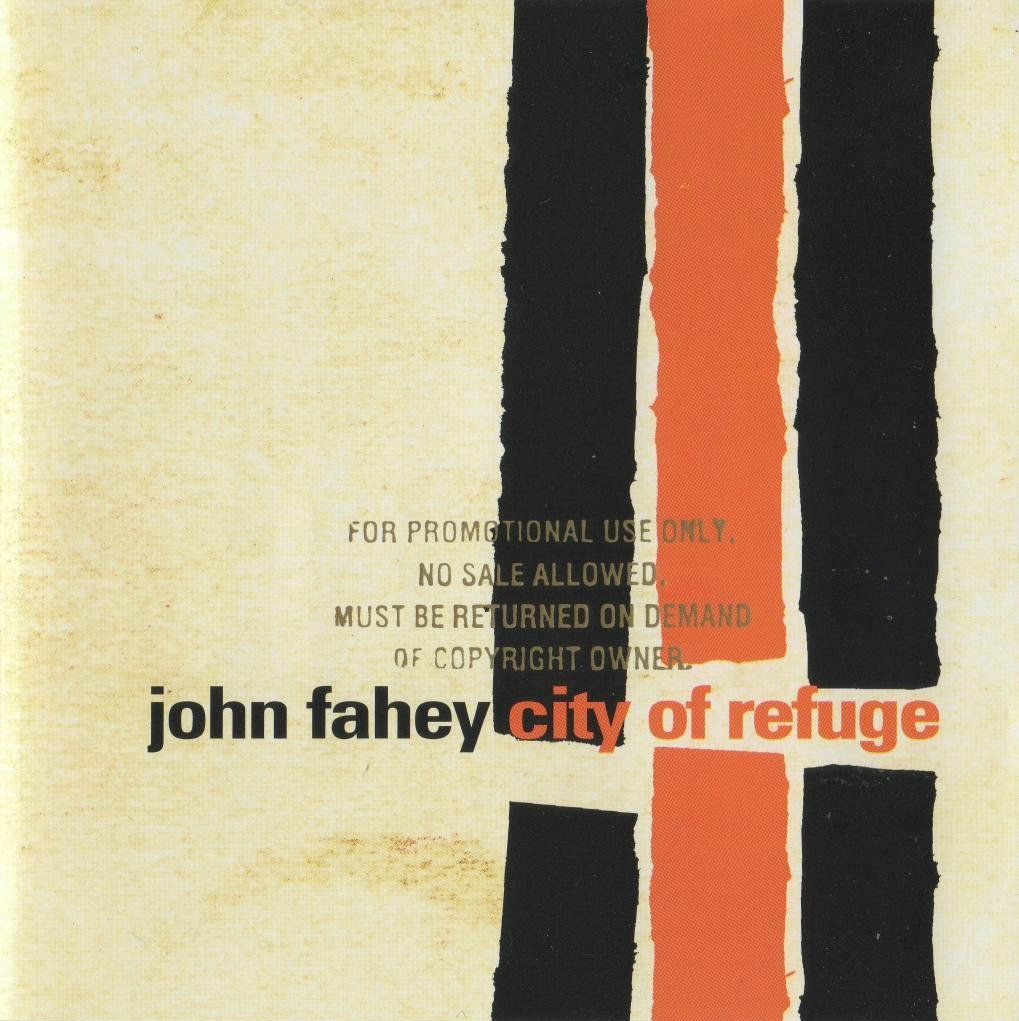
John Fahey - City of Refuge


In investigating Fahey's late period, I'm sympathetic with the fact that he felt dead-ended stylistically and was struggling to move beyond his signature American Primitive tropes into something a bit more...different and new.  The issue seems to be just what, precisely, that new direction is, and Fahey's frustration is evident in the music.

In spite of its recording date, City of Refuge most resembles 60's Fahey records like Volume 6: Days Have Gone By and Requia, with equal space and volume given to acoustic guitar and field recordings, found sounds and electronic sound sources.  As with those other recordings, this approach either stands (Days Have Gone By) or falls (Requia, often) on how well those elements mesh with one another compositionally.  The disc starts promisingly enough with "Fanfare," which sees an unusually (for Fahey) overdriven slide guitar layered on top of droning, industrial electronic sounds not unlike those produced by Keith Rowe, especially in his solo works.  As the tracks play on, for me the impression builds that the compositions aren't very well thought-out, which is a serious stumbling block for an artist whose greatest strength is arguably his ability as a longform composer, not as an improvisor, which is what he appears to attempt on "The Mill Pond" and large portions of "City of Refuge I," plucking single notes against a throbbing background drone.  While the proposition of a more spare approach to his guitar style is intriguing, the results here don't feel particularly well-realized.

Elsewhere we are suddenly jolted out of the avant-garde soundworld back into more traditional Fahey territory, with guitar-only excursions like "Chelsey Silver, Please Come Home," and the dirge-like "City of Refuge III."  The former hints at a new compositional twist on Fahey's slide style, with abrupt stops and rhythmic interruptions, but again it feels like he didn't thoroughly integrate the idea into the piece, or maybe it wasn't an idea after all and the performance is just choppy!  Both songs seem to lack distinctive melodies or a feel other than "Fahey filler"--pleasant enough, but by 1997 we know what this man is capable of!  To my ears, "Hope Slumbers Eternal" is the best-realized piece on the album, blending a droning background that relates tonally to the minor slide guitar melody it accompanies, provoking an eerie, meditative atmosphere--most importantly, the electronics and guitar seem to combine coherently, which is mostly not the case with the rest of the experiments here.  The album closes with the 19-minute "On the Death and Disembowelment of the New Age," which, as far as I can tell, contains no guitar (though it does keep alive Fahey's tradition of humorously long and barbed song titles).  It's probably the most successful sound collage on the disc, but sitting at the end of a selection of noodly acoustic guitar pieces, it raises questions about what it's doing here, and why these songs all belong on the same album.  There is some cool rhythmic phasing of a tambourine-like sound that kicks in around the 12-minute mark and lasts for several minutes, and the album closes like it opened, with a classic Fahey field recording motif--a lonely locomotive whistle. 

This is the kind of album that really gets under my skin--not because I think it's bad, but because there's a palpable sense of frustration from an artist with specific ideas and a seeming incapability to fully realize them.  Probably more troubling to me personally is Fahey's frustrated attempt to break beyond his established vocabulary as a guitarist--for a man who reportedly described fingerpicking as a "disease," he must have felt more than a little trapped.  When an artist verges into atonal and pure sound territories, success seems to become as ephemeral as the compositional building blocks are abstract.  I find it daunting to explore these areas as the measure of artistic success depends even more on an unquantifiable gut reaction, and the difference between good and bad is painfully difficult to control as a composer--but perhaps that's where the adventure lies!  My next stop for late-era Fahey is another 1997 album, Womblife.  While my hopes for a successful application of his challenging ideas are tentative, even unsuccessful attempts in this territory are rewarding and always thought-provoking.

Get it here.

Tuesday, June 5, 2012

Davy Graham - Anthology: 1961-2007 Lost Tapes


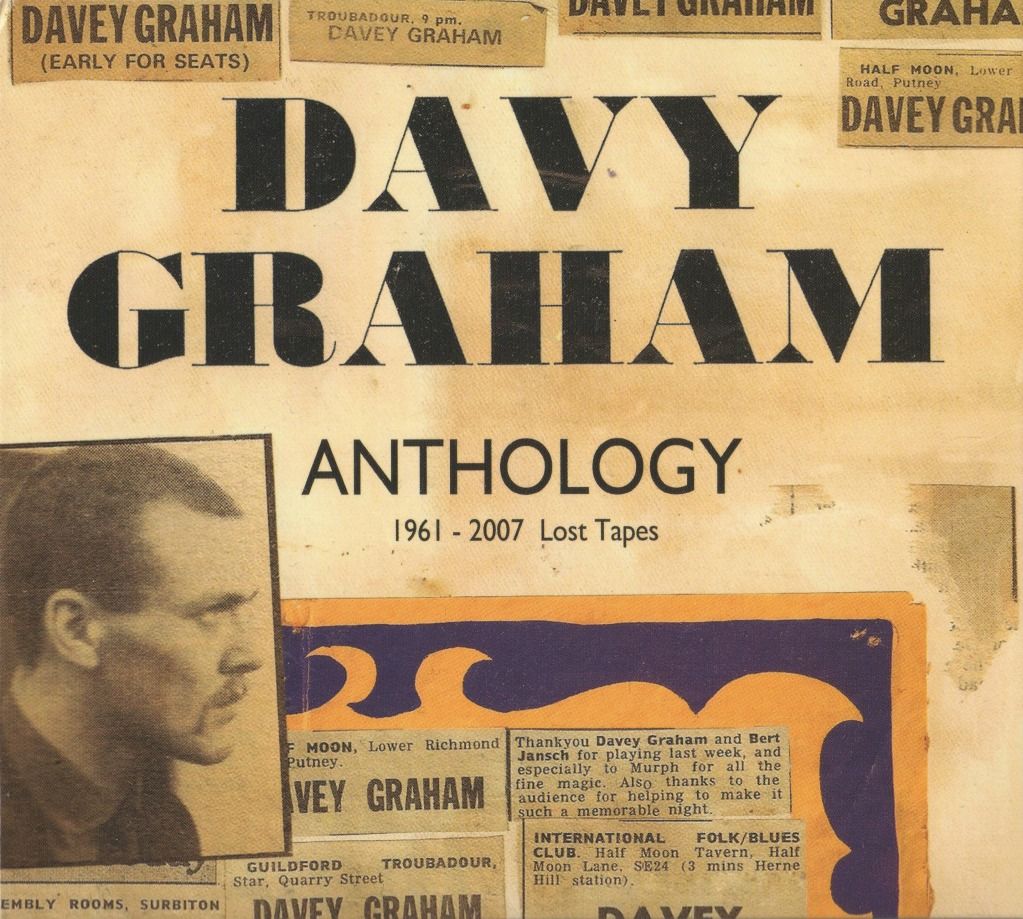
Almost four years after Davy Graham's death, the folks at Les Cousins Music are still working not only to preserve his officially-recorded legacy, but also to expand the scope and depth of his output, making it clearer for those who weren't there why the guitarist was the undisputed king of the 1960's English folk revival.  Nostalgically packaged in a collage of images gleaned from Graham's personal scrapbook (and simultaneously displaying both spellings of the guitarist's first name he confoundingly vacillated between), this three-CD collection anthologizes no less than 54 tracks across more than 2 1/2 hours of unreleased recordings.  Count me in!

It's a fool's errand to attempt a track-by-track analysis of an anthology so deep, so I'll attempt to convey some general impressions and reference tracks where appropriate.  Having been a Davy Graham fan for several years, I think I'm finally starting to understand how, as Roy Harper says, Graham "never managed to turn his talent into a brand that people could go out and buy and enjoy," yet every other guitarist from the same time period and beyond cites Graham as a towering giant of the six-string.  After five years of absorbing Graham's studio output I'm still at a loss to recommend a single album of his that fully conveys and encompasses what was so revolutionary about his playing, and not having been there it's been hard to picture myself in that bright-eyed hopeful time and imagine myself at some bohemian party with Graham conjuring untold spirits out of an acoustic while everyone just sits and listens.  Enter this anthology, which as far as I've heard does the best job this side of After Hours at Hull University of recreating such a scene.  The sound quality (especially on the first two discs) is almost exclusively of home/bootleg quality and most of the performances are solo, with Graham positively shredding in front of small audiences as he sends jazz, folk, blues and "world music" (before such a term existed) through a blender and we get to hear what comes out.

Since it's mostly just an acoustic with or without vocals, the sound quality isn't much of a bother--if anything, it enhances the intimacy of the performances, which find Graham energetically blasting solo performances of many of the folk and blues songs found on his albums as well as never-before-heard tracks.  Throughout, his technique is astounding, transitioning as quickly as ever between lead and rhythm, melody and harmony, from style to style.  Somehow the setting's informality allows the guitarist's hard-won chops to shine brighter with none of the studio adornments meant to commercialize his sound, and we instead get to hear him exclaim "Ah, fuck" after some imperceptible mistakes during a lightning-fast take on Leadbelly's "Fannin Street" with nary a missed note, as well as a verbal introduction to his classic instrumental "Anji" (there are two versions here, along with an unreleased track and album highlight "Anji's Greek Cousin") that details how he wrote the tune.  While the live renditions of guitar-and-vocal folk/blues tunes present uniformly great guitar and often contain vocals that are superior to the studio versions, they also miss the mark when it comes to what made the guitarist unique--more than almost any other Graham album, this anthology conveys the strange alchemy that occurred between Graham's musical influences, his fingers and his guitar, and these discs present ample, undiluted evidence of what was possible when only these elements were on display.

Of the three discs, the third is probably the least essential, reflecting the diminishing returns that Graham's post-60's releases offer, yet it often sounds more vital than studio recordings from the same period.  Though Graham's lifestyle choices and age would gradually slow his playing and attenuate his already limited vocals, we still get some surprisingly good representations of the more delicate British folk, jazz, medieval-sounding instrumentals and world folk music explorations he continued to make through the 70's and beyond.  "The Gold Ring" shows his pull-off speed undiminished, "Sita Ram" and "Mevlut" pair his further eastern experiments with appropriate accompaniment, and "DeVisee Suite" shows a subtle, slower side to his playing that was all but absent in the early days.  The final late-period tracks remind us that we're summing up the career accomplishments and contributions of a distinctive force in 20th century popular music.  As with his 2007 swansong Broken Biscuits, the joy here comes less from marveling at jaw-dropping speed, but more from giving credit where it's due and appreciating that the man's muse was still active at the end.

While I still think it's impossible to recommend an accurate starting point for a prospective Davy Graham fan (it takes more than the average time investment to really "get" him as an artist), this anthology is a surprisingly worthy addition to even a modest Davy Graham collection.  Unlike so many retrospective collections, it manages (with the help of Graham's considerable skill and restlessness) to make familiar songs sound fresh and new songs sound immediate and relevant to the further-broadening portrait available of Graham as an artist. 

Get it here.

Monday, January 2, 2012

Peter Lang - The Thing at the Nursery Room Window

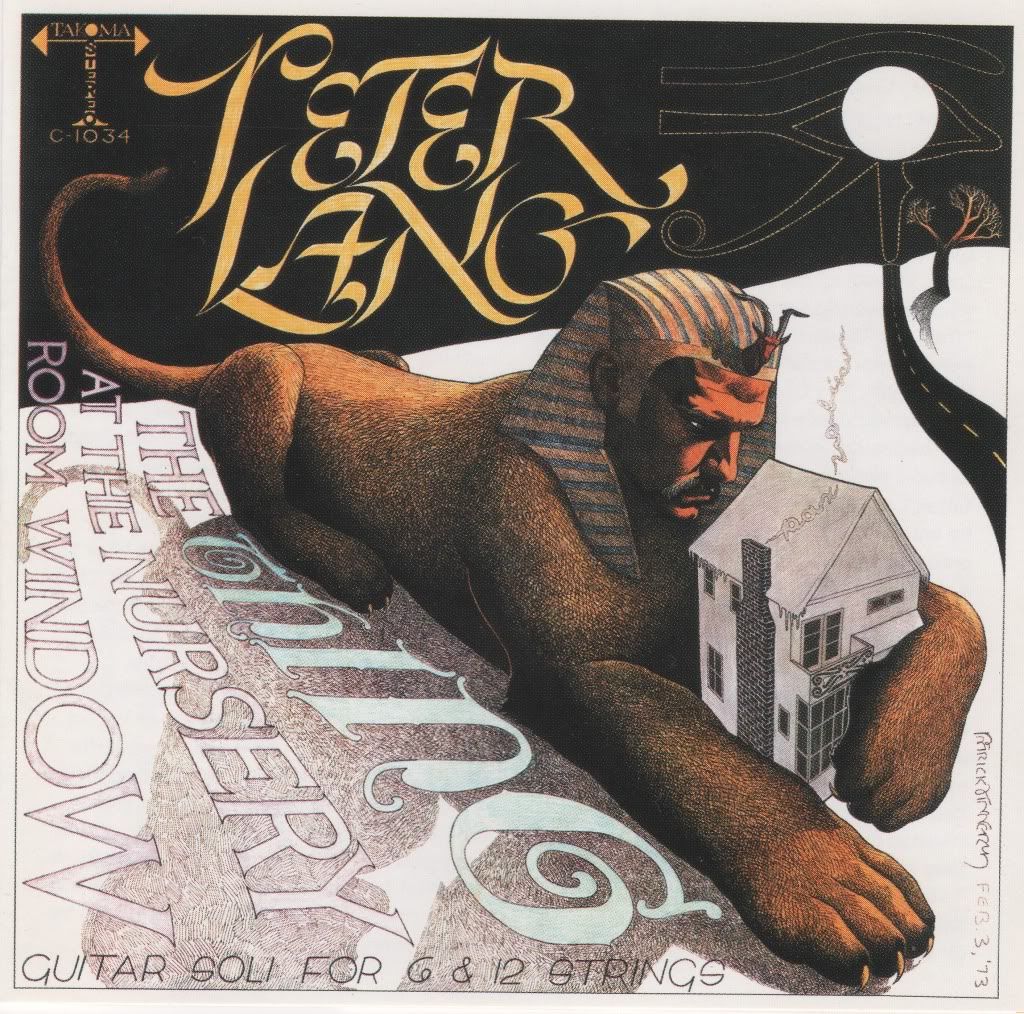
One of the greatest title/cover art combinations I'm aware of...what exactly is that cursive smoke spelling out?

Especially considering the fact that the "American Primitive" genre of folk guitar was just over a decade old in the early 1970's, I think it's a testament to the depth of the stable of outstanding guitarists Takoma Records had assembled that each one managed to have a distinctive style and purpose.  While genre founder John Fahey wanted to communicate something mystical he discovered by examining the elemental essence of early blues players under a microscope and Robbie Basho strove to reimagine his guitar technique to communicate incommunicable mystical secrets, Leo Kottke and Peter Lang both seemed to be players first and composers second--musicians driven most by the joy of making beautiful sounds come out of their instruments.  While this is an important component to any musician's working life, I think vision is one of the elements that separates musicians who truly have something to say from those who are simply technically proficient.  What I find most interesting about Peter Lang's Takoma debut is the fact that it finds the guitarist at a developmental crossroads, growing past his pure technical roots into a territory with far fewer limits, determined only by his own compositional imagination.

According to the CD reissue's liner notes, Fahey told Lang that he was thinking (as a composer) in too small blocks of time and urged him to allow his pieces to stretch out a bit.  You can hear where Fahey's coming from on the opening tracks "Snow Toad" and "Muggy Friday," where Lang's formidable technique seems bent on making the finish line.  While his rapid fingerpicking audibly owes more to Kottke's style than Fahey's, Lang's approach is subtly idiosyncratic, with a nice emphasis on string bends and slides.  As the album progresses, though, we get to see the fruits of Lang's response to Fahey's critique--"Turnpike Terror," though only slightly longer, starts playing with dynamic and textural changes, utilizing space and strumming to take the short piece in several directions.  The marvelous "Bituminous Nightmare" stretches even further, flirting with much more dissonance, theme development and single note layering (for lack of a better term) that seems to be wholly Lang's trick. 

Though only a few of the songs here fully demonstrate Lang's growth as a composer, his playing is always beautiful, engaging, and (for my money) more emotionally compelling than Kottke's.  He proves himself an able slide player on "Wide Oval Ripoff," a capable balladeer on "Young Man, Young Man, Look At Your Shoes," and unafraid of lightning fast swing on "Quetico Reel."  Satisfyingly, though, the album ends on his most ambitious and adventurous compositions, the nearly 10-minute "Future Shot at the Rainbow," which further explores his penchant for overlapping single note lines to an almost baroque extent, unfolding and refolding a humbly beautiful melody with a real sense of journey abetted by judicious pacing and flow.  While Lang never managed a consistent output, his playing is always delightful and this album stands as one of the most enjoyable Takoma releases and a hopeful nod to the virtue of stretching beyond your comfort zone.

Get it here.

Monday, August 8, 2011

Bert Jansch - Bert Jansch


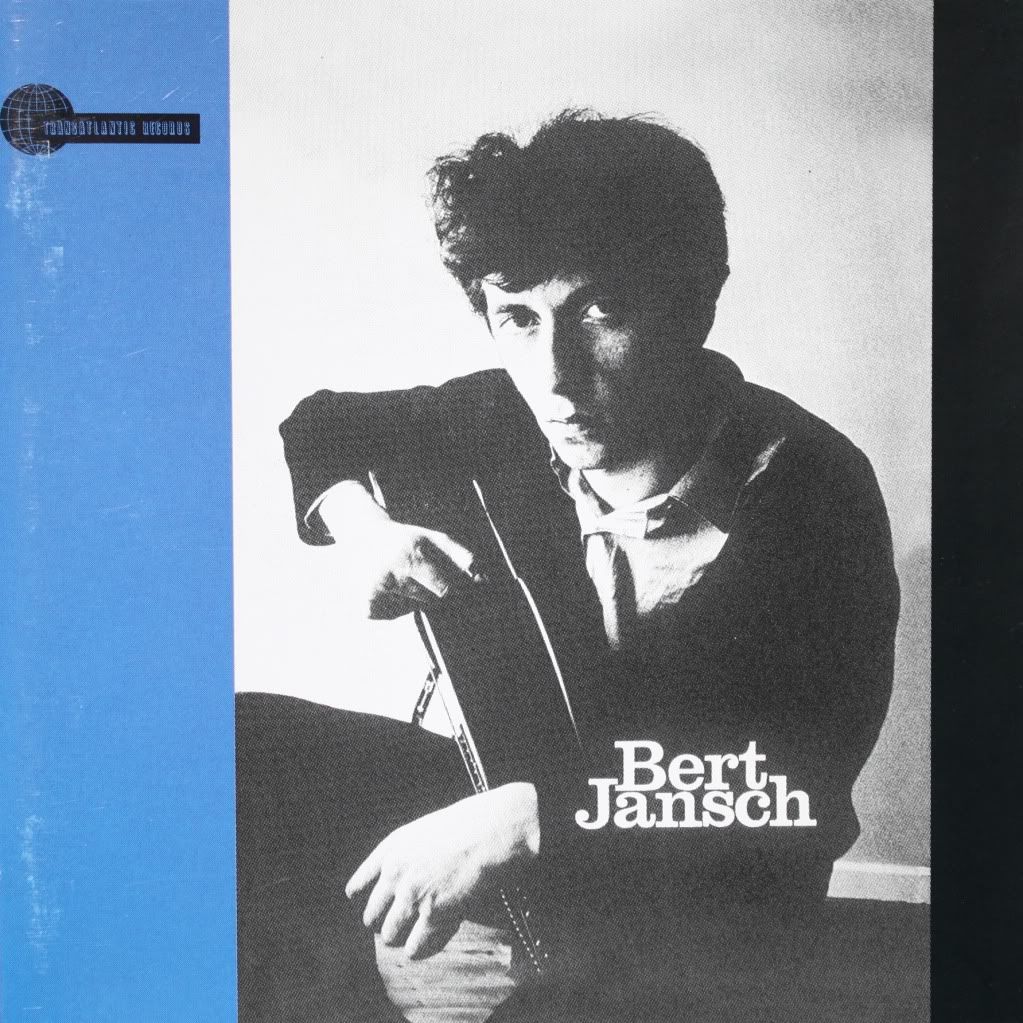
Bert Jansch is one of those figures whose legendary status in his field is easily justified but who never really succeeded in creating a categorically "great" album.  In Jansch's case, the field is contemporary folk and especially acoustic fingerpicking.  His prolific solo catalog and membership in The Pentangle (who arguably did record a few great albums), combined with his influence on many more notable guitar players add up to ample evidence for his reputation, but when it comes to selecting his best album, it's hard for me to find one that I feel is lacking in easily-identifiable flaws.  His 1965 debut, though, is probably the best album to check out because it demonstrates most purely his personality, guitar abilities, interests (or lack thereof) as a songwriter, and his unique role in the 60's British folk revival.

Since it seems to be the number one critical talking point regarding this album, you probably already know that part of this album's mystique stems from the fact that it was recorded in a friend's flat on a borrowed guitar.  Other than the fact that it actually sounds pretty good, considering, I think it speaks to Bert's abilities as a performer that the thing turned out so well--he makes nary a mistake in his playing, and it's easy to see how, in 1965 England, he was something of a rarity insofar as he was a folk(ish) singer who was actually quite capable at playing his instrument.  Though many fans might be unaware that Davy Graham had already set this precedent at least a couple of years earlier, Jansch easily sits as one of the other firsts alongside future collaborator John Renbourn.  Unlike Graham and many of the other young British people getting interested in folk music at the time, Jansch was one of the first to become recognized for his original songs; this pioneering shift from folk to singer/songwriter-contemporary folk is probably one of Jansch's most significant accomplishments.

As important as his debut was, listening in retrospect there are few really great songs on this album.  The opening track, "Strolling Down the Highway" is one of them--Jansch's rough vocals sound great in unison with his string bends as he describes his rambling lifestyle and ironically mentions the suspicion with which he's treated by the straight-laced general public.  "Needle of Death," notable for its unflinching directness (which overcomes one of the album's least interesting guitar arrangements and some awkward lyrical flow), is the best-known song on the album.  "Do You Hear Me Now?" is pretty good too, raising up some counterculture fire that's absent elsewhere on the album.  I know that some people don't cotton to Jansch's rough-hewn vocal style, but I actually don't mind it, considering the album's lo-fi vibe.  He's rarely off-key and musters a decent vibrato at places, and when the music's like this, I'd prefer some roughness to immaculate perfection.  In other places, Jansch seems content to tout the virtues and drawbacks of his rambling lifestyle through considerably less interesting songwriting, as on "Rambling's Going To Be the Death of Me," "Running From Home," and "Oh How Your Love Is Strong," where a rather unsympathetic narrator tries to explain to the mother of his child that he just has to keep his freedom.  Then there's the confused "I Have No Time," a dark, cautionary piece that can't decide if it's about social inequality, hippie ideals or war.  Despite the lack of vision in the songwriting department, though, Jansch's guitar is always a pleasure to hear.

Whenever I revisit this album, what strikes me most is how great the short instrumental tracks are.  While Jansch sticks to pretty standard picking patterns on the vocal songs, the instrumentals show quite a bit of range in mood and Jansch stretches out in his playing style quite a bit more.  "Smokey River" has a great sing-song melody for an opener and closer and the main body of the song rests on a chromatic figure punctuated by  lots of gently dissonant polyphony in the high strings.  It's easy to see that self-professed Jansch devotees like Roy Harper were listening closely; this piece is specifically reminiscent of Harper's own "Blackpool" from his debut, still a year to come.  The whimsical "Finches" features some excellent syncopation surrounding an ascending figure, while "Veronica" and "Alice's Wonderland" flirt with a minor jazz feel.  Finally, the instrumentals round off with two Davy Graham tributes--the single-note pounder "Casbah," which is quite obviously indebted to Graham's jaw-dropping arrangement of "Better Git In Your Soul," and Graham's own "Angie" [sic], of which Jansch produces a fine reading.  Though I've heard Martin Carthy complain that Jansch has never played the song correctly, I find his hammer-ons and bursts of percussive strumming make it a lively and fresh interpretation.

Though Jansch's debut is far from perfect, it's always a pleasure to listen to.  As a guitar player, it's also hard not to be inspired after hearing the man explore the possibilities of his instrument with such apparent ease.

Here's a great recent interview with Jansch that touches on his debut and Davy Graham's influence.

Monday, July 18, 2011

John Fahey - Death Chants, Breakdowns and Military Waltzes


In laying out markers for my musical landscape and contextualizing some of the other reviews I've written, I've been totally remiss in not yet mentioning John Fahey--sole creator of the solo steel string guitar genre, acoustic blues fanatic, composer and innovator--so I'll start with my first Fahey disc, and an enduring favorite from a man whose first 15 recorded years spanned an astonishing array of progression while still remaining anchored in the blues.

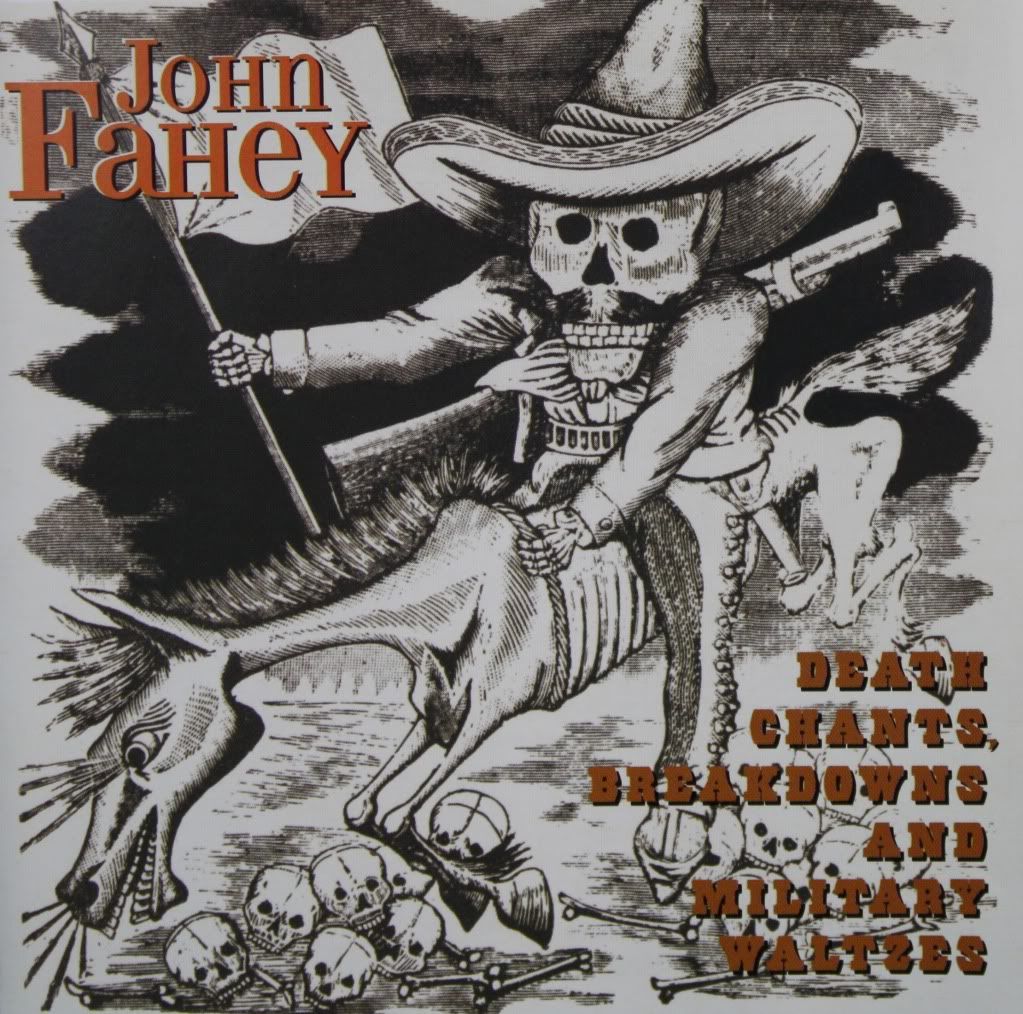
Death Chants, Breakdowns and Military Waltzes is John Fahey's second album, released on his own Takoma Records in 1963, four years after his unassuming but iconic debut.  The intervening years allowed Fahey to significantly refine his technique (mostly open tunings, allowing for lots of octave Travis picking, arpeggiatos and some majestic slow strums with blues-cum-classical melodies played on the high strings) as well as his compositional style, which sees the song lengths stretching out and the compositions featuring more surprising changes and contrasting movements.  Take "Stomping Tonight on the Pennsylvania/Alabama Border," which begins with a string-bending slow blues with a turnaround, mutates into a free, ascending arpeggio on the high strings, then again to a crushing minor blues dirge before revisiting each of its sections and closing on an arpeggio that crosses through dissonance to a dreamy major 7th concluding passage. 

Like a lot of albums that have become long-term favorites of mine, part of what I love about this album is how it sounds--the recording quality isn't great, but since it's (mostly) just one instrument, everything's still audible and the music is laced with an antique atmosphere--and the room reverb is awesome.  There are a few moments where the volume of Fahey's guitar threatens to distort the recording equipment (to its great) as on the slide glissando of "On the Beach of Waikiki," or where the distance of the guitar to the microphone lends a raucous feel, as on the energetic "Spanish Dance," and then on "John Henry Variations" when the instrument's slightly out-of-tune harmonic overtones warble with an unsettling but hypnotic pulse.  If I call some of this album "psychedelic," it's these sort of extra-melodic elements that I'm talking about, like 3:15 into "America" where (through the use of tape editing, I assume) the guitar timbre suddenly changes from bassy fingerstyle to tinny high-neck strumming, or 1:06 into "When the Springtime Comes Again," when the key abruptly shifts from minor to major but the theme remains almost the same--there's something within those quavering intervals that lingers on the precipice of some forgotten memory that never ceases to make my hairs stand on end.  The piece would continue to fascinate Fahey the composer as it evolved into numerous versions on the 1967 re-recording of this album, in numerous live recordings, and on 1971's America as "Mark 1:15"--each time expanding on the last but somehow leaving a trail of discrete incarnations, each with its own particular magic.

The dark corners of this album aren't without some extreme eccentricities, either, like the dissonant strumming on the flute duet, "The Downfall of the Adelphi Rolling Grist Mill" (Fahey's titles were often almost as great as the songs they labeled).  Ultimately, though, Fahey's genius substantially rests on his ability to bizarrely marry the familiar harmony and structure of the blues with the dissonance and imagination of 20th century classical composers.  For someone like myself who gets bored with the repetition inherent in a lot of blues music, hearing Fahey deconstruct his beloved genre and reassemble its innards into dazzling piecemeal sculptures breathes new life into what's usually a compositionally inert idiom.  His preternatural melodic abilities provide melodic lines that sink into the brain slowly but insidiously--not sounding like much at first, but ultimately sounding as beautiful as any music possibly could--I really love the way his sweeping melodies traverse multiple string plucks, simultaneously savoring a note and impatiently re-sounding it before the sound has a chance to decay.

I've got a feeling that whichever Fahey album most people name as their favorite is one of the first (if not the first) that they hear.  Though his early career covered expansive ideological and theoretical territory, it did so at a modest pace and Fahey would often repeat the same ideas either explicitly or intuitively.  At the time he was only pressing hundreds of copies of each album, so how was he to know how things would sound when his discography was considered retrospectively?  For example, he re-recorded and re-released most of the songs from this album (to be reviewed at a later date) in 1967, and the advancements he made in technique and composition are noticeable.  What I'm trying to convey is that, beautiful as they are, some of his ideas lose that "first time" magic when they crop up elsewhere, and where you hear them first tends to remain the most memorable.  For me, it was here with Death Chants, Breakdowns and Military Waltzes--I still think it's a great place to start with Fahey as it states many of the ideas he would continue to pursue--compositionally, technically, sonically (he'd continue to experiment with tape editing as the 60's wore on), and arrangement-wise (many more of his albums feature his own adaptations of Episcopal hymns as closers)--but it all comes in a relatively digestible form, mostly adhering to compartmentalized song structures and resonating with some sort of pop instinct in terms of flow and melody.  I've got several John Fahey favorites, but this is probably the one I'd give up last--you can pry this album from my corpse's withered fingers.

Thursday, March 10, 2011

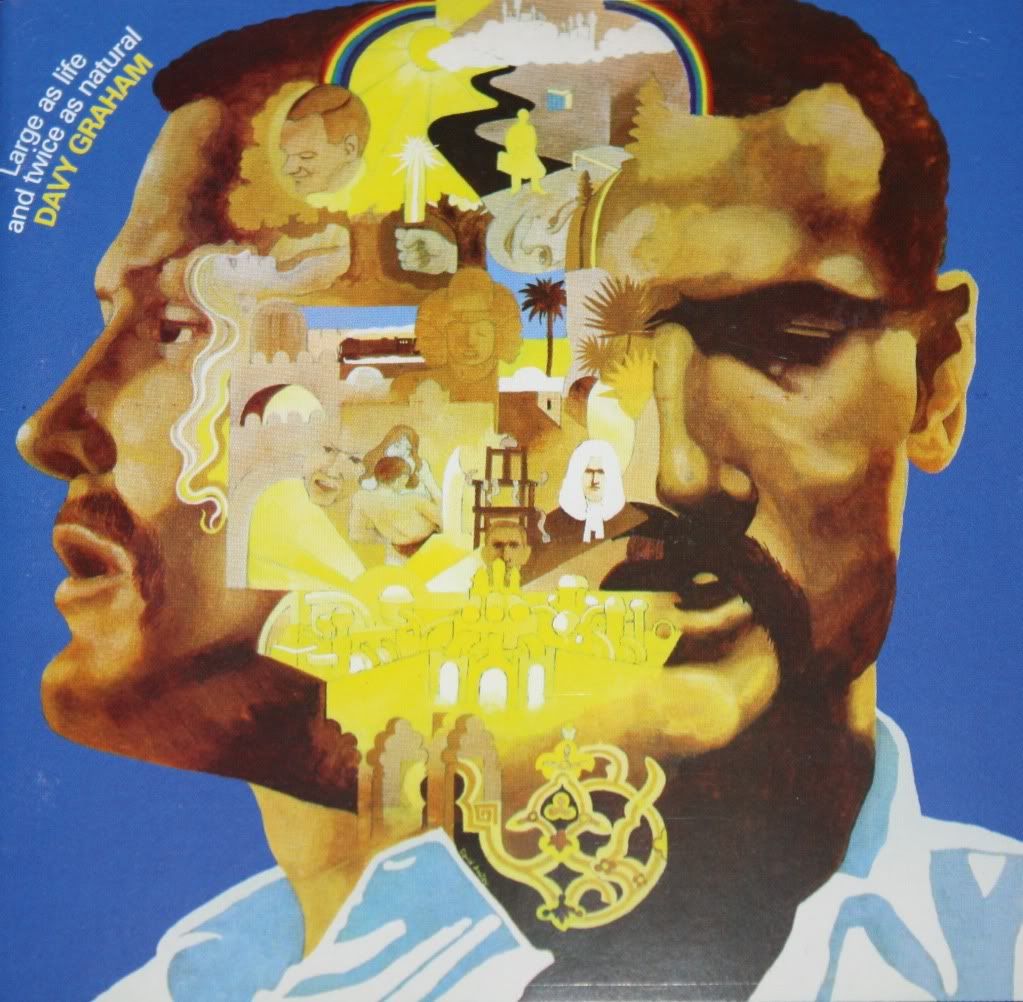
Davy Graham - Large As Life and Twice As Natural


Time to turn our probing ears to another unjustly-overlooked guitarist.  Today, few have even heard of Davy Graham, but he's unanimously considered "important" by those who have--a host of better-known performers and guitarists are quick to drop his name (Bert Jansch, John Renbourn, John Martyn, Paul Simon, Ralph McTell, Roy Harper, Jimmy Page, Martin Carthy, the list goes on...) as the most adventurous and eclectic guitarist of the early 60's English folk revival, yet his actual work remains painfully obscure (though thankfully currently in print).

Davy Graham's fourth LP, Large As Life and Twice As Natural (genius title!) presents equal justification for his esteemed reputation it does evidence for his failure to achieve commercial success.  The solo guitar "Tristano" reveals Graham as a virtuoso of the truest stripe, capable of seamless transition between (or simultaneous juggling of both) rhythm and lead parts, while the song itself fuses jazz, blues, folk and middle-Eastern modalities in a way that nobody in the mid-60's could have even imagined.  That's how Davy is usually described by the converted--a loner whose penchant for world-traveling gave him an untouchable breadth of experience which, combined with his seemingly boundless imagination and ungodly chops, meant he was fusing Irish folk songs with Indian ragas and Eastern-izing obscure blues songs (by all accounts he invented DADGAD guitar tuning) while his later followers were aping Anthology of American Folk Music standards and worshiping Dylan.  In reality, though, very little of Graham's recorded output consists of solo guitar, which I think might have played a role in his commercial difficulties.

More representative of Davy's standard MO would be his expansive reading of classic British folk song "Bruton Town," where the guitar flits jazzily around the traditional melody, refusing to adhere to traditional folk rules.  Graham's voice is probably his greatest limitation--not bad (I actually enjoy it) but certainly not traditionally "beautiful" or as marketable as his guitar abilities.  Likewise, "Both Sides Now" is a revelatory opener--its languorous, modal opening makes you wonder if this is actually the same "Both Sides Now" you thought it was, then BAM!  The bass and drums kick in and Davy presents us with an uncannily energetic and imaginative reading of Joni Mitchell's oft-covered standard.  The cacophonous rhythm section ably handles the eclectic mix of styles present here (Pentangle's Danny Thompson has got to be one of the best session bassists of the time period), bringing lots of ethnic flair to the Eastern songs (the major-key "Sunshine Raga" and minor-key "Blue Raga," as well as the hypnotic "Jenra") and provide a suitably grinding bottom to the  blues numbers ("Freight Train Blues" has some awesome cymbal work and Davy's singing is pretty rocking).

The whole album feels like it was recorded live (there are plenty of vocal imperfections and loose improvisation to attest to this observation) and the sound is great--nobody else's guitar sounded like Graham's.  The commercial flaws of the albums can be seen a mile off, though--it's neither folk (too experimental and eclectic) nor folk-rock (too jazzy and accoustic), and it's got nothing to do with psychedelia (apart from the delirium-inducing guitar excursions), which was the rage in 1968--how do you market that, and to whom?  Perhaps Davy's eclecticism became his career's undoing (deliberately becoming addicted to heroin in order to emulate his jazz idols probably didn't help either) but for me it's the best thing about him--you never know where the next song is going and his playing is full of surprises both compositionally and technically.  Here Graham might not quite fuse as many genres within the same song as he does on Folk, Blues and Beyond, but it's a fine representation of his style and contains some career highlights. 


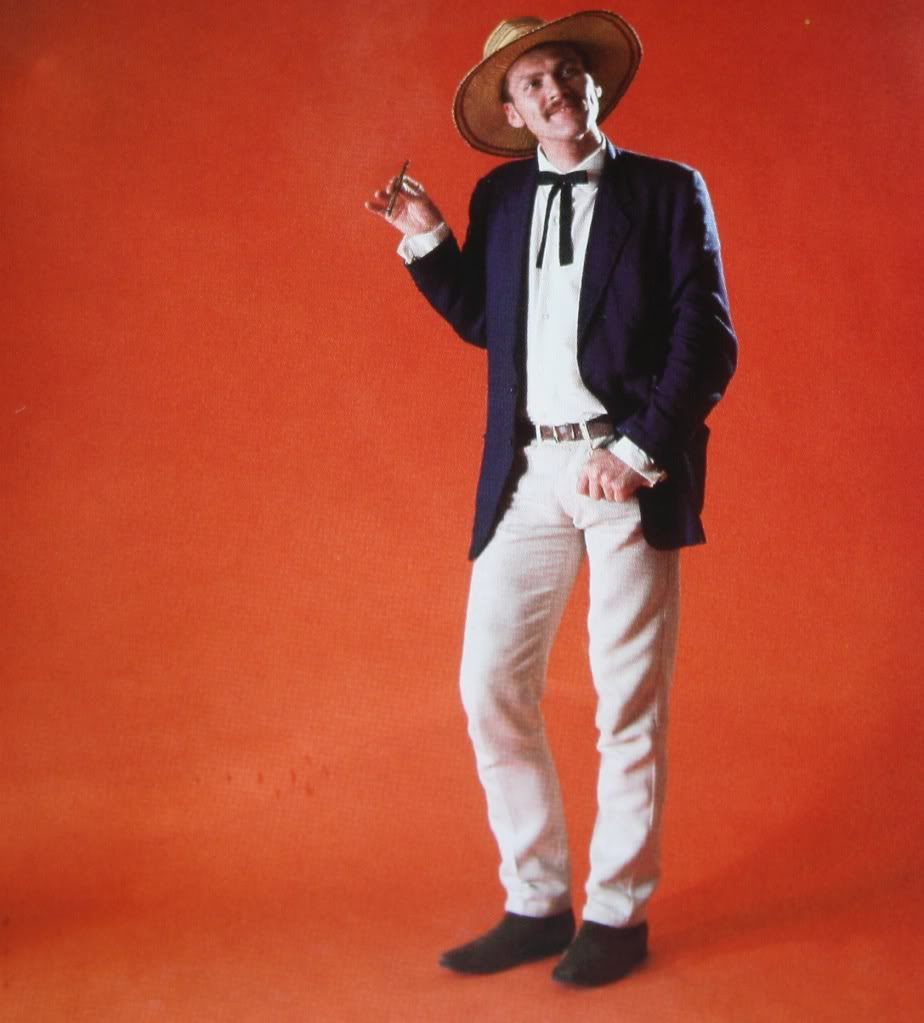
I couldn't resist including this shot from the album notes--what a cigarillo-smoking, big straw hat-wearing ladies man.  Thanks Davy. Get the CD here.

Thursday, February 17, 2011

Robbie Basho - Venus in Cancer

Photobucket was scared of this photo and wouldn't let me upload it, because a naked woman = pornography.
This is easily Robbie Basho's most celebrated recording, most likely due to the tragic state of his legacy--it's one of only three (counting the fact that the entirety of The Grail and the Lotus is presented on the Guitar Soli compilation) of his original studio albums that's available today on CD.  Despite this unjust reality, Venus in Cancer is one of the better Basho albums, so we can at least be glad that what's out there does the man's contribution justice. 

In a lot of ways, I consider this album to be Robbie Basho's study in arpeggio.  Instead of the gale-force sonic flurry often heard on his earlier albums, here we get gentle, climbing guitar figures in which each individual note is audible and easy to savor.  For me, the two six-string pinnacles of Basho's Venus in Cancer style are the leadoff title track and "Kowaka d'Amour."  The former is a tentative, searching piece that sounds partly improvised--there's not necessarily an explicit melody, but the piece has an overall melodic flow and the mood progresses from mysterious to soaringly sublime at a majestic pace.  The latter song is like a darker, moodier shadow of the opener (perhaps like the astrological cover art suggests), with more of a minor, Eastern feel, but still an emphasis on space with a lot of the playing in arpeggio form.

Aside from these two brilliant solo guitar pieces, we get three vocal tunes and a 12-string instrumental.  It's customary--nay, obligatory--when writing about Robbie Basho to comment on his "love it or hate it" voice.  People love pretty guitar instrumentals, but they don't want to worry about weird.  Basho's vocal style is undeniably unconventional, but I'd argue that it's also tough to deny his ability.  If you can listen to "Eagle Sails the Blue Diamond Waters" without being moved, you've got a harder heart than I.  For me, it's not the timbre or style of Basho's voice that's an issue--I think it's marvelously unique, especially in combination with his guitar style--it's more of an issue with his poetry, which is often a bit florid (see "Wine Song").  But somehow, it all fits together here--I think "Song for the Queen" is one of the best realizations of Basho's combined guitar/vocal vision, with an aura of stately mystery that meshes well with the track's french horn and string arrangement. Out of the man's entire discography, I think the vocals work best here--far better than the less distinctive Basho Sings! and probably also even better than the vocal-heavy The Voice of the Eagle.  Regardless, Basho's vocals will probably always be bound turn off a number of those listeners who are merely looking for another John Fahey.  To the initiated, though, it's clear that Basho had a different purpose and for better or worse wasn't willing to go all-instrumental.

Venus in Cancer is a pretty good place to start with Robbie Basho--I still remember my first listen, standing out in the late summer sun painting a barn door, watching birds cross overhead and marveling at the man's passion and ability without really understanding the extent of his vision.  A lot of my favorite albums have taken years to fully appreciate, but I can still vividly remember that first unknowing encounter--this is definitely one of them. 

Out of print, but For sale used here.