Showing posts with label Bert Jansch. Show all posts
Thursday, October 6, 2011
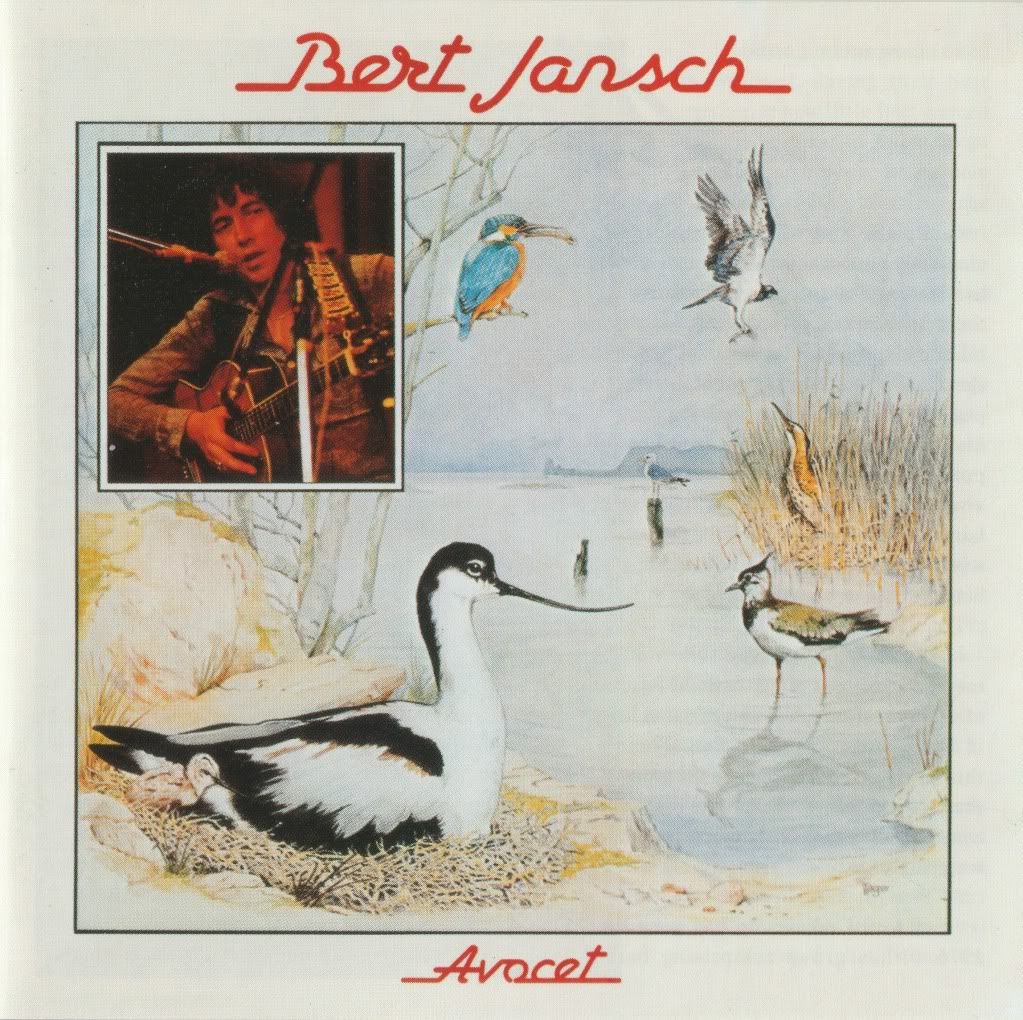
Bert Jansch - Avocet
In observance of Bert Jansch's passing yesterday, I think it's fitting to feature what's probably my favorite Bert Jansch album, 1979's Avocet. Though Bert had already flirted with pure instrumentals on his solo albums, as far as I know Avocet is his only all-instrumental album. While it may not get the attention Bert's earlier solo records generated, I think it's a fine showcase for Bert's abilities as a guitarist as well as a composer, and a sort of detour I always wish he would have pursued further on other albums.
The lengthy title track occupies the first side of the album and is thus its centerpiece. It's easy to realize right away that this is what music critics love to call a "pastoral" album (I wouldn't be surprised to hear the words "very British" either). The focus, of course, is on Jansch's fingerpicked acoustic guitar, supported by all-around double bass badass Danny Thompson and English folk journeyman Martin Jenkins on violin, flute, mandolin and mandocello (don't get to hear that one very often), who often carries the songs' melodic burden. Jansch's playing is typically beautiful, seamlessly superimposing arpeggios, single-note lines and multi-string leads on top of his characteristic Travis picking. I'm always struck by how understated yet impressive Jansch's playing is when viewed close-up; it doesn't sound like he's showing off, but the amount of string bending, pattern-changing and fluid stylistic variation is constant and awesome in its scope. "Avocet" meanders gently through its many parts, providing plenty of melody to anchor the musicianship--though it's not the most focused extended instrumental, it manages to weave a recurring melody across major/minor subsections that span folk, jazz and more of a renaissance flavor before gently coming to rest with Jansch's uniquely mellow-yet-somehow-violent plucking.
Call me a rogue, but the album's second side sounds even better to my ears--the shorter song lengths seem to lend themselves to more distinctive structures. "Lapwing" transcends Jansch's rudimentary piano technique to deliver a pensive minor melody, while "Bittern" introduces a hypnotic, swaying waltz melody and showcases Thompson's righteous bass skills (I can't decide if he's simply an awesome bassist, or it's just that he's miked hotter than most, or [more likely] both). Things get jazzy on the darker "Kingfisher," which features some of the album's more surprising chord changes. The 5/4 time of "Osprey" and the lush lyricism and guitar/mandolin doubling "Kittewake" close the album at its most melodic, proving that, though the title and mood of the disc connote nature documentary background music, there's more than enough substance here to justify close listening. After reacquainting my ears with these songs, I think Avocet is a fitting representation of Bert Jansch the musician--unassuming and humble, yet full of complex and effortless beauty--you just have to take the time to pay attention.
Monday, August 8, 2011
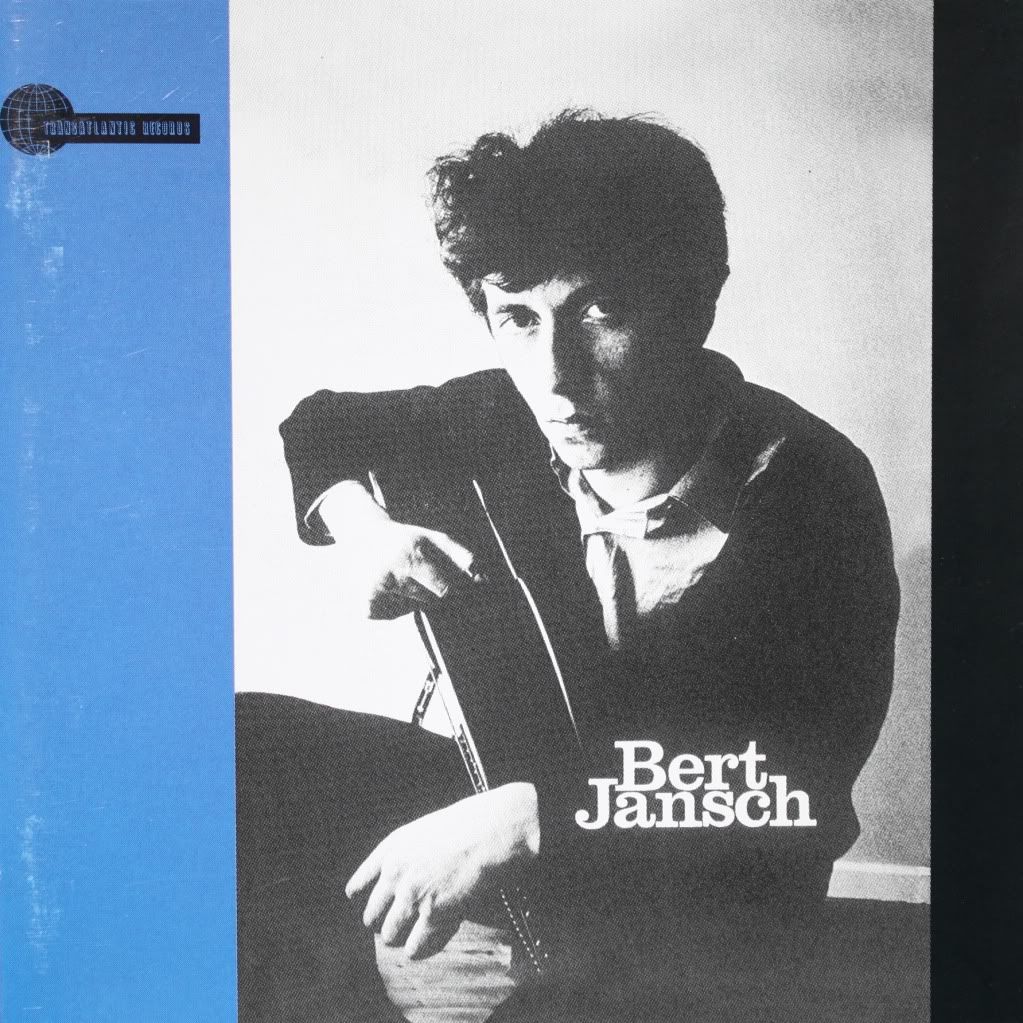
Bert Jansch - Bert Jansch
Bert Jansch is one of those figures whose legendary status in his field is easily justified but who never really succeeded in creating a categorically "great" album. In Jansch's case, the field is contemporary folk and especially acoustic fingerpicking. His prolific solo catalog and membership in The Pentangle (who arguably did record a few great albums), combined with his influence on many more notable guitar players add up to ample evidence for his reputation, but when it comes to selecting his best album, it's hard for me to find one that I feel is lacking in easily-identifiable flaws. His 1965 debut, though, is probably the best album to check out because it demonstrates most purely his personality, guitar abilities, interests (or lack thereof) as a songwriter, and his unique role in the 60's British folk revival.
Since it seems to be the number one critical talking point regarding this album, you probably already know that part of this album's mystique stems from the fact that it was recorded in a friend's flat on a borrowed guitar. Other than the fact that it actually sounds pretty good, considering, I think it speaks to Bert's abilities as a performer that the thing turned out so well--he makes nary a mistake in his playing, and it's easy to see how, in 1965 England, he was something of a rarity insofar as he was a folk(ish) singer who was actually quite capable at playing his instrument. Though many fans might be unaware that Davy Graham had already set this precedent at least a couple of years earlier, Jansch easily sits as one of the other firsts alongside future collaborator John Renbourn. Unlike Graham and many of the other young British people getting interested in folk music at the time, Jansch was one of the first to become recognized for his original songs; this pioneering shift from folk to singer/songwriter-contemporary folk is probably one of Jansch's most significant accomplishments.
As important as his debut was, listening in retrospect there are few really great songs on this album. The opening track, "Strolling Down the Highway" is one of them--Jansch's rough vocals sound great in unison with his string bends as he describes his rambling lifestyle and ironically mentions the suspicion with which he's treated by the straight-laced general public. "Needle of Death," notable for its unflinching directness (which overcomes one of the album's least interesting guitar arrangements and some awkward lyrical flow), is the best-known song on the album. "Do You Hear Me Now?" is pretty good too, raising up some counterculture fire that's absent elsewhere on the album. I know that some people don't cotton to Jansch's rough-hewn vocal style, but I actually don't mind it, considering the album's lo-fi vibe. He's rarely off-key and musters a decent vibrato at places, and when the music's like this, I'd prefer some roughness to immaculate perfection. In other places, Jansch seems content to tout the virtues and drawbacks of his rambling lifestyle through considerably less interesting songwriting, as on "Rambling's Going To Be the Death of Me," "Running From Home," and "Oh How Your Love Is Strong," where a rather unsympathetic narrator tries to explain to the mother of his child that he just has to keep his freedom. Then there's the confused "I Have No Time," a dark, cautionary piece that can't decide if it's about social inequality, hippie ideals or war. Despite the lack of vision in the songwriting department, though, Jansch's guitar is always a pleasure to hear.
Whenever I revisit this album, what strikes me most is how great the short instrumental tracks are. While Jansch sticks to pretty standard picking patterns on the vocal songs, the instrumentals show quite a bit of range in mood and Jansch stretches out in his playing style quite a bit more. "Smokey River" has a great sing-song melody for an opener and closer and the main body of the song rests on a chromatic figure punctuated by lots of gently dissonant polyphony in the high strings. It's easy to see that self-professed Jansch devotees like Roy Harper were listening closely; this piece is specifically reminiscent of Harper's own "Blackpool" from his debut, still a year to come. The whimsical "Finches" features some excellent syncopation surrounding an ascending figure, while "Veronica" and "Alice's Wonderland" flirt with a minor jazz feel. Finally, the instrumentals round off with two Davy Graham tributes--the single-note pounder "Casbah," which is quite obviously indebted to Graham's jaw-dropping arrangement of "Better Git In Your Soul," and Graham's own "Angie" [sic], of which Jansch produces a fine reading. Though I've heard Martin Carthy complain that Jansch has never played the song correctly, I find his hammer-ons and bursts of percussive strumming make it a lively and fresh interpretation.
Though Jansch's debut is far from perfect, it's always a pleasure to listen to. As a guitar player, it's also hard not to be inspired after hearing the man explore the possibilities of his instrument with such apparent ease.
Here's a great recent interview with Jansch that touches on his debut and Davy Graham's influence.
Subscribe to:
Posts (Atom)