Showing posts with label 1965. Show all posts

Wednesday, January 25, 2012

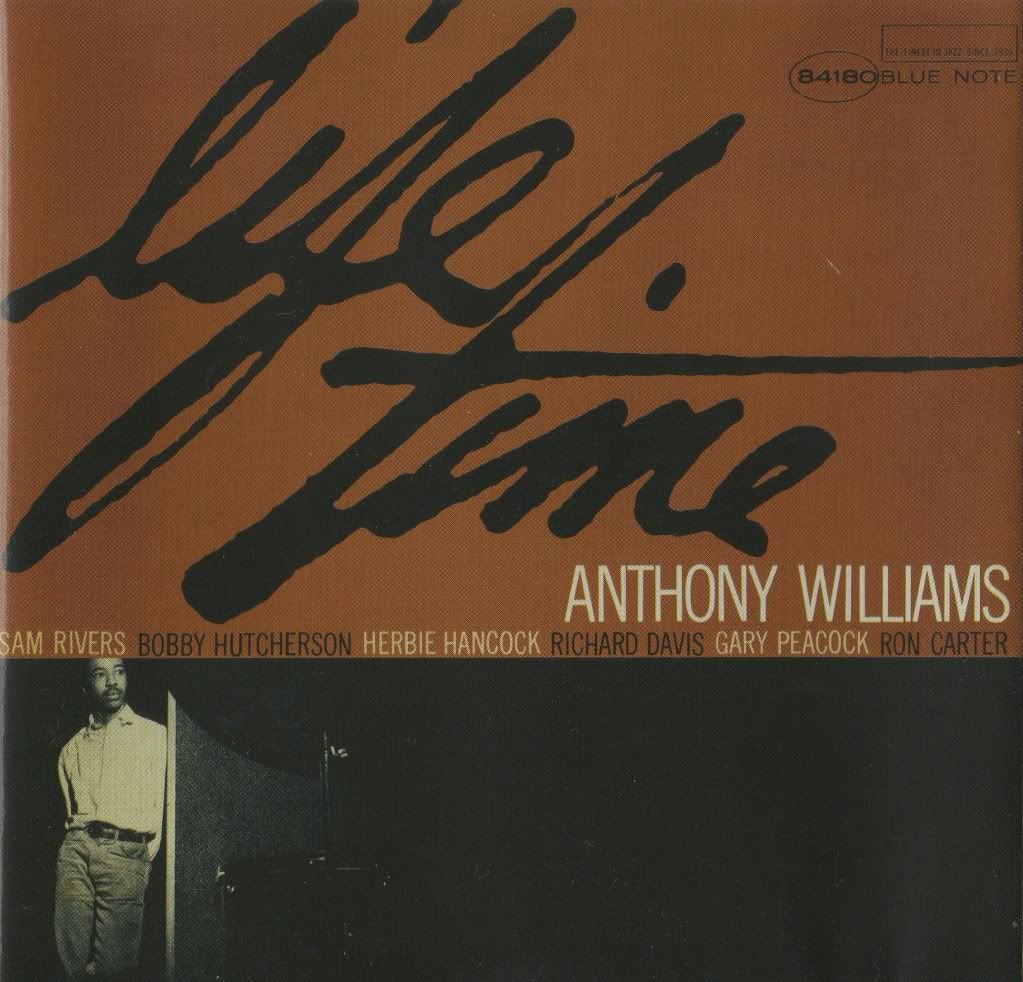
Tony Williams - Life Time


By 1965 and this--drummer Tony Williams' first set as a leader--the then-17-year-old had already been working with a slew of talented and innovative jazz artists, including Herbie Hancock, Eric Dolphy, Andrew Hill, Sam Rivers, Jackie McLean and Grachan Moncur III (not to mention his recent incorporation into Miles Davis' Second Great Quintet).  Listening to Life Time, it's clear that Williams was listening closely to what the latter two were doing, especially on the sessions for McLean's One Step Beyond and Moncur III's Evolution.  For me, this album represents one of several high points from the period when it comes to a distinctive brand of avant-garde jazz that seems to favor space over wild soloing.

You know from the eerie, quietly intense opening melody of "Two Pieces of One: Red" that this isn't going to be a typical bop album, but as Sam Rivers' tenor fades out and dual bowed basses from Richard Davis and Gary Peacock gently arpeggiate it's apparent that this subtle opening isn't going for the explosion your ears might expect.  One of the bassists takes the first solo, and from then on you can rest assured that we're not returning to the usual structures or sounds for the rest of the album.  "Two Pieces of One: Red" and the rest of Life Time are typified by a restrained, spacious atmosphere wherein solos take place with very little backing instrumentation (aided considerably by the fact that there's no piano on three of five tracks) and rarely take off into the rapid-fire solo excursions popular even with some of the players on this disc--Sam Rivers is surprisingly subdued here, but he manages to ride the transition with little difficulty, relying more on dynamics and the presence/non-presence duality that's much more of an option when you're playing in a musical landscape as open as this one.  Indeed, the overall sound of this album owes as much to the theoretical advancements of John Cage as it does to free jazz pioneers, setting up blocks of silence as both an effective compositional tool (making it easier to tell when the sometimes skeletal compositions are moving to another section) and as an invisible member of the combo, giving the players another (absence of) sound to play off and somehow adding depth and intensity to the sounds that are actually present.  Williams' drums in particular seem to particularly smolder in the open, reverb-heavy environment, with his brushwork lifelike in its texture and his cymbal work especially benefiting from miles of reverb and a lack of competition with other instruments (and himself, for that matter--this music wouldn't be so great if the players didn't match the mood by leaving a little space in their own playing).

"Two Pieces of One: Green" is the album's longest track, with Rivers contributing some more of his characteristic fire and blasting some really juicy overtones, while Williams explores the toms and un-snared snare.  While the subtle melody of some of the album's other tracks gradually reveals itself, this track is one of the freest of the bunch, demonstrating amply that free jazz doesn't have to always consist of several instruments blaring at the same time.  "Tomorrow Afternoon" comes closest to hard bop in melody and swing, but gradually breaks up into greater and greater caverns of space, like the floor is dropping away from the comfortable atmosphere that was so briefly established.  "Memory" drops Rivers and brings vibraphonist Bobby Hutcherson and Herbie Hancock in for a bassless free improvisation that sees Hutcherson and Williams riffing off one another quite effectively, with the vibes providing just enough of a tonal anchor; with Williams' wood block and other hand percussion providing yet another noticeable textural contribution.  The arrangement is so sparse that when Hancock finally asserts himself around 5:30 with a brief chord, it sounds like the loudest, most melodic thing you've ever heard.  The album ends with "Barb's Song to the Wizard," a piano and bass duet with no drums--the tense melody nods to Williams' aforementioned work with Moncur III and McLean.  Unlike those great albums, though, Williams always seems to take things one step further, providing no real traditional bop tunes to appease nervous listeners and committing fully to the album's mission statement.

The fact that this album works so well with such a piecemeal, rotating assortment of players exclusively playing the compositions of a 17-year-old drummer is a testament both to Williams' skill and unheard-of musical maturity at the time, but also to whatever it was in the air at the time that made all of these players so assured in their judgment, synchronicity and adventurousness.  Life Time is a grower in the best sense of the word--sounding like nothing much on first listen but gradually unfolding into a paradoxically dense work, considering its relative quietness--and every time I listen to it I find myself asking "Why isn't there more free jazz like this?!"  Luckily a little research into the discographies of the artists involved here yield further pairings in the same time period and several great albums in the same vein.  While Williams would go on in the next few years to collaborate with some of avant-garde jazz's most acclaimed albums (as well as Miles Davis' less challenging but equally iconic work [I bet he hated this album]) before heading into fusion territory, he did reconvene with some of these players for the nearly-as-excellent Spring, but no album I've found has done such a good job of fusing an AMM-like free improv space aesthetic with "traditional" free jazz harmony and melody--recommendations welcome!

Get it here.

Monday, August 8, 2011

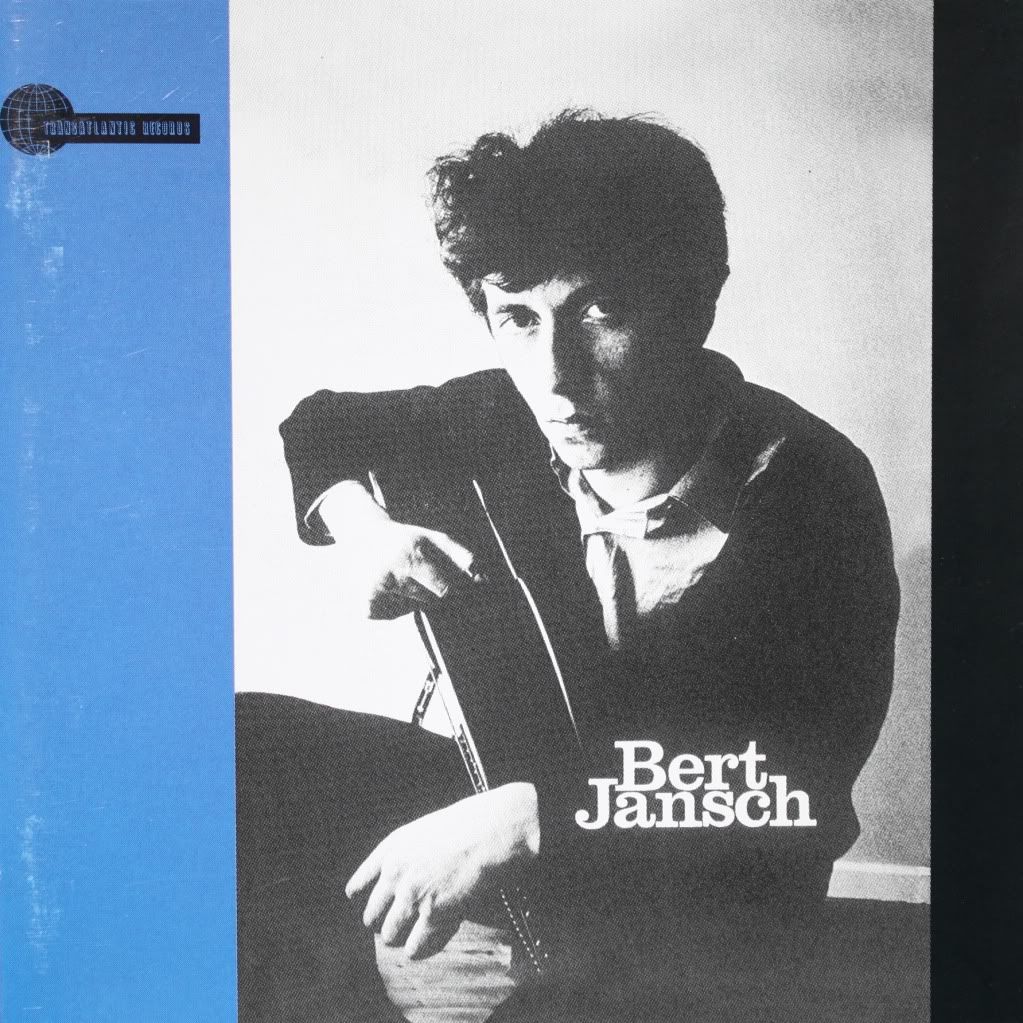
Bert Jansch - Bert Jansch


Bert Jansch is one of those figures whose legendary status in his field is easily justified but who never really succeeded in creating a categorically "great" album.  In Jansch's case, the field is contemporary folk and especially acoustic fingerpicking.  His prolific solo catalog and membership in The Pentangle (who arguably did record a few great albums), combined with his influence on many more notable guitar players add up to ample evidence for his reputation, but when it comes to selecting his best album, it's hard for me to find one that I feel is lacking in easily-identifiable flaws.  His 1965 debut, though, is probably the best album to check out because it demonstrates most purely his personality, guitar abilities, interests (or lack thereof) as a songwriter, and his unique role in the 60's British folk revival.

Since it seems to be the number one critical talking point regarding this album, you probably already know that part of this album's mystique stems from the fact that it was recorded in a friend's flat on a borrowed guitar.  Other than the fact that it actually sounds pretty good, considering, I think it speaks to Bert's abilities as a performer that the thing turned out so well--he makes nary a mistake in his playing, and it's easy to see how, in 1965 England, he was something of a rarity insofar as he was a folk(ish) singer who was actually quite capable at playing his instrument.  Though many fans might be unaware that Davy Graham had already set this precedent at least a couple of years earlier, Jansch easily sits as one of the other firsts alongside future collaborator John Renbourn.  Unlike Graham and many of the other young British people getting interested in folk music at the time, Jansch was one of the first to become recognized for his original songs; this pioneering shift from folk to singer/songwriter-contemporary folk is probably one of Jansch's most significant accomplishments.

As important as his debut was, listening in retrospect there are few really great songs on this album.  The opening track, "Strolling Down the Highway" is one of them--Jansch's rough vocals sound great in unison with his string bends as he describes his rambling lifestyle and ironically mentions the suspicion with which he's treated by the straight-laced general public.  "Needle of Death," notable for its unflinching directness (which overcomes one of the album's least interesting guitar arrangements and some awkward lyrical flow), is the best-known song on the album.  "Do You Hear Me Now?" is pretty good too, raising up some counterculture fire that's absent elsewhere on the album.  I know that some people don't cotton to Jansch's rough-hewn vocal style, but I actually don't mind it, considering the album's lo-fi vibe.  He's rarely off-key and musters a decent vibrato at places, and when the music's like this, I'd prefer some roughness to immaculate perfection.  In other places, Jansch seems content to tout the virtues and drawbacks of his rambling lifestyle through considerably less interesting songwriting, as on "Rambling's Going To Be the Death of Me," "Running From Home," and "Oh How Your Love Is Strong," where a rather unsympathetic narrator tries to explain to the mother of his child that he just has to keep his freedom.  Then there's the confused "I Have No Time," a dark, cautionary piece that can't decide if it's about social inequality, hippie ideals or war.  Despite the lack of vision in the songwriting department, though, Jansch's guitar is always a pleasure to hear.

Whenever I revisit this album, what strikes me most is how great the short instrumental tracks are.  While Jansch sticks to pretty standard picking patterns on the vocal songs, the instrumentals show quite a bit of range in mood and Jansch stretches out in his playing style quite a bit more.  "Smokey River" has a great sing-song melody for an opener and closer and the main body of the song rests on a chromatic figure punctuated by  lots of gently dissonant polyphony in the high strings.  It's easy to see that self-professed Jansch devotees like Roy Harper were listening closely; this piece is specifically reminiscent of Harper's own "Blackpool" from his debut, still a year to come.  The whimsical "Finches" features some excellent syncopation surrounding an ascending figure, while "Veronica" and "Alice's Wonderland" flirt with a minor jazz feel.  Finally, the instrumentals round off with two Davy Graham tributes--the single-note pounder "Casbah," which is quite obviously indebted to Graham's jaw-dropping arrangement of "Better Git In Your Soul," and Graham's own "Angie" [sic], of which Jansch produces a fine reading.  Though I've heard Martin Carthy complain that Jansch has never played the song correctly, I find his hammer-ons and bursts of percussive strumming make it a lively and fresh interpretation.

Though Jansch's debut is far from perfect, it's always a pleasure to listen to.  As a guitar player, it's also hard not to be inspired after hearing the man explore the possibilities of his instrument with such apparent ease.

Here's a great recent interview with Jansch that touches on his debut and Davy Graham's influence.

Wednesday, June 22, 2011

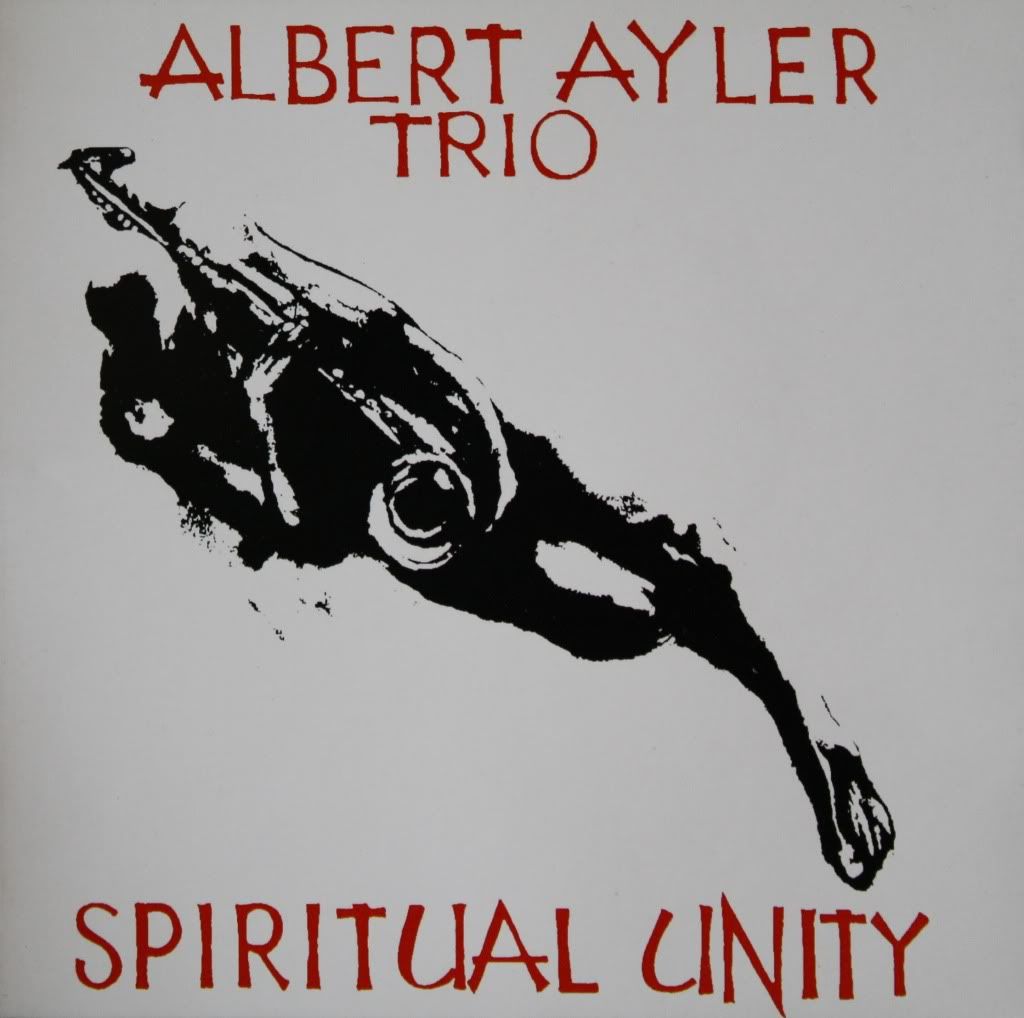
Albert Ayler - Spiritual Unity


Although I've mentioned free jazz a few times, I still haven't ever actually defined it or reviewed a full-on free jazz release.  Although free jazz is a widely-accepted subdivision of the jazz genre, it came about gradually over a couple of decades (mostly the 1950's and 60's) and through the work of a number of pioneers, so it can be difficult to pin down exactly what its characteristics are.  There is, for instance, a big difference between Ornette Coleman's unrestrained soloing over a relatively orthodox rhythm section in The Shape of Jazz to Come and some of the 20+ minute raging noisefests in Sun Ra's more audacious outings.  The unifying principle behind most music labeled "free jazz," though, is the elimination of some of the more traditional restrictions of the jazz idiom--be they adhering to chord changes when soloing, playing the instrument in a traditional way, including a repeating melody in the song, ensemble members playing in the same key (or even the same tempo), or ensemble members paying attention to what the others are doing.  It would also seem that free jazz places utmost importance on emotional expression--famous players have sought to avoid limitations in order to more authentically communicate their emotions through improvisation.  There will always be critics who argue that no jazz is actually "free," pointing out that there's always some structure, repetition, or limit to how the music will sound, but I think this observation misses the point--few free jazz players have ever claimed complete freedom; rather, the idea is to become freer from the traditional structures of jazz.  To this end, something that's interested me is the difference between free improvisation, a few examples of which I've already reviewed, and free jazz.  It's usually pretty easy to identify free jazz from free improvisation or atonal modern classical music, as the instrumentation is usually traditional, and the style of playing seems almost always to obviously fall within the jazz idiom (a saxophonist's phrasing, for example) no matter how noisy or atonal it is.  Free improvisation, on the other hand, often seems hell-bent on avoiding connections with any established musical idioms and more in combining elemental sound with the energy and unpredictability of improvisation.  While I'm neither a jazz musician nor particularly knowledgeable on the subject, I've recently gotten to a place where I feel like I'm starting to appreciate the tenets of jazz (especially of the free variety) and can enjoy and talk about it on specific aesthetic grounds.

Albert Ayler's 1965 album Spiritual Unity seems to me to be a great introduction to free jazz as it bridges the gap between early free jazz efforts and the much more ethereal works to come.  Ayler is widely regarded as one of the greatest free jazz saxophonists for his emphasis on timbre and characteristic vibrato-heavy style.  The album is book ended by two different versions of a tune called "Ghosts."  The first variation beautifully illustrates Ayler's stance in the free jazz movement--the piece opens with Ayler belting a winding gospel-influenced melody before gradually disassembling it over the course of the next five minutes only to recapitulate the original theme at the end.  It's thrilling to listen as Ayler inverts intervals between the notes, perverting what was originally an extremely recognizable melody into an at times hilarious and at other times furiously energetic caricature.  No matter how wild his trills and runs get, though, they still fit within the rhythmic footprint of the original theme.  The drums and bass are barely on the map, too, wildly filling the space with sound and energy, which seems to suffice in place of an actual beat.  

"The Wizard" continues to showcase Ayler's playing, beginning on an even shorter melodic motif before devolving into some of his rawest playing on the album--his harmonics and overblowing sound so amazing that it's easy to understand why some of the fathers of the movement believed texture alone could replace melody and harmony as the centerpiece of a solo.  "Spirits" brings the tempo down, showcasing the rhythm section with a little more space and room for the bass and drums to play off of each other, while Ayler's tremulous vibrato communicates a wailing sort of mourning sound reminiscent of a New Orleans jazz funeral.  The relatively short album closes with a second variation of "Ghosts" in which Ayler stretches beyond even the theme's rhythmic form, running all over the map during his solo and returning for more soloing after the bass and drum break before returning to the theme.  Spiritual Unity unifies free soloing with highly unstructured rhythm section playing to delve pretty deeply into free jazz territory, but its utilization of recognizable themes and loose but undeniable song structures make it considerably more accessible than some free jazz outings.  My only gripe is with the drummer, who spends too much time on the ride for my tastes, but I've got nothing bad to say about Ayler's stunning chops and energy. 

Get it here on CD or MP3.

Monday, March 7, 2011

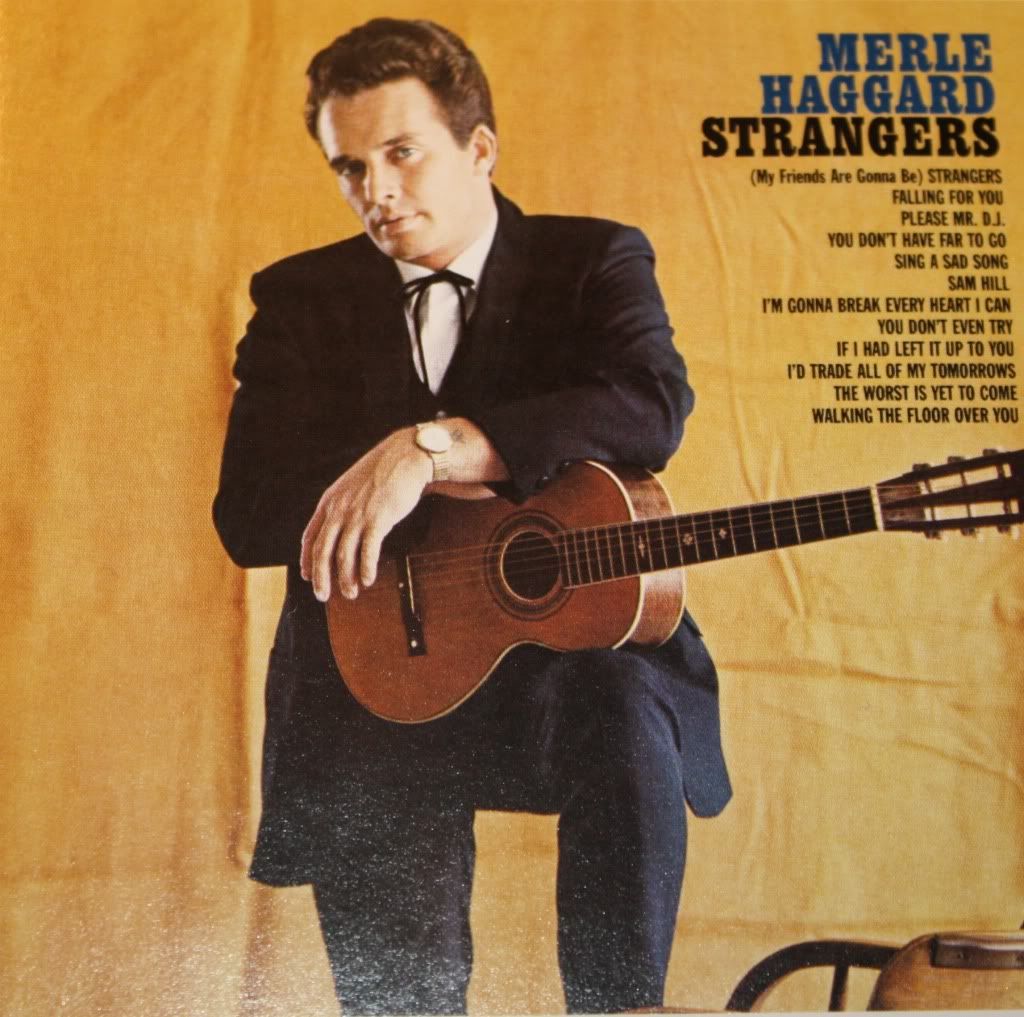
Merle Haggard - Strangers


Take a look at Merle Haggard on 1965's Strangers: even with that silly tie and leaning on that tiny guitar, he already knows he's a badass.  As might be expected, though, the full flower of Merle's greatness hasn't quite bloomed on this, his debut.  To my ears the reason is a combination of production/style and material.  It's pretty clear that Merle's being pitched as more of a crooner, with an emphasis on ballads and smooth melodies--too often the arrangements include big string arrangements and Nashville Patsy Cline-style backup singers, and the amount of reverb would suggest that Merle was performing inside a cave.  In retrospect it's easy to criticize the production choices, but it's worth mentioning that the more muscular Bakersfield brand of country that became Merle's signature was still in its very early stages in 1965--though Together Again/My Heart Skips A Beat had already been released in '64, there wasn't much precedent for the Bakersfield lightning bolt Haggard was about to call down in 1966's Swinging Doors and The Bottle Let Me Down.

So, that brings us to the material.  There are a handful of good-to-very-good songs, my favorites being "I'm Gonna Break Every Heart I Can" (or my name ain't Merle), the ridiculously awesome vocal on "Sing A Sad Song" (probably the only place where the crooner image actually fits), the title track, and "You Don't Have Very Far To Go" (for some reason Merle's recorded this song on at least three studio albums; my favorite version is on Branded Man).  Oh yeah, we also get a dynamite song title--"The Worst is Yet to Come."  There are a few bombs, too, like the novelty tune "Sam Hill," and a few bland ballads like "Falling for You" and "You Don't Even Try."  Merle's signature writing style was on its way to fulfillment, but he's only got writing credit on half of the songs, and it's pretty clear he didn't pick all of the covers (a glance at later albums' writing credits reveals that Merle had really good taste in filler; that's why the albums are so good).  Instead of a classic Hag album, we get a soft launch;   Strangers is a pleasant enough listen but I'm always left thirsting for a little more energy or a little bit better writing.  Thankfully the next nine albums of originals deliver better on both counts every single time.


Get it here in CD or MP3, along with the immortal Swinging Doors and The Bottle Let Me Down.