Showing posts with label Richard Davis. Show all posts

Wednesday, January 25, 2012

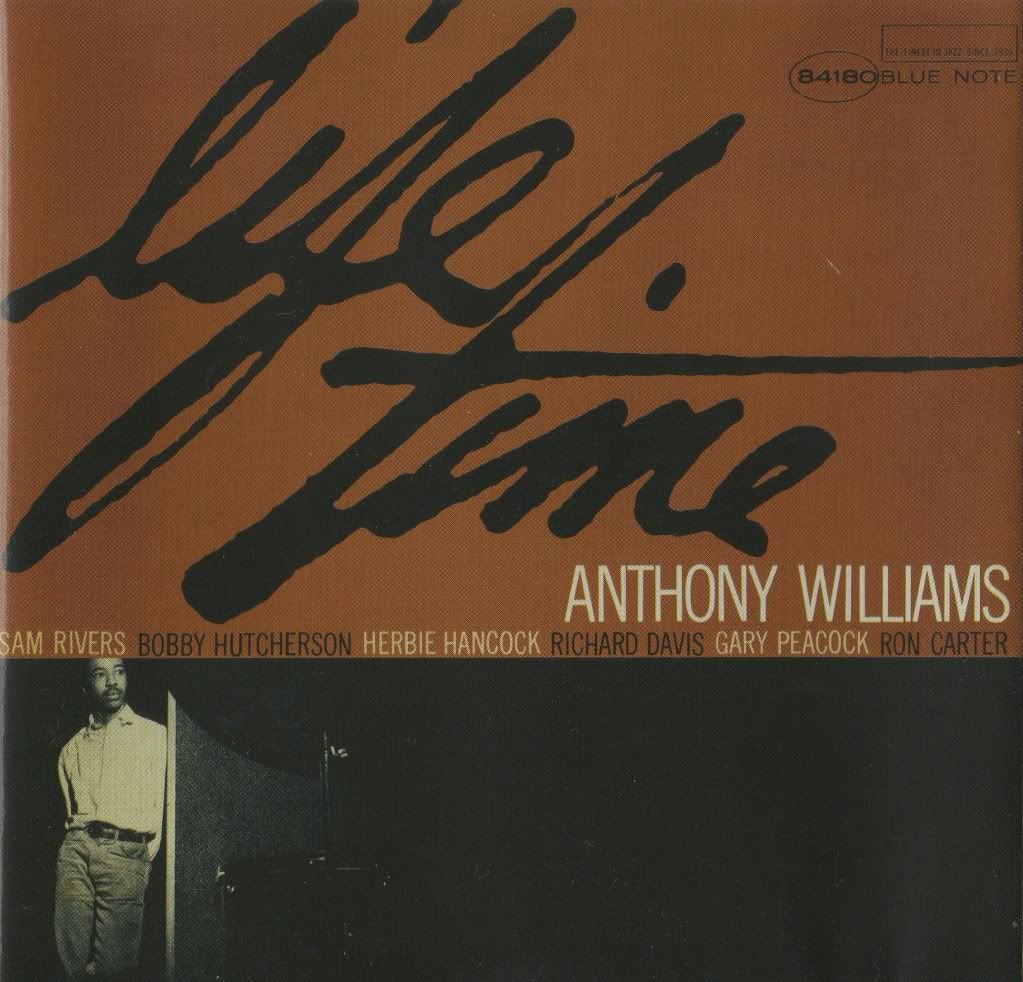
Tony Williams - Life Time


By 1965 and this--drummer Tony Williams' first set as a leader--the then-17-year-old had already been working with a slew of talented and innovative jazz artists, including Herbie Hancock, Eric Dolphy, Andrew Hill, Sam Rivers, Jackie McLean and Grachan Moncur III (not to mention his recent incorporation into Miles Davis' Second Great Quintet).  Listening to Life Time, it's clear that Williams was listening closely to what the latter two were doing, especially on the sessions for McLean's One Step Beyond and Moncur III's Evolution.  For me, this album represents one of several high points from the period when it comes to a distinctive brand of avant-garde jazz that seems to favor space over wild soloing.

You know from the eerie, quietly intense opening melody of "Two Pieces of One: Red" that this isn't going to be a typical bop album, but as Sam Rivers' tenor fades out and dual bowed basses from Richard Davis and Gary Peacock gently arpeggiate it's apparent that this subtle opening isn't going for the explosion your ears might expect.  One of the bassists takes the first solo, and from then on you can rest assured that we're not returning to the usual structures or sounds for the rest of the album.  "Two Pieces of One: Red" and the rest of Life Time are typified by a restrained, spacious atmosphere wherein solos take place with very little backing instrumentation (aided considerably by the fact that there's no piano on three of five tracks) and rarely take off into the rapid-fire solo excursions popular even with some of the players on this disc--Sam Rivers is surprisingly subdued here, but he manages to ride the transition with little difficulty, relying more on dynamics and the presence/non-presence duality that's much more of an option when you're playing in a musical landscape as open as this one.  Indeed, the overall sound of this album owes as much to the theoretical advancements of John Cage as it does to free jazz pioneers, setting up blocks of silence as both an effective compositional tool (making it easier to tell when the sometimes skeletal compositions are moving to another section) and as an invisible member of the combo, giving the players another (absence of) sound to play off and somehow adding depth and intensity to the sounds that are actually present.  Williams' drums in particular seem to particularly smolder in the open, reverb-heavy environment, with his brushwork lifelike in its texture and his cymbal work especially benefiting from miles of reverb and a lack of competition with other instruments (and himself, for that matter--this music wouldn't be so great if the players didn't match the mood by leaving a little space in their own playing).

"Two Pieces of One: Green" is the album's longest track, with Rivers contributing some more of his characteristic fire and blasting some really juicy overtones, while Williams explores the toms and un-snared snare.  While the subtle melody of some of the album's other tracks gradually reveals itself, this track is one of the freest of the bunch, demonstrating amply that free jazz doesn't have to always consist of several instruments blaring at the same time.  "Tomorrow Afternoon" comes closest to hard bop in melody and swing, but gradually breaks up into greater and greater caverns of space, like the floor is dropping away from the comfortable atmosphere that was so briefly established.  "Memory" drops Rivers and brings vibraphonist Bobby Hutcherson and Herbie Hancock in for a bassless free improvisation that sees Hutcherson and Williams riffing off one another quite effectively, with the vibes providing just enough of a tonal anchor; with Williams' wood block and other hand percussion providing yet another noticeable textural contribution.  The arrangement is so sparse that when Hancock finally asserts himself around 5:30 with a brief chord, it sounds like the loudest, most melodic thing you've ever heard.  The album ends with "Barb's Song to the Wizard," a piano and bass duet with no drums--the tense melody nods to Williams' aforementioned work with Moncur III and McLean.  Unlike those great albums, though, Williams always seems to take things one step further, providing no real traditional bop tunes to appease nervous listeners and committing fully to the album's mission statement.

The fact that this album works so well with such a piecemeal, rotating assortment of players exclusively playing the compositions of a 17-year-old drummer is a testament both to Williams' skill and unheard-of musical maturity at the time, but also to whatever it was in the air at the time that made all of these players so assured in their judgment, synchronicity and adventurousness.  Life Time is a grower in the best sense of the word--sounding like nothing much on first listen but gradually unfolding into a paradoxically dense work, considering its relative quietness--and every time I listen to it I find myself asking "Why isn't there more free jazz like this?!"  Luckily a little research into the discographies of the artists involved here yield further pairings in the same time period and several great albums in the same vein.  While Williams would go on in the next few years to collaborate with some of avant-garde jazz's most acclaimed albums (as well as Miles Davis' less challenging but equally iconic work [I bet he hated this album]) before heading into fusion territory, he did reconvene with some of these players for the nearly-as-excellent Spring, but no album I've found has done such a good job of fusing an AMM-like free improv space aesthetic with "traditional" free jazz harmony and melody--recommendations welcome!

Get it here.

Thursday, October 20, 2011

Eric Dolphy - Out to Lunch!


If I had to credit one album for inciting my recent obsession with jazz, it would have to be Eric Dolphy's 1964 crowning achievement, Out to Lunch!  Before then, I'd found something of a backward insertion point into jazz by moving into free jazz from the less idiomatic free improvisation realm.  After hearing this album, though, I realized that there's an entire movement within jazz (generally known as avant-garde jazz) that overlaps with free jazz in terms of soloist expression but also focuses heavily on expanding the compositional palette of bop and post-bop to a wide variety of places it'd never been before--undoubtedly, avant-garde jazz is the jazz for me!

By 1964 Eric Dolphy had had a storied career as both a sideman (supporting, among others, John Coltrane and Charles Mingus) and as a leader, recording several studio and live albums since his bandleader debut on 1960's Out There.  It's unsurprising that Dolphy was in great demand as a session and live ensemble member, as he could play alto saxophone, flute and bass clarinet--the wider success of which in jazz music he can arguably credited--with comparable (but always idiosyncratic) virtuosity.  Though he was playing "out" for years before the date of this recording, Out to Lunch! is the first (and last, since he died within months of its recording) of Dolphy's albums to feature only his own compositions.  As I've increasingly found among successful avant-garde jazz albums, the combination between the adventurousness and innovation of the compositions and the freedom, creativity and chemistry of the performers creates a perfect storm of blissful, challenging sounds.

On the compositional side, Dolphy provides songs that run the gamut between dissonant odd-metered avant-garde ("Out to Lunch," "Straight Up and Down," "Hat and Beard," dedicated to Thelonious Monk, one of the only jazz composers who could be said to foreshadow Dolphy's style), early 1900's gospel jazz (the ballad "Something Sweet, Something Tender") and frantic, twisted bop riffing ("Gazzelloni").  On the more dominant weird stuff, Dolphy strikes a fascinating balance between abstractness (which often pleasingly extends typical jazz harmony to the brink of atonality) and Ornette Coleman's sinuous sense of head melody.  "Hat and Beard," with its constantly mutating descending scale and lurching unison non-melody, fits the former category, while the title track fits the latter with a seemingly never-ending head that winds around in spiraling circles, somehow never separating the tight unison between trumpet and alto sax.  The final track, "Straight Up and Down" is supposed to emulate a drunken stagger but, really, the same could be said of most of the rhythms here!  What I really love about Dolphy's compositions is that they travel well beyond the head-solo-head formula that sometimes hangs like an albatross from so much ultra-orthodox jazz; sure, the songs have recognizable and recapitulated heads, but there are innumerable pockets of group dynamic shifts, coordinated rhythmic interplay and near complete dropouts that you never get the sense that things are happening without a good reason.

As far as the playing goes, like I said earlier, this is an undeniable example of a perfect storm where a dream team of players come together over a set that pushes them all to places they've never been before.  The absence of piano means that vibraphonist Bobby Hutcherson carries the mid-range chromatic accompaniment on his shoulders, which means a lot of the accompaniment is more spacious than the type of comping that piano usually provides.  I really enjoy how Hutcherson swaps between helping state the songs' melodies, comping with two or three-note chords over occasionally strange intervals, and spontaneously supporting solos with minor melodic excursions.  While Hutcherson's replacement of piano on this album is often lauded (as must be his ability to make one of the geekiest jazz instruments as cool as it could possibly be), I think some credit is also due to bassist Richard Davis, who often uses two-note chords (sometimes with a bow) in addition to a more standard walking style to emulate the piano's absent tonal cluster effect.  The tightness of Hutcherson and Davis allows Tony Williams free reign to play counter-rhythm to the vibes, alternate between blasting and delicate fills out of nowhere, and keep the ideas coming one after another without obsessing about blatantly stating the beat--sometimes it's just implied, and that space is one of the best parts about this music.  Trumpeter Freddie Hubbard could easily be labeled this set's least adventurous performer, but there's really no denying his chops; though he can't compete with Dolphy in terms of out-ness, he ably makes up for his relative conventionality with furious energy, which just might be considered out on its own.

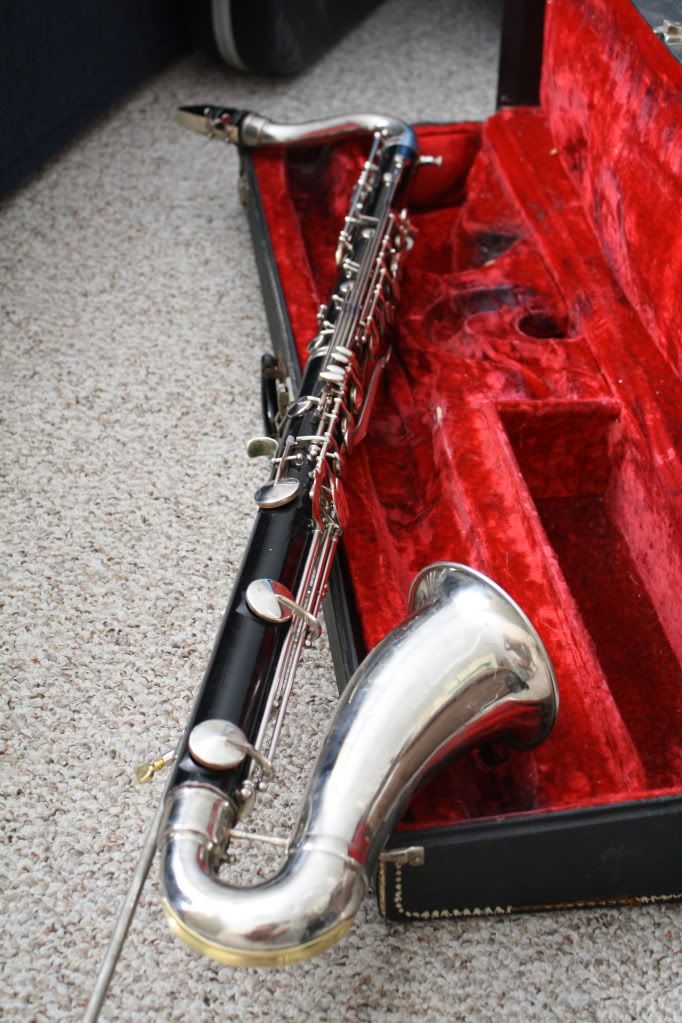
Finally, Dolphy manages to consolidate his well-documented strengths on all three instruments by stealing his own show.  I can never get enough of his bass clarinet playing--the instrument's ear candy timbre is enjoyable on its own, but in the hands of someone like Dolphy, it becomes something else entirely.  Especially with the bass clarinet, his intuitive feel for the instrument's range and voicing allows him to employ it quite vocally, screeching through wide intervals just as often as he blurts out vaguely tonal (but always strangely melodic) fragments.  The beauty of this approach comes out even more on "Something Sweet, Something Tender," where the slow tempo and old-timey feel allow for some wide vibrato and compelling emotional expression.  Dolphy's alto saxophone chops are another thing entirely; his tone is so flagrant it sounds like he's blowing fire out of his horn and the mics can barely handle it.  "Gazzelloni" is the only flute showcase, which seems like a good ratio--the vibraphone seems to overlap in terms of timbre, so one example of Dolphy's rapid fire, often viscerally percussive flute style satisfies quite well.

It's a shame Dolphy wasn't able to follow up this masterpiece with a few more albums of his own compositions--he was clearly on a roll.  Fortunately, there are numerous great examples of his ability as a sideman (my picks for a balance between Dolphy's chops and adventurous composition are Andrew Hill's Point of Departure, George Russell's Ezz-thetics, and Ornette Coleman's iconic Free Jazz), and if you just want to hear the man play, his Wikipedia page comprehensively lists his discography as a leader and sideman--enjoy the trip.  It's disappointing that few contemporary jazz artists have attempted to push the genre forward in this way--there's clearly lots of space left to fill with audacious sounds, and it's hard to argue that these guys didn't have a great time making this music.

On a side note, here's what happens when you listen to too much Eric Dolphy...for use on my upcoming recording project.

Monday, September 19, 2011

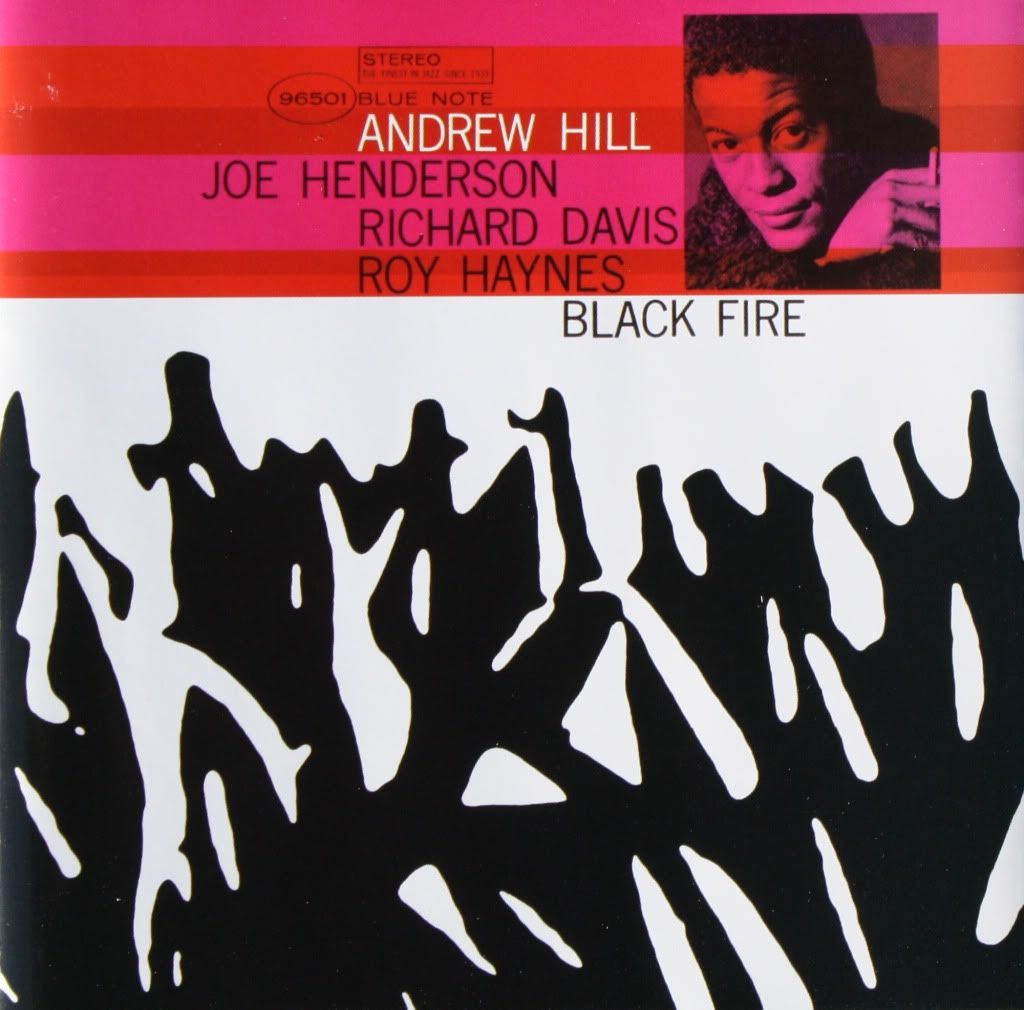
Andrew Hill - Black Fire

 
The path that's led me from dispassionate appreciation to real enjoyment of jazz has been a serpentine one, coming to like the genre not from its more accessible and well-known forms but backward from things like jazz-rock, the Canterbury scene and from experimental and free improvisation music to the more "out" forms of jazz like free jazz and avant-garde jazz.  I'm not sure if it was repeated exposure to jazz harmony (whose distinctive sound sometimes lacks the pointed directness of the more simplistic harmony employed by most pop music) or just the fact that I found jazz that's more up my alley, but after years of unsuccessfully trying to enjoy the genre, something finally clicked a few months ago and I'm pretty happy about it--there is a whole lot of great jazz out there, even within short 10 year spans (most of the jazz I've taken to seems to come from the 60's).  With jazz's current cultural dominance in an extremely attenuated form and many young people coming to jazz as outsiders, there's potential for jazz to sound samey; extended solo breaks, walking bass lines and a lot of commonality between different players' vocabulary can make it tough to distinguish between songs, styles and players, but repeated acquaintance with a couple of albums and the tenets of the style (most basic jazz compositions feature a melody or "head" that's stated a couple of times, embellished through one or more solos, and repeated again at the end of the song) make it a little easier to view jazz as something decipherable and not just a bunch of honking, noodling, or uncool music fit only for background at a restaurant.  In a suitably backward way, I've already introduced free jazz and jazz fusion on the blog, but have yet to share an album from the post-bop or avant-garde jazz styles.  It's fair to say that in the early 60's the dominant form of jazz was probably hard bop, known for its liveliness, dance-ability and connection to R&B, gospel and blues.  As early as the late 50's, though, there were jazz artists starting to stretch the somewhat conservative boundaries of bop both in their playing and compositions to such an extent that some jazz became different enough that new labels were needed to describe it.  In my understanding, at the time, jazz musicians referred to this trend using the adjective "out," and when free jazz started emerging there were enough people doing it that it was being referred to as "the new thing."  Nowadays we have varying descriptive shades from the mild alterations and expansions on the formula found in post-bop (probably the only time I'm comfortable using "post" as part of a genre title, as it represents changes in the music that really were unprecedented and couldn't be described by existing vocabulary) to the nebulous but definitely more acute abandonment of bop's rules found in avant-garde jazz, to the very "out" and least structured form that would become known as free jazz.  The terms usually aren't mutually exclusive and often don't describe in a hard-and-fast way what the music will sound like, only that it will be different and probably more adventurous than the bop, modal jazz, and cool jazz that preceded it--sounds like the jazz for me! 

On to the actual disc at hand, pianist Andrew Hill's debut for avant-garde and post-bop watershed label Blue Note, 1964's Black Fire.  Though he's best known for his star-studded 1965 album Point of Departure, Hill's career as both a sideman and band leader is  prolific, varied and vibrant--at this point in my fledgling jazz fandom, he might be my favorite jazz artist.  I think it has something to do with his ability to ride the line between edgy and accessible, the wide variety of styles his compositions cover, and the fact that he's got a million great albums.  Black Fire is a perfect example to introduce both avant-garde jazz and post-bop, and I'd venture to say it's a great gateway album through which the uninitiated can get into jazz.

What distinguishes this album most as avant-garde and post bop is definitely Hill's compositions, which are at times irreverent to jazz custom and obviously sound beyond the boundaries of bop.  "Pumpkin" opens the album with an uptempo and edgy bang, teetering between a dark minor theme stated by Joe Henderson on tenor saxophone and a rapid sax/piano run that gives way to a dissonant and playful counterpoint riff between the piano and sax.  Hill takes the first solo, ranging between flitting runs, rapid interval two-note chords, and a lot of inventive and acrobatic maintenance and embellishment of the repeating quarter note triplet riff that punctuates the song every several bars.  As with any good jazz album, the interplay between the players is top notch--in addition to Henderson and Hill, journeymen Roy Haynes and Richard Davis ably hold down the drum stool and double bass, respectively.  Even this early in his band leader discography, Hill's piano style and compositions are heavily rhythmic; his repeating riffs often form poly-rhythmic counterpoint with Haynes' aggressive drum style, leaving Davis to keep the steady pulse uninterrupted.

"Subterfuge" is another driving minor number, with Hill's percussive left hand riffing and two-hand unison riffs stating the melody.  The saxophone-less track leaves lots of room for unexpected turns in texture and mood in Hill's solos and makes space for a great drum solo from Haynes.  The title track lightens the mood with a lithe and cheerfully knotty saxophone melody and a lot more rhythmic juxtaposition between the low keys and the drums.  "Cantarnos" has more wonky rhythmic interplay, this time around a Latin-inflected riff and long-note legato melody from Henderson.  Things get slightly less driving on the bluesy and again horn-less "Tired Trade" and the album's only brief ballad, "McNeil Island."  The dizzying, stuttery and awesomely-titled "Land of Nod" closes the album with an excellent summation of the album's strengths and points the direction to Hill's later, even stranger compositions.

Black Fire is a great example of jazz that's simultaneously very listenable, extremely melodic (I can think of few jazz albums with melodies so instantly memorable), yet still strange and outside the bounds of what most jazz composers were doing in 1963.  Andrew Hill is as able a sideman as he is a composer and soloist; he never hogs the stage and displays impeccable taste when it comes to showing off his chops or supplementing the other players; such is the mercurial quality of truly great jazz musicians.  To speak in terms of my last two reviews, other than the risky compositions there isn't a lot formally to differentiate this music from the standard jazz formula, and yet there's no shortage of ideas regularly flowing out of all four players--the beauty of jazz is its liquidity.  All four are accomplished enough that they comp inventively and unpredictably around the chord changes and each others' solos, making for music that is founded on fixed elements but avoids repetition through in-the-moment and unrepeatable imagination.  Ideas are tossed out, perhaps repeated and slightly mutated a few times, then the player alters the idea enough that it's become something completely different, heading off into another direction like a feather in the wind.  Of course, it helps that Hill's compositions are so subtly unusual--I'm sure the weirdness lends itself to great idea-making in the minds of the sidemen.  There is much more great material to come from Andrew Hill and avant-garde jazz in general, but Black Fire is as good a place as any to get your first taste.