Showing posts with label Orchestration. Show all posts

Tuesday, April 30, 2013

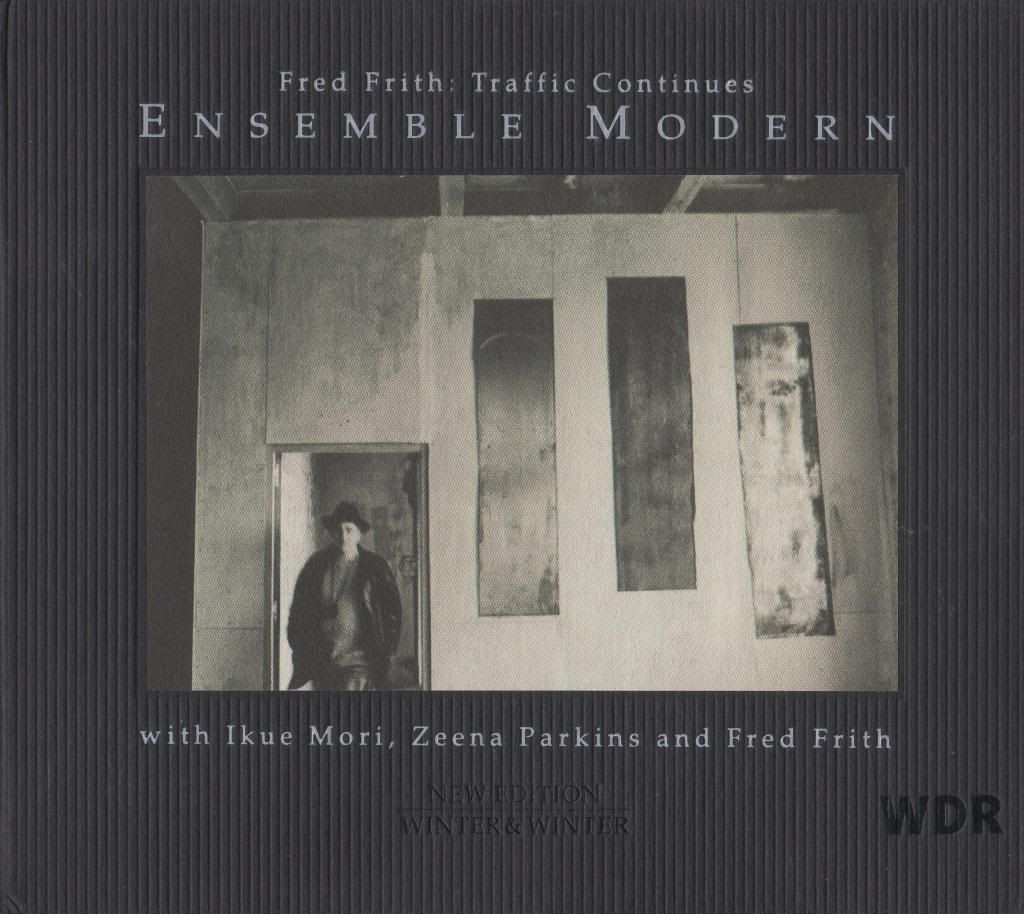
Fred Frith and Ensemble Modern: Traffic Continues


Although our man is credited as guitarist, this album plays more like a performance of Fred Frith compositions than it does like a "Fred Frith album," as we may have variously come to understand what they might sound like.  That said, the ensemble (which audibly sounds basically like classical instrumentation with a few subtle electronic elements) is fantastic, playing with virtuosity you'd expect from concert musicians, but also a zany freedom that firmly places them in a modern context.

To my ears the compositions start off very strongly with some brilliantly knotty orchestrations and a vaguely conventional harmonic aesthetic.  Evaluated through this type of lens, the disc loses some steam in the middle (around the beginning of "Traffic Continues II: Gusto", composed for and from audio samples of Frith's recently-deceased friend and Skeleton Crew bandmate, cellist Tom Cora) as it becomes more spare and quiet, then closes strongly with the final and longest track.  It may be true that the quieter bits require a different sort of criteria for evaluation and may succeed by those standards, but for me the act of readjusting what I'm listening for has so far proven frustrating to the extent that I'm usually left with a feeling that I just heard a recording with some great parts and some that merely passed me by.  I get the feeling that more effort could either yield more appreciation or a stronger sense that some of the writing is a bit too casual and reliant on free performances to carry the weight.  Either way, this is inarguably the kind of music you need to let act on you before imposing any kind of sweeping critical judgment.  Here's to more trying!

Get 'er.

Monday, September 10, 2012

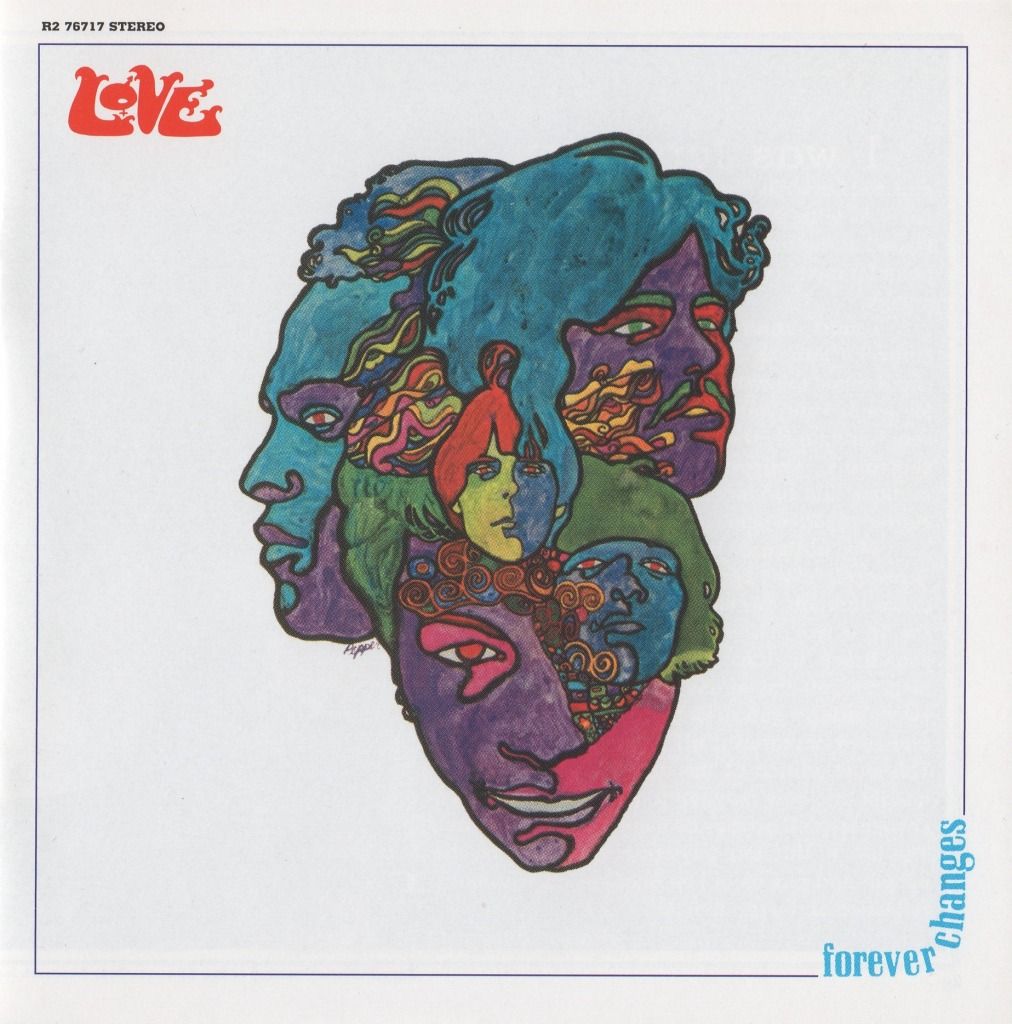
Love - Forever Changes


The past year has been so busy with recording and evaluating my own music that I've had much less time to listen to other people's sounds, which means I've focused a lot more on the "new" music I'm finding instead of revisiting old favorites.  When I do get around to albums I've heard many times, the experience is often quite illuminating.  Especially after doing so much critical evaluation of music on this blog, I sometimes realize that my "5 star" albums, upon relistening, aren't necessarily free from the kinds of things I might label as "flaws" in other music, and that ultimately, designating something "as good as it gets" rests on a certain feeling of affection or nostalgia toward the music, or at least an assertion that the great things in the music are so good that any "flaws" come across more as endearing idiosyncrasies.  In other words (and yet again), it's all subjective!  The fun part about analyzing music in writing is the disjuncture between personal preference and the fact that yes, we actually can (and should) identify and judge specific characteristics in the music that justify how "good" we say it is, but also that "good" will always be individual, and reading music reviews and blogs is ultimately most useful as a way of pairing others' tastes with your own to discover music you might enjoy. 

Forever Changes is one of those albums that winds up on innumerable critics' top lists, but has somehow kept a much lower mainstream profile in comparison with its contemporary "classics."  You never hear any Love songs on the radio or in movies etc., and you'll be lucky if you hear anyone talking about them outside of musicians and critics.  And yet, pick up Forever Changes and give it time to work its magic and you'll most likely understand why it quietly persists as a milestone in psychedelic folk-rock and as one of the best albums of the 1960's.

Like many great albums, Forever Changes is so great because it's often a bizarre combination of unquantifiable elements.  There's the fact that it's a much mellower affair than Love's previous two albums--the more garage-like electric sound of Love and Arthur Lee's aggressive vocal style on Da Capo mostly replaced by acoustic guitar and orchestral textures--and yet it's still insidiously edgy.  There's the album's unique twist on psychedelia, which often takes the form of hard-panned instrumental tracks (the nylon-stringed acoustic is so far to the right it's almost gone!) and brief additions of reverb as well as arrangement choices like having the background singers say a different word at the same time.  There's Arthur Lee's obvious magnetism as a front man, which twists together the role of a sort of tormented seer with a dark fragility, surprising poetic capabilities, an ability to distill the countless clashing emotions of the 60's into songs that are simultaneously emotionally gripping and ultimately ethereal, as well as being a larger-than-life historical legend, somehow more than fulfilling Da Capo's thwarted potential here but quickly unraveling into mental and artistic instability (he was reportedly sure his death was imminent during the creation of this album) in the following years--still capable of creating good music but never coming close to reaching the same level of insight (especially lyrically) repeatedly on display here.  And finally, in spite of Lee's dominant persona, there's the fact that the band was undeniably a collaboration, that Bryan MacLean's songwriting contributions and classical guitar contributions are as important to the album's success as any of the other elements, and that Lee's decision to disband the Forever Changes lineup soon after the album's release was a terrible blunder. 

The distinctive characteristic that most people note about Forever Changes is the inclusion of orchestral arrangements, especially prevalent on the MacLean numbers--the balance is sweet and delicate on "Alone Again Or," "Andmoreagain" and "Old Man," songs whose optimism counterbalance some of Lee's desperate worldview with detours into romantic euphoria.  Elsewhere, though, the strings and horns just as aptly provide a creepy, unsettling edge, as on the paranoid "The Red Telephone" and robotically closing "The Good Humor Man He Sees Everything Like This" (gotta love those Dylanesque 60's track titles), as well as brilliantly cathartic, as on the Latin-tinged "Maybe The People Would Be The Times Or Between Clark And Hilldale" (which boasts some of the album's most sly lyrical conceits, with expected rhymes interrupted by staccato horns only to appear to begin the next line...until the instrumental breaks, that is) and the transcendent album-closing "You Set the Scene."  The cleverest part of the delicate arrangements is how well the rock moments stick out--"A House is Not a Motel" sounds like the heaviest rock you've ever heard, despite the fact that at least half of the song doesn't even have electric guitar, and the solo on "Live and Let Live" is insanely scorching because there's nothing "hard" to compete with it.  Relistening I'm really surprised at how simple the arrangements actually are in comparison with the songs' complexity, usually consisting of just a standard two-guitar rock band with maybe a bit of piano and the aforementioned strings--the band's ability to make each part indispensable is a testament to the skill and care on display.

Lyrically, the album literally never lets up.  While it's often difficult to discern what exactly Lee is singing about in each song, the impressionistic moments paint a collectively awe-inspiring picture of urgent searching, resultant disillusionment, distress, cynicism and ultimately grasping a fleeting sort of brilliant something that makes it all worth it...a something that might just be the absence of alternatives.  Lee manages to toss out piercing one-liners right next to surreal scene-painting with the spontaneous force of a man possessed by something larger than his own conscious decision to create, and somehow manages to do so without completely slipping off the edge into incoherence.  Despite the fact that the album is so very 1960's, his struggle and observations about the world's contradictions can't help but still ring true.

Perhaps this is the only truly great album Arthur Lee had in him, but its quality does seem to justify its singularity.  Though it will likely always remain lauded but obscure, Forever Changes continues to humble me every time I revisit it--albums like this are something more than just old friends, comforting and diverting but always capable of teaching us something new.

Get it here.

Friday, October 14, 2011

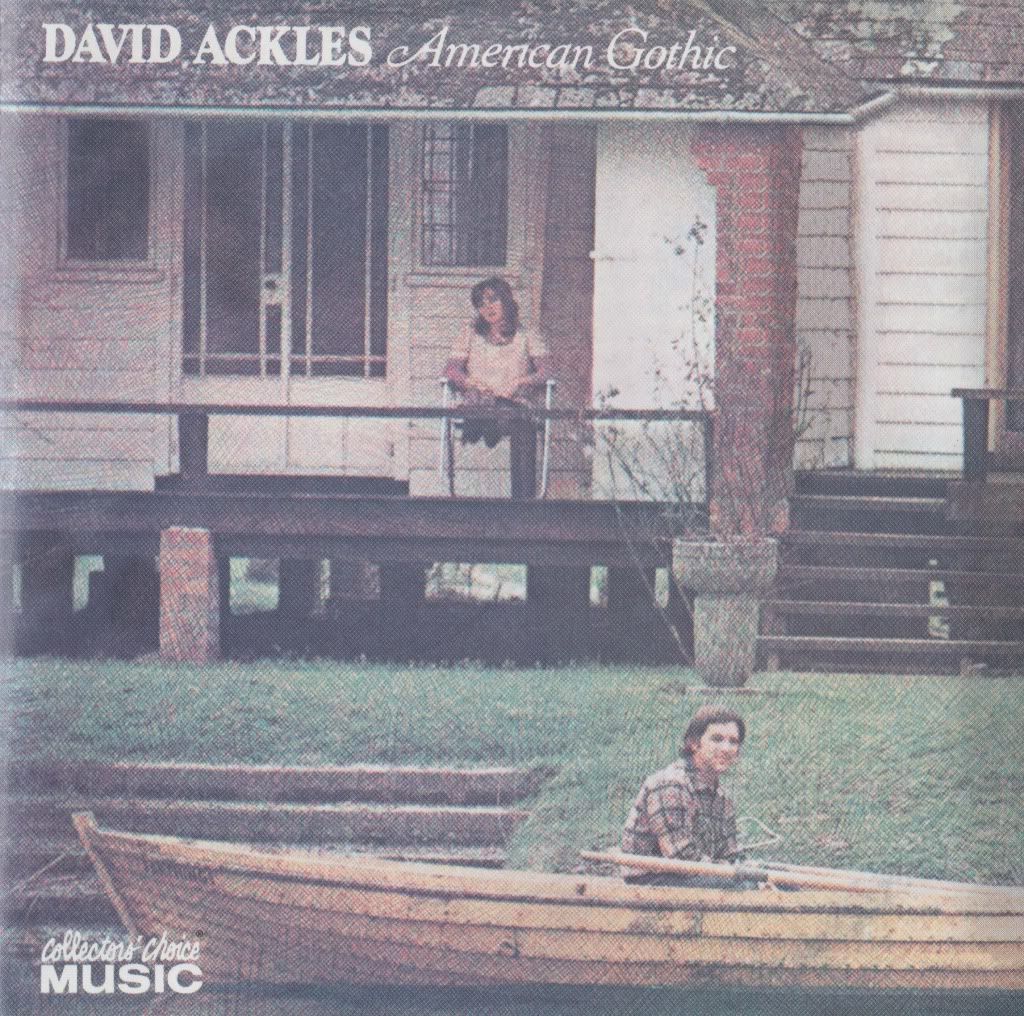
David Ackles - American Gothic


Continuing this week's re-re-refocus on singer/songwriters, here's something almost completely different.  Though he'd already released two full-length albums full of seedy, proto-Tom Waits character sketches by 1972, American Gothic is where David Ackles' unique and gritty vision reached full flower conceptually and musically.

As its title suggests, American Gothic is an attempt to paint a kaleidoscopic picture of American life (as he sees it) through a series of character narratives and internal monologues.  As sprawling a project as this may sound, Ackles manages to avoid the pitfall of overreaching in attempts to be all-inclusive by imagining himself quite snugly into extremely focused and well-drawn characters and situations.  From the title track's comically unhappy couple (a cuckolding wife who's true love is shoes and her porn-reading drunk of a husband) to the deliberate cheese of the traveling musician's "One Night Stand" to the choking malaise of Vietnam's effects on American society ("Ballad of the Ship of State") to a brilliantly succinct summation of the "Oh, California!" mentality with "Let's be happy until the sun goes out" to the blithe ignorance to the Native American experience on "Blues for Billy Whitecloud" to the touching rumination on the all-too-characteristically-American divorce rate in "Waiting for the Moving Van," Ackles proves his skills as an insightful and subtle songwriter again and again.  It seems at least part of his greatness rests in his ability to balance mordant wit and cutting appraisals with genuine heart, empathy and a constantly evident love for the totality of what he sees as American life, as especially evidenced on the desperate, cathartic redemption of "Another Friday Night" and a respectful exploration of communal religious music experience on "Family Band."

What unmistakably sets this apart from most of the singer/songwriter material I've shared is the music--there's barely a guitar in sight on American Gothic, with Ackles playing his own quite accomplished piano parts aided by a not inconsequential amount of orchestration--in comparison with the other two orchestrated albums I've discussed this week, Ackles' work reveals another distinct aspect of the practice--though his songs would easily stand alone with piano and voice arrangements, the style of the music almost necessitates a wealth of other instrumental textures.  Using a near-encyclopedic lexicon of musical styles, Ackles imbues his songs with jazz, rag, R&B, classical, gospel, folk and pop elements, occasionally within single songs ("Midnight Carousel").  As such, there are few other contemporary singer/songwriters to compare him with--while there's a similarity to Randy Newman and Ackles obviously paved the way for the tears-in-the-beer antics of early Tom Waits, his sincerity sets him apart from Newman and it's clear he isn't trying quite as hard to contrive a persona as Waits has.  In some ways, Ackles songs play more like musical theater--the American musical style blending of Rodgers and Hammerstein driven by some of the darkness of Brecht/Weill all funneled through Ackles' powerful, distinctive and closely-controlled (if often cigarette-husky) baritone.  I think the fact that Ackles' chosen style has little precedent in the pop music world (not to mention the fact that most people, on hearing it, associate it with musical theater and quickly dismiss it) obviously consigned this album to continued obscurity.  Even many of today's relic hunters seem quick to write off the album based purely on a lack of understanding of Ackles' stylistic choices--it's not like they're offering similarly-arranged music they think is better. 

Part of the reward of stretching to meet this album halfway is keeping in mind that not all artistic pop music has to fit the rock template that's dominated since the late 1950's--once you accept that Ackles' primary aesthetic compass is one that dates back to a time when the blaring horns and abrupt theatrical chord changes were actually a part of the public's conception of pop music, it's appreciable how well he manages to seamlessly update those building blocks to (1972) modern times and fill the spaces with a mature artistic vision.  This is probably best exemplified in the majestic and brilliant album-closing "Montana Song," which tells a multi-generational American family's story across Copland-influenced orchestral arrangements and a narrative that sums up the classic American life adventure against the starkness of nature, bound together only by the bonds of family, eventually complicated by the progress of time and children's new adventures, and finally resolved by the great-grandchild's connection with the distant context of his modern life.  Though it takes some effort to reset your ears' expectations to Ackles' willfully non-pop style, the effort is well worth it for a prolonged glimpse into the man's vision of American life past, future and his somehow even more diverse, limitless present.

Wednesday, October 12, 2011

Roy Harper - Valentine


You know you're in a good place artistically when you're pumping out massive, sweeping epics every couple of years and still find you have enough shorter, less ambitious songs coming out of your pen to collect another entire album without even having to try.  Roy Harper was in such a situation in 1974, coming off of a couple of conceptual beasts in 1971's Stormcock and 1973's Lifemask and realizing he'd amassed enough unrelated but equally strong material in the meantime to release an album of (mostly) love songs--1974's Valentine.

The fact that a spread of songs dating as far back as the mid-60's succeeds so well comes undoubtedly by the grace of the unstoppable roll Harper was on in the mid-70's.  Still in the continual process of honing his individualistic acoustic singer/songwriter-cum-absurdist rock experimenter style, it's clear on Valentine that there were plenty more song experiments and odd ideas yet to go before the well ran dry--indeed, with his move to a more rock centered style on 1975's HQ, Harper moved on before having to scrape the bottom of the barrel.

In Valentine we get the classic Harper blend of tenderness ("I'll See You Again," an update of his debut's "Forever,"), belligerence ("Male Chauvinist Pig Blues," "Che"), comic vulgarity ("Magic Woman Liberation Reshuffle") and spaciness ("Twelve Hours of Sunset," "Acapulco Gold"), all tied together by an ever-present sense of human searching in things both musical and lyrical.  While I know this schizophrenic aesthetic can be disorienting for Harper newcomers, it's the unflinching honesty that brings the converted back again and again.  In fact, it's often in the songs in which more than one of these contrasting moods are juxtaposed that Roy produces his most compelling tension--the lilting folk psychedelia of love song "Forbidden Fruit" belies the reality that, save some ambiguity regarding the narrator's age, it's about pedophilia (a fact the song's beauty makes fittingly all-to-easy to ignore).  The lush, well-paced "I'll See You Again" places the songwriter's compassion at odds with his stubborn pursuit of his own path, shading a hurtful move with obvious deep consideration.  The perennial live favorite "Commune" achieves this contrast perhaps best of all, with Harper exposing love's complexity through his own fickleness, gradually softening the chorus from "And love is my torment/And I'll take when I can/But I'll give in the moment/When you are my woman and I am your man" to "And love is no torment/For we'll give when we can/And we'll live in the moment/When you are my woman and I am your man" and finally altering the final line to "And we'll live for the moment/When she is my woman and I am her man," somehow using a few short words to subtly lay bare the simultaneously selfish and selfless act of reaching out that lies at the heart of love.  Oh, let's not forget that the same song also combines Harper's inclination for bodily imagery (enough to make many listeners squirm) with one of his most gloriously distinctive fingerstyle pull-off laden guitar riffs.

In light of my recent complaints against less refined attempts at adding orchestration to pop music, I want to make special note of the contributions of recently-deceased English composer and conductor David Bedford.  Appearing on a select handful of tracks, Bedford's arrangements are the quintessence of sympathetic--they swell with strings and blaring brass on the aforementioned "I'll See You Again," lending added drama but also harmonically enhancing Harper's vocal melody.  Repeating string figures rhythmically punctuate the guitar part on "Commune" without ever obscuring it, tonally enhancing the lyric's nature imagery and adding variation to the repeating guitar part.  Harper's version of "North Country" possesses a polish Dylan never matched, and the strings again swoop below, above and around the polytonality of his guitar line, their liquidity contrasting the more percussive sound of a fingerpicked guitar and at other times emphasizing Harper's naked guitar and vocals with judicious application of one of the most important (yet underutilized) tools in every musician's box--silence.  Finally, the arrangement collaboration between Harper and Bedford on the immortal "Twelve Hours of Sunset" produces some of the most spine-tinglingly beautiful moments I've ever heard, as Harper's multi-tracked vocal arrangement explores extended harmony while Bedford employs French horn and dissonance with more strings to funnel tension into the song's hair-raising dual crescendos.  Bedford's respect for Harper's songs and his crucial intuitive understanding of the colors his instrumentation contributes take these hallowed additions to the Harper songbook and elevate them even further.  In answer to the two orchestration-related questions from my last review, "yes," the songs work without the orchestration, and "yes," each and every added element enhances the song with distinctive character (there's virtually no excess in Bedford's instrumental choices or part writing), which seems to be the ideal outcome in all ways.

Aside from these canonical contributions, Harper also gives us a generous helping of his inimitable coarseness in "Male Chauvinist Pig Blues" and "Magic Woman Liberation Reshuffle," both of which experiment with electric guitars, rock arrangements, and what could politely be referred to as "contentious" attitudes toward monogamy and feminism (it wouldn't be a classic Harper album without some controversy).  "Acapulco Gold" combines Harper's love for dope with a rare vocal jazz piano arrangement, while mostly instrumental dedication "Che" successfully stretches Harper's formidable guitar skills into the Spanish realm with some of his best guitar playing on tape.  All in all, Valentine is often overshadowed by Harper's more ambitious 70's recordings, but its charms lie in the subtlety and quality of its somewhat more conventionally-constructed songs.  Once you've had a taste of singer/songwriter material that's this varied and deep, it's hard to settle for anything less.

Buy it from the artist.

More Roy Harper.