Showing posts with label Roy Harper. Show all posts
Wednesday, October 12, 2011
Roy Harper - Valentine
You know you're in a good place artistically when you're pumping out massive, sweeping epics every couple of years and still find you have enough shorter, less ambitious songs coming out of your pen to collect another entire album without even having to try. Roy Harper was in such a situation in 1974, coming off of a couple of conceptual beasts in 1971's Stormcock and 1973's Lifemask and realizing he'd amassed enough unrelated but equally strong material in the meantime to release an album of (mostly) love songs--1974's Valentine.
The fact that a spread of songs dating as far back as the mid-60's succeeds so well comes undoubtedly by the grace of the unstoppable roll Harper was on in the mid-70's. Still in the continual process of honing his individualistic acoustic singer/songwriter-cum-absurdist rock experimenter style, it's clear on Valentine that there were plenty more song experiments and odd ideas yet to go before the well ran dry--indeed, with his move to a more rock centered style on 1975's HQ, Harper moved on before having to scrape the bottom of the barrel.
In Valentine we get the classic Harper blend of tenderness ("I'll See You Again," an update of his debut's "Forever,"), belligerence ("Male Chauvinist Pig Blues," "Che"), comic vulgarity ("Magic Woman Liberation Reshuffle") and spaciness ("Twelve Hours of Sunset," "Acapulco Gold"), all tied together by an ever-present sense of human searching in things both musical and lyrical. While I know this schizophrenic aesthetic can be disorienting for Harper newcomers, it's the unflinching honesty that brings the converted back again and again. In fact, it's often in the songs in which more than one of these contrasting moods are juxtaposed that Roy produces his most compelling tension--the lilting folk psychedelia of love song "Forbidden Fruit" belies the reality that, save some ambiguity regarding the narrator's age, it's about pedophilia (a fact the song's beauty makes fittingly all-to-easy to ignore). The lush, well-paced "I'll See You Again" places the songwriter's compassion at odds with his stubborn pursuit of his own path, shading a hurtful move with obvious deep consideration. The perennial live favorite "Commune" achieves this contrast perhaps best of all, with Harper exposing love's complexity through his own fickleness, gradually softening the chorus from "And love is my torment/And I'll take when I can/But I'll give in the moment/When you are my woman and I am your man" to "And love is no torment/For we'll give when we can/And we'll live in the moment/When you are my woman and I am your man" and finally altering the final line to "And we'll live for the moment/When she is my woman and I am her man," somehow using a few short words to subtly lay bare the simultaneously selfish and selfless act of reaching out that lies at the heart of love. Oh, let's not forget that the same song also combines Harper's inclination for bodily imagery (enough to make many listeners squirm) with one of his most gloriously distinctive fingerstyle pull-off laden guitar riffs.
In light of my recent complaints against less refined attempts at adding orchestration to pop music, I want to make special note of the contributions of recently-deceased English composer and conductor David Bedford. Appearing on a select handful of tracks, Bedford's arrangements are the quintessence of sympathetic--they swell with strings and blaring brass on the aforementioned "I'll See You Again," lending added drama but also harmonically enhancing Harper's vocal melody. Repeating string figures rhythmically punctuate the guitar part on "Commune" without ever obscuring it, tonally enhancing the lyric's nature imagery and adding variation to the repeating guitar part. Harper's version of "North Country" possesses a polish Dylan never matched, and the strings again swoop below, above and around the polytonality of his guitar line, their liquidity contrasting the more percussive sound of a fingerpicked guitar and at other times emphasizing Harper's naked guitar and vocals with judicious application of one of the most important (yet underutilized) tools in every musician's box--silence. Finally, the arrangement collaboration between Harper and Bedford on the immortal "Twelve Hours of Sunset" produces some of the most spine-tinglingly beautiful moments I've ever heard, as Harper's multi-tracked vocal arrangement explores extended harmony while Bedford employs French horn and dissonance with more strings to funnel tension into the song's hair-raising dual crescendos. Bedford's respect for Harper's songs and his crucial intuitive understanding of the colors his instrumentation contributes take these hallowed additions to the Harper songbook and elevate them even further. In answer to the two orchestration-related questions from my last review, "yes," the songs work without the orchestration, and "yes," each and every added element enhances the song with distinctive character (there's virtually no excess in Bedford's instrumental choices or part writing), which seems to be the ideal outcome in all ways.
Aside from these canonical contributions, Harper also gives us a generous helping of his inimitable coarseness in "Male Chauvinist Pig Blues" and "Magic Woman Liberation Reshuffle," both of which experiment with electric guitars, rock arrangements, and what could politely be referred to as "contentious" attitudes toward monogamy and feminism (it wouldn't be a classic Harper album without some controversy). "Acapulco Gold" combines Harper's love for dope with a rare vocal jazz piano arrangement, while mostly instrumental dedication "Che" successfully stretches Harper's formidable guitar skills into the Spanish realm with some of his best guitar playing on tape. All in all, Valentine is often overshadowed by Harper's more ambitious 70's recordings, but its charms lie in the subtlety and quality of its somewhat more conventionally-constructed songs. Once you've had a taste of singer/songwriter material that's this varied and deep, it's hard to settle for anything less.
Buy it from the artist.
More Roy Harper.
Thursday, April 7, 2011
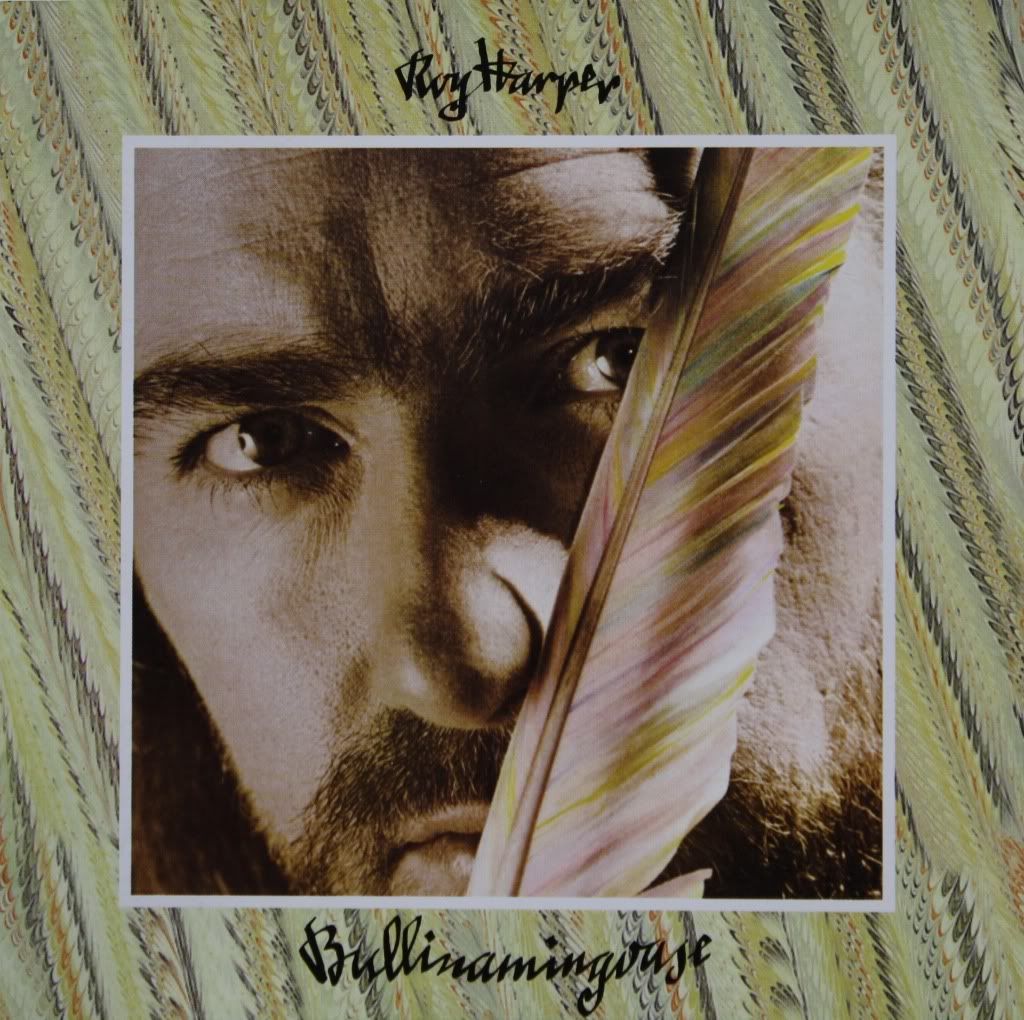
Roy Harper - Bullinamingvase
Bullinamingvase (apologetically titled One of Those Days in England for the US release) is Roy Harper's last album of the 1970's as well as his last truly great album for at least eight years (or more, depending on whose opinion you're hearing). Like HQ before it, this album delves further into a full band sound with slight progressive and psychedelic flourishes. Although the band is different and a bit less distinctive (no more Bill Bruford or Chris Spedding, unfortunately), the production is probably even more diverse than HQ's and the overall flow is smoother and more coherent--the album succeeds because Harper's songs exemplify the things that made his earlier works unique while at the same time entering territories as yet untrod by the the songwriter.
Listening to the "One of Those Days in England (Part 1)," it's hard to imagine the track was only worked up at the behest of the label in order to provide a single for the album--though the words are light, the song (in addition to being catchy with a great steel guitar riff and Paul and Linda McCartney on backing vocals) establishes a dreamy, wistful tone that permeates much of the album, not to mention the fact that it first introduces the melodic theme that will return several times in the song's later parts. "These Last Days" is a fascinating Harper song to which I find myself continually returning. In it the oft-indignant singer takes on a tone of acquiescence, singing "we might have to take the world the way we've made it"... "I'm not sure that any side is right/any side." The subtly jazzy harmony of the music is suitably narcotic for the song's message, and the final lines "Some of us ain't satisfied with less than any universe/Well hell I'll have to go along with that, 'cause I've got mine" eerily predict the self-absorbed malaise that seems to have stifled any chance at an efficacious counterculture movement in the 30+ years since the song was recorded.
"Cherishing the Lonesome," a hopeful love song is another favorite, with a dynamic arrangement that showcases Harper's inimitable fingerstyle guitar but also crescendos into a progressive full-band arrangement with overdriven electrics and some well-placed xylophone. "The Naked Flame" (a perpetual live performance survivor) is country-tinged with more steel guitar, recounting a dissolving relationship with some more great lines ("I can't believe we'll just exist/as figments of each other's past"), while the absurdly irreverent "Watford Gap" is a hoe-down singalong that rips the shit out of a roadside diner often frequented by touring bands. After listening to some of the lines ("the city's like a goolie in a groupie's stagnant womb," par example) it's easy to tell why early versions of the album excised the track for fear of legal reprisals. No one can accuse Roy of completely abandoning controversy despite this being one of his more meditative outings.
Of course, the sidelong "One of Those Days in England (Parts 2-10)" is the album's crown jewel--the pinnacle that the rest of the album's formidable poetry hints at. Harper's last great epic is suffused with English mythology, imagery and history and glows with sentimental passion. Harper employs parallel structure to simultaneously consider his changing homeland as well as the nature and trajectory of the human race and the passing of time. Throughout, Harper's humanistic outlook is at its most compelling, tempering his fire with the salt and wisdom of life experience, along with some vivid recollections of early-40's England. Where numerous singer/songwriters fail to provide interesting arrangements when playing in a full-band setting, Roy adorns his core voice/guitar nucleus with some great piano, a bit of harp, and plenty of (relatively) hard rock interludes and varying tempos and textures.
Though the songs on this album are geared toward a full band setting, Harper's at heart an intimate character--the songs play equally well in an all-acoustic setting, and the backing band is never the center of the show the way it almost was at times on HQ. Still, the production Roy was granted by EMI and Harvest is undeniably high-class, demanding that the music be taken seriously by simply sounding good. Not a lot of madcaps of Roy's stripe had so many opportunities to fully realize their musical visions, especially not at the end of the 1970's, and Bullinamingvase makes good on the investment (well, artistically, if not especially commercially, though I think the album performed fairly well in comparison with Roy's other releases). Though Roy's later career has had numerous peaks, Bullinamingvase is his last big success with a big label, fully utilizing the professional support without the bitterness or dodgy production judgment that would follow on The Unknown Soldier and Commercial Breaks.
You can buy it from Roy here, or here
Friday, February 18, 2011
Roy Harper - Flat, Baroque and Berserk
Roy Harper's one of my all-time favorites, but that doesn't mean I think he's got a Midas touch. Part of the reason why I love his music so much is because he wears his flaws on his sleeve--in many ways, he's made a career out of artistic as well as professional self-sabotage, always ready to nosedive with erratic behavior when a big break was on the way, and always quick to follow up an incisive gem of a song with a lewd throwaway. Really, he's just like any of the rest of us, he just exemplifies what it means to be human to the utmost degree--the peaks of his greatness are shadowed equally by the troughs and valleys necessary to achieve that success, and the evidence is there in his songs and public personality for us all to see. Part of great singer/songwriter music is coming to understand the person's deep personality, and Harper's got it in spades. Like Robbie Basho, though, it's not always easy to hear and a lot of listeners have been turned off by his unflinching honesty. As a songwriter, I think there's a lot to learn (obviously) from Harper's style as well as from his creative path--how his strengths have played out over a career and whether each of his experiments and artistic overreaches were worth the risk on principle alone, or when it's time to exercise restraint. Then again, you can't win if you don't play.
Flat, Baroque and Berserk is Roy Harper's fourth album, and to me it's his first unqualified artistic success. There are serious kinks in the first couple records with respect to production, focus and just how effectively his message is communicated, and the same can be argued of Folkjokeopus, but the blinding success of "McGoohan's Blues" still stands as a Harper classic and his first long-form triumph. Here those issues seem to melt into the ether--gone is the dainty lo-fi folk rock of Come Out Fighting Genghis Smith (it's almost all acoustic guitar here, with the occasional acoustic wind instrument and one hard-rocker to break up the monotony), and the poetic confusion from Folkjokeopus' is trimmed away, leaving multifaceted yet economical poetry sung with Harper's very last breath--or so it would seem.
The instrumental arrangements are much simpler, showing off Roy's best guitar playing since his debut. Snapshots like "Feeling All the Saturday," "Davey" and "Francesca" show a quietly intense mind working through mortality, aging and the (sometimes welcome) consequences of free love, and they're buoyed by Harper's distinctive fingerstyle. Of course, his flatpicking style is equally as idiosyncratic, as we hear on the Jesus/Judas dialogue "Don't You Grieve" and the valedictory kiss-off, "Goodbye." Even after all these years, the poetry on this disc still tantalizes--the inter-verse rhyming on "How Does it Feel" is fantastic, and there are numerous moments where he effortlessly pierces the shroud--a favorite of mine happens in "Tom Tiddler's Ground": "And you heard me say yes, but you know it's a guess/ Somebody else shouted 'No!'"
Yes, I'm aware I haven't even mentioned the obligatory mentionables--the gloriously ballsy "I Hate the White Man" was sort of an albatross around Harper's neck for years (listen to pretty much any live album to hear cries of "White Man!" from the audience). Then there's the painful, smoldering resignation of "Another Day," graced by a really grand David Bedford string arrangement that prefigures his crucial contributions to Stormcock and Valentine. Then, of course, the album closes with a hard rocking bang in "Hell's Angels," where Roy's backed by (of all bands) The Nice (ugh...Keith Emerson...shudder). While it's not quite as controversial as he may have intended, it's still a totally jarring close to a meditative album (see paragraph one) and his uncontrollable stoned laughter lets us know that the ride's only just beginning.
Flat, Baroque and Berserk has a few less memorable moments ("Song of the Ages" in particular), but overall it's a pillar of the Harper discography and a refreshing album to return to when you want the good stuff but not the pomp of his mid-70's output.
Get it here, direct from the artist, or here
Subscribe to:
Posts (Atom)