Showing posts with label Improvisation. Show all posts
Monday, September 26, 2011
Fred Frith - Clearing Customs
For the first of three 2011 releases I'm reviewing this week I've chosen a new album by an old hand--Fred Frith, an artist who's already popped up here in numerous places as a solo artist, band member and producer. I can think of few artists more prolific than Frith, who continues to improvise and compose with unabated verve at the age of 62. This album is a collaboration between Frith and six other musicians--Wu Fei on guzheng (zither) and vocals, Anantha Krishnan on Indian hand drum and tabla, Marque Gilmore on drums and electronics, Tilman Müller on trumpet, and Patrice Scanlon and Daniela Cattivelli, both on electronics. The disc contains one track--the 68 minute-long title track, which is based on a graphical score written by Frith and with a stated purpose of bringing together artists of diverse and unrelated backgrounds into a functioning, communicating performing unit.
Unsurprisingly, Clearing Customs unites Frith's modern classical compositional approach with not only free improvisation but also his predilection for rock and folk. As a large, extended composition, it's also unsurprisingly opaque on the first few listens, though the compositional elements and structure is evident and unfolds more and more with each revisitation. Overall, I think the atmosphere is best described as moody; the most dominant aspects to my ears are the sounds of the zither and the computer elements, both of which account for a large part of the album's spacious feel. The proceedings begin promisingly, with gently pulsing synth sounds and a (real or sampled?) ping pong ball bouncing. Fractured beats soon enter the picture along with some typically Frithian clusters of guitar squeals and atonal cries from the other instruments. After six minutes or so, a somewhat odd pace becomes apparent and persists for the duration of the piece. Generally speaking, things flow viscously between spurting free improvisation, solo showcases for each instruments, and a gently throbbing returning minor motif.
While the idea of a graphical score is a thought-provoking one, my first thoughts are "Will it actually sound audibly different from a conventional score, and will it make a difference?" After getting to know the album, it's difficult for me to say that there's anything inherently distinctive (audibly) about Frith's graphic score, but I don't mind--if the unconventional scoring method provides the musicians with enough direction and inspires their playing, I don't see why it shouldn't be employed as a tool. That said, it's safe to say that this particular graphical score didn't create some unheard-of new kind of music for the first time ever. Aside from the sultry mood, the music this album most reminds me of is Frith's own Traffic Continues orchestral collaboration, though his ensemble here would be more considered a "chamber" group. In fact, it's rather reminiscent of a lot I've heard from later-period Frith, inasmuch as it's organized longform and sandwiches frantic blurts along with quieter sections, utilizes repetitive ostinati figures quite a bit, and includes fragmented but undeniable melodicism. While this approach seems to reliably produce some great ideas from Frith and his collaborators, I think it almost always shows the demonstrable weakness of coming across as too inclusive--like the kind of painting that has piles and piles of paint, albums like this seem to always have a scattershot feel, with compelling ideas and textures juxtaposed starkly against less effective occupation of time and less strong ideas or ones that don't gain traction in the context provided. For that reason, these kinds of pieces can be a frustrating hybrid between improvised and scored music that offers less in the way of free improvisation's pure intuitive musicianship and elemental sound presentation as well as less in the way of the focus provided by careful composition.
There is, however, a lot to like about this--Frith's guitar is in fine form, both percussively and in his signature distorted lead, the zither and percussion add distinctively ethnic timbres to the mix, and some of the beats add a lot of richness and energy to what would otherwise remain more of a chill-out set. The main melodic theme is an attractive one, making use of a descending minor scale and spreading the line across multiple instruments--later in the album (I think in general things get strongest about 3/4 of the way in, especially right around the hour mark with some sweet grooves) it really flowers into full development. I'm not completely sold on all of the electronics; they sometimes verge on cheesy with bursting, blaring samples and obviously computer-generated beat loops (some of the settings are clearly recognizable from groups like Radiohead, while others much more satisfyingly conjure Keith Rowe-like electroacoustic signal manipulation). In all, I think my unease is due to their tendency to create a sterile, tinny and unorganic atmosphere that clashes with the very organic principles behind free improvisation; it seems like the more actual instrument-playing there is, the more alive and breathing the music seems. At best, though, the electronics (and especially their combination with the trumpet playing) conjure the sort of twitchy mystery that Supersilent has progressively explored more and more.
Clearing Customs might not be the most satisfying or efficient experience, nor is it Fred Frith's finest hour as a composer or performer, but it does provide enough substance to be worth the purchase and time spent listening. The album's mission statement is rather lofty, but the results are never really as transcendent or culturally gulf-bridging as the CD text would have you believe. Though Frith has succeeded at incorporating musicians of diverse backgrounds into a functioning ensemble, the "diverse" characters seem to come together anticlimactically--only to produce sounds under the banner of Frith's already-established musical vocabulary and palette of ideas, demonstrating the unfortunate reality that disciplined and capable musicianship doesn't always come hand-in-hand with interesting ideas and vision. Luckily Frith's got both, and so his quirks and idiosyncrasies (most of which he's already developed best and stated elsewhere in his prolificacy) creatively dominate the proceedings. Though some of the longer twiddly passages may, on close familiarity and examination, ultimately prove vacant of any special ideas (which perhaps has to do with that ineffable quality that separates the best free improvisers with those who are simply valiantly attempting), giving this album space, attention and more and more plays has only improved my listening experience and I hope to view it with increasingly (if incrementally) higher regard as an agreeable, if small and inessential, pleasure.
Get it here.
Tuesday, June 21, 2011
Aksak Maboul - Un Peu de l'Âme des Bandits
After a week that saw reviews for Brazilian pop, 60's folk and French pop, I feel it's time to travel back out into the...beyond. There's so much to say about this album, Belgian group Aksak Maboul, and RIO (Rock In Opposition) that I almost don't know where to start--let's begin with RIO. Rock In Opposition, though it's sometimes loosely used as a genre tag, was originally actually a festival organized by British group Henry Cow (with especial effort on the part of drummer Chris Cutler) in order to promote avant-garde rock groups selected by Cutler (eight in total) that were receiving little to no support from commercially-minded record companies. Though the movement was short-lived, it garnered a fair amount of press for the groups and, more importantly, facilitated the release of some of the most challenging progressive music produced throughout the 1970's and beyond. Since the loose movement became inactive in the 1980's, you're more likely to hear RIO referred to as a music genre used to describe either music that members of the original RIO groups have made, or music that is similar to, for example, Henry Cow's--dense, avant-garde, forward-looking, often with healthy doses of modern classical and jazz influences, though I personally don't find the tag to be the most helpful.
Belgian group Aksak Maboul was part of the second group of artists invited to RIO and was primarily the project of Marc Hollander (previously of CoS and founder of record label Crammed Discs). Aksak Maboul's 1977 debut was much more of a solo effort, with Hollander playing most of the instruments (a lot of keyboards, wind instruments and drum machines)--it's a playful, eclectic and enjoyable outing, but not today's album! In 1980, Hollander was joined by Henry Cow alumni Fred Frith and Chris Cutler and a few lesser-known European musicians for this, "their" second and final album. Though Aksak Maboul wasn't an original RIO group, I picked this album to introduce RIO because it's one of the most consistent, representative, and simply best RIO has to offer.
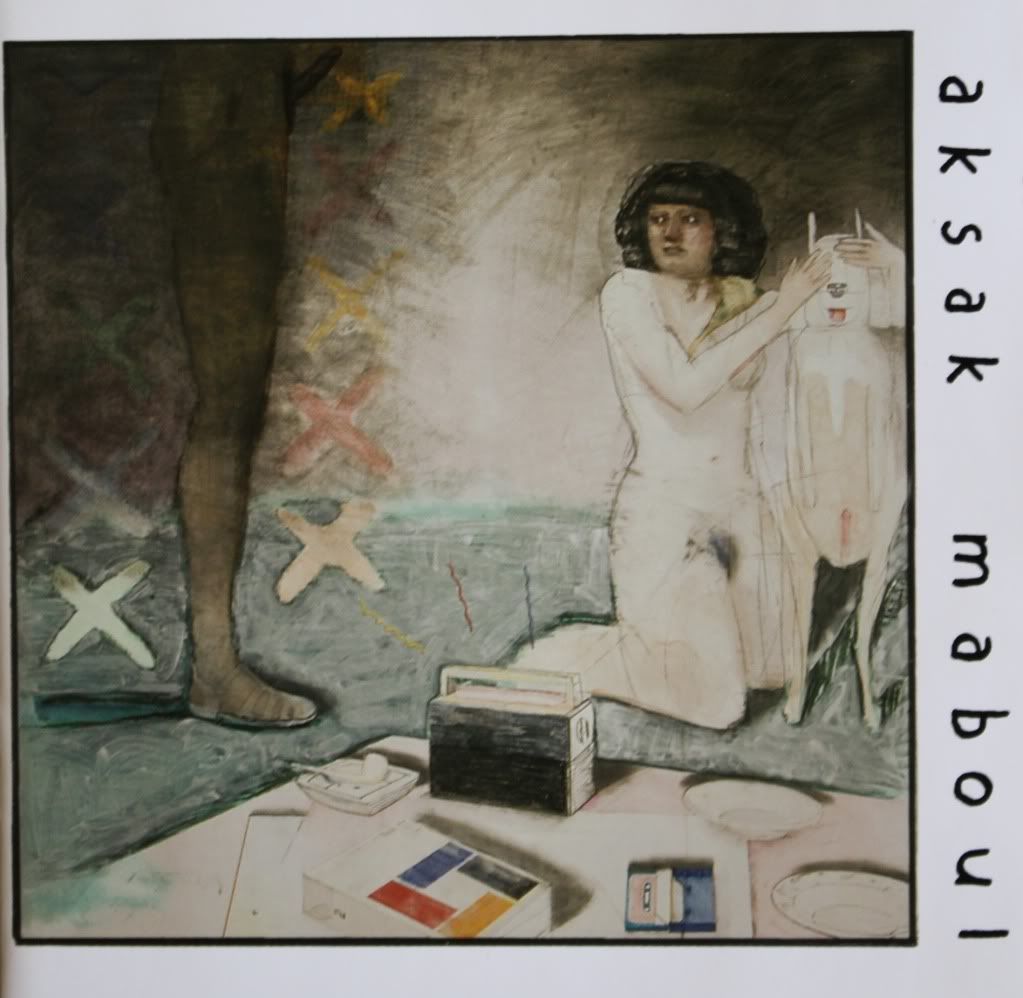
You know (or at least hope) from the ridiculous cover (depicting no fewer than two erections) that this album is going to be a crazy trip, and it certainly doesn't disappoint. Personally, I find this album extremely satisfying because of the experimentation--most all of the songs are based on at least one describable experiment, and the results are not only challenging, they're often quite listenable. A great example is the opener, "A Modern Lesson" (please, oh please, watch the video), which manages to deconstruct a classic blues riff with dissonance, drum machines, and wacked-out female vocals in under 6 seconds. As the track progresses, the wind instruments enter (along with some pinball machine recordings) for an interlude, the main riff returns, then the bass and tempo increase and Hollander's electronic keys and Frith's detuned guitars amp up the energy for a driving finale that sees an incredibly complex wind/key/string arrangement brimming with head-spinning counterpoint and--what elevates this beyond similar attempts--a memorable melody. "Palmiers en Pots" radically switches gears with a tango supposedly composed of (get this) pieces of several popular tangos, cut up with scissors, rearranged, and performed in random order.
That Fred Frith was on an unstoppable roll in the early 1980's, I'll never deny--his fingerprints (as musician, composer and producer) are all over this album, and in some ways it's better than its Frith solo contemporaries as his ideas (some heard already heard on other albums) are supplemented and developed by other musicians. Though the resulting disc doesn't exude quite as much of Hollander's personality as the Aksak Maboul debut, its diversity is one of its greatest assets--"Geistige Nacht" features a frantic sax-led melody with some great free jazz soloing in which the sax and eventually Frith's guitar trade squawks, and "I Viaggi Formano La Gioventu" features a snaking Middle-Eastern melody doubled on wordless vocal, violin that's strongly reminiscent of Frith's other 80's work, though that handclap track buried in the mix toward the end of the song shows up again on Cheap At Half the Price's "Absent Friends." "Inoculating Rabies" is probably the second best experiment on the disc, blending a balls-out punk riff driven by Frith's and Cutler's unfettered noise with the addition of a delicate woodwind arrangement. It's probably the best (if not only) progressive commentary on and appropriation of the burgeoning punk movement I've heard so far, which, by 1980, had all but swallowed what little market experimental progressive music like Aksak Maboul might have cornered. It's pretty ironic how loud Frith, bass and Cutler get considering how "obsolete" punk supposedly made their musical contributions.
The 23-minute-long "Cinema" rounds out the album with long-form composition interspersed with free improvisation (there's a lengthy and wicked cello solo as well as a pretty epic Fred Frith guitar solo), recording collage, a recurring sinister-sounding theme, some really heavy jamming from the full group (Cutler's drumming here is the liveliest I've heard since Henry Cow's last album, and recently, too). The melodies and ideas aren't quite as immediate as they are on the shorter songs, but the added space allows the group to accomplish some things that it couldn't in five minutes, and it gives us more to uncover on later listens. Pieces like this often seem to divide the camp of potentially interested listeners--take longer than five or six minutes and some people will complain about having their time wasted. If there are enough different ideas being developed, though, I don't mind it taking a while--as much as I'm leaning toward shorter songs packed with briefly-stated ideas these days, I can appreciate a piece that actually allows listeners to engage with and unravel the ideas being presented during the piece, rather than after numerous plays. While Hollander's personality is somewhat obscured by the thickness of the production and arrangements, it's perceptible on repeated listens, especially if you've heard his earlier works. I really enjoy his mechanical-sounding drum machines and keyboard lines, not to mention his contributions to the horn sections. Let's hear it for RIO, and this week let's keep going down the rabbit hole.
Available here on CD
Thursday, March 24, 2011
Taj Mahal Travellers - August 1974
Taj Mahal Travellers has nothing to do with American blues rock, or anything to do with the Indian mausoleum, for that matter--they're Japanese. This is another great example of music that should not be judged by traditional aesthetic standards as well as a good comparison/contrast to the AMM album I wrote about earlier this week.
The particulars of this music are actually easy to describe--few instruments are usually playing at the same time, there's little in the way of tonal development, and it's quite repetitive. Though each track fades out at the end, it appears to be a continuously-recorded performance. The backbone of the group's sound is drone; the recording moves incredibly slowly and deals with huge blocks of tone. For instance, at the album's outset the main drone is a bowed electric guitar, which plays more or less continuously on the same note while hand percussion, wooden xylophone, synthesizer, some sort of brass instrument, harmonica and voices all fade in and out. The instruments make and repeat short statements, or they let loose long threads of tone, layering with the guitar (for now) into the texture of the overall drone. Add to the list of instruments a few traditional Japanese instruments and a violin and you've basically got the sonic palette for the whole album, and it's a double.
Yes, it's easy to describe what's being done for over 80 minutes worth of music, and yet, when it comes to describing just why this album is so righteously awesome, the right words just can't be found. Though the style of music is totally different, on one level this album is strongly reminiscent of Miles Davis' On The Corner. At any given time, there aren't really that many instruments playing, but if you pay attention you start to notice that an instrument will appear in the mix, hang around for a few minutes then fade out just as delicately as it originally appeared, contributing a texture or color to the sound without altering the overall mood. After a while, though, you might notice that none of the instruments that were playing 20 minutes ago are still playing. The overall mood and quality of the sound moves similarly, changing slowly and subtly but hitting a few fairly distinctive areas over the course of the album. My favorite passage happens about a third of the way through the second track, where the layered wordless voices and dulcimer-like Japanese folk instruments reach a soaring, epic swell. The third track has some pretty awesome primal percussion/synth jams, and the fourth has a lot of delay-treated violin. This is one of my favorite mood-centric albums--the overall feeling is mysterious, cathartic, and at times pretty weird. While it's pretty moody, it's not really too dark, and it functions equally well as a meditative soundtrack as it does for close-listening. The emphasis on shifting texture, the change between spaciousness and thick soundscapes, and especially the sound-exaltation that's possible when you really lose yourself in the timbre of the droning instruments offers an experience unlike a lot of mainstream music, but at the same time fairly accessible. It's not quite as sonically-challenging as the less-repetitious and more freely-atonal works of a group like AMM, but this (and their strongly-recommended first album) demonstrates that experiments with free improvisation can deliver widely differing but similarly rewarding results.
This album is out of print...find it here.
Monday, March 21, 2011
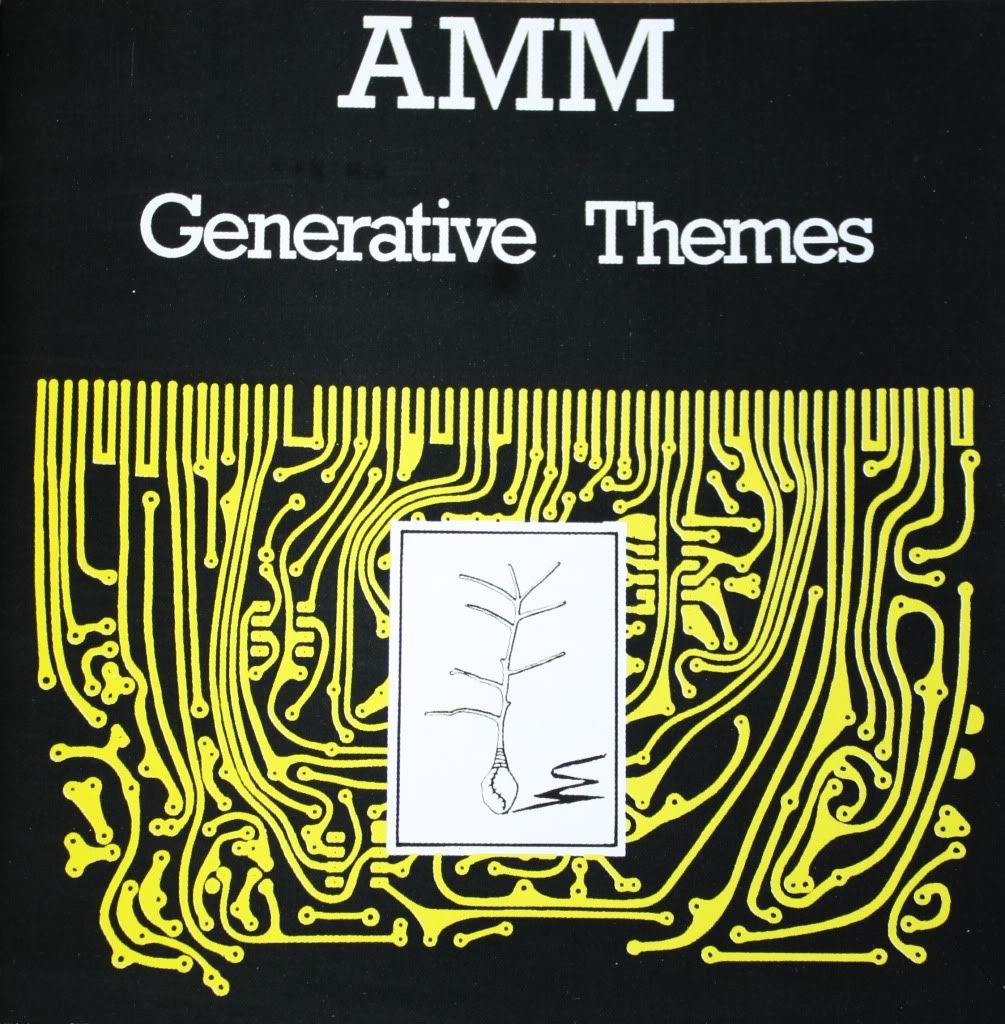
AMM - Generative Themes
AMM are the perfect group to bring up after part two of the essay I just posted, and Generative Themes is as good an album of theirs as I could hope to choose for an auditory example of some of the ideas discussed therein. AMM was formed in 1965 with the stated intent to make music completely unrelated to any established genre. By 1983 they'd gone through quite a few lineup changes but their group aesthetic had progressed somewhat close to the realm that they currently inhabit--free improvisation with a somewhat meditative feel, occasionally punctuated by noisy outbursts.
Generative Themes is a bit of an unusual AMM album because it's a studio recording--for this reason, it's made up of four discrete tracks instead of a single album-length track or an entire performance split up into gapless tracks for navigation purposes. I'll be up-front--this is one of my favorite AMM albums (though I do have several favorites). It's the first AMM album to feature pianist John Tilbury (a member to present day) and also the first to be saxophone-free. The result is a somewhat intelligible mix of Keith Rowe's tabletop guitar and radio tuner, Eddie Prévost's percussion and Tilbury's prepared piano--for the most part each instrument is distinct and the personality of each performer is somewhat apparent, at least to a much greater extent than on the gloriously cacophonous AMMMusic or The Crypt.
Due to the nature of the album's recording, it's possible (though not necessarily obligatory) to make statements about each track as individual "themes." The first is reminiscent of somewhat quieter early AMM--Rowe's guitar creates a gently percussive droning atmosphere, like he's dragging a pick (though it's likely something else) slowly across the coils of the strings. Inaudible radio lurks in the background, with the occasional word or phrase popping out into the space left by the musicians. Eventually Prévost joins in with toms and cymbals, and Tilbury makes some opening statements with the piano--the prepared instrument sounds at times more like a wooden xylophone than a piano--it's otherworldly. The second theme finds Rowe conjuring more uncommon sounds out of his guitar, with repetitive waggling noises and some liquidy but tuneless drones (sorry, this is the best way I can describe it). The overall texture of the track is dynamic, with lots of spaces between the piano notes and drum beats--sort of like popcorn popping, but much more engaging. After listening to a lot of more recent AMM albums, it's a fun change to hear Prévost playing like an actual drummer--the track winds together on the last couple of minutes into as close of a groove as AMM probably ever get, with delightfully wonky beats on the drums and some aggressive keys from Tilbury. The third theme is more brooding, with some great Rowe radio moments (at one point a child's voice audibly calls "It's a pie--it's hot!"), and Tilbury playing low on the keyboard's register. There's still plenty of space between short bursts of sound--the texture is mottled, almost playful, at times. The final theme conjures some of the early AMM spirit--some serious noise happens, with a barrage of radio ("the GEEK"), lots of tom and cymbal work from Prévost, thick clusters on the piano, and some wild, overdriven guitar squalls. Just five minutes before the end, the clouds break and things quiet down--the space returns, leaving pause for thought and the occasional brief noisy surprise from drum or piano.
Because of its abstractness, it's tough to write about this kind of music in any great detail, but among the AMM canon I think Generative Themes presents a pretty balanced amount of each personality as well as a good mix of old AMM/new AMM, quiet/loud, spaciousness/density, fast/slow, and the ever-present (yet easily-forgotten) element of chance--things lined up quite well, from Rowe's blind radio pulls to the collective teetering grooves which develop only to quickly disappear. This would make a good first exposure to AMM.
Get 'er here from the label, or from Amazon: Generative Themes
Thursday, March 10, 2011
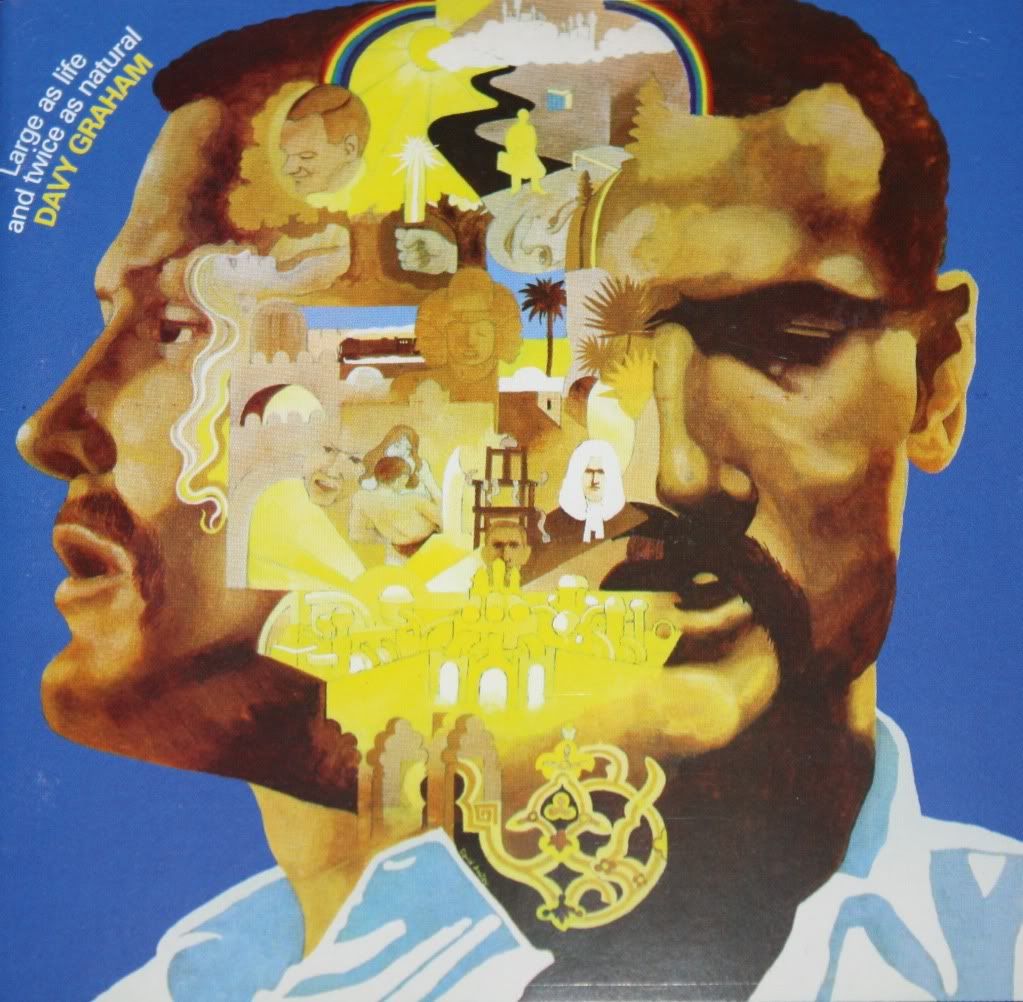
Davy Graham - Large As Life and Twice As Natural
Time to turn our probing ears to another unjustly-overlooked guitarist. Today, few have even heard of Davy Graham, but he's unanimously considered "important" by those who have--a host of better-known performers and guitarists are quick to drop his name (Bert Jansch, John Renbourn, John Martyn, Paul Simon, Ralph McTell, Roy Harper, Jimmy Page, Martin Carthy, the list goes on...) as the most adventurous and eclectic guitarist of the early 60's English folk revival, yet his actual work remains painfully obscure (though thankfully currently in print).
Davy Graham's fourth LP, Large As Life and Twice As Natural (genius title!) presents equal justification for his esteemed reputation it does evidence for his failure to achieve commercial success. The solo guitar "Tristano" reveals Graham as a virtuoso of the truest stripe, capable of seamless transition between (or simultaneous juggling of both) rhythm and lead parts, while the song itself fuses jazz, blues, folk and middle-Eastern modalities in a way that nobody in the mid-60's could have even imagined. That's how Davy is usually described by the converted--a loner whose penchant for world-traveling gave him an untouchable breadth of experience which, combined with his seemingly boundless imagination and ungodly chops, meant he was fusing Irish folk songs with Indian ragas and Eastern-izing obscure blues songs (by all accounts he invented DADGAD guitar tuning) while his later followers were aping Anthology of American Folk Music standards and worshiping Dylan. In reality, though, very little of Graham's recorded output consists of solo guitar, which I think might have played a role in his commercial difficulties.
More representative of Davy's standard MO would be his expansive reading of classic British folk song "Bruton Town," where the guitar flits jazzily around the traditional melody, refusing to adhere to traditional folk rules. Graham's voice is probably his greatest limitation--not bad (I actually enjoy it) but certainly not traditionally "beautiful" or as marketable as his guitar abilities. Likewise, "Both Sides Now" is a revelatory opener--its languorous, modal opening makes you wonder if this is actually the same "Both Sides Now" you thought it was, then BAM! The bass and drums kick in and Davy presents us with an uncannily energetic and imaginative reading of Joni Mitchell's oft-covered standard. The cacophonous rhythm section ably handles the eclectic mix of styles present here (Pentangle's Danny Thompson has got to be one of the best session bassists of the time period), bringing lots of ethnic flair to the Eastern songs (the major-key "Sunshine Raga" and minor-key "Blue Raga," as well as the hypnotic "Jenra") and provide a suitably grinding bottom to the blues numbers ("Freight Train Blues" has some awesome cymbal work and Davy's singing is pretty rocking).
The whole album feels like it was recorded live (there are plenty of vocal imperfections and loose improvisation to attest to this observation) and the sound is great--nobody else's guitar sounded like Graham's. The commercial flaws of the albums can be seen a mile off, though--it's neither folk (too experimental and eclectic) nor folk-rock (too jazzy and accoustic), and it's got nothing to do with psychedelia (apart from the delirium-inducing guitar excursions), which was the rage in 1968--how do you market that, and to whom? Perhaps Davy's eclecticism became his career's undoing (deliberately becoming addicted to heroin in order to emulate his jazz idols probably didn't help either) but for me it's the best thing about him--you never know where the next song is going and his playing is full of surprises both compositionally and technically. Here Graham might not quite fuse as many genres within the same song as he does on Folk, Blues and Beyond, but it's a fine representation of his style and contains some career highlights.
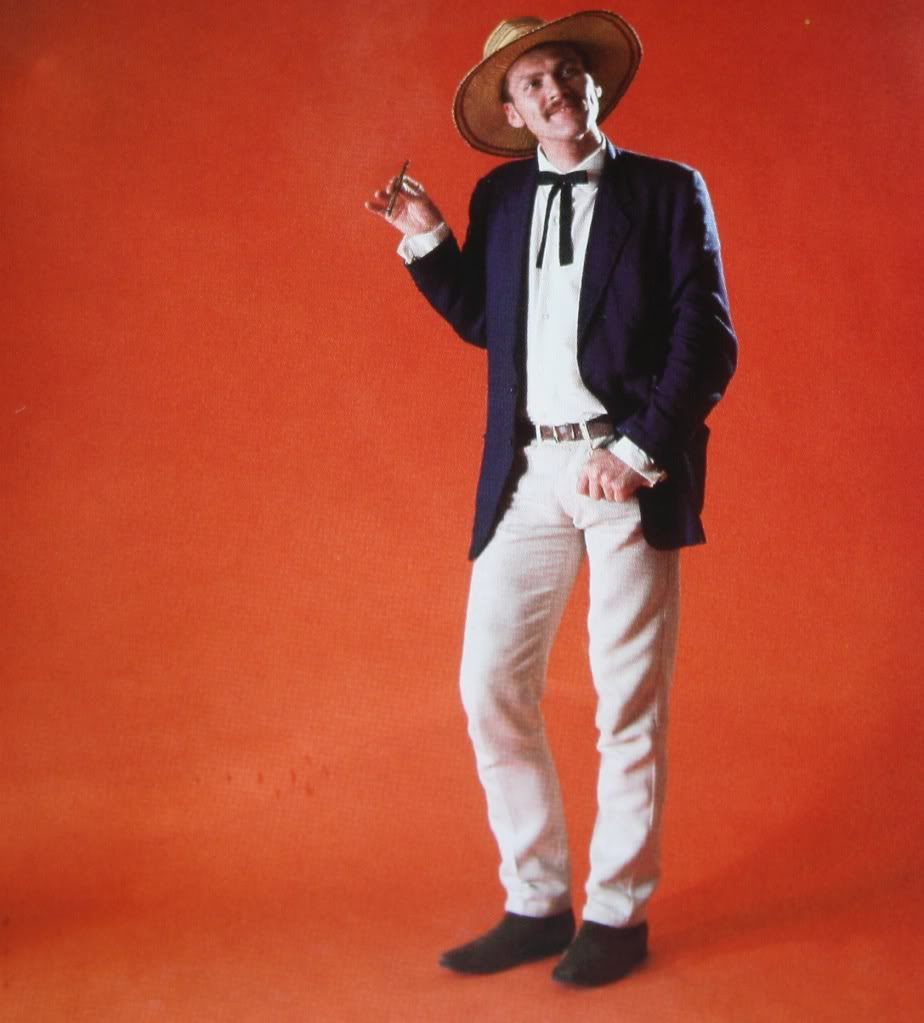
I couldn't resist including this shot from the album notes--what a cigarillo-smoking, big straw hat-wearing ladies man. Thanks Davy. Get the CD here
Sunday, February 27, 2011
Third Ear Band - Third Ear Band (Review)
Third Ear Band's second album, 1970's self-titled (now sometimes retroactively titled Elements) builds on the oboe melody-led excursions of Alchemy by assigning each of its four songs to an element. While the instrumentation is still basically the same as the debut, the songs are considerably more identifiable from each other.
Every time I listen to this album I'm amazed at how fun a listen it is without being particularly melodic--the opener, "Air" gently coalesces out of the ether based on a repetitive tabla beat and some probing oboe and cello/violin groans and fails to present any melody except for an occasionally repeated violin riff. And yet, its smoky mystery is utterly compelling and lushly gorgeous, especially considering how few instruments produce the music. "Earth" shifts gears completely, with the strings playing pizzicato over a much more minstrel-like beat from the drums. Dual oboes improvise gently, probing Eastern-scales, while the tempo subtly gathers pace. All of a sudden it's an ecstatic frenzy, then just as suddenly the tension disappears, the rhythmic pattern slightly shifts, and the process starts again. Despite the general mood and ever-present tonal center of the music, there's no real melody to speak of--clear and quite listenable evidence that melody needn't reign supreme as the only musical element worthy of close attention.
"Fire" is a brilliant study in high-register drones and another shift in texture, with a relentless wavering feeling not unlike that of a dancing flame. "Water" closes the album with an actual melody (imagine that) over sustained violin with just enough dissonance to remind us that we're not in any territory that had been scouted at the time of the album's release, or really a whole lot more since. As I listen and re-listen in rapture to the strange and evocative sounds these instruments make together, I'm not always sure how the structures pertain to the elements they're named for, but in reality it's immaterial--by consciously giving each suite a distinct mood, the band stretched itself beyond its impressive but sometimes nebulous debut and gave structure to another forty odd minutes of rare beauty with memorable compositional elements.
Get it here on CD along with the band's first album
Subscribe to:
Posts (Atom)