Showing posts with label 1963. Show all posts

Saturday, January 14, 2012

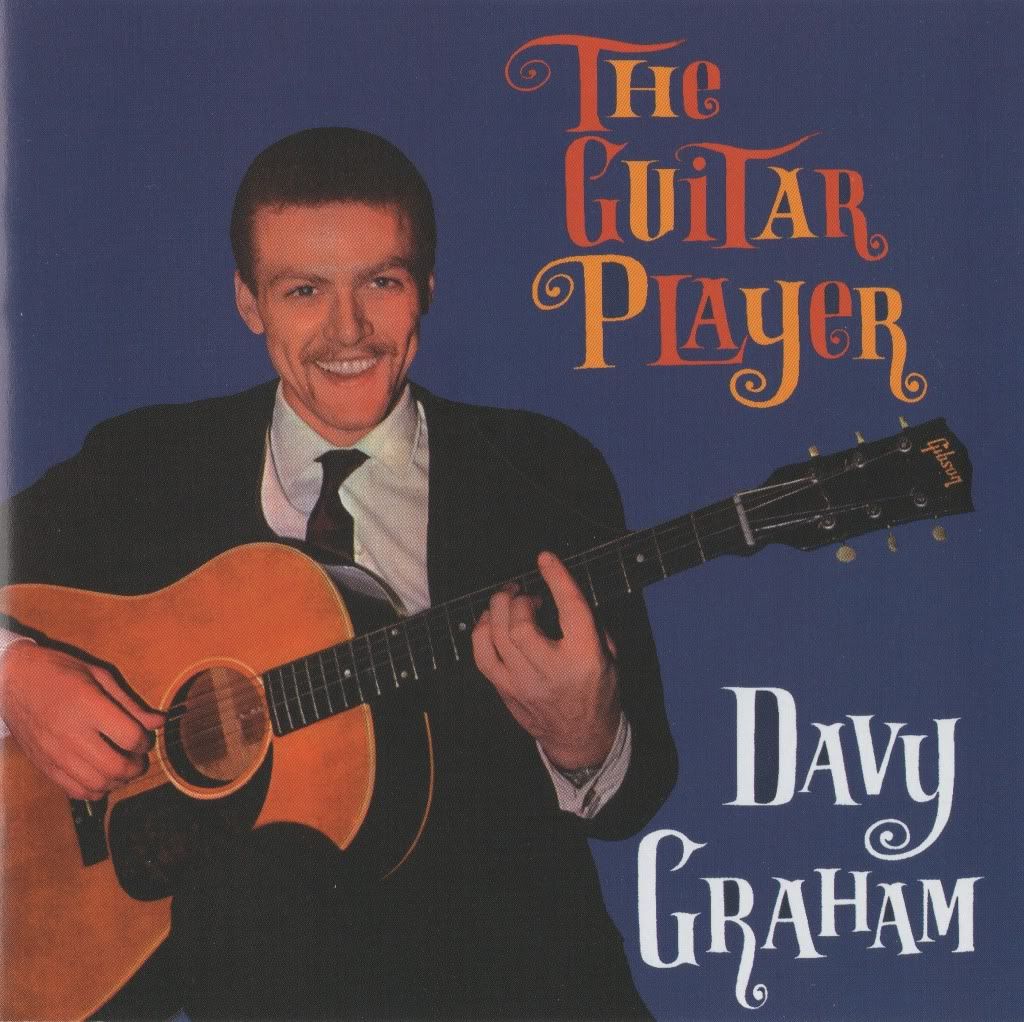
Davy Graham - The Guitar Player


If you're interested in delving into the influential and often mind-blowing rabbit hole that is Davy Graham's guitar playing and inimitable fusion of jazz and blues with folk from across the world, I urge you not to start here!  That's right, it's another installment of the only-very-occasionally-controversial Know Your Enemy series.  This time it's not really poor Davy or his fleet fingers, but rather his presumed audience who's the enemy.  It's got to be pretty much impossible to reckon how many great artists' originality and instincts have been stifled (either by their record labels or by themselves) in hopes of presenting their music as inoffensive and appealing to the largest and most middle-of-the-road audience possible.  By this album's 1963 release, Davy had already been doing the things that made him a legend among many British musicians who would find considerably more fame (things like showing up to a party and playing a single-guitar arrangement of Ravel's Boléro).  Instead of committing his unrivaled guitar excursions to tape, Pye subsidary Golden Guinea decided it would be more commercially accessible to pair Graham with a jazz session drummer and record an inoffensive mix of jazz and blues standards.

And so, we have The Guitar Player, whose title and cover promises an aural vision of Graham it doesn't deliver, at least in relation to his historical reputation.  We get "Take Five" and "Cry Me A River" (an earlier filmed version of which secured Graham this record deal) as well as Cannonball Adderly's "Sermonette."  While the material is in places somewhat mundane, Graham's playing is always flowingly organic (the tempo ebbs and flows with quite a bit of endearing imperfection) and it's fascinating to hear him collapse all the vocal and instrumental parts of a song like "Ray Charles' "Hallelujah, I Love Her So" into a single fingerstyle guitar part.  Disappointingly, most of the songs veer toward jazzy blues (or maybe bluesy jazz, as many Graham's mini-fills tend to riff on blues scales), though there are a few outliers that hint at the man's true passion--"The Ruby and the Pearl" injects a satisfying amount of minor Latin into the mix (and the drummer manages to play the sticks in a considerably more complementary way than he often does elsewhere, or maybe it's the fact that it's just acoustic guitar and drums that makes some of the arrangements sound  just a bit hollow).

Re-listening to this album, I'm reminded how much of a joy it is to listen to Graham's guitar playing, no matter what the context--sort of the guitar equivalent of saying you'd be OK listening to your favorite singer singing names out of the phone book.  It's just the knowledge that Graham had much bigger ideas to share and the way the songs are all so self-consciously happy sounding that rings somewhat forced.  The liner notes Davy writes "I sincerely hope you enjoy this record either to listen to or as a background to a good conversation," which just about sums it up--cowering in submission to your hoped-for audience so very rarely produces the stuff from which legends are born.  The CD reissue of this album seems determined to apologize for the original album's timidness, including examples of what actually made Graham legendary (raga-infused Irish folk in "She Moved Thru' The Bizarre/Blue Raga," Greek folk in "Miserlou" and a considerably more eclectic selection of songs from Graham's later-70's All That Moody, including his legendary instrumental "Anji").  Still, the unfortunate truth is that, pleasant as it is, this album doesn't come close to doing Graham's contributions justice.  While Graham would have career-long troubles finding a marketable niche for himself and regularly seemed to make artistic choices in hopes of endearing himself to an intangible audience, he at least managed to create a concurrent legacy of music that more successfully represented his unique and unprecedented vision.  While it's frustrating that he never produced an epic, vocal-less collection of his genre-shattering experiments (I'm sure partly owing to the fact that solo acoustic guitar as a genre was pretty much just getting going in the early 1960's), there are much better places to start than The Guitar Player.

You can get it here.

Monday, September 19, 2011

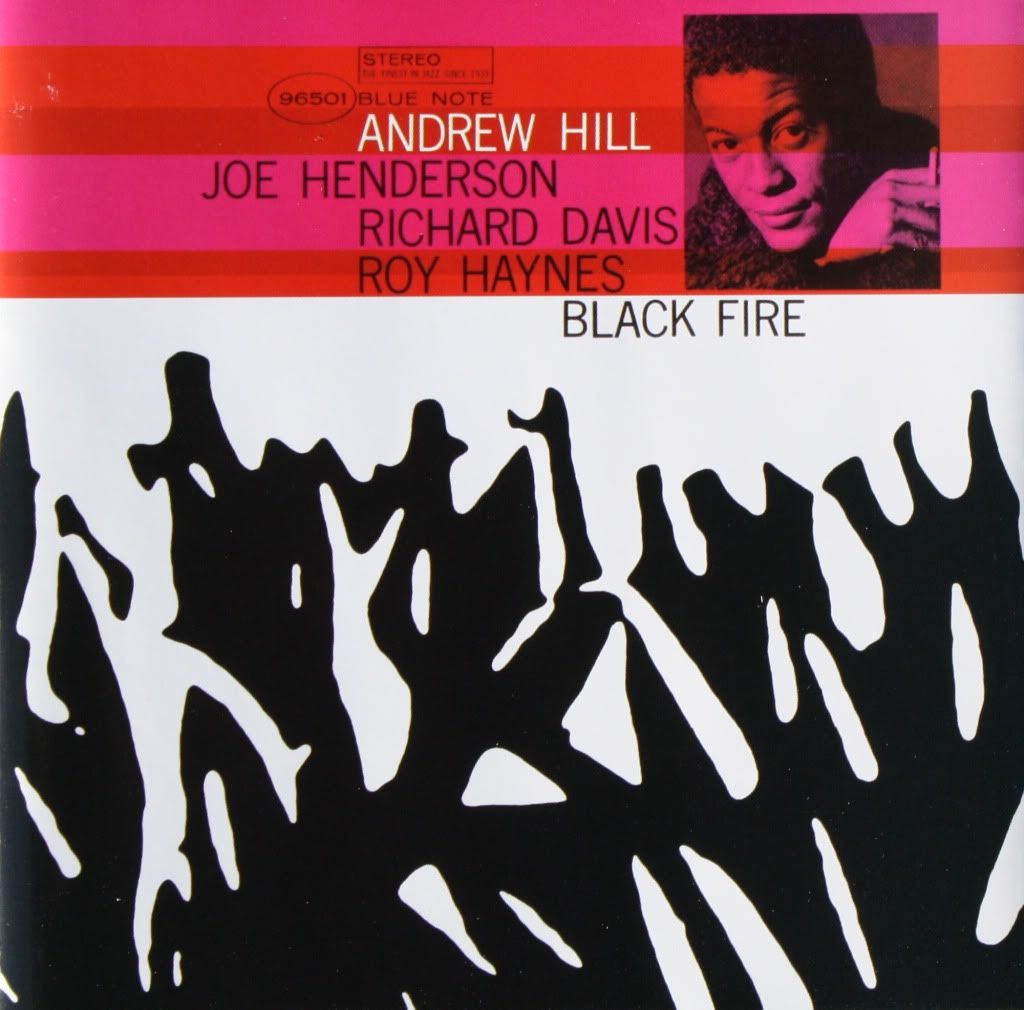
Andrew Hill - Black Fire

 
The path that's led me from dispassionate appreciation to real enjoyment of jazz has been a serpentine one, coming to like the genre not from its more accessible and well-known forms but backward from things like jazz-rock, the Canterbury scene and from experimental and free improvisation music to the more "out" forms of jazz like free jazz and avant-garde jazz.  I'm not sure if it was repeated exposure to jazz harmony (whose distinctive sound sometimes lacks the pointed directness of the more simplistic harmony employed by most pop music) or just the fact that I found jazz that's more up my alley, but after years of unsuccessfully trying to enjoy the genre, something finally clicked a few months ago and I'm pretty happy about it--there is a whole lot of great jazz out there, even within short 10 year spans (most of the jazz I've taken to seems to come from the 60's).  With jazz's current cultural dominance in an extremely attenuated form and many young people coming to jazz as outsiders, there's potential for jazz to sound samey; extended solo breaks, walking bass lines and a lot of commonality between different players' vocabulary can make it tough to distinguish between songs, styles and players, but repeated acquaintance with a couple of albums and the tenets of the style (most basic jazz compositions feature a melody or "head" that's stated a couple of times, embellished through one or more solos, and repeated again at the end of the song) make it a little easier to view jazz as something decipherable and not just a bunch of honking, noodling, or uncool music fit only for background at a restaurant.  In a suitably backward way, I've already introduced free jazz and jazz fusion on the blog, but have yet to share an album from the post-bop or avant-garde jazz styles.  It's fair to say that in the early 60's the dominant form of jazz was probably hard bop, known for its liveliness, dance-ability and connection to R&B, gospel and blues.  As early as the late 50's, though, there were jazz artists starting to stretch the somewhat conservative boundaries of bop both in their playing and compositions to such an extent that some jazz became different enough that new labels were needed to describe it.  In my understanding, at the time, jazz musicians referred to this trend using the adjective "out," and when free jazz started emerging there were enough people doing it that it was being referred to as "the new thing."  Nowadays we have varying descriptive shades from the mild alterations and expansions on the formula found in post-bop (probably the only time I'm comfortable using "post" as part of a genre title, as it represents changes in the music that really were unprecedented and couldn't be described by existing vocabulary) to the nebulous but definitely more acute abandonment of bop's rules found in avant-garde jazz, to the very "out" and least structured form that would become known as free jazz.  The terms usually aren't mutually exclusive and often don't describe in a hard-and-fast way what the music will sound like, only that it will be different and probably more adventurous than the bop, modal jazz, and cool jazz that preceded it--sounds like the jazz for me! 

On to the actual disc at hand, pianist Andrew Hill's debut for avant-garde and post-bop watershed label Blue Note, 1964's Black Fire.  Though he's best known for his star-studded 1965 album Point of Departure, Hill's career as both a sideman and band leader is  prolific, varied and vibrant--at this point in my fledgling jazz fandom, he might be my favorite jazz artist.  I think it has something to do with his ability to ride the line between edgy and accessible, the wide variety of styles his compositions cover, and the fact that he's got a million great albums.  Black Fire is a perfect example to introduce both avant-garde jazz and post-bop, and I'd venture to say it's a great gateway album through which the uninitiated can get into jazz.

What distinguishes this album most as avant-garde and post bop is definitely Hill's compositions, which are at times irreverent to jazz custom and obviously sound beyond the boundaries of bop.  "Pumpkin" opens the album with an uptempo and edgy bang, teetering between a dark minor theme stated by Joe Henderson on tenor saxophone and a rapid sax/piano run that gives way to a dissonant and playful counterpoint riff between the piano and sax.  Hill takes the first solo, ranging between flitting runs, rapid interval two-note chords, and a lot of inventive and acrobatic maintenance and embellishment of the repeating quarter note triplet riff that punctuates the song every several bars.  As with any good jazz album, the interplay between the players is top notch--in addition to Henderson and Hill, journeymen Roy Haynes and Richard Davis ably hold down the drum stool and double bass, respectively.  Even this early in his band leader discography, Hill's piano style and compositions are heavily rhythmic; his repeating riffs often form poly-rhythmic counterpoint with Haynes' aggressive drum style, leaving Davis to keep the steady pulse uninterrupted.

"Subterfuge" is another driving minor number, with Hill's percussive left hand riffing and two-hand unison riffs stating the melody.  The saxophone-less track leaves lots of room for unexpected turns in texture and mood in Hill's solos and makes space for a great drum solo from Haynes.  The title track lightens the mood with a lithe and cheerfully knotty saxophone melody and a lot more rhythmic juxtaposition between the low keys and the drums.  "Cantarnos" has more wonky rhythmic interplay, this time around a Latin-inflected riff and long-note legato melody from Henderson.  Things get slightly less driving on the bluesy and again horn-less "Tired Trade" and the album's only brief ballad, "McNeil Island."  The dizzying, stuttery and awesomely-titled "Land of Nod" closes the album with an excellent summation of the album's strengths and points the direction to Hill's later, even stranger compositions.

Black Fire is a great example of jazz that's simultaneously very listenable, extremely melodic (I can think of few jazz albums with melodies so instantly memorable), yet still strange and outside the bounds of what most jazz composers were doing in 1963.  Andrew Hill is as able a sideman as he is a composer and soloist; he never hogs the stage and displays impeccable taste when it comes to showing off his chops or supplementing the other players; such is the mercurial quality of truly great jazz musicians.  To speak in terms of my last two reviews, other than the risky compositions there isn't a lot formally to differentiate this music from the standard jazz formula, and yet there's no shortage of ideas regularly flowing out of all four players--the beauty of jazz is its liquidity.  All four are accomplished enough that they comp inventively and unpredictably around the chord changes and each others' solos, making for music that is founded on fixed elements but avoids repetition through in-the-moment and unrepeatable imagination.  Ideas are tossed out, perhaps repeated and slightly mutated a few times, then the player alters the idea enough that it's become something completely different, heading off into another direction like a feather in the wind.  Of course, it helps that Hill's compositions are so subtly unusual--I'm sure the weirdness lends itself to great idea-making in the minds of the sidemen.  There is much more great material to come from Andrew Hill and avant-garde jazz in general, but Black Fire is as good a place as any to get your first taste.

Monday, July 18, 2011

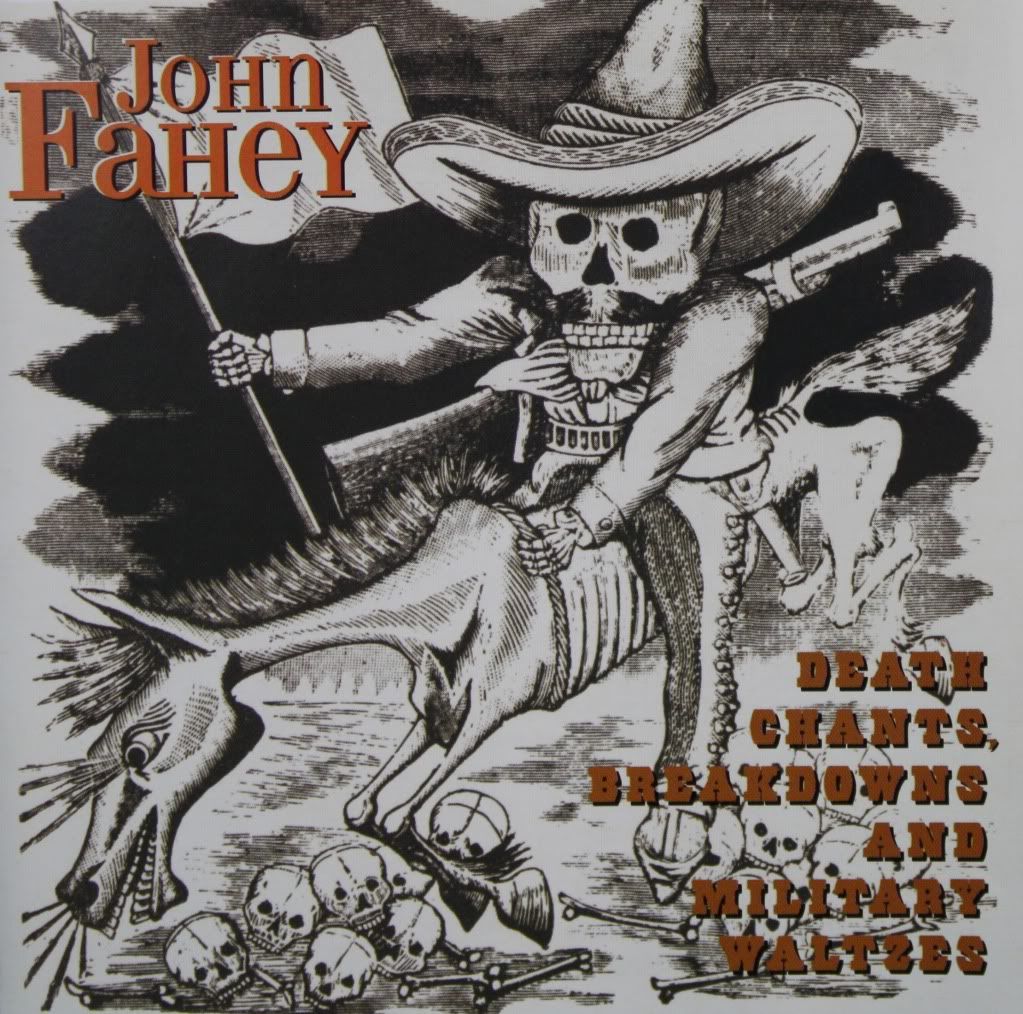
John Fahey - Death Chants, Breakdowns and Military Waltzes


In laying out markers for my musical landscape and contextualizing some of the other reviews I've written, I've been totally remiss in not yet mentioning John Fahey--sole creator of the solo steel string guitar genre, acoustic blues fanatic, composer and innovator--so I'll start with my first Fahey disc, and an enduring favorite from a man whose first 15 recorded years spanned an astonishing array of progression while still remaining anchored in the blues.

Death Chants, Breakdowns and Military Waltzes is John Fahey's second album, released on his own Takoma Records in 1963, four years after his unassuming but iconic debut.  The intervening years allowed Fahey to significantly refine his technique (mostly open tunings, allowing for lots of octave Travis picking, arpeggiatos and some majestic slow strums with blues-cum-classical melodies played on the high strings) as well as his compositional style, which sees the song lengths stretching out and the compositions featuring more surprising changes and contrasting movements.  Take "Stomping Tonight on the Pennsylvania/Alabama Border," which begins with a string-bending slow blues with a turnaround, mutates into a free, ascending arpeggio on the high strings, then again to a crushing minor blues dirge before revisiting each of its sections and closing on an arpeggio that crosses through dissonance to a dreamy major 7th concluding passage. 

Like a lot of albums that have become long-term favorites of mine, part of what I love about this album is how it sounds--the recording quality isn't great, but since it's (mostly) just one instrument, everything's still audible and the music is laced with an antique atmosphere--and the room reverb is awesome.  There are a few moments where the volume of Fahey's guitar threatens to distort the recording equipment (to its great) as on the slide glissando of "On the Beach of Waikiki," or where the distance of the guitar to the microphone lends a raucous feel, as on the energetic "Spanish Dance," and then on "John Henry Variations" when the instrument's slightly out-of-tune harmonic overtones warble with an unsettling but hypnotic pulse.  If I call some of this album "psychedelic," it's these sort of extra-melodic elements that I'm talking about, like 3:15 into "America" where (through the use of tape editing, I assume) the guitar timbre suddenly changes from bassy fingerstyle to tinny high-neck strumming, or 1:06 into "When the Springtime Comes Again," when the key abruptly shifts from minor to major but the theme remains almost the same--there's something within those quavering intervals that lingers on the precipice of some forgotten memory that never ceases to make my hairs stand on end.  The piece would continue to fascinate Fahey the composer as it evolved into numerous versions on the 1967 re-recording of this album, in numerous live recordings, and on 1971's America as "Mark 1:15"--each time expanding on the last but somehow leaving a trail of discrete incarnations, each with its own particular magic.

The dark corners of this album aren't without some extreme eccentricities, either, like the dissonant strumming on the flute duet, "The Downfall of the Adelphi Rolling Grist Mill" (Fahey's titles were often almost as great as the songs they labeled).  Ultimately, though, Fahey's genius substantially rests on his ability to bizarrely marry the familiar harmony and structure of the blues with the dissonance and imagination of 20th century classical composers.  For someone like myself who gets bored with the repetition inherent in a lot of blues music, hearing Fahey deconstruct his beloved genre and reassemble its innards into dazzling piecemeal sculptures breathes new life into what's usually a compositionally inert idiom.  His preternatural melodic abilities provide melodic lines that sink into the brain slowly but insidiously--not sounding like much at first, but ultimately sounding as beautiful as any music possibly could--I really love the way his sweeping melodies traverse multiple string plucks, simultaneously savoring a note and impatiently re-sounding it before the sound has a chance to decay.

I've got a feeling that whichever Fahey album most people name as their favorite is one of the first (if not the first) that they hear.  Though his early career covered expansive ideological and theoretical territory, it did so at a modest pace and Fahey would often repeat the same ideas either explicitly or intuitively.  At the time he was only pressing hundreds of copies of each album, so how was he to know how things would sound when his discography was considered retrospectively?  For example, he re-recorded and re-released most of the songs from this album (to be reviewed at a later date) in 1967, and the advancements he made in technique and composition are noticeable.  What I'm trying to convey is that, beautiful as they are, some of his ideas lose that "first time" magic when they crop up elsewhere, and where you hear them first tends to remain the most memorable.  For me, it was here with Death Chants, Breakdowns and Military Waltzes--I still think it's a great place to start with Fahey as it states many of the ideas he would continue to pursue--compositionally, technically, sonically (he'd continue to experiment with tape editing as the 60's wore on), and arrangement-wise (many more of his albums feature his own adaptations of Episcopal hymns as closers)--but it all comes in a relatively digestible form, mostly adhering to compartmentalized song structures and resonating with some sort of pop instinct in terms of flow and melody.  I've got several John Fahey favorites, but this is probably the one I'd give up last--you can pry this album from my corpse's withered fingers.