Showing posts with label John Fahey. Show all posts

Friday, January 25, 2013

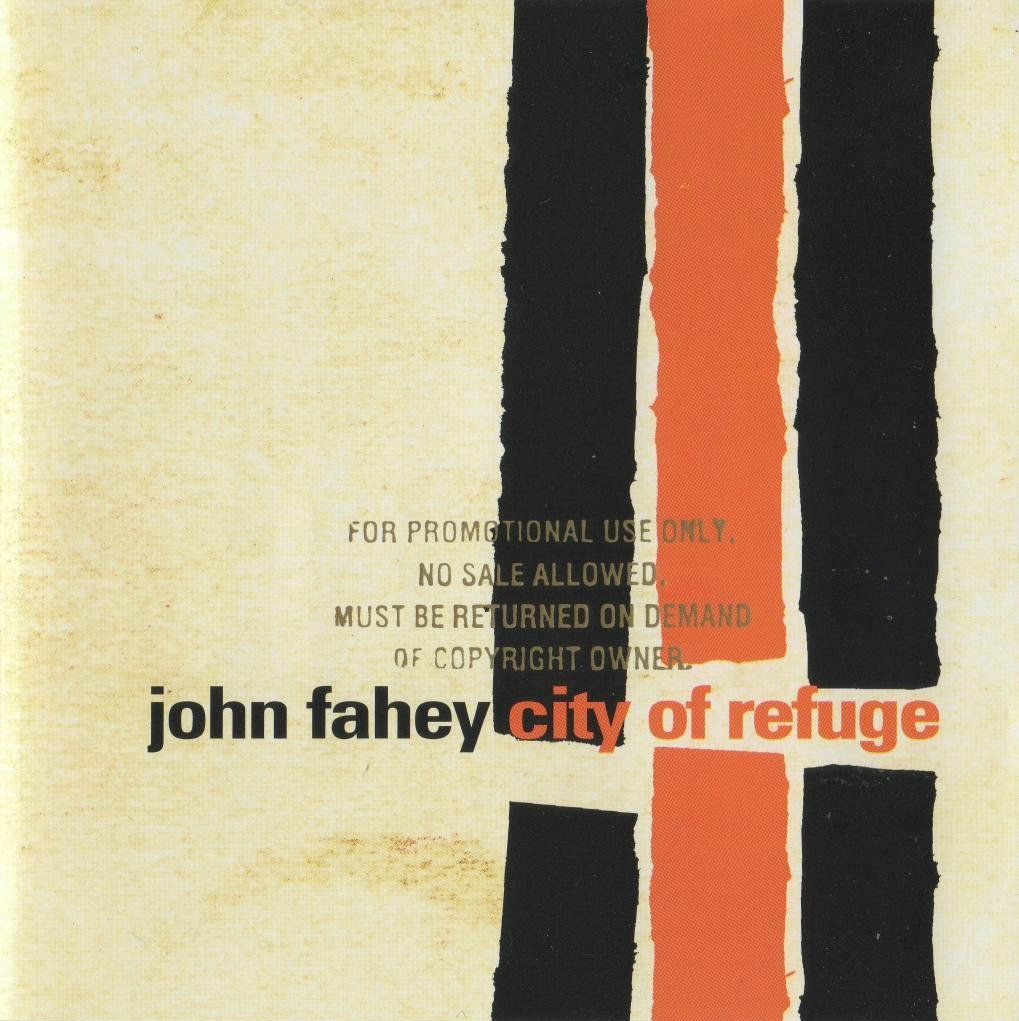
John Fahey - City of Refuge


In investigating Fahey's late period, I'm sympathetic with the fact that he felt dead-ended stylistically and was struggling to move beyond his signature American Primitive tropes into something a bit more...different and new.  The issue seems to be just what, precisely, that new direction is, and Fahey's frustration is evident in the music.

In spite of its recording date, City of Refuge most resembles 60's Fahey records like Volume 6: Days Have Gone By and Requia, with equal space and volume given to acoustic guitar and field recordings, found sounds and electronic sound sources.  As with those other recordings, this approach either stands (Days Have Gone By) or falls (Requia, often) on how well those elements mesh with one another compositionally.  The disc starts promisingly enough with "Fanfare," which sees an unusually (for Fahey) overdriven slide guitar layered on top of droning, industrial electronic sounds not unlike those produced by Keith Rowe, especially in his solo works.  As the tracks play on, for me the impression builds that the compositions aren't very well thought-out, which is a serious stumbling block for an artist whose greatest strength is arguably his ability as a longform composer, not as an improvisor, which is what he appears to attempt on "The Mill Pond" and large portions of "City of Refuge I," plucking single notes against a throbbing background drone.  While the proposition of a more spare approach to his guitar style is intriguing, the results here don't feel particularly well-realized.

Elsewhere we are suddenly jolted out of the avant-garde soundworld back into more traditional Fahey territory, with guitar-only excursions like "Chelsey Silver, Please Come Home," and the dirge-like "City of Refuge III."  The former hints at a new compositional twist on Fahey's slide style, with abrupt stops and rhythmic interruptions, but again it feels like he didn't thoroughly integrate the idea into the piece, or maybe it wasn't an idea after all and the performance is just choppy!  Both songs seem to lack distinctive melodies or a feel other than "Fahey filler"--pleasant enough, but by 1997 we know what this man is capable of!  To my ears, "Hope Slumbers Eternal" is the best-realized piece on the album, blending a droning background that relates tonally to the minor slide guitar melody it accompanies, provoking an eerie, meditative atmosphere--most importantly, the electronics and guitar seem to combine coherently, which is mostly not the case with the rest of the experiments here.  The album closes with the 19-minute "On the Death and Disembowelment of the New Age," which, as far as I can tell, contains no guitar (though it does keep alive Fahey's tradition of humorously long and barbed song titles).  It's probably the most successful sound collage on the disc, but sitting at the end of a selection of noodly acoustic guitar pieces, it raises questions about what it's doing here, and why these songs all belong on the same album.  There is some cool rhythmic phasing of a tambourine-like sound that kicks in around the 12-minute mark and lasts for several minutes, and the album closes like it opened, with a classic Fahey field recording motif--a lonely locomotive whistle. 

This is the kind of album that really gets under my skin--not because I think it's bad, but because there's a palpable sense of frustration from an artist with specific ideas and a seeming incapability to fully realize them.  Probably more troubling to me personally is Fahey's frustrated attempt to break beyond his established vocabulary as a guitarist--for a man who reportedly described fingerpicking as a "disease," he must have felt more than a little trapped.  When an artist verges into atonal and pure sound territories, success seems to become as ephemeral as the compositional building blocks are abstract.  I find it daunting to explore these areas as the measure of artistic success depends even more on an unquantifiable gut reaction, and the difference between good and bad is painfully difficult to control as a composer--but perhaps that's where the adventure lies!  My next stop for late-era Fahey is another 1997 album, Womblife.  While my hopes for a successful application of his challenging ideas are tentative, even unsuccessful attempts in this territory are rewarding and always thought-provoking.

Get it here.

Monday, July 18, 2011

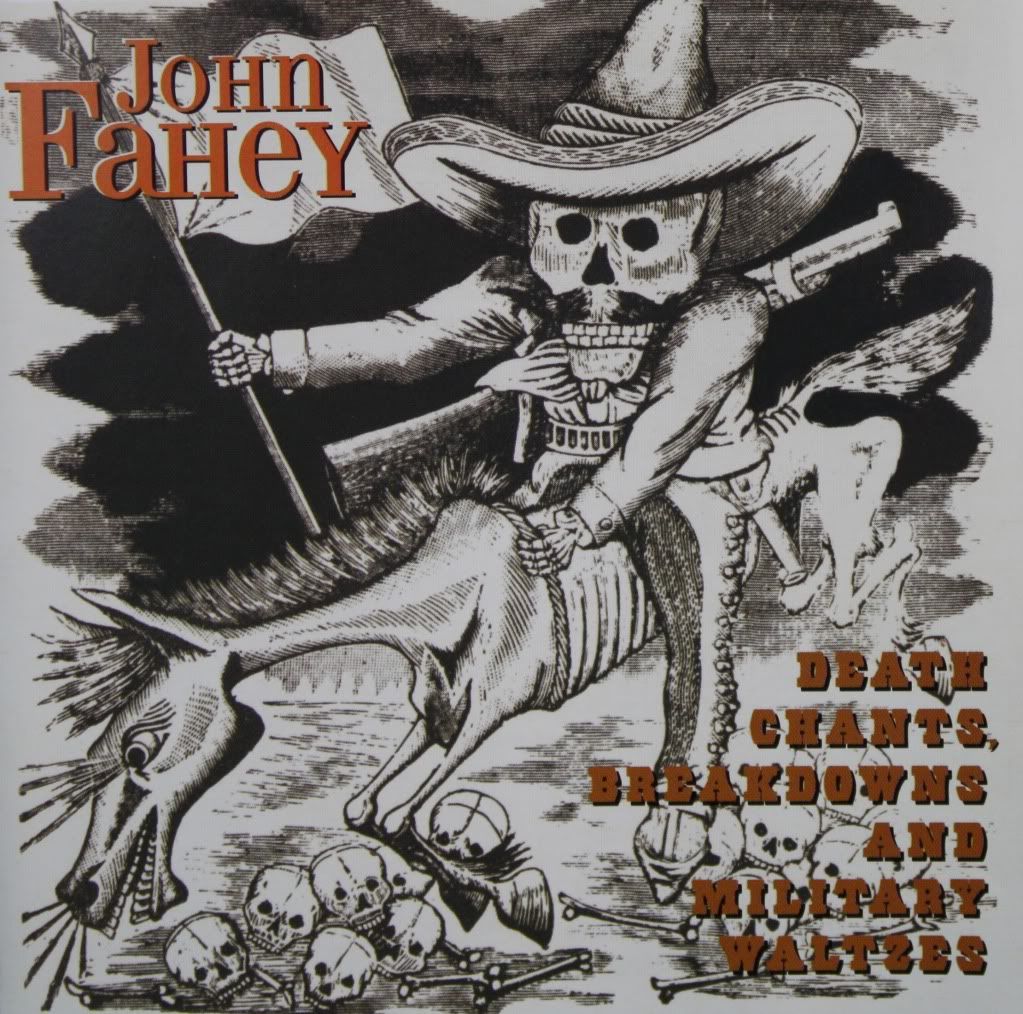
John Fahey - Death Chants, Breakdowns and Military Waltzes


In laying out markers for my musical landscape and contextualizing some of the other reviews I've written, I've been totally remiss in not yet mentioning John Fahey--sole creator of the solo steel string guitar genre, acoustic blues fanatic, composer and innovator--so I'll start with my first Fahey disc, and an enduring favorite from a man whose first 15 recorded years spanned an astonishing array of progression while still remaining anchored in the blues.

Death Chants, Breakdowns and Military Waltzes is John Fahey's second album, released on his own Takoma Records in 1963, four years after his unassuming but iconic debut.  The intervening years allowed Fahey to significantly refine his technique (mostly open tunings, allowing for lots of octave Travis picking, arpeggiatos and some majestic slow strums with blues-cum-classical melodies played on the high strings) as well as his compositional style, which sees the song lengths stretching out and the compositions featuring more surprising changes and contrasting movements.  Take "Stomping Tonight on the Pennsylvania/Alabama Border," which begins with a string-bending slow blues with a turnaround, mutates into a free, ascending arpeggio on the high strings, then again to a crushing minor blues dirge before revisiting each of its sections and closing on an arpeggio that crosses through dissonance to a dreamy major 7th concluding passage. 

Like a lot of albums that have become long-term favorites of mine, part of what I love about this album is how it sounds--the recording quality isn't great, but since it's (mostly) just one instrument, everything's still audible and the music is laced with an antique atmosphere--and the room reverb is awesome.  There are a few moments where the volume of Fahey's guitar threatens to distort the recording equipment (to its great) as on the slide glissando of "On the Beach of Waikiki," or where the distance of the guitar to the microphone lends a raucous feel, as on the energetic "Spanish Dance," and then on "John Henry Variations" when the instrument's slightly out-of-tune harmonic overtones warble with an unsettling but hypnotic pulse.  If I call some of this album "psychedelic," it's these sort of extra-melodic elements that I'm talking about, like 3:15 into "America" where (through the use of tape editing, I assume) the guitar timbre suddenly changes from bassy fingerstyle to tinny high-neck strumming, or 1:06 into "When the Springtime Comes Again," when the key abruptly shifts from minor to major but the theme remains almost the same--there's something within those quavering intervals that lingers on the precipice of some forgotten memory that never ceases to make my hairs stand on end.  The piece would continue to fascinate Fahey the composer as it evolved into numerous versions on the 1967 re-recording of this album, in numerous live recordings, and on 1971's America as "Mark 1:15"--each time expanding on the last but somehow leaving a trail of discrete incarnations, each with its own particular magic.

The dark corners of this album aren't without some extreme eccentricities, either, like the dissonant strumming on the flute duet, "The Downfall of the Adelphi Rolling Grist Mill" (Fahey's titles were often almost as great as the songs they labeled).  Ultimately, though, Fahey's genius substantially rests on his ability to bizarrely marry the familiar harmony and structure of the blues with the dissonance and imagination of 20th century classical composers.  For someone like myself who gets bored with the repetition inherent in a lot of blues music, hearing Fahey deconstruct his beloved genre and reassemble its innards into dazzling piecemeal sculptures breathes new life into what's usually a compositionally inert idiom.  His preternatural melodic abilities provide melodic lines that sink into the brain slowly but insidiously--not sounding like much at first, but ultimately sounding as beautiful as any music possibly could--I really love the way his sweeping melodies traverse multiple string plucks, simultaneously savoring a note and impatiently re-sounding it before the sound has a chance to decay.

I've got a feeling that whichever Fahey album most people name as their favorite is one of the first (if not the first) that they hear.  Though his early career covered expansive ideological and theoretical territory, it did so at a modest pace and Fahey would often repeat the same ideas either explicitly or intuitively.  At the time he was only pressing hundreds of copies of each album, so how was he to know how things would sound when his discography was considered retrospectively?  For example, he re-recorded and re-released most of the songs from this album (to be reviewed at a later date) in 1967, and the advancements he made in technique and composition are noticeable.  What I'm trying to convey is that, beautiful as they are, some of his ideas lose that "first time" magic when they crop up elsewhere, and where you hear them first tends to remain the most memorable.  For me, it was here with Death Chants, Breakdowns and Military Waltzes--I still think it's a great place to start with Fahey as it states many of the ideas he would continue to pursue--compositionally, technically, sonically (he'd continue to experiment with tape editing as the 60's wore on), and arrangement-wise (many more of his albums feature his own adaptations of Episcopal hymns as closers)--but it all comes in a relatively digestible form, mostly adhering to compartmentalized song structures and resonating with some sort of pop instinct in terms of flow and melody.  I've got several John Fahey favorites, but this is probably the one I'd give up last--you can pry this album from my corpse's withered fingers.