Showing posts with label Jazz Fusion. Show all posts

Friday, January 20, 2012

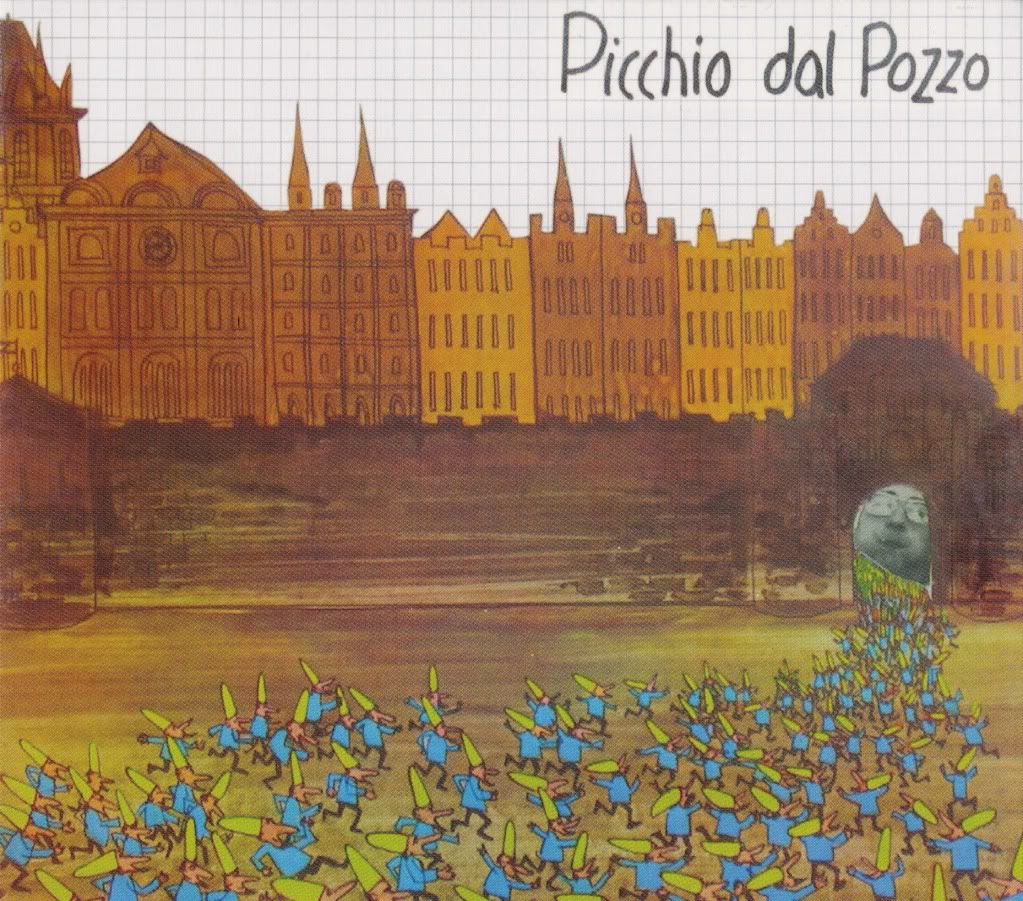
Picchio dal Pozzo - Picchio dal Pozzo


To round out this week's Canterbury Scene focus, here's one of the best examples of how the scene's sounds eventually transcended their geographical and physical origins, and a few even more obscure groups in Europe carried the Canterbury influence in an expanded and often quite interesting and artistically successful direction.  On their 1976 eponymous debut, Italian group Picchio dal Pozzo manage to fuse the gentle synth atmospheres and vocalizing of solo Robert Wyatt with space rock jams not unlike those of mid-70s Gong, all the while sticking to a very Canterburian classical-jazz instrumentation that's heavy on flute, xylophone, oboe, keyboard and fuzzed-out bass and guitar.   

Like so many of my very favorite albums, part of what I love about this album is simply how the music sounds--from the first fade-in acoustic guitar notes of "Merta" the tone of this album is like a warm bath--enveloping, soothing and somehow comforting in spite of its more challenging moments.  Though it's easy to trace this group's influences to Canterbury, there's something about their hazy, dreamy sound and penchant for mischievous wordless vocals that is totally their own.  "Cocomelastico" follows with a direct segue into an awesome-sounding guitar/saxophone counterpoint melody underpinned by layers of spacey synths and some sort of twisted lounge music with suitably gently goofy singing.  As you can see from the lyrics provided on the band's official website, the few words to these songs are mostly nonsense and whimsical wordplay; perhaps one of the Canterbury scene's greatest strengths in terms of longevity is that, unlike most progressive bands, its groups never seemed to take themselves too seriously!

The album's darkest track and arguably its centerpiece is the magnificent "Seppia," beginning with a minor ostinato and some well-chosen dissonant note pairs in the bass before stating a dramatic oboe-led melody and dropping into on of the most deliriously hypnotic fuzz bass riffs in Canterbury history for a synth/xylophone/vocal jam that lasts a good six minutes before dropping suddenly into a quietly avant-garde flute/xylophone/bass trio and closing the tune with some spoken word and a stately, mysterious reed-led section.  The number of sudden surprises, dynamics, details and layers of beauty in a track like this are my total ideal--it's at once accessible and traditionally melodic, while at the same time playing with dissonance and bizarre choices.  The genius of Picchio dal Pozzo's approach seems to be their use of gentle instruments and textures to explore these potentially grating musical moves; they're not going to offend anybody too blatantly, but if you pay attention you realize that there's a lot more going on here than it might initially appear.

"Napier" and the rest of the tracks present more densely-packed, swiftly-moving ideas, quirky but accessible melodies and almost narcotic timbres.  While the last couple of tracks are perhaps less obviously memorable in terms of melody and structure, their humble beauty does improve with further listening and the texture and atmosphere suits the rest of the album's mood so well that the disc trails off in a dreamy whisper that makes me want to start over immediately.  Though it can be argued that the heavy Canterbury influences make Picchio dal Pozzo's debut a bit derivative, as far as I'm concerned we could do with a few more great Canterbury albums and the quality of this music is so consistent and the atmosphere is so uniquely dreamy that it really doesn't bother me; sometimes doing something really well trumps doing something first, and you'll often find there are subtle wrinkles of originality hidden within.

Picchio dal Pozzo is one of my favorite Canterbury albums and is probably favorite Italian progressive album (though there are only a few Italian progressive groups who have actually clicked with me; Stormy Six, Area and Museo Rosenbach and maybe one or two others who manage to do more than rehash the less interesting aspects of symphonic prog).  I'm also really excited to say that this album is back in print on CD--just reissued by Italy's Goodfellas label at the end of 2011.  Now I can review it guilt-free and point you to one of my favorite online storefronts, Recommended Records, as a great place to purchase this CD and support these artists. Obviously, this album is highly recommended, as is the group's second and final studio release, the more challenging and RIO-flavored (but equally rewarding) Abbiamo tutti i suoi problemi, which has been consistently commercially available--more on that album later!

Wednesday, January 18, 2012

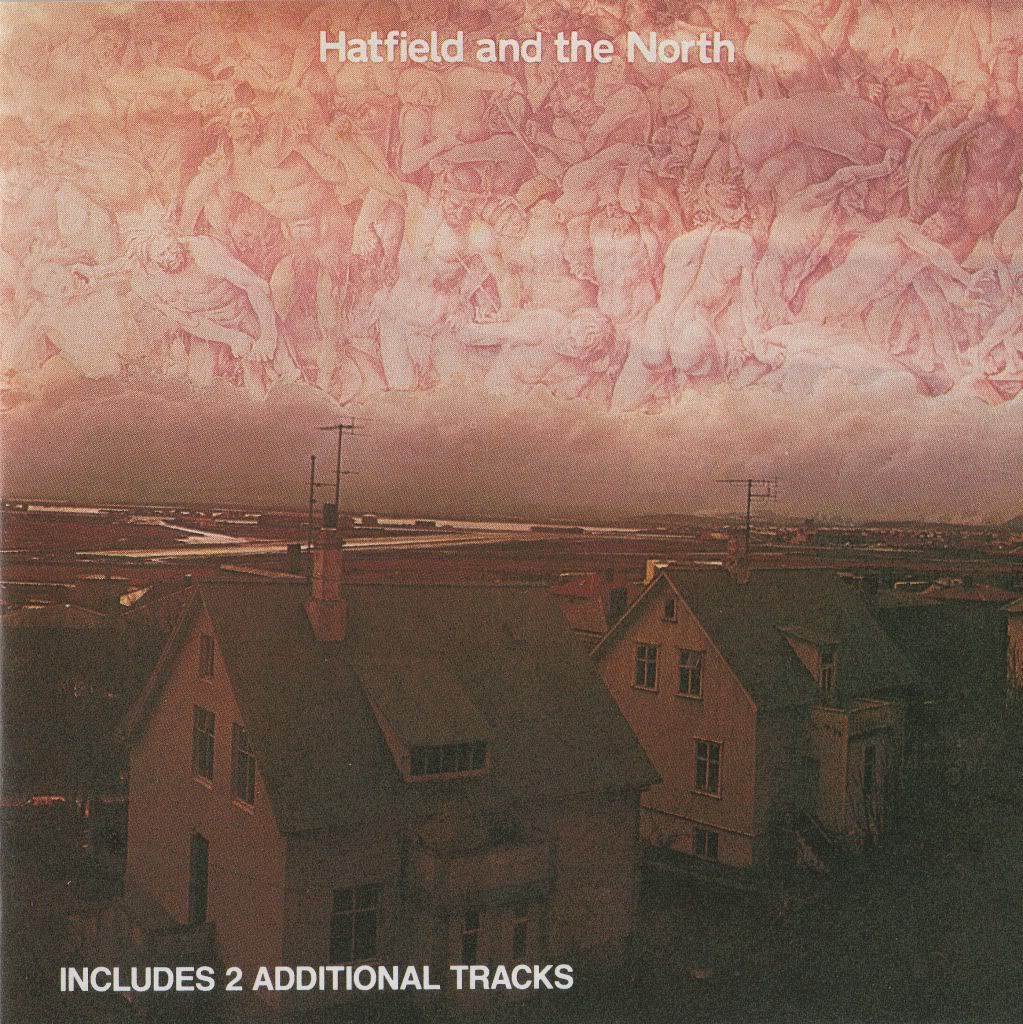
Hatfield and the North - Hatfield and the North


To delve further into the dense stuff of the Canterbury Scene, Hatfield and the North's 1974 debut is a great place to explore how the scene evolved both personnel-wise and sound-wise as the 70's wore on.  By this time Soft Machine was firmly on a jazz-heavy fusion route, with Robert Wyatt long-since departed, finished with his next project Matching Mole, a paraplegic and releasing his first masterpiece, Rock Bottom, the same year.  Gong and Caravan were already very different bands, with drummer Pip Pyle gone from Gong (to drum for Hatfield and the North) and guitarist Steve Hillage added to the fold, and bassist Richard Sinclair departing Caravan, also to work with the Hatfields.  By the time of this album's recording, the core group was rounded out by Egg (among other groups) keyboardist Dave Stewart and Matching Mole/Delivery guitarist Phil Miller.  My intention isn't to get overly cluttered with names and group references, but rather to show just how intermingling the Canterbury Scene was (and continues to be, to some extent)--Hatfield and the North can in some ways be considered the first Canterbury supergroup as it was formed from members who had already demonstrated their abilities on the classic albums of other Canterbury groups.

Sound-wise, Hatfield and the North amply demonstrates how the Canterbury sound continued to get more sophisticated, more refined, and jazzier.  Unlike mid-70's Soft Machine (or the trace jazz elements found in Caravan, for example), Hatfield and the North's debut sound is one of fusion of jazz harmony, complex composition and improvisation with appealing, gentle melodies.  The complexity of these compositions is far from the relative pop-simplicity of Caravan's songs, yet Richard Sinclair seems to have no trouble accommodating his bass skills to the material.  And don't think that this group is just going to sound like a summation of all the things the members did before--this album is rife with seamless transitions and sub-one-minute segue tracks, and the mission of the vocals (the lyrics for which are mostly tongue-in-cheek nonsense) seems to be to give listeners an accessible insertion point into what's often complex and difficult-to-get-the-first-time music.

Though it's not his group, per se (at least not as much as later incarnation National Health was), Dave Stewart's keyboards provide the most noticeable framework for this music--fluidly transitioning between Rhodes electric piano, Hammond organ, various synthesizers and acoustic piano to provide both texture and melodic substance.  "Son of 'There's No Place Like Homerton'" boasts some of the most Egg-like contrapuntal puzzle keyboard of the album, with a complex, ever-shifting atmosphere abetted by airy, ethereal contributions of the "Northettes" (background singers Barbara Gaskin, Amanda Parsons and Ann Rosenthal, who also contributed to Egg's Civil Surface album, released the same year).  Robert Wyatt guest vocalizes on "Calyx," eventually joined by Richard Sinclair in a delicate, wordless duet.  It's these kinds of complex but unassuming moments that make Hatfield and the North's two albums so rewarding on repeated listens.

I have to admit that it took me quite a few before my attitude shifted from mere respectful appreciation to all-out enthusiasm--I'm beginning to think that there's something about the language of jazz harmony that's fundamentally different from that found in most rock and pop--you have to have to acquaint yourself a certain amount with it before it stops just sounding like silly noodling and the multiple facets possible with extended harmony start to shine through.  The songs here don't often "rock out" (even by Canterbury's gentle standards), and the often major-key extended harmonies are much more reminiscent of later smooth jazz music than their darker minor counterparts being explored by Soft Machine and Henry Cow.  The band does manage to get pretty uptempo and a little more aggressive in sound on the fast-paced "Rifferama," which features Gong saxophonist Didier Malherbe and on which Dave Stewart coyly quotes the "I Never Glid Before" melody.  "Shaving is Boring" is likely the album's most epic composition, treading some darker territory with some Mahavishnu Orchestra-like ostinato patterns, gnarly Canterbury fuzz organ and an uncharacteristically distorted and noticeable contribution from Phil Miller's guitar (we won't quite get to see him cut loose until National Health's Of Queues and Cures, which fulfills all of Hatfield and the North's promise and then some).  Richard Sinclair does his best Robert Wyatt in the vaguely sexual "Licks for the Ladies," displaying that his sometimes subdued vocals aren't without a considerable amount of nuance.  He also manages some of the album's funniest quirky Canterbury nonsense vocals when "Big Jobs No. 2" recapitulates the second track with metacommentary on the band's hopes for commercial success.

It's interesting to see how all of these Canterbury figures continued to develop their distinct but collective musical visions while at the same time working for some kind of commercial success.  As the band morphed into National Health and progressive music became less and less popular in the late 70's, it became clear that the golden days of having label support and a mouthpiece through which to broadcast these ideas were drawing to a close.  Luckily several of these musicians have soldiered on to make more worthwhile music, but we also have a legacy of densely enjoyable recordings and ideas to engage in the present.  This album is warmly recommended along with the band's sophomore effort The Rotters' Club, as well as National Health's self-titled debut and the aforementioned Of Queues and Cures--more thoughts on those records later!

Get it here.

Friday, December 30, 2011

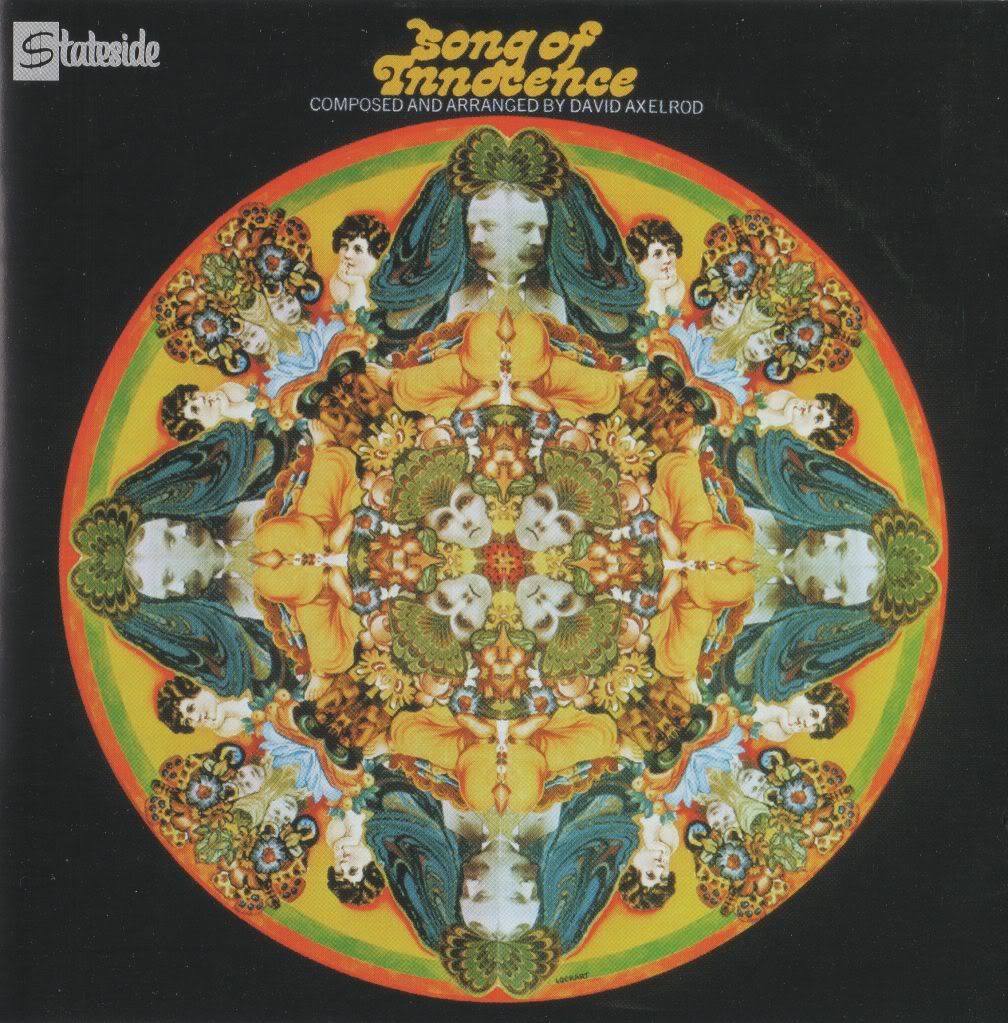
David Axelrod - Song of Innocence


Here's a longtime favorite from producer David Axelrod, who worked with Lou Rawls, Cannonball Adderly, the Electric Prunes and others as well as producing a pretty consistent string of solo albums through the late 60's and 70's.  This album and its 1969 follow-up Songs of Experience are notable for being based on the poetry of William Blake and being sampled by quite a few hip hop artists.  While the suite's sound is undeniably 60's, I always enjoy how Axelrod managed to take bits and pieces of several styles and make something that really has no stylistic equal that I've heard.

Perhaps I'm reading too much into the album title (and keep in mind I have no familiarity with Blake's poetry), but to my ears the "innocence" of Axelrod's compositions here is manifest in the simplicity of the riffs and themes (especially in comparison with this album's follow-up).  Most of the songs are built on repeating two-note riffs or ascending and descending scales in deliberately-paced quarter notes, delivered by the orchestral instruments--sweeping strings and a lot of swelling brass.  The creepy string fanfare that opens "Urizen" definitely sets the tone, which is often dark but always groovy.  In my mind's eye I always picture the orchestra facing a rock trio, blasting out the dramatic and cinematic themes while the bass and drums lay down some visceral funky beats and the guitarist (probably the main reason this album gets tagged "psychedelic") cuts loose with distorted soloing.  Bridging the gap between the orchestra's lofty sounds and the drive of the rock instrumentation are a few really well-placed and arranged jazz instruments--piano, organ and vibraphone manage to tie the album's disparate purposes together and enhance the lounge-like atmosphere, as well as provide some of the best details--like the vibraphone breakdown right before the two-minute mark of the oft-sampled "Holy Thursday," which builds into one of the album's most tremendous climaxes.

It may take several listens before the album's melodic cohesion stops sounding like homogeneity, like the subtle twist between the descending two-note riff of "Holy Thursday" and the ascending two-note riff of "The Smile," and subtle shadings like the groovily baroque harpsichord start to poke out.  While it's still pretty far off from the joyousness to be found on Songs of Experience, "A Dream" breaks the album's minor template with lovely restraint.  "Song of Innocence" is an example of one of the best-realized longer tracks of the album, blending some truly sick drumming with dissonant tension in the strings, an uncharacteristically clean volume pedal guitar solo and a dizzying orchestral conclusion.  "Merlin's Prophecy" develops the album's themes with more energy and complexity, progressively pushing the tempo as the track concludes, while "The Mental Traveler" closes the album with a forceful return to the earlier minor textures, including a righteous Morricone-like guitar melody and a dynamic false ending before the strings eerily bleed out into the beyond.

When I share Song of Innocence, it often provokes laughter--it's true that the style is pretty schmaltzy and our ears are conditioned to treat strings and horns as movie soundtrack music, but I find the atmosphere here really great and the session playing rivals many other jazz-pop crossovers of the late 60's--it's easy to hear how influential Axelrod continues to be from trip-hop and beyond.

Get it here.

Wednesday, November 30, 2011

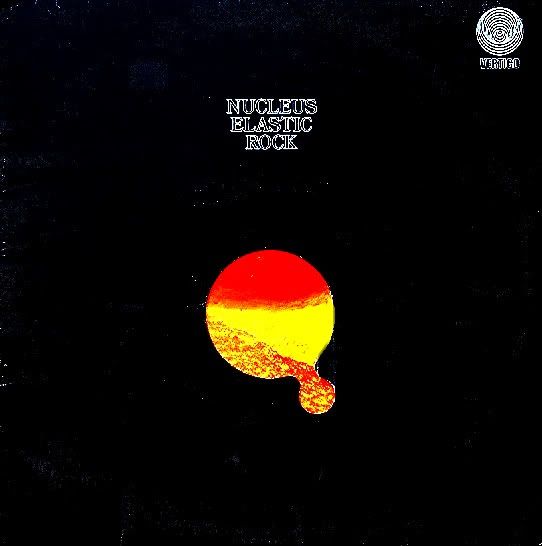
Nucleus - Elastic Rock


In celebration of some of the great jazz I've had the fortune to discover in the past six months, here's a longtime jazz/rock favorite that certainly eventually helped ease me into traditional jazz.  Though it's probably best known today as a member contributor to later incarnations of Soft Machine, British jazz rock collective Nucleus was in actuality a close contemporary of the Softs in terms of pioneering the fusion of jazz and rock music in the UK.  While Nucleus is often written about as "trumpeter Ian Carr's band," one of the things I find most interesting revisiting this album is how democratic the whole thing seems to be, with solo time and composition credits split relatively evenly.  In fact, if I were going to make a guess who the leader is, it'd probably be Karl Jenkins, whose name is on seven composition credits and whose oboe soloing at least partially defines the band's sound.  In any case, though, there's an air of equality about Elastic Rock that might detract just a bit from a sense of personality but also allows the band to cover quite a bit of ground.

Compared with the music of their Canterbury soon-to-be-kinsmen, Nucleus is probably a bit tamer, but also a fair bit more blues-oriented.  Maybe it's guitarist Chris Spedding's unshakable ties with rock music, but songs like "Elastic Rock" and especially "Crude Blues Part 2" are so tied to electric blues (especially considering the heavy backbeat in John Marshall's drumming) that it'd be tough to tie the music to jazz but for the wind instruments.  While the Softs sought to pursue the avant-garde potential in a marriage between jazz and rock by diving into labyrinthine melodies and atonal soloing, Nucleus pursues an altogether more populist mission, discovering possibilities in the space between cool jazz and rock's propulsive beats.  This is excellently evidenced in the hypnotic bassline and hi-hat of "Torrid Zone," which features some of the ensemble's best soloing over a rhythm section that is obviously rock-influenced but somehow retains an undeniably laid-back jazz vibe.

The bubbling, fragile restraint of "Earth Mother" illustrates well one of my favorite aspects of this album--thematic cohesion.  The track partially utilizes the "Torrid Zone" bassline but the group takes the energy in a completely different direction with Marshall's frenetic drumming and Spedding's unpredictable riffing.  The other, perhaps even more dominant thematic chunk is "1916," which opens the album as a melodic fragment over explosive percussion, then reappears (with much more development) doubled by trumpet and saxophone over a wicked Rhodes/guitar groove in "1916 (Battle of Boogaloo)," is quoted in various solos throughout the album, and even returns on the band's sophomore release.  I really love the cohesion that comes from a little melodic restatement, and it allows the band to play with balladry, ethnic flavors and frantic jamming in a flowing progression of short tracks that might seem overly eclectic and tossed off without the thematic context. 

When it comes to Nucleus' particular aesthetic, it would seem that "jazz/rock fusion" pertains primarily to the beat and the inclusion of a not-very-jazzy guitar.  While Marshall's got undeniable jazz chops, the beat tends to get heavier and just a little bit straighter than an actual jazz group, allowing a lot more weight when it comes to emphasizing certain melodic moments or crafting a beautiful buildup on "Twisted," for example.  There is a sacrifice, though, when it comes to rhythmic fluidity--the band members' phrasing during solos tends to be a bit square, ending neatly on those heavy kick drums and spaces created by the rock beats.  I'm sure jazz purists would point to this rigidity as evidence of fusion's inferiority, but I for one am glad bands like Nucleus explored the combination--there's a directness that's not usually found in even the most raucous of jazz, and while the chops evidenced on this disc aren't likely to make anyone throw away their Blue Note collections, it's a far cry from jam band stuff.  Through it all and bracketing any arguments about the historical trajectory of jazz, it should be said that the sounds here have aged remarkably well due to the band's clean instrumentation (electric only in the bass, guitar and Rhodes) and timelessly elegant melodic instincts.  While Soft Machine usually gets most of the props, Nucleus proves (starting here) that there's depth worthy of plumbing in the rest of the 1970's British jazz fusion scene. 

Get it here.

Wednesday, November 16, 2011

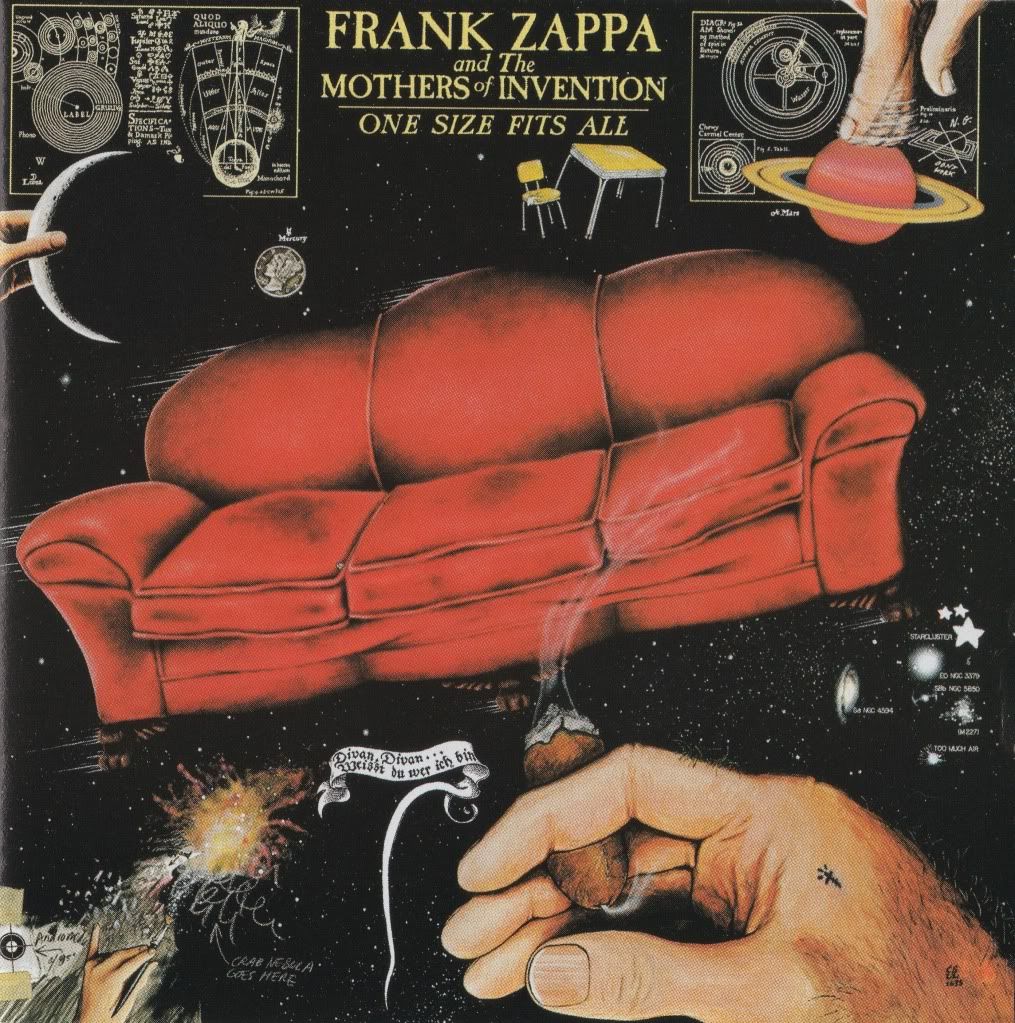
Frank Zappa and the Mothers of Invention - One Size Fits All


While his skills as a composer and guitarist are self-evident on everything I've ever heard by him, Frank Zappa hasn't ever really clicked with me as a personal favorite.  I think it might have something to do with the tension between his obvious seriousness and discipline as a composer and player but the apparently complete lack of seriousness when it comes to thoroughly crafting an album or imbuing his songs with anything but the most lightweight of messages.  I know, I know--it's just how Zappa is, but the slapdash composite of dense jazz rock, rock and roll parody and novelty song that makes up most of his fans' favorite albums just hasn't satisfied me to the point of admitting that any of them are really great.

One Size Fits All is about as enjoyable as others I've heard, though.  The dense, twinkling jazz rock that initiates the album with "Inca Roads" is my favorite part; these compositions are fluid, full of little ostinati and vibraphone/vocal runs that precariously and quickly speed through a jaw-dropping number of notes.  Zappa could always build a band, and in terms of musicianship, there are virtually no chinks in the armor here, especially in the rhythm section.  For his part, Zappa's playing runs the typical mix of able but jammy blues-inflected lead guitar interspersed with some more interesting standout ideas.  For example, his fun but repetitive fuzz solo on "Po-Jama People" sounds really familiar, while the twiddly clean riff near the end of "Sofa No. 1" sounds like only Zappa could have written it.  Obviously, I prefer the more peculiar and idiosyncratic stuff, and there's at least an adequate amount of it here, thanks to the late-game clutch pull of "Andy," with more ridiculous vocal arrangements, freely-flowing ideas, and a little bit of atypical guitar playing. 

Though I don't really find the songwriting especially consistent, the sound on this album definitely is--wide open, major seventh, ninth and eleventh chords give the music a happy feel and provide a lot of roaming territory for the vocalists, which are another strength--Zappa's proficient but limited voice is aided quite ably by some of the African American members of his band, including a welcome guest appearance by Johnny "Guitar" Watson on "San Ber'dino," which almost sounds like ELO (sorry, bigtime Zappa fans!).  As a much bigger fan of groups from the Canterbury scene (most of which are undeniably influenced by Zappa's earlier work), I can hear traces of Hatfield and the North in some of this album's intricate jazz rock, but the idea of a group from Canterbury managing to successfully include black American music in their blend is laughable.  In this way, Zappa is to Canterbury almost like extreme fascism is to extreme communism--almost the exact same thing, but somehow fundamentally and permanently separate.  For me, at least, the Canterbury bands usually did a better job of looking at the big picture and creating really solid albums, even if the music gets a little darker and less "fun," and for some reason I find their sense of humor more compelling.  And the problem for me with Zappa's idea of fun, on this album, at least, is that most of the songs are merely just goofy and rarely cross over into a level of humor that actually makes me laugh--"Po-Jama People" seems to be trying to be satirical but the identity of Zappa's actual target remains a mystery to me, while the punchline to all of the verbosity on "Evelyn, A Modified Dog" is merely "arf."  I thoroughly understand that Zappa's "I don't give a shit" attitude is deliberate and is precisely what a lot of people love about his music, but for me it's more attractive in theory than in practice.  He does come close, though, on the rock and roll bum send-up "Can't Afford No Shoes" with "maybe there's a bundle of rags that I can use."

Maybe I just need to keep sorting through the favored albums of the Zappa-converted for a couple more to help me really appreciate the man's music and humor, but for now I prefer the more successful satire of We're Only in It for the Money and Hot Rats is still my go-to for concentrated playing and compositions.  Recommendations welcome!

Get it here.

Wednesday, August 24, 2011

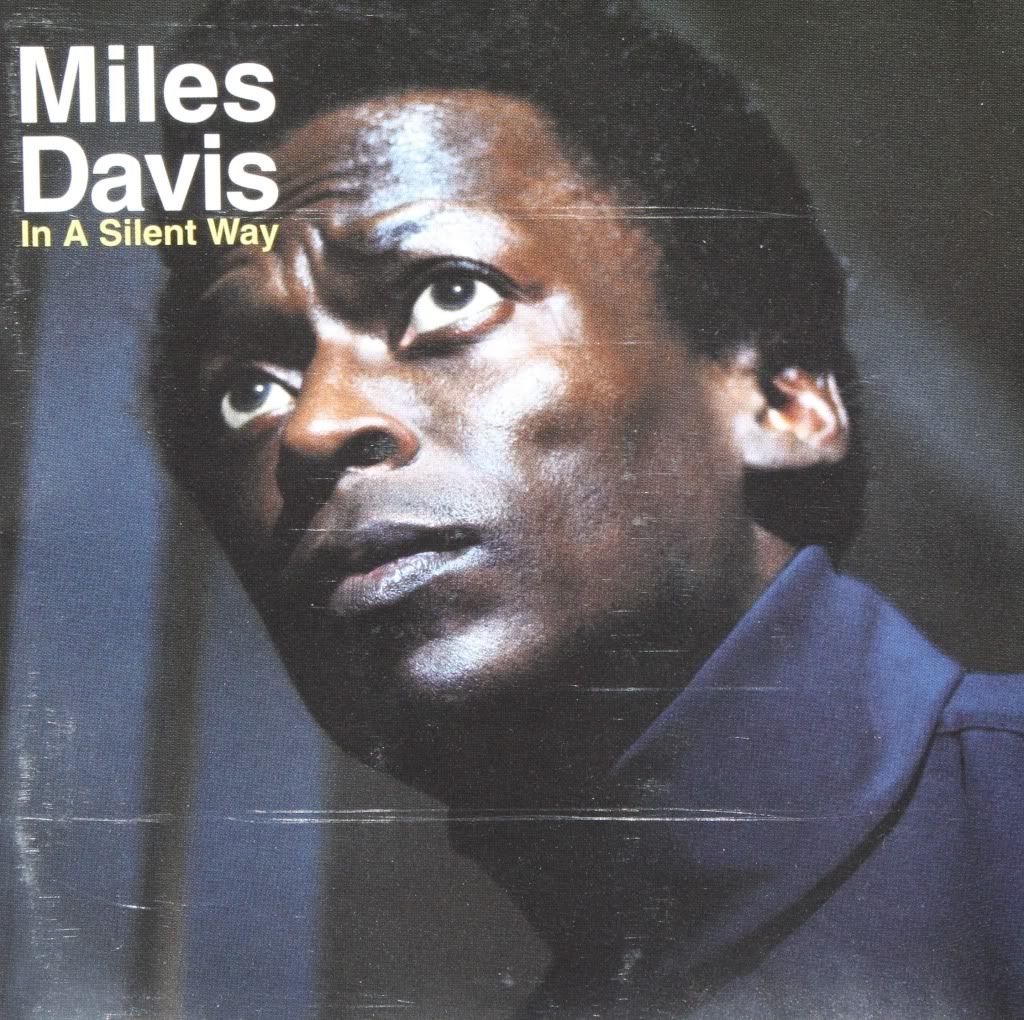
Miles Davis - In a Silent Way


From the intense turtleneck cover shot to the audacity of consisting of only two tracks to the brilliantly succinct poetry of the title (as in, "do that in a silent way" and when used like "I'm in a real bad way"), it's easy to see that In a Silent Way is a classic Miles Davis album.  With a lineup that would become a virtual who's-who of jazz fusion music by the end of the 70's (including Chick Corea, Herbie Hancock, Tony Williams, Joe Zawinul, and John McLaughlin), the album is literally a first statement of the vocabulary that many other early fusion efforts reiterated close to verbatim.

From Hancock's (or is it Corea's--they both play electric piano) dissonant opening chord cluster to the last ringing guitar notes, the album is like a warm bath of pure tone.  Historically, a lot is made both of Davis' unprecedented and extensive use of electric keyboards and electric guitar as well as his pioneering introduction of rock rhythms into the jazz idiom.  Listening over 40 years later, when all of these things are commonplace, I'm struck--not with surprise at Davis' irreverent artistic choices, but more by a sense of how much better he did it than countless other followers who managed to turn fusion from an exciting and edgy novelty to a naughty word (much like "prog," hmmm...) in fewer than 10 years.

What's the secret?  It's hard to say, but near the top of my list has got to be taste, variously on the parts of Davis as a bandleader, the rest of the players, and producer Teo Macero.  As an avowed fan, I'll take the risk and say that I appreciate Miles Davis even more as a bandleader than I do as a player.  All you have to do is look at the careers he helped start or further (from the first and second great quintets on through the 70's) to see that he had a keen ear for talent, an ability to properly employ his bandmates, and an uncanny ability to nurture them and propel them to successful, often visionary careers of their own.  While most of the artists in this band weren't fresh (McLaughlin was practically unknown, though), Davis puts them to work with impeccable taste, fusing and contrasting two electric pianos, using organ as both a tonal and atmospheric device, slowing the guitar down in its statement of major melodies and laying out its full harmonic range, and employing an unbelievably great rhythm section (Dave Holland and Tony Williams) in some of the most boring and repetitive patterns seen in the history of jazz--because it's what the compositions need.

On the part of the players, infallible taste crops up again and again in their willingness to leave space for each other (after all, it's a pretty big band--show me footage of Davis from the 70's or 80's ever attempting to wring so much quietness out of such a large ensemble) and space for nothing at all.  Players take relatively long breaks between phrases, allowing the timbral subtleties to contrast without competition, and the keys and especially the guitar manage to produce enough jaw-dropping fills that full-fledged solos seem unnecessary.   Wayne Shorter's role on soprano saxophone, limited though it is, has got to be one of the most restrained and atypical soprano performances I've ever heard.  For his part, Miles provides undeniable cool (even quoting [or self plagiarizing, depending on how generous you want to be] his landmark "So What" solo in "Shhh/Peaceful") as well as just a bit of speed when the energy ramps up.  The entire performance, really, exudes an air of collective purpose that melds Davis' well-established cool with a sort of spare, breath-holding restrained energy--while few jazz albums even have a collective purpose, even fewer actually pull it off.

Likewise, Teo Macero's contributions to this (and numerous Davis albums to come) are integral to the album's success.  While I feel it sort of breaks the final studio album's inimitable spell, the Complete In a Silent Way Sessions box set makes obvious the differences between the traditional ballad style and final album version of "In a Silent Way" (the song) as well as the longer jams and final versions that were "It's About That Time" and "Shhh/Peaceful," differences which seem like insurmountable gulfs.  Macero's editing provides subtle but crisp breaks that punctuate the otherwise homogeneous extended tracks, especially within "Shhh/Peaceful" (listen for those lower-register electric piano riffs) and right before the "In A Silent Way" theme is repeated right at 15:35 in the second track--these moments of gentle juxtaposition, heretical as they may be to jazz's organic and spontaneous origins, are pure magic.  While the entire album has been accused of not going anywhere (though I believe describing the music as ambient or even proto-ambient is a laughable proposition; let's not confuse a de-emphasis on obvious melody with a genre solely focused on exploring one--and only one--of music's many great characteristics), I think the beauty lies in the subtlety--crank up the sound to soak up those glorious analog keys and guitar, and by the time the crescendo in "It's About That Time" happens, you know that things are changing.  I think Macero's editing is again crucial, since the songs--long though they are--use vaguely classical structures to state themes, travel elsewhere, then return.

Like I hear it is for many people, Miles Davis was one of the very first jazz artists that got me more interested in trying to understand and enjoy the genre.  The more I explore avant-garde and free jazz, the more I realize that while those movements are aimed at stretching the expressive, compositional and pure sound aspects of jazz to the fullest extent, Davis never really went that direction and was almost always focused on jazz as a pop form.  Now, both approaches are equally valid and I'm not saying "pop" as in lightweight, lowest-common-denominator or shallow, but rather as an ideal of accessibility and an attempt to acknowledge what the people are listening to.  As he began to transcend the trappings of cool, modal and bop forms of jazz, Davis attempted to combining jazz with other forms of popular music, including rock, blues, R&B, funk, and folk music from around the world in effort to keep the genre evolving.   While it worked brilliantly more than once for Davis and nearly as well for some others, it's debatable whether it was healthy for the genre's identity in the long run to continue attenuating its key characteristics and adding more and more generic content (much like what's happened to country music since the 70's).  Stuffy historical observations aside, In a Silent Way remains a revelatory experience with every spin and a great jazz album for people who don't even like jazz. 

Thursday, July 7, 2011

Joni Mitchell - For the Roses


If ever there were a transition album, it's got to be Joni's 1972 long-player, For the Roses.  In almost every way, it straddles the line between her earlier folky roots and her later dive into jazzy pop, while never reaching the peaks that both eras achieved.  Moreover, the album is a reminder of the delicate balance (since it's largely absent here) between all of Mitchell's different aspects that occurs on her best albums.

Attractive as the aforementioned combination between folky, acoustic Mitchell and slick, jazzy Mitchell might sound, the songs on For the Roses mostly fail to gel.  In my opinion, it's mostly down to a dearth of good melodies and hooks.  Although all classic Joni Mitchell albums seem to thrive on ear-shocking chord changes and surprisingly far-ranging melodies, For the Roses illustrates just how fine the line is between a novel, ear-surprising vocal melody and one that just sounds strange and is ultimately unmemorable.  The inauspiciously preachy allegorical piano ballad opener, "Banquet," demonstrates this as good as any other tracks ("Lesson in Survival" and "See You Sometime" suffer similar fates)--the sounds that made "The Last Time I Saw Richard" such a haunting closer to Blue sound here like an artist looking for inspiration in uncommon chord progressions but not bothering to listen to hear if the results are compelling.  And yet, we get to hear Mitchell experimenting with some of the deep vocal vibrato that she'd later put to great use on Court and Spark and The Hissing of Summer Lawns.

Similarly, we get the first appearance of the saxophone and flute arrangements that typify those next albums, but in a much more subdued and organic setting.  The results are certainly sonically interesting, as on the wah-guitar, saxophone and synthesizer arrangements "Cold Blue Steel and Sweet Fire," the jazzy flute harmonies and bass clarinet of "Barangrill," and the tremulous vocal arrangements of "Electricity," among others.   It's just a pity that none of these songs presents a melody or lyrical hook that Mitchell had already demonstrated she was capable of on her previous two albums.  The latter, though, marks her turn toward the character sketches that would dominate her later 70's work, though it also heralds more preachiness directed toward the music industry, which we get in smaller doses here than on later albums.

Fortunately, it's not all bland--"For the Roses" is a nice mid-tempo acoustic guitar-based piece, while "You Turn Me On, I'm A Radio" calls down some much-needed catchiness in both words, structure and melody.  "Blonde in the Bleachers" (especially the last 30 seconds) and "Judgment Of the Moon and Stars" aren't necessarily great tunes, but their neo-Mitchell arrangements reach lush and stimulating heights.  Overall, For the Roses fails to impress particularly because of where it resides in the Joni Mitchell chronology.  Perhaps Mitchell was contractually rushed into writing and recording the album when she didn't quite have many ideas fully fleshed out (sometimes it's better to wait until you have something to say before trying to say anything at all), or maybe the album just needed to happen in order for Joni Mitchell the artist to progress into what was to come.  Either way, this album's mostly of interest to the already-converted and probably won't grab any newcomers.

You can get it on CD here.

Friday, June 24, 2011

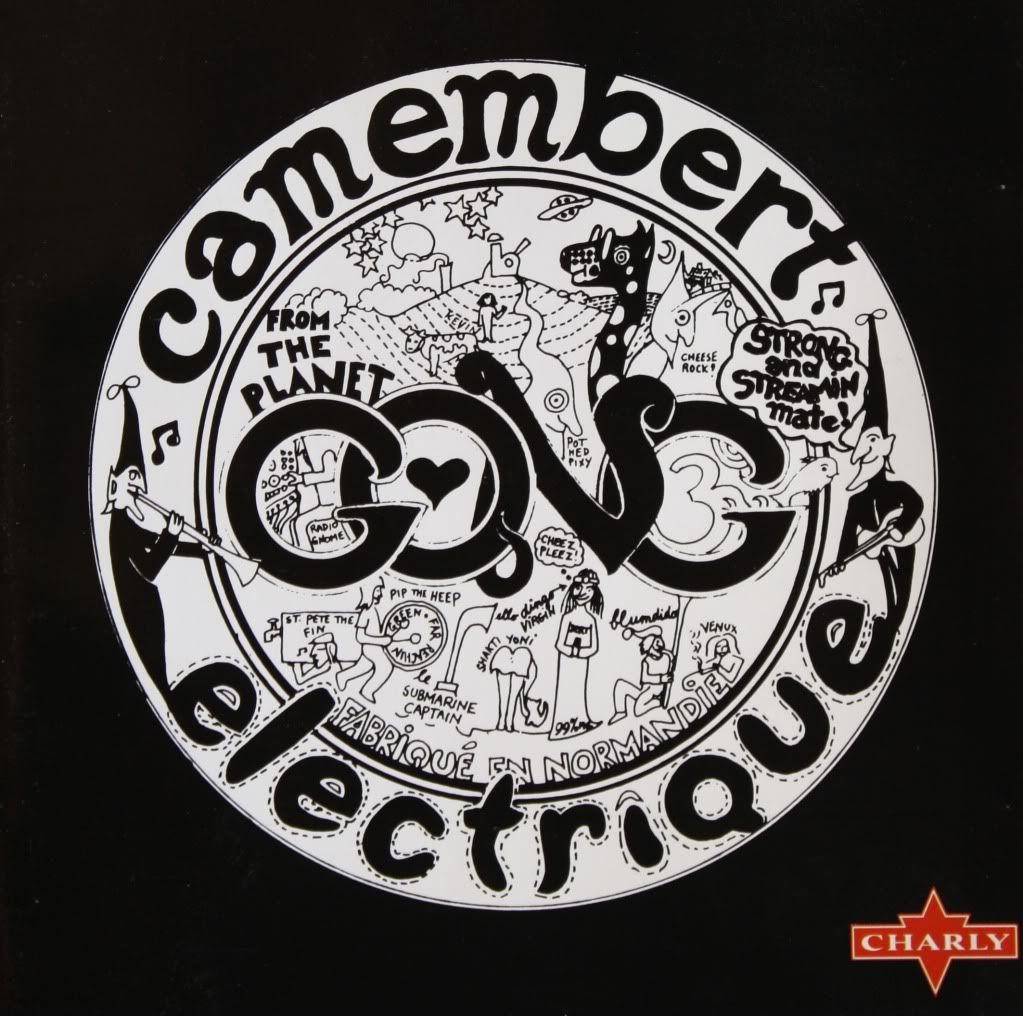
Gong - Camembert Electrique


Back to the Canterbury scene, but certainly not too far of a step away from free jazz or even RIO, here we've got one of the all-time great Canterbury albums and one of the most frenetic psychedelic rock albums of the early 70's.  Even though he's not British, Aussie Gong bandleader Daevid Allen was a member of that most embryonic of Canterbury groups--The Soft Machine--which, along with other proto-Canterbury group The Wilde Flowers, was at one time home to members of most of the scene's later core bands.  If ever there was a hippie, it would be Daevid Allen--he was famously refused reentry into the UK when attempting to return from Europe because of overstaying his visa on a previous trip, so he remained in Europe (mostly France) and formed Gong.  It's for this reason that Gong is one of the most (if not the most) international of the original Canterbury bands. 

Although Cambembert Electrique isn't the Gong debut (that honor goes to 1970's Magick Brother), it's undeniably the beginning of what most people consider the classic form of Gong--the one that concerns itself with Allen's hippie mystical and anti-establishment vision shrouded in mythology of teapots, Pothead Pixies and mythical planets, all displayed over some of the craziest jazz-influenced psychedelic music to be heard in the entire era.  The story of the planet Gong is first broached in the sound-effect heavy opening introductory snipped voiced by the "Radio Gnome"--from there on out, though, the album is a nearly nonstop barrage of weirdness, humor, noise, rock and jazz that knows no equal--in the Gong discography and elsewhere.

"You Can't Kill Me" offers a pretty solid template for the album--Allen's winding but catchy compositions feature a lot of repeating figures and ostinati, looping rhythms and noise, while the lyrics hilariously toy with ideas of reincarnation and karma, while his partner Gilli Smyth contributes heavily-reverbed high-pitched moans, groans and what became known as "space whispers."  Though on first listen this music might sound like utter chaos (well, it is chaotic, but not necessarily utterly), closer attention reveals an almost punk rock-like attitude supplemented by Didier Malherbe (distinctly "French" saxophone style) and Pip Pyle (unparalleled prowess on the drum kit, later to become one of the most experienced Canterbury journeymen) both of whom seem to have no difficulty negotiating Allen's compositions and their innumerable and quickly-transitioning ideas.  Though the tumultuous Gong lineup later featured the more-lauded guitar hero Steve Hillage on lead guitar, I find Allen's guitar style particularly impressive for its audacity (just listen to the noise he conjures up on "You Can't Kill Me").

The album continues to plow an increasingly eclectic furrow with the organ-driven music hall "I've Been Stoned Before," where Allen goes from comical farce to sounding like he's going to shred his vocal chords in torment in just about 2 1/2 minutes.  "Mr. Long Shanks" (see above video) transistions from gleeful carnival jazz rock ("The man in the parlor/you know what he's after") to a Gilli Smyth space whisper tour-de-force at its halfway point, while "I Am Your Animal" finds the female vocalist projecting a more aggressive (even x-rated) performance over Allen's spiky repeated riff, which morphs into a rapid-fire vocal barrage that ends with Allen madly yelling about licking the moon.

After a couple of sound collage interludes ("Tu veux un Camembert?") the band returns with the forward-looking (to later Gong albums) "Fohat Digs Holes in Space," which spins an atmosphere out of Allen's "glissando" slide guitar--the part when he seamlessly drops from the eerie high register into the midrange before 40 seconds is breathtaking.  I'm not sure if glissando is really the correct word for the playing style, but that's what Gong fans have decided to call it--anyway, it's that echoey spacey sound that starts about 30 seconds in.  The song's eventual rock riff is one of the album's catchiest, with Allen extolling some beat-cum-hippie poetry ("mirror mirror, on the wall, who's the biggest fool of all?") before another overdriven sax and lead guitar breakdown.  The beginning of "And You Tried So Hard" is the closest thing to folk rock to be found on the album, though it quickly weirds itself out with more Gong flavor.  The album closes just as powerfully as it opened with "Tropical Fish"--one of the band's most effective mechanisms is doubling the melodies on guitar and sax for a stabbing effect--with a heaping handful of bizarre riffs and lyrics ("seem like a typical witch to me/seem like a tropical fish to me"), a spaced-out interstellar desert in the middle ("I couldn't believe my eyes....") and closing with the almost martial invocation of the moon goddess, "Selene," and a recapitulation of the album's earlier machine-gun lyrical themes.  The Radio Gnome returns to remind you that the ride's only just beginning, and you'd better believe him.

Although the full on Gong mythology isn't in narrative form here, the lyrical themes set the scene for the epic Radio Gnome Trilogy to come.  Though Gong may have equaled the fun, trippiness and quality and ideological resourcefulness found here on later albums, they did it from a spacier angle, and sadly this album is in many ways one-of-a-kind with its energy, barrage of ideas, and noisy edginess.  It manages to incorporate a lot of jazz influence without committing to long-form jazzy passages (like so many later groups, including Gong would do) by radically changing from idea to idea in short periods of time.  Their arrangement style here is one that was certainly emulated by later Canterbury bands, and it's easy to tell that Allen's association with Robert Wyatt and Kevin Ayers was a mutually-enriching one; his idiosyncratic sense of humor obviously influenced to a large extent the sense of whimsy and insubordination prevalent in a lot of the Canterbury scene's later music.  My only complaint with the Charly CD reissue of this album is sound, which is quiet, treble-heavy and not as full as I imagine it should be.  Let's hope for a good remaster.

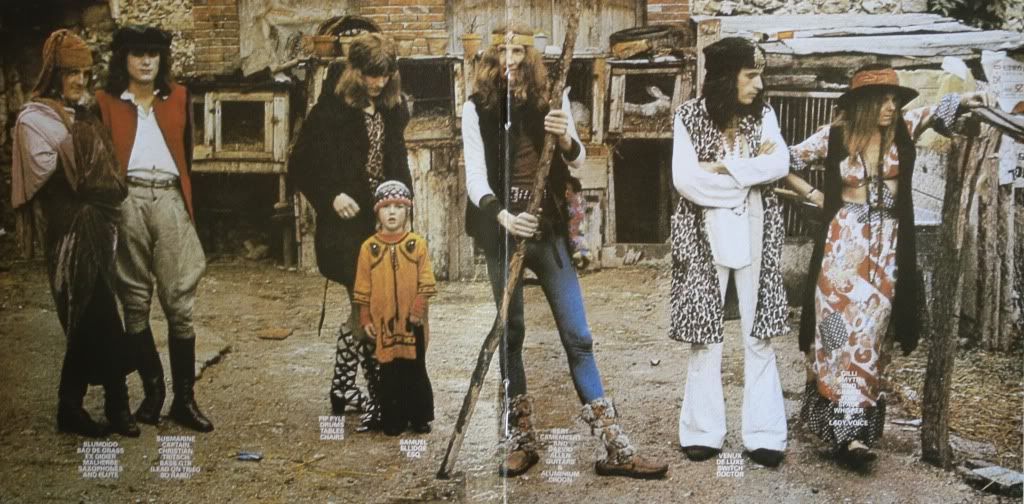
Until then, you can get it here on CD or MP3.  Oh, and if you listen to any of this and think Gong don't sound like typical hippies, take a gander at their ridiculous get-ups.  Allen appears not to mind being stapled in the face...and that's quite a wizard staff.
Tuesday, June 21, 2011

Aksak Maboul - Un Peu de l'Âme des Bandits


After a week that saw reviews for Brazilian pop, 60's folk and French pop, I feel it's time to travel back out into the...beyond.  There's so much to say about this album, Belgian group Aksak Maboul, and RIO (Rock In Opposition) that I almost don't know where to start--let's begin with RIO.  Rock In Opposition, though it's sometimes loosely used as a genre tag, was originally actually a festival organized by British group Henry Cow (with especial effort on the part of drummer Chris Cutler) in order to promote avant-garde rock groups selected by Cutler (eight in total) that were receiving little to no support from commercially-minded record companies.  Though the movement was short-lived, it garnered a fair amount of press for the groups and, more importantly, facilitated the release of some of the most challenging progressive music produced throughout the 1970's and beyond.  Since the loose movement became inactive in the 1980's, you're more likely to hear RIO referred to as a music genre used to describe either music that members of the original RIO groups have made, or music that is similar to, for example, Henry Cow's--dense, avant-garde, forward-looking, often with healthy doses of modern classical and jazz influences, though I personally don't find the tag to be the most helpful.

Belgian group Aksak Maboul was part of the second group of artists invited to RIO and was primarily the project of Marc Hollander (previously of CoS and founder of record label Crammed Discs).  Aksak Maboul's 1977 debut was much more of a solo effort, with Hollander playing most of the instruments (a lot of keyboards, wind instruments and drum machines)--it's a playful, eclectic and enjoyable outing, but not today's album!  In 1980, Hollander was joined by Henry Cow alumni Fred Frith and Chris Cutler and a few lesser-known European musicians for this, "their" second and final album.  Though Aksak Maboul wasn't an original RIO group, I picked this album to introduce RIO because it's one of the most consistent, representative, and simply best RIO has to offer.

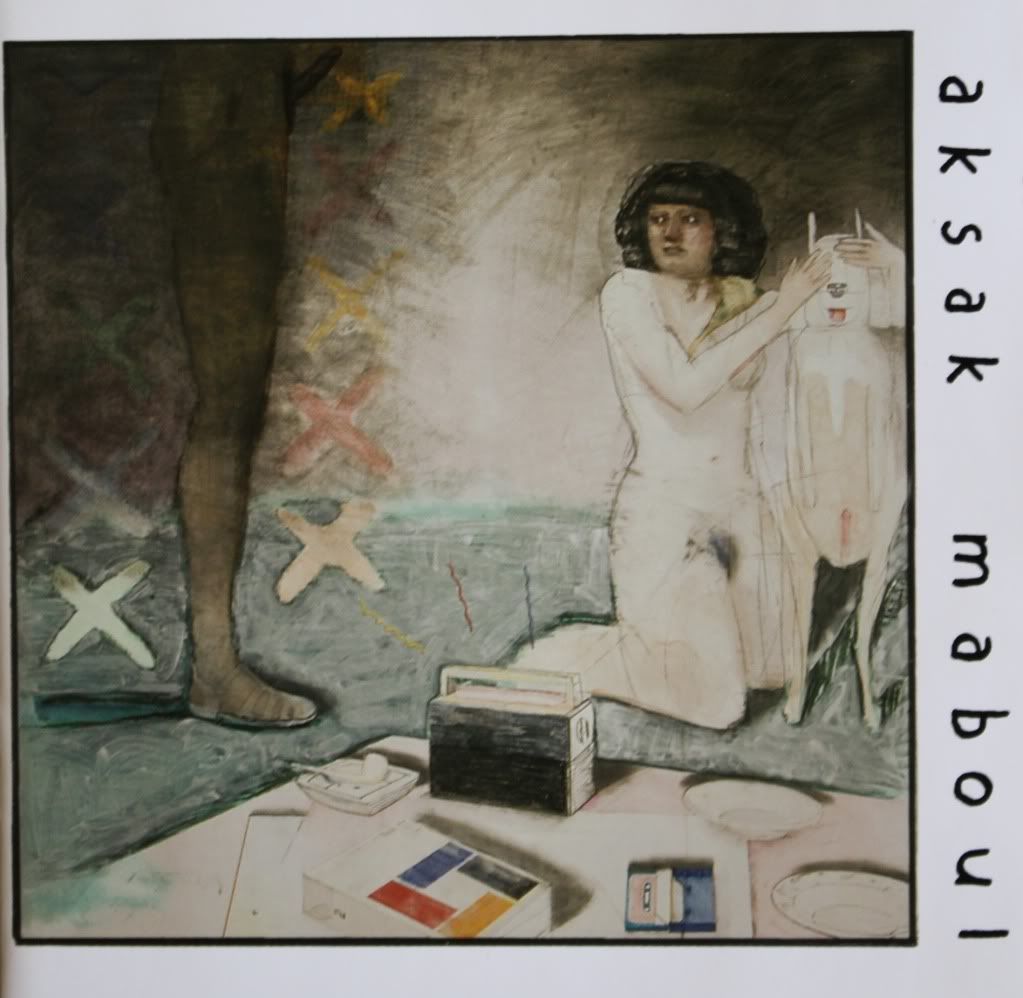
You know (or at least hope) from the ridiculous cover (depicting no fewer than two erections) that this album is going to be a crazy trip, and it certainly doesn't disappoint.  Personally, I find this album extremely satisfying because of the experimentation--most all of the songs are based on at least one describable experiment, and the results are not only challenging, they're often quite listenable.  A great example is the opener, "A Modern Lesson" (please, oh please, watch the video), which manages to deconstruct a classic blues riff with dissonance, drum machines, and wacked-out female vocals in under 6 seconds.  As the track progresses, the wind instruments enter (along with some pinball machine recordings) for an interlude, the main riff returns, then the bass and tempo increase and Hollander's electronic keys and Frith's detuned guitars amp up the energy for a driving finale that sees an incredibly complex wind/key/string arrangement brimming with head-spinning counterpoint and--what elevates this beyond similar attempts--a memorable melody.  "Palmiers en Pots" radically switches gears with a tango supposedly composed of (get this) pieces of several popular tangos, cut up with scissors, rearranged, and performed in random order.

That Fred Frith was on an unstoppable roll in the early 1980's, I'll never deny--his fingerprints (as musician, composer and producer) are all over this album, and in some ways it's better than its Frith solo contemporaries as his ideas (some heard already heard on other albums) are supplemented and developed by other musicians.  Though the resulting disc doesn't exude quite as much of Hollander's personality as the Aksak Maboul debut, its diversity is one of its greatest assets--"Geistige Nacht" features a frantic sax-led melody with some great free jazz soloing in which the sax and eventually Frith's guitar trade squawks, and "I Viaggi Formano La Gioventu" features a snaking Middle-Eastern melody doubled on wordless vocal, violin that's strongly reminiscent of Frith's other 80's work, though that handclap track buried in the mix toward the end of the song shows up again on Cheap At Half the Price's "Absent Friends."   "Inoculating Rabies" is probably the second best experiment on the disc, blending a balls-out punk riff driven by Frith's and Cutler's unfettered noise with the addition of a delicate woodwind arrangement.  It's probably the best (if not only) progressive commentary on and appropriation of the burgeoning punk movement I've heard so far, which, by 1980, had all but swallowed what little market experimental progressive music like Aksak Maboul might have cornered.  It's pretty ironic how loud Frith, bass and Cutler get considering how "obsolete" punk supposedly made their musical contributions.

The 23-minute-long "Cinema" rounds out the album with long-form composition interspersed with free improvisation (there's a lengthy and wicked cello solo as well as a pretty epic Fred Frith guitar solo), recording collage, a recurring sinister-sounding theme, some really heavy jamming from the full group (Cutler's drumming here is the liveliest I've heard since Henry Cow's last album, and recently, too).  The melodies and ideas aren't quite as immediate as they are on the shorter songs, but the added space allows the group to accomplish some things that it couldn't in five minutes, and it gives us more to uncover on later listens.  Pieces like this often seem to divide the camp of potentially interested listeners--take longer than five or six minutes and some people will complain about having their time wasted.  If there are enough different ideas being developed, though, I don't mind it taking a while--as much as I'm leaning toward shorter songs packed with briefly-stated ideas these days, I can appreciate a piece that actually allows listeners to engage with and unravel the ideas being presented during the piece, rather than after numerous plays.  While Hollander's personality is somewhat obscured by the thickness of the production and arrangements, it's perceptible on repeated listens, especially if you've heard his earlier works.  I really enjoy his mechanical-sounding drum machines and keyboard lines, not to mention his contributions to the horn sections.  Let's hear it for RIO, and this week let's keep going down the rabbit hole.


Available here on CD, and here on MP3.

Friday, May 20, 2011

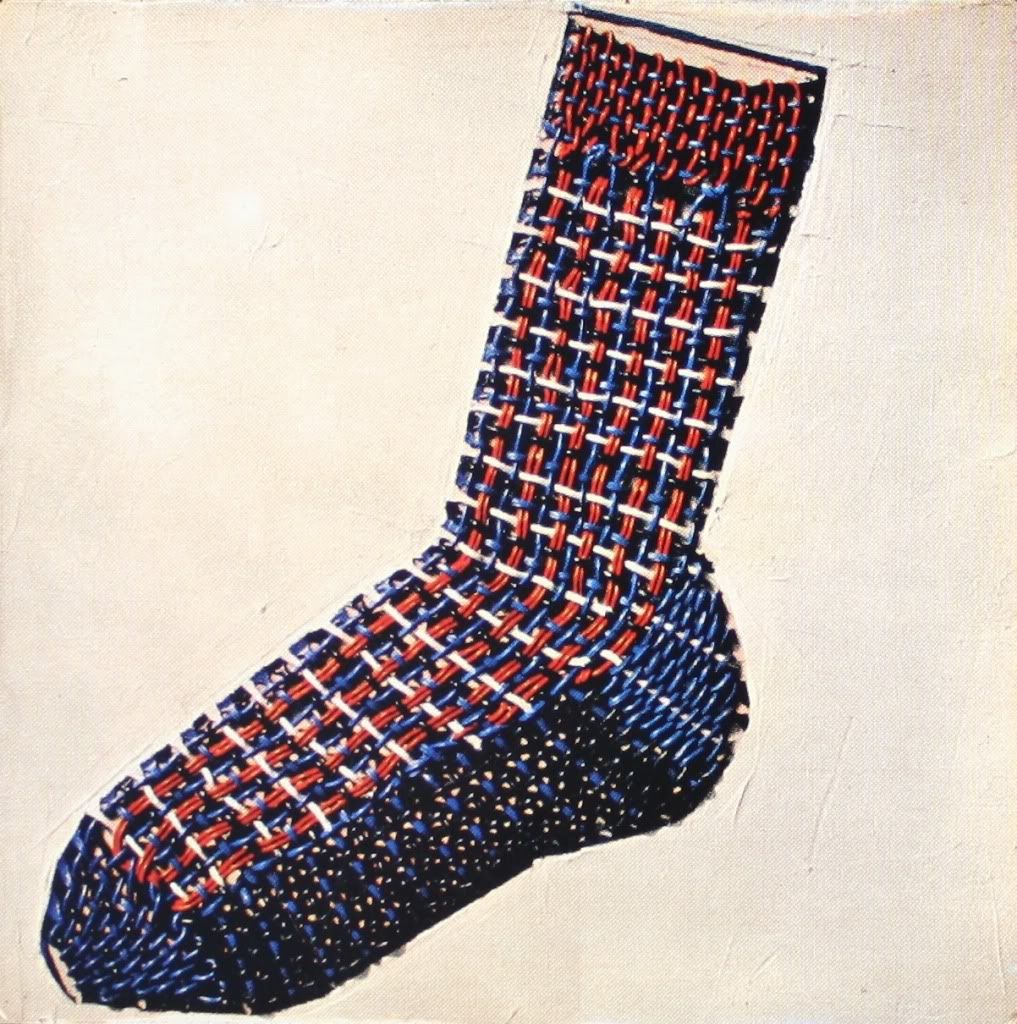
Henry Cow - Leg End


There is apparently some debate as to whether Henry Cow can accurately be deemed part of the Canterbury scene as an actual physical scene, but to me they're both clearly a part of the scene (due to guitarist Fred Frith's geographical origins and the band's association with Robert Wyatt both live and on his Rock Bottom and Ruth is Stranger than Richard albums) and part of the Canterbury scene as a genre of music that blends rock, jazz, folk, experimental and a playful sense of whimsy.  Henry Cow is one of my favorite groups in or out of the Canterbury scene for the complexity and dense melody of their music, the way each member of the group contributes in an identifiable and irreplaceable way, for the way they blend avant-garde compositions with improvised music across their sparse but evolutionary discography, and for the fact that their music remains challenging but listenable no matter how many times I return to it.

Leg End is the band's 1973 debut--it doesn't take too many seconds after the rimshot that kicks off "Nirvana for Mice" before it's obvious that Henry Cow is probably the Canterbury band most influenced by avant-garde modern classical music, which shows in their compositions' weaving concentric circles of odd-metered counterpoint as well as a hefty dose of atonality and dissonance lurking behind and within the jazzy melodies.  The sound is saxophone-heavy, with at least two horns at most times, and Fred Frith's guitar is often double-tracked, while some synthesizer fills in the background not covered by the manic drums and restlessly probing bass lines.  "Nirvana..." sort of sums up a good part of the band's mission on Leg End, consisting of a vibrantly intricate composition which quickly dissolves into a jam over which Geoff Leigh's saxophone runs rampant in an ecstatic free jazz testimony.  Interestingly, the rest of the group's vamping mechanism during Leigh's solo acts as a sort of improvisational version of the composed sections, as each band member sticks with a different meter and improvises accompaniment.  The parts interweave, at times synchronizing and at other times sounding rather tenuously held-together.  For me, it's exhilarating.  If you weren't already awake, the song-ending staccato blast will ensure either your attention or annoyance (these guys are admittedly not for everyone).

The rest of Leg End follows a similar path, though there is a superabundance of ideas, great variety in mood and melody, and some more surprises in instrumental arrangements, including flute, clarinet and Frith's violin.  The Tim Hodgkinson-penned "Amygdala" boasts an ever-shifting melodic structure that dabbles in the types of Renaissance style that is Gentle Giant's stock in trade, while the dark and cacophonous "Teenbeat Introduction" goes further down the free jazz rabbithole before swelling gloriously into Frith's "Teenbeat" composition.  "The Tenth Chaffinch" sounds very much like one of the group's live improvisations (mostly unreleased until the release of the box set The Road), blending musique concrete (pre-recorded sounds) with totally atonal, unstructured improvisation.  The album closes with an odd track, "Nine Funerals of the Citizen King," which actually features a vocal arrangement.  Though the music is extremely dense (perhaps even impenetrable on first listen), further listening reveals melodic motifs that pop up in "Teenbeat" and return again throughout "With the Yellow Half-Moon" and again in "Nine Funerals..."

For me, Leg End and the rest of Henry Cow's discography represents the real deal when it comes to progressive music--genre is irrelevant, and the band unflinchingly incorporates modern musical concepts into a sound that assaults the ear with surprises at every turn but remains a fun and energetic (especially Chris Cutler's drums, which rival Robert Wyatt's Soft Machine-era drums in energy and creativity) listen with innumerable moments of twinkling beauty.  I've heard the band's earlier material compared with Frank Zappa and the Mothers' albums from the same period, and while I can see a general stylistic similarity (jazzy, complex compositions, lots of noise and craziness), Henry Cow sounds so much more out-of-this-world and surprising to my ears, while Zappa's compositions (and especially his guitar playing), idiosyncratic as they are, always remind me directly of something I've already heard before.  This album is the perfect example of music that doesn't need lyrics--when it sounds and feels this indescribable, why limit it with the trappings of lyrics?

The whole Henry Cow discography can be found at Recommended Records, which is owned and operated by drummer Chris Cutler, or here, if you don't want to pay in GBP.

Saturday, April 9, 2011

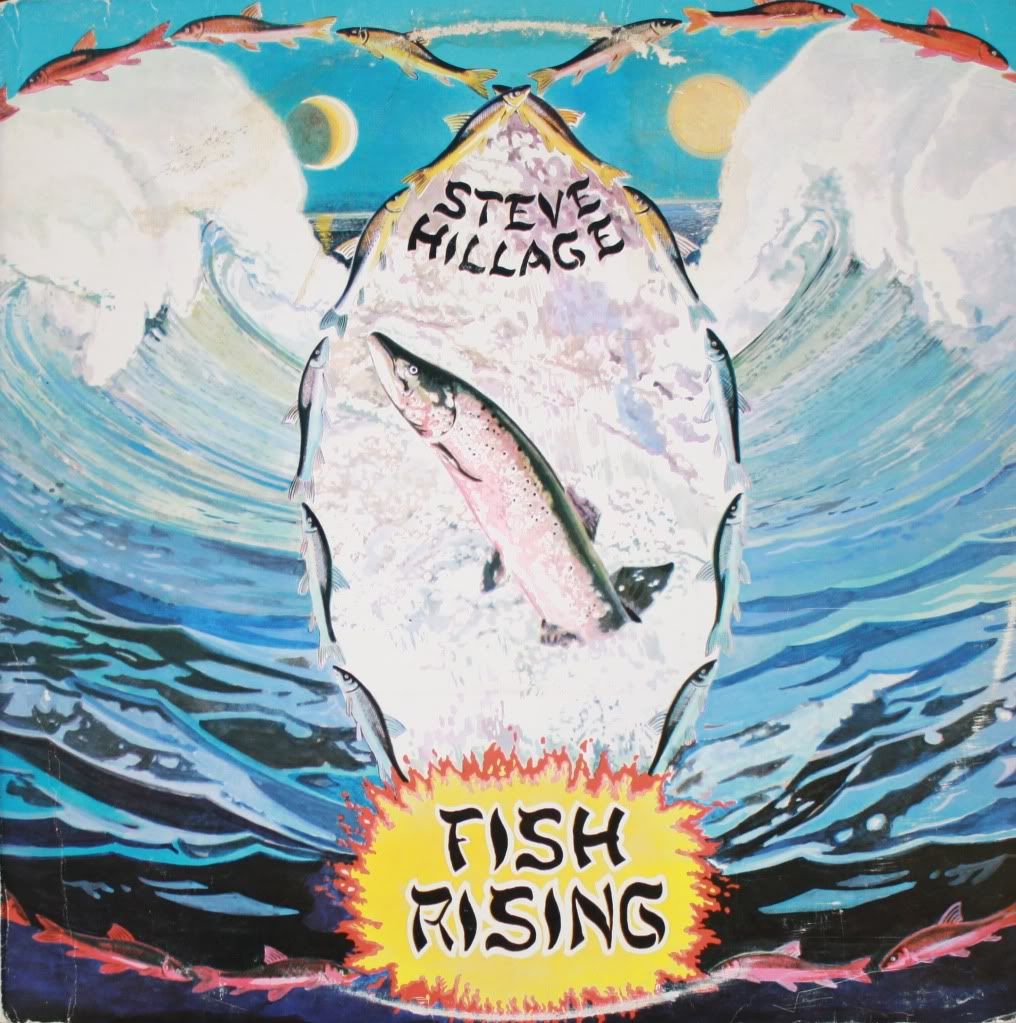
Steve Hillage - Fish Rising


Here's another later Canterbury favorite.  Due to its associations with jazz, the Canterbury scene was never as guitar-centric as mainstream rock.  Nevertheless, Steve Hillage is certainly one of the biggest Canterbury guitar heroes and probably the most accessible one in terms of his style and technique.  He was a member of both Arzachel and Khan, then joined Gong in the early 70's.  This, his first solo album, features numerous Gong members as well as Henry Cow's Lindsay Cooper on bassoon and Egg/Hatfield and the North/National Health keyboardist Dave Stewart.

Like a lot of the classic Canterbury albums, I treasure this one for its variety, intelligence and light-heartedness.  1970's progressive rock music is often associated with bloated epics, overseriousness and romantic-period leanings, but I believe that the music on albums like this is actually more progressive in the literal meaning of the word--yes, there are epics (steer clear if you don't like long songs!) but the primary goal is advancing music past the established forms and status quo.  Hillage manages to challenge us with his compositions but simultaneously provides some of the tastiest guitar ever laid to tape.

The opening suite is the longest on the album, building from gentle psychedelia with jazzy soloing to a harder sound, more reminiscent of Gong.  This is much more centered on Hillage, though, and the compositions are organized around nice, identifiable guitar riffs and themes, though there's a great ostinato section with some furious soloing by Stewart.  "Fish" and "Meditation of the Snake" are shorter experiments, the first being a fast-paced Gong-like discussion of different fish and the second being a delay-guitar soundscape.

Side two is more hypnotic and repetitive than the first--"Salmon Song" may be my favorite track, with a spacey riff and a barnstorming set of dual solos.  Similarly, "Aftaglid" features several repeating patterns that act as platforms for Hillage's guitar soloing.  The key to these long songs is organization, as the mood segues seamlessly between gentler, quieter parts and heavier soloing, never wearing out each riff and always following with a change of texture.

The only bad thing about this album is that I bought three more Steve Hillage albums hoping they'd come close and none of them quite match the glory of Fish Rising--I don't mind Hillage's voice, but the New Age lyrics get heavier and heavier-handed on later efforts, and though the more song-oriented sound is in some places successful, many of the guitar ideas are just restatements of things heard here and on earlier Hillage collaborations.  It's a bit disappointing, but this album is so good and so full of ideas that Hillage can't be blamed for being unable to match their breadth and quality on every other album.  At least we've got Fish Rising

Observant readers may notice that this one is another deep pull from my tiny but cherished vinyl collection.  Out of the few records I own, I have to say that this one sounds better in its remastered CD version; the vinyl is actually a bit muddy (not well-balanced between clarity and heaviness the way my Captain Beyond LP is), making it hard to catch the small details that this album is packed with--I think I know what's going on because I recognize the riffs but closer listening reveals numerous quieter passages and depth uncommon in guitar-oriented rock. 

Get the CD or MP3s here.

Friday, April 8, 2011

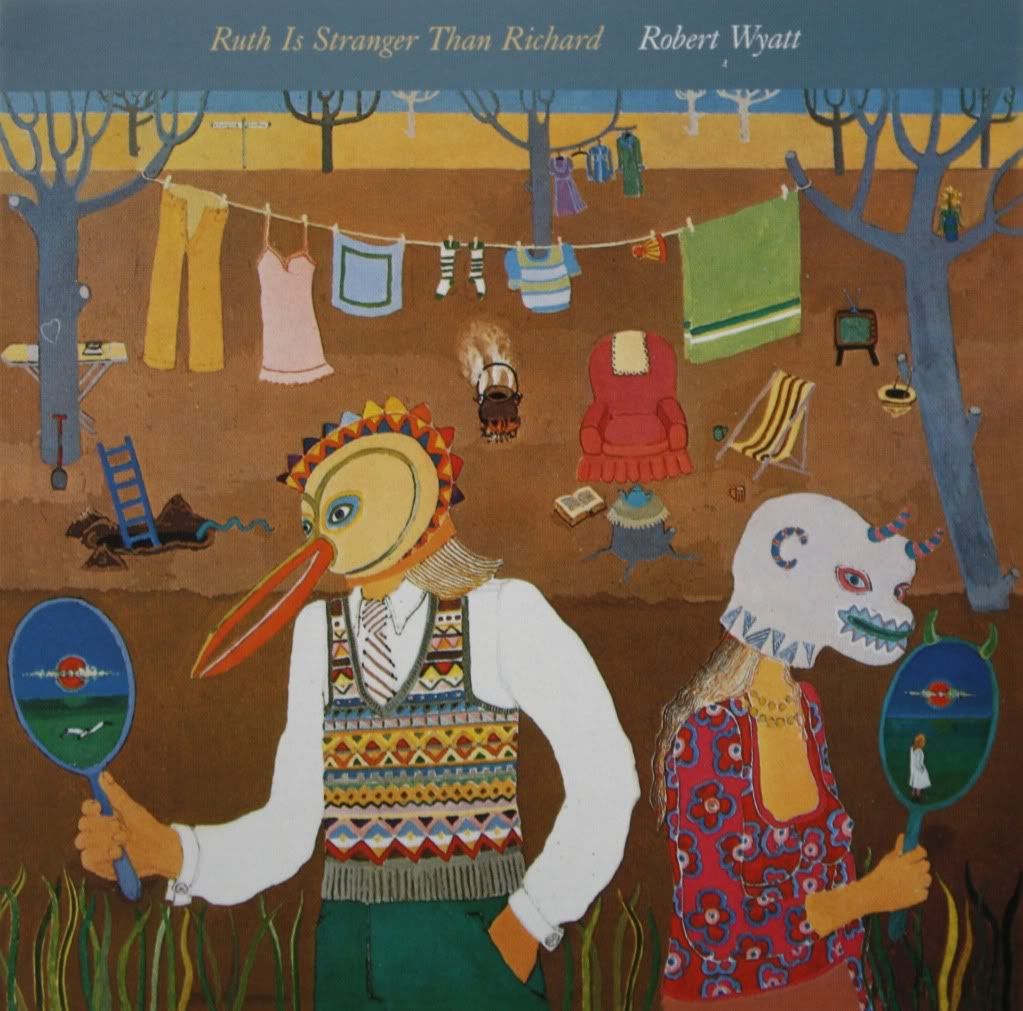
Robert Wyatt - Ruth Is Stranger Than Richard


Robert Wyatt's first album after the career-defining Rock Bottom is not likely to satisfy any relative newcomers looking for a reprise of its predecessor's dark catharsis and cohesive brilliance.  To longer-term initiates, though, it's a solid representation of what's most often expected from Wyatt from his Soft Machine days to his more recent work.  In many ways, I think this album sets the template for his material from the last 15 years in terms of the wealth of guest contributions (John Greaves and Fred Frith from Henry Cow, Phil Manzanera and Brian Eno) and its unevenness.

Like most of Wyatt's post-accident music, the sounds here are gentle but quirky, moodily psychedelic and jazzy in that classic Canterbury way.  The whimsical, melodically-challenging "Muddy Mouse" segments punctuate the first, "Richard" side of the album (or second, depending which version you have), breaking up the hypnotic groove and progressive sonic layering of "Solar Flares" and the equally languid, spine-tingling "Five Black Notes and One White Note," which plays with gorgeous intervals on a magnified level, similarly to some of his later work on Dondestan.  Wyatt accomplishes some of his best vocal trumpet impressions on the side-closing "Muddy Mouth" as well as some pretty humorous and casual singing regarding the world's oceans.

The other, "Ruth" side of the album is rather different, featuring much more conventional song structures, as on the jazzy sort-of-funny (mostly for the words) "Soup Song" and the slightly quirky blues of "Sonia."  "Team Spirit" is a more rocking, long-form song about a football that stretches into more interesting territory with some cool sonic excursions.  The dirge-like "Song for Che" closes the album on a fittingly valedictory note.

While Ruth Is Stranger Than Richard rarely succeeds in the same ways Rock Bottom did, it's pretty typical of later Wyatt--despite its status as a mixed bag of sorts, there is plenty of experimentation going on and it's a pleasant listen without ever being too hard on the ears.  If you manage your expectations and can forgive the album's inability to stack up to its predecessor, it'll be a good gauge of how much you'll likely enjoy Wyatt's later albums. 

Get it here on CD, or here on MP3.

Sunday, March 27, 2011

Fred Frith - Gravity


Gravity, Fred Frith's first post-Henry Cow solo outing, is an album positively packed with ideas.  From its through-and-through dance/rhythm concept, to the dizzying array of styles presented by each song, to the mottled textures of Frith's fantastically wrinkly songs to the man's all-over-the-place guitar playing, a lesser group would have make a career's worth of albums out of the ideas present on just half of these songs. 

The songs presented here tread middle-Eastern themes and modes ("Hands of the Juggler"), Scandanavian and British folk ("Don't Cry For Me" and "A Career in Real Estate," respectively), as well as more familiar Frith subjects like melodic jazz (on "Spring Any Day Now" I could swear he single-handedly created the template for all Nintendo music to come) and the avant-garde ("Year of the Monkey," "Crack in the Concrete").  We also get a taste of classic Canterbury humor with a totally wonky-melodied but somehow recognizable rendition of "Dancing in the Street."

I think what sets this apart from other 80's (and beyond) Fred Frith albums is the driving energy, which must in part be attributed to the backing bands--Samla Mammas Manna on the A-Side and the Muffins on the B-Side--who lend able, ballsy and often manic flesh to the bones of Frith's compositions.  Additionally, it's probably the highest concentration of pure guitar shredding ever collected on one Fred Frith album (including his solo guitar albums)--the avant-garde rock songs here have some of the most complex riffs, lead lines and soloing I've ever heard the man play, and considering the rest of the projects he's been involved in, that's really saying something.  Songs like "Norrgarden Nyvla," with its majestic-turned-insane distortion-soaked lead lines contrast yet sit perfectly comfortably near the clean Massacre-esque riffing and unbalanced sliding he pulls of on "Slap Dance."

At times the music gets quite atonal and almost mathematical in its composition (though Frith's kind of atonality rivals Captain Beefheart's in its sense of melody), but somehow it's more listenable (if still quite busy) than a lot of other avant-garde music--even examples from Frith's own canon.  Probably its greatest asset is its sense of humor and the aura of fun surrounding the whole album--a sense of humor that was surely lacking from the final days of Henry Cow and the entirety of the Art Bears project.  To hear this album immediately after Western Culture is to believe against plain evidence that avant-garde can be fun.

Get the CD here.

Wednesday, March 2, 2011

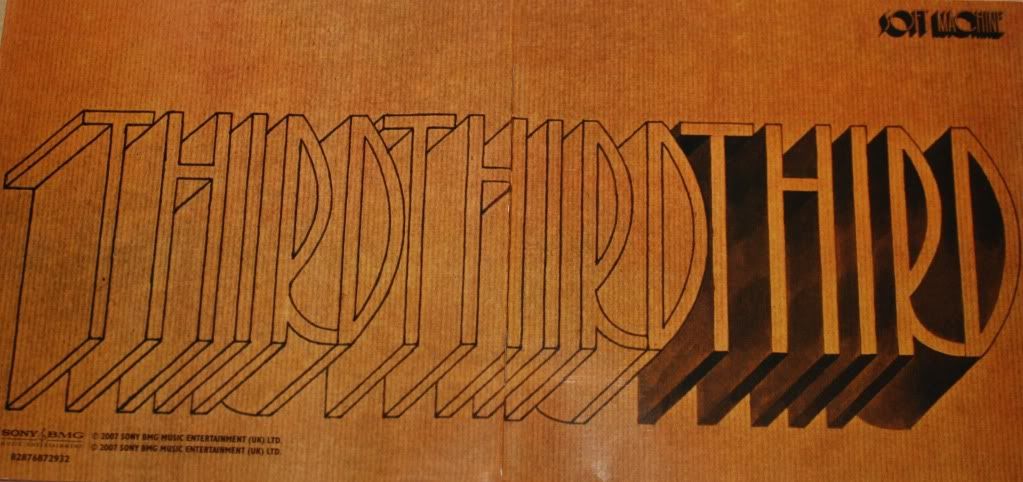
Soft Machine - Third


I've been thinking and thinking about which album I should review in order to broach the subject of the Canterbury scene--something quintessentially Canterbury, exhibiting all of the hallmark characteristics.  Ultimately, I'm not sure that's quite possible--there are albums that seem textbook Canterbury but aren't really that great, don't feature any of the important Canterbury musicians, or are just too obscure to introduce a phenomenon that's simultaneously a scene built around specific bands and people, but also a genre and approach to music that's ultimately transce.nded its origins to produce a lot of great music that has absolutely no connection to the original scene.  So, instead of attempting to find the Canterbury exemplar, I've decided to just pick one of the very best albums by arguably the most well-known Canterbury band--Soft Machine's Third.

On Third, Soft Machine became something very different from what they were on their first album (an organ-driven jazzy psychedelic pop group) as well as their second (an even more abstruse psychedelic group augmented by jazz instrumentation)--on Third, Soft Machine became something more like a jazz combo playing a more serious and epic version of what they played on Volume Two.  It's early jazz-rock fusion of an undeniably British stripe--the booty-shaking Afro-American elements that drove the seminal fusion behind Bitches Brew is nowhere to be found, replaced instead by some sort of dark, intellectual, avant-garde European sensibility.

Take the Hugh Hopper-penned opening track, "Facelift," for instance.  The live-recorded behemoth of a song opens with Mike Ratledge's outrageously overdriven organ (a classic Canterbury element) in a flagrant barrage of sound--it's arrhythmic, amelodic and fucking righteous--it's not notes, it's sound.  Say what you will about overintellectualization robbing "rock" music of its bestial nature, there's something primal in the howl and shrieks that Ratledge calls out of that thing that destroys the system in a whole other way.  It's a good six minutes before the lurking horns fall in step and state the song's main theme over Hopper's fuzz bass (another Canterbury staple).  The melody is a thing of dark imperial grandeur, threatening and tense, suddenly shattering into a driving rock beat, with Elton Dean's saxophone battling with Ratledge's organ for shrieking supremacy.  Through some clever editing (this is a live concert, remember) we cut away to Ratledge on a hypnotic electric piano vamp that prefigures Hopper's 1984 album.  A forboding flute solo, then the whole thing slowly builds back into the main theme, suddenly run backward and the song closes with analog tape squeals.  We're already a long way from home--the last vestiges of pop instincts of Volume Two have been sacrificed to the jazz gods--and what a ritual it is, with some crushing solos from Ratledge, Dean and Caravan's Jimmy Hastings on flute; the free jazz influence here is much stronger than ever before, with texture and chops reigning supreme.  Robert Wyatt, that most-celebrated of Canterbury figures, "only" plays the drums, effortlessly making the complex changes and driving the whole beast forward with imagination and verve.

"Slightly All the Time" lightens up just a bit, built on songwriter Ratledge's odd-metered electric piano riffs' interplay with Hopper's looping bass intervals.  Wyatt shines several times on cymbals.  The multi-part song treads some slow-groove territory and abruptly shifts between hypnotic vamps and manic "The Price Is Right Theme Song From Hell" excursions.  Just when you think the group's diving undersea to Sun Ra's Atlantis, "Moon In June" comes along--Robert Wyatt's thin, high, lispy vocals remind us where the band came from.  The album's third epic suite combines Wyatt's playful whimsy (another Canterbury cornerstone) with the band's newer experimental bent, soon wheeling away from Wyatt's vocal meanderings to fast riffing to a warped soundworld of slowed-down tapes, skittering violin and Wyatt's wordless voice blending with the other unrecognizable instruments as the thing rumbles to a close.

The double album finishes on the dreamiest number of the bunch, "Out-Bloody-Rageous."  Again, it's more about sound, timbre and texture as several minutes of delay keyboard collage bookend the extended suite, also appearing at the midpoint.  The driving melodic sections are again backboned by Ratledge's keys--he often solos on organ over his mightily complex electric piano riffs.  The song is similar enough in mood and style to match the rest of the album well but it takes a few listens before its individual character shines through--after all, there are only four tracks but they're each almost 20 minutes long; surely a little attention will help unlock their secrets.  I love the alien sense of melody on this album as well as its cohesiveness and foreboding majesty--it's an unexpectedly dark turn in the progression of Soft Machine's albums, but it's also a masterpiece in composition and fearless exploration of jazz fusion, which at the time was brand new.  It's hard to believe the direction other artists took the genre as the decade wore on--why would you ever want Weather Report when fusion can sound this threatening?  I didn't fully appreciate this album until getting the 2007 CD remaster--the earlier CD reissue's sound is quite murky which, combined with the material's murkiness, makes assimilating the song structures and recognizing and appreciating the melodies much more difficult.  Plus, the new remaster has three live bonus tracks.

So, Soft Machine was home to a number of Canterbury luminaries--Robert Wyatt, Hugh Hopper, Mike Ratledge, Kevin Ayers (formerly) and Elton Dean--and exhibited (actually, it often created) many classic Canterbury musical traits from the jazz influence, the sense of lyrical humor, fuzz bass and overdriven organ, as well as the general experimental spirit of the entire scene.  As will be apparent as I review more good-to-great albums from this scene, its characteristics are fluid enough that they're not immutable, and "Canterbury" became more of an attitude toward music that transcended its geographical origins.


Get it here on CD, with a bonus disc.