Showing posts with label Dave Stewart. Show all posts

Wednesday, January 18, 2012

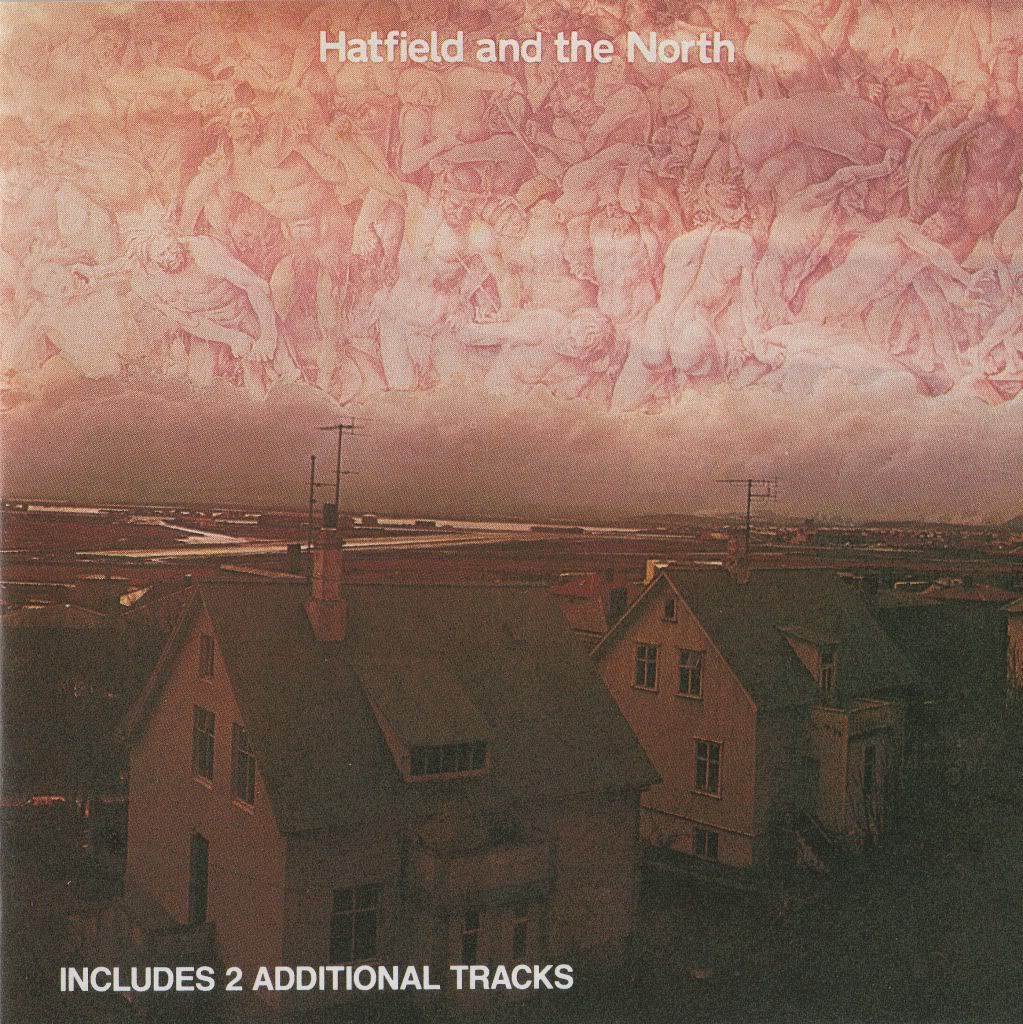
Hatfield and the North - Hatfield and the North


To delve further into the dense stuff of the Canterbury Scene, Hatfield and the North's 1974 debut is a great place to explore how the scene evolved both personnel-wise and sound-wise as the 70's wore on.  By this time Soft Machine was firmly on a jazz-heavy fusion route, with Robert Wyatt long-since departed, finished with his next project Matching Mole, a paraplegic and releasing his first masterpiece, Rock Bottom, the same year.  Gong and Caravan were already very different bands, with drummer Pip Pyle gone from Gong (to drum for Hatfield and the North) and guitarist Steve Hillage added to the fold, and bassist Richard Sinclair departing Caravan, also to work with the Hatfields.  By the time of this album's recording, the core group was rounded out by Egg (among other groups) keyboardist Dave Stewart and Matching Mole/Delivery guitarist Phil Miller.  My intention isn't to get overly cluttered with names and group references, but rather to show just how intermingling the Canterbury Scene was (and continues to be, to some extent)--Hatfield and the North can in some ways be considered the first Canterbury supergroup as it was formed from members who had already demonstrated their abilities on the classic albums of other Canterbury groups.

Sound-wise, Hatfield and the North amply demonstrates how the Canterbury sound continued to get more sophisticated, more refined, and jazzier.  Unlike mid-70's Soft Machine (or the trace jazz elements found in Caravan, for example), Hatfield and the North's debut sound is one of fusion of jazz harmony, complex composition and improvisation with appealing, gentle melodies.  The complexity of these compositions is far from the relative pop-simplicity of Caravan's songs, yet Richard Sinclair seems to have no trouble accommodating his bass skills to the material.  And don't think that this group is just going to sound like a summation of all the things the members did before--this album is rife with seamless transitions and sub-one-minute segue tracks, and the mission of the vocals (the lyrics for which are mostly tongue-in-cheek nonsense) seems to be to give listeners an accessible insertion point into what's often complex and difficult-to-get-the-first-time music.

Though it's not his group, per se (at least not as much as later incarnation National Health was), Dave Stewart's keyboards provide the most noticeable framework for this music--fluidly transitioning between Rhodes electric piano, Hammond organ, various synthesizers and acoustic piano to provide both texture and melodic substance.  "Son of 'There's No Place Like Homerton'" boasts some of the most Egg-like contrapuntal puzzle keyboard of the album, with a complex, ever-shifting atmosphere abetted by airy, ethereal contributions of the "Northettes" (background singers Barbara Gaskin, Amanda Parsons and Ann Rosenthal, who also contributed to Egg's Civil Surface album, released the same year).  Robert Wyatt guest vocalizes on "Calyx," eventually joined by Richard Sinclair in a delicate, wordless duet.  It's these kinds of complex but unassuming moments that make Hatfield and the North's two albums so rewarding on repeated listens.

I have to admit that it took me quite a few before my attitude shifted from mere respectful appreciation to all-out enthusiasm--I'm beginning to think that there's something about the language of jazz harmony that's fundamentally different from that found in most rock and pop--you have to have to acquaint yourself a certain amount with it before it stops just sounding like silly noodling and the multiple facets possible with extended harmony start to shine through.  The songs here don't often "rock out" (even by Canterbury's gentle standards), and the often major-key extended harmonies are much more reminiscent of later smooth jazz music than their darker minor counterparts being explored by Soft Machine and Henry Cow.  The band does manage to get pretty uptempo and a little more aggressive in sound on the fast-paced "Rifferama," which features Gong saxophonist Didier Malherbe and on which Dave Stewart coyly quotes the "I Never Glid Before" melody.  "Shaving is Boring" is likely the album's most epic composition, treading some darker territory with some Mahavishnu Orchestra-like ostinato patterns, gnarly Canterbury fuzz organ and an uncharacteristically distorted and noticeable contribution from Phil Miller's guitar (we won't quite get to see him cut loose until National Health's Of Queues and Cures, which fulfills all of Hatfield and the North's promise and then some).  Richard Sinclair does his best Robert Wyatt in the vaguely sexual "Licks for the Ladies," displaying that his sometimes subdued vocals aren't without a considerable amount of nuance.  He also manages some of the album's funniest quirky Canterbury nonsense vocals when "Big Jobs No. 2" recapitulates the second track with metacommentary on the band's hopes for commercial success.

It's interesting to see how all of these Canterbury figures continued to develop their distinct but collective musical visions while at the same time working for some kind of commercial success.  As the band morphed into National Health and progressive music became less and less popular in the late 70's, it became clear that the golden days of having label support and a mouthpiece through which to broadcast these ideas were drawing to a close.  Luckily several of these musicians have soldiered on to make more worthwhile music, but we also have a legacy of densely enjoyable recordings and ideas to engage in the present.  This album is warmly recommended along with the band's sophomore effort The Rotters' Club, as well as National Health's self-titled debut and the aforementioned Of Queues and Cures--more thoughts on those records later!

Get it here.

Friday, August 5, 2011

Egg - The Civil Surface


The sound of a ticking metronome opens Egg's third and final album, 1974's The Civil Surface.  I don't think there's any better sound to introduce a band like Egg, whose music is probably the most classically-influenced of all the Canterbury bands and is typified by Mont Campbell's precise, intricate compositions that are filled in by Dave Stewart's interweaving organ and keyboard parts and driven by Clive Brooks' undeniably exact skills at the drum kit.  The Civil Surface is really more of a reunion album for Egg (not to be confused with newer group, The Egg), as the group had broken up in 1972--luckily for us, they had another album in them and here develop the sound of their first two albums even further.

Being a reunion album, The Civil Surface is a bit of a fractured collection.  Therein lies the main stumbling block regarding my ability to enjoy Egg--they present some of the most interesting and "out" ideas of any of the Canterbury (or any other progressive bands, for that matter), but when it comes to crafting a cohesive and really great album, they were never really able to make it happen.  The ideas really do reach rarefied heights, though.  The aforementioned opener, "Germ Patrol" is perhaps most typical of the group's overall career sound, with plenty of Canterbury fuzz organ and bass, jazz harmony and ear-surprising twists.  It's on this track I most notice a common complaint with The Civil Surface--the drums are mixed extremely loudly, and it's especially painful when Brooks goes for the high-hat, with lots of sibilance that can be really sharp and hard on the ears.  Because of this, the album doesn't really sound good on a lot of sound systems (especially ones prone to treble-y sound), and the more you push the volume to discern the compositional intricacies, the more the drums get in the way.  The song plays effectively with additive rhythms and builds on its somewhat anonymous melody, though, and features nice clarinet and bassoon from Henry Cow guests Tim Hodgkinson and Lindsay Cooper, respectively, and some signature french horn from Campbell.  This style reprises on the confusingly-titled mid-album "Prelude," which also features wordless female vocals reminiscent of those which would later appear on related acts Hatfield and the North and National Health.

The album's crowning achievement is undoubtedly "Enneagram," which Mont Campbell supposedly composed in response to composer Aaron Copland's criticism that his "Long Piece" (from The Polite Force) was merely music of repetitions and didn't develop.  Campbell certainly took Copland's words to heart--over its 9 minutes, "Enneagram" develops Egg's tricky rhythms to their fullest, alternating between driving hard, fuzzed-out riffs and spacey sections where Stewart's keys flitter away with echo and the cymbals provide a backdrop for Campbell's bass runs.  The song's rousing conclusion fuses heavy toms with stuttering organ and bass unison.  It's really interesting to hear Dave Stewart's keyboard work in the midst of the 70's; though the compositions are mostly Campbell's, there are keyboard moments that recall both the gentle jazzy interludes of previous band Khan as well as crisp contrapuntal figures that predict breaks that show up later in National Health and Hatfield and the North.  Though that style dominates here, I think it displays Stewart's abilities to play to different styles but also forge a distinctive style of his own when the time came for his compositions to dominate.

As for the rest of the set, there's material that echoes Egg's earlier work ("Wring Out the Ground Loosely Now"), featuring what are probably Campbell's weakest vocals to date and some mainly textural guitar from Gong and future solo star Steve Hillage.  Compared musically and lyrically with "Contrasong" from The Polite Force, it doesn't hold up so well--depending on how you look at it, the vocals either add variety to or awkwardly interrupt a mostly-instrumental album.  There's also plenty of material exhibiting some modern classical vibes, like the interesting and blithely-plodding "Nearch" which joyfully experiments with continually-increasing amounts of silence, and two wind quartets, which only feature Campbell from the Egg lineup.  To my ears, the sprightly first quartet ironically echoes some of Copland's more accessible works, albeit with a little more dissonance, and the second experiments more with longer-sustained notes and a sort of rocking eighth-note rhythmic figure.  The quartets are good, in my opinion, but if you came to Egg looking for their more rocking tendencies, I can see how you might find them irrelevant and cluttering.  As I mentioned earlier, despite a wealth of creative ideas, the album can't seem to weave its variety into a really good flow.  Still, I manage to enjoy it quite a bit every time I hear it!

Thinking about Egg in the context of their whole discography and the Canterbury scene in general, it seems like their strengths lie more in their rhythmic and contrapuntal pursuits rather than their melodies--even the best songs here are difficult to recall melodically, in part due to the fact that only bass and keyboards contribute to the melodic statements.  Though melody probably wasn't on top of the list of the band's intentions, I can't help feeling that this contributes in a mildly negative way to their overall accessibility--but hey, we're talking about the Canterbury scene already, so there's no need to worry about billboard charts!  Judging by his recent interviews on the BBC's progressive rock documentary and on blog friend It's Psychedelic Baby's recent interview, Mont Campbell is fairly bitter that he wasn't allowed to fully flower as a composer and musician because the music business wasn't nurturing enough.  It's the sad truth, but three albums released on fairly large labels is a whole lot better than similar artists are getting these days!  Sometimes we just have to nurture ourselves.