Showing posts with label Singer/Songwriter. Show all posts

Monday, October 29, 2012

Cheap Seats 8: Tyler Fortier Interview

Today we've got the second installment of the handful of interviews I conducted for the Cheap Seats series.  I've written about my old school friend Tyler Fortier's (Bandcamp, Facebook) music before, and back in September I posed to him a series of questions similar to those in the last interview.  Just as all of the other interviews seem to have turned out, Tyler's offers a unique perspective and an emphasis on some of the constant challenges independent artists face and strive to surmount (with many of which I can seriously identify) on a day-to-day basis.


As a musician who's been doing this for a number of years, how have things changed across your career, both in terms of how you make and release your music, and in how you've attempted to promote and advance it?  What are some of the most valuable lessons/tricks you've picked up?


Over the years I have become more and more self-sufficient.  Each new project has a lower cost attached to it.  Releasing music is easy.  Promoting music is tough.  I'm burnt out and can't imagine releasing anything anytime soon.  It's a lot of politics.  It's all about who you know.  It's like looking for a job--sending resumes (press kits) to every city your traveling to.  There is probably a 10% success rate in that.   And out of the hundreds of people who read a review or see your picture or are even slightly interested, maybe one person will go out of their way to come to a show or go listen to music online.

Recently I've tried releasing digital singles because I wasn't having as much luck selling CDs as I wanted and going digital is a good way to keep overhead low.  I hate digital though so it's hard for me to do that and I probably won't continue releasing anything just in a digital format.  


What's been the most difficult challenge to overcome?


Performing intimate lyrical based music in loud and obnoxious settings for people who don't give a shit.


What's the best way to convert a new fan?  How do you measure your progress--record sales, live show attendance, Facebook "likes," etc.?


I'm not sure.  The best thing is seeing return people in your audience though, I know that.  I don't measure my success because that's a fine and blurry line, but having people that were at a show 6 months ago come back the next time and say they've been loving the CD they bought is as good as it gets.


In your experience, what does it take to break beyond a fanbase of friends and family to one populated by people solely interested in the music?


That's a tough one.  I'm not sure.  There has to be an emotional connection made somewhere but as to how to do that, I'm still trying to figure it out.


How would you describe the Eugene music scene?  How do you book your shows, especially when it comes to traveling outside your home base? At this point, would you say you're most successful regionally or online/globally?


There is a lot of good music in Eugene.  Mostly empty venues though from what I can tell.  It seems like everyone is having the same battle with getting people out to listen.  To book shows, I research a lot on the internet and then send emails or call depending on the venue.  I'm probably most successful regionally, though that doesn't mean too much.  I do appear to have a small fan base in the Netherlands area as well, judging from online sales.  Great bands out of Eugene: The Royal Blue, Leo London, Kingdom County, Tara Stonecipher and the Tall Grass, Scott Austin, Mike Surber, Beth Wood, and.....so many more but my mind just went blank.


What does it take to sell an album?  What sells most for you, physical media or downloads?  For you, are recording sales the goal, or are recordings more a piece of the overall puzzle in terms of promoting the music?  Have you reached a point where the recordings pay for themselves, or are they a necessity you're willing to support yourself?  Are people actually willing to pay for the music, or do they expect it to be free?


I'm not sure what it takes to sell an album.  I sell most of my albums at shows.  Out of town shows, that is.  I can't sell a CD in Eugene to save my life but I sell a good amount when I travel.  I don't know why.  Recording sales are not my goal, but I'm proud of my work and I want people to hear it and like it, and I want to be paid what I think I deserve for the work I and everyone who contributed put into it.  People do expect music to be free these days.  I feel like a sex worker most of the time, folding up my tips after playing with extra emotion because I needed to make some money tonight and maybe if I just sing this part with lots of gusto, I'll make an extra $20.

How important are production values when it comes to your recordings?  Your albums have spanned from lo-fi home recordings to more produced, professional products--do you think it's important to fans to have a polished, professional recording, or are they willing to sacrifice production values for quality content?  Do professional production values manifest themselves in the finished product in a way that justifies their cost?


Production is the most fun part of making music for me.  I'm always plotting the next big idea even when I'm still in the writing phase.  It is very important.  It is opening yourself up, connecting with a song on some unexplainable level, and understanding every word, guitar strum, and breath to the point that you know exactly what the song wants, what the song needs, and how to make that song sound how it was meant to sound even from the point of its conception in the pen-and-paper stage.  I think certain songs need certain things and whether it is lo-fi or polished, the song will reveal itself to the producer in time.  Fans or music listeners don't need anything.  They just want a song they like and they don't care how it's done or what work went into it.  People who like to dance want a fun beat to move to and people who like lyrics want to be challenged existentially.  I think it is literally that black and white for a majority of “music listeners.”


When it comes to promoting an album, what avenues seem the most successful in getting the music heard?  Do you do everything yourself, or do you get help from anywhere?


I haven't had much luck in promoting my albums.  Local radio here has been super supportive, especially 89.7 KLCC NPRNinkasi Brewing has been a big supporter as well and I have had great support from The Eugene Weekly.  As far as getting my music out to the masses though, I haven't had luck.  Facebook is an awful way to do this, but it is the easiest way so I rely on that sometimes because I don't have time to do anything else.  I think management is key for any serious musician.  Everyone needs some knowledgeable cheerleaders on their team.


When do you decide it's time to head back into the studio? When you've got all the songs written...when it feels right creatively...when you've got ideas but not necessarily songs?


I'm always in the studio (aka the spare bedroom in my house).  This is where I record all my projects as well as projects for my clients.  Sometimes I will record a song when I deem it “ready” or sometimes I'll record a song when I am stuck melodically or lyrically with it.  Most of the stuff I don't keep, but I am always recording songs and thinking as a producer--how can I construct them to reach their highest potential?  In the last week I've been working on seven songs that I have recorded in the last two-and-a-half weeks (two of which are mine).


What keeps you going in the tough row-to-hoe that is the independent music world?  Where's your inspiration coming from right now?


I don't have inspiration or hope as an independent artist, but I do have inspiration as a songwriter.  The desire to always be better and never being satisfied with anything I do has been my inspiration and fuel for the last few years.


Do you have any advice for aspiring musicians?


Don't let your ego get in the way and don't take anything too personally.


What have you been listening to this week?  How do you seek out new music?


My playlist this week has pretty much been:
-Joe Pug's first two EP's, a record by Dolly Parton, Linda Ronstadt, and Emmylou Harris called Trio, John Prine - Common Sense, Van Morrison - Saint Dominic's Preview, Elvis Costello - Armed Forces, and in my car stereo is Saves The Day's first record: Can't Slow Down

.

What's on the horizon for you musically?


I'm putting my music on the back burner and starting to work specifically with songwriters on their songs in the role of a producer and mixing engineer.  My debut as a producer was with Mike Surber, who released is debut full length this past June.  I'm currently working on Scott Austin's first full-length, as well as some EPs for three other clients.

Cheap Seats Part 1
Cheap Seats Part 2: Non-Commercial Music 
Cheap Seats Part 3: A Day in the Studio 
Cheap Seats Part 4: The (Un)Happy Accident 
Cheap Seats Part 5: Mix Mix, Stir Stir 
Cheap Seats Part 6: Kickstarter Campaign
Cheap Seats Part 7: Alicia Dara Interview

Wednesday, September 26, 2012

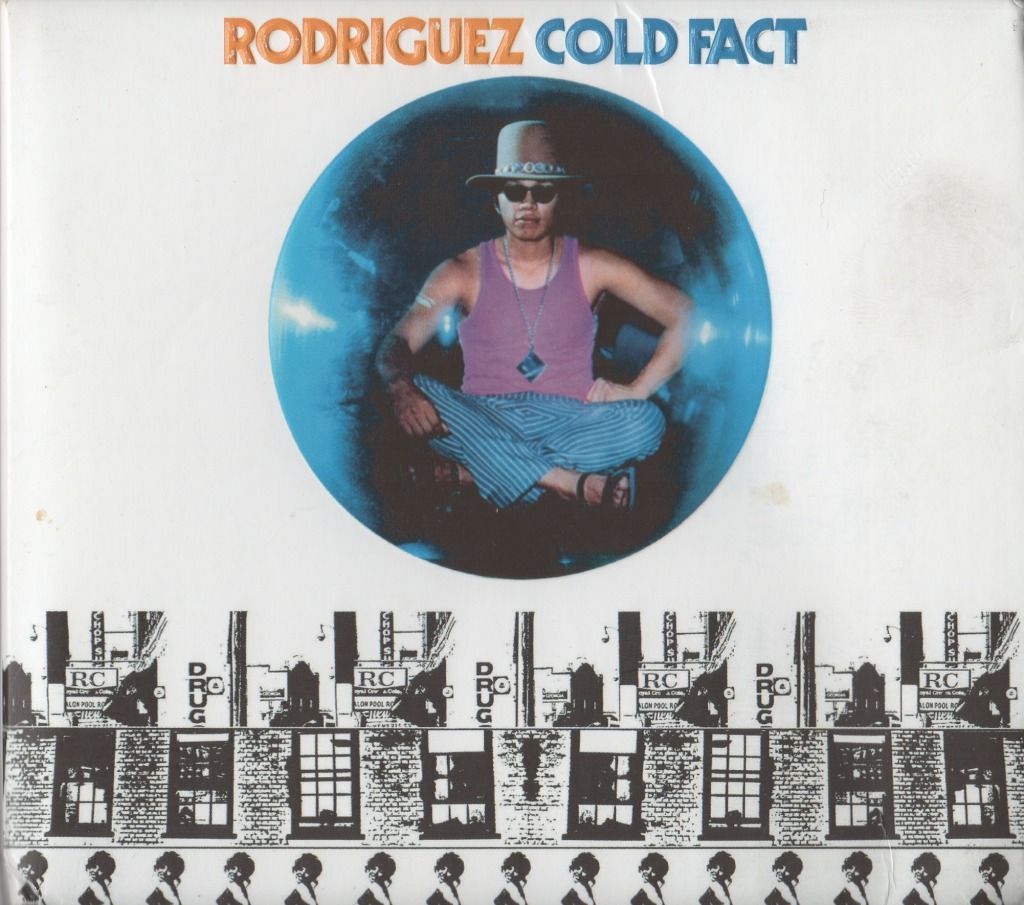
Rodriguez - Cold Fact


I first heard Rodriguez's 1970 debut Cold Fact back in 2008 at local record shop Sonic Boom--ironic, considering the store's typical "KEXP: The Record Store" selection (to be fair, I've found some great jazz classics there, as well as those epic Betty Davis reissues).  These days, Rodriguez is getting all kinds of press for Searching for Sugar Man, a new documentary detailing how the singer disappeared in the 1970's after recording two albums only to find out decades later that he'd become a star in South Africa and nobody knew where he was or what became of him.  It's a fascinating story--so many quality artists disappear without ever achieving recognition in their heyday (or ever, for that matter), so it's pretty cool, if bittersweet, to see that someone actually was appreciated, even if it took decades for his art to be recognized.  It's also nice that Rodriguez is actually still around to get his due (as well as tour and actually make some money from his music). 

As for the music, it must be said that Bob Dylan casts a long shadow--Rodriguez is clearly heavily influenced both by Dylan's songwriting as well as his vocal delivery.  "This is Not A Song, It's an Outburst: Or, The Establishment Blues" is an awkward attempt at a talking blues in the style of "Subterranean Homesick Blues," there are several kiss-offs in the style (with added venom) of  "Don't Think Twice, It's All Right" ("Forget It" and "I Wonder," for example), and Rodriguez is one of legions of singers to adopt a mid-60's sneering Dylan inflection (though his underlying vocal talents are formidable).

To write off this artist for being indebted to Dylan, though, would be to pass judgment before giving his craft a chance.  Besides, there's nary a post-60's artist who's not influenced by Dylan in some way--one of the greatest things about him is that his music showed aspiring artists that it was possible to make pop music that aspired to greater artistic depths in terms of songwriting, lyrical aesthetics and subject matter, without abandoning mainstream appeal.  While Rodriguez doesn't necessarily create a completely unique style for himself, his songs exude careful construction.

There's plenty of great one-liners (like the "you're the coldest bitch I know" conceit in "Only Good for Conversation") and Rodriguez's lyrical vision is often both emotionally direct and open to multiple interpretations.  Coming in well after the flower power movement, there's a dark, disenchanted, urban and undeniably cynical edge to a lot of the words and attitude, as heard in the unsettling "Gomorrah (A Nursery Rhyme)" and the brilliant "Hate Street Dialogue." What's more, Rodriguez has a real knack for concise, melodic song structures, a characteristic that's amplified by some great production choices--from a wet reverb on most of the vocals to the orchestrations that back many of the songs to the occasional psychedelic flourish like overdriven guitar or delay, the arrangements add tasteful depth to songs that probably could have stood alone with stripped-down arrangements.  These, of course, exist in ideal harmony on the album's flagship track, "Sugar Man" a drug song that any songwriter would kill to have penned--from the hair-raising melody to the way it ambiguously seems to both endorse and caution against drugs.

Rodriguez was probably never destined to be a huge star, but his abilities are undeniable and this album is a recommended addition to the collection of any Dylan fan who's looking for other artists of a similar caliber and style.  In light of the continuing Cheap Seats content posted here, I think a story like Rodriguez's is another piece of the puzzle that answers some questions and probably raises even more--people just might be out there listening, but you may never know.  Is it worth it to make music even if no one recognizes it in your day?  I like to hope there will always be thoughtful listeners out there just waiting for the right circumstances to lead them to music like this.

Get it here.

Monday, September 10, 2012

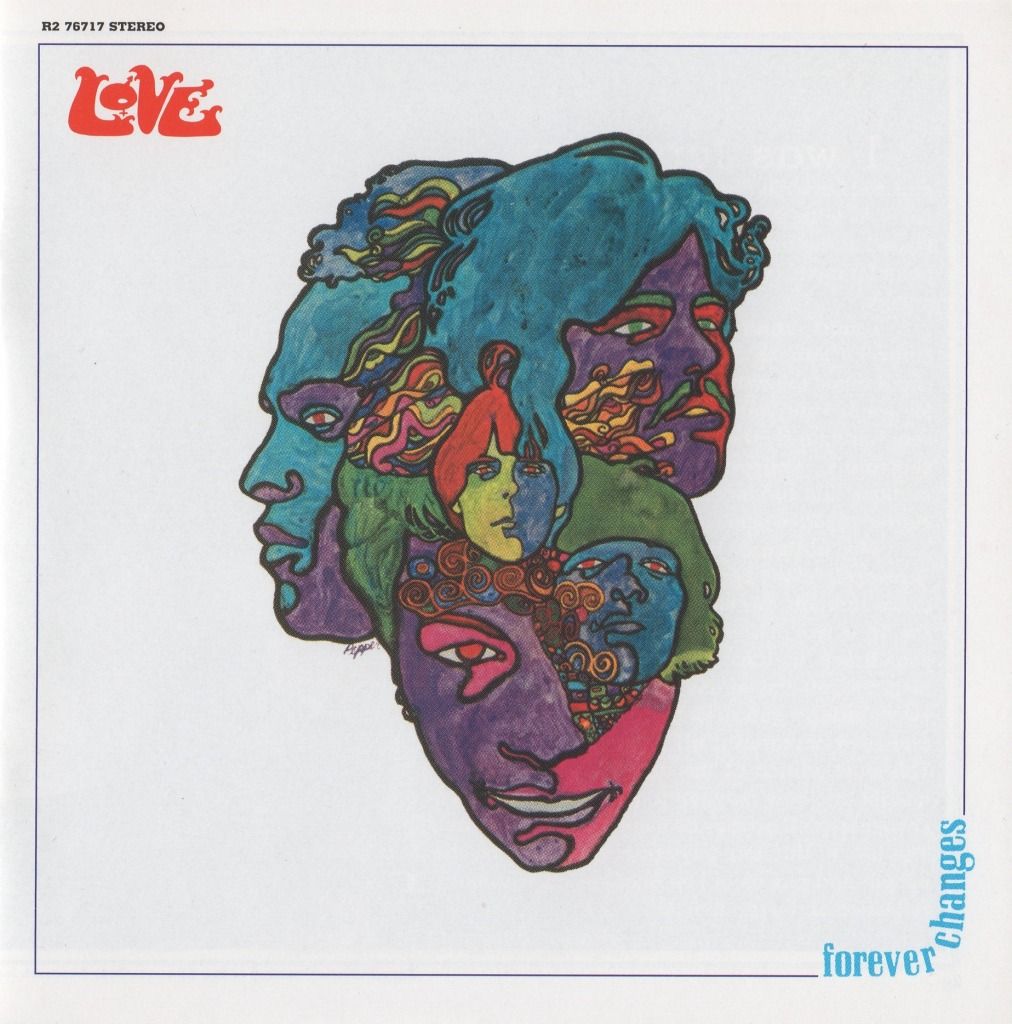
Love - Forever Changes


The past year has been so busy with recording and evaluating my own music that I've had much less time to listen to other people's sounds, which means I've focused a lot more on the "new" music I'm finding instead of revisiting old favorites.  When I do get around to albums I've heard many times, the experience is often quite illuminating.  Especially after doing so much critical evaluation of music on this blog, I sometimes realize that my "5 star" albums, upon relistening, aren't necessarily free from the kinds of things I might label as "flaws" in other music, and that ultimately, designating something "as good as it gets" rests on a certain feeling of affection or nostalgia toward the music, or at least an assertion that the great things in the music are so good that any "flaws" come across more as endearing idiosyncrasies.  In other words (and yet again), it's all subjective!  The fun part about analyzing music in writing is the disjuncture between personal preference and the fact that yes, we actually can (and should) identify and judge specific characteristics in the music that justify how "good" we say it is, but also that "good" will always be individual, and reading music reviews and blogs is ultimately most useful as a way of pairing others' tastes with your own to discover music you might enjoy. 

Forever Changes is one of those albums that winds up on innumerable critics' top lists, but has somehow kept a much lower mainstream profile in comparison with its contemporary "classics."  You never hear any Love songs on the radio or in movies etc., and you'll be lucky if you hear anyone talking about them outside of musicians and critics.  And yet, pick up Forever Changes and give it time to work its magic and you'll most likely understand why it quietly persists as a milestone in psychedelic folk-rock and as one of the best albums of the 1960's.

Like many great albums, Forever Changes is so great because it's often a bizarre combination of unquantifiable elements.  There's the fact that it's a much mellower affair than Love's previous two albums--the more garage-like electric sound of Love and Arthur Lee's aggressive vocal style on Da Capo mostly replaced by acoustic guitar and orchestral textures--and yet it's still insidiously edgy.  There's the album's unique twist on psychedelia, which often takes the form of hard-panned instrumental tracks (the nylon-stringed acoustic is so far to the right it's almost gone!) and brief additions of reverb as well as arrangement choices like having the background singers say a different word at the same time.  There's Arthur Lee's obvious magnetism as a front man, which twists together the role of a sort of tormented seer with a dark fragility, surprising poetic capabilities, an ability to distill the countless clashing emotions of the 60's into songs that are simultaneously emotionally gripping and ultimately ethereal, as well as being a larger-than-life historical legend, somehow more than fulfilling Da Capo's thwarted potential here but quickly unraveling into mental and artistic instability (he was reportedly sure his death was imminent during the creation of this album) in the following years--still capable of creating good music but never coming close to reaching the same level of insight (especially lyrically) repeatedly on display here.  And finally, in spite of Lee's dominant persona, there's the fact that the band was undeniably a collaboration, that Bryan MacLean's songwriting contributions and classical guitar contributions are as important to the album's success as any of the other elements, and that Lee's decision to disband the Forever Changes lineup soon after the album's release was a terrible blunder. 

The distinctive characteristic that most people note about Forever Changes is the inclusion of orchestral arrangements, especially prevalent on the MacLean numbers--the balance is sweet and delicate on "Alone Again Or," "Andmoreagain" and "Old Man," songs whose optimism counterbalance some of Lee's desperate worldview with detours into romantic euphoria.  Elsewhere, though, the strings and horns just as aptly provide a creepy, unsettling edge, as on the paranoid "The Red Telephone" and robotically closing "The Good Humor Man He Sees Everything Like This" (gotta love those Dylanesque 60's track titles), as well as brilliantly cathartic, as on the Latin-tinged "Maybe The People Would Be The Times Or Between Clark And Hilldale" (which boasts some of the album's most sly lyrical conceits, with expected rhymes interrupted by staccato horns only to appear to begin the next line...until the instrumental breaks, that is) and the transcendent album-closing "You Set the Scene."  The cleverest part of the delicate arrangements is how well the rock moments stick out--"A House is Not a Motel" sounds like the heaviest rock you've ever heard, despite the fact that at least half of the song doesn't even have electric guitar, and the solo on "Live and Let Live" is insanely scorching because there's nothing "hard" to compete with it.  Relistening I'm really surprised at how simple the arrangements actually are in comparison with the songs' complexity, usually consisting of just a standard two-guitar rock band with maybe a bit of piano and the aforementioned strings--the band's ability to make each part indispensable is a testament to the skill and care on display.

Lyrically, the album literally never lets up.  While it's often difficult to discern what exactly Lee is singing about in each song, the impressionistic moments paint a collectively awe-inspiring picture of urgent searching, resultant disillusionment, distress, cynicism and ultimately grasping a fleeting sort of brilliant something that makes it all worth it...a something that might just be the absence of alternatives.  Lee manages to toss out piercing one-liners right next to surreal scene-painting with the spontaneous force of a man possessed by something larger than his own conscious decision to create, and somehow manages to do so without completely slipping off the edge into incoherence.  Despite the fact that the album is so very 1960's, his struggle and observations about the world's contradictions can't help but still ring true.

Perhaps this is the only truly great album Arthur Lee had in him, but its quality does seem to justify its singularity.  Though it will likely always remain lauded but obscure, Forever Changes continues to humble me every time I revisit it--albums like this are something more than just old friends, comforting and diverting but always capable of teaching us something new.

Get it here.

Tuesday, June 26, 2012

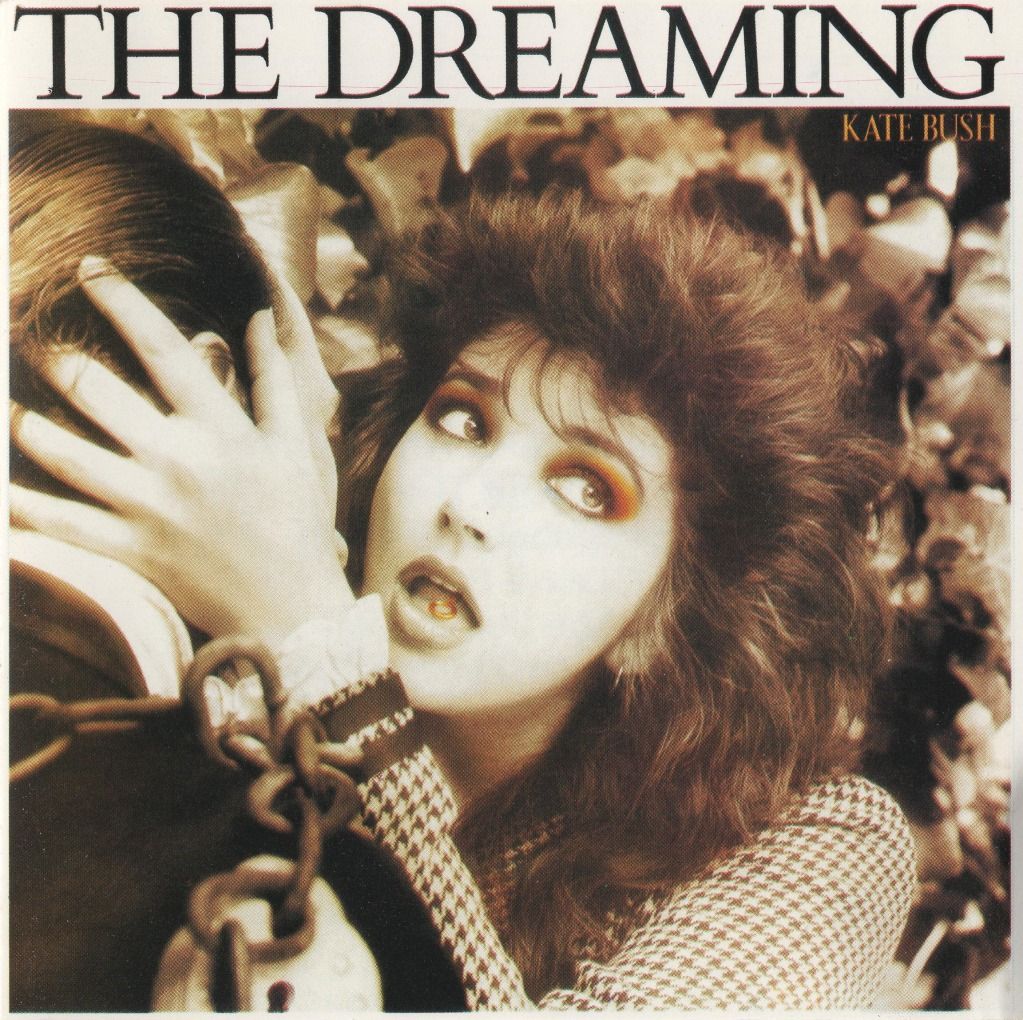
Kate Bush - The Dreaming


The Dreaming--Kate Bush's fourth album, arriving less than five years after her debut--has got me thinking about a whole mess of different things.  Approaching her music fairly indirectly (not having been around when the music was new [no real change there!], or being a hardcore fan, and not having much of an interest in 80's pop music) made for slow progress in appreciating it, but a couple of years have provided an enlightening and broadening experience in getting to know and learn from this music.

While I agree with most fans that Hounds of Love is her most distinctive and cohesive set, this album makes a close second for many of the same reasons.  Partially fulfilling her move toward tighter pop structures and chic sounds of the day, the songs here continue to move away from the more traditional (especially piano-dominated) instrumentation of her first albums into an area where 80's synths and effects surround the songs' core piano parts and multi-part structures juxtapose wildly different styles within pop-length tracks, with Bush's multi-tracked vocals calling and responding in an often bizarre array of different vocal deliveries.  Needless to say, these songs can come across as difficult to penetrate at first, a fact that's not helped by the fact that the late-80's CD reissue is in dire need of remastering, making the already-difficult songscapes even tougher to perceive because of the mediocre sound reproduction. 

Nevertheless, this shit's awesome!  What's especially interested me lately is the fine balance Bush strikes between weirdness, progressive and experimental complexity, and pop accessibility.  When I say "weirdness" I mean things like singing in a weird voice (like those shrill backing vocals that nobody else has really done the same way), laying a really strange-sounding effect on a guitar line, or singing Australian narratives and utilizing native Australian instruments.  Weirdness is a great attention-getter, and is a great way to make music distinctive and set it apart from the vast pack of musicians out there just trying to make something that sounds pretty and inoffensive in hopes that it'll appeal to the largest audience possible.  However, weirdness alone isn't enough to keep my attention long-term.  Really, the lukewarm feelings I get from a lot of today's music come from a feeling that weirdness and style often outweigh the actual content of the songs, music, lyrics etc.  Not that every artist should be changing time signatures every two measures and shredding ridiculously difficult guitar parts for music to be considered good, but there's more to making some distinctive music than singing a tired indie breakup song in an overwrought plaintive voice over eighth-note staccato power chords. 

What I love about Kate Bush is how well she backs up her weirdness with musical substance--every song has a discreet feel, be it narrative or more philosophical, and upon close examination it seems that every element of the song is carefully tailored to fulfill the song's conceptual promise, from playfully poetic lyrics to song sections that brilliantly channel Bush's twisting moods with shifting timbres and pacing (see "Pull Out the Pin," "Night of the Swallow") to vastly differing stylistic experiments between pounding, expansive rock like "Sat In Your Lap" and waltzing existential pop like "Suspended in Gaffa." 

Finally, I'm continually amazed by how poppy the music ultimately is--in spite of the fact that she's often reimagining and further developing a lot of concepts explored by then-and-now-villified progressive musicians when the genre was all but completely forced from mainstream interest, Bush manages to maintain a pure, sincere emotional core along with a buoyant conciseness that makes these songs accessible in spite of their complexity.  Even more, she's still making new fans 30 years later in spite of the extreme 80's vibe, although that's a retro aesthetic that's still currently regarded as "ok" with today's young music fans.  I'm sure it doesn't hurt that her visual aesthetic pretty much rivaled her musical one--if only today's pop songstresses could back up their audacious imagery with such equally challenging music!  Anyway, good on KB for proving that great pop doesn't have to skimp on nuance, and for helping me expand into some new musical areas.  This makes me want to check out some of her more recent work...


Get it here.

Wednesday, May 9, 2012

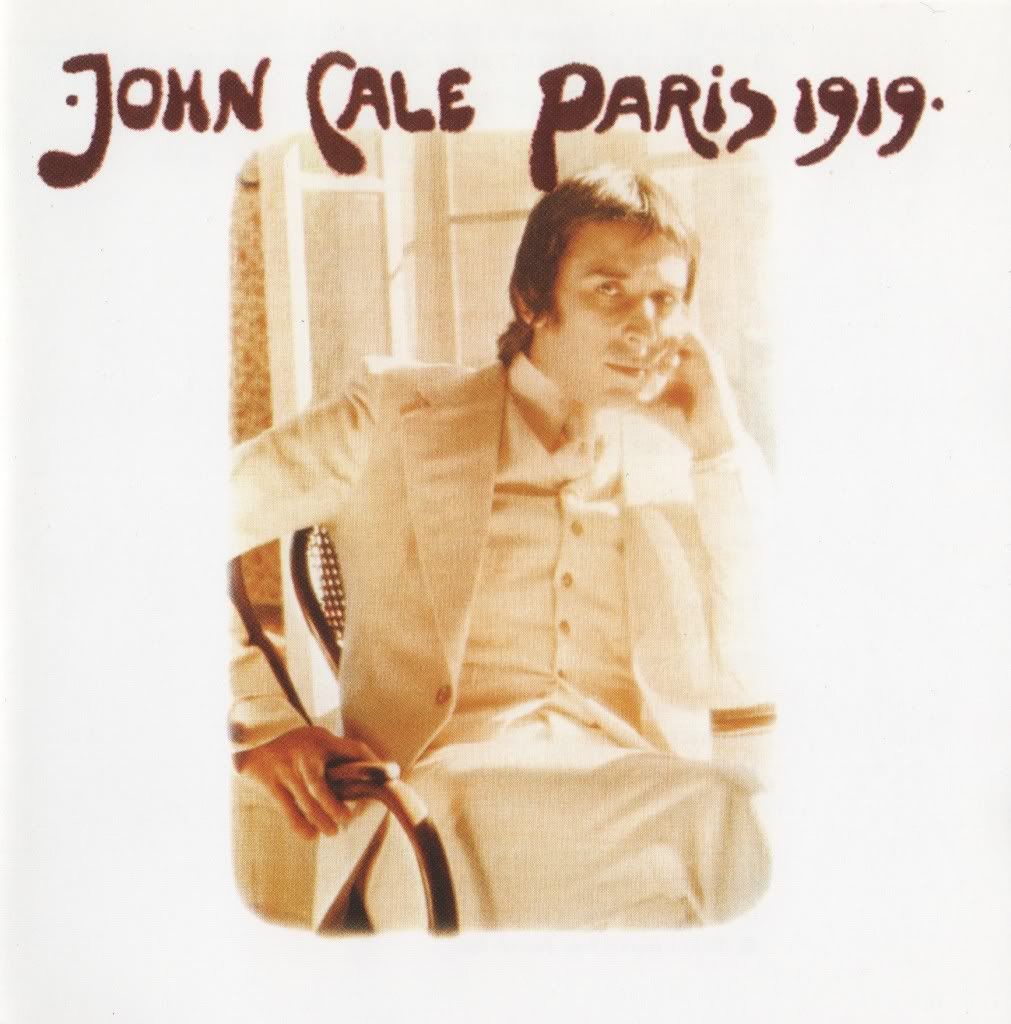
John Cale - Paris 1919


Another album I've rediscovered in the past few months, iTunes tells me I've listened to this album over 10 times.  Though I wouldn't consider it a major favorite I was trying to think of something soothing to listen to after a difficult session and this album instantaneously popped into my head.  After listening a few more times it's not hard to pinpoint why the album produces such a specific reaction: everything--from Cale's half-obscured vocals to the slide guitar, organ and strings that dominate the arrangements--everything here is the aural equivalent of being wrapped in an old but still comfy quilt (rainy day included).  If I may, it's these kinds of feelings that a lot of people might be describing when they say an album or song sounds "British" as if it's a genre or aesthetic descriptor.  There's a pervasive sophistication in these songs that seems to be uniformly reigned-in by an instinctual desire for understatement, and they all seem grounded in the sort of beauty that takes some attention to uncover and--no matter what the subject matter--is touched by a sort of resigned sadness.

Not to say that Paris 1919 is a downer, but if you're looking for some sort of extension of Cale's role in The Velvet Underground, you're likely to be repeatedly disappointed.  Sure, there are comparative moments of "rock" like the romping "Macbeth" and the quirkier, Eno-esque "Graham Green," but really nothing close to anything found on early Velvet Underground.  Not being much of a Velvet Underground fan at all, this doesn't really bother me, but I can see how this album's style might come as a shock--you're going to have to also enjoy pretty, orchestrated pop rock to make the transition to this one! 

There's so many things to enjoy in this album, from the evocative-yet-cryptic lyrics (Cale jumps from a brilliant one-liner in "nothing frightens me more than religion at my door" to the completely indecipherable titular chorus in "Hanky Panky Nohow").  The opener and "Andalucia" evoke a fragile nostalgic yearning that's only made stronger by the songs' simple and accessible melodies.  I can see how things might get a bit plodding for rock listeners ("Half Past France" gets a bit sedate, at least tempo-wise), but like many great pieces of art, a lot can change when you give yourself over to the creator's vision--when you're into it, Cale's repeated "we're so far away/floating in this bay" delivers a desolate, opiate euphoria.  Likewise, "The Endless Plain of Fortune" can change from plodding excess to gripping drama, and Cale's whispered vocals on the brilliantly-titled "Antarctica Starts Here" close the album with the sort of creepy intensity that only restrained dynamics and brevity can bring--in a scant two minutes the song is already fading away, closing the lid on a similarly terse album; packing your message into a concise package is a difficult feat to achieve, and I'm always impressed by how much more power a 31-minute album like this can pack into such a short time span.

Finally, I have to praise Cale's vocals--nothing makes me happier than hearing a great songwriter and musician achieve so much emotional resonance and deliver such beautiful performances with such a limited voice--there's nothing displeasing about Cale's delivery or tone, but it's fair to say he's not the most distinctive, technically-skilled or expressive vocalist.  That's the beauty of great singer/songwriter music--when it all comes together and the elements of composition, arrangement, performance and self-expression add up to something greater than their individual merits.  Though it may not sit at the front line of close-to-my-heart favorites, my collection always has more room for music as well-crafted as this!

Get it here.

Monday, February 27, 2012

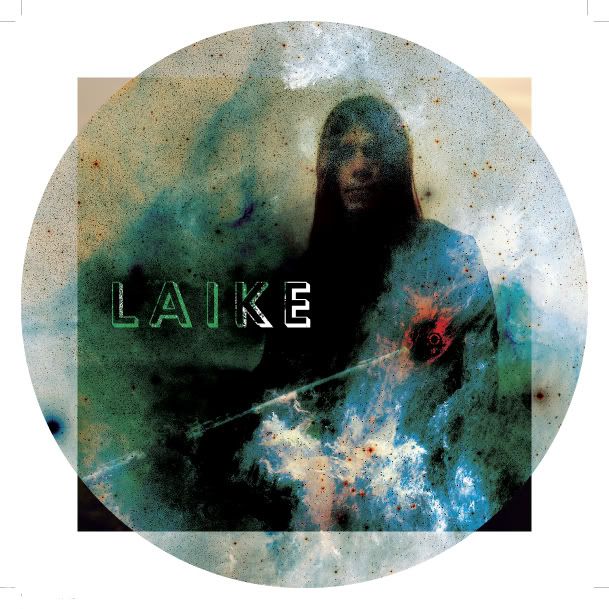
Laike - Långt från stadslivets dån


Today I've got the pleasure of writing about an independent artist's album on the day of its release.  Laike is a Swedish artist whose debut solo album Långt från stadslivets dån is released today on British label Les Cousins, one that's got a special place in my heart for reissuing most of Davy Graham's back catalog and making possible his welcome (if painfully shaky) 2007 swan song, Broken Biscuits.  Laike is the artist moniker of a sort of one-man show in Christofer Ståhle; he writes, sings and plays guitar, piano and flute here, though he's joined by a number of friends performing various instrumental duties.  Laike's album notes refer to a recent enthusiasm for 1970's British folk rock bands like Fairport Convention and The Pentangle (I also hear some Comus in the violin parts), and I think there's a lot here to compare with that music but there's also a lot more here.

I spend a lot of time as a musician and writer worrying about originality and distinctiveness--not necessarily expecting others or myself to produce a musical product that's never been done before, but rather hoping to avoid the decisions that have been made so many times by other artists that they're both clichéd and (for lack of a less snobby word) lazy.  Listening to Laike's debut I come to the realization that the fact that much of the music here sounds stylistically familiar really isn't a problem.  As a listener who's pursued some of the same bands, I feel that the progressive folk, acid folk, eccentric singer/songwriter (or whatever you want to call them) fields are specifically underdeveloped and any contemporary artist who makes a point of further exploring those areas has both a rich and varied template to draw from, but also a multitude of unanswered musical questions and new directions to explore.  Perhaps I'm biased, but I think that as long as the personality, enthusiasm and artistry match the music heard on this album, there's plenty of room for more music in these areas and it'll be quite a while before their ideas are exhausted.

On to some specific impressions--on first listen, Laike's debut is an unassuming collection of straightforward, gently floating melodies framed by accessibly organic arrangements of mostly acoustic instruments playing parts that are sometimes instrumentally impressive but always designed to serve the songs.  As always hoped-for with this kind of music, further familiarization shades the hookier aspects with all kinds of subtle nuances (like psychedelic electric guitars you won't even notice until the third spin) and details that both broaden the experience and speak to Laike's craftsmanship and judgment.  For the most part, the songs are split between buoyant folk-rock like tunes as found on the opener "Modeslavarnas marsch," "Gladiatorkamp," and "Du är mer än vad jag ser" (where the violin riff, bass line and Dave Mattacks-like drumming most closely recall the aforementioned British bands), and quieter acoustic numbers like "Ensamhetens borg" (where Laike's guitar takes on a Jansch-esque swing), the playful melody of "Bygger stegar upp till himmelen" and the spare-yet-trippy "Städernas tid blev inte lång."  Then there's the stuff that's something more, where jazzier tendencies meld with overt pop instincts and melodies like the great guitar riffing and grooving Fender Rhodes on "Långt från stadslivets dån" or the frantic 5/4 piano riff that anchors the valedictory "Tankefabriken."  And let's not forget the spacey field recordings that bookend a few of the tracks, pitting Laike's voice and flute against boundless natural reverb with great textural and thematic effect, not to mention how far they stretch past the folky feel of the rest of the music. 

Laike's voice, guitar and flute run throughout as cohesive threads, his voice especially providing an ethereal lightness and impressive depth of expression to the songs, at times reminding me of singers like Duncan Browne and Jorge Ben in its deceptive delicacy.  I only read the English lyric transcriptions Christofer sent me after listening to the album a few times--I'm surprised how dark they are in relation to the music, dealing with themes of the oppressive nature of urban life (the title translates Far Away from the Noise of City Life) but also isolation and a frustration with the state of the world.  Luckily, the beautiful melancholy of the music and a few moments of hopeful idealism tug the emotional feeling back into the satisfying realm of coldly shining Scandinavian bleakness.  Långt från stadslivets dån is an album I'm both happy to share and an album I'm looking forward to getting to know even further--congratulations to Christofer on a job well done and best of luck as he continues on his artistic path and releases this music to the world! 

Get it here.

Tuesday, February 14, 2012

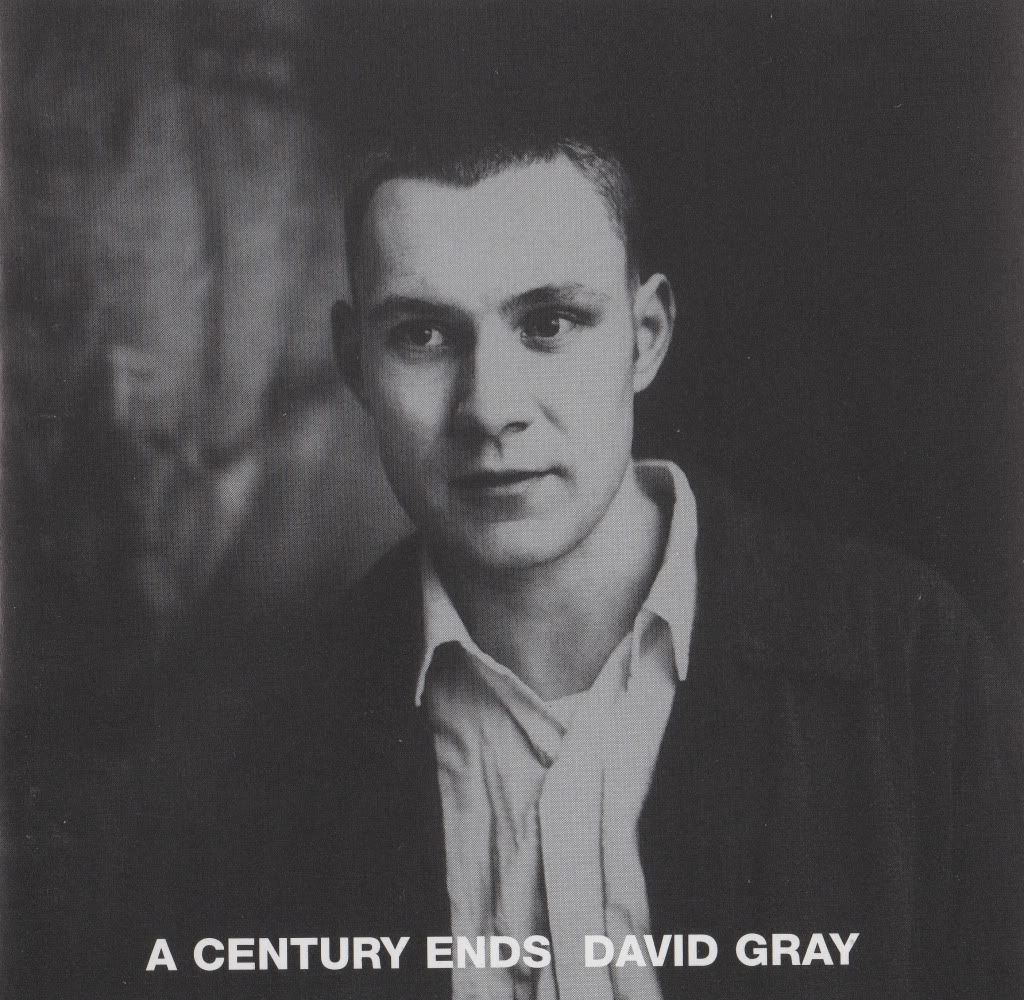
David Gray - A Century Ends


After a busy couple of weeks in the studio, here I am back again to talk about some more music (another Cheap Seats installment should be issuing forth pretty soon as well).  I first got into David Gray since seeing him live in 2001 when he was just breaking through with White Ladder.  Since then I've stayed a fan as his popularity has ebbed and flowed, but it wasn't White Ladder that cemented my support--it was Gray's back catalog, and especially Flesh and A Century Ends, his 1993 debut.

Though Gray's first couple albums display his liking for Van Morrison and Bob Dylan a lot more than his more recent stuff, they're also a lot more focused on pure songwriting than fusing electronic and accessible acoustic elements than his breakthrough albums are.  The arrangements mostly center on Gray's acoustic guitar, though there's some uncharacteristically (for Gray's music) overdriven electrics that accentuate some of the album's edgier tracks.  What always draws me into A Century Ends is the fact that it's much angrier than Gray's later works--as he's matured his cynicism has often been re-routed into less recognizable forms as he strives to keep his music accessible and prolong his mainstream popularity.  Here, though, Gray rails against the apathy and decline he sees in society on songs like "Let the Truth Sting," "Birds Without Wings" and the title track, singing in a sometimes growling brogue and spitting bile with every line.  Revisiting this album I occasionally feel that Gray's poetic lyrics are occasionally a bit florid and sound exactly like the kind of stuff an earnest, angry 24-year-old writes (which probably explains why I liked it so much when I was a teenager), but he repeatedly delivers goods that offer insight beyond his years with lines like "when the cat comes/we're just birds without wings."

Also noticeable throughout the set is a sort of dingy grit that comes with the life of a frustrated young artist--"Debauchery," "Living Room" and "Wisdom" abound with grimy urban imagery and a sense of urgent desperation that rarely appears in Gray's works these days.  This might be most evident on the quietly simmering "Lead Me Upstairs," which focuses the album's themes of innocence lost and disillusionment into the image of a single romantic encounter.  What really balances Gray's youthful angst, though, is a few unassumingly gorgeous tracks that blend the singer's exuberance with an open-ended bittersweetness and depth that's occasionally lacking on some of the collection's more straightforward material.  The opener, "Shine" continues to be one of Gray's finest heartbreak songs, based on open-tuned guitar and rising to a crescendo that sees the singer experimenting with Van Morrison-like vocalizations.  "Gathering Dust," further develops a quiet sense of searching, featuring one of the album's most memorable melodies (delivered by Gray's wordless na-na-na's).

While it's probably true that A Century Ends presents some of David Gray's least mature material, it's also refreshing to hear someone singing passionately and obviously caring about the subject matter, even if the wide-eyed sincerity of youth is a little overly-apparent.  And while the music sometimes suffers the characteristic fate of existing merely as a platform for Gray's voice and lyrics, he does present us with a lot to enjoy in those departments.  I've heard Gray speak mildly disparagingly about his first few albums and say that the too-familiar folk rock arrangements were part of the reason he didn't achieve success before White Ladder (not to mention that this album is a way too British-sounding to find widespread success overseas).  That may be true, but listen to both albums in 10 years (or maybe even now) and I bet this collection sounds a whole lot more difficult to date in comparison.  While Gray has continued to tread middle-of-the-road territory with his recent albums, he always seems to show glimmers of the insight and un-poplike impulses that made his early stuff so compelling.  He's got his fair share of detractors who validly point out his overplay and recent blandness at the expense of recognizing his well-developed craft, but I live in hope that his continuing maturity and subtlety will again result in something that aims to challenge more than it does generate another safe adult contemporary hit.  A taste of success seems to often instigate a hunger that's fraught with compromise, and that feeling is never evident on A Century Ends.

Get it here.

Saturday, January 28, 2012

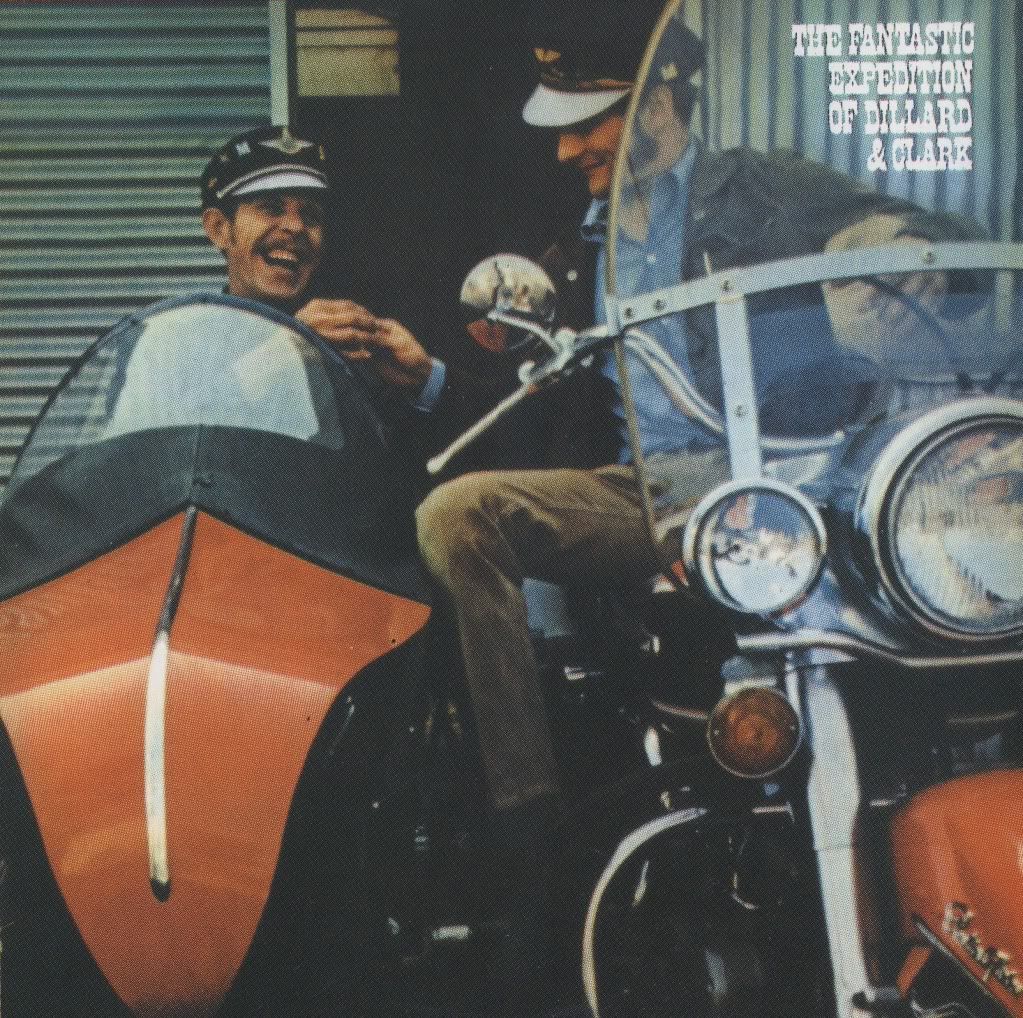
Dillard and Clark - The Fantastic Expedition of Dillard and Clark


The other night I was having trouble choosing something to listen to--ultimately, instead of one of my recent jazz purchases, I reached for this--Gene Clark's first (of two) albums with bluegrass virtuoso Doug Dillard, sandwiched between his post-Byrds solo debut Gene Clark With The Gosdin Brothers and the stunning White Light.  While a lot of country rock aficionados like to place this album as one of the first country rock collections, I prefer to think of it in the context of Gene Clark's discography as both his first masterpiece as a performer and songwriter as well as the only full album where he's complemented by an instrumentalist with an equally impressive and distinctive personality.

It's a Gene Clark album, so of course there are some great songs--"Train Leaves Here This Morning" is likely many people's favorite with its laid-back swing and one of Gene's best ambiguous chorus lines since "I'll Feel A Whole Lot Better" with "there's a train leaves here this morning/I'm not sure what I might be on."  The arrangements still show a Byrds-like penchant for thick harmony vocal arrangements, but to my ears Dillard and company provide considerably stronger accompaniment.  Also quickly noticeable are "Out On the Side," which showcases Clark's aching emotional vocal delivery backed by a full band (organ included) arrangement, and "Don't Come Rollin'," which starts as a loose harmonica jam and builds into a buoyantly conversational tell-off replete with some fast-talking from Clark, not to mention a hash reference. 

As usual, though, the songs that withhold their treasures for patient attention are ultimately just as interesting--"She Darked the Sun" proves Clark was able to adapt his songwriting to an old-timey bluegrass aesthetic while at the same time dropping crushingly modern lines like "with the length of her mind she darked the sun."  Even more affecting is the album's one-two closing punch--the jubilant banjo and familiar bass pattern of "The Plan" belie Clark's desperate existential searching, and "Something's Wrong," focuses the songwriter's profound melancholy into one of the most powerful coming-of-age songs I've ever heard, full of childhood reminiscences and a devastating bridge--and with its album-closing fiddle denouement it still clocks in under three minutes. 

These would still be great songs even if Clark were just singing them with an acoustic guitar, but Dillard (as well as Bernie Leadon) provide a shimmering backdrop of banjo, mandolin and lead acoustic guitar that adds both depth and warmth to Clark's songs as well as playing that's worthy of focusing on for its beauty alone.  Dillard's banjo skills in particular are mesmerizing--his speed is remarkable, but even more so is his ability to change up his picking patterns on the fly, providing a rhythm/lead accompaniment that constantly and fluidly changes.  It's also worth noting how well the album incorporates subtle psychedelic production elements--the harmonies in particular lend themselves to such treatment, as the brilliant instrumental section, break, and final chorus of "With Care From Someone" demonstrate, and the inclusion of harpsichord on a number of songs adds a sort of exoticism that again reminds us that what we're listening to is more than just a bluegrass album with original songs--check out the trippy swelling atmosphere at the end of "The Radio Song"--it was 1968, after all. 

Even though this album clocks in under 30 minutes and the follow-up utterly fails to live up to its predecessor, The Fantastic Expedition of Dillard and Clark lives on in my collection as a perfect collection of songs and performances--listening to it the other night was like having a conversation with an old friend.

Get it here.

Wednesday, January 4, 2012

Tyler Fortier - Bang On Time


Time for some friend music!  I've known today's artist--Eugene, Oregon-based singer/songwriter Tyler Fortier--since we were both about five years old, having both grown up in Camas, so it's always a pleasure today to track his continuing path as an artist and a special pleasure to feature an album of his here on the blog.  Bang on Time is Tyler's third release of 2011, following February's ...And They Rode Like Wildfire Snaking Through the Hills 'Neath the Scarlet Sun and April's Fear of the Unknown.  The fact that he managed to even find time and energy to write, record, distribute and tour behind three releases (let alone take the care to give each album a discrete identity) is hard to imagine, yet here the evidence is for us to enjoy.

One thing we songwriters and musicians hate to hear is that we've improved or gotten "better"--there's no quicker way to backhandedly dismiss a creative legacy that took years and an immeasurable amount of personal investment to create.  When I say Tyler has improved, I mean that he's progressively honed the aspects of his music that have been there making his albums great since the beginning--he's become more assured as a vocalist, his artistic vision has become clearer with each release and, most importantly, his craft as a songwriter has reached a level of nuance that pushes it well past what many working musicians are even capable of. 

Tyler introduces Bang On Time as stripped-down and lyrically-driven; while I'd hesitate to call the arrangements stripped-down (songs often feature several acoustic instruments, three-part vocal harmony, and there are a few string arrangements), the mood is certainly more contemplative than the rock arrangements of Fear of the Unknown.  The lyrics are indeed the centerpiece, with the irrevocable passing of time being the prime thread that connects Tyler's varied thoughts.  After listening a few times, I'm most struck by a feeling of immediacy, the sense that now is the imperative time for action, whether it's to get out of "A Place I Used To Know," to stop the clock in the title track, to continue moving "To Keep From Growing Old," or to cut the shit and get back to the things we really care about in "This World Is Moving Slow."  Tyler for the most part avoids cliché when dealing with these topics, and overcomes their familiarity to the listener with an earnest emotional authenticity that always shines through.

Of course, melody and hooks never hurt.  Moments like the transition from the chorus "home" to the bridge "home" on "This World Is Moving Slow" come at just the right time, and the restraint and simplicity of a chorus melody like the one on "When The Day Gets Lonely" transform and elevate a track that begins deceptively plainly.  While we're on the subject, one of my very favorite things about Tyler's recent work is his continuing musical relationship with his fiance, Erin Flood, whose harmony vocals blend with and accent Tyler's lead vocals perfectly, amplifying the emotional power and lifting less memorable songs like "Sweet Marie" with enhanced melodicism. 

Equally as exciting as Tyler's attention to songwriting and arranging craft are the places where he starts taking risks outside his established field, like when the breathiness gives way for a naked, strong high or low note in the vocals, or on unexpected songwriting experiments.  While the textured instrumental arrangements occasionally have me wondering if the same result couldn't necessarily be achieved with fewer sounds, a song like the moodily dark "Bang On Time" hangs on its hypnotic bassline, cavernous reverb and multiple guitars, while the album-closing "We Waited For Everything" successfully employs a dense arrangement that includes bells, pre-recorded voices, piano and spacious delay to enhance the song's dream theme with subtle psychedelic touches.  With today's proliferation of independent musicians and the ease of creating and distributing digital recordings, I often wonder what it takes for good music to finally reach mainstream notoriety--hearing songs like these, it seems like Tyler's starting to tap into even more methods that can distinguish him from the host of other Americana acts out there. 

I spend so much time looking for "out-there" artists that deconstruct our fundamental assumptions about music aesthetics that I can forget how equally rewarding more traditional music can be if the songwriting is crafted with minute and loving detail--I look forward to seeing where Tyler takes his rarefied craft with his next release.  For now, you can see him live on his solo tour around Oregon and Washington--I'll be at Nectar Lounge to see him this Friday!

Wednesday, December 7, 2011

Cheap Seats Part 1: New Album Go!


The time has come--I'm fresh off my first two days at Cloud City Sound Studios in Portland, OR starting work with engineer Justin Phelps on my next album.  Though I've been working on demos for a few months, this week marks the official start of the album as a professional production.  It was an interesting and activity-packed couple of days with plenty of progress made--we tracked rhythm guitar for eight songs and vocals for four.  Although there will be numerous other instruments on the songs, getting a tight and accurate base skeleton of one instrument and vocals is one of the most crucial parts of the process.  Less quantifiably, I'm really glad to get the learning experience portion my first professional studio days behind me--the differences between demoing and recording (my last album was all home recorded) at home and in a professional studio are huge.  On the one hand, at home creative control and patience for perfectionism are absolute.  On the other hand, though, the ceiling for perfection is much higher at a professional studio, and the technical and creative input of a professional engineer like Justin are invaluable.  After I started getting through the jitters and self-consciousness of having to take and retake certain sections over and over, Justin and I were able to get in a good groove and the benefit of his professional experience became apparent--not only does it help to have input from someone who's approaching my songs and arrangements with fresh ears and a well-developed sense of taste, it's also helpful to have someone there to say, "Hey, that take was great, let's keep going" when I would probably continue trying to get every performance detail perfect (in my ears) before moving on.  Most of all, it feels really good to work with someone who is taking my vision and goals seriously and is investing himself creatively in the project--I know it'll be much stronger for it.  Having someone besides myself treat the project as something worthy of that investment is immeasurably boosting to my confidence.

As I continue to create this album I'm planning to continue this "Cheap Seats" series to both document my experiences and in hopes of providing people I know and all of you music "sharers" with an insight into what goes into the production of an album like the one I'm making.  I'd like to dig deeper into some of the unanswerable questions relating to modern music and the life of an independent musician like myself.  These questions include: What is the measurable value of music and music recordings?  What is non-commercial music and what's its purpose?  Is it reasonable for a musician to attempt to make music a paying career, or should music only be pursued as a hobby?  Will more or less great music be created if musicians are poorly compensated financially?  How has modern technology impacted the creation and distribution of music recordings?  What are the reasonable responsibilities of a music consumer?  What does it take to be heard?  While these questions probably sound like the setup for a bitter rant, they are all complex issues with many sides and I'm hoping to get feedback from both musicians and music fans alike.  I'm just as much (or more) of a music fan as I am a musician, and consequently I think these issues are relevant to more than just independent musicians trying to make it big.  If anything, the goal of the pieces will be to show that there's much more to that MP3 or concert you just listened to than meets the ears and eyes.  Welcome to the world of an unknown independent musician and the process of recording a contribution to the vast abundance of music this world has to offer--you've got the cheapest seats in the house!

Monday, November 28, 2011

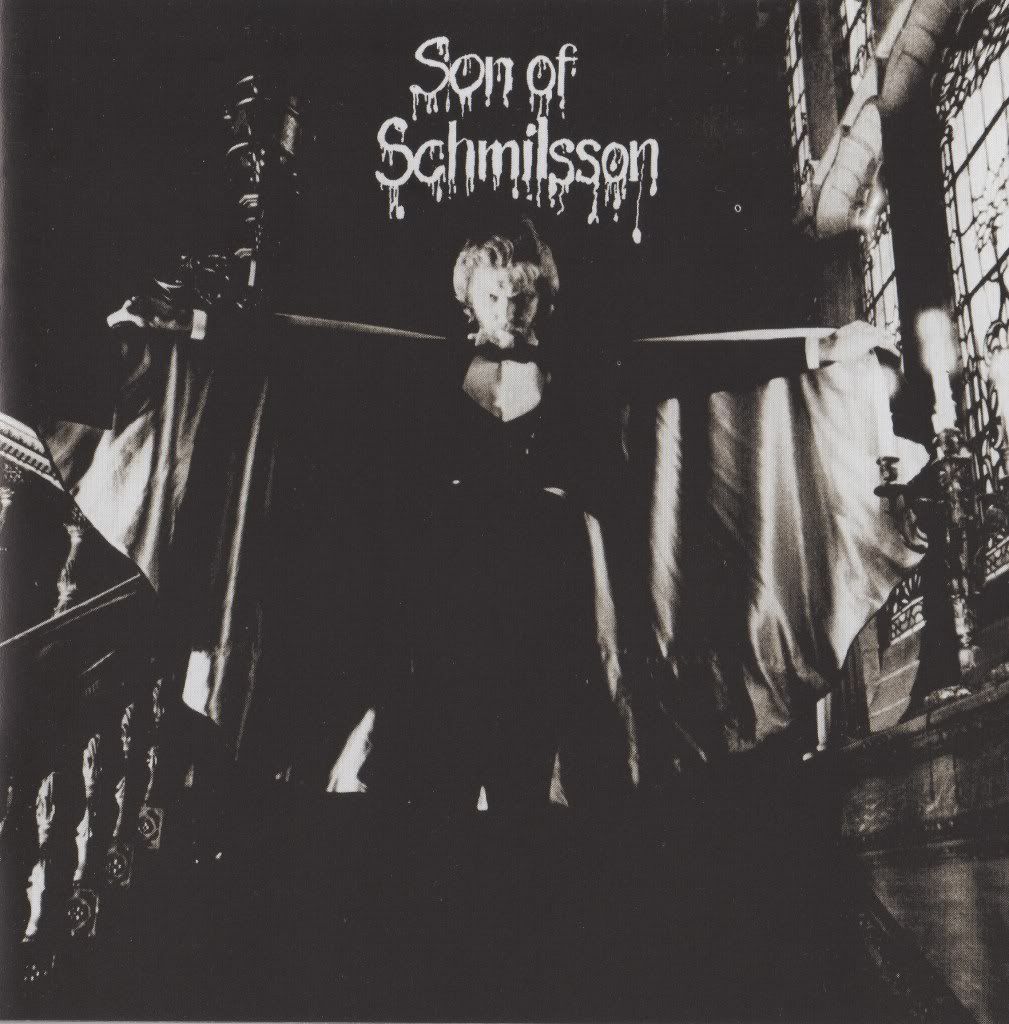
Harry Nilsson - Son of Schmilsson


No matter what institution you're a part of, be it politics, academia or just an everyday workplace, it's always good for perspective to have somebody around who's bound and determined to demonstrate on a daily basis that it's all ultimately just a pile of horseshit.  For early 70's rock, that man is undoubtedly Harry Nilsson.  When it comes to being the neighborhood subversive asshole, the usual weapons of choice are humor, satire and mockery, and Nilsson's got them in droves.  As far as I can tell, the only thing he actually cares about is singing ridiculously awesomely.  The rest seems to be an indiscriminate sampling and deconstruction of pop music in all its myriad forms with an emphasis on the puerile.  It worked pretty well for Nilsson on the previous year's breakthrough album Nilsson Schmilsson (though he'd already had successful singles and was well-known for a cover of Fred Neil's "Everybody's Talkin'").  When crafting a follow-up, it would appear that Harry's main goal was to throw the record label's desires to revisit his previous success back in their face with an album so full of jokey throwaways that it was pretty much guaranteed not to be as successful as its predecessor.

And yet, Son of Schmilsson just might be my favorite Harry Nilsson, from its righteous B horror movie cover (and sound effects at the end of the first track) to all of the burping and gargling (for serious) to the kid-in-a-candy-store smorgasbord of musical styles represented here, this album is pretty much a party record all the way.  Old school rock and roll is probably the genre of choice, as in "Take 54" where Harry "sings [his] balls off" to impress a woman who wanders into the studio, or "You're Breakin' My Heart," where Nilsson's sudden profanity sits at odds with the song's bouncy piano riff, or on the fake live boogie of "At My Front Door."  But there's so much more than rock and roll, which obviously isn't Nilsson's musical passion--"Joy" has got to be my favorite, sending up country music with all of the common tropes (spoken word, Latin flourishes, cheesy puns); I can't help but laugh every time when Nilsson sneers "good...bad...good bad" toward the end.  There's also ridiculous pseudo-Caribbean music on "The Most Beautiful World in the World" and sort of a musical theater vibe on "I'd Rather Be Dead," which famously features a chorus of retirement home residents singing about how they'd "rather be dead than wet my bed" (make sure to watch the equally hilarious documentary about the making of this album for more on that detail).

At its base level, though, this is a pop album, full of great melodies, catchy changes and Nilsson's voice and personality pushed to the front by anonymous session musicians playing a million different instruments.  For all the ridiculousness and the fact that the songs are pretty easy to grasp after a couple of listens, Nilsson's voice is (as always) a revelation, silky smooth but capable of brilliant natural distortion and some ornamentations other singers could only dream of on songs like "Take 54," "At My Front Door" and "Spaceman."  Don't tell anybody, but the merry prankster exhibits signs of actually having a heart on the velvety ballad "Remember (Christmas)" and the thoughtful "Turn on Your Radio."  Depending on which way you look at it, these songs are almost all throwaway novelty tunes or this is just a good time party album.  Either way, I think it's one hell of a fun ride with no strings attached and only a slight hangover. 

Get it here.

Friday, November 25, 2011

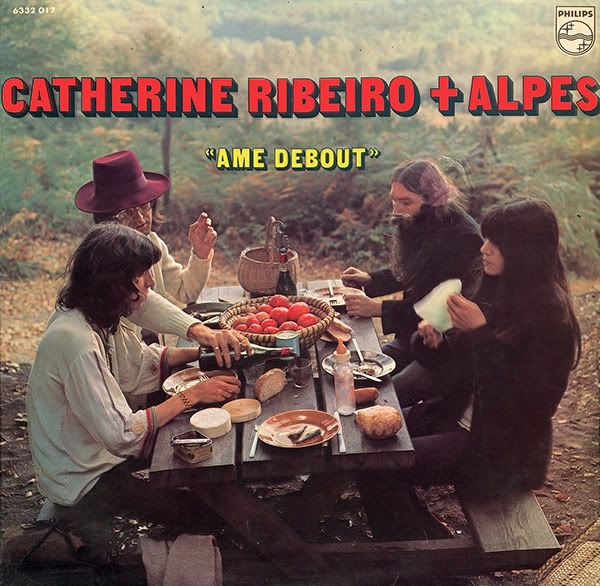
Catherine Ribeiro et Alpes - Ame Debout


We're not done with you yet, France.  In spite of all of my spirited attempts to express what I do and don't like about music into writing, sometimes it actually feels good to have those words and opinions shoved right back down my throat.  The exceptional work of singer and poet Catherine Ribeiro and her sometime-group Alpes (consisting primarily of guitarist and composer Patrice Moullet) not only defies all of my complaints about excessive repetition, its use of repetition in and across all of the album's tracks is often the precise reason why it's so great.

Rather than attempting to fuse any real recognizable styles of music with lyrics and vocals, Alpes' relationship with Ribeiro is at once more complicated and more elemental.  The band's sound is indeed consistent on most of these songs, formed primarily of repeating hand drum, bass, violin and guitar figures and droning organ and synth tones supplemented by a couple of bizarre instruments (the percuphone and the cosmophone).  The repetitious sounds are stretched long across time--minutes of the same textures, shifting perhaps ever so slightly, but rarely ever responding directly to Ribeiro's vocals rhythmically.  Instead, the music floats like an uneasy sea beneath Ribeiro's, swelling to support her vocals harmonically but rarely (if ever) displaying enough ego to act as anything other than a perfect platform for her existential angst.  For her part, Ribeiro displays peerless skills as both a singer and an actress, projecting a distilled humanity with a powerful, husky low register and desperate, cracking high range, sometimes speak-singing, sometimes freely vocalizing with moans, growls, whispers and frantic pleas.

The superb title track demonstrates the band's unique aesthetic with grace and power, as the droning instrumentation fades in with subtle dynamism and Ribeiro's vocals soar and dive as if she's pacing inside a six foot cell.  A spare organ backdrop is all that's needed to supplement the chanteuse's vocals "Le Kleenex, Le Drap De Lit Et L'etendard," wherein the bitter irony of a line like "je cherche un kleenex" sits bizarrely comfortably next to the singer's pleas to "regarde-moi, ecoute-moi."  The heart-rending "Diborowska" is undoubtedly the most compelling song melodically, with its harrowing "le train en partance pour Diborowska" merging tragically with the song's arpeggiated nylon string guitar and eerie train whistles.  The band manages to assert that its fleeting, gossamer instrumentation can arguably stand alone without Ribeiro's words with a few instrumentals, including the atmospheric "Alpes 1," the bizarre, unintelligible vocalizations of "Alpes 2" and Ribeiro's ghostly wordless vocal on "Aria Populaire."  The album comes to a folky, pounding close with "Dingue," which combines the folkiness of Ribeiro's earlier recordings with 2 Bis with a similar sort of energy to early Leonard Cohen with even more bile and energy in the vocals.

While the compositional elements and harmony employed by this music are really quite simple, there's an emotional expression happening in the combination of the vocals and music that is so rare and direct that I can't say I've ever heard anything quite like it, even in the realm of similar artists like Peter Hammill.  It's almost like the instrumentation is there for the explicit purpose of putting Ribeiro in the zone to extemporaneously conjure her deepest self onto tape, and it's always inspiring to hear.  As much as I'll probably continue to rail against excessive repetition in all forms of music, this album (along with the rest of Ribeiro's work from the same period) is a humbling reminder that there is never one single right way to make music, and the effort to conceptualize and verbalize a musical aesthetic is only an imperfect attempt to reach the sort of unquantifiable magic found here, using incomplete means.  If you can achieve this level of intuitive expression, it doesn't really matter to me how many chords are in the song or how many times you play the same note in a row.  Unfortunately most of us mortals lack the innate spark required and must attempt to find our lesser inspiration by toying with established theory and idioms down in the everyday muck.  It's absolutely criminal that these albums are out of print and Ribeiro's music is even harder to find out about than it should be.

For now, you can find it here.

Wednesday, November 9, 2011

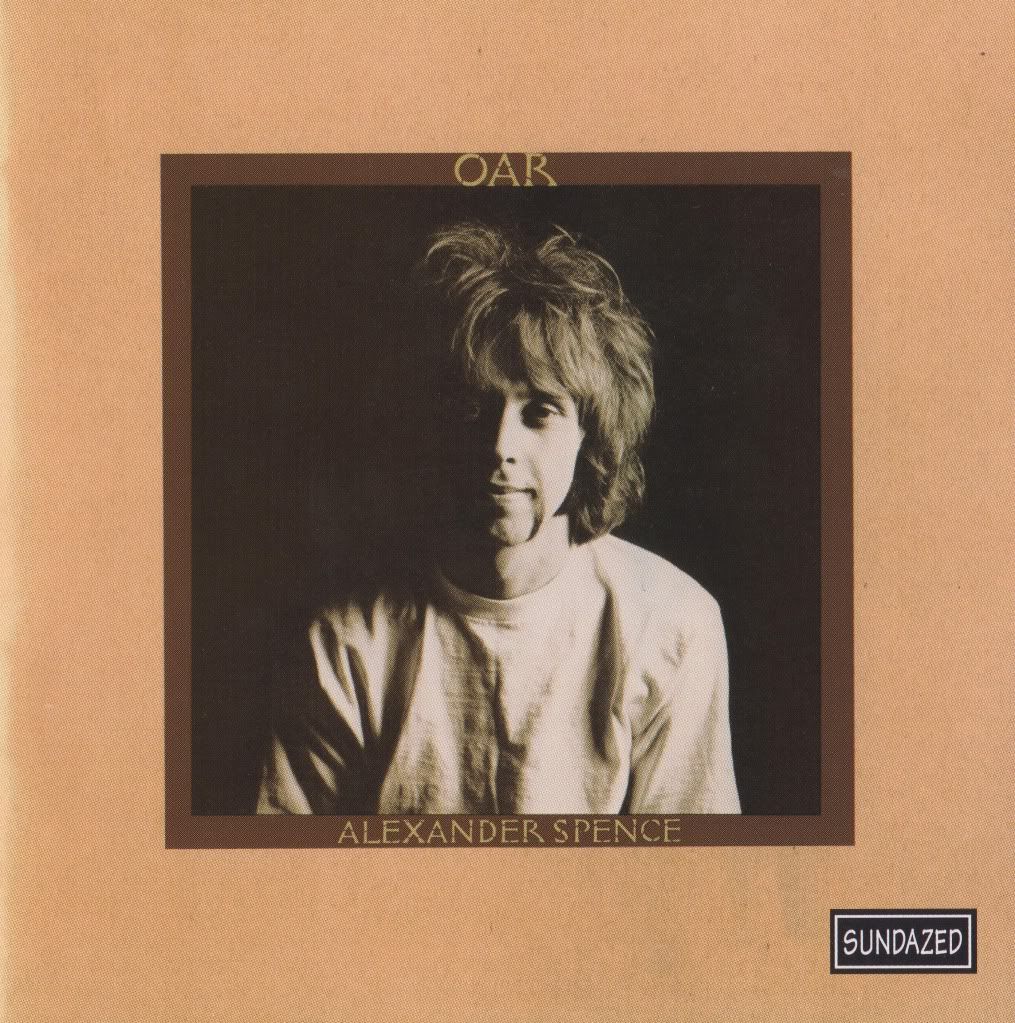
Alexander Spence - Oar


I always thought that Skip Spence was the least technically proficient of Moby Grape's three guitarist/vocalists, but that he always made up for it with unmatched manic energy and that unquantifiable magic in his songwriting that few career songwriters manage to conjure.  Of course, by 1969 and the release of this much-celebrated (but still obscure) solo album, Skip (now billed as Alexander) was long gone from the ranks of Moby Grape.  There's a lot of mythology surrounding Spence's departure from the band, his time in Bellevue Hospital and the genesis of this album, which has generated a sort of Syd Barrett-like reputation for Spence as some sort of acid messiah.  While I think it's easy to project an impression of the man's mental state onto this collection of songs, I think it holds up as fascinating and idiosyncratic work without reading too much into or presuming too much about its creator's psyche.

Probably the album's defining characteristic is that it was recorded in seven days with Spence playing all of the instruments (mostly guitar, bass and drums), which gives the album a loose, tentative feel that occasionally comes across as sort of half-assed and shambling.  What continually fascinates me on repeated listens, though, is that the rushed, uncertain mood sort of fades away like a patina being polished to reveal songwriting that's often full of musical nuances and clever wordplay and not nearly as tossed-off as it seems.  Like Syd Barrett, Spence has a reputation for sort of spontaneously firing great material straight out of his drug and illness-wracked brain, but I think he's a lot more in control than the songs' cowboy ballad structures and sketchy, plodding arrangements would suggest.  Take the tongue-in-cheek mockery of Eastern religion-obsessed hippies of "Dixie Peach Promenade," the hilarious wordplay of "Broken Heart" ("an Olympic super swimmer whose belly doesn't flop/a super race car driver whose pit it can't be stopped") or the more somber punning "weighted/waited" turnaround of the country lament, "Weighted Down (The Prison Song)."  Spence clearly has a knack for sharp satire, a taste for evocative images and an eye for the overall structure and flow that is so crucial to "classically" good songwriting. 

While the album's songs veer toward a folk/country ballad style more often than not, it wouldn't have gained its cult status without some overt psychedelia--the opening "Little Hands" has the album's most hippie-ish message and amply demonstrates Spence's ability to blend droning acoustic guitar with clean electric parts for a unique texture.  This palette reappears on the hazy "All Come to Meet Her," the closer, "Grey/Afro," which drones a little aimlessly but pays off with some cool bass/drum interplay at the end, and the album's psychedelic crown jewel "War in Peace," where Spence's delay and reverb-treated whispery vocals float above a sinuous, repeatedly swelling chord progression that finally breaks open with some understated but well-chosen lead guitar notes.  Spence's delayed vocal sound effects twitter in between blooming guitar strums as the song fades out over a forgivable ripoff of the "Sunshine of Your Love" riff.

I sometimes wonder what this album had been like if Spence had demoed the songs and rehearsed a lot more before going into the professional studio.  It certainly would have smoothed the rough edges on some of the wheezy vocals and tightened up the tendency of the drums and bass to emulate drunken lurching (hear both on "Lawrence of Euphoria").  Then again, I think the ragged feel is part of the album's charming appeal--it's almost like a trick, duping the listener into believing the music is garbage when in reality all of the most important melodic, structural and creative elements are there in droves.  Consequently, the low-key sound means the songs are never really obtrusive despite their psychedelic tinges but anyone really paying attention will be rewarded by Spence's craftsmanship, which comes across as confused muttering if the disc is played as background music.  This deceptively casual veneer has got to be one of the reasons this album is so popular with musicians--it's not easy to pull off, and the minimalism of the album's template means the songs could be (and were) embellished in unlimited ways.  I can think of few other albums quite as effortlessly subtle, and none that do it in quite this way. 

Get it here.

Wednesday, November 2, 2011

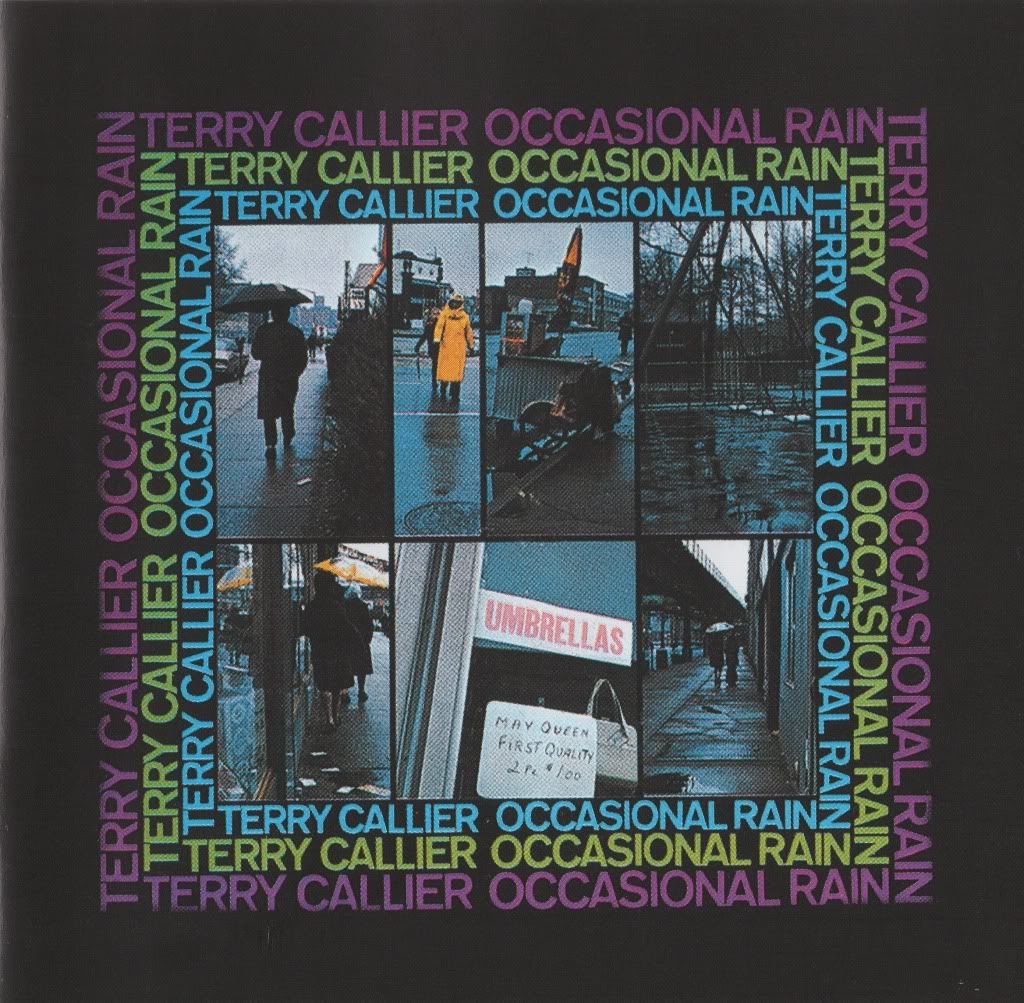
Terry Callier - Occasional Rain


Though it seems most intrepid music searchers choose What Color Is Love for a first taste of folk/soul guru Terry Callier's music (I'm sure it has nothing to do with the fact that there's a naked woman on the cover), Occasional Rain is in my books just as worthy a place to start or continue appreciating Callier's totally unique style. 

On paper, it would appear tough get too excited about this music--it's slow-moving, combines folk and soul with occasionally extravagant orchestral and choral arrangements, and Callier sings about social unrest, heartbreak and mystical insights in a husky baritone that's never far away from a wide, smooth vibrato.  In spite of the fact that people have outright laughed when I played this for them, I've always loved Terry Callier's music.  Maybe it's his deep sincerity or his ability to turn a profound phrase out of nowhere, but once you suspend your sense of being too cool to hear a man channel his deepest feelings into a pop music context, it's actually not that difficult to take this music seriously.  Actually, I don't even know why I'm writing so defensively about Callier's music--this is an awesome album! 

The only vestiges of Callier's folk debut (eight years old at the time of this recording) show up in a broken up blues called "Go Head On," which is used as segue material between the rest of the tracks, which amply demonstrate that something changed for Callier in the interim that suddenly made him capable of fusing black and white music (a bizarre artistic choice that few other black artists seemed interested in making) with an unadorned but brilliantly perceptive poetic instinct in his lyric writing.  Combine his strange amalgamation of styles with the arranging skills of Charles Stepney (of Rotary Connection and later of Earth, Wind and Fire fame) and the brew becomes even more unusual--there's a Burt Bacharach-like schmaltz (especially on things like the bouncy "Ordinary Joe" and pop blues of "Sweet Edie-D" to these arrangements, but somehow it's always justified by Callier's passionate energy and words, which freely leap from one insight to the next without ever abandoning the consistent mood of each song.

Actually, I think in some places Stepney's production is actually one of the best things about this album--he seems to know just what to use and when, like the clean cello arrangement that accompanies Callier's spare guitar and vocal parts on "Blues for Marcus," and the spine tingling organ and twinkling choral interjections (that's Minnie Riperton singing soprano!) that make "Occasional Rain" the most psychedelic thing on the album.  In other places the quality of the choral arrangements is absolutely hair-raising ("Lean On Me" is the best build-up on the album, and an excellent climax as well).  The dusky mood and extemporaneous feel of "Trance On Sedgwick Street" foreshadows the epic grandeur of Callier's forthcoming works--revisiting these songs I can't help but think that Stepney's influence expanded Callier's songwriting imagination in a way that paved the path forward to his most distinctive work.  Occasional Rain is a confidant for those moments of introspection and deep soul, and (for me, at least) it never fails to remind of the smoldering beauty that can be found in those quiet, honest spaces.

Friday, October 14, 2011

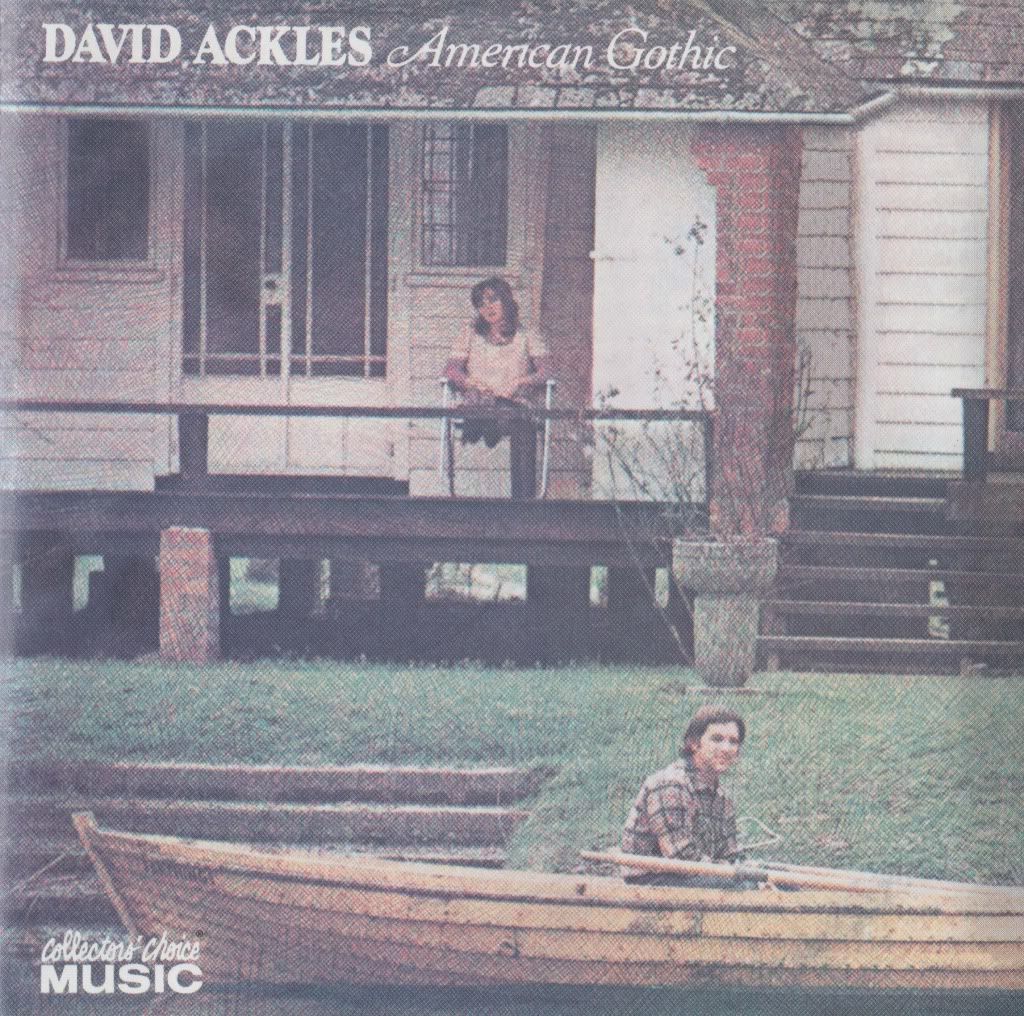
David Ackles - American Gothic


Continuing this week's re-re-refocus on singer/songwriters, here's something almost completely different.  Though he'd already released two full-length albums full of seedy, proto-Tom Waits character sketches by 1972, American Gothic is where David Ackles' unique and gritty vision reached full flower conceptually and musically.

As its title suggests, American Gothic is an attempt to paint a kaleidoscopic picture of American life (as he sees it) through a series of character narratives and internal monologues.  As sprawling a project as this may sound, Ackles manages to avoid the pitfall of overreaching in attempts to be all-inclusive by imagining himself quite snugly into extremely focused and well-drawn characters and situations.  From the title track's comically unhappy couple (a cuckolding wife who's true love is shoes and her porn-reading drunk of a husband) to the deliberate cheese of the traveling musician's "One Night Stand" to the choking malaise of Vietnam's effects on American society ("Ballad of the Ship of State") to a brilliantly succinct summation of the "Oh, California!" mentality with "Let's be happy until the sun goes out" to the blithe ignorance to the Native American experience on "Blues for Billy Whitecloud" to the touching rumination on the all-too-characteristically-American divorce rate in "Waiting for the Moving Van," Ackles proves his skills as an insightful and subtle songwriter again and again.  It seems at least part of his greatness rests in his ability to balance mordant wit and cutting appraisals with genuine heart, empathy and a constantly evident love for the totality of what he sees as American life, as especially evidenced on the desperate, cathartic redemption of "Another Friday Night" and a respectful exploration of communal religious music experience on "Family Band."

What unmistakably sets this apart from most of the singer/songwriter material I've shared is the music--there's barely a guitar in sight on American Gothic, with Ackles playing his own quite accomplished piano parts aided by a not inconsequential amount of orchestration--in comparison with the other two orchestrated albums I've discussed this week, Ackles' work reveals another distinct aspect of the practice--though his songs would easily stand alone with piano and voice arrangements, the style of the music almost necessitates a wealth of other instrumental textures.  Using a near-encyclopedic lexicon of musical styles, Ackles imbues his songs with jazz, rag, R&B, classical, gospel, folk and pop elements, occasionally within single songs ("Midnight Carousel").  As such, there are few other contemporary singer/songwriters to compare him with--while there's a similarity to Randy Newman and Ackles obviously paved the way for the tears-in-the-beer antics of early Tom Waits, his sincerity sets him apart from Newman and it's clear he isn't trying quite as hard to contrive a persona as Waits has.  In some ways, Ackles songs play more like musical theater--the American musical style blending of Rodgers and Hammerstein driven by some of the darkness of Brecht/Weill all funneled through Ackles' powerful, distinctive and closely-controlled (if often cigarette-husky) baritone.  I think the fact that Ackles' chosen style has little precedent in the pop music world (not to mention the fact that most people, on hearing it, associate it with musical theater and quickly dismiss it) obviously consigned this album to continued obscurity.  Even many of today's relic hunters seem quick to write off the album based purely on a lack of understanding of Ackles' stylistic choices--it's not like they're offering similarly-arranged music they think is better. 

Part of the reward of stretching to meet this album halfway is keeping in mind that not all artistic pop music has to fit the rock template that's dominated since the late 1950's--once you accept that Ackles' primary aesthetic compass is one that dates back to a time when the blaring horns and abrupt theatrical chord changes were actually a part of the public's conception of pop music, it's appreciable how well he manages to seamlessly update those building blocks to (1972) modern times and fill the spaces with a mature artistic vision.  This is probably best exemplified in the majestic and brilliant album-closing "Montana Song," which tells a multi-generational American family's story across Copland-influenced orchestral arrangements and a narrative that sums up the classic American life adventure against the starkness of nature, bound together only by the bonds of family, eventually complicated by the progress of time and children's new adventures, and finally resolved by the great-grandchild's connection with the distant context of his modern life.  Though it takes some effort to reset your ears' expectations to Ackles' willfully non-pop style, the effort is well worth it for a prolonged glimpse into the man's vision of American life past, future and his somehow even more diverse, limitless present.

Wednesday, October 12, 2011

Roy Harper - Valentine


You know you're in a good place artistically when you're pumping out massive, sweeping epics every couple of years and still find you have enough shorter, less ambitious songs coming out of your pen to collect another entire album without even having to try.  Roy Harper was in such a situation in 1974, coming off of a couple of conceptual beasts in 1971's Stormcock and 1973's Lifemask and realizing he'd amassed enough unrelated but equally strong material in the meantime to release an album of (mostly) love songs--1974's Valentine.

The fact that a spread of songs dating as far back as the mid-60's succeeds so well comes undoubtedly by the grace of the unstoppable roll Harper was on in the mid-70's.  Still in the continual process of honing his individualistic acoustic singer/songwriter-cum-absurdist rock experimenter style, it's clear on Valentine that there were plenty more song experiments and odd ideas yet to go before the well ran dry--indeed, with his move to a more rock centered style on 1975's HQ, Harper moved on before having to scrape the bottom of the barrel.

In Valentine we get the classic Harper blend of tenderness ("I'll See You Again," an update of his debut's "Forever,"), belligerence ("Male Chauvinist Pig Blues," "Che"), comic vulgarity ("Magic Woman Liberation Reshuffle") and spaciness ("Twelve Hours of Sunset," "Acapulco Gold"), all tied together by an ever-present sense of human searching in things both musical and lyrical.  While I know this schizophrenic aesthetic can be disorienting for Harper newcomers, it's the unflinching honesty that brings the converted back again and again.  In fact, it's often in the songs in which more than one of these contrasting moods are juxtaposed that Roy produces his most compelling tension--the lilting folk psychedelia of love song "Forbidden Fruit" belies the reality that, save some ambiguity regarding the narrator's age, it's about pedophilia (a fact the song's beauty makes fittingly all-to-easy to ignore).  The lush, well-paced "I'll See You Again" places the songwriter's compassion at odds with his stubborn pursuit of his own path, shading a hurtful move with obvious deep consideration.  The perennial live favorite "Commune" achieves this contrast perhaps best of all, with Harper exposing love's complexity through his own fickleness, gradually softening the chorus from "And love is my torment/And I'll take when I can/But I'll give in the moment/When you are my woman and I am your man" to "And love is no torment/For we'll give when we can/And we'll live in the moment/When you are my woman and I am your man" and finally altering the final line to "And we'll live for the moment/When she is my woman and I am her man," somehow using a few short words to subtly lay bare the simultaneously selfish and selfless act of reaching out that lies at the heart of love.  Oh, let's not forget that the same song also combines Harper's inclination for bodily imagery (enough to make many listeners squirm) with one of his most gloriously distinctive fingerstyle pull-off laden guitar riffs.

In light of my recent complaints against less refined attempts at adding orchestration to pop music, I want to make special note of the contributions of recently-deceased English composer and conductor David Bedford.  Appearing on a select handful of tracks, Bedford's arrangements are the quintessence of sympathetic--they swell with strings and blaring brass on the aforementioned "I'll See You Again," lending added drama but also harmonically enhancing Harper's vocal melody.  Repeating string figures rhythmically punctuate the guitar part on "Commune" without ever obscuring it, tonally enhancing the lyric's nature imagery and adding variation to the repeating guitar part.  Harper's version of "North Country" possesses a polish Dylan never matched, and the strings again swoop below, above and around the polytonality of his guitar line, their liquidity contrasting the more percussive sound of a fingerpicked guitar and at other times emphasizing Harper's naked guitar and vocals with judicious application of one of the most important (yet underutilized) tools in every musician's box--silence.  Finally, the arrangement collaboration between Harper and Bedford on the immortal "Twelve Hours of Sunset" produces some of the most spine-tinglingly beautiful moments I've ever heard, as Harper's multi-tracked vocal arrangement explores extended harmony while Bedford employs French horn and dissonance with more strings to funnel tension into the song's hair-raising dual crescendos.  Bedford's respect for Harper's songs and his crucial intuitive understanding of the colors his instrumentation contributes take these hallowed additions to the Harper songbook and elevate them even further.  In answer to the two orchestration-related questions from my last review, "yes," the songs work without the orchestration, and "yes," each and every added element enhances the song with distinctive character (there's virtually no excess in Bedford's instrumental choices or part writing), which seems to be the ideal outcome in all ways.

Aside from these canonical contributions, Harper also gives us a generous helping of his inimitable coarseness in "Male Chauvinist Pig Blues" and "Magic Woman Liberation Reshuffle," both of which experiment with electric guitars, rock arrangements, and what could politely be referred to as "contentious" attitudes toward monogamy and feminism (it wouldn't be a classic Harper album without some controversy).  "Acapulco Gold" combines Harper's love for dope with a rare vocal jazz piano arrangement, while mostly instrumental dedication "Che" successfully stretches Harper's formidable guitar skills into the Spanish realm with some of his best guitar playing on tape.  All in all, Valentine is often overshadowed by Harper's more ambitious 70's recordings, but its charms lie in the subtlety and quality of its somewhat more conventionally-constructed songs.  Once you've had a taste of singer/songwriter material that's this varied and deep, it's hard to settle for anything less.

Buy it from the artist.

More Roy Harper.