Showing posts with label free improvisation. Show all posts

Tuesday, April 30, 2013

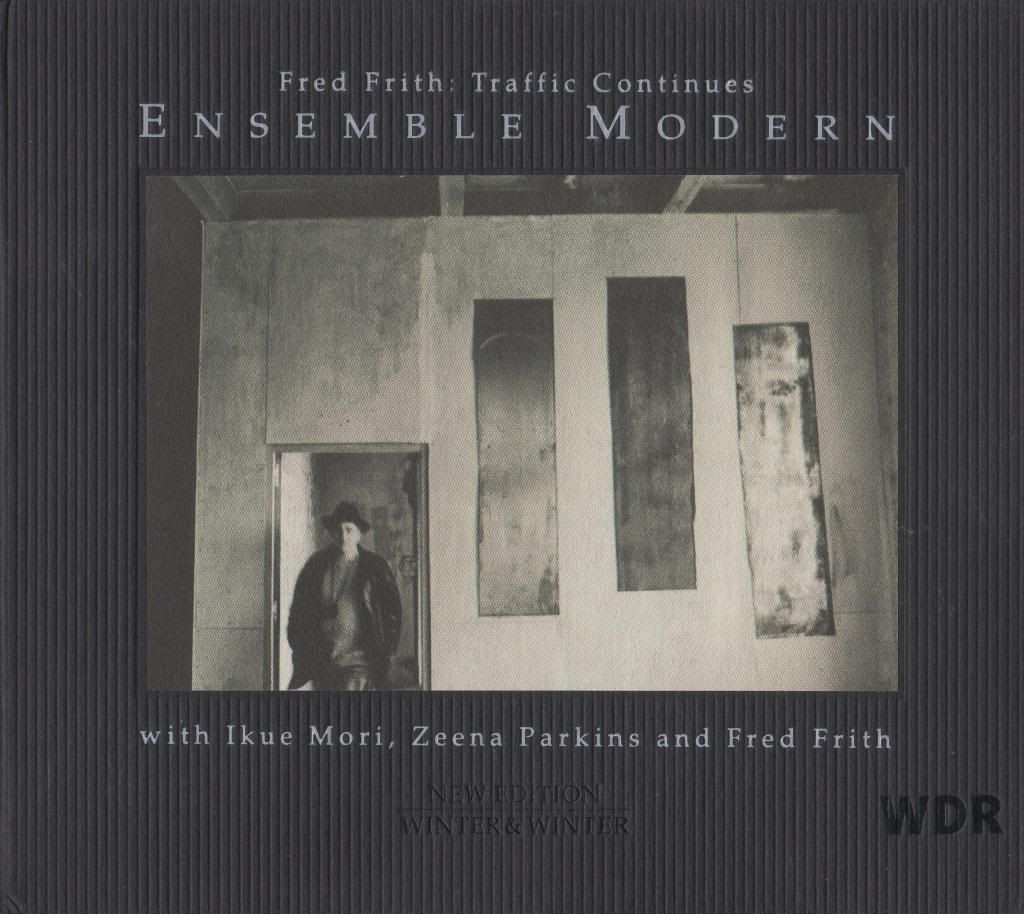
Fred Frith and Ensemble Modern: Traffic Continues


Although our man is credited as guitarist, this album plays more like a performance of Fred Frith compositions than it does like a "Fred Frith album," as we may have variously come to understand what they might sound like.  That said, the ensemble (which audibly sounds basically like classical instrumentation with a few subtle electronic elements) is fantastic, playing with virtuosity you'd expect from concert musicians, but also a zany freedom that firmly places them in a modern context.

To my ears the compositions start off very strongly with some brilliantly knotty orchestrations and a vaguely conventional harmonic aesthetic.  Evaluated through this type of lens, the disc loses some steam in the middle (around the beginning of "Traffic Continues II: Gusto", composed for and from audio samples of Frith's recently-deceased friend and Skeleton Crew bandmate, cellist Tom Cora) as it becomes more spare and quiet, then closes strongly with the final and longest track.  It may be true that the quieter bits require a different sort of criteria for evaluation and may succeed by those standards, but for me the act of readjusting what I'm listening for has so far proven frustrating to the extent that I'm usually left with a feeling that I just heard a recording with some great parts and some that merely passed me by.  I get the feeling that more effort could either yield more appreciation or a stronger sense that some of the writing is a bit too casual and reliant on free performances to carry the weight.  Either way, this is inarguably the kind of music you need to let act on you before imposing any kind of sweeping critical judgment.  Here's to more trying!

Get 'er.

Monday, December 19, 2011

Supersilent - 1


Though I've written a fair bit about free improvisation, I've only written about a couple of groups (mostly AMM and related artists).  Here's something different from a more recent group from Norway called Supersilent.  1 is the first disc of their 1997 debut 1-3, which I've decided (after no small deliberation) to break up into three parts to review despite the fact that the albums are all grouped (like each of Supersilent's numbered releases) in one single-colored package and since each disc is over an hour long.  While it took my ears a while to grow accustomed to the synth-heavy sounds on these albums (I'm used to the comparatively organic sounds of groups like AMM), the music here has eventually become the kind of paradoxically noisy brain relaxant that I've come to look for in the best free improv.

The fact that Supersilent's music is related to free jazz is immediately apparent here--"1.1" opens with 2:30 of drums before the first synth statement.  The drummer's jazz chops is probably one of my favorite aspects about the group's sound--often the longer tracks come down to layering extended synth tones over the top of the kit sounds, which keep things interesting and remind us that there are indeed humans making this music.  The first track also demonstrates the group's interest in both sampling wordless vocals and throwing a little bit of trumpet into the mix, which deepens the connection to free jazz (though the trumpeter's chops aren't especially jazzy).  Things also get satisfyingly twitchy in the first track's second half and in "1.2" when repeating bass synth tones start to contrast the drum beats. 

"1.3" shows the group's interest in both treated sounds (with synths that undergo brilliant changes in timbre and texture) and the power of volume, with densely layered soundscapes made of shrieking synths and pounding drums.  I like how the group manages to keep things kinetic in these places--it's the judgment to ensure an energetic beat (no matter how fractured or buried by abrasive sounds) that (for me) separates this noise from just anybody out there with a keyboard and a big amp.  The final track, "1.4" finds the group toying much more with dynamics, using a repeating minor trumpet melodic motif as a backbone and running past it with a series of percussion and comparatively gentle synth improvisations.  Though the band rarely manages to use silence as an effective tool on this disc, the shift in volume dynamics is a welcome and arguably necessary one (if you're going to try and make it through all three discs at once!).  The melodic fragment is effective but repetitive and predicts the group's later, much tamer forays into more melodic, tonally-anchored improvisations.  While it's definitely a more accessible sound, I prefer the group's more distinctive and energetic early work, but I understand that it sure must be tough to try and achieve success playing such harsh-sounding music.  6 seems to be the group's most popular release, but I appreciate the edge that's present here on their earlier material, which inhabits a niche in the free improv realm that I haven't heard anyone else quite fill.

Get it here.

Monday, November 21, 2011

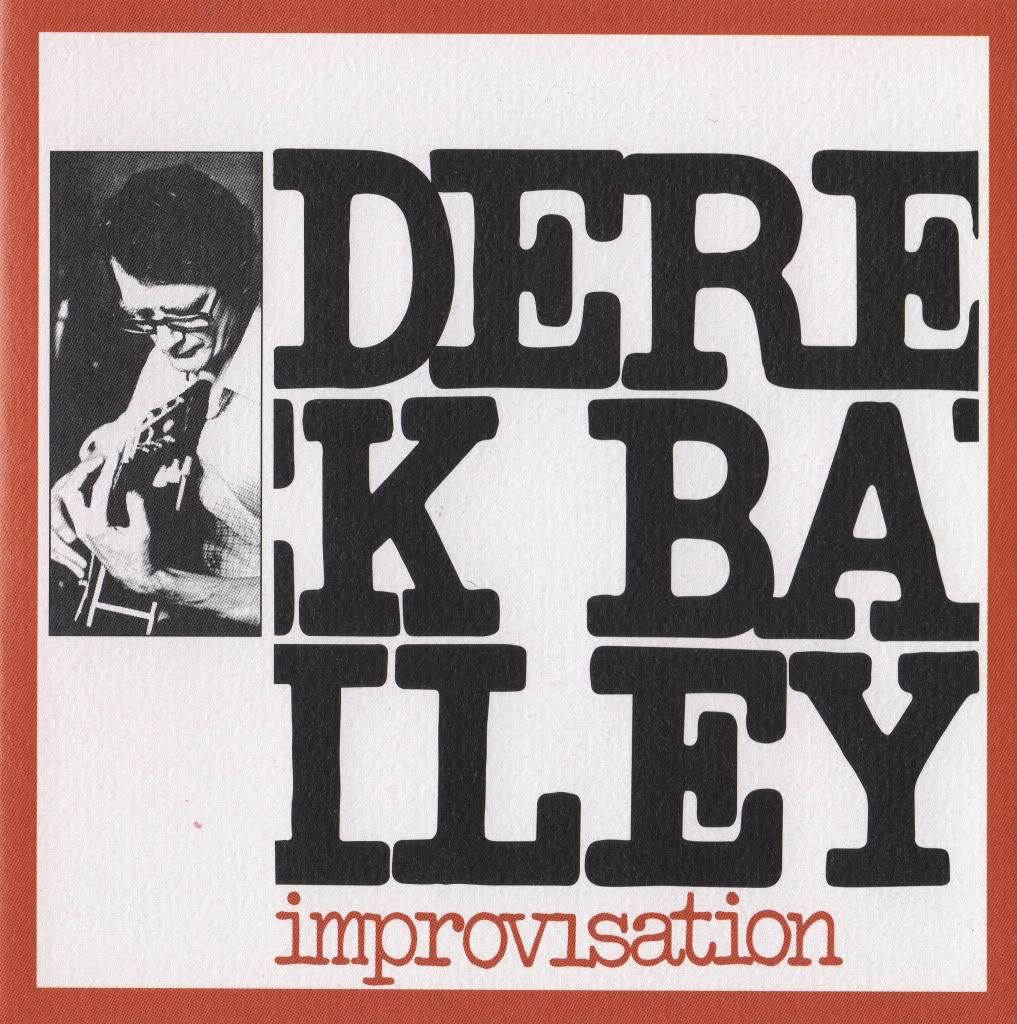
Derek Bailey - Improvisation


Derek Bailey is known for two things: being a grouchy old man when he wasn't even old, and for single-handedly creating his own free improvisation idiom on the six-string guitar.  Right up my alley on both counts!  By the time Bailey recorded Solo Guitar Volume One in 1971, he'd already been a prominent figure in the British and European free jazz circuits, performing with people like saxophonists Evan Parker and Peter Brötzmann and bassist Dave Holland, and by the time this 1975 album was released he had refined his solo improvisational technique (which came across as a bit tentative in his debut) to the rarefied level it remained for most of the rest of his career.

Listening to Derek Bailey for the first time can be a disorienting--his style is thoroughly and often brutally atonal, arrhythmic and usually very nonrepetitive.  It's also most assuredly the type of music that sounds like an irritating mess if the volume is low and you're only half paying attention.  Crank it up so your surrounded by Bailey's sound world and focus on what he's doing and an exciting (if somewhat cold) sense of adventure-in-logic dominates every move the guitarist makes.

While Keith Rowe is responsible for making equally influential advances in the guitar free improvisation realm, Bailey's music sounds much more like a conventional guitar played to an exponentially "out" degree; in fact, his amplification is so clean it's almost difficult to discern that he's playing an electric guitar on this album.  Though he almost exclusively flatpicks, Bailey's style relies heavily on harmonics, muting and exploiting the instrument's natural sustain and decay.  This can be easily heard on "M4" and to even greater depth on "M8," where Bailey's harmonics and string bends pit two strings against one another on nearly the same note, deftly controlling the oscillation between the two notes as they eerily decay into space.  At other points Bailey embarks on furious runs across bizarre intervals, sporadically halting to interject with brief spurts of silence or allowing a note to ring before again changing direction completely with some explosively percussive cluster chords ("M10").

One of the things I love most about Bailey's style is how fluidly he moves from one idea to the next; though there really isn't any melody to his playing, it's usually easy to discern what is fascinating him at any given moment, and the thrill of his free improvisation is in the headlong rush into whatever the next idea might be.  Sometimes the difference lies in the textural discrepancy between harmonics, standard string plucking and jabbing chords ("M13"), and at other points it might be a digression into exploring the percussive potential of the instrument with skittering string scrapes ("M14") or interjecting taps on the guitar top between the string's tonal sounds.  Finally, and perhaps most subtly, Bailey uses a two-amplifier setup and volume/swell pedals to dynamically pan the output of his guitar, which adds a richness and mobility to his fretboard wandering (especially noticeable on "M5").  While not quite as finely controllable as Fred Frith's dual pickup/output experiments, it's easy to see that Frith's guitar solos owe a sizable debt to the pioneering done by Bailey.

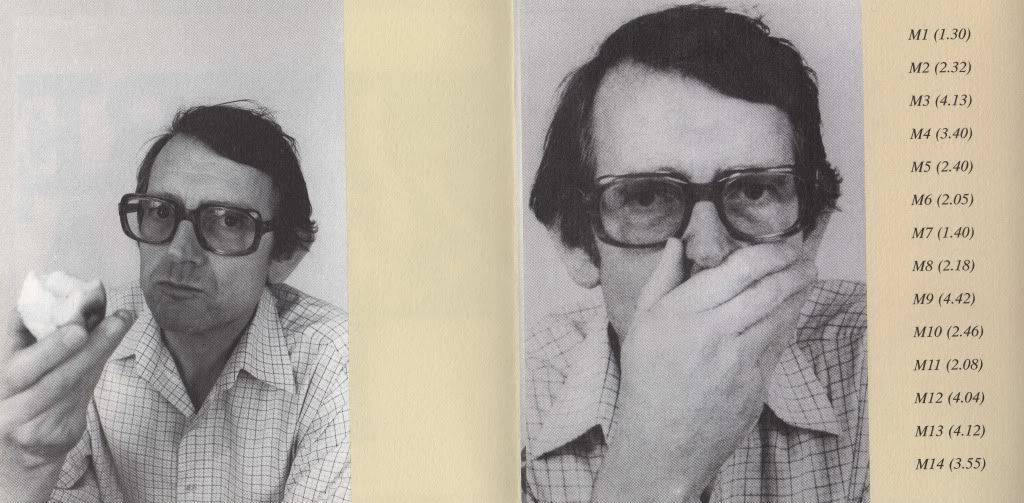
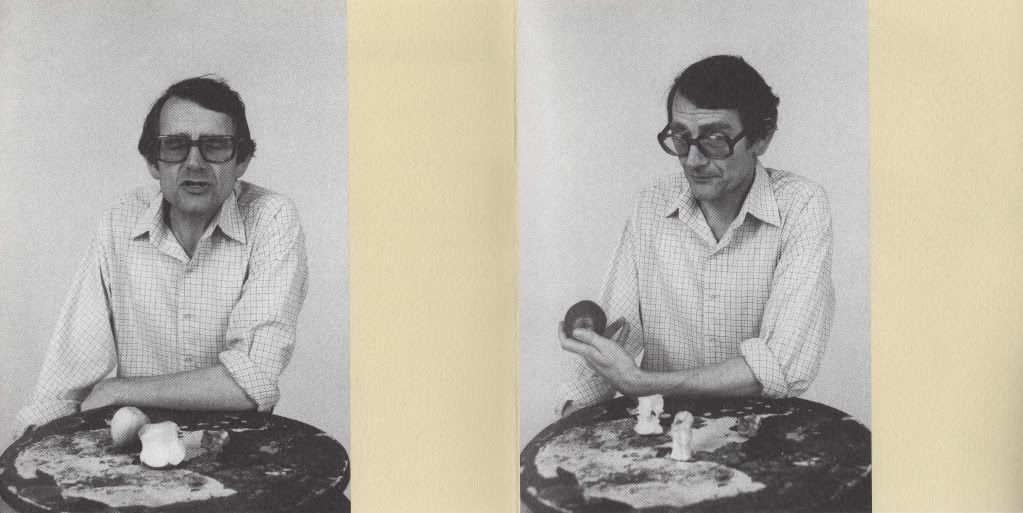
While he's got more epic albums (Aida is often regarded as his best), I think Improvisation is just as strong and is probably a better introduction to Bailey's challenging style because the track lengths are short and can be more easily focused on and digested.  Though my interest in Bailey has been tempered by the realization that his style became formalized mid-70's and didn't develop much further, revisiting his best works reminds me that 1) his style is so radically different from those who came before him that he didn't really need to reinvent himself to maintain his validity and 2) his style is so all-over-the-place that there isn't a whole lot more he could do to develop it further.  Bailey's playing is an inescapable golden standard for atonal guitar as well as an audacious challenge to all followers to conjure something else new and exciting from those six strings.  Please enjoy these pictures of Derek Bailey eating some apples.
Get it here.

Friday, October 28, 2011

Keith Rowe - The Room


Now, back to something really weird.  Keith Rowe, formerly the guitarist for house favorites AMM, is probably one of the most influential underground guitarists of all time.  He was one of the first guitarists to pioneer a tabletop prepared guitar technique wherein the instrument is placed flat on a table and manipulated with various found objects to create unusual and unconventional timbres.  After quitting AMM for the second time in 2004 (a move of which he's apparently quite proud), Rowe's solo performance and album release schedule has picked up markedly, as has his further exploration of the possibilities of Electroacoustic Improvisation (EAI), a loosely-defined branch of free improvisation with an emphasis on live computer processing of improvised sound sources.  This, a 2007 solo release, is regarded by some as Rowe's best solo album and was released on Erstwhile Records, which courageously releases an impressive amount of good EAI to a generally apathetic public (awesomely enough, the label also eschews barcodes in their packaging).

While Rowe's contributions to AMM often seem intended to amplify the sounds of his unusual guitar approach into a space (i.e. a room or concert hall), The Room sounds to me much more inward, as if he is listening to the innards of the things producing the sound.  This impression is probably intensified by the fact that Rowe's improvisations sound like they're directly input to the recording device, rather than amplified and miked.  In any case, the result is a single 38:57 continuous track (though there are brief silences between sections) of droning guitar tone, amplified signals and electronic processors, some traces of Rowe's signature radio frequency manipulation, and some visceral textures produced by Rowe's physical manipulation of the guitar's strings.  If that description doesn't sound like much, please be aware that the actual sounds contained on this disc are very difficult to verbalize!  Though this album is much too indie to appear on YouTube, this video of Rowe playing prepared guitar will at least give you a better idea of what some of this sounds like (though I personally prefer not having these bizarre sounds attached to any visual explanations for their origins).  To me, the dominant timbres of the music are a sort of ambient hum (presumably the guitar), and a more rhythmically dynamic, twittering, upper-frequency sort of repetitive digital bleeping.  It's fascinating how the textures overlap in a sort of progressively sliding series of layers, with one tone source pulsing gently while another simultaneously rapidly dances on top, and before you know it one of the sounds has disappeared while your ears were transfixed by another, and a new one is just moving into the picture.

How does this music compare to free improvisation like AMM?  Well, for starters, I think it's not completely discrete--if there was some way to only hear what Rowe was doing during certain AMM performances (I'm thinking especially of the drone-heavy 2001 album Fine), I think it might sound a lot like parts of this album, despite Rowe's written assertions that it's an attempt to go somewhere completely new.  In other ways, though, it's much colder, more alien and less organic than AMM's albums, conjuring a claustrophobic atmosphere (perhaps there's a connection to the album's title and the feeling the music conveys) and a sort of digital industrial feel that never really occurs on AMM albums.  Not that it's a particularly bad thing--I vividly remember on my first listen feeling (perhaps around the 22:30 minute mark, when Rowe starts scraping the strings beneath a piercing electronic tone) a powerful sense of unease and a strange, alien emotion that no other music has ever made me feel before.  Though it's far from the warm-and-fuzzy elation that most listeners hope to achieve from an album, the experience remains ingrained in my memory as an inspirational example of music's unlimited emotional potential, and as a sort of revelation (how often do you feel a feeling you've never felt before, right?!).  Don't get me wrong--Rowe's sometimes laughably-strident views on musical aesthetics (which seem to come with the territory of free improvisation) inform this music with an uncommon level of academic seriousness--but attempting to deny the music's very real emotional power in the name of disagreeing with Rowe's artistic choices seems to unjustly disregard his contributions to the ever-growing palette of potential moods and emotions available to listeners and musicians alike. 

It's hard to really assess the quality of music like this--it's so fundamentally different structurally and in its aesthetic goals that even when talking in terms of elemental sound, it's hard to separate what's "good" from "bad," and the subjectivity of personal preference that's present with all music becomes a starting point rather than an ultimate conclusion.  Despite Rowe's professed anti-virtuosic method, though, he clearly (in my ears, at least) has a flair for space, flow and tone/timbre choice that few other improvisers do.  Though I think The Room occasionally suffers from the sort of repetitiousness and aimless structure that understandably pops up in a lot of free improv, the frigid atmosphere and occasional moments of revelation (like the digital explosion at about 24:25) make it a much-appreciated part of my collection (though I'm not sure I currently have the interest to sustain a lot more similar additions).  Support some fringe indie music facilitators and grab a copy from Erstwhile!

Monday, September 26, 2011

Fred Frith - Clearing Customs


For the first of three 2011 releases I'm reviewing this week I've chosen a new album by an old hand--Fred Frith, an artist who's already popped up here in numerous places as a solo artist, band member and producer.  I can think of few artists more prolific than Frith, who continues to improvise and compose with unabated verve at the age of 62.  This album is a collaboration between Frith and six other musicians--Wu Fei on guzheng (zither) and vocals, Anantha Krishnan on Indian hand drum and tabla, Marque Gilmore on drums and electronics, Tilman Müller on trumpet, and Patrice Scanlon and Daniela Cattivelli, both on electronics.  The disc contains one track--the 68 minute-long title track, which is based on a graphical score written by Frith and with a stated purpose of bringing together artists of diverse and unrelated backgrounds into a functioning, communicating performing unit.

Unsurprisingly, Clearing Customs unites Frith's modern classical compositional approach with not only free improvisation but also his predilection for rock and folk.  As a large, extended composition, it's also unsurprisingly opaque on the first few listens, though the compositional elements and structure is evident and unfolds more and more with each revisitation.  Overall, I think the atmosphere is best described as moody; the most dominant aspects to my ears are the sounds of the zither and the computer elements, both of which account for a large part of the album's spacious feel.  The proceedings begin promisingly, with gently pulsing synth sounds and a (real or sampled?) ping pong ball bouncing.  Fractured beats soon enter the picture along with some typically Frithian clusters of guitar squeals and atonal cries from the other instruments.  After six minutes or so, a somewhat odd pace becomes apparent and persists for the duration of the piece.  Generally speaking, things flow viscously between spurting free improvisation, solo showcases for each instruments, and a gently throbbing returning minor motif.

While the idea of a graphical score is a thought-provoking one, my first thoughts are "Will it actually sound audibly different from a conventional score, and will it make a difference?"  After getting to know the album, it's difficult for me to say that there's anything inherently distinctive (audibly) about Frith's graphic score, but I don't mind--if the unconventional scoring method provides the musicians with enough direction and inspires their playing, I don't see why it shouldn't be employed as a tool.  That said, it's safe to say that this particular graphical score didn't create some unheard-of new kind of music for the first time ever.  Aside from the sultry mood, the music this album most reminds me of is Frith's own Traffic Continues orchestral collaboration, though his ensemble here would be more considered a "chamber" group.  In fact, it's rather reminiscent of a lot I've heard from later-period Frith, inasmuch as it's organized longform and sandwiches frantic blurts along with quieter sections, utilizes repetitive ostinati figures quite a bit, and includes fragmented but undeniable melodicism.  While this approach seems to reliably produce some great ideas from Frith and his collaborators, I think it almost always shows the demonstrable weakness of coming across as too inclusive--like the kind of painting that has piles and piles of paint, albums like this seem to always have a scattershot feel, with compelling ideas and textures juxtaposed starkly against less effective occupation of time and less strong ideas or ones that don't gain traction in the context provided.  For that reason, these kinds of pieces can be a frustrating hybrid between improvised and scored music that offers less in the way of free improvisation's pure intuitive musicianship and elemental sound presentation as well as less in the way of the focus provided by careful composition.

There is, however, a lot to like about this--Frith's guitar is in fine form, both percussively and in his signature distorted lead, the zither and percussion add distinctively ethnic timbres to the mix, and some of the beats add a lot of richness and energy to what would otherwise remain more of a chill-out set.  The main melodic theme is an attractive one, making use of a descending minor scale and spreading the line across multiple instruments--later in the album (I think in general things get strongest about 3/4 of the way in, especially right around the hour mark with some sweet grooves) it really flowers into full development.  I'm not completely sold on all of the electronics; they sometimes verge on cheesy with bursting, blaring samples and obviously computer-generated beat loops (some of the settings are clearly recognizable from groups like Radiohead, while others much more satisfyingly conjure Keith Rowe-like electroacoustic signal manipulation).  In all, I think my unease is due to their tendency to create a sterile, tinny and unorganic atmosphere that clashes with the very organic principles behind free improvisation; it seems like the more actual instrument-playing there is, the more alive and breathing the music seems.  At best, though, the electronics (and especially their combination with the trumpet playing) conjure the sort of twitchy mystery that Supersilent has progressively explored more and more.

Clearing Customs might not be the most satisfying or efficient experience, nor is it Fred Frith's finest hour as a composer or performer, but it does provide enough substance to be worth the purchase and time spent listening.  The album's mission statement is rather lofty, but the results are never really as transcendent or culturally gulf-bridging as the CD text would have you believe.  Though Frith has succeeded at incorporating musicians of diverse backgrounds into a functioning ensemble, the "diverse" characters seem to come together anticlimactically--only to produce sounds under the banner of Frith's already-established musical vocabulary and palette of ideas, demonstrating the unfortunate reality that disciplined and capable musicianship doesn't always come hand-in-hand with interesting ideas and vision.  Luckily Frith's got both, and so his quirks and idiosyncrasies (most of which he's already developed best and stated elsewhere in his prolificacy) creatively dominate the proceedings.  Though some of the longer twiddly passages may, on close familiarity and examination, ultimately prove vacant of any special ideas (which perhaps has to do with that ineffable quality that separates the best free improvisers with those who are simply valiantly attempting), giving this album space, attention and more and more plays has only improved my listening experience and I hope to view it with increasingly (if incrementally) higher regard as an agreeable, if small and inessential, pleasure.

Get it here.

Tuesday, August 2, 2011

AMM - The Crypt: 12th June 1968


It's been a while since my last AMM review--with The Crypt we move to the primary album outside of AMM's 1967 debut AMMMusic that points to the foundations of their immortality in the world of avant-garde music.  Despite my passion for AMM and other free improvisation and avant-garde groups, writing about music like this is at once easier and more difficult than writing about traditional styles or genres.  Easier because the lack of structure and outrageously long tracks usually demand considerably less writing, since there aren't any lyrics or a large number of individual "songs" to describe and evaluate, and more difficult because the music bears little relation to most traditional music and the vocabulary used to describe such music is of little use.  It may or may not help to reference an earlier essay in which I tried to articulate some aesthetic concepts that more accurately apply to music like this.  Either way, I'll do my best to describe in a meaningful just what it is that I enjoy in The Crypt: 12th June 1968.

By this time in the collective's history, the core group of Eddie Prévost (percussion), Lou Gare (saxophone), Keith Rowe (guitar/transistor radio) and Cornelius Cardew (cello/piano) were augmented by percussionist Christopher Hobbs; absent from the AMMMusic lineup is multi-instrumentalist Laurence Sheaff.  It's not my primary focus in these reviews to chronicle groups' membership and instrumental roles--the main reason I mention it is because, when the music starts, there's really no way to discern who's making which sound and what the audible instruments even are.  The concert begins with a couple of seconds of high-pitched feedback, a couple of seconds of dissonance not unlike the sound of an orchestra tuning, and then around the seven second mark, a thick howl is undeniably the center of attention, as it will be for over a half hour of this 90-minute set.  "Noise"-haters, please exit through the wings--I'm not here to argue about whether or not this is "noise" or music, nor am I here to apologize for the characteristics of the sounds contained here; I wholly understand that most people probably won't enjoy how this sounds, but the validity of the assertion that someone can and does enjoy this isn't up for debate.  Not that the two are mutually exclusive, but one great thing about being an AMM fan compared with loving Captain Beefheart and Trout Mask Replica is, for the most part, you don't have a chorus of sanctimonious people telling you that you're lying about liking how it sounds--even fewer people give a shit about AMM.

When I think about The Crypt, it's this howling sound is the first thing that comes to mind.  The sustained collective sound is the most purposeful study of timbre I can call to mind; it's not the note or pitch that attracts attention, but the quality of the sound.  Hearing the undulating screech as the layered instruments blend and enfold only to compete again, the descriptors that come to mind pertain to the sense of touch--rasping roughness drags across the seconds, and a certain viscosity seems to govern the pace with which each instrument's sound slowly evolves across time, and the primal sense of vibration happening between the different sound sources shifts at what seems like a glacial pace between the miniature warbles of dissonance to the earthquake rattling of flagrantly high volume.  Also particularly noticeable are definite spatial feelings--the music sounds at some points like it's expanding omni-directionally into an endless void and at other times it conjures a feeling of rapidly speeding through a narrow tunnel.  In one sense, the collective sound is liquid in the way it seems to move within itself slowly and naturally, but there's simultaneously a dryness to the collective sound, as if every sound source is being scraped to produce the sound.  When it comes to declaring that this is "good" (implying that there's similar music that isn't), my first instinct is to say that it's the collectivity that elevates this music above the quality of so-called "noise rock" for me.  It's likely that Keith Rowe's prepared guitar and electronics account for the backbone of the sound, but without the shadings and constant flux of the other players (keep in mind there's a saxophone, percussion, cello and piano contributing, though, as the liner notes so eloquently state, "It was not uncommon for the musician to wonder who or what was creating a particular sound, stop playing, and discover that it was he himself who had been responsible") that separates the subtlety of this sound from just a couple of guys seeing how loud they can get their distorted guitars to feedback. Though the sound is ultimately inseparable and cohesive, all of the players' personalities are perceptible to an extent; like the best free jazz that came before free improvisation, each person leaves enough space for the others.

The dynamics of the epic howl ebb and flow past the half-hour point, at which time the proceedings become significantly quieter.  It's pretty surprising, actually, how similarly the second disc sounds to the AMM of the 90's and 00's; the contributions of each member are quite a bit more audible, though it's not a lot easier to discern what the instruments are (percussion aside).  Interestingly, the droning of the first half is still present, but in an attenuated form--it's almost like a different version of the same thing, more distant or more spacious.  In this way, part of the magic of The Crypt is the way in which it plays with the experience of time.  The music could easily be summed up thus: "A really loud screechy howling noise, then more quieter droning with a bit more space and silence with some intermittent crescendos."  Thing is, it takes 90 minutes for all of that to happen--it's like the shriek of a hawk slowed to 5,000 times the original length of the cry.  If you're not paying attention, time disappears and a limitless pool of sound is the only thing there is.  I can only imagine how awe-inspiring it must have been to experience the concert live, in the moment, without the ability to replay the recording over and over.  As anathema as recordings are to the AMM school of improvisation, albums like The Crypt bear repeated listening remarkably well.  Beholding the sounds the group produces is like turning over a crystal in front of your eyes--there are innumerable intricacies and crannies to be found.  There's also something to be said for the cathartic effect produced by the band's immediate sonic assault and the lengthy but punctuated denouement.

There are AMM albums with more variety, more changes in dynamics and diversity in instrument color and perhaps more relatable musical structures, but I'd be hard pressed to find one that's more intense or one that goes any deeper in pursuit of a single idea than The Crypt.  In closing, I take enjoyment in recollecting the first time I realized that the track titles on this (as well as some on AMMMusic) come from my favorite Daoist text, and a major influence on In Not-Even-Anything Land, the Zhuangzi (the liner notes quote the part of the text that "Box Elder" is based on, though they call him Kwang-sze).  Strangely enough I leaned heavily on the Zhuangzi when first attempting to wrap my head around music like AMM and Henry Cow's free improvisation--the text's exhortations to strip away preconceptions in pursuit of the gnarled beauty that lies in spontaneity and the natural state of things were key to my understanding of the music.  Nice to hear that I'm not the only person who thinks the Zhuangzi might have something useful to say about music appreciation.

CD available here.

Tuesday, June 21, 2011

Aksak Maboul - Un Peu de l'Âme des Bandits


After a week that saw reviews for Brazilian pop, 60's folk and French pop, I feel it's time to travel back out into the...beyond.  There's so much to say about this album, Belgian group Aksak Maboul, and RIO (Rock In Opposition) that I almost don't know where to start--let's begin with RIO.  Rock In Opposition, though it's sometimes loosely used as a genre tag, was originally actually a festival organized by British group Henry Cow (with especial effort on the part of drummer Chris Cutler) in order to promote avant-garde rock groups selected by Cutler (eight in total) that were receiving little to no support from commercially-minded record companies.  Though the movement was short-lived, it garnered a fair amount of press for the groups and, more importantly, facilitated the release of some of the most challenging progressive music produced throughout the 1970's and beyond.  Since the loose movement became inactive in the 1980's, you're more likely to hear RIO referred to as a music genre used to describe either music that members of the original RIO groups have made, or music that is similar to, for example, Henry Cow's--dense, avant-garde, forward-looking, often with healthy doses of modern classical and jazz influences, though I personally don't find the tag to be the most helpful.

Belgian group Aksak Maboul was part of the second group of artists invited to RIO and was primarily the project of Marc Hollander (previously of CoS and founder of record label Crammed Discs).  Aksak Maboul's 1977 debut was much more of a solo effort, with Hollander playing most of the instruments (a lot of keyboards, wind instruments and drum machines)--it's a playful, eclectic and enjoyable outing, but not today's album!  In 1980, Hollander was joined by Henry Cow alumni Fred Frith and Chris Cutler and a few lesser-known European musicians for this, "their" second and final album.  Though Aksak Maboul wasn't an original RIO group, I picked this album to introduce RIO because it's one of the most consistent, representative, and simply best RIO has to offer.

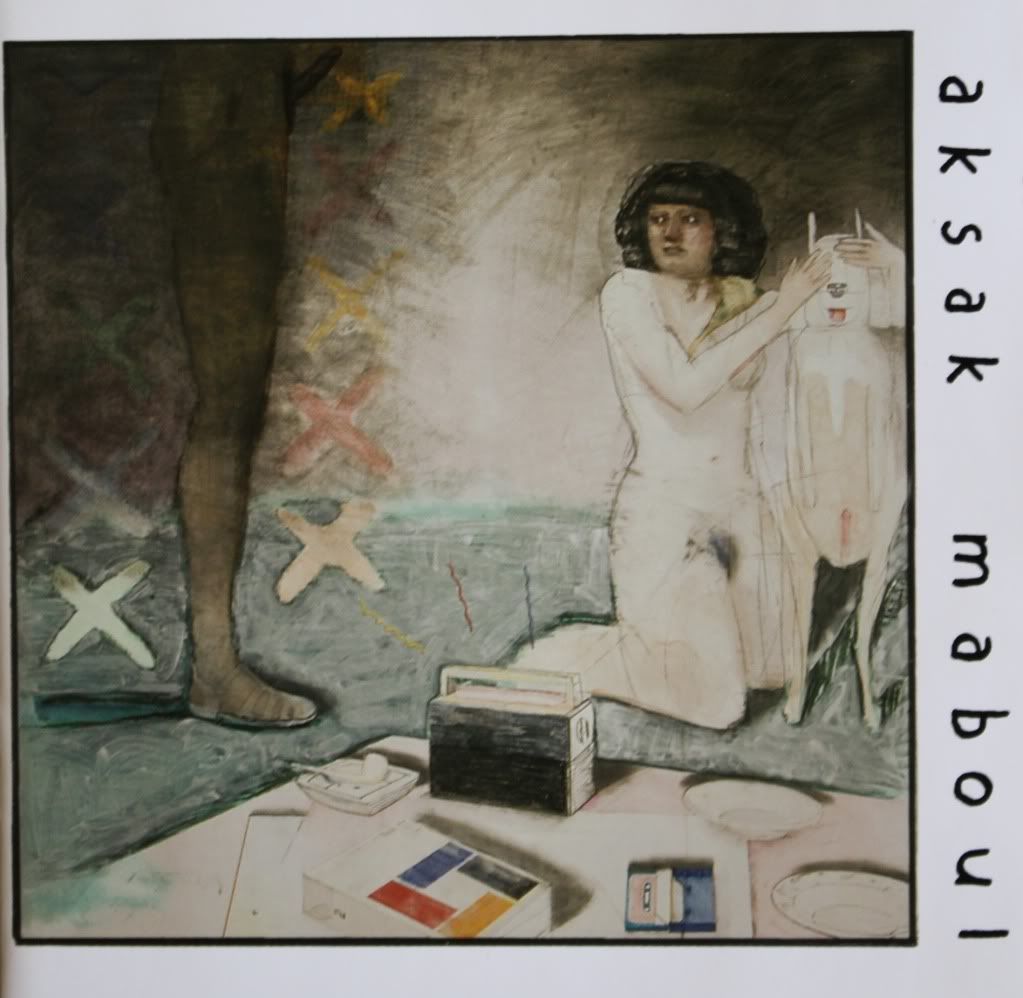
You know (or at least hope) from the ridiculous cover (depicting no fewer than two erections) that this album is going to be a crazy trip, and it certainly doesn't disappoint.  Personally, I find this album extremely satisfying because of the experimentation--most all of the songs are based on at least one describable experiment, and the results are not only challenging, they're often quite listenable.  A great example is the opener, "A Modern Lesson" (please, oh please, watch the video), which manages to deconstruct a classic blues riff with dissonance, drum machines, and wacked-out female vocals in under 6 seconds.  As the track progresses, the wind instruments enter (along with some pinball machine recordings) for an interlude, the main riff returns, then the bass and tempo increase and Hollander's electronic keys and Frith's detuned guitars amp up the energy for a driving finale that sees an incredibly complex wind/key/string arrangement brimming with head-spinning counterpoint and--what elevates this beyond similar attempts--a memorable melody.  "Palmiers en Pots" radically switches gears with a tango supposedly composed of (get this) pieces of several popular tangos, cut up with scissors, rearranged, and performed in random order.

That Fred Frith was on an unstoppable roll in the early 1980's, I'll never deny--his fingerprints (as musician, composer and producer) are all over this album, and in some ways it's better than its Frith solo contemporaries as his ideas (some heard already heard on other albums) are supplemented and developed by other musicians.  Though the resulting disc doesn't exude quite as much of Hollander's personality as the Aksak Maboul debut, its diversity is one of its greatest assets--"Geistige Nacht" features a frantic sax-led melody with some great free jazz soloing in which the sax and eventually Frith's guitar trade squawks, and "I Viaggi Formano La Gioventu" features a snaking Middle-Eastern melody doubled on wordless vocal, violin that's strongly reminiscent of Frith's other 80's work, though that handclap track buried in the mix toward the end of the song shows up again on Cheap At Half the Price's "Absent Friends."   "Inoculating Rabies" is probably the second best experiment on the disc, blending a balls-out punk riff driven by Frith's and Cutler's unfettered noise with the addition of a delicate woodwind arrangement.  It's probably the best (if not only) progressive commentary on and appropriation of the burgeoning punk movement I've heard so far, which, by 1980, had all but swallowed what little market experimental progressive music like Aksak Maboul might have cornered.  It's pretty ironic how loud Frith, bass and Cutler get considering how "obsolete" punk supposedly made their musical contributions.

The 23-minute-long "Cinema" rounds out the album with long-form composition interspersed with free improvisation (there's a lengthy and wicked cello solo as well as a pretty epic Fred Frith guitar solo), recording collage, a recurring sinister-sounding theme, some really heavy jamming from the full group (Cutler's drumming here is the liveliest I've heard since Henry Cow's last album, and recently, too).  The melodies and ideas aren't quite as immediate as they are on the shorter songs, but the added space allows the group to accomplish some things that it couldn't in five minutes, and it gives us more to uncover on later listens.  Pieces like this often seem to divide the camp of potentially interested listeners--take longer than five or six minutes and some people will complain about having their time wasted.  If there are enough different ideas being developed, though, I don't mind it taking a while--as much as I'm leaning toward shorter songs packed with briefly-stated ideas these days, I can appreciate a piece that actually allows listeners to engage with and unravel the ideas being presented during the piece, rather than after numerous plays.  While Hollander's personality is somewhat obscured by the thickness of the production and arrangements, it's perceptible on repeated listens, especially if you've heard his earlier works.  I really enjoy his mechanical-sounding drum machines and keyboard lines, not to mention his contributions to the horn sections.  Let's hear it for RIO, and this week let's keep going down the rabbit hole.


Available here on CD, and here on MP3.

Thursday, March 24, 2011

Taj Mahal Travellers - August 1974


Taj Mahal Travellers has nothing to do with American blues rock, or anything to do with the Indian mausoleum, for that matter--they're Japanese.  This is another great example of music that should not be judged by traditional aesthetic standards as well as a good comparison/contrast to the AMM album I wrote about earlier this week.

The particulars of this music are actually easy to describe--few instruments are usually playing at the same time, there's little in the way of tonal development, and it's quite repetitive.  Though each track fades out at the end, it appears to be a continuously-recorded performance.  The backbone of the group's sound is drone; the recording moves incredibly slowly and deals with huge blocks of tone.  For instance, at the album's outset the main drone is a bowed electric guitar, which plays more or less continuously on the same note while hand percussion, wooden xylophone, synthesizer, some sort of brass instrument, harmonica and voices all fade in and out.  The instruments make and repeat short statements, or they let loose long threads of tone, layering with the guitar (for now) into the texture of the overall drone.  Add to the list of instruments a few traditional Japanese instruments and a violin and you've basically got the sonic palette for the whole album, and it's a double.

Yes, it's easy to describe what's being done for over 80 minutes worth of music, and yet, when it comes to describing just why this album is so righteously awesome, the right words just can't be found.  Though the style of music is totally different, on one level this album is strongly reminiscent of Miles Davis' On The Corner.  At any given time, there aren't really that many instruments playing, but if you pay attention you start to notice that an instrument will appear in the mix, hang around for a few minutes then fade out just as delicately as it originally appeared, contributing a texture or color to the sound without altering the overall mood.  After a while, though, you might notice that none of the instruments that were playing 20 minutes ago are still playing.  The overall mood and quality of the sound moves similarly, changing slowly and subtly but hitting a few fairly distinctive areas over the course of the album.  My favorite passage happens about a third of the way through the second track, where the layered wordless voices and dulcimer-like Japanese folk instruments reach a soaring, epic swell.  The third track has some pretty awesome primal percussion/synth jams, and the fourth has a lot of delay-treated violin.  This is one of my favorite mood-centric albums--the overall feeling is mysterious, cathartic, and at times pretty weird.  While it's pretty moody, it's not really too dark, and it functions equally well as a meditative soundtrack as it does for close-listening.  The emphasis on shifting texture, the change between spaciousness and thick soundscapes, and especially the sound-exaltation that's possible when you really lose yourself in the timbre of the droning instruments offers an experience unlike a lot of mainstream music, but at the same time fairly accessible.  It's not quite as sonically-challenging as the less-repetitious and more freely-atonal works of a group like AMM, but this (and their strongly-recommended first album) demonstrates that experiments with free improvisation can deliver widely differing but similarly rewarding results.

This album is out of print...find it here.

Monday, March 21, 2011

AMM - Generative Themes


AMM are the perfect group to bring up after part two of the essay I just posted, and Generative Themes is as good an album of theirs as I could hope to choose for an auditory example of some of the ideas discussed therein.  AMM was formed in 1965 with the stated intent to make music completely unrelated to any established genre.  By 1983 they'd gone through quite a few lineup changes but their group aesthetic had progressed somewhat close to the realm that they currently inhabit--free improvisation with a somewhat meditative feel, occasionally punctuated by noisy outbursts.

Generative Themes is a bit of an unusual AMM album because it's a studio recording--for this reason, it's made up of four discrete tracks instead of a single album-length track or an entire performance split up into gapless tracks for navigation purposes.  I'll be up-front--this is one of my favorite AMM albums (though I do have several favorites).  It's the first AMM album to feature pianist John Tilbury (a member to present day) and also the first to be saxophone-free.  The result is a somewhat intelligible mix of Keith Rowe's tabletop guitar and radio tuner, Eddie Prévost's percussion and Tilbury's prepared piano--for the most part each instrument is distinct and the personality of each performer is somewhat apparent, at least to a much greater extent than on the gloriously cacophonous AMMMusic or The Crypt.

Due to the nature of the album's recording, it's possible (though not necessarily obligatory) to make statements about each track as individual "themes."  The first is reminiscent of somewhat quieter early AMM--Rowe's guitar creates a gently percussive droning atmosphere, like he's dragging a pick (though it's likely something else) slowly across the coils of the strings.  Inaudible radio lurks in the background, with the occasional word or phrase popping out into the space left by the musicians.  Eventually Prévost joins in with toms and cymbals, and Tilbury makes some opening statements with the piano--the prepared instrument sounds at times more like a wooden xylophone than a piano--it's otherworldly.  The second theme finds Rowe conjuring more uncommon sounds out of his guitar, with repetitive waggling noises and some liquidy but tuneless drones (sorry, this is the best way I can describe it).  The overall texture of the track is dynamic, with lots of spaces between the piano notes and drum beats--sort of like popcorn popping, but much more engaging.  After listening to a lot of more recent AMM albums, it's a fun change to hear Prévost playing like an actual drummer--the track winds together on the last couple of minutes into as close of a groove as AMM probably ever get, with delightfully wonky beats on the drums and some aggressive keys from Tilbury. The third theme is more brooding, with some great Rowe radio moments (at one point a child's voice audibly calls "It's a pie--it's hot!"), and Tilbury playing low on the keyboard's register.  There's still plenty of space between short bursts of sound--the texture is mottled, almost playful, at times.  The final theme conjures some of the early AMM spirit--some serious noise happens, with a barrage of radio ("the GEEK"), lots of tom and cymbal work from Prévost, thick clusters on the piano, and some wild, overdriven guitar squalls.  Just five minutes before the end, the clouds break and things quiet down--the space returns, leaving pause for thought and the occasional brief noisy surprise from drum or piano.

Because of its abstractness, it's tough to write about this kind of music in any great detail, but among the AMM canon I think Generative Themes presents a pretty balanced amount of each personality as well as a good mix of old AMM/new AMM, quiet/loud, spaciousness/density, fast/slow, and the ever-present (yet easily-forgotten) element of chance--things lined up quite well, from Rowe's blind radio pulls to the collective teetering grooves which develop only to quickly disappear.  This would make a good first exposure to AMM. 

Get 'er here from the label, or from Amazon: Generative Themes.