Showing posts with label Cheap Seats. Show all posts

Sunday, December 9, 2012

Cheap Seats 11: Thanks! (I Couldn't Have Done It--Not Alone!)

Oh!  It's The Noble Fir!  With Ellen and Rick
Ok!  Official Release Day for the album is behind us, as is the release party (I performed an acoustic set and released CDs to Kickstarter contributors, friends and family and regulars at The Noble Fir on Thursday).  Before I get to the business of introducing some of the specific creative content on this album, I'd like to expand a bit on the album's credits and "thank you" section, as there are many people whose efforts helped bring the project to fruition.  Though this diary entry comes out a bit long-winded, it's of paramount importance to me to give credit where it's due.

As far as the sounds recorded on the album, nobody played a bigger role than Justin Phelps--he was recording, mixing and mastering engineer, and as I've mentioned before, he played a crucial role in the quality control department.  In addition to those technical roles, Justin was pretty much the first person I met after emerging from my creative cave--he's a hard-working, friendly guy, and the fact that he instantly took my artistic goals seriously was a hugely important boost to my confidence and morale.  There's a lot of loneliness involved in making music independently, and it's connections like these that, for me at least, act as lifelines.  Though we didn't always reach complete accord regarding my artistic goals (which is to-be-expected), Justin was always ready to constructively challenge and question my decision-making, which is an important part of the learning process for me as I move forward to my next projects--knowing how a sympathetic pair of ears hears ideas you may have thought you made clear is a good signpost to understanding how completely unsympathetic listeners might respond.  Most importantly, I'm looking forward to teaming up with Justin again on my upcoming plans.

Sarah, of course, sits at the top of the thank-you list.  I can't imagine what it's like to be subjected to another person's artistic ups and downs in close quarters, but she is always emotionally supportive even if it's hard for her to understand how high the stakes can be for me personally in the midst of these projects.  Also crucial is having a stable, "real" life to return to from the peaks and troughs of the creative roller coaster.  It's good to be reminded of your responsibilities and know how important the simple things are in life.  Speaking of real life, my mom and dad have also been incredibly supportive throughout the process, hosting me in Camas for long periods while I commuted to and from the studio.  While I'm sure my aesthetic path and career choices continue to mystify them, I know they appreciate how important and critical my current goals are to my happiness and I'm proud to have shown them how seriously I'm taking my current endeavor.

Rick and Ellen at The Noble Fir deserve very special mention, too.  Ever since I burned them a CD-R of the In Not-Even-Anything Land material as I was finishing it up in summer of 2010, they've generously exceeded any expectations as patrons of the "arts," hosting not one, but two CD releases and always providing positive feedback and the warmth of friendship that allows labors of love to flourish.  It was a great pleasure to celebrate this friendship in song, performing "The Noble Fir" at the release party.  In a more serious, "brass tacks" sense, the fact that they've also employed me at the bar since June 2011 has provided me with enough income and leave time to actually afford projects like this--the costs for this album would have equaled about half a year's worth of my previous income, and I'm extremely grateful for the fact that my job enables me to fund artistic projects of this scale while still maintaining a reasonable standard of living and savings--I take this privilege very seriously!

Working my way through the list, I again find cause to thank Nick and Cathy Manwell--I've been friends with them since Nick gave me a dollar when I was playing at 4th Avenue Coffee Shop outside the Liberty Theater in Camas back around 2002.  Since then I've played countless hours of guitar with Nick and "borrowed" pieces of his gear for years at a time (it's his bass heard on the whole album).   It was a real pleasure to get Nick involved in Cheap Seats--he plays lead acoustic on "Chrysalis (In Three Verses)."

In terms of the rest of the "band" heard on the album, much thanks is owed to the kinetic energy provided by drummers Drew Shoals and Russ Kleiner.  I've known Drew since he was an already-legendary presence on the Whitman College campus, playing for every band from the school's jazz band to r&b/hip hop group Love Child to his own solo stuff (releasing such unforgettable singles as "I Can Hear You Having Sex")--apart from a brief stand-in soundcheck appearance, we never played music together.  So, Drew's appearance on eight songs here fulfills a goal I'd long had in the back of my mind.  Additionally, Drew came into the recording process at a very early point (December 22nd of last year), so his willingness to take the music seriously and add some real bones to the fleshy mass I'd concocted was a huge boost to my confidence, which was quite low at the start of the sessions.  I love how Drew's contributions acknowledge the complexity of the songs' meters but also aren't afraid to run rampant, enhancing the "nearly-falling-apart" feel with a free-flowing, intuitive groove.  Russ (to whom Drew introduced me after his school schedule prohibited his return to the later sessions), somewhat contrastingly, approached his songs with a meticulous attention to the details--I was really surprised at how thoroughly he'd internalized the knotty meters of songs I'd not even bothered to chart for him--his energy and sympathetic attention to detail really shine through on his contributions, which were made in spite of a monumental cold (he went on antibiotics after our session).  Finally, my friend Peter Bruckner provided piano for two album tracks and one bonus track, lending a lot of complex feeling with his jazz voicing knowledge, and providing some really choice melodic nuggets in the small spaces that were left by the time he came into the picture.  Here's hoping I'll get to work with these musicians again! 

Chelcie (L), Michelle (R)

Though they're further down this posting than they really deserve for their staggering team accomplishment, the post-production design team that created all of the album art and other visuals for the release deserve huge props for making this package something eye-catching and realizing of a concept I'd had in my...brain...for two-plus years.  Chelcie (who sits both in the credits and "thank you" sections of the booklet, deserves enduring credit for acting as a sounding board for ideas, a confidant for hopes and fears and a companion/fellow traveler on the artistic path) contributed the hand-made collage and watercolors that grace the album art, as well as the watercolor image of my imbecilic grin that disgraces the deluxe package.  Michelle Koelbl (who designed the whole package for In Not-Even-Anything Land) returned for some stellar typographic contributions to the outside cover.  My brother Andy took a lion's share of the "odds and ends" that always crop up with this kind of thing, impressingly finding an attractive layout for the verbosity that is the inside of the CD jacket and the liner notes, as well as promptly responding to needs for posters, image manipulation, print layout for the deluxe package, and probably more time-consuming minutiae that I'm ungratefully forgetting (*brrriiiing*"Hey, I know you're at work, but can you do me a favor?").  Similarly, Courtney Morgan picked up numerous loose ends, creating the sweet brain graphic that appears a few times in the art and became a rubber stamp for the deluxe package, designing the t-shirts, and responding to numerous small design needs throughout the project.  Finally, Johnnie Heinz hand-painted the menagerie of brains that sit quietly behind the lyrics in the insert. Again--I'll be a lucky man if these people continue to help me in the future!

This brother band is formed!  Tentative band names include: Knappetite for Destruction and Knapp Kin.

Finally, I need to round out this list with some people whose contributions are less measurable but no less important in sum--Patrick (whose djembe I've been using for something like 6 years) gets thanks for providing ongoing cheerleader support and continuing connection with an atrophied social life.  Randy Parsons and Cody Green at Parsons Guitars have continually serviced my guitars from basic setups to trouble-shooting to exacting custom work, all the while with professional attention to detail and reasonable prices.  Ike's Auto Repair in Centralia replaced my truck's alternator within two hours when it failed in the middle of one of my many trips to Portland--talk about coming through when it counts!  Professor Mitch Clearfield and his metaphysics course at Whitman must be credited with introducing me to many of the philosophical and cognitive science ideas and writings that form the conceptual basis of these songs and the album's overarching concept--these unsolvable problems still haven't let go of my imagination something like eight years later!  Joel, Andy, Donny, Rick, Sandi and all of the interns at Cloud City Sound and Super Digital provided a welcoming studio environment, friendly support and feedback and some especially professional studio and duplication services.  Paul Davison provided inspiration for "Adjacent to Not-Really-Anyhow Time" in conversation on his Roy Harper Podcast.  Finally, there are all of the Kickstarter campaign contributors, supportive music fans and friends, family, artists, teachers and thinkers who provide a huge grassroots network out of which creative projects like this spring.  I'm sure my frazzled brain has forgotten to credit specific contributions, but please know I am constantly thankful for the wellspring of energy that has brought this to fruition.  One of the later lines on the album is "I couldn't have done it not-alone;" rest assured--when it comes to this project, "I couldn't have done it--not alone!"  Thank you!

John gleefully brandishes his deluxe package CD.


Cheap Seats Part 1
Cheap Seats Part 2: Non-Commercial Music 

Cheap Seats Part 3: A Day in the Studio 

Cheap Seats Part 4: The (Un)Happy Accident 

Cheap Seats Part 5: Mix Mix, Stir Stir 

Cheap Seats Part 6: Kickstarter Campaign
 
Cheap Seats Part 7: Alicia Dara Interview  
Cheap Seats Part 8: Tyler Fortier Interview 
Cheap Seats Part 9: Anna Coogan Interview 

Monday, November 19, 2012

Cheap Seats 10: Chris Cutler Interview

Today we've got the final interview of the Cheap Seats series, and one that I've been looking forward to since it was conducted all the way back in July (time flies when you're leading a double life!) inasmuch as it nicely caps the interview collection by not only encapsulating an independent musician's perspective, but also that of an owner and operator of an independent music label with a long career in non-commercial music.  As a musician, Chris Cutler is perhaps best known as the drummer for Henry Cow and Art Bears, but like the other members of those groups his recordings and performances have spanned innumerable notable collaborations and solo projects that encompass and cross too many genres and ideas to even attempt cataloging them.  In addition to his percussion skills, Cutler is an experienced lyricist, composer and writer/speaker on various musical topics and, finally, is the creator and operator of Recommended Records (ReR), which has released and distributed an eclectic array of music (most of which broadly falls under the experimental and avant-garde umbrella, and much of it falls in my "absolutely essential" category) since its creation in 1978. 


How would you say the state of non-commercial music (as a whole) in 2012 differs from when you first entered the professional music world in the late 60's/early 70's?


In the late ‘60s there was a handful of major labels and an almost non-existent independent sector. The idea that a band could release its own LPs was not in the air (though there were a few visionary exceptions, mostly in other fields—such as Sun Ra’s Saturn and Harry Partch’s Gate V labels, though lacking any general distribution, these were effectively invisible). And there was the additional problem of distribution: you could make a record, but how would you get it into the shops? A tiny monopoly of distributors dominated the market, structurally tied into the needs of the majors; anything outside that was too much trouble. So bands didn’t think of going it alone, instead they looked for labels. And that meant major labels or their specialist subsidiaries.

On the other hand, in the late ‘60s and early ‘70s—through a complex set of special circumstances—both labels and public were looking for novelty and innovation, and these are things that an essentially parasitic music industry can’t manufacture, so they had to chase after them instead, meaning that it was still possible for outsiders to get into the game. In addition, there was a moderately healthy gig circuit routinely programming new bands, and these were gigs that paid. Support groups didn’t play for nothing then, or ‘pay to play’ as now; they got reasonable money. So the sign-posted way to success was to get onto the ladder and climb up into the system. And it seemed to work. So there was no thought—and no reason to think—of finding a public in any other way.

This picture has now changed beyond all recognition.  The old patriarchy has long collapsed and the few surviving major labels face ever-diminishing sales, so they invest what they have in safe mainstream product or dirt-cheap back-catalogue reissues. The old practice of ploughing a healthy percentage of turnover back into speculative releases—testing the water and discovering new talent—has long since devolved onto more energetic, less profit-oriented, independent labels, the first batch of which emerged in the late ‘70s, part of the mini-revolution that was Punk (swiftly followed by its more canny beneficiaries, the New Wave). In that environment, if a band rose to the top, a major could buy it up, thereby avoiding the cost of speculative research. And occasionally an independent might be able to hang on to a success and edge a little closer to mini-major status.

In this climate, all but very mainstream bands had to aim to be signed by independents or release their own records. The independent marketplace expanded crazily throughout the ‘80s and ‘90s, at the same time fragmenting into a mass of disconnected and self-contained specialist niche communities. Everything changed: a relatively inclusive mainstream (Beefheart and Sinatra had coexisted on the Warner catalogue) fractured into a major, hits-only, mainstream while a multiplying catalogue of subcultures peeled away, disappearing from the general conversation altogether. So, as the nature of the listening public changed, bands’ ambitions changed along with it.

Looking back, Henry Cow was extraordinarily lucky: we, like many other bands of our era, having strayed across—or broken through—the common-practice fences, had been pitched into the wild, uncharted territories of extended electrification, new instruments, hybrid compositional techniques, cross genre borrowing, radical recording practices, unfettered improvisation and controlled noise… a relatively uncharted terrain. Most of those territories are mapped now, so the sense of possibility and discovery has inevitably dimmed. Of course, there are other terrae novae, but they are not—as they were for us—in such plain sight. I hasten to add that that is not because we were smarter; it’s just that we were just lucky enough to be active during an untypical historical hiccup.  The next musical breakthrough will come along in its own time, as they always do.  Meanwhile, consolidation, revival and minor modifications of existing forms will continue to dominate a musical climate no longer particularly supportive of experiment and innovation. In other words, it couldn’t be much more different now than it was it the late ‘60s, or much harder to survive in.

Thursday, November 8, 2012

Cheap Seats 9: Anna Coogan Interview

The Cheap Seats train rolls on--this time we've got an interview with Anna Coogan, a talented songwriter and artist working roughly in the Americana vein.  A seasoned independent musician since her days with north19, Anna now has three solo albums and numerous tours of the US and Europe under her belt, as well as a continuing portfolio of good press.  I'm excited to interview Anna as her career has seen her begin as a regionally-successful artist and grow from national to international touring, not to mention the great leap she's taken from musician-with-a-day-job to full-time musician.  Take it from Anna's experience--if you want to progress in the independent music world, you'll need to cultivate some perseverance.   

Photo: Marcel Houweling, taken at Roepaen Podium in Ottersum, NL.

As a musician who's been doing this for a number of years, how have things changed across your career, both in terms of how you make and release your music, and in how you've attempted to promote and advance it?  What are some of the most valuable lessons/tricks you've picked up?


A lot of things have changed so much, and a lot of things have stayed the same over the past ten years.  I started playing at the most turbulent, exciting, and vulnerable time in the music industry--right around 2002--and so much has changed since then for everybody.  Sometimes I kick myself for not getting into it a few years earlier, but things work out the way they work.

Mostly I have learned how to treat it like a business, with a balance sheet and a realistic view.  What is going in (financially, emotionally, and time-wise) and what is coming out?  Are these things balancing out?  How many years of investment are you willing to make before you want to see some returns?  What kind of returns are you looking for?

The thing that seems to be most important is to hire a good team to help promote you – and that can take years to find.  But I think if you are good, and you are relentless, and you tour your brains out and make records and videos and send a lot of emails and show up on time and are polite and friendly to people, eventually you will build a good group of people who care about you and are willing to help you out, and that makes all the difference.

Monday, October 29, 2012

Cheap Seats 8: Tyler Fortier Interview

Today we've got the second installment of the handful of interviews I conducted for the Cheap Seats series.  I've written about my old school friend Tyler Fortier's (Bandcamp, Facebook) music before, and back in September I posed to him a series of questions similar to those in the last interview.  Just as all of the other interviews seem to have turned out, Tyler's offers a unique perspective and an emphasis on some of the constant challenges independent artists face and strive to surmount (with many of which I can seriously identify) on a day-to-day basis.


As a musician who's been doing this for a number of years, how have things changed across your career, both in terms of how you make and release your music, and in how you've attempted to promote and advance it?  What are some of the most valuable lessons/tricks you've picked up?


Over the years I have become more and more self-sufficient.  Each new project has a lower cost attached to it.  Releasing music is easy.  Promoting music is tough.  I'm burnt out and can't imagine releasing anything anytime soon.  It's a lot of politics.  It's all about who you know.  It's like looking for a job--sending resumes (press kits) to every city your traveling to.  There is probably a 10% success rate in that.   And out of the hundreds of people who read a review or see your picture or are even slightly interested, maybe one person will go out of their way to come to a show or go listen to music online.

Recently I've tried releasing digital singles because I wasn't having as much luck selling CDs as I wanted and going digital is a good way to keep overhead low.  I hate digital though so it's hard for me to do that and I probably won't continue releasing anything just in a digital format.  


What's been the most difficult challenge to overcome?


Performing intimate lyrical based music in loud and obnoxious settings for people who don't give a shit.


What's the best way to convert a new fan?  How do you measure your progress--record sales, live show attendance, Facebook "likes," etc.?


I'm not sure.  The best thing is seeing return people in your audience though, I know that.  I don't measure my success because that's a fine and blurry line, but having people that were at a show 6 months ago come back the next time and say they've been loving the CD they bought is as good as it gets.


In your experience, what does it take to break beyond a fanbase of friends and family to one populated by people solely interested in the music?


That's a tough one.  I'm not sure.  There has to be an emotional connection made somewhere but as to how to do that, I'm still trying to figure it out.


How would you describe the Eugene music scene?  How do you book your shows, especially when it comes to traveling outside your home base? At this point, would you say you're most successful regionally or online/globally?


There is a lot of good music in Eugene.  Mostly empty venues though from what I can tell.  It seems like everyone is having the same battle with getting people out to listen.  To book shows, I research a lot on the internet and then send emails or call depending on the venue.  I'm probably most successful regionally, though that doesn't mean too much.  I do appear to have a small fan base in the Netherlands area as well, judging from online sales.  Great bands out of Eugene: The Royal Blue, Leo London, Kingdom County, Tara Stonecipher and the Tall Grass, Scott Austin, Mike Surber, Beth Wood, and.....so many more but my mind just went blank.


What does it take to sell an album?  What sells most for you, physical media or downloads?  For you, are recording sales the goal, or are recordings more a piece of the overall puzzle in terms of promoting the music?  Have you reached a point where the recordings pay for themselves, or are they a necessity you're willing to support yourself?  Are people actually willing to pay for the music, or do they expect it to be free?


I'm not sure what it takes to sell an album.  I sell most of my albums at shows.  Out of town shows, that is.  I can't sell a CD in Eugene to save my life but I sell a good amount when I travel.  I don't know why.  Recording sales are not my goal, but I'm proud of my work and I want people to hear it and like it, and I want to be paid what I think I deserve for the work I and everyone who contributed put into it.  People do expect music to be free these days.  I feel like a sex worker most of the time, folding up my tips after playing with extra emotion because I needed to make some money tonight and maybe if I just sing this part with lots of gusto, I'll make an extra $20.

How important are production values when it comes to your recordings?  Your albums have spanned from lo-fi home recordings to more produced, professional products--do you think it's important to fans to have a polished, professional recording, or are they willing to sacrifice production values for quality content?  Do professional production values manifest themselves in the finished product in a way that justifies their cost?


Production is the most fun part of making music for me.  I'm always plotting the next big idea even when I'm still in the writing phase.  It is very important.  It is opening yourself up, connecting with a song on some unexplainable level, and understanding every word, guitar strum, and breath to the point that you know exactly what the song wants, what the song needs, and how to make that song sound how it was meant to sound even from the point of its conception in the pen-and-paper stage.  I think certain songs need certain things and whether it is lo-fi or polished, the song will reveal itself to the producer in time.  Fans or music listeners don't need anything.  They just want a song they like and they don't care how it's done or what work went into it.  People who like to dance want a fun beat to move to and people who like lyrics want to be challenged existentially.  I think it is literally that black and white for a majority of “music listeners.”


When it comes to promoting an album, what avenues seem the most successful in getting the music heard?  Do you do everything yourself, or do you get help from anywhere?


I haven't had much luck in promoting my albums.  Local radio here has been super supportive, especially 89.7 KLCC NPRNinkasi Brewing has been a big supporter as well and I have had great support from The Eugene Weekly.  As far as getting my music out to the masses though, I haven't had luck.  Facebook is an awful way to do this, but it is the easiest way so I rely on that sometimes because I don't have time to do anything else.  I think management is key for any serious musician.  Everyone needs some knowledgeable cheerleaders on their team.


When do you decide it's time to head back into the studio? When you've got all the songs written...when it feels right creatively...when you've got ideas but not necessarily songs?


I'm always in the studio (aka the spare bedroom in my house).  This is where I record all my projects as well as projects for my clients.  Sometimes I will record a song when I deem it “ready” or sometimes I'll record a song when I am stuck melodically or lyrically with it.  Most of the stuff I don't keep, but I am always recording songs and thinking as a producer--how can I construct them to reach their highest potential?  In the last week I've been working on seven songs that I have recorded in the last two-and-a-half weeks (two of which are mine).


What keeps you going in the tough row-to-hoe that is the independent music world?  Where's your inspiration coming from right now?


I don't have inspiration or hope as an independent artist, but I do have inspiration as a songwriter.  The desire to always be better and never being satisfied with anything I do has been my inspiration and fuel for the last few years.


Do you have any advice for aspiring musicians?


Don't let your ego get in the way and don't take anything too personally.


What have you been listening to this week?  How do you seek out new music?


My playlist this week has pretty much been:
-Joe Pug's first two EP's, a record by Dolly Parton, Linda Ronstadt, and Emmylou Harris called Trio, John Prine - Common Sense, Van Morrison - Saint Dominic's Preview, Elvis Costello - Armed Forces, and in my car stereo is Saves The Day's first record: Can't Slow Down

.

What's on the horizon for you musically?


I'm putting my music on the back burner and starting to work specifically with songwriters on their songs in the role of a producer and mixing engineer.  My debut as a producer was with Mike Surber, who released is debut full length this past June.  I'm currently working on Scott Austin's first full-length, as well as some EPs for three other clients.

Cheap Seats Part 1
Cheap Seats Part 2: Non-Commercial Music 
Cheap Seats Part 3: A Day in the Studio 
Cheap Seats Part 4: The (Un)Happy Accident 
Cheap Seats Part 5: Mix Mix, Stir Stir 
Cheap Seats Part 6: Kickstarter Campaign
Cheap Seats Part 7: Alicia Dara Interview

Saturday, September 29, 2012

Cheap Seats 7: Alicia Dara Interview

As part of the continuing Cheap Seats series I've conducted a handful of interviews with independent artist friends from the Pacific Northwest and beyond.  So far, this series has focused on my own experiences making and promoting independent music, but the reality is that each artist interacts and responds to the challenges and necessities of the independent music world in his or her own unique way.  In this first interview, conducted in early July, I'm excited to feature Alicia Dara of Seattle-based bands The Volcano Diary (with Gus Palaskas and Dave Bush) and Diamondwolf (with Glen Cooper).  Alicia has been an active independent musician for over 15 years and brings a wide-range of experiences in the music industry to her ever-evolving mission as an independent musician.

Alicia performs with The Volcano Diary

As a musician who's been doing this for a number of years, how have things changed across your career, both in terms of how you make and release your music, and in how you've attempted to promote and advance it?  What are some of the most valuable lessons/tricks you've picked up?


The most awesome, fantastic, and nightmarish event in my career was the advent of the internet. I started way back in 1997, before FB, Twitter, Wikipedia, Reverbnation, and MySpace. There was email and there were websites, which weren't very interactive and tended to crash while listening to MP3's (remember them?) if you stayed on too long. Before that I had been making cassette tapes of my songs in my tiny bathroom on my friend's 8-track recorder. That bathroom was fully tiled and created the best echo/reverb effect ever. I'm still trying to find a plug-in effect that can beat it!

I was raised by classical musicians who never touched a computer in their lives, so I had absolutely zero tech background to draw from as I slogged my way through the maze of the internet, and the various ways that the music business was working to stay one step ahead of it. I had had some radio play locally and on a few stations on the West Coast before internet radio but I was pretty frickin' pleased to discover there was some demand for my music online, on the early stations like mp3.com.

Once mp3.com took off it was like the gold rush; everybody wanted a piece of the action, and the industry responded accordingly. I started making records on digital recorders in people's home studios, because all that recording equipment was suddenly affordable. I like being in the studio a lot, but I work quickly, and it was tough on my patience back then while everyone was learning these new programs called "Logic" and "QBase."  I was quite grumpy during that era.

These days when you Google my name you can find over 6 million results, which on a good day makes me feel like I'm getting somewhere. But the reality is that since music became "free" I know very few musicians who are able to make a living at it. I am fortunate enough to pay the bills through a combination of teaching, singing session work (adding my vocals to commercials and other people's music projects), and soundtrack work for film, TV, and Internet stuff. Live shows are my passion but they pay so little unless you're in a national touring band. Record labels--contrary to popular belief--are still very much alive, and they are the ones that sign and promote the bands you've heard of in the last 10 years. They also act as filters for music, though in many cases their taste is at best questionable and at worst horrific.

There are 2 things that I've learned over the past decade. The first is my great strength, which is that I can walk away from anything. If you mistreat me, if you disrespect me or my bandmates, if you do not honor the contract I signed or if you change it without informing my lawyer, I will take my toys and go home--and I will never look back. This saves me some headaches.

The second is that I am able to see into the future a bit and know which projects are worth my time and which ones aren't. I value my time.  Granted, I get paid a great big hourly rate to sing on commercials, and I do that even when I don't really want to. But I also know in my soul how short this life truly is, and I (mostly) refuse to spend it on shit that doesn't make me feel sublimely on fire.

What's been the most difficult challenge to overcome?


The biggest challenge to overcome was adjusting to the lifestyle of being an independent artist. It took awhile, and it was a bumpy ride. Making music is its own reward; you have to love it more than being loved. Everyone around me was telling me to go back to school, get a degree, learn a trade or skill that would bring a mountain of cash to my door. But I look around at the world and I see an awful lot of lost souls with fat paychecks. I don't envy them one bit.

Friday, September 14, 2012

Cheap Seats 6: Kickstarter Campaign


I've started a campaign on Kickstarter.com, a website that helps independent artists like myself fund creative projects.  As described in the video above, the campaign is meant to fund the CD duplication and promotion of my new album, Cheap Seats at the Cartesian Theater, the professional recording of which was funded out of my own pocket.  There are some fun rewards, starting with digital and CD preorders of the album.  Any contributions or help in spreading the word about the album and Kickstarter campaign would be greatly appreciated!  I've put a lot of work into making this music the kind of stuff that readers of these blogs will enjoy, so I hope you check it out and find the money and effort I've expended worthy of a small contribution in exchange for the finished product, and help support more music to come!

More Cheap Seats content to come, including some interviews and thoughts on the brass tacks of independent recording.

Cheap Seats Part 1
Cheap Seats Part 2: Non-Commercial Music 
Cheap Seats Part 3: A Day in the Studio 
Cheap Seats Part 4: The (Un)Happy Accident 
Cheap Seats Part 5: Mix Mix, Stir Stir

Friday, July 6, 2012

Cheap Seats 5: Mix Mix, Stir Stir


After a seemingly interminable two-month break after the end of recording (a day of righteous drum tracking), Justin and I are mixing this record.  It's also worthwhile to note that it's been seven months since this album's first recording dates back in December and two years this week since I wrapped up recording for my last album in my parents' basement!  Time, naturally, flies, and it's sort of hard to believe I've been working so long on a single project. 

We've got two business weeks for mixing and at this point Justin's doing pretty much all of the work--I mostly sit around and do things like this while he sorts through the amorphous pile of tracks I heaped upon him, and after he works on a song for a few hours I chime in with some kind of verbal ingratitude like "the lead guitar isn't very audible, can we do something about that?"  While I've got a musician's and seasoned listener's ears for mixing, Justin has a professional's ears and the skills to make things happen efficiently, quickly, and with an ever-present sense of each song's big picture.

The process starts with the drums; since the record contains recorded contributions from two drummers, it's possible to dial in the mixing settings for one drummer, apply them to every song recorded with those drums to save time, then tweak them minimally for each song.  After that, Justin seems to work on the bass (if there is any) and so forth on to the guitars, horns, vocals and other instruments.  To treat this like a mixing version of A Day in the Studio, let's start by saying that "mixing" basically means arranging and adjusting the characteristics of all of the tracks that make up a song in order to make them sound cohesive, organized, and to properly represent the song's arrangement and most important elements in a way that's audible to the listener.  The process involves things as simple as setting the volume and panning (whether the track's coming from the left speaker, the right, or a mixture of both) of each track (which can actually become quite complex when there's lots of tracks), but also encompasses things like compression, equalization (or EQ; adjusting the bass, midrange and treble of a track to compensate for too much of something or allow two tracks with similar frequency ranges to coexist without covering each other up, a problem that can happen with dense arrangements like the ones in a lot of these songs), and all sorts of effects--commonplace ones like reverb and delay as well as more "proprietary" tricks of the trade.

In a nutshell, the fact that Justin's done this hundreds of times means that he has a method and a creative vision that form a solid launch pad for each song well before we even get to the point where I'm giving my own input.  As with all of the phases of this project, mixing has been a real learning experience.  I've gotten to hear the consequences of the arrangements I've made--sometimes things work great and there's space for all of the instrumental voices to sound audible and distinct, and sometimes things I thought we'd be able to fit in end up sitting atmospherically in the background, where they certainly contribute, but not quite as identifiably.  It's also been instructive to see how Justin reacts as a listener to the ideas and concepts in the music--more than a couple of times ideas I've had regarding the mix have met with questions about why exactly it needs to happen.  Not that there's some kind of creative struggle happening, but rather Justin's been quite helpful with providing feedback as to how well ideas I've had are actually audible in the music, and whether or not the things I want to do are actually making it easier for the listener to grasp the concept.  Though I don't have a lot to do to make the mixing happen, I'm trying to learn as much as I can conceptually to use during my next project--there are a lot of things I could do ahead of time to make things run smoother, and and I have a better idea of what kinds of things will later become problematic.

Hopefully, I'll also be able to maintain the inspiration that naïveté brings--I want to remain focused on coming up with the weirdest, most distinctive ideas I can rather than thinking of the mixing process first--things have a way of working out, and everything can be fixed, in one way or another!  Bottom line, this record's sound is a week away from being 95% complete...after we finish mixing, it's mastering, duplication and release!  Stay tuned for more overarching Cheap Seats content (including interviews!), as well as details about preorder and release of this behemoth. 

Cheap Seats Part 1
Cheap Seats Part 2: Non-Commercial Music 
Cheap Seats Part 3: A Day in the Studio 
Cheap Seats Part 4: The (Un)Happy Accident

Tuesday, May 29, 2012

Cheap Seats 4: The (Un)Happy Accident

Signal to...1, 0 or some combination thereof
The previous Cheap Seats installments have mostly focused on my own recent creative experiences as an independent musician recording a new album.  Please permit me (in an effort to gradually expand the scope of the discussion to a realm that involves all musicians and listeners alike) to get a little bit macro.  Today's focus is the single most powerful determining factor affecting the distribution of any artist's music as well as the top force that dictates the ebb and flow of today's commercial music marketplace--I'm talking about the advent and full scale implementation of digital music recording

I'm sure when Sony and Philips designed and released the first CDs in 1982 they were mostly thinking about the obvious benefits CDs possess in comparison with the analog music media of the day--unlike vinyl and tape, CDs are sturdier and less easily damaged, are smaller and more lightweight, last much longer and are not degraded by use, and have ultimately become as inexpensive (or more) than the other available options.  In the intervening 30 years, though, the simple twist of converting source analog audio recording data to the universal binary 1's and 0's of the digital vernacular has had far-reaching implications for the music world.  On the consumer end, the introduction of CD-R technology first allowed easy copying of any audio files, while the increasing capabilities of home computers and the internet have gradually made the distribution of audio files (the size of which has more or less remained the same) easier and easier, providing music consumers with innumerable sources to acquire recordings for purchase or for free.  This increasing broadening has significantly diminished the sales of traditional physical recording media, not to mention how it's made it more and more difficult for copyright holders to keep track of and protect their intellectual property. 

On the "industry" side, not only has digital music technology changed the shape of music as a product, in the last 15 or so years it's also replaced analog recording as the most accepted method for the very creation of recordings.  ProTools has both become the industry standard software for recording studios, but its relative ease of use and availability (as well as the availability of similar free and inexpensive recording software) has meant that the average person potentially has the ability to record and edit digital music in much the same way (and with many of the same tools) as a professional recording studio--and when the product's finished, the aforementioned home computer technology and internet advancements have made it possible for artists to distribute their recordings without any of the record label, distribution and promotional infrastructure that was compulsory before digital recording dominated the market. 

Like most of the issues I'm trying to wrestle with in this series, digital recording is the quintessential double-edged sword.  Music listeners now have unprecedented access to almost any music they'd like to hear--gone are the days when local record stores could only mail-order expensive imports of cult artists whose distribution was too poor to make the music widely available, and the realities of file sharing mean that most recordings can be found and downloaded for free without risk of punishment and regardless of the recordings' copyright status or availability for sale through mainstream channels.  MP3 players allow consumers to consolidate a nearly limitless library of digital music that can be accessed instantaneously and portably (my personal favorite!).  Up-and-coming artists are no longer necessarily forced to demonstrate popularity in order to make their first recordings (a chicken-and-egg scenario that imploded as often as it succeeded).  It's never been easier to find out about and sample new music, and there's more music being recorded than ever before. 

For the recording industry, the sword mostly cuts viciously in the negative direction--though digital music does offer even more avenues for sales, when offered the choice, "You can either pay us and download the recordings, or search Google and download the recordings for free," consumers have by and large chosen the second option.  Promotional power still rests in varying degrees in the hands of record labels, but it's often limited in the case of independent labels and diminishing sales have scared the big labels into a policy of recording and promoting only guaranteed money-makers, which, as you can imagine, does little to further the spread of non-commercial music, impairing the strength of music as a product one degree of blandness at a time.  For independent musicians, it may indeed be easier and cheaper to record music, but when it comes to standing out amongst a constantly-swelling sea of competition, there are few promotional tools that seem to be worth the time or monetary investment. 

This is where the pros and cons of digital recording become even subtler.  For cash-strapped musicians, free recording is often a deal that's difficult to pass up, but the benefits of using a professional recording studio (high quality microphones and other recording equipment that most musicians don't possess, and especially the technical expertise of recording professionals) are often noticeably manifest in the quality of the finished product.  Then there comes the role of the recordings themselves--are they designed as a promotional device, to be given away at no cost to spread the word about the artist and hopefully convert more fans?  Or, is the artist hoping to offer the recordings as a product for sale?  I've heard again and again that music recordings "are free" and that the only way for musicians to make money these days is through live performance.  While I don't want to diminish the value of live performance, this argument denies the fundamental fact that regardless of the recording, somebody is investing a certain amount of time and/or money into its creation, and investments with virtually no chance of return are utterly unsustainable.  Since this entry is not supposed to focus completely on the financial aspects of independent music, I'll leave further development of those points for a later date.  Additionally, the choice to give away recordings is a difficult decision for reasons unrelated to finances--what message does it send a potential listener if you're willing to give up the fruits of your hard work in exchange for nothing?  There is an intangible degree of integrity lost when you tell listeners that your recording is worth...nothing...even when your decision is motivated by a desire to acknowledge the inevitability that your recordings will be pirated.  In such a competitive music marketplace, I've repeatedly found that the most difficult accomplishment is to simply get people to give your music a chance and listen to even one song all the way through (let alone a whole album).  Can unknown musicians afford to devalue their work at the very outset?

Likewise, for listeners, digital music has made it easy to react in a knee-jerk fashion, skipping or abandoning a recording if it doesn't instantly gratify our spoiled ears and robbing us of that crucial repeated exposure that so much great music needs in order to sink in and sound great to our often inattentive ears.   Similarly, the art of a cohesively-crafted album has been all but lost in the mainstream, with consumers able to pick and choose tracks selectively without hearing them in the intended context.  There is indeed more music than ever for listeners to choose from, but it's also becoming increasingly difficult to find out if it's actually good (of course, by "good" I mean relative to each listener's tastes and musical ideals).  How does the average listener navigate the swarm of hopeful independent musicians without help and without becoming cynical?  Do the types of algorithms that govern internet radio stations like Pandora actually succeed in steering us toward new music we'll eventually love, or do their fixed formulae actually rob us of the chance of hearing something new or different that might actually expand our tastes?  On a hopeful note, there does seem to be a kinesthetic aspect to recordings that cannot be digitized--many people believe that the added dimension of a physical package that comes with a CD or LP isn't sufficiently conveyed by a digital scan of the album art, and the artistic possibilities that come with mixed media can enhance the music and facilitate the development of a special relationship between listeners and the musical thing they're holding in their hands that's simply not possible with an intangible digital file.  Additionally, the "warm" analog sound quality, enhanced art and retro chic of vinyl records has recently experienced a resurgence among aficionados, probably for very similar reasons--still, the challenge of dealing with the rest of the potential market persists!

As an independent musician on the verge of releasing another recording, I wish I had answers to these questions--the more I think about it the more I realize that the digitization of music recordings is neither good nor bad, but that it's at its root a coincidental reality that further complicates an already complicated endeavor!  Printed text will likely remain a viable physical product in books and magazines because it can simply be unpleasant to read text on a computer screen for extended periods of time; digital reproduction of physical art like paintings and especially sculpture never comes close to capturing the physical dimensions apparent in person; television and movies may be easily digitally-reproduced at home, but live theater, dance and movie theater screenings offer an experience that cannot be digitally reproduced to come anywhere close to the live experience.  In our increasingly digitized world, recorded music has been the perfect victim of an unhappy accident insofar as it's easily reduced to digital form and sent down the waterfall into the world's digital information collective.  The issues of promotion and the value of music recordings will be further developed later, but for now I pose these questions:  What's your relationship with digital recordings?  If you're old enough, how has your relationship with music changed as digital has become standard?  Do you think the digitization of music recordings is a good or bad thing for musicians and listeners, and why?  Comments welcome and appreciated!

Cheap Seats Part 1
Cheap Seats Part 2: Non-Commercial Music 
Cheap Seats Part 3: A Day in the Studio

Monday, April 30, 2012

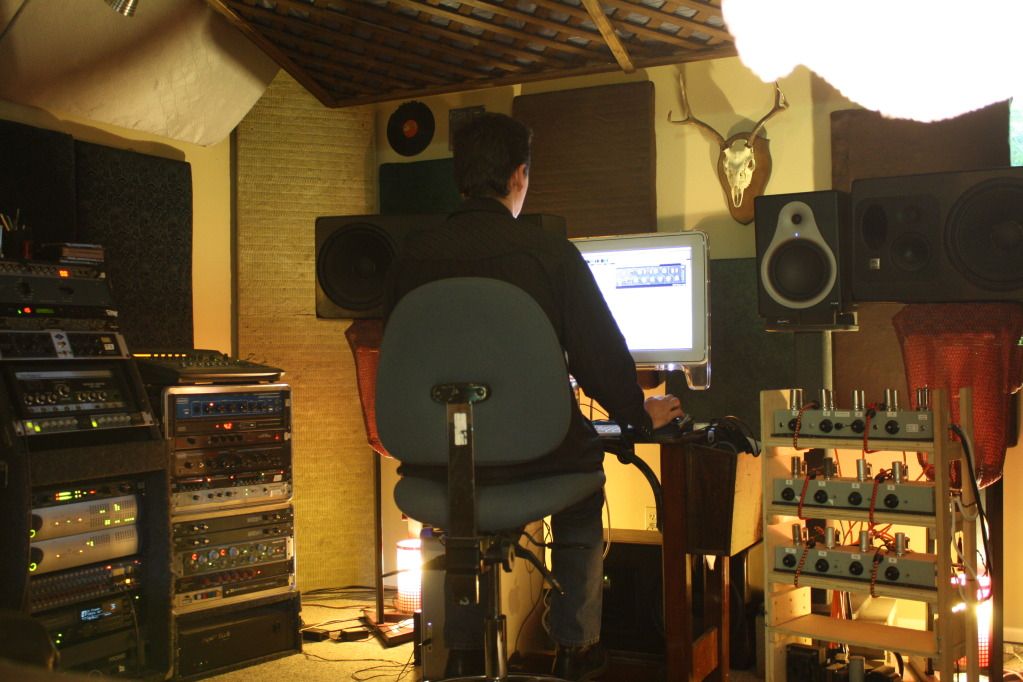
Cheap Seats 3: A Day in the Studio

The blog is back, and why is that?!  Last week I reached a surreal milestone in the recording of my next album--I've pretty much finished tracking overdubs; just one more drum session and we're on to mixing, mastering and release!  This means the blogging time I had to sacrifice to recording-related work is all freed-up and you can expect resumption of a steady stream of reviews and Cheap Seats content!


To keep the Cheap Seats ball rolling, I've decided that the next logical step is to delve a bit deeper into the technical details of the recording process itself.  Based on conversations I've had with friends and family, most people are pretty unfamiliar with the process by which music is recorded in a professional studio.  This blog's readership includes quite a number of music enthusiasts who probably have an above-average understanding of the recording process and terminology--at the risk of insulting your intelligence, please permit me to define some of the basics as I describe a recent day in the studio.

.......................................

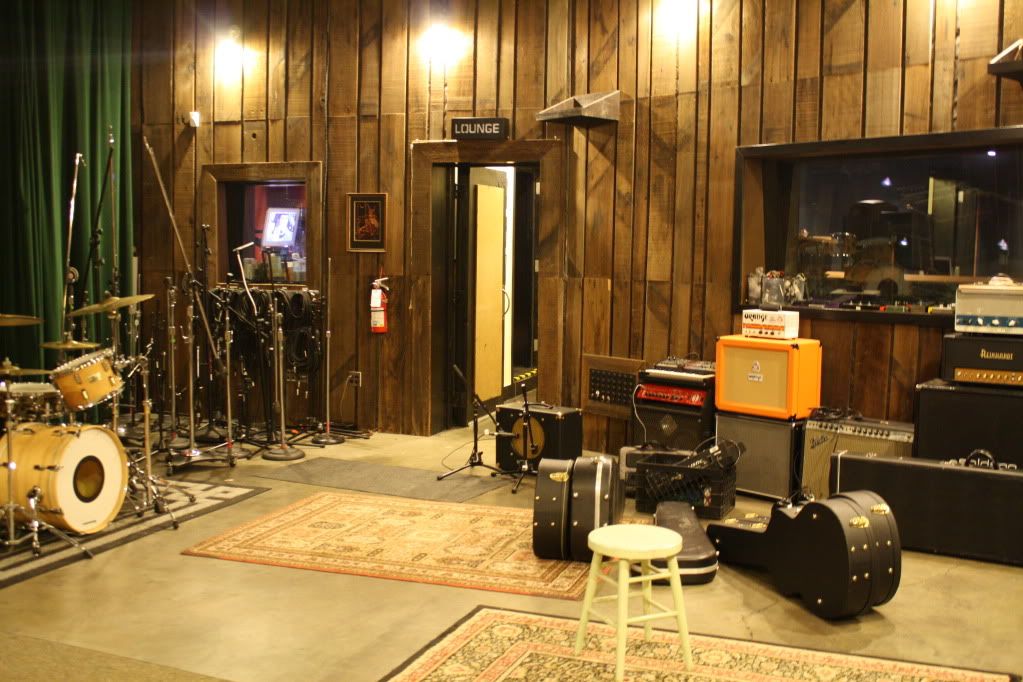
April 25, 2012: It's day three of a five-day session week.  The recording is in its twilight phase--we're starting the 20th day of what will probably be 26 total studio days to track the whole album.  At this point, almost all of the songs are pretty fleshed-out and Justin and I are adding some of the final parts to the songs at Cloud City Sound.  Things are starting to get a little bit surreal, as the project has been going for almost six months and we're finally getting to the point where we're doing "the last" of things--yesterday we recorded the last of the woodwind parts (good riddance, as far as I'm concerned--my wind chops plateaued in 1999) and today's going to be most of the final guitar parts.  What we're doing is called "overdubbing," a process where new parts are added to a pre-existing recording.  Most recording sessions start with what's called "basic tracking," where several members of the ensemble record a number of instruments simultaneously; usually it's at least the rhythm section with at least the bass, drums, guitar, keys etc. laying down a recording of the song's core parts, after which the vocals, extra guitar parts, horns, etc. are overdubbed.  Of course, every recording and group is different--for example, a lot of jazz groups are doing everything live, so there won't really be any overdubs, whereas a lot of rock groups may have four members playing on a song with three or four guitar parts, so it won't be physically possible the play all of the parts live, and vocals are often overdubbed because of the technical issues of getting a hi-fi recording of a voice while lots of other noise is happening.  In the case of this project, where I play almost all of the instruments, there wasn't really such a thing as basic tracking--for each song there was a day when I recorded the first part (usually either an electric or acoustic guitar) to a "click track" (a recording of a metronome) which will be used as a guide throughout the rest of the recording project and removed in the final recording--everything else from there on out is an overdub!

It's been a fun week so far--we've worked on a lot of songs, recorded a lot of different instruments (including the studio's awesome vintage Hammond B3 organ) and made some serious progress.  Monday was a fun day because my jazz pianist friend Peter tracked some slick piano on three of the songs, making him the second musician besides myself to contribute to the album (more on the special guests later!).  Being a one-man recording project has its positives and negatives.  On the one hand, I've usually got extremely specific ideas and goals I want to get across and playing every part gives me the maximum amount of control and cuts down on the sometimes difficult process of communicating desires and instructions to other musicians.  On the other hand, it can be extremely time-consuming to compose, arrange and rehearse (if I even get around to that phase) parts for numerous instruments--some of which I am barely familiar with--and in spite of my confidence in my own ideas, I'm always humbled by the fresh air that a skilled collaborator can breathe into arrangements that are in danger of becoming claustrophobic; it's thrilling to see someone else's ideas transform a piece of music I thought I'd considered from all angles into something more

Emboldened by my recent woodwind accomplishment, I've decided that today's the day to finish most of the final electric guitar overdubs.  Justin's job title is audio engineer, which means he performs a number of different duties crucial to the recording process.  Firstly, there's the physical engineering of the sound--selecting the microphones and preamps best suited to whatever instrument we're recording, and setting the volume and compression levels to get the best possible sound for the part.  Secondly, there's the actual recording of the instrument--Justin uses his thorough knowledge and years of experience with industry-standard ProTools recording software to set up tracks for each instrument, hits "record" over...and over...and over...and applies editing wizardry where needed to compensate from the fact that this isn't actually a live recording and to make things as smooth and seamless as possible.  Later, these skills will reach their culmination when we mix and master the raw tracks we've been recording.  Simply having a professional engineer means that this project is instantly worlds more high-quality than In Not-Even-Anything Land, and Justin's particular expertise and sympathetic attitude to the material has really taken things to the next level. 

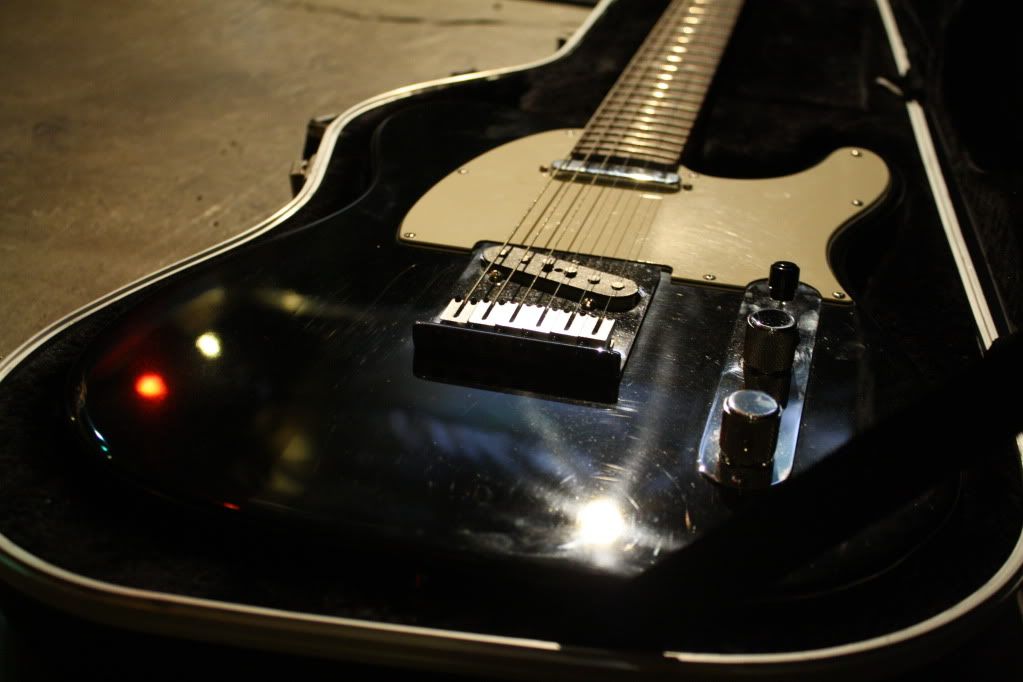
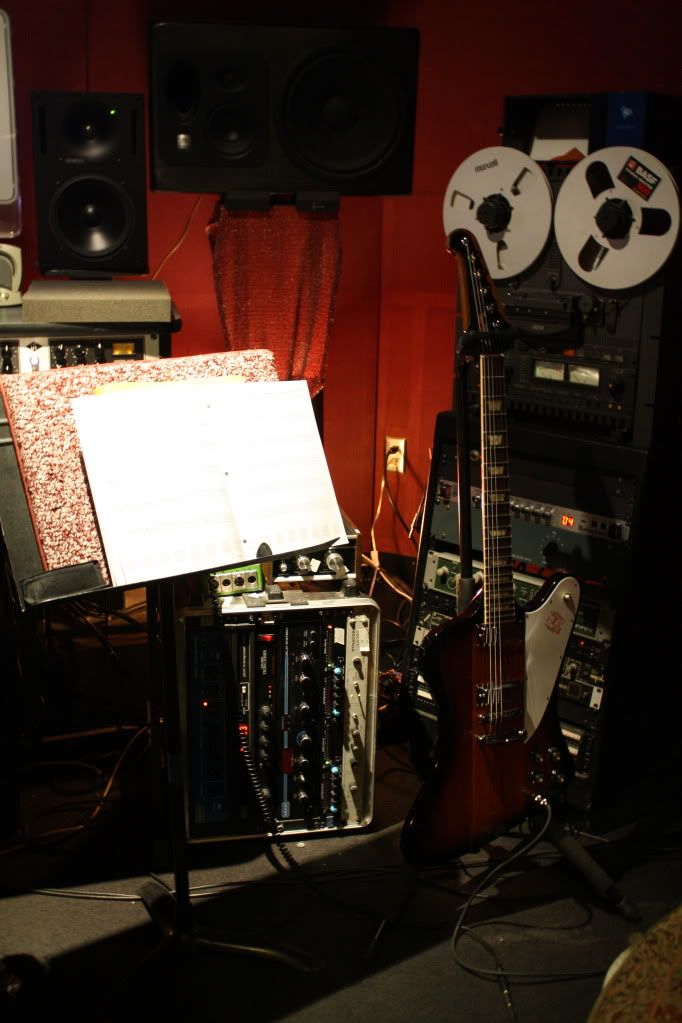
When it comes to recording guitar for this album, we've used countless combinations of mics, guitars and amplifiers to give each part a distinctive character and ensure that this will be a kick-ass guitar album with awesome tone that matches the often ear-challenging guitar parts.  We start our 10-hour day two hours later than usual at 12 pm, loading three amps into the isolation booth (the tiny room next to Justin's office where I've been recording vocals, horns and various acoustic instruments).  From there, we'll send out cables and I'll sit right next to Justin while I play and he records.  The guitar parts for this album can be roughly divided into three categories--composed rhythm parts, composed lead parts and more improvisational textural parts.  Today, we're recording some of both of the latter two categories.  While it's anathema to what a lot of musicians and music fans think the recording process "should be," the creation of this album has been an unusual and painstaking one.  The process starts at home, where I compose the parts in demo form using Apple's free recording software, GarageBand.  The sound quality is horrible and the performances are often pretty lackluster, but the main function is to figure out what the instruments are playing and give me a chance to hear what things sound like together, as I work primarily by ear.  At this time, if I'm "working smart," I'll also be transcribing the part I'm composing either with standard music notation onto a five-bar staff, or onto a guitar tablature sheet for later reference in the studio (one of the earliest lessons I learned is that the inconvenience of transcribing a part as I'm writing it pales in comparison with having to go back and figure out what I played two weeks ago).  Ideally, I'd then practice the parts at home in advance of the session to ensure smooth reproduction of the ideas for the final recording.  In reality, though, my time is limited--I work to pay for the privilege of recording this music, and during the last six months my free time at home has been more often spent writing, arranging and composing the next parts for whatever songs are coming down the pipe, and my rehearsal discipline has suffered accordingly. 

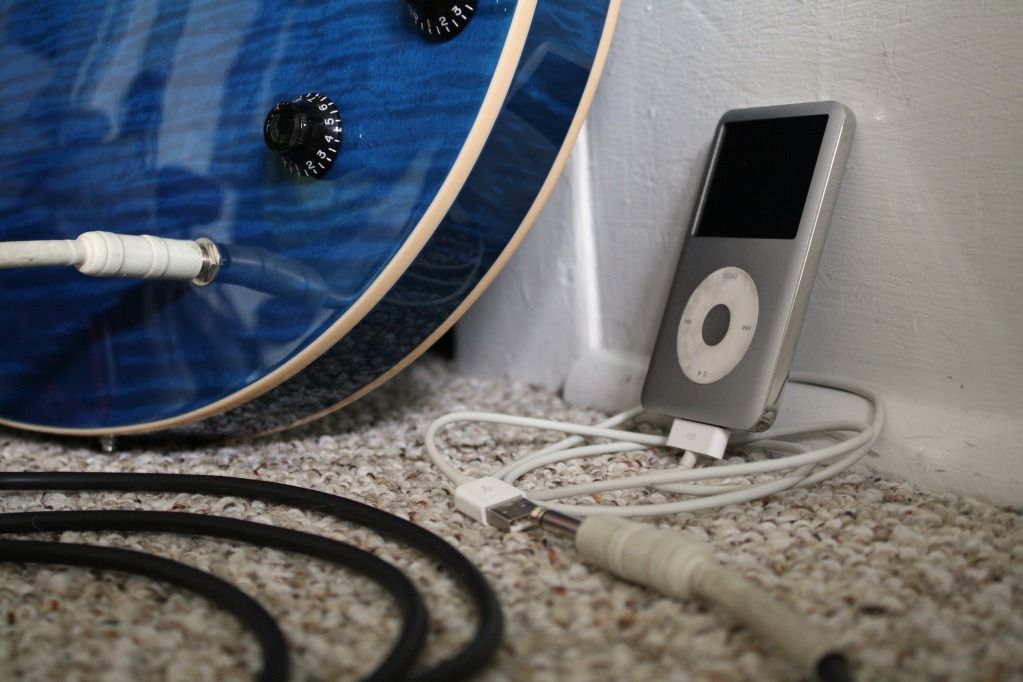
When it comes to recording the parts in the studio, I sit with my notes in front of me and a copy of the demo queued up on my iPod for immediate reference.  Here's where things start to become anathema to some people's expectations.  Of the aforementioned three guitar part categories, the first two are meticulous in their specificity and can be extremely time-consuming.  While some believe that guitar parts should be recorded all in one pass or compiled from several complete takes, that's simply not how we've recorded the guitar for this album.  ProTools has a function called "punching in," where the engineer can roll the recording and start and stop recording with the click of a button.  The function is designed to fix small mistakes, continue a take where maybe the first half was keep-able but the performer stopped playing, etc., by giving the performer a chance to play perhaps just one missed note correctly without having to record a whole take.  From what I understand, this process has been around since the analog days, but digital technology makes punching in much easier and more controllable.  Not to pull the curtain back too far, but in the case of my sometimes-labyrinthine composed guitar parts, they are most often recorded using a punch-heavy technique where sections of the part are recorded one at a time.  The composed rhythm parts tend to be less difficult and can be recorded in larger chunks, but some of the more difficult lead parts eventually have to be broken down phrase-by-phrase in order to accurately achieve the part I've composed, often including a formidable amount of rigidity and precision  in terms of interlocking parts and counterpoint.  I'm sure some purists scoff at the approach and I can understand why; it's natural for a musician's ego to demand an uninterrupted live performance, which is one of music's core avenues of expression.  In truth, I would love to have prepared the parts to technical perfection and recorded them in just a couple of passes, but the reality is that some of the parts I wrote are so difficult that rehearsing them all to perfection would probably add another year onto what's already been a half-year-long recording process!  Beside, the "off the cuff" approach is pretty much abandoned the minute you decide you're going to record a one-man project. 

There's also the objection that the element of spontaneity is lost when all of the parts are pre-composed.  In relation to my artistic goals, this objection is beside the point--the ultimate goal here is the final product, which is the total experience of an album-long recorded piece of music.  Whatever it takes to get there is what has to be done.  Again, I'd love to be able to simply improvise these parts in the studio, but my guitar part goals usually center on coming up with the most out-there and cliché-avoiding parts possible; only improvisers of unbelievable skill (i.e., definitely not I) are capable of ad libbing such parts (indeed, most improvisation actually tends toward the spontaneous reassembly of what can fairly be described as...clichés), and the benefit of hindsight allows me to fine-tune the parts I've written in order to improve them before they're set in stone.  It's true that I could eliminate the middleman by doing the part-composing in the studio, but that situation would remove the option to tweak the part later and would not be a cost effective use of my studio time--for every hour I spend reproducing a composed part in the studio there's at least two to three hours of hair-pulling and composition at home.  The punch-in recording method is likely to be a surprise for a lot of music listeners, but the truth is--though they aren't using the functionality to quite the same painstaking extent--almost all recording artists use punch-ins, editing and take compilation to create the best recordings possible.  In the case of my project, it's simply what the process is--the compositions, ideas and listening experience are the ultimate goals, and those goals take however much time and whatever means necessary. 

So, Justin and I sit down to start the day, choose a song, and fire away.  I've decided to use the morning's freshness on one of the more difficult parts left to record, and away we go--there's lots of "again please, same punch," a lot of swearing on my part, and a lot of digital clean-up needed when all's said and done, but the parts get done and it takes as long as it takes--the record for this album is five hours for a four minute lead part!  Whatever it takes for the ultimate goal!  At this point in the session Justin and I have gotten our system in place and things tend to go faster--one to two hours for a difficult lead part, and I've been playing so much guitar that I've gotten much better at hitting the parts in fewer tries.  At this point Justin performs one of his most important duties: quality control--paying attention to timing and synch while I do my best to hit the parts and keep the energy up in what's often an energy-draining situation.  Today we've got three difficult lead parts (two of which are in the same song) and some more textural, improvised stuff.  Each song change necessitates a change of guitar and amp, a resetting of levels and another adventure--luckily we can alternate between tough parts and improvised/textural ones, which gives me a break from the demands of brutal precision, and gives Justin's punch finger and patience a much-needed break.  We break for lunch around 2:00 (today's a big milestone; I'm redeeming my buy-seven-get-one-free coupon at the Safeway deli) and get back to work around 2:30.  By 8:30 we've recorded guitar for eight different songs and the scheduled guitar program is finished.  I decide to spend the last 90 minutes hitting a few backing vocals, which provides a nice cool-down for a day of hard work.  Tomorrow will be the final acoustic guitar overdubs, more vocals and starting the last of the bass recordings. 
.......................................

And that's how it goes...the days are long and things can get frustrating, but hearing everything together (which has been happening more and more as time goes on) is worth it for many reasons, not least of which is that the sound quality blows the demos out of the water.  This'll probably be the last really "technical" post until we get to mixing (others will probably focus more on the artistic and aesthetic aspects), but a lot of people have been asking me since as early as January, "So, you're almost done?"  I hope the detail here has helped clarify my "No, it's going to be a long time" reply and, as is the overarching goal of the Cheap Seats series, I hope it's given you some more pieces of the puzzle of what exactly goes into the production of an independent album and the way we can attempt to quantify and express the ultimate value of this kind of thing.  More soon!

Cheap Seats Part 1
Cheap Seats Part 2: Non-Commercial Music

Saturday, February 18, 2012

Cheap Seats 2: Non-Commercial Music

I'm 11 studio days and nine songs deep into my next album and thinking hard about how the work so far measures up to my standards, where I'm going next, and what's coming in the distant future in terms of post-recording production and an eventual release.  Though writing, arranging and recording is a challenging and difficult process, it's mostly straightforward to me and is still ultimately rewarding even when it's frustrating.  When it comes to thinking about how I can best represent my music once it's released and how to reach the kind of people who actually might be interested, things get a lot foggier. That's what a lot of this Cheap Seats series is about--what else (and there's potentially a lot of it) besides writing, recording and performing goes into the average independent musician's quest to be heard.  One of the fundamental issues that continues to plague my thoughts is the issue of non-commercial music and how it fits into today's bizarre musical marketplace. 

The struggle to define the phrase "non-commercial music" instantly reminds me of the classic US Supreme Court opinion on obscenity and pornography--creating a concise definition is all but impossible, but "I know it when I see it."  In the case of non-commercial music, it might easier to define its opposite--commercial music.  To me, "commercial music" is broadly music that is specifically created to appeal to the widest audience possible and consequently maximize sales.  This is neither necessarily a bad thing nor an absolute category, but under this definition, it's pretty easy to "know it when you see it."  In terms of musical characteristics, commercial music is almost always concise (songs under, say, six minutes), utilizes conventional harmony (major or minor keys with occasional implementation of jazz-related harmony), lyrically appeals to specific emotions that most people feel on a regular basis (romance-related, nostalgia, euphoria, sadness [use sparingly]), is full of easily recognizable elements that are catchy and memorable, and often identifies strongly with the conventions of a particular well-established musical genre in order to provide listeners with a clear connection to music they already like.  If it hadn't started becoming such a pejorative term and associated exclusively with corporate-produced mass market music, I'd even say that "commercial music" is synonymous with "pop music," but let's not narrow the definition unnecessarily with negative connotations.  Like I mentioned before, none of these characteristics are inherently bad and they describe a lot of great music, but surely they don't describe the only way to make good music?  It would seem that problems arise when the characteristics that describe commercial music become the only guiding principles in making music.

Indeed--they aren't; all kinds of great music has been made across the years with varying levels of non-commerciality including attention-span-testing song lengths, unconventional dissonant harmony or atonality, unconventional song structure (or complete lack of structure), inaccessible lyrics, a focus on less straightforward hooks, expression of less attractive moods and emotions, lack of easy identification with recognizable genres, and all-around weirdness in the sound of the music and especially the sound of the singer's voice.  Naturally, the list goes on and these descriptors have and will be freely combined, mixed and matched with each other as well as with characteristics associated with commercial music.  The point is, the more non-commercial elements you employ, the tougher it's going to be to achieve significant commercial success.  However, just as making the decision to produce purely commercially-oriented music doesn't guarantee commercial success, plenty of non-commercial music has (eventually) achieved widespread commercial success.  Tom Waits is an artist who immediately springs to mind; these days he's a hallowed saint of the independent/weird music world, but it took him a long time to break past the cult status to which his now-classic 1980's albums initially resigned him.  So, commercial and non-commercial music aren't necessarily mutually exclusive, and non-commercial music can succeed commercially, it just has a bit less going for it in terms of accessibility.  However, it seems reasonably undeniable that certain types of music will never be commercially successful by the conventional measures (like, say, the Billboard charts)--but they have to have some kind of value, right? 

I think the Tom Waits example speaks well to the tough-to-quantify value of non-commercial music.  Simply put, if you're slavishly working toward the goal of creating music that's as commercial as possible, there's a good chance it's going to come across as boring.  There have been innumerable artists treading the exact same path, and the characteristics that define strictly commercial music limit your artistic options from the get-go.  Yes, there's joy to be found in those options, but there's also the soulless thirst for the lowest common denominator that makes so much commercial music hackneyed to the extreme.  There are many artistically-justifiable reasons non-commercial music is valuable, including one that can even be connected to the all-sacred dollar--the fact that it plays a key role in refreshing what qualifies as commercial music.  It's been happening throughout history, from Beethoven to Elvis--the avant-garde does something weird and against the rules, enough people like it and prove that it can make somebody some money, then it becomes an acceptable convention for the mainstream.  Tom Waits is a great example, especially considering the fact that a lot of his Captain Beefheart-influenced material introduced just enough commercial elements for Waits to eventually succeed where the Captain utterly failed commercially.  Good ideas have a way of rising to the top, and in addition to being aesthetically enjoyable for its own idiosyncratic reasons, each type of non-commercial music is always ultimately connected to the mainstream, whether it's valued monetarily or not. 

After working on this music for several months, I have no illusions that nearly all of the songs I'm working on qualify as non-commercial music.  Personally, I find an exciting freedom in non-commercial music (which explains why the majority of albums I review here display varying levels of non-commercial characteristics) that means anything goes, as long as it's expressing an interesting idea.  If you're not afraid of breaking a rule that'll cost you sales, then your options are unlimited.  Of course, it's a double-edged sword and each non-commercial choice you make further limits your potential appeal to the average listener.  And aesthetically, the further you tread from the established rules, the more subjective the evaluation of the quality of your work becomes--who says what I think is an interesting or dull idea is interpreted the same way by others (a principle amply demonstrated by the response I've gotten to some of the critical reviews I've written)?  This ambiguity is one of my favorite parts about art, since I believe it's ultimately true even when evaluating art that abides by strictly established rules. 

So, I personally believe that non-commercial music is valuable both artistically in terms of the potential for innovation and the unlimited scope of expression, as well as for the role that it plays in propelling forward the slower-moving behemoth of popular music.  Choosing to make non-commercial music means I'm subject only to my own artistic whims, but it also means I'm further narrowing the already-limited avenues through which I can seek success as an unknown independent musician.  It's not a matter of "being discovered" at this point (since there's no major pop label that would be interested in trying to sell this kind of music), but rather a matter of finding ways to connect with the disparate but very real audience that could potentially be interested in the music.  It's the how that continually occupies my thoughts--how does any non-commercial musician access the narrower and diffuse selection of people who are interested in non-commercial music, and what does it take in the present day to achieve enough commercial success with that audience to sustain and continue the artistic process?  The answers are probably extremely complicated and different for every band or artist, but repeatedly considering these questions will be a key part of this series as I continue trying to outline the labyrinthine choose-your-own-adventure that faces today's independent musicians. 

Cheap Seats Part 1

Wednesday, December 7, 2011

Cheap Seats Part 1: New Album Go!


The time has come--I'm fresh off my first two days at Cloud City Sound Studios in Portland, OR starting work with engineer Justin Phelps on my next album.  Though I've been working on demos for a few months, this week marks the official start of the album as a professional production.  It was an interesting and activity-packed couple of days with plenty of progress made--we tracked rhythm guitar for eight songs and vocals for four.  Although there will be numerous other instruments on the songs, getting a tight and accurate base skeleton of one instrument and vocals is one of the most crucial parts of the process.  Less quantifiably, I'm really glad to get the learning experience portion my first professional studio days behind me--the differences between demoing and recording (my last album was all home recorded) at home and in a professional studio are huge.  On the one hand, at home creative control and patience for perfectionism are absolute.  On the other hand, though, the ceiling for perfection is much higher at a professional studio, and the technical and creative input of a professional engineer like Justin are invaluable.  After I started getting through the jitters and self-consciousness of having to take and retake certain sections over and over, Justin and I were able to get in a good groove and the benefit of his professional experience became apparent--not only does it help to have input from someone who's approaching my songs and arrangements with fresh ears and a well-developed sense of taste, it's also helpful to have someone there to say, "Hey, that take was great, let's keep going" when I would probably continue trying to get every performance detail perfect (in my ears) before moving on.  Most of all, it feels really good to work with someone who is taking my vision and goals seriously and is investing himself creatively in the project--I know it'll be much stronger for it.  Having someone besides myself treat the project as something worthy of that investment is immeasurably boosting to my confidence.

As I continue to create this album I'm planning to continue this "Cheap Seats" series to both document my experiences and in hopes of providing people I know and all of you music "sharers" with an insight into what goes into the production of an album like the one I'm making.  I'd like to dig deeper into some of the unanswerable questions relating to modern music and the life of an independent musician like myself.  These questions include: What is the measurable value of music and music recordings?  What is non-commercial music and what's its purpose?  Is it reasonable for a musician to attempt to make music a paying career, or should music only be pursued as a hobby?  Will more or less great music be created if musicians are poorly compensated financially?  How has modern technology impacted the creation and distribution of music recordings?  What are the reasonable responsibilities of a music consumer?  What does it take to be heard?  While these questions probably sound like the setup for a bitter rant, they are all complex issues with many sides and I'm hoping to get feedback from both musicians and music fans alike.  I'm just as much (or more) of a music fan as I am a musician, and consequently I think these issues are relevant to more than just independent musicians trying to make it big.  If anything, the goal of the pieces will be to show that there's much more to that MP3 or concert you just listened to than meets the ears and eyes.  Welcome to the world of an unknown independent musician and the process of recording a contribution to the vast abundance of music this world has to offer--you've got the cheapest seats in the house!