Showing posts with label Davy Graham. Show all posts

Tuesday, June 5, 2012

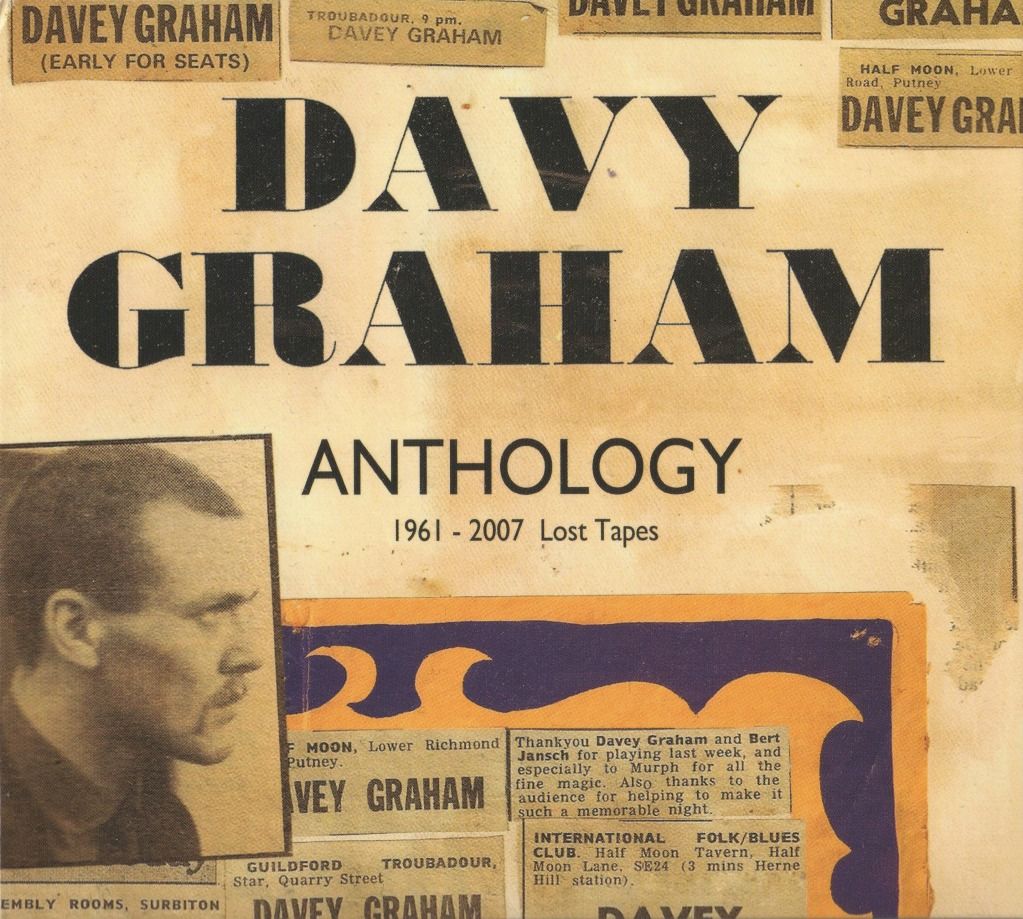
Davy Graham - Anthology: 1961-2007 Lost Tapes


Almost four years after Davy Graham's death, the folks at Les Cousins Music are still working not only to preserve his officially-recorded legacy, but also to expand the scope and depth of his output, making it clearer for those who weren't there why the guitarist was the undisputed king of the 1960's English folk revival.  Nostalgically packaged in a collage of images gleaned from Graham's personal scrapbook (and simultaneously displaying both spellings of the guitarist's first name he confoundingly vacillated between), this three-CD collection anthologizes no less than 54 tracks across more than 2 1/2 hours of unreleased recordings.  Count me in!

It's a fool's errand to attempt a track-by-track analysis of an anthology so deep, so I'll attempt to convey some general impressions and reference tracks where appropriate.  Having been a Davy Graham fan for several years, I think I'm finally starting to understand how, as Roy Harper says, Graham "never managed to turn his talent into a brand that people could go out and buy and enjoy," yet every other guitarist from the same time period and beyond cites Graham as a towering giant of the six-string.  After five years of absorbing Graham's studio output I'm still at a loss to recommend a single album of his that fully conveys and encompasses what was so revolutionary about his playing, and not having been there it's been hard to picture myself in that bright-eyed hopeful time and imagine myself at some bohemian party with Graham conjuring untold spirits out of an acoustic while everyone just sits and listens.  Enter this anthology, which as far as I've heard does the best job this side of After Hours at Hull University of recreating such a scene.  The sound quality (especially on the first two discs) is almost exclusively of home/bootleg quality and most of the performances are solo, with Graham positively shredding in front of small audiences as he sends jazz, folk, blues and "world music" (before such a term existed) through a blender and we get to hear what comes out.

Since it's mostly just an acoustic with or without vocals, the sound quality isn't much of a bother--if anything, it enhances the intimacy of the performances, which find Graham energetically blasting solo performances of many of the folk and blues songs found on his albums as well as never-before-heard tracks.  Throughout, his technique is astounding, transitioning as quickly as ever between lead and rhythm, melody and harmony, from style to style.  Somehow the setting's informality allows the guitarist's hard-won chops to shine brighter with none of the studio adornments meant to commercialize his sound, and we instead get to hear him exclaim "Ah, fuck" after some imperceptible mistakes during a lightning-fast take on Leadbelly's "Fannin Street" with nary a missed note, as well as a verbal introduction to his classic instrumental "Anji" (there are two versions here, along with an unreleased track and album highlight "Anji's Greek Cousin") that details how he wrote the tune.  While the live renditions of guitar-and-vocal folk/blues tunes present uniformly great guitar and often contain vocals that are superior to the studio versions, they also miss the mark when it comes to what made the guitarist unique--more than almost any other Graham album, this anthology conveys the strange alchemy that occurred between Graham's musical influences, his fingers and his guitar, and these discs present ample, undiluted evidence of what was possible when only these elements were on display.

Of the three discs, the third is probably the least essential, reflecting the diminishing returns that Graham's post-60's releases offer, yet it often sounds more vital than studio recordings from the same period.  Though Graham's lifestyle choices and age would gradually slow his playing and attenuate his already limited vocals, we still get some surprisingly good representations of the more delicate British folk, jazz, medieval-sounding instrumentals and world folk music explorations he continued to make through the 70's and beyond.  "The Gold Ring" shows his pull-off speed undiminished, "Sita Ram" and "Mevlut" pair his further eastern experiments with appropriate accompaniment, and "DeVisee Suite" shows a subtle, slower side to his playing that was all but absent in the early days.  The final late-period tracks remind us that we're summing up the career accomplishments and contributions of a distinctive force in 20th century popular music.  As with his 2007 swansong Broken Biscuits, the joy here comes less from marveling at jaw-dropping speed, but more from giving credit where it's due and appreciating that the man's muse was still active at the end.

While I still think it's impossible to recommend an accurate starting point for a prospective Davy Graham fan (it takes more than the average time investment to really "get" him as an artist), this anthology is a surprisingly worthy addition to even a modest Davy Graham collection.  Unlike so many retrospective collections, it manages (with the help of Graham's considerable skill and restlessness) to make familiar songs sound fresh and new songs sound immediate and relevant to the further-broadening portrait available of Graham as an artist. 

Get it here.

Saturday, January 14, 2012

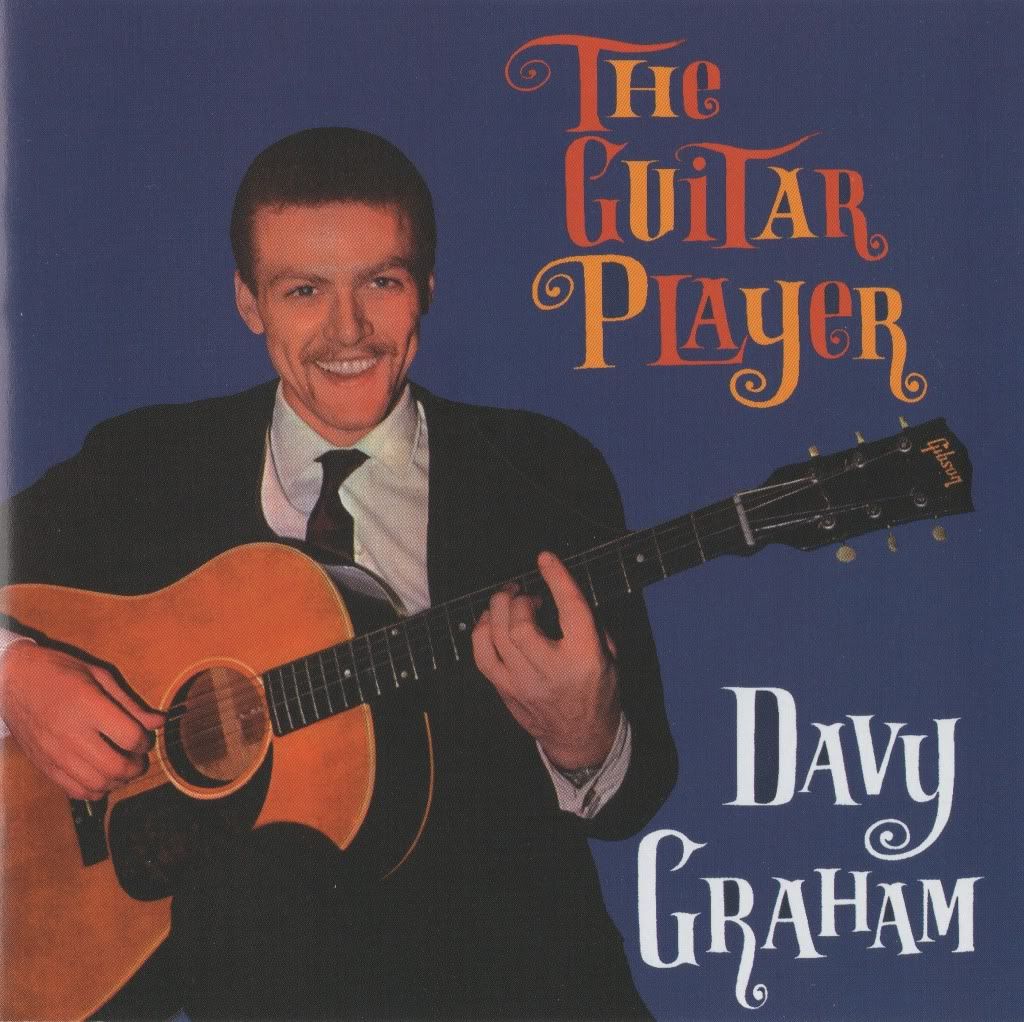
Davy Graham - The Guitar Player


If you're interested in delving into the influential and often mind-blowing rabbit hole that is Davy Graham's guitar playing and inimitable fusion of jazz and blues with folk from across the world, I urge you not to start here!  That's right, it's another installment of the only-very-occasionally-controversial Know Your Enemy series.  This time it's not really poor Davy or his fleet fingers, but rather his presumed audience who's the enemy.  It's got to be pretty much impossible to reckon how many great artists' originality and instincts have been stifled (either by their record labels or by themselves) in hopes of presenting their music as inoffensive and appealing to the largest and most middle-of-the-road audience possible.  By this album's 1963 release, Davy had already been doing the things that made him a legend among many British musicians who would find considerably more fame (things like showing up to a party and playing a single-guitar arrangement of Ravel's Boléro).  Instead of committing his unrivaled guitar excursions to tape, Pye subsidary Golden Guinea decided it would be more commercially accessible to pair Graham with a jazz session drummer and record an inoffensive mix of jazz and blues standards.

And so, we have The Guitar Player, whose title and cover promises an aural vision of Graham it doesn't deliver, at least in relation to his historical reputation.  We get "Take Five" and "Cry Me A River" (an earlier filmed version of which secured Graham this record deal) as well as Cannonball Adderly's "Sermonette."  While the material is in places somewhat mundane, Graham's playing is always flowingly organic (the tempo ebbs and flows with quite a bit of endearing imperfection) and it's fascinating to hear him collapse all the vocal and instrumental parts of a song like "Ray Charles' "Hallelujah, I Love Her So" into a single fingerstyle guitar part.  Disappointingly, most of the songs veer toward jazzy blues (or maybe bluesy jazz, as many Graham's mini-fills tend to riff on blues scales), though there are a few outliers that hint at the man's true passion--"The Ruby and the Pearl" injects a satisfying amount of minor Latin into the mix (and the drummer manages to play the sticks in a considerably more complementary way than he often does elsewhere, or maybe it's the fact that it's just acoustic guitar and drums that makes some of the arrangements sound  just a bit hollow).

Re-listening to this album, I'm reminded how much of a joy it is to listen to Graham's guitar playing, no matter what the context--sort of the guitar equivalent of saying you'd be OK listening to your favorite singer singing names out of the phone book.  It's just the knowledge that Graham had much bigger ideas to share and the way the songs are all so self-consciously happy sounding that rings somewhat forced.  The liner notes Davy writes "I sincerely hope you enjoy this record either to listen to or as a background to a good conversation," which just about sums it up--cowering in submission to your hoped-for audience so very rarely produces the stuff from which legends are born.  The CD reissue of this album seems determined to apologize for the original album's timidness, including examples of what actually made Graham legendary (raga-infused Irish folk in "She Moved Thru' The Bizarre/Blue Raga," Greek folk in "Miserlou" and a considerably more eclectic selection of songs from Graham's later-70's All That Moody, including his legendary instrumental "Anji").  Still, the unfortunate truth is that, pleasant as it is, this album doesn't come close to doing Graham's contributions justice.  While Graham would have career-long troubles finding a marketable niche for himself and regularly seemed to make artistic choices in hopes of endearing himself to an intangible audience, he at least managed to create a concurrent legacy of music that more successfully represented his unique and unprecedented vision.  While it's frustrating that he never produced an epic, vocal-less collection of his genre-shattering experiments (I'm sure partly owing to the fact that solo acoustic guitar as a genre was pretty much just getting going in the early 1960's), there are much better places to start than The Guitar Player.

You can get it here.

Thursday, March 10, 2011

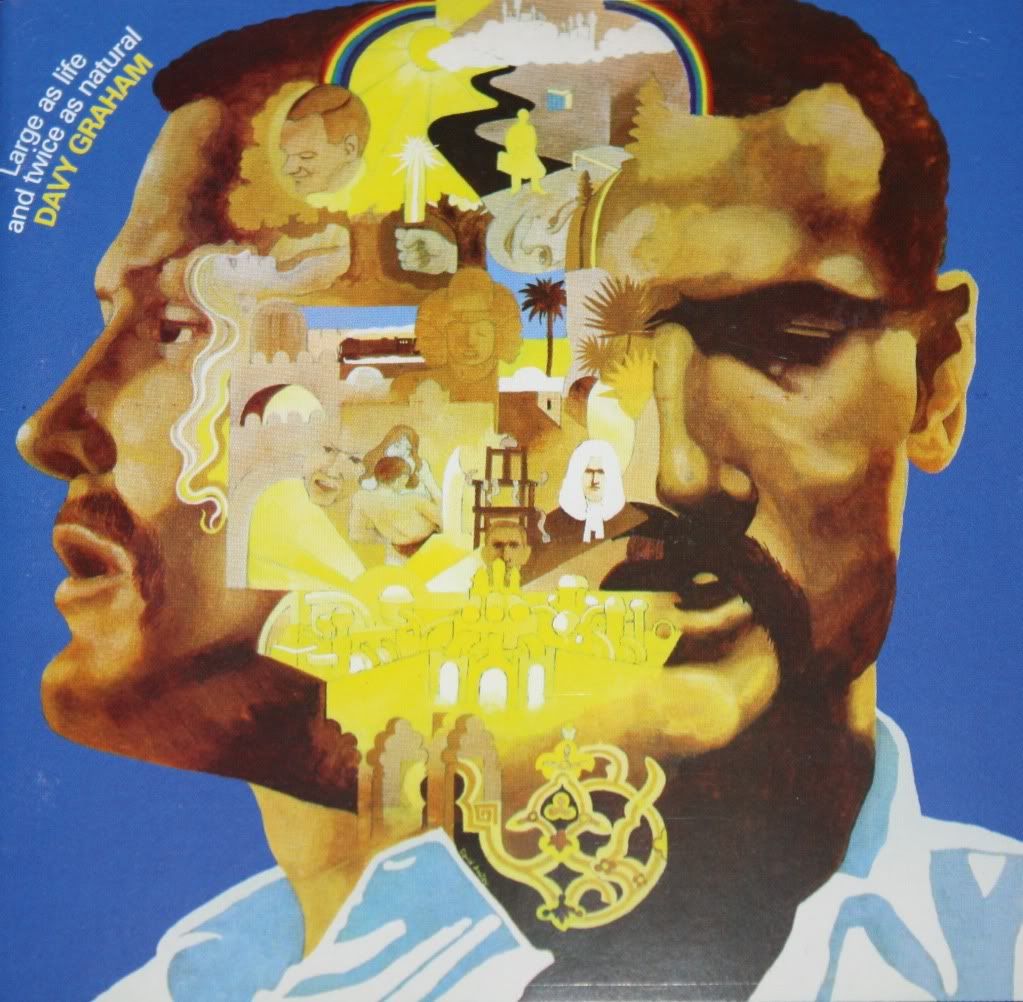
Davy Graham - Large As Life and Twice As Natural


Time to turn our probing ears to another unjustly-overlooked guitarist.  Today, few have even heard of Davy Graham, but he's unanimously considered "important" by those who have--a host of better-known performers and guitarists are quick to drop his name (Bert Jansch, John Renbourn, John Martyn, Paul Simon, Ralph McTell, Roy Harper, Jimmy Page, Martin Carthy, the list goes on...) as the most adventurous and eclectic guitarist of the early 60's English folk revival, yet his actual work remains painfully obscure (though thankfully currently in print).

Davy Graham's fourth LP, Large As Life and Twice As Natural (genius title!) presents equal justification for his esteemed reputation it does evidence for his failure to achieve commercial success.  The solo guitar "Tristano" reveals Graham as a virtuoso of the truest stripe, capable of seamless transition between (or simultaneous juggling of both) rhythm and lead parts, while the song itself fuses jazz, blues, folk and middle-Eastern modalities in a way that nobody in the mid-60's could have even imagined.  That's how Davy is usually described by the converted--a loner whose penchant for world-traveling gave him an untouchable breadth of experience which, combined with his seemingly boundless imagination and ungodly chops, meant he was fusing Irish folk songs with Indian ragas and Eastern-izing obscure blues songs (by all accounts he invented DADGAD guitar tuning) while his later followers were aping Anthology of American Folk Music standards and worshiping Dylan.  In reality, though, very little of Graham's recorded output consists of solo guitar, which I think might have played a role in his commercial difficulties.

More representative of Davy's standard MO would be his expansive reading of classic British folk song "Bruton Town," where the guitar flits jazzily around the traditional melody, refusing to adhere to traditional folk rules.  Graham's voice is probably his greatest limitation--not bad (I actually enjoy it) but certainly not traditionally "beautiful" or as marketable as his guitar abilities.  Likewise, "Both Sides Now" is a revelatory opener--its languorous, modal opening makes you wonder if this is actually the same "Both Sides Now" you thought it was, then BAM!  The bass and drums kick in and Davy presents us with an uncannily energetic and imaginative reading of Joni Mitchell's oft-covered standard.  The cacophonous rhythm section ably handles the eclectic mix of styles present here (Pentangle's Danny Thompson has got to be one of the best session bassists of the time period), bringing lots of ethnic flair to the Eastern songs (the major-key "Sunshine Raga" and minor-key "Blue Raga," as well as the hypnotic "Jenra") and provide a suitably grinding bottom to the  blues numbers ("Freight Train Blues" has some awesome cymbal work and Davy's singing is pretty rocking).

The whole album feels like it was recorded live (there are plenty of vocal imperfections and loose improvisation to attest to this observation) and the sound is great--nobody else's guitar sounded like Graham's.  The commercial flaws of the albums can be seen a mile off, though--it's neither folk (too experimental and eclectic) nor folk-rock (too jazzy and accoustic), and it's got nothing to do with psychedelia (apart from the delirium-inducing guitar excursions), which was the rage in 1968--how do you market that, and to whom?  Perhaps Davy's eclecticism became his career's undoing (deliberately becoming addicted to heroin in order to emulate his jazz idols probably didn't help either) but for me it's the best thing about him--you never know where the next song is going and his playing is full of surprises both compositionally and technically.  Here Graham might not quite fuse as many genres within the same song as he does on Folk, Blues and Beyond, but it's a fine representation of his style and contains some career highlights. 


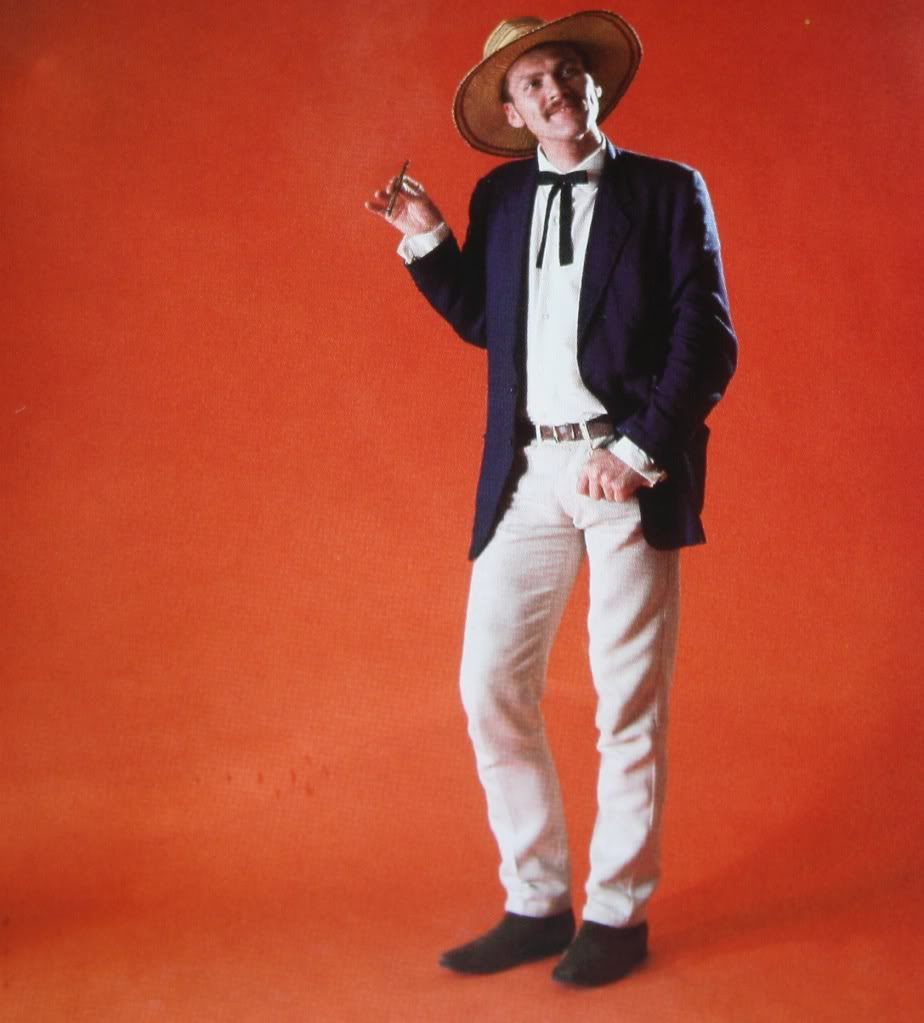
I couldn't resist including this shot from the album notes--what a cigarillo-smoking, big straw hat-wearing ladies man.  Thanks Davy. Get the CD here.