Monday, February 28, 2011

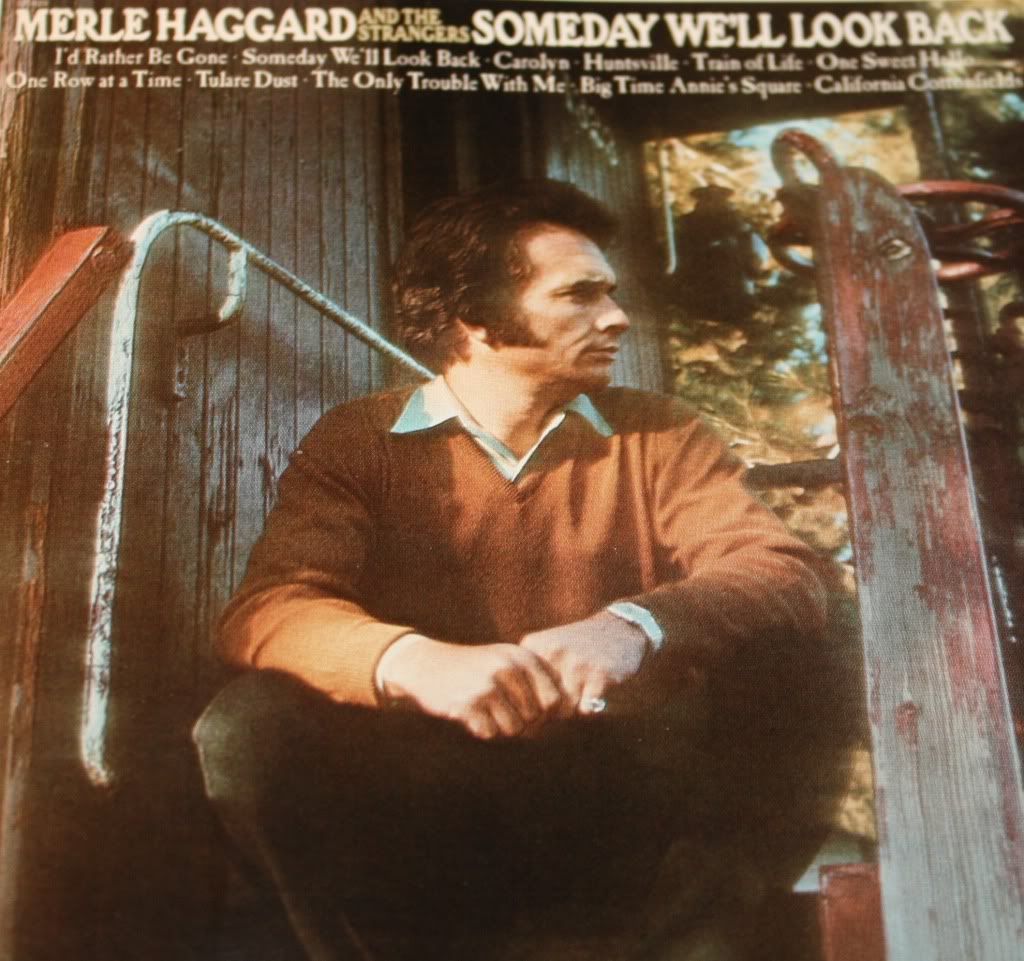
Merle Haggard - Someday We'll Look Back


Merle Mondays continue with the Hag's 1971 tour de force.  As if releasing a progressive gem in Hag earlier in the year wasn't enough, Merle saw fit to bestow upon us an even better album of bewitchingly eclectic Bakersfield country in Someday We'll Look Back.

Although my favorite side of Merle is the hard-edged Bakersfield honky-tonk sound with lots of steel guitar, I just can't fault this album (or Merle's entry in the "widest sideburn in the world" competition).  This album blends Merle's songwriting mastery (it's clear that by 1971 he'd achieved an uncommon level of assurance in his songwriting abilities) with some of his most mature vocals and a dizzying array of country blended from everything from Latin to blues on through to jazz, swing and even straight-up pop.

Though it's a mellow listen, this is classic Hag through and through--we get a dig at hippies in "Big Time Annie's Square," a badass prison song in "Huntsville" ("the man better keep both eyes on me/or they're gonna lose ol' Hag"), and some crushing heartbreak laments like "I'd Rather Be Gone."  What really tugs at my heart strings, though, is the authentic nostalgia that pervades the whole set--from the hit title track to the wistful, bittersweet imagery of "California Cottonfields," "Tulare Dust" and "One Row at a Time," Haggard has a way of sizing up his past in such a way that the emotion and sense of remembrance is overwhelming--when Merle sings "California cottonfields--as close to wealth as daddy ever came," you know he lived it.  There are Haggard albums I reach for more often, but this album is like a warm embrace from a relative you haven't seen in years.

Get it here on CD or MP3, along with the similarly strong Hag.

Sunday, February 27, 2011

Third Ear Band - Third Ear Band (Review)


Third Ear Band's second album, 1970's self-titled (now sometimes retroactively titled Elements) builds on the oboe melody-led excursions of Alchemy by assigning each of its four songs to an element.  While the instrumentation is still basically the same as the debut, the songs are considerably more identifiable from each other.

Every time I listen to this album I'm amazed at how fun a listen it is without being particularly melodic--the opener, "Air" gently coalesces out of the ether based on a repetitive tabla beat and some probing oboe and cello/violin groans and fails to present any melody except for an occasionally repeated violin riff.  And yet, its smoky mystery is utterly compelling and lushly gorgeous, especially considering how few instruments produce the music.  "Earth" shifts gears completely, with the strings playing pizzicato over a much more minstrel-like beat from the drums.  Dual oboes improvise gently, probing Eastern-scales, while the tempo subtly gathers pace.  All of a sudden it's an ecstatic frenzy, then just as suddenly the tension disappears, the rhythmic pattern slightly shifts, and the process starts again.  Despite the general mood and ever-present tonal center of the music, there's no real melody to speak of--clear and quite listenable evidence that melody needn't reign supreme as the only musical element worthy of close attention.

"Fire" is a brilliant study in high-register drones and another shift in texture, with a relentless wavering feeling not unlike that of a dancing flame.  "Water" closes the album with an actual melody (imagine that) over sustained violin with just enough dissonance to remind us that we're not in any territory that had been scouted at the time of the album's release, or really a whole lot more since.  As I listen and re-listen in rapture to the strange and evocative sounds these instruments make together, I'm not always sure how the structures pertain to the elements they're named for, but in reality it's immaterial--by consciously giving each suite a distinct mood, the band stretched itself beyond its impressive but sometimes nebulous debut and gave structure to another forty odd minutes of rare beauty with memorable compositional elements.

Get it here on CD along with the band's first album.

Saturday, February 26, 2011

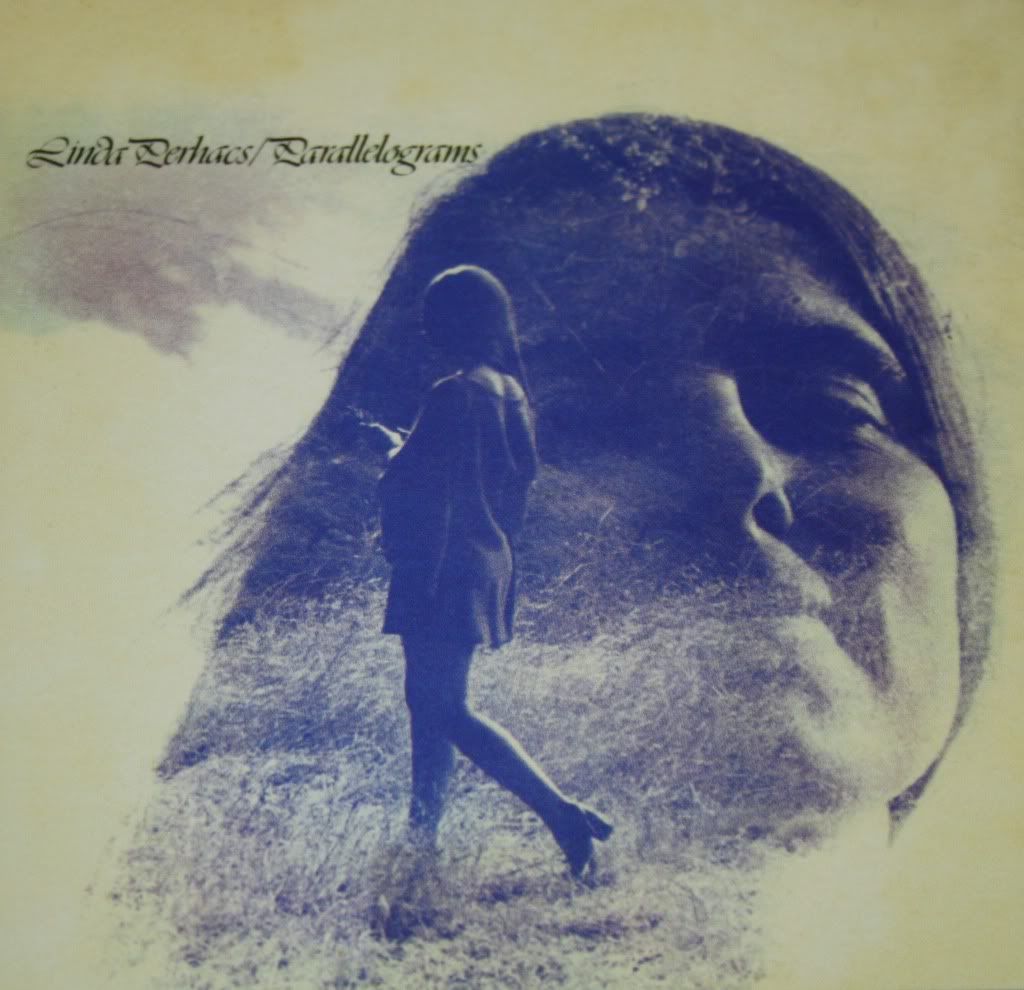
Linda Perhacs - Parallelograms


It's hard to believe but I've had this album for about five years.  It's been interesting progressing from instantly enjoying it on first listen, driving across the Bay Bridge with Sarah in August, to returning to it again and again like an old friend--then all of a sudden I can't imagine living without it.  I hate to blaspheme, but I probably like this album as much or more than I like any one album by Joni Mitchell, to whom people most often compare Linda Perhacs.  Ok, maybe I like Blue as much, but in a different way.

The mood here is flawless--hypnotic, subtly psychedelic, simultaneously hazily nocturnal and narcotically dawn-like.  Perhacs' voice isn't quite as lithe or showy as that of similar female singers, but, more importantly, it fits the songs she's written and serves the words and atmosphere perfectly.  The album's shimmering opener sets the tone--a gently unusual fingerpicked arpeggio is soon joined by Perhacs' quietly intense, cascading multitracked vocals, which emulate the titular rain.  These elements reappear repeatedly--on "Moons and Cattails" and again on the most overtly psychedelic track, "Parallelograms," which blends another chant-like guitar figure with hypnotic vocals--the comfortably dissonant combination is shattered by hand percussion and delay-treated flutes as Perhacs' vocals sink past unintelligibly before recapitulating the original theme.

Some songs reach yearning heights over delicately understated guitar--as when Perhacs pleads, "Dolphin, take me with you..." or on the exquisite "Hey, Who Really Cares?", while elsewhere her delicate vocals convey a sense of place and sense experience that's uncanny, as on the swaying "Sandy Toes" or the almost mystically sensuous "Delicious."  The arrangements are impeccable throughout the entire album--whoever's producing knows just when to leave it to voice and guitar and when to add a reverbed guitar, a 12-string, wind instruments or some appropriate bass and ethnic drums.

Sure, it's easy to point out so-called hippie elements on this album--the amount of time spent lingering on small experiential and nature-oriented details is uncommonly high, and "Paper Mountain Man" and "Porcelain Baked Cast Iron Wedding" sound pretty late-60's.  Last time I checked, though, the value of savoring the moment didn't end with flower power.  It's too late anyway--I'm too close, it's too good.  I wouldn't change one thing about this album--it's these kinds of friendships that keep me coming back--stricken, helplessly content.

Get it here on CD and MP3.

Friday, February 25, 2011

One Tea


 ` ` ` ` ` ` ` ` ` ` ` ` ` ` ` ` ` ` ` ` ` ` ` ` ` ` ` ` ` ` `

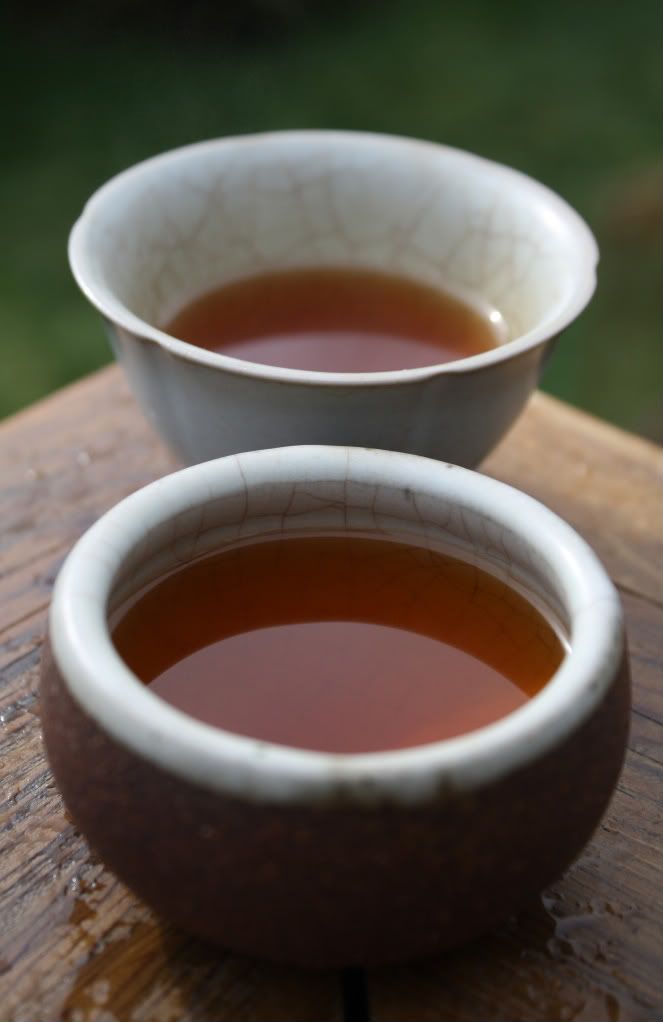
One tea shared between two cups
Separate pools, distinct
Two cups tilt--contents together
Crashing marbles, silent groans

Still two together
or now a third--discrete from one?
What force set two from one?
Moot questions, you may assert
Recombination erases any artificial identity

However, moving closer
can't you see?
Two side by side
around
passing under
Restless pacing


 ` ` ` ` ` ` ` ` ` ` ` ` ` ` ` ` ` ` ` ` ` ` ` ` ` ` ` ` ` `

A new poem and song I've been performing this past month.  It's a quiet observation from my tea table.  Here's how it goes--I pour the tea from the pot into the sharing pitcher.  From there, the tea goes into two cups.  Now we have two different cups of tea--sure, it's the "same" tea, but not quite--the tea in the first cup isn't exactly the same as the second--to start with, they're in completely different vessels.  So, now the tea substance in each cup has a name--let's call them "A" and "B."  And what if I pour them back, together, into the sharing pitcher?  Does the tea return to being the exact same as before it was poured into cups and became "A" and "B"?  Is the distinction (which surely described something that was different about the two cups) so easily discarded and forgotten about?  Then I start thinking about the "A" molecules and the "B" molecules swimming, intermingling there in that pitcher.  It's happening as an utterly unmeasurable, ever-shifting dance.  The broader implications of this exercise constitute a substantial cornerstone of my worldview.  It's a good day when I can become so lost in amazement at a small wonder...it's nice to have some perspective.  Oh yeah, this is also a love song describing what happens to two personalities together over time.

Thursday, February 24, 2011

Peter Hammill - Over


Over is probably the Peter Hammill album that's received the most mainstream acclaim, a fact which is aided in no small part by the fact that it's the ultimate breakup album.  A fair number of critics (ah, the critics) praise Hammill's move from sci-fi existentialism to a more "mature" interpersonal lyrical bent.  This riles me for a number of reasons, chief among them being popular music's oversaturation with trite lyrics about love and breakups, and the fact that Hammill's earlier solo and Van der Graaf Generator works act as a cleansing and inspirational alternative in their passion and fascinating depth.  All value judgments regarding lyrical subjects aside, though, Over succeeds in spades at examining oft-repeated material from a fresh perspective and an honesty that makes it seem like the first breakup album ever made.

What I really love about this album is how hard on himself Hammill is--sure, there are the shallow accusations and laments that plague every breakup song, but they always sit side-by-side with Hammill's barbed, self-directed insults and self-blame.  This isn't merely a self-pity party, it's a man wrestling passionately with his mistakes in a vain effort to rise above his own faults.  In this way, Over takes the breakup beyond musical clichĂ©s--reminding us all that we're ultimately responsible for our actions--and lifts it to a level of psychological accuracy that most resembles the actual experience of an awful falling-out of any attempt that I've ever heard on record.  The emotions on this album bounce between self-pity, self-loathing, finger-pointing, outward blame, pure sorrow, confusion, anger, regret, betrayal and longing--just like you feel when a relationship disintegrates.  This turbulent stream of consciousness spans almost all of the songs (excepting the parent/child-themed "Autumn," and perhaps the ghostly "This Side of the Looking Glass," which mostly conveys despair); they could easily be strung together as one long internal dialogue.  That's not to say the songs sound samey--there's just an extremely cohesive mood.

Musically, there's much more demarcation.  Hammill's voice has filled out a little since the early 70's, though he's still capable of formidable rasps and pitch-perfect falsetto; he sounds great.  The song styles run the gamut from rockers ("Crying Wolf") to brooding acoustic numbers ("Alice [Letting Go]" and "[On Tuesdays She Used to do] Yoga") to lush, string-backed ballads ("Autumn" and "Betrayed" are like some kind of fucked-up version of Colin Blunstone's One Year) to extended, multi-part progressive suites ("Time Heals" and "Lost and Found").  Hammill's songwriting skills are in full force, and the changing instrumentation and dynamics perfectly suit his inner battles.  In the end, just like in real life, there's no true resolution--just the promise of new love and a hope that history won't completely repeat itself.

My only complaints about Over pertain to Hammill's instrumental prowess (here I'm suddenly wishing for Roy Harper's guitar abilities and Death or Glory?, my second-favorite breakup album)--if ever there were a musical visionary whose instrumental limitations necessitate compensatory collaborators, it'd be Hammill.  He comes up with fine riffs and guitar and piano figures for his songs but too often stiffly plays too many instruments by himself when his songs' creative turns are begging to have their ideas fleshed out by a more skilled guitarist and/or keyboardist--probably why Van der Graaf Generator worked so well.  Really, though, it's a minor issue as this album is a towering masterpiece of song, mood and evocation of one person's intense experience.  Over is far too complex of an album to do justice to in a few paragraphs; it's gnarled, circuitous and achingly beautiful (often in its ugliness)--time to just listen to it.


Get it here on CD, or here on MP3.

Monday, February 21, 2011

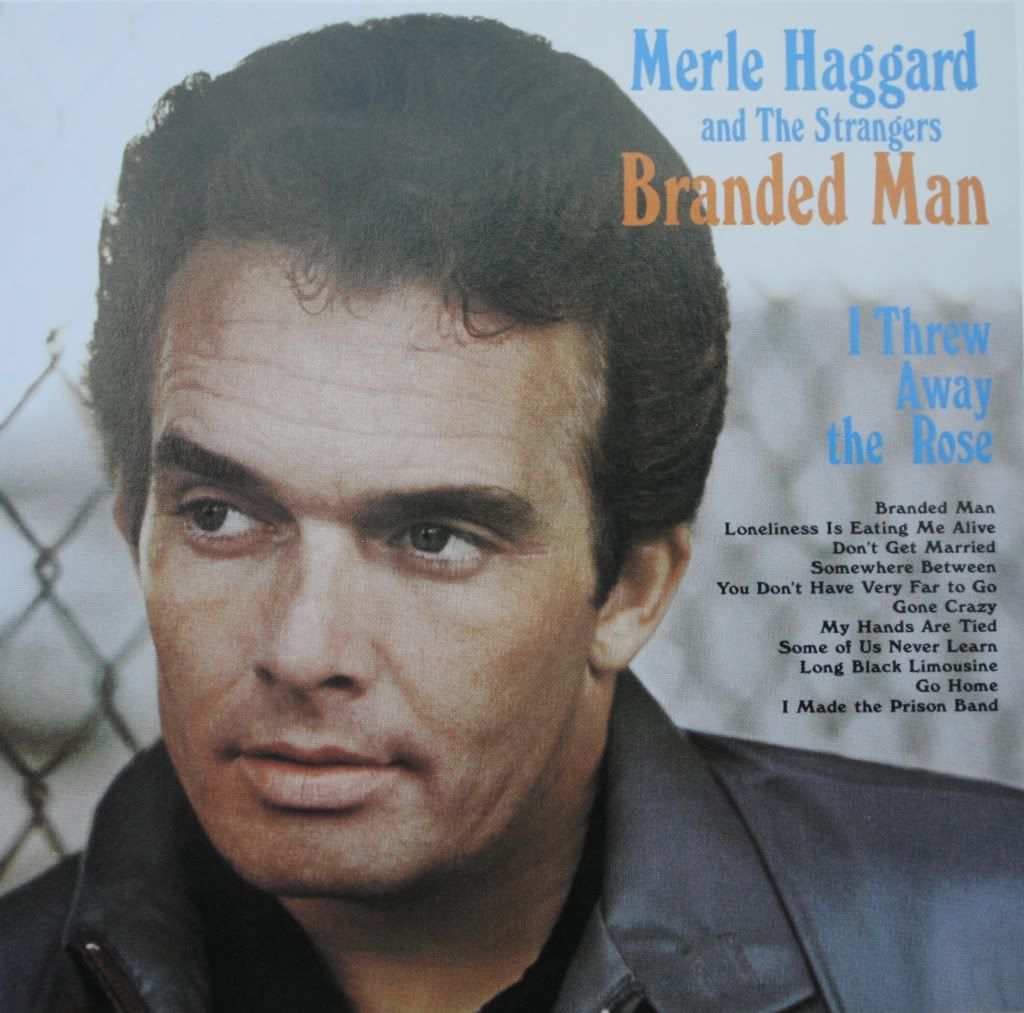
Merle Haggard - Branded Man


Yeah, that's right, there used to be such a thing as good country, and we're not talking about pill-popping tough-guy posers, we're talking about the guy who was in San Quentin for armed robbery when said legend performed there.  In spite of his heavenly pipes, Merle has always resonated with me because of his realism and authenticity--he writes and sings about what he knows, most often drinking, heartbreak and jail.

Branded Man was my first Merle Haggard album and still one of my very favorites.  Merle hits some glorious notes on this album both low (on "I Threw Away the Rose" and "Some of Us Never Learn") and high (on "Long Black Limousine" and "I Made the Prison Band").  A lot of these songs trade on the time-honored country trope of cheesy wordplay (a tradition that has somehow even remained in shitty contemporary country):  lines like "If you're trying to break my heart/You don't have very far to go" are glorious in their down-home cleverness, while elsewhere Haggard, referring to his past days of wine and roses, admits with a straight face "I kept the wine and threw away the rose."  There are many facets of this album's glory, from the track titles--some of which stand alone quite well--to the unbounded variety.  Merle goes from classic Bakersfield honky tonk to jazz to Spanish-flavored and back again in a very short time, and the Strangers have no trouble adapting to the style changes.  I swear, country music probably has the best session musicians out of any music genre.  Though there are a couple of driving Bakersfield numbers, I wouldn't mind a couple more.

Get the CD or MP3s here, on a two-for-one with I'm a Lonesome Fugitive.

Saturday, February 19, 2011

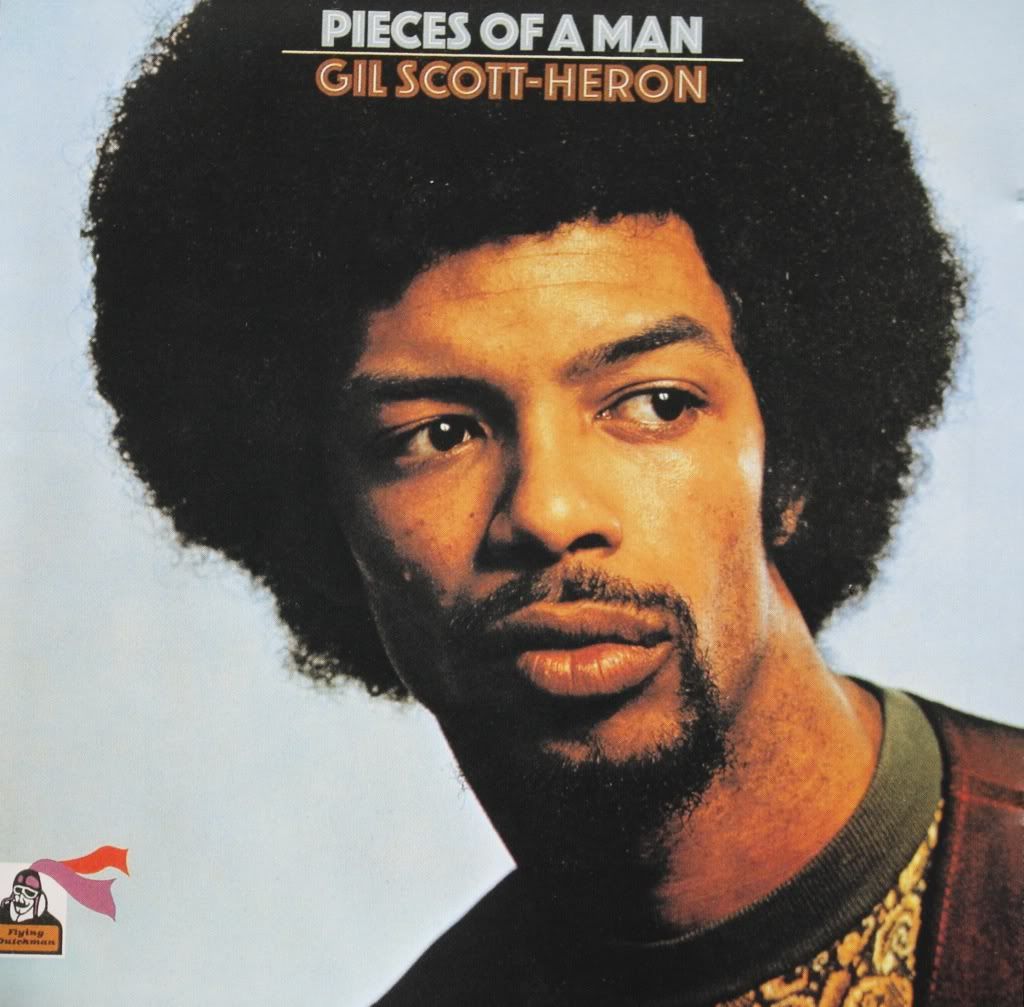
Gil Scott-Heron - Pieces of a Man


Although I've chosen some favorites to start off the review side of this blog, I'm unfortunately not completely in love with every album I review.  Not to say I don't enjoy this album, it's just too easy to describe the ways it doesn't fit with what I look for in this type of music and to list choices I wouldn't have made if I were the artist or producer.

Then again, it's pretty hard to fault the opening track--the one everyone thinks of when they think of Gil Scott-Heron--"The Revolution Will Not Be Televised."  This is the song people are thinking of when they say Gil Scott-Heron was the first rapper (or somesuch fanfare), and it's unarguably the freshest thing on the disc with Scott-Heron's rapid-fire, cutting assessment of black America's imperatives in 1971 (as he sees it) over funky drum and bass, supported by a jazzy flute.  This is one of those cases, though, where almost all of the album is totally different from the flagship song.

The rest of Pieces of a Man sees Scott-Heron considering the state of his fellow man, often through the lens of what he's feeling about himself.  On the one hand, it's fascinating from a historical perspective--it's clear that socially-conscious black artists in the early 70's were processing their world musically in a pretty different way than their analogs do today.  The problem is that none of the other songs here capture the wit or verve of the leadoff track.  Instead of using irony to prove his point with a bit of sting, Gil seems content to rely on relentlessly earnest exposition.

This problem could be thoroughly alleviated by the music; lyrics don't get much more severe than Curtis or What's Going On, but the orchestral sweep of both albums and the frantic, redemptive highs found on the former fill the words with a sense of gravitas that overcomes the seriousness of the words.  Here we get an organic (lots of flute), jazzy type of soul that seems like it would have already fallen out of fashion by 1971.  Now, that's an artistic choice I don't totally agree with, but there are issues here that go beyond taste.  First off, Scott-Heron's voice isn't up to the challenge.  There are plenty of vocally-limited artists I love: Allen Toussaint is one, and an R&B artist.  Whereas Toussaint plays to his abilities by singing simple, catchy melodies that present him as an endearing personality, Scott-Heron attempts to hit notes and run off on flourishes that he can't nail.  Moreover, there's a distinct melodic deficit in a lot of these songs--most have at least a hook or two, sometimes around the chorus, but the verses show a pretty distinct lack of attention--like he decided on the chords but didn't bother to think about which notes he was singing as long as they fit the harmonic structure.  Perhaps less important but still irritating to me personally is that, for someone who's reputedly strongest on the lyrical/poetic side of things, Scott-Heron also pays little attention to how the meter of his words fits with the rhythm of each song, running fast to fit words in too small a space or awkwardly stretching a couple of words to fill a blank space demanded by the rather rigid, unimaginative song structures.  You can't expect the artist to cover all of these bases every time, but a good producer would have at least found one way to tighten things up a little bit.

It sounds like I really hate this album.  Not so; despite the ill-fitting music and cheese ("When You Are Who You Are," "I Think I'll Call It Morning"), there are some moments where it gels and gets worked-up the way it should--"Home is Where the Hatred Is" conjures an appropriate dark edginess, and "Pieces of a Man" overcomes its Van Morrison lounge feel to do the words justice with a pretty solid vocal performance.  Overall, Pieces of a Man is actually a pleasant listen (I actually play it fairly regularly) and a pretty cohesive album, it's just that the unique promise and potential of the first track is nowhere to be found as the album progresses.  And that, my friends, is not a classic.

Get it here--out of print, but affordable on MP3.

Friday, February 18, 2011

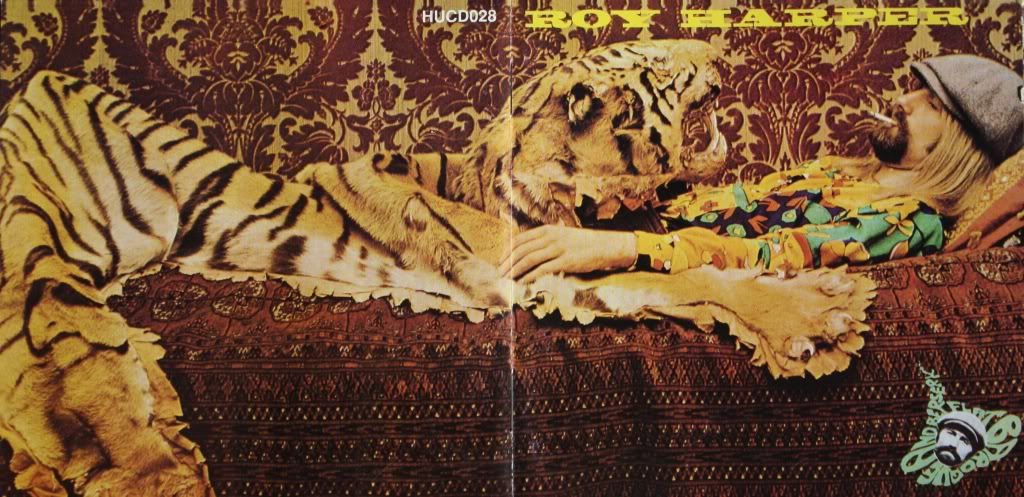
Roy Harper - Flat, Baroque and Berserk


Roy Harper's one of my all-time favorites, but that doesn't mean I think he's got a Midas touch.  Part of the reason why I love his music so much is because he wears his flaws on his sleeve--in many ways, he's made a career out of artistic as well as professional self-sabotage, always ready to nosedive with erratic behavior when a big break was on the way, and always quick to follow up an incisive gem of a song with a lewd throwaway.  Really, he's just like any of the rest of us, he just exemplifies what it means to be human to the utmost degree--the peaks of his greatness are shadowed equally by the troughs and valleys necessary to achieve that success, and the evidence is there in his songs and public personality for us all to see.  Part of great singer/songwriter music is coming to understand the person's deep personality, and Harper's got it in spades.  Like Robbie Basho, though, it's not always easy to hear and a lot of listeners have been turned off by his unflinching honesty.  As a songwriter, I think there's a lot to learn (obviously) from Harper's style as well as from his creative path--how his strengths have played out over a career and whether each of his experiments and artistic overreaches were worth the risk on principle alone, or when it's time to exercise restraint.  Then again, you can't win if you don't play.

Flat, Baroque and Berserk is Roy Harper's fourth album, and to me it's his first unqualified artistic success.  There are serious kinks in the first couple records with respect to production, focus and just how effectively his message is communicated, and the same can be argued of Folkjokeopus, but the blinding success of "McGoohan's Blues" still stands as a Harper classic and his first long-form triumph.  Here those issues seem to melt into the ether--gone is the dainty lo-fi folk rock of Come Out Fighting Genghis Smith (it's almost all acoustic guitar here, with the occasional acoustic wind instrument and one hard-rocker to break up the monotony), and the poetic confusion from Folkjokeopus' is trimmed away, leaving multifaceted yet economical poetry sung with Harper's very last breath--or so it would seem.

The instrumental arrangements are much simpler, showing off Roy's best guitar playing since his debut.  Snapshots like "Feeling All the Saturday," "Davey" and "Francesca" show a quietly intense mind working through mortality, aging and the (sometimes welcome) consequences of free love, and they're buoyed by Harper's distinctive fingerstyle.  Of course, his flatpicking style is equally as idiosyncratic, as we hear on the Jesus/Judas dialogue "Don't You Grieve" and the valedictory kiss-off, "Goodbye."  Even after all these years, the poetry on this disc still tantalizes--the inter-verse rhyming on "How Does it Feel" is fantastic, and there are numerous moments where he effortlessly pierces the shroud--a favorite of mine happens in "Tom Tiddler's Ground": "And you heard me say yes, but you know it's a guess/ Somebody else shouted 'No!'"

Yes, I'm aware I haven't even mentioned the obligatory mentionables--the gloriously ballsy "I Hate the White Man" was sort of an albatross around Harper's neck for years (listen to pretty much any live album to hear cries of "White Man!" from the audience).  Then there's the painful, smoldering resignation of "Another Day," graced by a really grand David Bedford string arrangement that prefigures his crucial contributions to Stormcock and Valentine.  Then, of course, the album closes with a hard rocking bang in  "Hell's Angels," where Roy's backed by (of all bands) The Nice (ugh...Keith Emerson...shudder).  While it's not quite as controversial as he may have intended, it's still a totally jarring close to a meditative album (see paragraph one) and his uncontrollable stoned laughter lets us know that the ride's only just beginning. 

Flat, Baroque and Berserk has a few less memorable moments ("Song of the Ages" in particular), but overall it's a pillar of the Harper discography and a refreshing album to return to when you want the good stuff but not the pomp of his mid-70's output.

Get it here, direct from the artist, or here.

Thursday, February 17, 2011

Robbie Basho - Venus in Cancer

Photobucket was scared of this photo and wouldn't let me upload it, because a naked woman = pornography.
This is easily Robbie Basho's most celebrated recording, most likely due to the tragic state of his legacy--it's one of only three (counting the fact that the entirety of The Grail and the Lotus is presented on the Guitar Soli compilation) of his original studio albums that's available today on CD.  Despite this unjust reality, Venus in Cancer is one of the better Basho albums, so we can at least be glad that what's out there does the man's contribution justice. 

In a lot of ways, I consider this album to be Robbie Basho's study in arpeggio.  Instead of the gale-force sonic flurry often heard on his earlier albums, here we get gentle, climbing guitar figures in which each individual note is audible and easy to savor.  For me, the two six-string pinnacles of Basho's Venus in Cancer style are the leadoff title track and "Kowaka d'Amour."  The former is a tentative, searching piece that sounds partly improvised--there's not necessarily an explicit melody, but the piece has an overall melodic flow and the mood progresses from mysterious to soaringly sublime at a majestic pace.  The latter song is like a darker, moodier shadow of the opener (perhaps like the astrological cover art suggests), with more of a minor, Eastern feel, but still an emphasis on space with a lot of the playing in arpeggio form.

Aside from these two brilliant solo guitar pieces, we get three vocal tunes and a 12-string instrumental.  It's customary--nay, obligatory--when writing about Robbie Basho to comment on his "love it or hate it" voice.  People love pretty guitar instrumentals, but they don't want to worry about weird.  Basho's vocal style is undeniably unconventional, but I'd argue that it's also tough to deny his ability.  If you can listen to "Eagle Sails the Blue Diamond Waters" without being moved, you've got a harder heart than I.  For me, it's not the timbre or style of Basho's voice that's an issue--I think it's marvelously unique, especially in combination with his guitar style--it's more of an issue with his poetry, which is often a bit florid (see "Wine Song").  But somehow, it all fits together here--I think "Song for the Queen" is one of the best realizations of Basho's combined guitar/vocal vision, with an aura of stately mystery that meshes well with the track's french horn and string arrangement. Out of the man's entire discography, I think the vocals work best here--far better than the less distinctive Basho Sings! and probably also even better than the vocal-heavy The Voice of the Eagle.  Regardless, Basho's vocals will probably always be bound turn off a number of those listeners who are merely looking for another John Fahey.  To the initiated, though, it's clear that Basho had a different purpose and for better or worse wasn't willing to go all-instrumental.

Venus in Cancer is a pretty good place to start with Robbie Basho--I still remember my first listen, standing out in the late summer sun painting a barn door, watching birds cross overhead and marveling at the man's passion and ability without really understanding the extent of his vision.  A lot of my favorite albums have taken years to fully appreciate, but I can still vividly remember that first unknowing encounter--this is definitely one of them. 

Out of print, but For sale used here.

Wednesday, February 16, 2011

This and That (The Piping of Earth)


` ` ` ` ` ` ` ` ` ` ` ` ` ` ` ` ` ` ` ` ` ` ` ` ` ` ` ` ` ` 
Adding, swelling
More in one spot
Growing, staying
Pretty much the same
Slowly, quicker
Helps if it's hot

At once--release!
In pieces small enough to have no name

Hurry, arms outstretched
Carry seeds of gold on uplifting fingers
Don't delay--to the weightless depths!
Peek with wonder
Fertile currents allow spring again!
You can know if you don't understand

Choosing, changing
Switching order
Sculpting, fleshing
Accidents become the laws
Encircling meaning
With a porous border

A shape is born!
The product falsely clarifies the cause

Hurry, arms outstretched
Carry seeds of gold on uplifting fingers
Don't delay--to the weightless depths!
Peek with wonder
Fertile currents allow spring again!
You can know if you don't understand


` ` ` ` ` ` ` ` ` ` ` ` ` ` ` ` ` ` ` ` ` ` ` ` ` ` ` ` ` ` 
This poem is about a dream I had--it was one of those dreams with very little action, but a whole lot of implicit meaning and impressionistic understanding.  I was facing a giant aquarium that was lit from the inside, full of tiny microorganisms floating around.  In the dream I remember feeling it was imperative that I get to the aquarium with what I was holding in my hands (which I knew was the beginning of a new life) so it could grow in the hot, fertile waters--and I wasn't the only one there ferrying life to the waters.

I spend a lot of In Not-Even-Anything Land trashing on our unqualified glorification of life (Hiding from Heaven and Dedicated... in particular), but this song celebrates the utterly inexplicable, microscopic transmutation that occurs when inanimate material becomes life.  Although I think we humans prize life as the ultimate good without giving much thought to the greater picture of the other amazing things going on in the universe, the beginning of life is a pretty amazing thing...just not necessarily better than something else. 

Among other things, the music experiments with ambiguous time signatures (for life's seeming randomness) and also with the guitar's timbre--I used a fine brush to play a hotly-miked guitar on the chorus to try and get ahold of the mysterious feeling the dream gave me.

New blog

With loads of help from my buddy Chelcie (take a look at her Etsy Shop) here is my new blog.  It's been an interesting but somewhat draining month playing around Seattle trying to get a couple of people interested in what I'm singing about.  With this new blog I'm planning to include a lot more writing about other people's music as well as hopefully get some YouTube videos recorded and uploaded in hopes of reaching a few more people who might be interested in the type of music I'm trying to make.  If nothing else, it'll keep my keyboard warm and it looks a whole lot better than the old blog.  Have a look around....Thanks again Chelcie!

Elliot

Tuesday, February 15, 2011

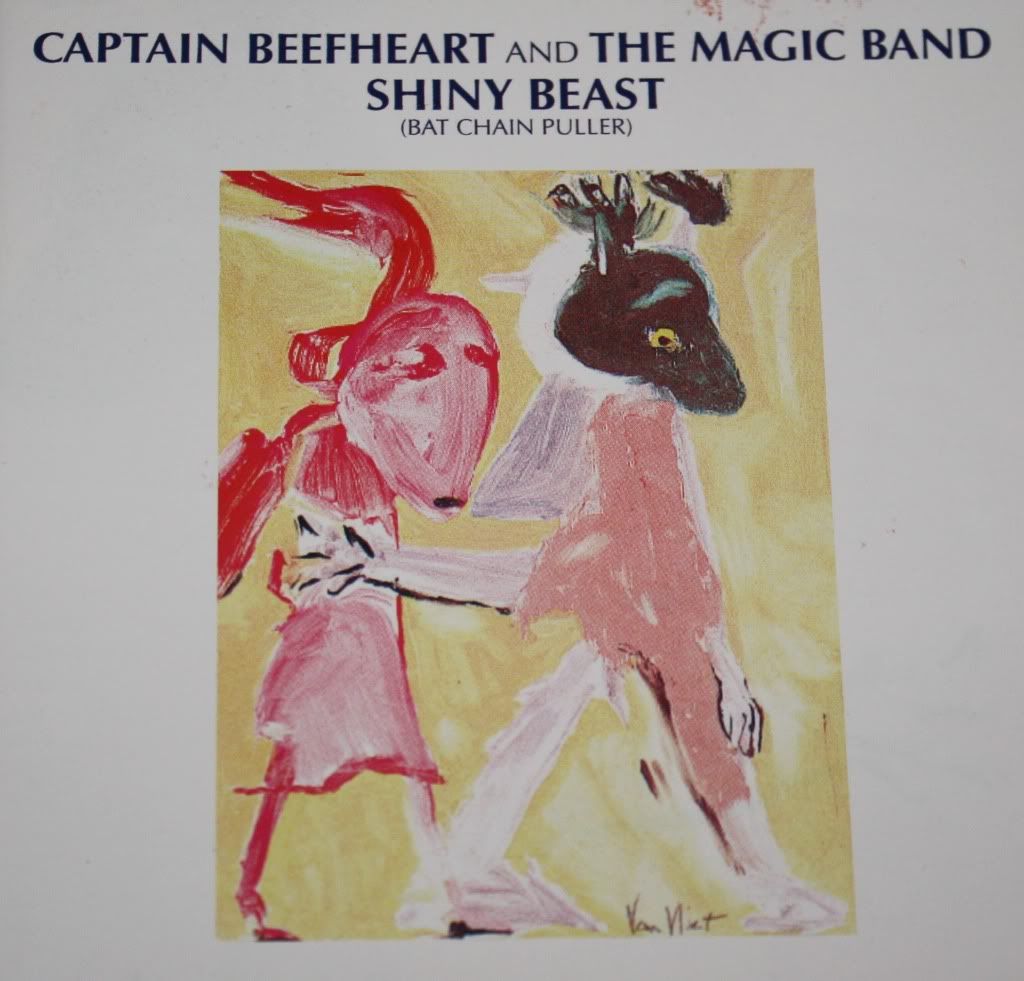
Captain Beefheart and the Magic Band - Shiny Beast (Bat Chain Puller)


I'm totally embarrassed to admit it, but I waited to buy the last three Captain Beefheart albums until last December when I heard Don Van Vliet passed away.  After all--two of them were recorded in the 80's, which has been proven time and again as the kryptonite decade for my favorite 70's artists, and even worse for artists who were great in the 60's.  Even albums hailed as creative comebacks usually come across as pale shadows of the artist's original glory.  Rarely does it felt so good to be proven wrong.

So, after they languished on my wishlist for a couple of years I finally have a chance to listen to the Captain's last three albums, and I'm kicking myself for not getting them sooner.  Shiny Beast (Bat Chain Puller) is easily the most accessible and mainstream of the bunch, but that's not to say it's anywhere near normal--a far cry indeed from Clear Spot, which has its moments but really toes the conventionality line in comparison with some of the material here.

What strikes me most about this album is how much I hear it echoing in popular music from the past 30 years.  "Tropical Hot Dog Night," with its horns and overdriven guitar, sounds like the blueprint for nearly every single Cake song ever recorded, "Suction Prints" prefigures the downtown sound of bands like Massacre, while "Harry Irene" sounds like the kind of made-up story that continues to be Tom Waits' bread and butter.  In appropriating the Captain's growl, instrumentation and general style, though, Waits comes across as grayscale to Van Vliet's technicolor--there's shit on here that I can't even imagine he came up with, like the buzzing and bouncing "Bat Chain Puller," the epic voyage that is "Ice Rose," and the grooving "Candle Mambo."  The instrumental palette is strikingly vibrant with horns, synths and even a bit of marimba which, on paper, seems like it would be too much for Beefheart's style.  Oh yeah, let's not forget the seemingly endless number of variations in Van Vliet's vocal timbre.  And don't get me started on the wild, scattershot intensity of his words...

Fans of earlier Beefheart will have a lot to enjoy here, too.  As always, he's still got a tight connection with the blues, as on the leadoff track and things like "You Know You're a Man" and "Love Lies," and there's enough mathematically atonal guitar interplay to keep Trout Mask Replica fans drooling throughout the instrumental passages.  Most of all, this album is a hell of a lot of fun--a comeback indeed!

Get it.


Saturday, February 12, 2011

Hiding from Heaven

Hiding from Heaven

Elbows gasping, nails bleeding—following electricity (whatever THAT is)

I fought my way out of a box to find myself in a bigger box
Then it hit me—it’s not about boxes!
They’re always collapsing—you’re always in the (W)ay

If you think you’re outside the box, then you forgot
The hardest rocks are the ones rattling round inside our heads--Dead!
I found you no longer breathing from your heels
But from your throat!

Each radical breath you take is speeding you to
The shallow grave your lungs are digging for you

It will be filled by a frail form that failed to feel the flailing madness

In the old days they called it ‘hiding from heaven’—back in the day
These days they call it “faith”

Ears sputtering, spine coughing—chased down by stars (whatever THEY are)
I sucked to empty self-fulfilling prophecies, filling my saintly virtue
Til the whole of my being leaked excess in puddles on the floor

What’s more—I awoke to find my “I”ness gone
In its place, a view through the eye of the storm

Can I trouble you to stop a sec, explain why death’s so bad
When everything that ever lived on earth is dead except for this now

Huh? Huh? Don’t make me laugh!

You reek of a living way of thinking, stinking of “human first”—“life as good”

You’re clawing forward as you fall back instead of graciously giving yourself to
A deep grave, gallantly going on with the great game, gulping gutfuls of ground
Grasp the gatekeeper’s grip when you gasp in a new way

In the old days they called it “hiding from heaven”—back in the day
These days they call it “salvation”


` ` ` ` ` ` ` ` ` ` ` ` ` ` ` ` ` ` ` ` ` ` ` ` ` ` `

Before I launch into what’s likely to be another tiresome rant, let me just comment on that very subject. This is the reason I love and MUST practice music and songwriting. You can discuss these things with prose, but you’ll never achieve the thrill of understanding the same (or many more) ideas from only five, well-chosen and aesthetically appealing words. You can write poems about these ideas, but you can never feel the same sublime, soaring feeling or crushing weight without the addition of music and at least one singing human voice. There’s something irreplaceable in that combination, and the coalescence of popular music’s conciseness and accessibility with high art’s depth, audacity and range of emotion is dizzyingly intoxicating—a vein that I can see myself mining for the rest of my days. So, I’ll try to explain myself in these entries, but only for those interested in a different perspective on the sounds than they’ve already provided themselves, and also, personally, to help me understand what I actually think myself.

Out of these 11 songs, “Hiding from Heaven” is unequivocally my baby…a “Rosemary’s” baby of sorts, but no less loved for it. Ever since it began its 2+ year gestation period on the back patio of the farm as an enormous, serpentine, wonky poem, this song has constantly harassed my thoughts. It took two years before I had fit the entire asymmetrical shape of the poem to music, and when it came to recording, “Hiding from Heaven” was the first song I started in November and one of the last ones finished in early April (most of the songs took 1-2 hours to mix, this one took over 4). A lot of thoughts were expended on how best to translate the booming din I’d been hearing in my head into a thing of dark, terrible majesty (insert “yeah, Elliot, it really is TERRIBLE” joke here) and you can rest assured I started feeling sympathetic pangs of the song’s professed madness in the process.

Musically, the song is a culmination of a large number of influences, tempered with a sense of my own personality. Despite its length, the song moves quickly and often abruptly between different musical sections—from the dissonant and odd-metered intro to the spacious first vocal section, the proggy breakdown, etc. I’ve tried my hardest to populate this song with guitar riffs and leads that other players will appreciate, but also that don’t tread the same ground too many times, playing with the song’s themes, dissonance, listener expectations and musical styles. A lot of these parts didn’t seem humanly possible when I started attempting takes, so hopefully that’s a good sign…most importantly, though, they strive to support the song’s overarching ideas. This principle has been crucial for all of these songs, but “Hiding from Heaven” required even more reaching on my part to bring the ideas to fruition—I used (but by no means invented) a few different techniques to get uncommon sounds out of the guitar. The eerie sustained notes at 1:45 are produced by a rubbing/tapping a steel slide on the strings; the single notes with the high-pitched texture around 3:10 come from scraping the pick perpendicularly against the strings windings instead of plucking. Finally, I couldn’t have realized my ideals for this song if my voice hadn’t gotten better. The theatrics you already heard in “No More” are turned up a notch in so many ways and the emotional brunt of the poem required a number of different singing styles and moments of strangeness and wildness to illustrate its intensity. I mention all of this out of a sense of accomplishment, but also to give you an idea of just how obsessively hard I worked to make this song sound how it does.

Lyrically, this is a long and complicated song. It’s heavily influenced by the ideas of and uses a few images from the ancient Taoist text, the Chuang-Tzu to illustrate a feverishly personal mind journey. You know you’re in for a fun time when a song starts with sensory dissociation and disbelief in such “comprehensible” and “tangible” items as electricity and stars…teetering on the edge. The one thing I keep thinking of when rounding up my thoughts for this note is Thomas Paine’s revolutionary “Common Sense” pamphlet—“Hiding from Heaven” means ignoring common sense—the way things simply are—attempting to circumvent demonstrable reality in favor of a coddling lollipop philosophy that panders to our most selfish indulgences. In my opinion, the major religious traditions offered in the world’s marketplace today offer solutions to undeniable human needs that insult our progress as thinking beings. Despite everything our science, art and long historical record has shown us, the best we can come up with is still an anthropomorphized “god” who created everything and will reward us with an eternal “after”life that fulfills all of our creature wants and pacifies all of our living fears—that is, only if we follow the arbitrary system of morality in the book that He (never She) wrote! Please! First of all, our infinitesimal scientific knowledge about the vastness of the universe, physics and biology here on earth demonstrate that a human-centric vision of the universe is a laughable proposition—on top of that, an omnipotent god that looks like a human and any system that is so clearly tailored to compensate for and satisfy human-only desires can only be human creations. Secondly, the justification for this system can be distilled to just one element—fear: fear of not having enough to eat, fear of physical pain, fear of losing loved ones, and fear of the inexplicable experience of death. These fears are entirely reasonable aspects of the human condition, but I think that we, as thinking creatures, deserve a better response than the utter fantasy that is fed to us by the religious institutions who can’t see beyond their own experience of power. There are currently a lot of social and environmental threats to our human world, but we can’t fight them effectively if we don’t address the fundamental ways of thinking that spawn them.

In spite of the above, this song isn’t merely another attempt to tear down organized religion—all you need for that is a bit of common sense, and it’s been done eloquently and effectively many times in the past 200+ years, regardless of whether or not the masses have climbed on board. Rather, it’s an attempt to address the same base human dilemmas in a way that takes into account our current advances (which should be obvious enough to be taken for granted) and reaches beyond to the unknowable to postulate a meaning—a rational mystic’s rally call. Sure, it’s much more difficult than jumping through moral hoops for a pie in the sky, but it’s ultimately a lot more rewarding and realistic.

Achievement of this sort of reconciliation not only requires abandonment of the status quo, but also engagement of our mystical potential (see “Head in the Clouds,” which also cautions against over-rationalization)—it requires intuitive experience of the Tao—(a descriptor for) the ineffable, indescribable, incomprehensible, inhuman, infinite and chaotic way the universe operates and is. For me personally, this process was a turbulent one that included several points of despair. When it comes to conjuring visions of the holistic nature of the universe, there’s a fine line between despair and ecstasy—easing the attachment to the knee-jerk ego response and ultimately abandoning the arrogance of any sense of human importance in the universe eventually replaces fear and despair with serene calmness and even sublime ecstasy. It’s not the human that takes first place, but the awe-inspiring, all-inclusive storm of the universe, from which we’re kidding ourselves if we say we’re separate. Death of a living organism is just one of incalculable aspects of the universe, and seen in such a vast perspective isn’t very dramatic at all. As the only living creatures (we’re aware of) that have the ability to contemplate the void, death is less of a loss of our beloved senses to be feared, and more of a reunification with the one to be anticipated when the time comes—to me a concept much more empowering, exciting and “other” than an eternity of sensory fulfillment on a cloud. So, despite the song’s foreboding atmosphere, the message is ultimately a positive (if challenging) one. Oh, and just remember—these are all opinions.

There, I finally got some ideas across without explaining the song line by line! I am pretty satisfied with the aesthetics of this song, though, and if you’ll indulge my hubris I’ll mention a line that indicates the layered detail that went into the word choice for the whole poem: “I sucked to empty self-fulfilling prophecies, filling my saintly virtue/till the whole of my being leaked excess in puddles on the floor,” which can be variously taken to mean “I sucked” (in the parlance of our time), “I sucked/latched [on]to self-fulfilling prophecies that were empty,” and “I sucked self-fulfilling prophecies until they were empty.”

Not sure how much I like this professor Elliot…luckily tomorrow’s song doesn’t require his services in the least, and he won’t be coming back in this capacity any time soon.

Wednesday, April 28, 2010

Chained and Bound

I know you make a little money—but you owe it faster than you can
‘Cause you’ll buy anything if it fits into your little plan

You like and tell me that I’m better than anyone you’ve found
You’re gonna have to do it all yourself as soon as I’m not around

I know that you only want to keep me where I am
You don’t even notice you’re chained and bound

I know you’ve got expectations ‘cause you think there’s some things that you know
And you want me to shut up and agree there’s just one way to go

I can’t hear the words ‘cause I don’t like the way that they sound
When you tell me that I’ve crashed before my feet have stopped touching the ground

All you can talk about is money and what makes it grow
You forgot what it was like before you were chained and bound

------------------------------------------------------------------------


If one of these 11 songs is the “single,” it’s got to be “Chained and Bound”—concise, punchy and accessible, it’s even got a couple of hooks! If I ever describe myself as something like an “experimental singer-songwriter,” it’s not because I think I’m creating something that’s never been done before, but more that most songs are experiments—attempts to do something specifically musically, lyrically or both that I haven’t done before. When composing the guitar parts for this song, the idea was that the song would combine more aggressive proto-punk-style (out of my comfort zone) power chords with some more progressive elements (right up my alley). The moody, faux Graham/Frith (80%/20%) intro gives way to power chords with additive rhythms and between the verses is a loopier instrumental section. I’ve never played this song live—I probably can, but it’ll be a challenge to keep the wonky changing riff lengths straight with the vocals. It was pretty fun to finally hear the ideas come to life when I assembled everything together in one day of recording—probably some of the most efficient work I did during this whole project. I’m pretty happy with this one, although the progressive elements aren’t quite as noticeable audibly as they were in my brain.

The lyrics are pretty aren’t meant to be too poetic on this one—more economical and attitude-oriented, not to mention extremely personal. This song is an aggressive “fuck-you” to the forces within and without that try to break concerted resolve. The first verse addresses the issue of imposed inertia and the second addresses the sort of reasoning used to talk people out of pursuing more important priorities in favor of safer, more mundane comforts—a kind of sneering affront thinly disguising a desperate plea for acceptance. See you tomorrow.

Tuesday, April 27, 2010

She is kind and beautiful/I am young and strong

I feel strong. I've spent almost six months recording 11 songs (55 minutes) and the entire process has been overwhelmingly positive and empowering. The past four years have actually been pretty turbulent ones as far as my creative musical life is concerned--in 2006 I started to change the style and approach of my songs. Through the summer of 2007 in the creative shelter of my aunt and uncle's farm my new intended direction began to be realized as a collection of lyrics and compositions that fit my new standard started to grow. I started a recording project at the end of the summer that split some of my more conventional songs with some of my newer, more experimental and complex songs. Unfortunately, the project was never completed before the deadline for my move to Seattle fell--in addition, during the process of recording I developed health issues with my throat and vocal chords (a very long and tedious sob story) that effectively prevented me from singing until some tentative attempts in 2009.

The intervening years have been really difficult for me both as a musician and generally as a person. My intention was to pursue music as soon as I moved to Seattle, and the last few years haven't seen much progress in that direction. At first I made attempts to continue writing and composing despite my inability to sing properly, but eventually the prospect of writing songs I knew I couldn't sing had a debilitating effect on both my work and my spirits. My self confidence hit an all-time low--there I was claiming that songwriting and performing are my ultimate passions, but I was doing next to none of either one. I often felt like a complete sham and doubted any ability in which I may have believed in the first place, and my depression negatively affected all aspects of my life.

After trying multiple marginally helpful solutions for my throat, I made a concerted effort to pit my resolve and so-called passion against my health problems and the subsequent disabling psychological effects of which I'm still embarrassed and ashamed today. I performed at Miro Tea last June for the first time in over two years at my dear friend Courtney Morgan's art opening, and since then my throat issues have mysteriously subsided enough (I may never know why, but I think it's a combination of the steroids the doctor gave me and strength I gained from practicing in safer, more effective ways learned from some speech therapy I took during my many different treatments) that I also performed at a number of other small and unpopulated (except for my generously supportive friends and family) venues before deciding that in order to properly convey the songs that I'd been developing in my head, I needed to fully-realize them in the form of recordings to supplement any live performances I may do.

So, I holed up in the living room end of our apartment in November with the intention of recording a handful of songs to fill up my MySpace and Facebook, promote myself to potential venues, and maybe even send to a record label or two. In truth, I didn't actually even know how many songs I was going to have until putting the finishing touches on the files a couple of weeks ago. Recording has been a long, difficult, but ultimately cathartic and rewarding process. At first I was often haunted by the familiar crippling lack of productivity that plagued my last two years--the limitations of my recording equipment, abilities as an engineer and producer, and often as a guitarist frequently conspired to block my momentum--I remember a few dark days of unsuccessfully playing the same 30 second fingerstyle guitar part over and over, still unsatisfied that the sounds didn't match the ideas that had been bouncing around my head for two years. Things picked up, though, after a visit with some friends in Mexico restored my belief in pursuing what's really important to me--no matter how little free time I have. My time management skills sharpened to an alarming degree and I've obsessively spent as much free time as possible in the last 3 months working toward my goal.

The closer the project has come to completion, the happier I've been with both the results and with my decision to do the whole thing in the first place. I've had the chance to present songs I've performed live in a form that more completely represents the concepts and sounds I've been hearing in my head for the last two years, and I've also had the chance to record a couple songs that I've never played live--hearing completed productions of songs that have only existed as plans and concepts in my head and on paper has been thrilling and intensely fulfilling.

So, at the end of this recording process, I feel strong--not only do I feel that my songwriting, poetry and guitar playing have made immense progress and become more sophisticated and distinctive in the last four years, my damaged throat not only met the challenge of recording, I feel like my singing is the most technically proficient and nuanced it's ever been. My original intentions have been supplemented with a desire to actually produce a CD--I feel that the recording quality is adequate and that the works are fully-realized enough to press onto a physical medium. My current plans are to select a number of these 11 songs as well as record a couple more early this summer and have them professionally mastered (which should make a demonstrable difference in sound quality). I'm so enthusiastic about the accomplishments I've made I'm already thinking forward to a second album, but there's no need to get too far ahead of myself!

Although I feel strong, let's not confuse strong with confident--the progress I feel I've made as a songwriter and musician over the last few years has remained largely an introverted, personal transformation that I feel like I've failed to effectively show (as opposed to tell) to anyone. Though I've eagerly devoured more new music in the last 4 years than all the previous years of my life combined, I've shown precious little evidence of the effect it's had on my approach to songwriting and playing. Now it's time to relax my grip on my music and share it with other people, which is a frightful proposition--I've had very little feedback on my music in a few years and I'm quite nervous, but not enough to keep the fruits of hundreds of hours of work to myself.

Now that the back story is on the table, it's time to start presenting the songs--one per day for 11 days. As I mentioned before, about two-thirds of these songs are intended for an album. The rest either didn't fit with the planned collection of songs or I recorded them just for fun to include with the other, usually more serious compositions as 'palate cleansers.' There are also two songs that were partially recorded in Walla Walla in the summer of 2007; I'll go into more detail about each song as I post the recordings and lyrics. I physically made all of the sounds on the songs, and almost all the instruments are acoustic (only excepting some electric guitar on "Ghost in the Machine," I think). I'm satisfied with the quality of the recording, but when I eventually produce a quality CD, I'm hoping to fund a professional mastering job, which will match the volume levels between each song and smooth out the general sound and balance, hopefully eliminating any of the slight distortion you may hear, especially in the EQ department (Bass/Mid/Treble) department, of which I've only done a poor-man's job for these songs I'll be posting. I sincerely hope you get something out of the songs I've produced, and it's my greatest pleasure to finally share them. Here they come...

http://www.myspace.com/elliotknapp
http://www.facebook.com/elliotgknapp
http://twitter.com/elliot_knapp

Saturday, September 5, 2009

Tough Love

Shut yourself in a dark room in the daytime
Fill it with your own oppressive smoke
Your eyes will water--really you're just self-blind
Better realize it's you before you choke

If you're not happy, do something about it!

So you stumbled on a tripwire that you strung out
When you promised everyone you had control
And you fell into your pride now you can't get out
Until you return to yourself the time you stole

If you're not happy, do something about it!

You say the world is just a darkened mirror
You can't see anything that's worth your sweat
It's only you and you don't know what you're here for
Well, if you're all alone, then alone take your first step!

If you're not happy, do something about it!
You have to see: you're the one who can
You have to be more than just a plan

And you medicate yourself with words and plans to fix yourself
But those pills are blowing clouds across your eyes
You slide into bed thinking that you're really doing well
Forgetting that you haven't even tried!

I'm sorry that I couldn't fix your problems
I can't accept the gift of all your grief
Once you climb a person, you can't be down there with them
I can't move 'cause I'm buckling underneath

If you're not happy, do something about it!
You have to see: you're the one who can
You have to be more than just a plan

------------------------------------------------------------

My mom recently asked me if I ever planned to post any happy songs, so here's one with an explicitly positive message. Real life is real life, though, and most ideas I end up writing about are at least touched by trouble. Sorry!

To my memory, I've only performed this song once, at a Whitman Coffeehouse in 2006. Revisiting the words, I'm pretty happy with the flow, straightforward economy, and a few nifty bits. But the music is straightforward and poppy, especially compared to the kinds of stuff I've been working on recently, so I don't know how well it'd fit. Recently, though, I've been thinking more about how a lot of artists these days obediently accept the conventions of a single genre, which can get a bit boring, unless it's really well done (I think I was reading a review referencing the eclecticism of the Al Kooper-led Blood Sweat and Tears album Child Is Father To The Man). Then again, you can't be too eclectic--you've got to have a recognizable sound, and there's danger of becoming a jack-of-all-trades, master-of-none. Getting way off track here.

Not too much going on that can't be gleaned from reading the words. Mostly it deals with those times a person (sometimes myself, sometimes others, as is often the case) spends more time lamenting problems, feeling sorry for oneself, and rationalizing depression by blaming others when the only real solution is taking responsibility and owning the agency to improve the situation. The side note in the bridge is the maddening practice of "OK, this sucks, I'd better do something. Wow, it felt good to admit that--I'll get around to dealing with the problems tomorrow, maybe." Meanwhile, time passes.

Maybe I'll resurrect this one for the next gig.

Thursday, August 6, 2009

The Rules Are Changing

Naked soil, barren earth
The sun is shining down for what it's worth
Writhing field, funny crop
Flailing, scrambling just to stay on top

Full and fat today by forcing fields to fallow
Bodies pressed together meet a hungry end tomorrow

The rules are changing

Chasing blackness, dripping gold
Guiding sparks inside the things we hold
Making journeys sitting still
Entrusting labor to an easy fill

Speeding South today by spinning wheels with smoke
Tomorrow journeys screech and halt as fires cough and choke

The rules are changing

Sweating earns phantom power
Trading numbers for a safer tower
Rules are set, deals are made
Symbols printed, everyone gets paid

Paper notes in piles today make bags and pounds of plenty
Tomorrow numbered paper just won't fill a mouth that's empty

The rules are changing

------------------------------------

A pretty straightforward song. It's probably not inaccurate to say that overpopulation is at the root of almost every major problem facing the human race, and the curve shows no signs of tapering off. Unfortunately, food and energy aren't unlimited, and there's a good chance many of us will live to see serious crises on both fronts. If we do, the things we take for granted (labor made easy with the help of cheap power, cheap and abundant food) will be even harder to come by than they already are today (for much of the world's population, that is). In that kind of situation, the basic economic system (money=goods or services)--in which we all have so much faith--could poof-be-gone like the illusion it truly is. At that point, I'm not sure exactly what the rules will be (Cormac McCarthy's The Road might be onto something), but they're sure going to be different. What can we do about it? I wish I knew. The head-in-the-sand status quo doesn't seem to be doing us many favors. This song has music but something's missing--it might just be too straightforward or too unrelentingly dark, but I do like some of the words and the rhythm. I'll see what I can do. Meanwhile, please enjoy this tea-stained lyric sheet.

Monday, August 3, 2009

Head in the Clouds (Clarity)

Head in the clouds
Vapor zones
Blurry edges--hazy borders
Escaping capture
Disappointing grasping fingers
Established ghosts mock expectations
With the unquestionable touch of rain

Head's in the clouds
Feet not far below
Dangling out of touch with something solid
On the ground, with sense consensus
Is the ideal position
To stage the tired compulsory spectacle
No choosing--celebrate the magnificent piles we've made!

Head in the clouds
The inevitable diffusion
Viewpoints equal, denominators common
The skies--now--the only show--one!
Shield your eyes with illusion now, you'll see it later
Or stare now while you can feel


----------------------------------------------------------------------

I'm in the process of setting these admittedly abstract words to music; sort of a dreamy but insistent guitar part with some tone painting and a growing between-verse guitar line that splits into R and L stereo channels for some hopefully interesting psychedelic interplay. We'll see. It'll certainly be difficult to realize by myself in a live setting, but the sound of the recorded version is already pretty well-formed in my head.

Since I'm trying to babble less extensively about these words, here are a few way markers. The song uses the familiar figure of speech "head in the clouds" to evoke the battle between abstract, mystical, imaginative thinking and extremely rational, cause-and-effect, score-keeping thinking. The first verse illustrates the mystical process--reality clearly exists as a force to be intuitively experienced, but its purpose is unclear--you can't deny the feeling of rain, but the abstract idea of the process of rain forming in the sky is difficult for the human mind to comprehend and express. Verse 2 more disparagingly refers to the rational denial of those types of thinking ("Get your head out of the clouds!") in favor of peaceful interaction with the rational world we strive to create for ourselves in human society (i.e. the "magnificent piles we've made," which is probably one of my more venomous images for the status quo). The third verse asserts that large, abstract and greater-than-human processes are at work whether you want to bury your head in society's sand or not. Ironically, the two viewpoints aren't really mutually exclusive, though today's world seems to have a large enough body of rational evidence that many people seem uninterested in contemplating what's going on beyond the reality that is immediately affecting their personal worlds.

Thursday, July 30, 2009

On Sacrifice

Hand on my shoulder
You rocked me awake, gently
I knew I was struggling
I knew I'd grown older
You reached for my hands when they could only take
And you showed me that everything's good when you give it so free

Then you made me afraid of what you might do
You scared me so badly

Loving me
You remade my eyes--clearly
Colors, faces, reasons for living
That I couldn't see
You poured out your love and you sang to the skies
And you brought me to life when my future had died--nearly

Then you twisted in rage and cut me down
Clutching my face, dragging me closer
Mocking my past--pushing my future
Taking your gifts, refusing to leave
Slitting your throat to save my life

----------------------------------

An exercise in surprise; exaggerated happiness undercut by sudden ugliness. This song comes from a difficult, painful place. I'm arranging it minimally; a far-ranging vocal melody barely accompanied by some guitar. As far as surprise goes, it should be fairly effective in performance.

Monday, July 27, 2009

No More (In the World of Men)

I come from a home where the guns are cocked
The book is open and the safe is locked
Wide open spaces are holes to be filled
Babies just breathing await to be billed
Diseases and difference just need to be pilled
Everyone pays when the black stuff gets spilled

You don't need to ask questions when the answers are wrong!
You just get us excited when you talk about change
Can you really change a habit when you've had it this long?
We think we need ideas, but we need something strange...

I see what you're pushing and I've seen it before
NO MORE!

I come from a home where the end is near
The walls are thin and the pace is fear
I live in a place where the past is a tower
The purpose is fluid and the illusion is power
Senses are gods and they won't be ignored
Your rights and your wrongs will be tallied and scored
Life is one exit and it's got to be doored
The food chain got topped and we're really just bored

You don't need to ask questions when the answers are wrong!
You just get us excited when you talk about change
Can you really change a habit when you've had it this long?
We think we need ideas, but we need something strange...

I see what you're pushing and I've seen it before
NO MORE!

NO MORE
NOT AGAIN
UNREPEATED
AGAIN-LESS
NO MORE TIMES
NE PLUS PAS
FREE FROM REPETITION
NON-MORE
IRREPEATED
UNMORELESSLY
NEVER ANOTHER EXTRA TIME IN THE FUTURE MORE AGAIN

------------------------------------------------------------------

Get ready for Elliot 2.0, the guy who actually updates this blog regularly. This surge is what we need! This is a favorite of my newer songs--in my endless questing after good music, I've come to realize that the songwriters with the gravest messages come across more effectively when their seriousness is not all-encompassing and is sometimes leavened with appropriate doses of irreverence or, at the very least, scornful mockery. So, I try to keep the humor principle alive, especially since it's a large part of my non-music life.

Looking back on my past postings, I realize I've tried to write too much after every song, mostly in fear that nobody really reads poetry analytically these days. That may be so, but it's probably best to explain less and hope someone can appreciate the serious brain sweat I've put into this stuff just from reading (or later hearing) it. Henceforward, I'll strive to annotate less.

This song is pretty recent and was set to music quickly after being written. It's been a favorite of mine because I'm very happy with both the images used to describe our society, and also the way the words flow with the music. This song is a resounding rejection of the same rhetoric, list of problems, ways of thinking, and list of solutions we've been force-fed from every angle for as long as we can remember. Bullshit! Instead of a repackaged version of what we've already heard, seen and done, the only thing that's going to provoke actual """"change"""" is something known to the English-speaking Buddhist world as "expedient means"--a shocking, strange but simple event that grants deep and profound insight. Unfortunately I'm not sure if this is really possible on a large-scale level, since I've mostly seen it happen on an individual basis. Here's hoping. Something like the sudden worldwide absence of electricity or food might do the trick, but it's also likely that by the time those eventualities come around we'll not be in a very efficacious position as a species to act on our new insight.

More incoherent blathering:

The format exhibited in “No More” is a big aspect of my current MO: a bit longer, more of a dynamic range between loud/soft and fast/slow, with a sense of drama, and with the music often attempting to conceptually illustrate the poem. The song’s in an open guitar tuning---DADGAD (thanks Davy, thanks Roy); you’ll get to hear me bust out some lead guitar and also a bit of slide (more of that later).

The words focus on the peculiar state of the modern human condition—I’m not sure we think very often about just how different the experience of our lives is compared to 100 years ago, or maybe even less. I think our arrogant fascination with some of our civilization’s “advances” denies some of the types of favors we’re not doing ourselves in terms of our longevity as a species and the quality of experience we reach as individual human beings.

Revisiting and re-singing these words over and over for recording, I’ve been pretty satisfied with the fulfillment of my vision for this song—the verses start with one poetically-dense stanza where the lines ideally contain layered meaning (“I come from a home where the guns are cocked” is supposed to represent our violent nature, but also the underlying male/penis connections when it comes to aggression and guns, or “I live in a place where the past is a tower” is meant to illustrate one of the primary human characteristics that sets us apart from other animal species—we have a continually-growing collective record of history from which we all [more or less] benefit, but also the fact that our pride in that history and our accomplishments has given us a sense of superiority over our surroundings that is causing us untold problems). I don’t want to insult anybody’s interpretive abilities, and the meaning of poetry is also meant to be determined by the reader/listener, but for those interested I’ll fill in some more blanks further down after the lyrics—I also use these notes as an opportunity to process my work personally.

The second halves of the verses are more direct observations, and the chorus concludes that our inertia is great enough that we won’t be able to use our own tools to solve our problems—to really wise up and overcome ourselves, we need some sort of catastrophe to act as an “expedient means” for immediate understanding. This song is a rejection of the stale political solutions (even attractive, eloquent liberal ones), ways of thinking, and ways of thinking, speaking and communicating that bore me to death on a daily basis. The refrain at the end mocks this repetitiveness with a little bit of humor…something from my personality that doesn’t get a chance to show up quite as often in my more serious songs as I’d like. Hopefully it leavens the heavy message a bit. If you’re still reading, you’re either procrastinating from something more important(!), of maybe you’re my biggest fan…tomorrow I’ll do something a bit…quieter.

More notes:

“The Book is open” is about how the different religious scriptures often dominate our behavior as a species in questionable ways, but also that the interpretation of these texts is “open,” and people will always bend them to their own predetermined rationalizations regardless of the texts’ supposed authority.

“the safe is locked” has to do with the effort we expend on gathering and protecting material wealth, but also that our wealth is inaccessible to a great deal of our population.

“I come from a home where the end is near” details the irony between the perennial crisis many religions have been perpetuating over the past 2,000 years about some god catastrophe being imminent and the more measurable ways that the end of our species and civilization is threatening.

“The walls are thin”—our technological and governmental advances mean that our privacy is sacrificed daily, and also our gross overpopulation means that you can hardly turn around without bumping into somebody else.

“The pace is fear”—find me a more common motivator for human behavior.

“The purpose is fluid”—we’re so adept at shifting our reasoning and convictions to suit our wants that we can’t even separate our true wills from our own hot air, and let’s not forget—the whole basis of our tenuous living existence on this planet is fluid—water.

“and the illusion is power”—illusion might produce tangible power more often than physical force (just watch the news, and I’m not only talking about FOX), and also the power we think we have over our lives, over each other, over our actions and over our physical habitat in the long-term, is ultimately a laughable fallacy. 

Saturday, March 14, 2009

Box Elder (Virtue Complete)

You're out of order!
At least, any order I can see
You don't even know why you do the things you do, but you do them!
Ugly, even hideous in eyes that fail to see beyond near sight

Slender branch no good for burning
growth not quick enough returning
winding trunk too bent for planing,
and a grain unfit for staining
Not worth chopping, stopping interest
in your wisdom buried deep
asleep

Bend in a breeze you don't need to understand and
if you break, it's ok.
Bending, breaking, who decided they were different anyway?
You never know; you feel
Everything imaginary, everything is real

You sprang from a great clod
You sprang, an unhewn log
You sprang from yourself!

The laws that you obey change with the wind
As soon as you begin the old rules blow away
but you don't mind

Action is overrated; supple reaction makes for taller growth
Growing toward a fall
Falling to the sky

When they think they know what's good
they will cut you down to make room for square plans
Plans that stand til wind blows
Plans based on good that is not bad
With an end that is not beginning
Because they know when they go they do not return
When they are gone for good you will begin
from end anew

Bend in a breeze you don't need to understand and
when you break, it's ok.
Bending, breaking, who decided they were different anyway?
You never know; you feel
Everything imaginary, everything is real

From the In Not-Even-Anything Land CD Tray

` ` ` ` ` ` ` ` ` ` ` ` ` ` ` ` ` ` ` ` ` ` ` ` ` ` ` ` ` ` ` ` ` `


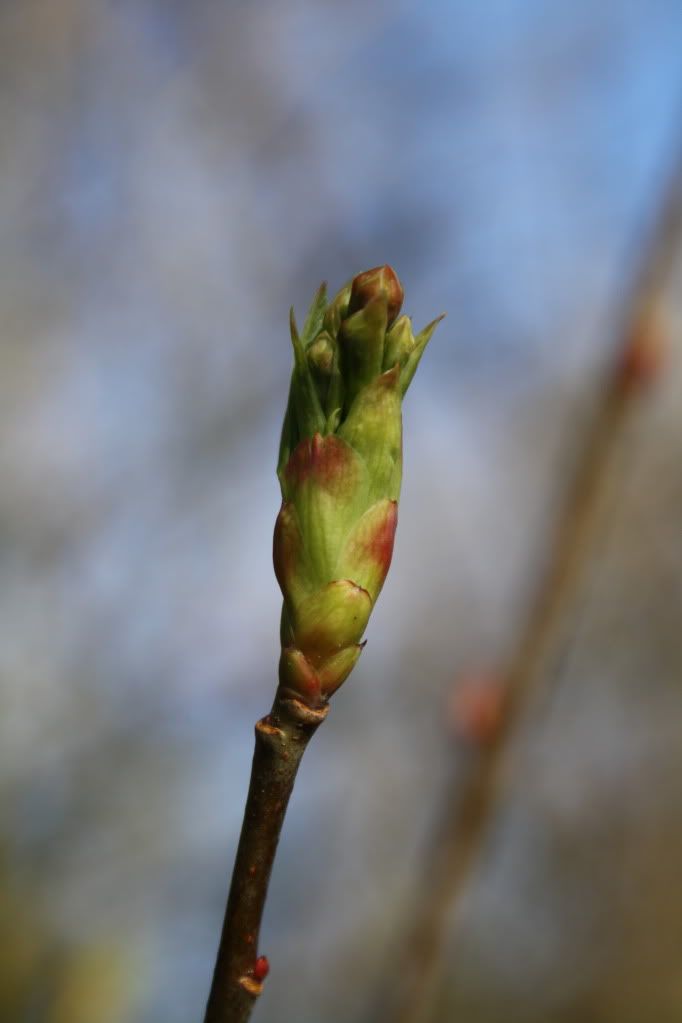
This is one of my favorite creations from the summer of 2007. The titular box elder is pictured above--it's located on my aunt and uncle's farm in Walla Walla, among my favorite (if not my very favorite) places to be. It's a curious tree--not particularly pretty, symmetrical or shapely. It tends to blow over, break and continue growing in odd directions. It's also a great place to sit in the shade on a hot Walla Walla day. The tree reminded me of a couple stories from the Chuang Tzu about a tree that grows to a monstrous size because it isn't ideal for any of the applications for which humans cut trees down. So, by being useless, the tree lives a happy and long life.

The song is meant to be a mess with no apparent structure (poetically or musically), just like the tree. I'm pretty happy with the words I've chosen insofar as they evoke a number of meanings (for me anyway) and I've been a little unhappy with my tendency to explain too much on this blog, so I'll just say generally that we humans seem to try to understand structure and usefulness from a fairly limited perspective--and often with catastrophic results--when in reality what's "good" (more like what's efficacious) is less fixed and more situational. Perhaps an alternative to attempting to understand and control unfathomable and uncontrollable situations and events (like, why are we here, man?) a bit more supple and reactive attitude might result in a deeper intuitive understanding of what's going on. Less wordily: Go with the flow, and nothing can break you. Or maybe it will break you, but maybe being broken isn't a problem from a wider perspective.

In seeming validation of this trash heap of a song, the rough winter of '07 and '08 kicked this tree's ass pretty bad--it lost some major limbs and looks much less full, and perhaps a bit uglier. It's still growing strong, though. I'm about halfway through putting this song to music which mimics the lyric's formlessness. It probably won't be easy listening, but then again I'll probably have a smile on my face when I sing it.

Tuesday, February 10, 2009

This Stretch of Road

Tenderness and words so full of meaning
Slopes of pleasure down which your thoughts just keep careening
For the first time the only thing you want is more
Yeah, you had all of these things, before

Is this love?
It's not what you're thinking of
When did it become a chain to the place you're coming from?

Second chances never turn out like the first
'Cause they start with promises that just end up hurting worse
No matter how bright the memories of old
You can't start a fire from ashes gray and cold

Is this love?
It's not what you're thinking of
When did it become a chain to the place you're coming from?

Sometimes the future seems so very far away
When the echoing past holds you hostage here today
Oh don't compromise your hope with this constant throbbing pain
You won't ever walk this stretch of road again

Is this love?
It's not what you're thinking of
When did it become a chain to the place you're coming from?
Where are you going?


______________________________________


After a busy move and settling down in the new place a bit, I'm back.

For the most part I think writing a song about love is like standing in line to beat a dead horse's grave, especially with a lot of today's songwriters--even so-called experimental musicians don't seem capable of stretching outside of their own sighing and navel-gazing to come up with words that challenge something outside the lowest common denominator. It's tough not to become desensitized to the entire subject, though I'm still partial to a love song done well, as long as it's not an album full of them. Suffice to say, if I'm going to write a song about romantic love, I hope to do it in a way that approaches the subject from a fresh angle and/or imbues the song with some authentic and compelling emotion (though even that is becoming hackneyed these days).

A lot of people seem to define love as some sort of objective phenomenon that exists based on criteria outside of their control. Being "in" love and "out of" love become black-and-white states and people seem to put up with a lot of unacceptable behavior from others because they've already signed the "I love you" contract. I've suspected for a while that love (in any transcendental sense) is a flimsy concept, and that each person probably has a unique, very complex definition surrounding love, and that's probably the only real (extremely subjective) standard by which all things "love" should be measured--on an individual basis.

The first verse starts out describing a seemingly ideal situation between two people only to reveal that the good times are now memories. Verse two describes the perpetual descent of the relationship into repeated pain in the hope that the old happy times can be re-attained. Finally, the third verse encourages a break in the cycle and alludes to now as a time that is precious and won't be repeated. All the while the chorus asks--is this constantly painful relationship, this ghost of past emotional pleasure, this daily defeat, is this LOVE? If the answer is yes, perhaps the "love" contract you signed and are tragically trying to uphold needs to be compared with reality and the pros and cons need to be weighed. Not the happiest or easiest proposal, but the payoff comes in the potential of the future and freedom from the energy vacuum of a negative situation.

A pretty simple song about owning up to reality and actively making your own life better (by cutting your losses, if need be), written from the heart in empathy for a friend. Why trap yourself in the confines of someone else's definition of love when you can define, embrace, and bestow your own version of love on someone who will appreciate it?