Tuesday, May 29, 2012

Cheap Seats 4: The (Un)Happy Accident

Signal to...1, 0 or some combination thereof
The previous Cheap Seats installments have mostly focused on my own recent creative experiences as an independent musician recording a new album.  Please permit me (in an effort to gradually expand the scope of the discussion to a realm that involves all musicians and listeners alike) to get a little bit macro.  Today's focus is the single most powerful determining factor affecting the distribution of any artist's music as well as the top force that dictates the ebb and flow of today's commercial music marketplace--I'm talking about the advent and full scale implementation of digital music recording

I'm sure when Sony and Philips designed and released the first CDs in 1982 they were mostly thinking about the obvious benefits CDs possess in comparison with the analog music media of the day--unlike vinyl and tape, CDs are sturdier and less easily damaged, are smaller and more lightweight, last much longer and are not degraded by use, and have ultimately become as inexpensive (or more) than the other available options.  In the intervening 30 years, though, the simple twist of converting source analog audio recording data to the universal binary 1's and 0's of the digital vernacular has had far-reaching implications for the music world.  On the consumer end, the introduction of CD-R technology first allowed easy copying of any audio files, while the increasing capabilities of home computers and the internet have gradually made the distribution of audio files (the size of which has more or less remained the same) easier and easier, providing music consumers with innumerable sources to acquire recordings for purchase or for free.  This increasing broadening has significantly diminished the sales of traditional physical recording media, not to mention how it's made it more and more difficult for copyright holders to keep track of and protect their intellectual property. 

On the "industry" side, not only has digital music technology changed the shape of music as a product, in the last 15 or so years it's also replaced analog recording as the most accepted method for the very creation of recordings.  ProTools has both become the industry standard software for recording studios, but its relative ease of use and availability (as well as the availability of similar free and inexpensive recording software) has meant that the average person potentially has the ability to record and edit digital music in much the same way (and with many of the same tools) as a professional recording studio--and when the product's finished, the aforementioned home computer technology and internet advancements have made it possible for artists to distribute their recordings without any of the record label, distribution and promotional infrastructure that was compulsory before digital recording dominated the market. 

Like most of the issues I'm trying to wrestle with in this series, digital recording is the quintessential double-edged sword.  Music listeners now have unprecedented access to almost any music they'd like to hear--gone are the days when local record stores could only mail-order expensive imports of cult artists whose distribution was too poor to make the music widely available, and the realities of file sharing mean that most recordings can be found and downloaded for free without risk of punishment and regardless of the recordings' copyright status or availability for sale through mainstream channels.  MP3 players allow consumers to consolidate a nearly limitless library of digital music that can be accessed instantaneously and portably (my personal favorite!).  Up-and-coming artists are no longer necessarily forced to demonstrate popularity in order to make their first recordings (a chicken-and-egg scenario that imploded as often as it succeeded).  It's never been easier to find out about and sample new music, and there's more music being recorded than ever before. 

For the recording industry, the sword mostly cuts viciously in the negative direction--though digital music does offer even more avenues for sales, when offered the choice, "You can either pay us and download the recordings, or search Google and download the recordings for free," consumers have by and large chosen the second option.  Promotional power still rests in varying degrees in the hands of record labels, but it's often limited in the case of independent labels and diminishing sales have scared the big labels into a policy of recording and promoting only guaranteed money-makers, which, as you can imagine, does little to further the spread of non-commercial music, impairing the strength of music as a product one degree of blandness at a time.  For independent musicians, it may indeed be easier and cheaper to record music, but when it comes to standing out amongst a constantly-swelling sea of competition, there are few promotional tools that seem to be worth the time or monetary investment. 

This is where the pros and cons of digital recording become even subtler.  For cash-strapped musicians, free recording is often a deal that's difficult to pass up, but the benefits of using a professional recording studio (high quality microphones and other recording equipment that most musicians don't possess, and especially the technical expertise of recording professionals) are often noticeably manifest in the quality of the finished product.  Then there comes the role of the recordings themselves--are they designed as a promotional device, to be given away at no cost to spread the word about the artist and hopefully convert more fans?  Or, is the artist hoping to offer the recordings as a product for sale?  I've heard again and again that music recordings "are free" and that the only way for musicians to make money these days is through live performance.  While I don't want to diminish the value of live performance, this argument denies the fundamental fact that regardless of the recording, somebody is investing a certain amount of time and/or money into its creation, and investments with virtually no chance of return are utterly unsustainable.  Since this entry is not supposed to focus completely on the financial aspects of independent music, I'll leave further development of those points for a later date.  Additionally, the choice to give away recordings is a difficult decision for reasons unrelated to finances--what message does it send a potential listener if you're willing to give up the fruits of your hard work in exchange for nothing?  There is an intangible degree of integrity lost when you tell listeners that your recording is worth...nothing...even when your decision is motivated by a desire to acknowledge the inevitability that your recordings will be pirated.  In such a competitive music marketplace, I've repeatedly found that the most difficult accomplishment is to simply get people to give your music a chance and listen to even one song all the way through (let alone a whole album).  Can unknown musicians afford to devalue their work at the very outset?

Likewise, for listeners, digital music has made it easy to react in a knee-jerk fashion, skipping or abandoning a recording if it doesn't instantly gratify our spoiled ears and robbing us of that crucial repeated exposure that so much great music needs in order to sink in and sound great to our often inattentive ears.   Similarly, the art of a cohesively-crafted album has been all but lost in the mainstream, with consumers able to pick and choose tracks selectively without hearing them in the intended context.  There is indeed more music than ever for listeners to choose from, but it's also becoming increasingly difficult to find out if it's actually good (of course, by "good" I mean relative to each listener's tastes and musical ideals).  How does the average listener navigate the swarm of hopeful independent musicians without help and without becoming cynical?  Do the types of algorithms that govern internet radio stations like Pandora actually succeed in steering us toward new music we'll eventually love, or do their fixed formulae actually rob us of the chance of hearing something new or different that might actually expand our tastes?  On a hopeful note, there does seem to be a kinesthetic aspect to recordings that cannot be digitized--many people believe that the added dimension of a physical package that comes with a CD or LP isn't sufficiently conveyed by a digital scan of the album art, and the artistic possibilities that come with mixed media can enhance the music and facilitate the development of a special relationship between listeners and the musical thing they're holding in their hands that's simply not possible with an intangible digital file.  Additionally, the "warm" analog sound quality, enhanced art and retro chic of vinyl records has recently experienced a resurgence among aficionados, probably for very similar reasons--still, the challenge of dealing with the rest of the potential market persists!

As an independent musician on the verge of releasing another recording, I wish I had answers to these questions--the more I think about it the more I realize that the digitization of music recordings is neither good nor bad, but that it's at its root a coincidental reality that further complicates an already complicated endeavor!  Printed text will likely remain a viable physical product in books and magazines because it can simply be unpleasant to read text on a computer screen for extended periods of time; digital reproduction of physical art like paintings and especially sculpture never comes close to capturing the physical dimensions apparent in person; television and movies may be easily digitally-reproduced at home, but live theater, dance and movie theater screenings offer an experience that cannot be digitally reproduced to come anywhere close to the live experience.  In our increasingly digitized world, recorded music has been the perfect victim of an unhappy accident insofar as it's easily reduced to digital form and sent down the waterfall into the world's digital information collective.  The issues of promotion and the value of music recordings will be further developed later, but for now I pose these questions:  What's your relationship with digital recordings?  If you're old enough, how has your relationship with music changed as digital has become standard?  Do you think the digitization of music recordings is a good or bad thing for musicians and listeners, and why?  Comments welcome and appreciated!

Cheap Seats Part 1
Cheap Seats Part 2: Non-Commercial Music 
Cheap Seats Part 3: A Day in the Studio

Wednesday, May 16, 2012

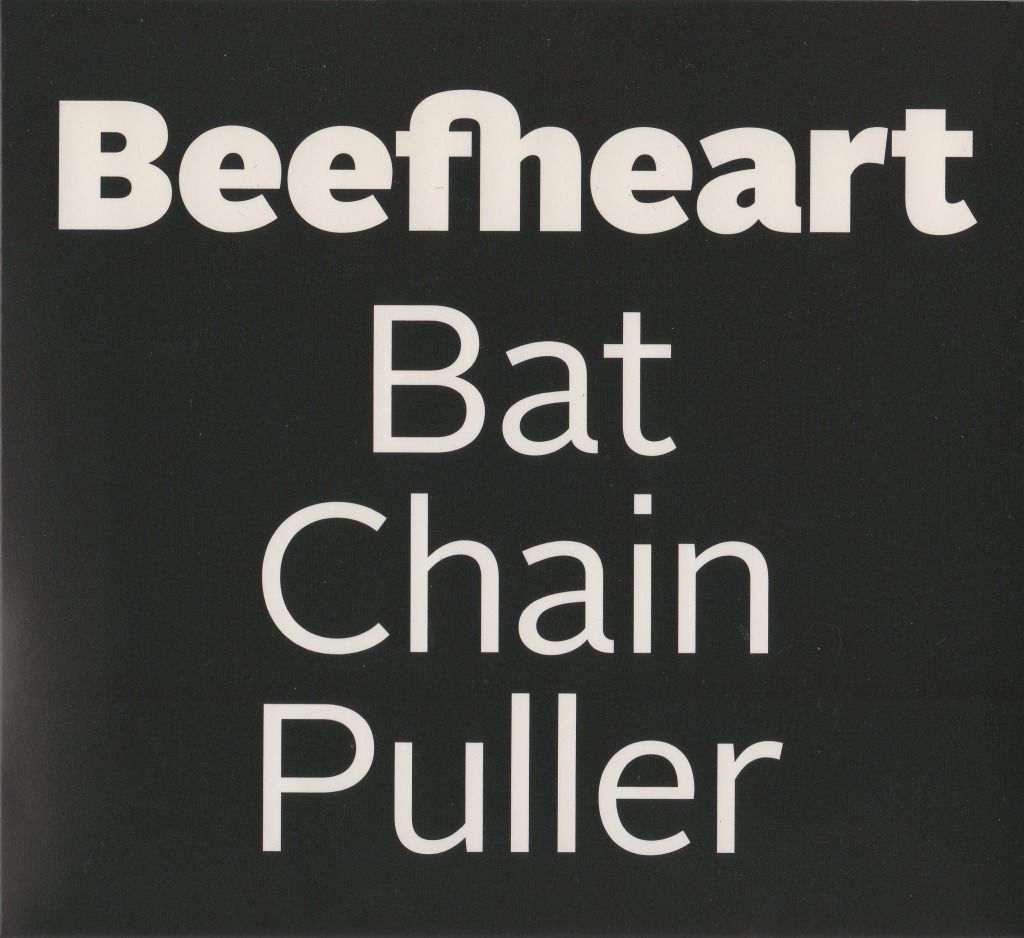
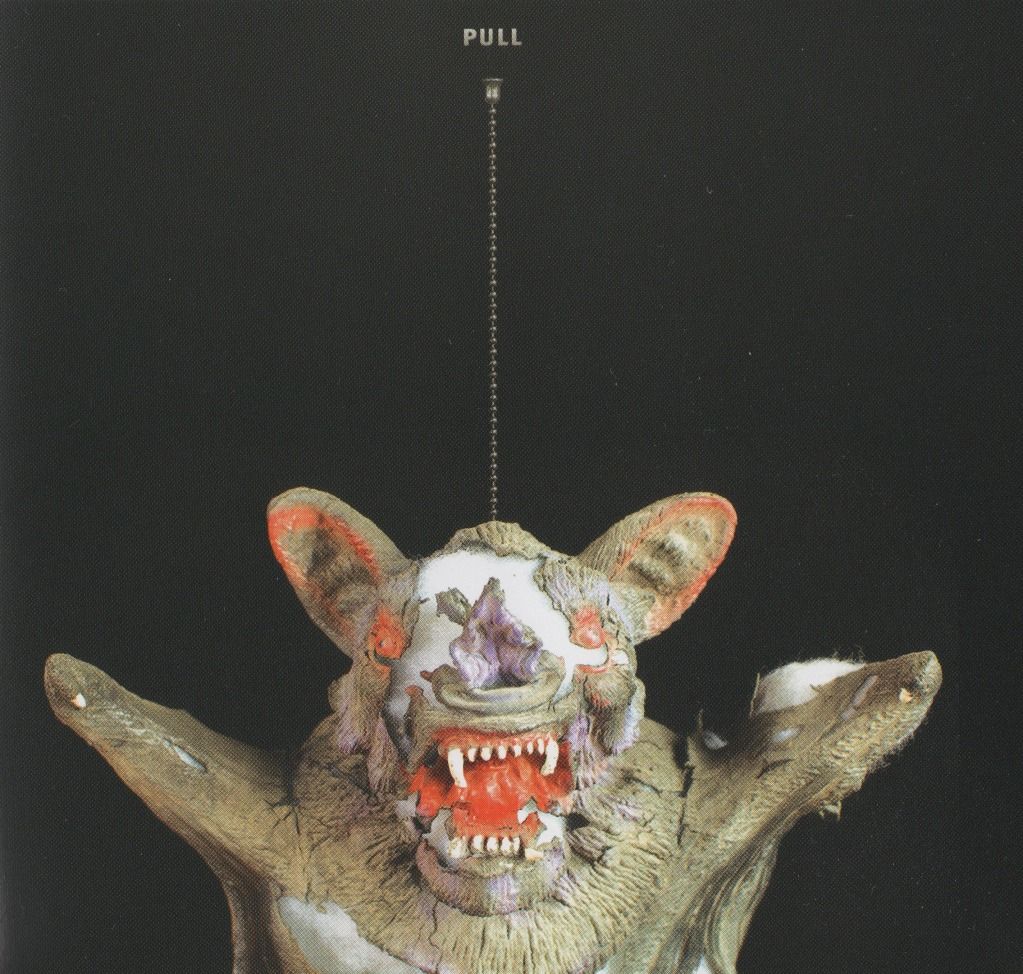
Captain Beefheart - Bat Chain Puller


It's been well over a year since I kicked off the reviews division of this site with a review of Captain Beefheart and the Magic Band's Shiny Beast (Bat Chain Puller), and considering how much the Captain's work has continued to influence my approach to music and writing I'm surprised I haven't waxed poetic about any of his other classic albums.  Technically, today still isn't that day--I'm here to gush about the "brand new" 2012 Captain Beefheart release, the lost 1976 first studio version of Bat Chain Puller, just released this spring (to disappointingly limited fanfare) on the Frank Zappa record label and nearly exclusively available for purchase here (which just might be why the album's gotten so little press).

To describe the genesis of this release briefly, Don Van Vliet decided in 1976 to return to the avant-garde and stage a creative comeback.  Herb Cohen (Frank Zappa's manager) secretly used Zappa's money to fund the project and the two had a falling out upon Zappa's return from tour, resulting in Cohen's seizure of many of Zappa's assets, unreleased Bat Chain Puller masters included. Zappa eventually reclaimed his property through legal means, but by that time Van Vliet had re-recorded most of the material on his final albums.  Since then Zappa, and now his widow Gail, have been busy enough managing Zappa's gargantuan legacy that the tapes have remained neglected in the vaults...until now!

With 10 of 12 tracks already appearing on Captain Beefheart albums that have been available for 30 years, the biggest worry with Bat Chain Puller is that it'll come across as merely supplementary to those "definitive" versions, or worse that it'll sound only partially complete in comparison to the later recordings.  Thankfully, the disc falls prey to neither possibility, playing like the hazy, dream-like album-that-never-was that it's always been!

After listening to these different versions of familiar songs and becoming familiarized with the new track sequencing, I'm left with the strong impression that this album has an undeniably distinct feel, especially in relation to Shiny Beast (Bat Chain Puller) in terms of its accessibility.  Compared to Shiny Beast's almost exclusively song-based program, this Bat Chain Puller is very much a venture split between songs, spoken word-over-music and pure poetry.  Sure, it's still considerably more mainstream than the hallowed stuff of Doc at the Radar Station, but even compared with Doc's orchestrated prickles, the poetry/music tracks here feel much more spontaneously arranged and the sonic palette more often unexpectedly drops down to just one instrument or Van Vliet's voice in some very effective instances. 

Perhaps as expected, some of the material here isn't significantly different from later versions--the arrangement of "Harry Irene" (never one of my favorite later Beefheart tracks, but an important contributor to this album's accessibility) includes guitar, but otherwise isn't much different.  The title track has its own subtle identity (further shaded by a third version here in bonus track form), bristling with kinetic motion (it's easy as ever to hear how Van Vliet originally pulled the rhythm from windshield wipers), more of an organic feel with cranked harmonica and just-barely-conflicting guitar layers (though the ever-important synths are still there) and outstanding vocal delivery (dig the the naked place he takes "their very remains and belongings").  Right off the bat, my highest hopes are kindled--one of my disappointments with later Beefheart albums is the marked reduction in the elasticity of Van Vliet's voice and additionally, in the case of Ice Cream for Crow, an overall dip in energy and compositional effort--here the Captain's voice still possesses a razor's edge and he takes enough risks that we can almost forgive him wasting the early/mid-70's trying to become a mainstream star.  "Owed T'Alex" burns with a reinvigorated closeness that's magnified further on "Floppy Boot Stomp," where the band's joyous delirium pushes the vocals so close that it sounds like the Captain's ranting all the way inside your brain. 

The most exciting aspect of Bat Chain Puller, of course, is the brand new material, namely the poetry/music hybrids "Seam Crooked Sam" and "Odd Jobs."  The former is a moody guitar/electric piano duet with Van Vliet's downbeat-yet-intense images spinning seemingly unrelated on top, while the latter is more of a full band piece with tunefully-spun vagrant imagery while the band shifts ever so slightly into what must be the first kernel of Shiny Beast's "Tropical Hot Dog Night."

Evaluating these pieces has helped me identify a couple of the specific traits that make Captain Beefheart one of my top favorite artists--first, it's the way his poetry mirrors the music, flowing smoothly then stopping, jerking, suddenly rhyming or playfully riffing off of a phrase's connotations or expected syntactical outcome.  Unsurprisingly, Van Vliet chooses words like paint colors on a palette, not necessarily concerned with their logical or expository value but rather their energy, emotional color, and the way they sound.  When I hear these songs, there are countless unexpected images and feelings popping into my head, and I can't think of too many other poets in the popular music sphere who can achieve that.  And yet, there's a strange logic or narrative to many of these pieces--what at first seems like incoherent rambling in "81 Poop Hatch," for example, gradually reveals itself to be an impressionistic panoramic scene including Van Vliet's beloved natural imagery as well as a view of his internal landscape--at least, that is, until he leaps mid-sentence to somewhere completely different; every piece seems to be at its root a rational enigma with unlimited emotional potential.

Secondly, the compositions here are a dazzling presentation of Van Vliet's painterly approach implemented in yet another aspect of the music.  More than on any of his other albums we hear open, warm-sounding jazz harmony on songs like "Seam Crooked Sam" and "Ah Carrot Is As Close As Ah Rabbit Gets To Ah Diamond."  Again, though, Van Vliet applies these combinations of notes intuitively and without regard to how theoretical rules say they're "supposed" to be used.  Fragile, sweet harmony can dissolve into dissonant, minor darkness just as quickly as it can pursue a completely fresh melodic path, as evidenced on "The Human Totem Pole (The 1,000th And 10th Day Of The Human Totem Pole)," one of two album-closing commentaries on the human race's cumulative achievements (or lack thereof) and precarious current position on earth.  Here he fuses this weird compositional approach with one of his more straightforward (yet most compelling) poems, sketching a partially-obscured picture of the skin-crawling, comical-yet-repulsive "pole," and delivering it all with a seething creepy mystery that trumps the Ice Cream for Crow version within just a few seconds..."the man on the top was starrrrrrrrvinnnnng" indeed!  Now is probably an important time to laud the contributions of the rest of the band--this music certainly couldn't have been made without the conscientious talent and attention of the rest of the band, especially drummer/guitarist John French, who also performed a crucial "music director" role in transcribing Van Vliet's hastily-blurted musical ideas into a form that the other band members could understand and memorize--just listen to the through-composed spacious atmosphere as the song sputters out in a denouement that takes up over half the song's length.  The idea that it's possible and even ideal to consent to the urge to compose and arrange notes and sounds in whatever way sounds intuitively best (regardless of the rules) is one of the important lessons I've learned from Van Vliet's music and attempted to apply to my own process.  Though the difficulty of successfully communicating such an idiosyncratic method to collaborating musicians is challenging to overcome, the singular character of the end result can really be worth the sweat.  It's also one of the few lessons any artist can potentially adapt from Van Vliet's work without necessarily ripping off his total sound wholesale--it's possible, no matter what Tom Waits tells you!

In the end, this album is like a gift sent from beyond Van Vliet's grave (though very real thanks are due to all of the living collaborators who finally brought this album to release).  Amazingly, it never sounds unnecessary in comparison with the later albums--"Brick Bats" is the only song that sounds more unfocused than its later version, with a much looser guitar arrangement, less effective vocal delivery and a fun but meandering free jazzy end section made more effective in the shorter Doc at the Radar Station version.  Nor does this earlier album obviate the ones that follow (except Ice Cream for Crow, which was always teetering on the brink of being a "completists only" release, especially now that two of its best tracks are revealed to belong to a more vital earlier work), with Shiny Beast (Bat Chain Puller) still best straddling avant-garde and pop and Doc at the Radar Station best warping Trout Mask Replica poetic/musical craziness into a newer, mature and carefully-integrated form.  Thankfully, we now have all three to consider as required listening--though the price of this CD is still uncommonly high (it cost me $27 including shipping and tax), it's worth the added expense and work it takes to track it down--let's hope there's some wider distribution on the way to make it a little easier to get the word out about this remarkable album's first issue.

Wednesday, May 9, 2012

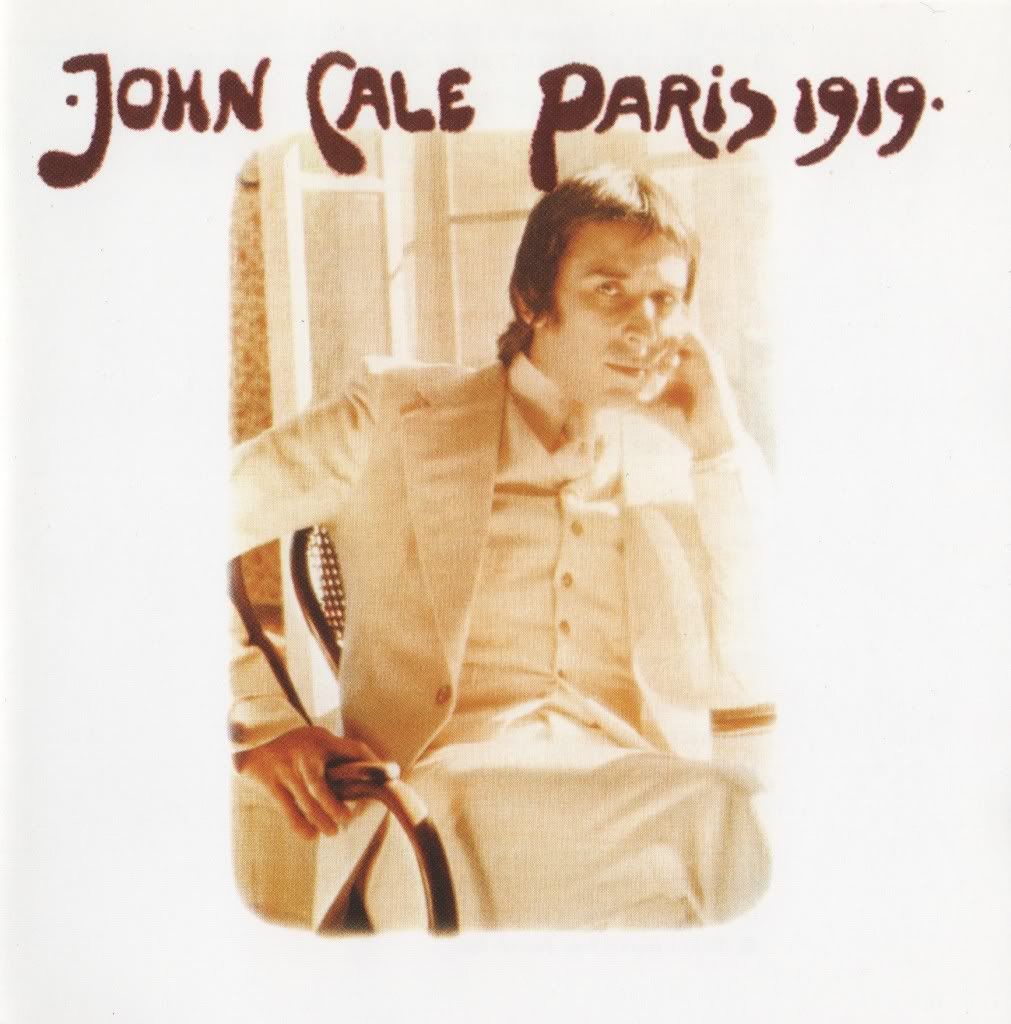
John Cale - Paris 1919


Another album I've rediscovered in the past few months, iTunes tells me I've listened to this album over 10 times.  Though I wouldn't consider it a major favorite I was trying to think of something soothing to listen to after a difficult session and this album instantaneously popped into my head.  After listening a few more times it's not hard to pinpoint why the album produces such a specific reaction: everything--from Cale's half-obscured vocals to the slide guitar, organ and strings that dominate the arrangements--everything here is the aural equivalent of being wrapped in an old but still comfy quilt (rainy day included).  If I may, it's these kinds of feelings that a lot of people might be describing when they say an album or song sounds "British" as if it's a genre or aesthetic descriptor.  There's a pervasive sophistication in these songs that seems to be uniformly reigned-in by an instinctual desire for understatement, and they all seem grounded in the sort of beauty that takes some attention to uncover and--no matter what the subject matter--is touched by a sort of resigned sadness.

Not to say that Paris 1919 is a downer, but if you're looking for some sort of extension of Cale's role in The Velvet Underground, you're likely to be repeatedly disappointed.  Sure, there are comparative moments of "rock" like the romping "Macbeth" and the quirkier, Eno-esque "Graham Green," but really nothing close to anything found on early Velvet Underground.  Not being much of a Velvet Underground fan at all, this doesn't really bother me, but I can see how this album's style might come as a shock--you're going to have to also enjoy pretty, orchestrated pop rock to make the transition to this one! 

There's so many things to enjoy in this album, from the evocative-yet-cryptic lyrics (Cale jumps from a brilliant one-liner in "nothing frightens me more than religion at my door" to the completely indecipherable titular chorus in "Hanky Panky Nohow").  The opener and "Andalucia" evoke a fragile nostalgic yearning that's only made stronger by the songs' simple and accessible melodies.  I can see how things might get a bit plodding for rock listeners ("Half Past France" gets a bit sedate, at least tempo-wise), but like many great pieces of art, a lot can change when you give yourself over to the creator's vision--when you're into it, Cale's repeated "we're so far away/floating in this bay" delivers a desolate, opiate euphoria.  Likewise, "The Endless Plain of Fortune" can change from plodding excess to gripping drama, and Cale's whispered vocals on the brilliantly-titled "Antarctica Starts Here" close the album with the sort of creepy intensity that only restrained dynamics and brevity can bring--in a scant two minutes the song is already fading away, closing the lid on a similarly terse album; packing your message into a concise package is a difficult feat to achieve, and I'm always impressed by how much more power a 31-minute album like this can pack into such a short time span.

Finally, I have to praise Cale's vocals--nothing makes me happier than hearing a great songwriter and musician achieve so much emotional resonance and deliver such beautiful performances with such a limited voice--there's nothing displeasing about Cale's delivery or tone, but it's fair to say he's not the most distinctive, technically-skilled or expressive vocalist.  That's the beauty of great singer/songwriter music--when it all comes together and the elements of composition, arrangement, performance and self-expression add up to something greater than their individual merits.  Though it may not sit at the front line of close-to-my-heart favorites, my collection always has more room for music as well-crafted as this!

Get it here.

Thursday, May 3, 2012

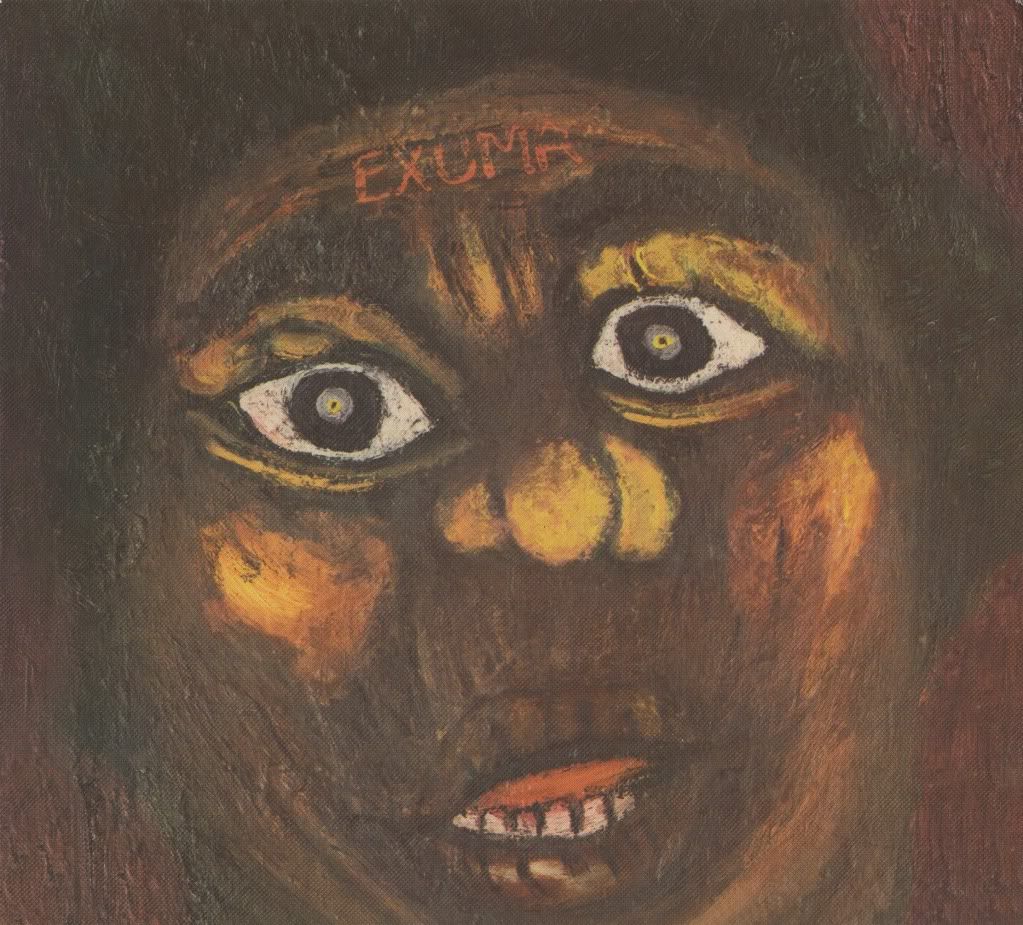
Exuma - Exuma


Getting deep into a recording project, I've found I usually go through a specific progression in my listening habits.  At the beginning, I'll keep listening to my never-ending queue of new music as a sort of respite from the day's work of composing parts and worrying about small details.  As the project starts to take shape and I realize I'm getting somewhere close to actually completing it, it gets harder and harder to tear myself away, and all I can do is compulsively listen and re-listen, fretting over the relative strength of the tracks, what should be done during mixing, whether I need to come up with more songs, and what track sequencing will eventually look like.  During this phase my exploration of new music all but dries up--if I check out something new, I find I don't even fully pay attention and maybe won't even give the music a fair shot--not ideal!  At the same time, though, when I've got a spare 40 minutes, I might pull something random out of my back collection that I haven't listened to for quite a while--because it's already familiar I don't have to pay complete attention, but the result is usually quite pleasant.  Such was my recent experience with Exuma's 1970 debut--reacquaintance with an old friend, and a fresh perspective on the kind of decisions available to musicians. 

This album makes great use of that most classic option available to singer/songwriters--create a ridiculous, outlandish personality for yourself and perform an entire conceptual album in that persona (cf. Comus, Captain Beefheart, and especially Dr. John circa Gris Gris, to which this album owes both a conceptual and musical debt).  Whether or not Exuma is actually a practitioner of obeah is pretty much immaterial--this disc is an immersive experience of primal witchcraft and dangerously good times.  In the tradition of "Seventh Son," the album opens with some classic boasting, with "Exuma, the Obeah Man" standing as a howled litany of Exuma's supernatural abilities over an appealingly filthy musical canvas of strummed acoustic guitar, hand percussion, chanting and animal sounds.  Exuma's voice is awesome--thick, edgy and surprisingly nuanced as the album goes on; few people can go from tender and soft to throat-shredding roaring with such ease, and it perfectly complements the weird song program on display here.

After the first track's invitation, the album practically plays like a field recording of an obeah ritual, including an ode to "Dambala," wherein Exuma chillingly assures us that we won't be going to heaven or hell, we'll just be stuck in our graves with the stench and the smell...over one of the album's most liltingly beautiful melodies.  We get explicit zombie references in "Mama loi, Papa loi," spiritual testimony in "The Vision," and an extended séance in "Séance in the Sixth Fret."  The reason I wrote earlier that this album makes me think of the choices available to musicians is that Exuma makes some strange and specific ones through the course of the album--instrumentally, it's pretty simple, with nary an instrumental melody to be found (lead and background vocals bear that burden) with commitment to the album's concept sometimes overriding the call for actual songs ("Séance..." isn't so much a song as it is something more like musical performance art, while "Junkanoo" is a fantastic but structure-free percussion jam).  Considering this, it's surprising when a fully-formed Caribbean folk song in "You Don't Know What's Going On" shows up to entertain us with verses, choruses, and absolutely nothing to do with the rest of the album's concept.

I really like how an album like this demonstrates it's possible to pursue alternative goals and produce music just as thrilling as an album full of "good songs;" it's as heartening as it is entertaining, though the challenge of spinning a great album out of personality and mood is probably much harder to achieve than by simply writing some great songs.  As such, Exuma is an album not quite like any other and one that contains some great songs, but ultimately stands best as an album-length statement than it does when you try to pick it apart song-by-song.

Dive into this bizarre world, and get it here.

Monday, April 30, 2012

Cheap Seats 3: A Day in the Studio

The blog is back, and why is that?!  Last week I reached a surreal milestone in the recording of my next album--I've pretty much finished tracking overdubs; just one more drum session and we're on to mixing, mastering and release!  This means the blogging time I had to sacrifice to recording-related work is all freed-up and you can expect resumption of a steady stream of reviews and Cheap Seats content!


To keep the Cheap Seats ball rolling, I've decided that the next logical step is to delve a bit deeper into the technical details of the recording process itself.  Based on conversations I've had with friends and family, most people are pretty unfamiliar with the process by which music is recorded in a professional studio.  This blog's readership includes quite a number of music enthusiasts who probably have an above-average understanding of the recording process and terminology--at the risk of insulting your intelligence, please permit me to define some of the basics as I describe a recent day in the studio.

.......................................

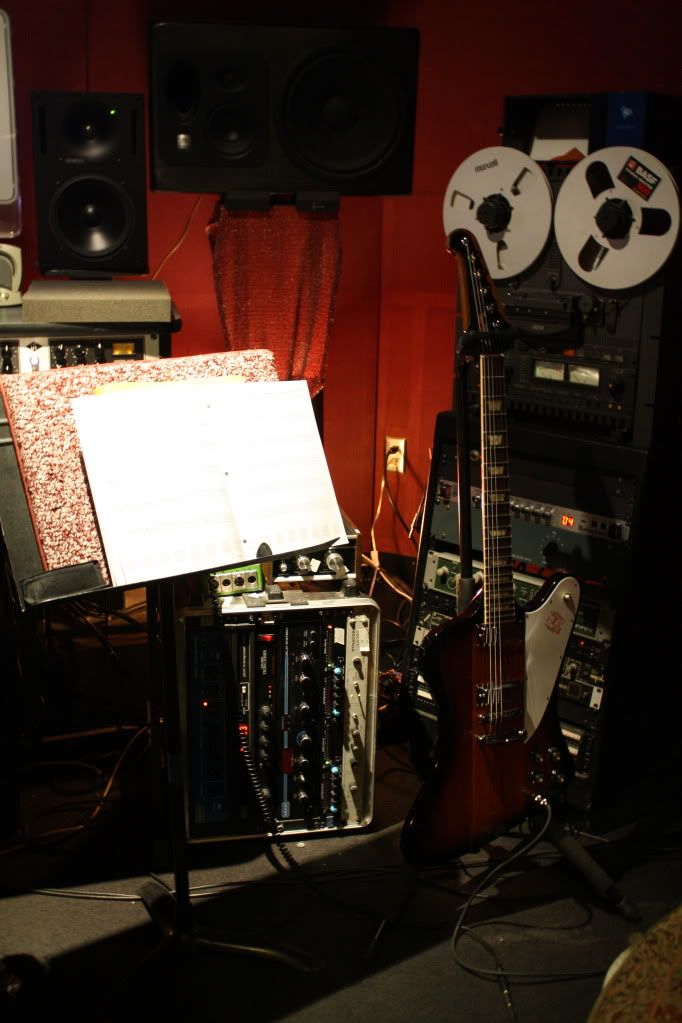
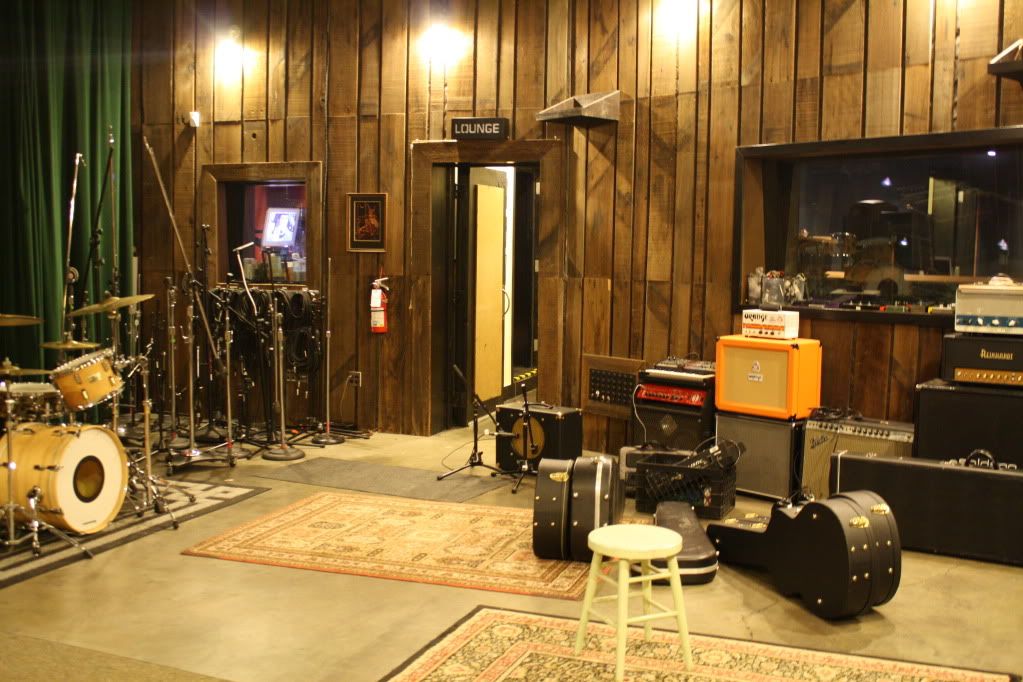
April 25, 2012: It's day three of a five-day session week.  The recording is in its twilight phase--we're starting the 20th day of what will probably be 26 total studio days to track the whole album.  At this point, almost all of the songs are pretty fleshed-out and Justin and I are adding some of the final parts to the songs at Cloud City Sound.  Things are starting to get a little bit surreal, as the project has been going for almost six months and we're finally getting to the point where we're doing "the last" of things--yesterday we recorded the last of the woodwind parts (good riddance, as far as I'm concerned--my wind chops plateaued in 1999) and today's going to be most of the final guitar parts.  What we're doing is called "overdubbing," a process where new parts are added to a pre-existing recording.  Most recording sessions start with what's called "basic tracking," where several members of the ensemble record a number of instruments simultaneously; usually it's at least the rhythm section with at least the bass, drums, guitar, keys etc. laying down a recording of the song's core parts, after which the vocals, extra guitar parts, horns, etc. are overdubbed.  Of course, every recording and group is different--for example, a lot of jazz groups are doing everything live, so there won't really be any overdubs, whereas a lot of rock groups may have four members playing on a song with three or four guitar parts, so it won't be physically possible the play all of the parts live, and vocals are often overdubbed because of the technical issues of getting a hi-fi recording of a voice while lots of other noise is happening.  In the case of this project, where I play almost all of the instruments, there wasn't really such a thing as basic tracking--for each song there was a day when I recorded the first part (usually either an electric or acoustic guitar) to a "click track" (a recording of a metronome) which will be used as a guide throughout the rest of the recording project and removed in the final recording--everything else from there on out is an overdub!

It's been a fun week so far--we've worked on a lot of songs, recorded a lot of different instruments (including the studio's awesome vintage Hammond B3 organ) and made some serious progress.  Monday was a fun day because my jazz pianist friend Peter tracked some slick piano on three of the songs, making him the second musician besides myself to contribute to the album (more on the special guests later!).  Being a one-man recording project has its positives and negatives.  On the one hand, I've usually got extremely specific ideas and goals I want to get across and playing every part gives me the maximum amount of control and cuts down on the sometimes difficult process of communicating desires and instructions to other musicians.  On the other hand, it can be extremely time-consuming to compose, arrange and rehearse (if I even get around to that phase) parts for numerous instruments--some of which I am barely familiar with--and in spite of my confidence in my own ideas, I'm always humbled by the fresh air that a skilled collaborator can breathe into arrangements that are in danger of becoming claustrophobic; it's thrilling to see someone else's ideas transform a piece of music I thought I'd considered from all angles into something more

Emboldened by my recent woodwind accomplishment, I've decided that today's the day to finish most of the final electric guitar overdubs.  Justin's job title is audio engineer, which means he performs a number of different duties crucial to the recording process.  Firstly, there's the physical engineering of the sound--selecting the microphones and preamps best suited to whatever instrument we're recording, and setting the volume and compression levels to get the best possible sound for the part.  Secondly, there's the actual recording of the instrument--Justin uses his thorough knowledge and years of experience with industry-standard ProTools recording software to set up tracks for each instrument, hits "record" over...and over...and over...and applies editing wizardry where needed to compensate from the fact that this isn't actually a live recording and to make things as smooth and seamless as possible.  Later, these skills will reach their culmination when we mix and master the raw tracks we've been recording.  Simply having a professional engineer means that this project is instantly worlds more high-quality than In Not-Even-Anything Land, and Justin's particular expertise and sympathetic attitude to the material has really taken things to the next level. 

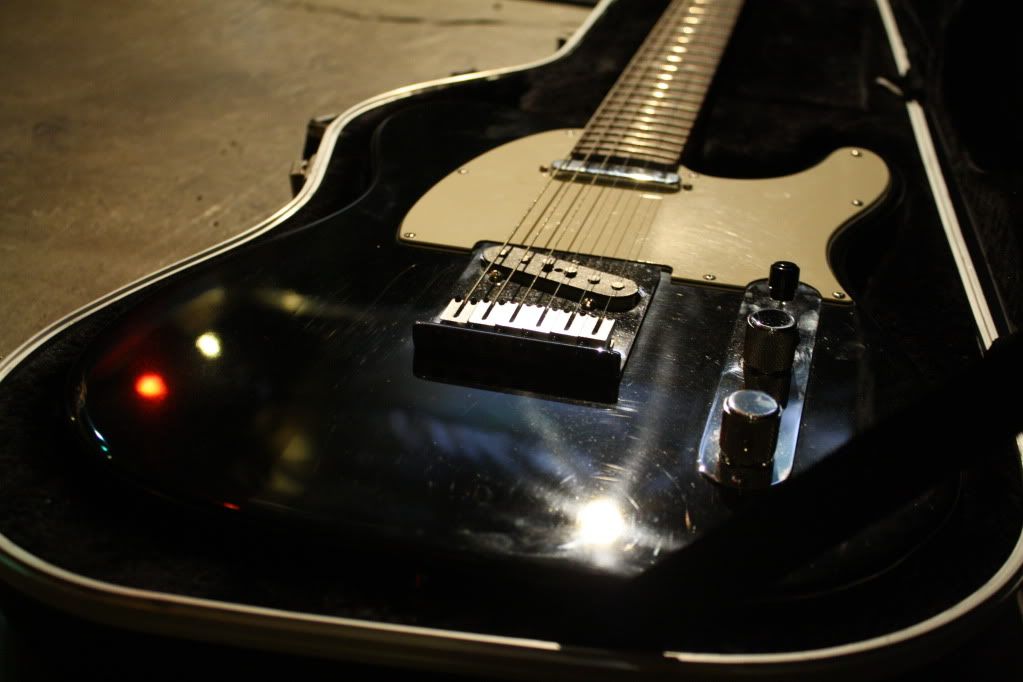
When it comes to recording guitar for this album, we've used countless combinations of mics, guitars and amplifiers to give each part a distinctive character and ensure that this will be a kick-ass guitar album with awesome tone that matches the often ear-challenging guitar parts.  We start our 10-hour day two hours later than usual at 12 pm, loading three amps into the isolation booth (the tiny room next to Justin's office where I've been recording vocals, horns and various acoustic instruments).  From there, we'll send out cables and I'll sit right next to Justin while I play and he records.  The guitar parts for this album can be roughly divided into three categories--composed rhythm parts, composed lead parts and more improvisational textural parts.  Today, we're recording some of both of the latter two categories.  While it's anathema to what a lot of musicians and music fans think the recording process "should be," the creation of this album has been an unusual and painstaking one.  The process starts at home, where I compose the parts in demo form using Apple's free recording software, GarageBand.  The sound quality is horrible and the performances are often pretty lackluster, but the main function is to figure out what the instruments are playing and give me a chance to hear what things sound like together, as I work primarily by ear.  At this time, if I'm "working smart," I'll also be transcribing the part I'm composing either with standard music notation onto a five-bar staff, or onto a guitar tablature sheet for later reference in the studio (one of the earliest lessons I learned is that the inconvenience of transcribing a part as I'm writing it pales in comparison with having to go back and figure out what I played two weeks ago).  Ideally, I'd then practice the parts at home in advance of the session to ensure smooth reproduction of the ideas for the final recording.  In reality, though, my time is limited--I work to pay for the privilege of recording this music, and during the last six months my free time at home has been more often spent writing, arranging and composing the next parts for whatever songs are coming down the pipe, and my rehearsal discipline has suffered accordingly. 

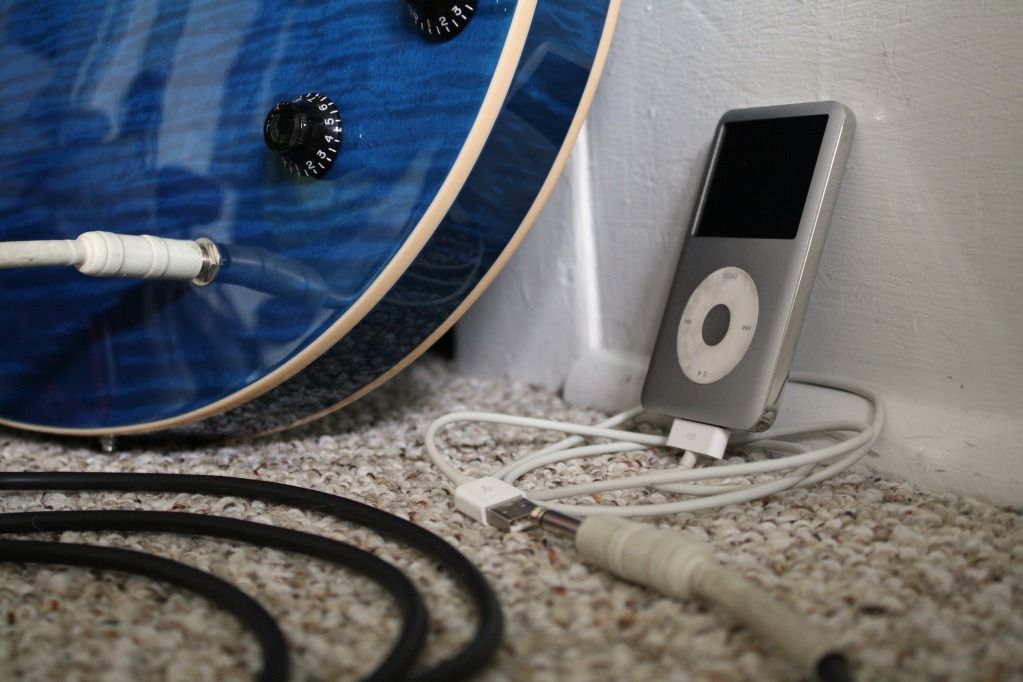
When it comes to recording the parts in the studio, I sit with my notes in front of me and a copy of the demo queued up on my iPod for immediate reference.  Here's where things start to become anathema to some people's expectations.  Of the aforementioned three guitar part categories, the first two are meticulous in their specificity and can be extremely time-consuming.  While some believe that guitar parts should be recorded all in one pass or compiled from several complete takes, that's simply not how we've recorded the guitar for this album.  ProTools has a function called "punching in," where the engineer can roll the recording and start and stop recording with the click of a button.  The function is designed to fix small mistakes, continue a take where maybe the first half was keep-able but the performer stopped playing, etc., by giving the performer a chance to play perhaps just one missed note correctly without having to record a whole take.  From what I understand, this process has been around since the analog days, but digital technology makes punching in much easier and more controllable.  Not to pull the curtain back too far, but in the case of my sometimes-labyrinthine composed guitar parts, they are most often recorded using a punch-heavy technique where sections of the part are recorded one at a time.  The composed rhythm parts tend to be less difficult and can be recorded in larger chunks, but some of the more difficult lead parts eventually have to be broken down phrase-by-phrase in order to accurately achieve the part I've composed, often including a formidable amount of rigidity and precision  in terms of interlocking parts and counterpoint.  I'm sure some purists scoff at the approach and I can understand why; it's natural for a musician's ego to demand an uninterrupted live performance, which is one of music's core avenues of expression.  In truth, I would love to have prepared the parts to technical perfection and recorded them in just a couple of passes, but the reality is that some of the parts I wrote are so difficult that rehearsing them all to perfection would probably add another year onto what's already been a half-year-long recording process!  Beside, the "off the cuff" approach is pretty much abandoned the minute you decide you're going to record a one-man project. 

There's also the objection that the element of spontaneity is lost when all of the parts are pre-composed.  In relation to my artistic goals, this objection is beside the point--the ultimate goal here is the final product, which is the total experience of an album-long recorded piece of music.  Whatever it takes to get there is what has to be done.  Again, I'd love to be able to simply improvise these parts in the studio, but my guitar part goals usually center on coming up with the most out-there and cliché-avoiding parts possible; only improvisers of unbelievable skill (i.e., definitely not I) are capable of ad libbing such parts (indeed, most improvisation actually tends toward the spontaneous reassembly of what can fairly be described as...clichés), and the benefit of hindsight allows me to fine-tune the parts I've written in order to improve them before they're set in stone.  It's true that I could eliminate the middleman by doing the part-composing in the studio, but that situation would remove the option to tweak the part later and would not be a cost effective use of my studio time--for every hour I spend reproducing a composed part in the studio there's at least two to three hours of hair-pulling and composition at home.  The punch-in recording method is likely to be a surprise for a lot of music listeners, but the truth is--though they aren't using the functionality to quite the same painstaking extent--almost all recording artists use punch-ins, editing and take compilation to create the best recordings possible.  In the case of my project, it's simply what the process is--the compositions, ideas and listening experience are the ultimate goals, and those goals take however much time and whatever means necessary. 

So, Justin and I sit down to start the day, choose a song, and fire away.  I've decided to use the morning's freshness on one of the more difficult parts left to record, and away we go--there's lots of "again please, same punch," a lot of swearing on my part, and a lot of digital clean-up needed when all's said and done, but the parts get done and it takes as long as it takes--the record for this album is five hours for a four minute lead part!  Whatever it takes for the ultimate goal!  At this point in the session Justin and I have gotten our system in place and things tend to go faster--one to two hours for a difficult lead part, and I've been playing so much guitar that I've gotten much better at hitting the parts in fewer tries.  At this point Justin performs one of his most important duties: quality control--paying attention to timing and synch while I do my best to hit the parts and keep the energy up in what's often an energy-draining situation.  Today we've got three difficult lead parts (two of which are in the same song) and some more textural, improvised stuff.  Each song change necessitates a change of guitar and amp, a resetting of levels and another adventure--luckily we can alternate between tough parts and improvised/textural ones, which gives me a break from the demands of brutal precision, and gives Justin's punch finger and patience a much-needed break.  We break for lunch around 2:00 (today's a big milestone; I'm redeeming my buy-seven-get-one-free coupon at the Safeway deli) and get back to work around 2:30.  By 8:30 we've recorded guitar for eight different songs and the scheduled guitar program is finished.  I decide to spend the last 90 minutes hitting a few backing vocals, which provides a nice cool-down for a day of hard work.  Tomorrow will be the final acoustic guitar overdubs, more vocals and starting the last of the bass recordings. 
.......................................

And that's how it goes...the days are long and things can get frustrating, but hearing everything together (which has been happening more and more as time goes on) is worth it for many reasons, not least of which is that the sound quality blows the demos out of the water.  This'll probably be the last really "technical" post until we get to mixing (others will probably focus more on the artistic and aesthetic aspects), but a lot of people have been asking me since as early as January, "So, you're almost done?"  I hope the detail here has helped clarify my "No, it's going to be a long time" reply and, as is the overarching goal of the Cheap Seats series, I hope it's given you some more pieces of the puzzle of what exactly goes into the production of an independent album and the way we can attempt to quantify and express the ultimate value of this kind of thing.  More soon!

Cheap Seats Part 1
Cheap Seats Part 2: Non-Commercial Music

Monday, February 27, 2012

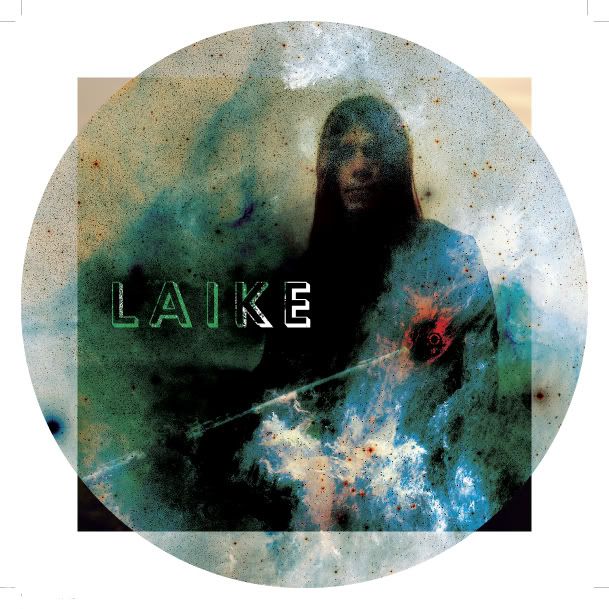
Laike - Långt från stadslivets dån


Today I've got the pleasure of writing about an independent artist's album on the day of its release.  Laike is a Swedish artist whose debut solo album Långt från stadslivets dån is released today on British label Les Cousins, one that's got a special place in my heart for reissuing most of Davy Graham's back catalog and making possible his welcome (if painfully shaky) 2007 swan song, Broken Biscuits.  Laike is the artist moniker of a sort of one-man show in Christofer Ståhle; he writes, sings and plays guitar, piano and flute here, though he's joined by a number of friends performing various instrumental duties.  Laike's album notes refer to a recent enthusiasm for 1970's British folk rock bands like Fairport Convention and The Pentangle (I also hear some Comus in the violin parts), and I think there's a lot here to compare with that music but there's also a lot more here.

I spend a lot of time as a musician and writer worrying about originality and distinctiveness--not necessarily expecting others or myself to produce a musical product that's never been done before, but rather hoping to avoid the decisions that have been made so many times by other artists that they're both clichéd and (for lack of a less snobby word) lazy.  Listening to Laike's debut I come to the realization that the fact that much of the music here sounds stylistically familiar really isn't a problem.  As a listener who's pursued some of the same bands, I feel that the progressive folk, acid folk, eccentric singer/songwriter (or whatever you want to call them) fields are specifically underdeveloped and any contemporary artist who makes a point of further exploring those areas has both a rich and varied template to draw from, but also a multitude of unanswered musical questions and new directions to explore.  Perhaps I'm biased, but I think that as long as the personality, enthusiasm and artistry match the music heard on this album, there's plenty of room for more music in these areas and it'll be quite a while before their ideas are exhausted.

On to some specific impressions--on first listen, Laike's debut is an unassuming collection of straightforward, gently floating melodies framed by accessibly organic arrangements of mostly acoustic instruments playing parts that are sometimes instrumentally impressive but always designed to serve the songs.  As always hoped-for with this kind of music, further familiarization shades the hookier aspects with all kinds of subtle nuances (like psychedelic electric guitars you won't even notice until the third spin) and details that both broaden the experience and speak to Laike's craftsmanship and judgment.  For the most part, the songs are split between buoyant folk-rock like tunes as found on the opener "Modeslavarnas marsch," "Gladiatorkamp," and "Du är mer än vad jag ser" (where the violin riff, bass line and Dave Mattacks-like drumming most closely recall the aforementioned British bands), and quieter acoustic numbers like "Ensamhetens borg" (where Laike's guitar takes on a Jansch-esque swing), the playful melody of "Bygger stegar upp till himmelen" and the spare-yet-trippy "Städernas tid blev inte lång."  Then there's the stuff that's something more, where jazzier tendencies meld with overt pop instincts and melodies like the great guitar riffing and grooving Fender Rhodes on "Långt från stadslivets dån" or the frantic 5/4 piano riff that anchors the valedictory "Tankefabriken."  And let's not forget the spacey field recordings that bookend a few of the tracks, pitting Laike's voice and flute against boundless natural reverb with great textural and thematic effect, not to mention how far they stretch past the folky feel of the rest of the music. 

Laike's voice, guitar and flute run throughout as cohesive threads, his voice especially providing an ethereal lightness and impressive depth of expression to the songs, at times reminding me of singers like Duncan Browne and Jorge Ben in its deceptive delicacy.  I only read the English lyric transcriptions Christofer sent me after listening to the album a few times--I'm surprised how dark they are in relation to the music, dealing with themes of the oppressive nature of urban life (the title translates Far Away from the Noise of City Life) but also isolation and a frustration with the state of the world.  Luckily, the beautiful melancholy of the music and a few moments of hopeful idealism tug the emotional feeling back into the satisfying realm of coldly shining Scandinavian bleakness.  Långt från stadslivets dån is an album I'm both happy to share and an album I'm looking forward to getting to know even further--congratulations to Christofer on a job well done and best of luck as he continues on his artistic path and releases this music to the world! 

Get it here.

Saturday, February 18, 2012

Cheap Seats 2: Non-Commercial Music


I'm 11 studio days and nine songs deep into my next album and thinking hard about how the work so far measures up to my standards, where I'm going next, and what's coming in the distant future in terms of post-recording production and an eventual release.  Though writing, arranging and recording is a challenging and difficult process, it's mostly straightforward to me and is still ultimately rewarding even when it's frustrating.  When it comes to thinking about how I can best represent my music once it's released and how to reach the kind of people who actually might be interested, things get a lot foggier. That's what a lot of this Cheap Seats series is about--what else (and there's potentially a lot of it) besides writing, recording and performing goes into the average independent musician's quest to be heard.  One of the fundamental issues that continues to plague my thoughts is the issue of non-commercial music and how it fits into today's bizarre musical marketplace. 

The struggle to define the phrase "non-commercial music" instantly reminds me of the classic US Supreme Court opinion on obscenity and pornography--creating a concise definition is all but impossible, but "I know it when I see it."  In the case of non-commercial music, it might easier to define its opposite--commercial music.  To me, "commercial music" is broadly music that is specifically created to appeal to the widest audience possible and consequently maximize sales.  This is neither necessarily a bad thing nor an absolute category, but under this definition, it's pretty easy to "know it when you see it."  In terms of musical characteristics, commercial music is almost always concise (songs under, say, six minutes), utilizes conventional harmony (major or minor keys with occasional implementation of jazz-related harmony), lyrically appeals to specific emotions that most people feel on a regular basis (romance-related, nostalgia, euphoria, sadness [use sparingly]), is full of easily recognizable elements that are catchy and memorable, and often identifies strongly with the conventions of a particular well-established musical genre in order to provide listeners with a clear connection to music they already like.  If it hadn't started becoming such a pejorative term and associated exclusively with corporate-produced mass market music, I'd even say that "commercial music" is synonymous with "pop music," but let's not narrow the definition unnecessarily with negative connotations.  Like I mentioned before, none of these characteristics are inherently bad and they describe a lot of great music, but surely they don't describe the only way to make good music?  It would seem that problems arise when the characteristics that describe commercial music become the only guiding principles in making music.

Indeed--they aren't; all kinds of great music has been made across the years with varying levels of non-commerciality including attention-span-testing song lengths, unconventional dissonant harmony or atonality, unconventional song structure (or complete lack of structure), inaccessible lyrics, a focus on less straightforward hooks, expression of less attractive moods and emotions, lack of easy identification with recognizable genres, and all-around weirdness in the sound of the music and especially the sound of the singer's voice.  Naturally, the list goes on and these descriptors have and will be freely combined, mixed and matched with each other as well as with characteristics associated with commercial music.  The point is, the more non-commercial elements you employ, the tougher it's going to be to achieve significant commercial success.  However, just as making the decision to produce purely commercially-oriented music doesn't guarantee commercial success, plenty of non-commercial music has (eventually) achieved widespread commercial success.  Tom Waits is an artist who immediately springs to mind; these days he's a hallowed saint of the independent/weird music world, but it took him a long time to break past the cult status to which his now-classic 1980's albums initially resigned him.  So, commercial and non-commercial music aren't necessarily mutually exclusive, and non-commercial music can succeed commercially, it just has a bit less going for it in terms of accessibility.  However, it seems reasonably undeniable that certain types of music will never be commercially successful by the conventional measures (like, say, the Billboard charts)--but they have to have some kind of value, right? 

I think the Tom Waits example speaks well to the tough-to-quantify value of non-commercial music.  Simply put, if you're slavishly working toward the goal of creating music that's as commercial as possible, there's a good chance it's going to come across as boring.  There have been innumerable artists treading the exact same path, and the characteristics that define strictly commercial music limit your artistic options from the get-go.  Yes, there's joy to be found in those options, but there's also the soulless thirst for the lowest common denominator that makes so much commercial music hackneyed to the extreme.  There are many artistically-justifiable reasons non-commercial music is valuable, including one that can even be connected to the all-sacred dollar--the fact that it plays a key role in refreshing what qualifies as commercial music.  It's been happening throughout history, from Beethoven to Elvis--the avant-garde does something weird and against the rules, enough people like it and prove that it can make somebody some money, then it becomes an acceptable convention for the mainstream.  Tom Waits is a great example, especially considering the fact that a lot of his Captain Beefheart-influenced material introduced just enough commercial elements for Waits to eventually succeed where the Captain utterly failed commercially.  Good ideas have a way of rising to the top, and in addition to being aesthetically enjoyable for its own idiosyncratic reasons, each type of non-commercial music is always ultimately connected to the mainstream, whether it's valued monetarily or not. 

After working on this music for several months, I have no illusions that nearly all of the songs I'm working on qualify as non-commercial music.  Personally, I find an exciting freedom in non-commercial music (which explains why the majority of albums I review here display varying levels of non-commercial characteristics) that means anything goes, as long as it's expressing an interesting idea.  If you're not afraid of breaking a rule that'll cost you sales, then your options are unlimited.  Of course, it's a double-edged sword and each non-commercial choice you make further limits your potential appeal to the average listener.  And aesthetically, the further you tread from the established rules, the more subjective the evaluation of the quality of your work becomes--who says what I think is an interesting or dull idea is interpreted the same way by others (a principle amply demonstrated by the response I've gotten to some of the critical reviews I've written)?  This ambiguity is one of my favorite parts about art, since I believe it's ultimately true even when evaluating art that abides by strictly established rules. 

So, I personally believe that non-commercial music is valuable both artistically in terms of the potential for innovation and the unlimited scope of expression, as well as for the role that it plays in propelling forward the slower-moving behemoth of popular music.  Choosing to make non-commercial music means I'm subject only to my own artistic whims, but it also means I'm further narrowing the already-limited avenues through which I can seek success as an unknown independent musician.  It's not a matter of "being discovered" at this point (since there's no major pop label that would be interested in trying to sell this kind of music), but rather a matter of finding ways to connect with the disparate but very real audience that could potentially be interested in the music.  It's the how that continually occupies my thoughts--how does any non-commercial musician access the narrower and diffuse selection of people who are interested in non-commercial music, and what does it take in the present day to achieve enough commercial success with that audience to sustain and continue the artistic process?  The answers are probably extremely complicated and different for every band or artist, but repeatedly considering these questions will be a key part of this series as I continue trying to outline the labyrinthine choose-your-own-adventure that faces today's independent musicians. 

Cheap Seats Part 1

Tuesday, February 14, 2012

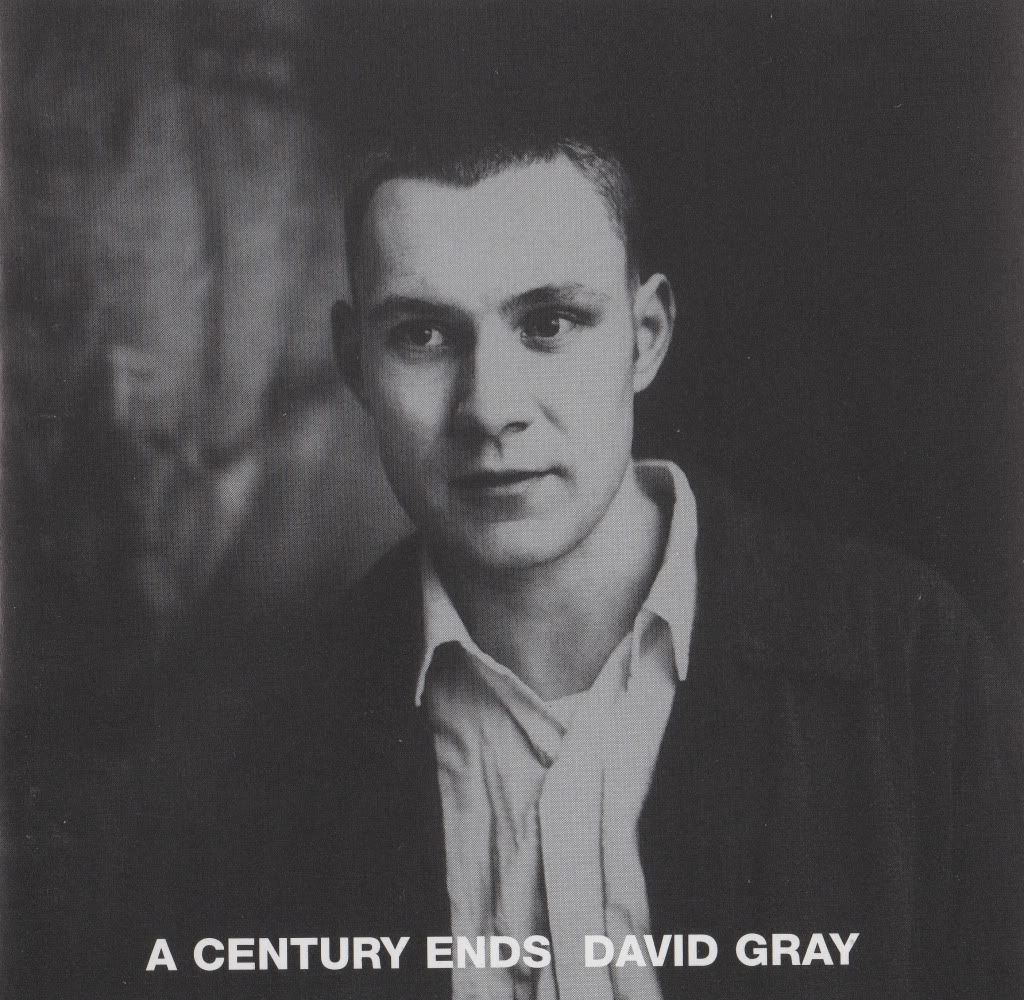
David Gray - A Century Ends


After a busy couple of weeks in the studio, here I am back again to talk about some more music (another Cheap Seats installment should be issuing forth pretty soon as well).  I first got into David Gray since seeing him live in 2001 when he was just breaking through with White Ladder.  Since then I've stayed a fan as his popularity has ebbed and flowed, but it wasn't White Ladder that cemented my support--it was Gray's back catalog, and especially Flesh and A Century Ends, his 1993 debut.

Though Gray's first couple albums display his liking for Van Morrison and Bob Dylan a lot more than his more recent stuff, they're also a lot more focused on pure songwriting than fusing electronic and accessible acoustic elements than his breakthrough albums are.  The arrangements mostly center on Gray's acoustic guitar, though there's some uncharacteristically (for Gray's music) overdriven electrics that accentuate some of the album's edgier tracks.  What always draws me into A Century Ends is the fact that it's much angrier than Gray's later works--as he's matured his cynicism has often been re-routed into less recognizable forms as he strives to keep his music accessible and prolong his mainstream popularity.  Here, though, Gray rails against the apathy and decline he sees in society on songs like "Let the Truth Sting," "Birds Without Wings" and the title track, singing in a sometimes growling brogue and spitting bile with every line.  Revisiting this album I occasionally feel that Gray's poetic lyrics are occasionally a bit florid and sound exactly like the kind of stuff an earnest, angry 24-year-old writes (which probably explains why I liked it so much when I was a teenager), but he repeatedly delivers goods that offer insight beyond his years with lines like "when the cat comes/we're just birds without wings."

Also noticeable throughout the set is a sort of dingy grit that comes with the life of a frustrated young artist--"Debauchery," "Living Room" and "Wisdom" abound with grimy urban imagery and a sense of urgent desperation that rarely appears in Gray's works these days.  This might be most evident on the quietly simmering "Lead Me Upstairs," which focuses the album's themes of innocence lost and disillusionment into the image of a single romantic encounter.  What really balances Gray's youthful angst, though, is a few unassumingly gorgeous tracks that blend the singer's exuberance with an open-ended bittersweetness and depth that's occasionally lacking on some of the collection's more straightforward material.  The opener, "Shine" continues to be one of Gray's finest heartbreak songs, based on open-tuned guitar and rising to a crescendo that sees the singer experimenting with Van Morrison-like vocalizations.  "Gathering Dust," further develops a quiet sense of searching, featuring one of the album's most memorable melodies (delivered by Gray's wordless na-na-na's).

While it's probably true that A Century Ends presents some of David Gray's least mature material, it's also refreshing to hear someone singing passionately and obviously caring about the subject matter, even if the wide-eyed sincerity of youth is a little overly-apparent.  And while the music sometimes suffers the characteristic fate of existing merely as a platform for Gray's voice and lyrics, he does present us with a lot to enjoy in those departments.  I've heard Gray speak mildly disparagingly about his first few albums and say that the too-familiar folk rock arrangements were part of the reason he didn't achieve success before White Ladder (not to mention that this album is a way too British-sounding to find widespread success overseas).  That may be true, but listen to both albums in 10 years (or maybe even now) and I bet this collection sounds a whole lot more difficult to date in comparison.  While Gray has continued to tread middle-of-the-road territory with his recent albums, he always seems to show glimmers of the insight and un-poplike impulses that made his early stuff so compelling.  He's got his fair share of detractors who validly point out his overplay and recent blandness at the expense of recognizing his well-developed craft, but I live in hope that his continuing maturity and subtlety will again result in something that aims to challenge more than it does generate another safe adult contemporary hit.  A taste of success seems to often instigate a hunger that's fraught with compromise, and that feeling is never evident on A Century Ends.

Get it here.

Saturday, January 28, 2012

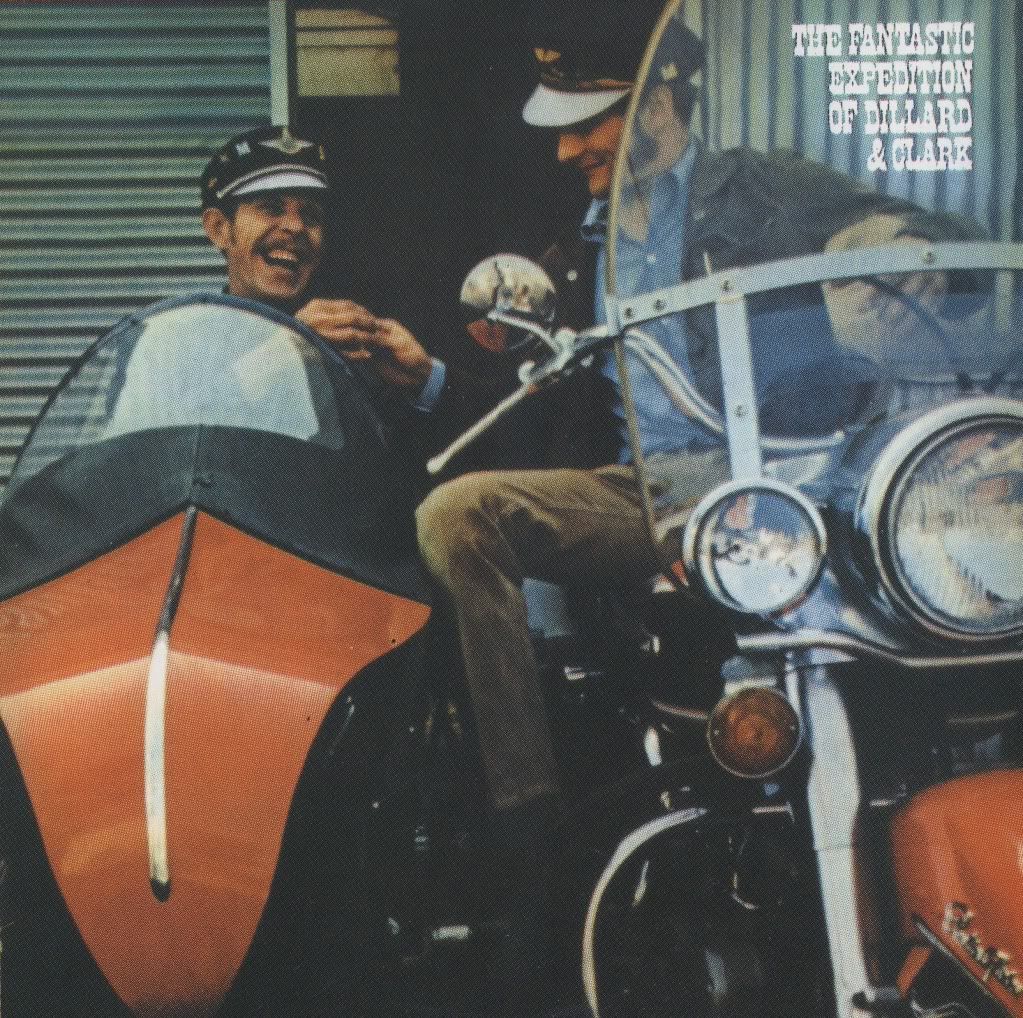
Dillard and Clark - The Fantastic Expedition of Dillard and Clark


The other night I was having trouble choosing something to listen to--ultimately, instead of one of my recent jazz purchases, I reached for this--Gene Clark's first (of two) albums with bluegrass virtuoso Doug Dillard, sandwiched between his post-Byrds solo debut Gene Clark With The Gosdin Brothers and the stunning White Light.  While a lot of country rock aficionados like to place this album as one of the first country rock collections, I prefer to think of it in the context of Gene Clark's discography as both his first masterpiece as a performer and songwriter as well as the only full album where he's complemented by an instrumentalist with an equally impressive and distinctive personality.

It's a Gene Clark album, so of course there are some great songs--"Train Leaves Here This Morning" is likely many people's favorite with its laid-back swing and one of Gene's best ambiguous chorus lines since "I'll Feel A Whole Lot Better" with "there's a train leaves here this morning/I'm not sure what I might be on."  The arrangements still show a Byrds-like penchant for thick harmony vocal arrangements, but to my ears Dillard and company provide considerably stronger accompaniment.  Also quickly noticeable are "Out On the Side," which showcases Clark's aching emotional vocal delivery backed by a full band (organ included) arrangement, and "Don't Come Rollin'," which starts as a loose harmonica jam and builds into a buoyantly conversational tell-off replete with some fast-talking from Clark, not to mention a hash reference. 

As usual, though, the songs that withhold their treasures for patient attention are ultimately just as interesting--"She Darked the Sun" proves Clark was able to adapt his songwriting to an old-timey bluegrass aesthetic while at the same time dropping crushingly modern lines like "with the length of her mind she darked the sun."  Even more affecting is the album's one-two closing punch--the jubilant banjo and familiar bass pattern of "The Plan" belie Clark's desperate existential searching, and "Something's Wrong," focuses the songwriter's profound melancholy into one of the most powerful coming-of-age songs I've ever heard, full of childhood reminiscences and a devastating bridge--and with its album-closing fiddle denouement it still clocks in under three minutes. 

These would still be great songs even if Clark were just singing them with an acoustic guitar, but Dillard (as well as Bernie Leadon) provide a shimmering backdrop of banjo, mandolin and lead acoustic guitar that adds both depth and warmth to Clark's songs as well as playing that's worthy of focusing on for its beauty alone.  Dillard's banjo skills in particular are mesmerizing--his speed is remarkable, but even more so is his ability to change up his picking patterns on the fly, providing a rhythm/lead accompaniment that constantly and fluidly changes.  It's also worth noting how well the album incorporates subtle psychedelic production elements--the harmonies in particular lend themselves to such treatment, as the brilliant instrumental section, break, and final chorus of "With Care From Someone" demonstrate, and the inclusion of harpsichord on a number of songs adds a sort of exoticism that again reminds us that what we're listening to is more than just a bluegrass album with original songs--check out the trippy swelling atmosphere at the end of "The Radio Song"--it was 1968, after all. 

Even though this album clocks in under 30 minutes and the follow-up utterly fails to live up to its predecessor, The Fantastic Expedition of Dillard and Clark lives on in my collection as a perfect collection of songs and performances--listening to it the other night was like having a conversation with an old friend.

Get it here.

Wednesday, January 25, 2012

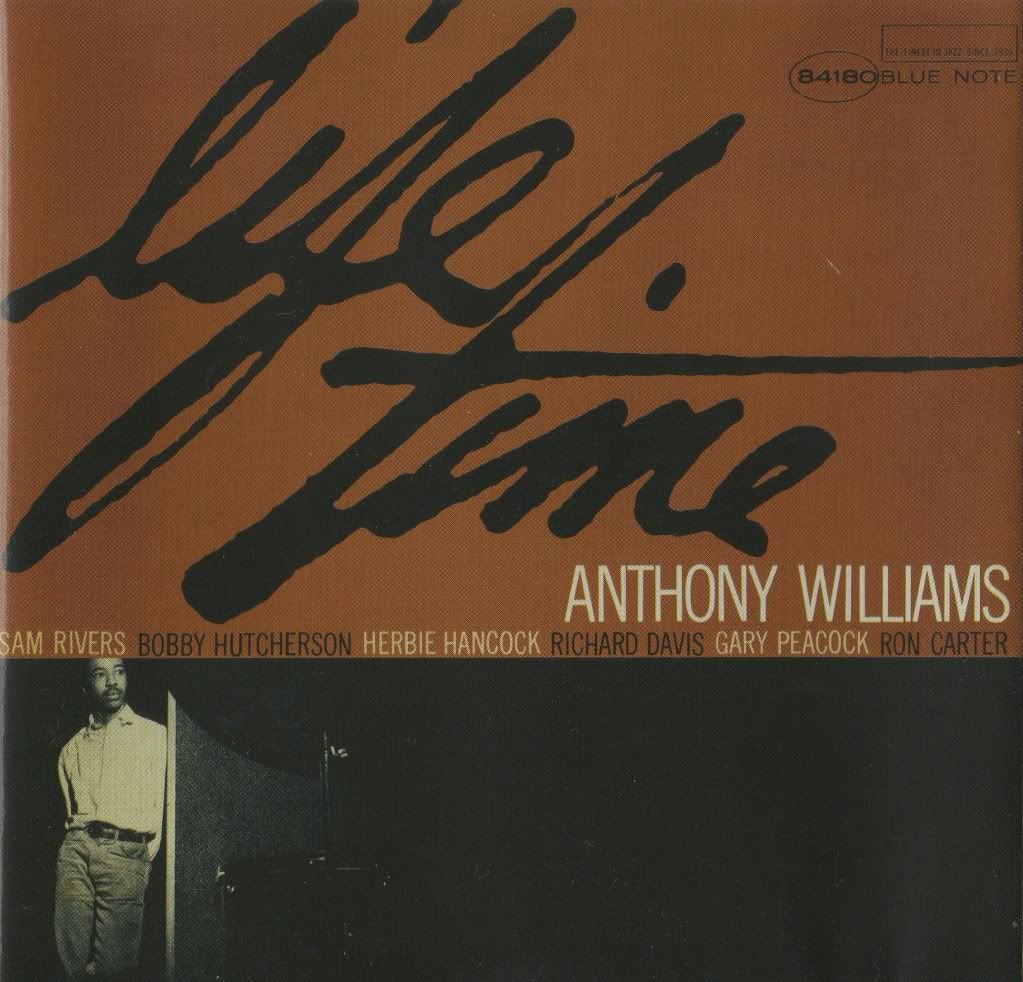
Tony Williams - Life Time


By 1965 and this--drummer Tony Williams' first set as a leader--the then-17-year-old had already been working with a slew of talented and innovative jazz artists, including Herbie Hancock, Eric Dolphy, Andrew Hill, Sam Rivers, Jackie McLean and Grachan Moncur III (not to mention his recent incorporation into Miles Davis' Second Great Quintet).  Listening to Life Time, it's clear that Williams was listening closely to what the latter two were doing, especially on the sessions for McLean's One Step Beyond and Moncur III's Evolution.  For me, this album represents one of several high points from the period when it comes to a distinctive brand of avant-garde jazz that seems to favor space over wild soloing.

You know from the eerie, quietly intense opening melody of "Two Pieces of One: Red" that this isn't going to be a typical bop album, but as Sam Rivers' tenor fades out and dual bowed basses from Richard Davis and Gary Peacock gently arpeggiate it's apparent that this subtle opening isn't going for the explosion your ears might expect.  One of the bassists takes the first solo, and from then on you can rest assured that we're not returning to the usual structures or sounds for the rest of the album.  "Two Pieces of One: Red" and the rest of Life Time are typified by a restrained, spacious atmosphere wherein solos take place with very little backing instrumentation (aided considerably by the fact that there's no piano on three of five tracks) and rarely take off into the rapid-fire solo excursions popular even with some of the players on this disc--Sam Rivers is surprisingly subdued here, but he manages to ride the transition with little difficulty, relying more on dynamics and the presence/non-presence duality that's much more of an option when you're playing in a musical landscape as open as this one.  Indeed, the overall sound of this album owes as much to the theoretical advancements of John Cage as it does to free jazz pioneers, setting up blocks of silence as both an effective compositional tool (making it easier to tell when the sometimes skeletal compositions are moving to another section) and as an invisible member of the combo, giving the players another (absence of) sound to play off and somehow adding depth and intensity to the sounds that are actually present.  Williams' drums in particular seem to particularly smolder in the open, reverb-heavy environment, with his brushwork lifelike in its texture and his cymbal work especially benefiting from miles of reverb and a lack of competition with other instruments (and himself, for that matter--this music wouldn't be so great if the players didn't match the mood by leaving a little space in their own playing).

"Two Pieces of One: Green" is the album's longest track, with Rivers contributing some more of his characteristic fire and blasting some really juicy overtones, while Williams explores the toms and un-snared snare.  While the subtle melody of some of the album's other tracks gradually reveals itself, this track is one of the freest of the bunch, demonstrating amply that free jazz doesn't have to always consist of several instruments blaring at the same time.  "Tomorrow Afternoon" comes closest to hard bop in melody and swing, but gradually breaks up into greater and greater caverns of space, like the floor is dropping away from the comfortable atmosphere that was so briefly established.  "Memory" drops Rivers and brings vibraphonist Bobby Hutcherson and Herbie Hancock in for a bassless free improvisation that sees Hutcherson and Williams riffing off one another quite effectively, with the vibes providing just enough of a tonal anchor; with Williams' wood block and other hand percussion providing yet another noticeable textural contribution.  The arrangement is so sparse that when Hancock finally asserts himself around 5:30 with a brief chord, it sounds like the loudest, most melodic thing you've ever heard.  The album ends with "Barb's Song to the Wizard," a piano and bass duet with no drums--the tense melody nods to Williams' aforementioned work with Moncur III and McLean.  Unlike those great albums, though, Williams always seems to take things one step further, providing no real traditional bop tunes to appease nervous listeners and committing fully to the album's mission statement.

The fact that this album works so well with such a piecemeal, rotating assortment of players exclusively playing the compositions of a 17-year-old drummer is a testament both to Williams' skill and unheard-of musical maturity at the time, but also to whatever it was in the air at the time that made all of these players so assured in their judgment, synchronicity and adventurousness.  Life Time is a grower in the best sense of the word--sounding like nothing much on first listen but gradually unfolding into a paradoxically dense work, considering its relative quietness--and every time I listen to it I find myself asking "Why isn't there more free jazz like this?!"  Luckily a little research into the discographies of the artists involved here yield further pairings in the same time period and several great albums in the same vein.  While Williams would go on in the next few years to collaborate with some of avant-garde jazz's most acclaimed albums (as well as Miles Davis' less challenging but equally iconic work [I bet he hated this album]) before heading into fusion territory, he did reconvene with some of these players for the nearly-as-excellent Spring, but no album I've found has done such a good job of fusing an AMM-like free improv space aesthetic with "traditional" free jazz harmony and melody--recommendations welcome!

Get it here.

Friday, January 20, 2012

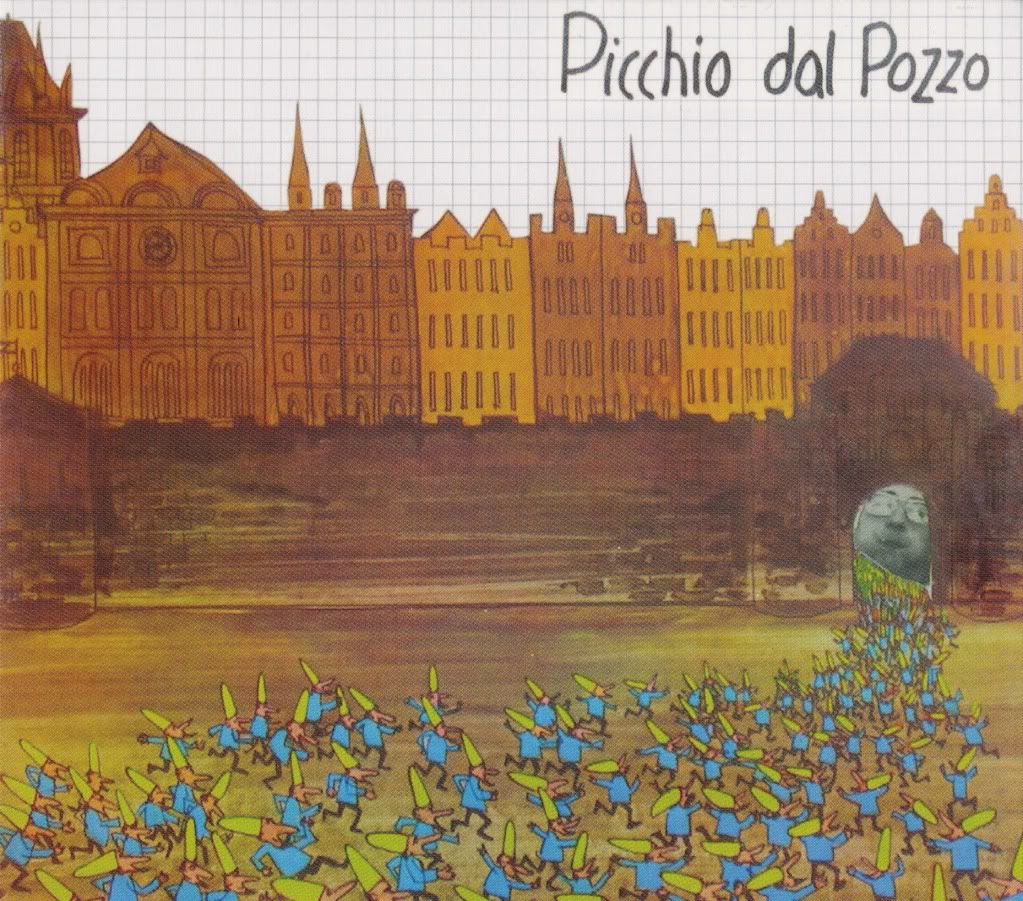
Picchio dal Pozzo - Picchio dal Pozzo


To round out this week's Canterbury Scene focus, here's one of the best examples of how the scene's sounds eventually transcended their geographical and physical origins, and a few even more obscure groups in Europe carried the Canterbury influence in an expanded and often quite interesting and artistically successful direction.  On their 1976 eponymous debut, Italian group Picchio dal Pozzo manage to fuse the gentle synth atmospheres and vocalizing of solo Robert Wyatt with space rock jams not unlike those of mid-70s Gong, all the while sticking to a very Canterburian classical-jazz instrumentation that's heavy on flute, xylophone, oboe, keyboard and fuzzed-out bass and guitar.   

Like so many of my very favorite albums, part of what I love about this album is simply how the music sounds--from the first fade-in acoustic guitar notes of "Merta" the tone of this album is like a warm bath--enveloping, soothing and somehow comforting in spite of its more challenging moments.  Though it's easy to trace this group's influences to Canterbury, there's something about their hazy, dreamy sound and penchant for mischievous wordless vocals that is totally their own.  "Cocomelastico" follows with a direct segue into an awesome-sounding guitar/saxophone counterpoint melody underpinned by layers of spacey synths and some sort of twisted lounge music with suitably gently goofy singing.  As you can see from the lyrics provided on the band's official website, the few words to these songs are mostly nonsense and whimsical wordplay; perhaps one of the Canterbury scene's greatest strengths in terms of longevity is that, unlike most progressive bands, its groups never seemed to take themselves too seriously!

The album's darkest track and arguably its centerpiece is the magnificent "Seppia," beginning with a minor ostinato and some well-chosen dissonant note pairs in the bass before stating a dramatic oboe-led melody and dropping into on of the most deliriously hypnotic fuzz bass riffs in Canterbury history for a synth/xylophone/vocal jam that lasts a good six minutes before dropping suddenly into a quietly avant-garde flute/xylophone/bass trio and closing the tune with some spoken word and a stately, mysterious reed-led section.  The number of sudden surprises, dynamics, details and layers of beauty in a track like this are my total ideal--it's at once accessible and traditionally melodic, while at the same time playing with dissonance and bizarre choices.  The genius of Picchio dal Pozzo's approach seems to be their use of gentle instruments and textures to explore these potentially grating musical moves; they're not going to offend anybody too blatantly, but if you pay attention you realize that there's a lot more going on here than it might initially appear.

"Napier" and the rest of the tracks present more densely-packed, swiftly-moving ideas, quirky but accessible melodies and almost narcotic timbres.  While the last couple of tracks are perhaps less obviously memorable in terms of melody and structure, their humble beauty does improve with further listening and the texture and atmosphere suits the rest of the album's mood so well that the disc trails off in a dreamy whisper that makes me want to start over immediately.  Though it can be argued that the heavy Canterbury influences make Picchio dal Pozzo's debut a bit derivative, as far as I'm concerned we could do with a few more great Canterbury albums and the quality of this music is so consistent and the atmosphere is so uniquely dreamy that it really doesn't bother me; sometimes doing something really well trumps doing something first, and you'll often find there are subtle wrinkles of originality hidden within.

Picchio dal Pozzo is one of my favorite Canterbury albums and is probably favorite Italian progressive album (though there are only a few Italian progressive groups who have actually clicked with me; Stormy Six, Area and Museo Rosenbach and maybe one or two others who manage to do more than rehash the less interesting aspects of symphonic prog).  I'm also really excited to say that this album is back in print on CD--just reissued by Italy's Goodfellas label at the end of 2011.  Now I can review it guilt-free and point you to one of my favorite online storefronts, Recommended Records, as a great place to purchase this CD and support these artists. Obviously, this album is highly recommended, as is the group's second and final studio release, the more challenging and RIO-flavored (but equally rewarding) Abbiamo tutti i suoi problemi, which has been consistently commercially available--more on that album later!

Wednesday, January 18, 2012

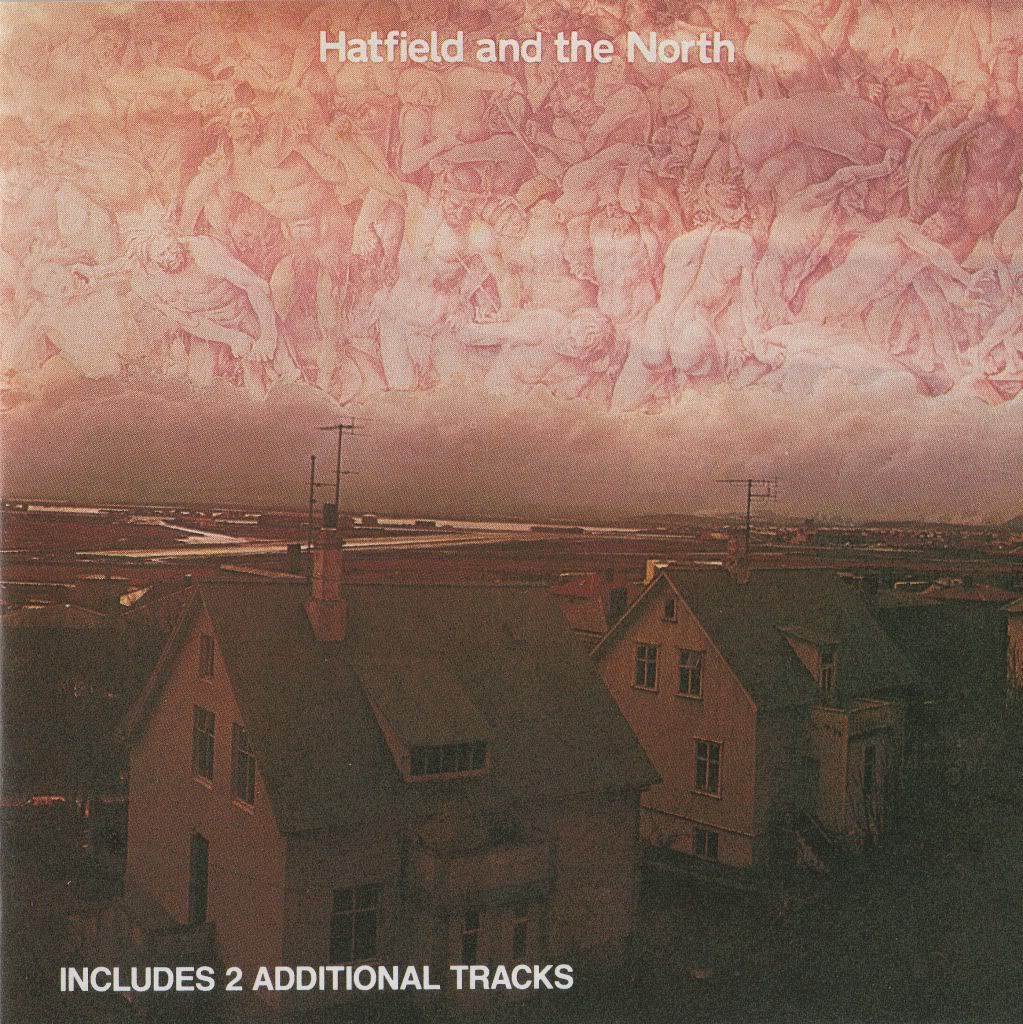
Hatfield and the North - Hatfield and the North


To delve further into the dense stuff of the Canterbury Scene, Hatfield and the North's 1974 debut is a great place to explore how the scene evolved both personnel-wise and sound-wise as the 70's wore on.  By this time Soft Machine was firmly on a jazz-heavy fusion route, with Robert Wyatt long-since departed, finished with his next project Matching Mole, a paraplegic and releasing his first masterpiece, Rock Bottom, the same year.  Gong and Caravan were already very different bands, with drummer Pip Pyle gone from Gong (to drum for Hatfield and the North) and guitarist Steve Hillage added to the fold, and bassist Richard Sinclair departing Caravan, also to work with the Hatfields.  By the time of this album's recording, the core group was rounded out by Egg (among other groups) keyboardist Dave Stewart and Matching Mole/Delivery guitarist Phil Miller.  My intention isn't to get overly cluttered with names and group references, but rather to show just how intermingling the Canterbury Scene was (and continues to be, to some extent)--Hatfield and the North can in some ways be considered the first Canterbury supergroup as it was formed from members who had already demonstrated their abilities on the classic albums of other Canterbury groups.

Sound-wise, Hatfield and the North amply demonstrates how the Canterbury sound continued to get more sophisticated, more refined, and jazzier.  Unlike mid-70's Soft Machine (or the trace jazz elements found in Caravan, for example), Hatfield and the North's debut sound is one of fusion of jazz harmony, complex composition and improvisation with appealing, gentle melodies.  The complexity of these compositions is far from the relative pop-simplicity of Caravan's songs, yet Richard Sinclair seems to have no trouble accommodating his bass skills to the material.  And don't think that this group is just going to sound like a summation of all the things the members did before--this album is rife with seamless transitions and sub-one-minute segue tracks, and the mission of the vocals (the lyrics for which are mostly tongue-in-cheek nonsense) seems to be to give listeners an accessible insertion point into what's often complex and difficult-to-get-the-first-time music.

Though it's not his group, per se (at least not as much as later incarnation National Health was), Dave Stewart's keyboards provide the most noticeable framework for this music--fluidly transitioning between Rhodes electric piano, Hammond organ, various synthesizers and acoustic piano to provide both texture and melodic substance.  "Son of 'There's No Place Like Homerton'" boasts some of the most Egg-like contrapuntal puzzle keyboard of the album, with a complex, ever-shifting atmosphere abetted by airy, ethereal contributions of the "Northettes" (background singers Barbara Gaskin, Amanda Parsons and Ann Rosenthal, who also contributed to Egg's Civil Surface album, released the same year).  Robert Wyatt guest vocalizes on "Calyx," eventually joined by Richard Sinclair in a delicate, wordless duet.  It's these kinds of complex but unassuming moments that make Hatfield and the North's two albums so rewarding on repeated listens.

I have to admit that it took me quite a few before my attitude shifted from mere respectful appreciation to all-out enthusiasm--I'm beginning to think that there's something about the language of jazz harmony that's fundamentally different from that found in most rock and pop--you have to have to acquaint yourself a certain amount with it before it stops just sounding like silly noodling and the multiple facets possible with extended harmony start to shine through.  The songs here don't often "rock out" (even by Canterbury's gentle standards), and the often major-key extended harmonies are much more reminiscent of later smooth jazz music than their darker minor counterparts being explored by Soft Machine and Henry Cow.  The band does manage to get pretty uptempo and a little more aggressive in sound on the fast-paced "Rifferama," which features Gong saxophonist Didier Malherbe and on which Dave Stewart coyly quotes the "I Never Glid Before" melody.  "Shaving is Boring" is likely the album's most epic composition, treading some darker territory with some Mahavishnu Orchestra-like ostinato patterns, gnarly Canterbury fuzz organ and an uncharacteristically distorted and noticeable contribution from Phil Miller's guitar (we won't quite get to see him cut loose until National Health's Of Queues and Cures, which fulfills all of Hatfield and the North's promise and then some).  Richard Sinclair does his best Robert Wyatt in the vaguely sexual "Licks for the Ladies," displaying that his sometimes subdued vocals aren't without a considerable amount of nuance.  He also manages some of the album's funniest quirky Canterbury nonsense vocals when "Big Jobs No. 2" recapitulates the second track with metacommentary on the band's hopes for commercial success.

It's interesting to see how all of these Canterbury figures continued to develop their distinct but collective musical visions while at the same time working for some kind of commercial success.  As the band morphed into National Health and progressive music became less and less popular in the late 70's, it became clear that the golden days of having label support and a mouthpiece through which to broadcast these ideas were drawing to a close.  Luckily several of these musicians have soldiered on to make more worthwhile music, but we also have a legacy of densely enjoyable recordings and ideas to engage in the present.  This album is warmly recommended along with the band's sophomore effort The Rotters' Club, as well as National Health's self-titled debut and the aforementioned Of Queues and Cures--more thoughts on those records later!

Get it here.